
JAMES JOYCE 1882 1941 LIFE Dublin Paris Born
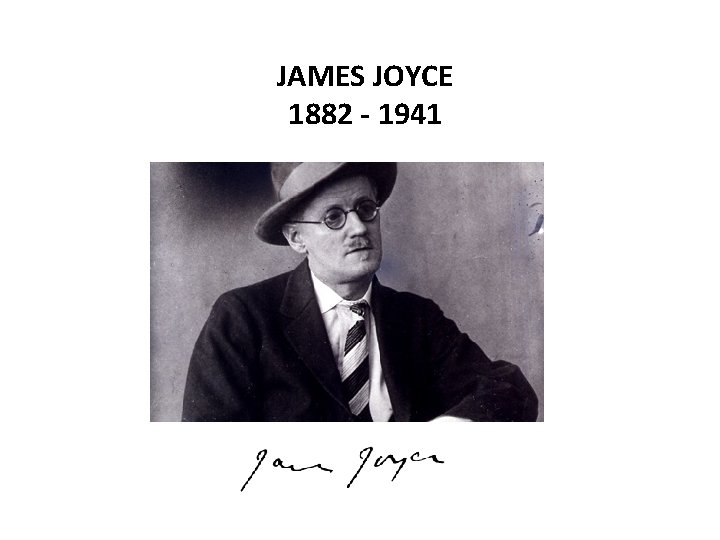
JAMES JOYCE 1882 - 1941
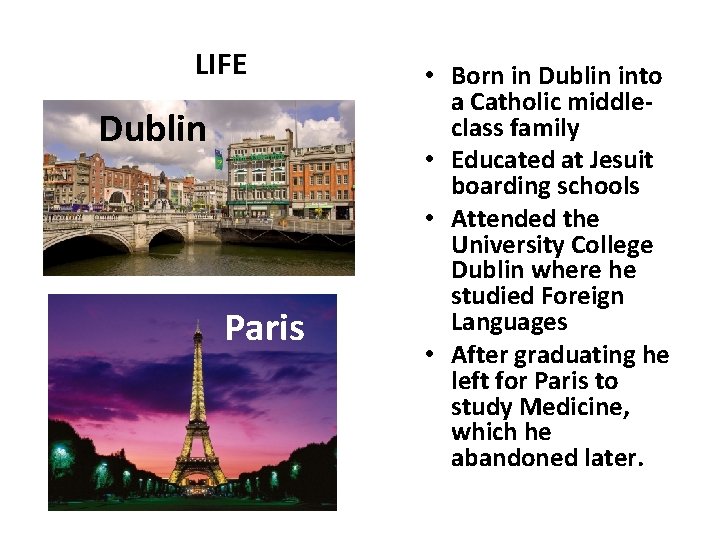
LIFE Dublin Paris • Born in Dublin into a Catholic middleclass family • Educated at Jesuit boarding schools • Attended the University College Dublin where he studied Foreign Languages • After graduating he left for Paris to study Medicine, which he abandoned later.
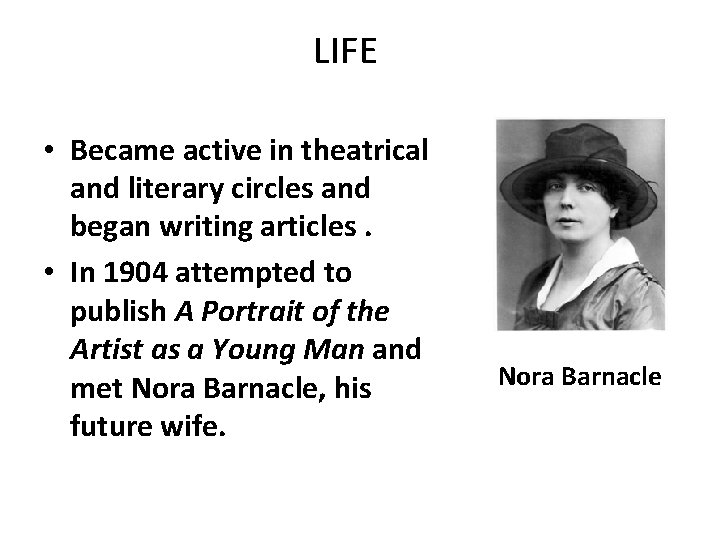
LIFE • Became active in theatrical and literary circles and began writing articles. • In 1904 attempted to publish A Portrait of the Artist as a Young Man and met Nora Barnacle, his future wife. Nora Barnacle
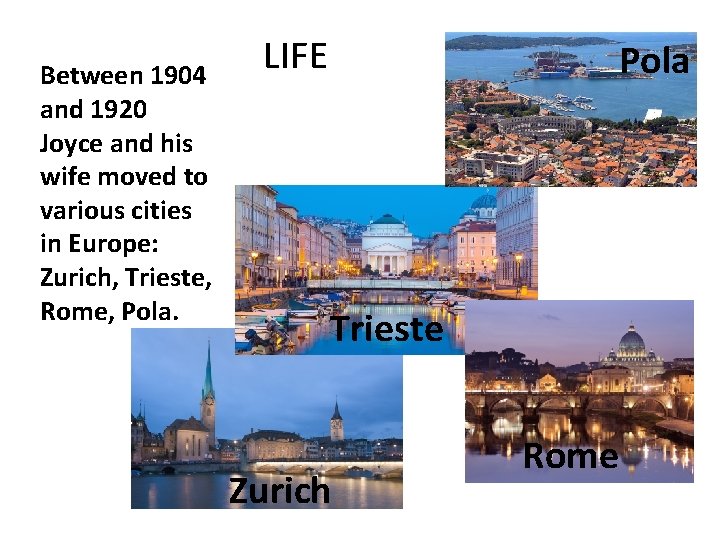
Between 1904 and 1920 Joyce and his wife moved to various cities in Europe: Zurich, Trieste, Rome, Pola. LIFE Pola Trieste Zurich Rome

LIFE • The Joyces had two children, Giorgio and Lucia. • In Trieste Joyce made friends with Italo Svevo The Joyces
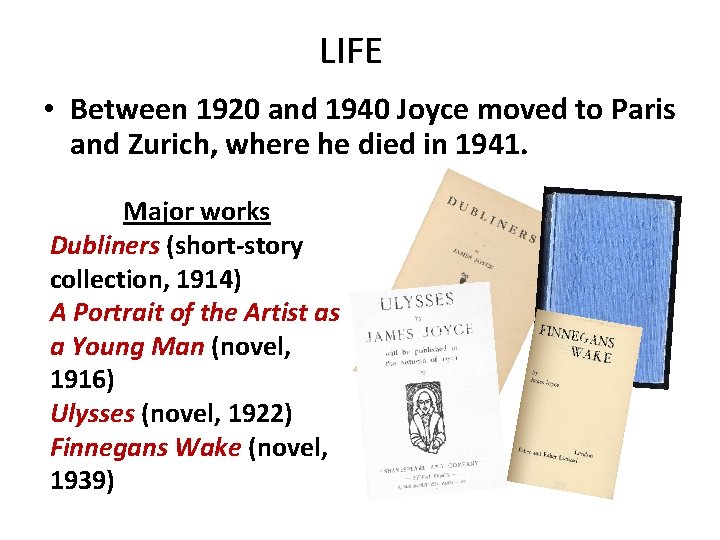
LIFE • Between 1920 and 1940 Joyce moved to Paris and Zurich, where he died in 1941. Major works Dubliners (short-story collection, 1914) A Portrait of the Artist as a Young Man (novel, 1916) Ulysses (novel, 1922) Finnegans Wake (novel, 1939)
The most important features of Joyce’s works • The setting of most of his works is Ireland, especially Dublin. • Time is perceived as subjective. • The author’s task is to render life objectively. • The artist is isolated and detached from society. • Great importance is given to the inner world of the characters (stream of consciousness).

The evolution of Joyce’s style Dubliners • • Realism Disciplined prose Different points of view Free-direct speech

The evolution of Joyce’s style A Portrait of the Artist as a Young Man • Third-person narration • Minimal dialogue • Language and prose used to portray the protagonist’s state of mind • Free-direct speech

The evolution of Joyce’s style Ulysses • Interior monologue with two levels of narration • Extreme interior monologue
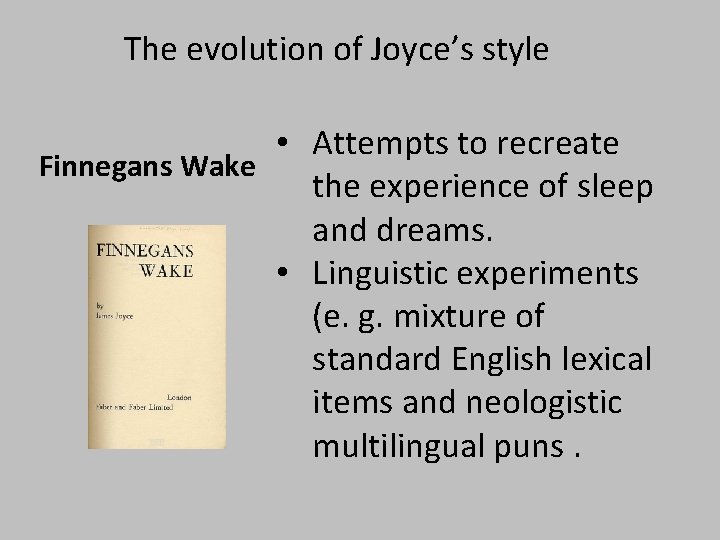
The evolution of Joyce’s style • Attempts to recreate Finnegans Wake the experience of sleep and dreams. • Linguistic experiments (e. g. mixture of standard English lexical items and neologistic multilingual puns.
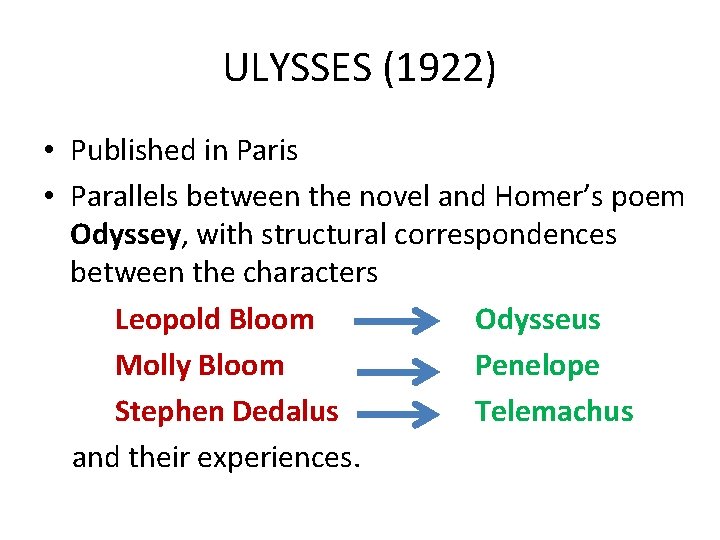
ULYSSES (1922) • Published in Paris • Parallels between the novel and Homer’s poem Odyssey, with structural correspondences between the characters Leopold Bloom Odysseus Molly Bloom Penelope Stephen Dedalus Telemachus and their experiences.
ULYSSES (1922) • The story developes on a single day, 16 June 1904, the date when James Joyce and Nora Barnacle first stepped out together, an event which would be commemorated by providing the date for the action of Ulysses.
ULYSSES (1922) • Divided into three parts subdivided into eighteen episodes: • Part I 3 episodes Stephen • Part II 12 episodes Leopold • Part III 3 episodes Molly • Every episode of Ulysses has a theme, technique, and correspondence between its characters and those of the Odyssey.
ULYSSES (1922) I. Stephen Dedalus • Joycean alter ego (main character in Joyce’s A Portrait of the Artist as a Young Man, 1916). • His Christian name is that of the first Christian martyr. He is a young man with intellectual ambitions and considers himself a martyr to art. • His surname is that of the legendary builder of the first maze. Stephen wants to convert the Irish to the cult of beauty inherited from the Greeks.
ULYSSES (1922) II. Leopold Bloom The Ulysses of the title, he is a middleaged man who wanders around Dublin as Ulysses wandered around the Mediterranean, encountering adventures which roughly parallel those of the Homeric hero.
ULYSSES (1922) III. Molly Leopold’s wife, she stays at home waiting for the wanderers (Leopold and Stephen) like Penelope on Ithaca, though not so faithful. Actually she has an affair while her husband is out.
ULYSSES (1922) Parallel with the Odyssey Chapter 1 Telemachus • On Ithaca, Telemachus is forced to share the house with his mother’s suitors. He is discontented and seeks for his father. • In Dublin, Stephen is forced to share the house with some companions who mock him. He is evicted and wanders in search of a «Father» .
ULYSSES (1922) Parallel with the Odyssey Chapter 6 Hades • Leopold attends a friend’s funeral and meditates on death. • Ulysses visits the Underworld and speaks with the souls of the dead
ULYSSES (1922) The Mythical Method • Leopold Bloom is a modern Ulysses, an archetypal who can stand for humanity. • The circumstances have changed but the human quest continues unchanged. • The narration develops around a parallel between a mythical, legendary and heroic age and an unexcitingly human, mediocre, modern age.
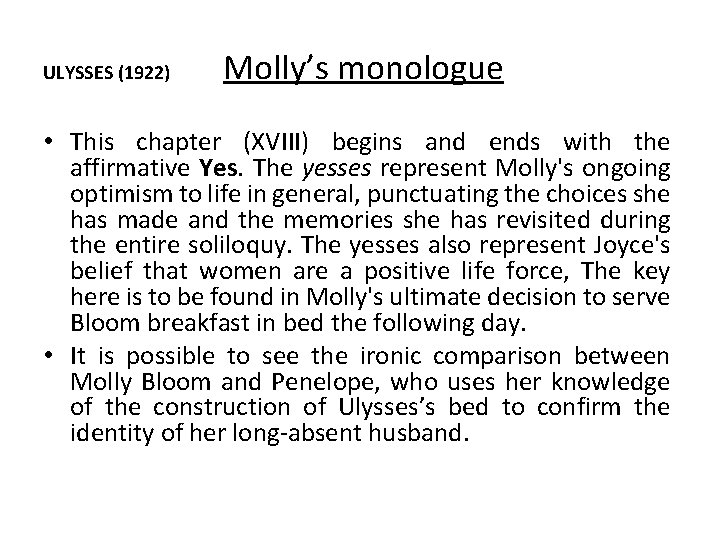
ULYSSES (1922) Molly’s monologue • This chapter (XVIII) begins and ends with the affirmative Yes. The yesses represent Molly's ongoing optimism to life in general, punctuating the choices she has made and the memories she has revisited during the entire soliloquy. The yesses also represent Joyce's belief that women are a positive life force, The key here is to be found in Molly's ultimate decision to serve Bloom breakfast in bed the following day. • It is possible to see the ironic comparison between Molly Bloom and Penelope, who uses her knowledge of the construction of Ulysses’s bed to confirm the identity of her long-absent husband.
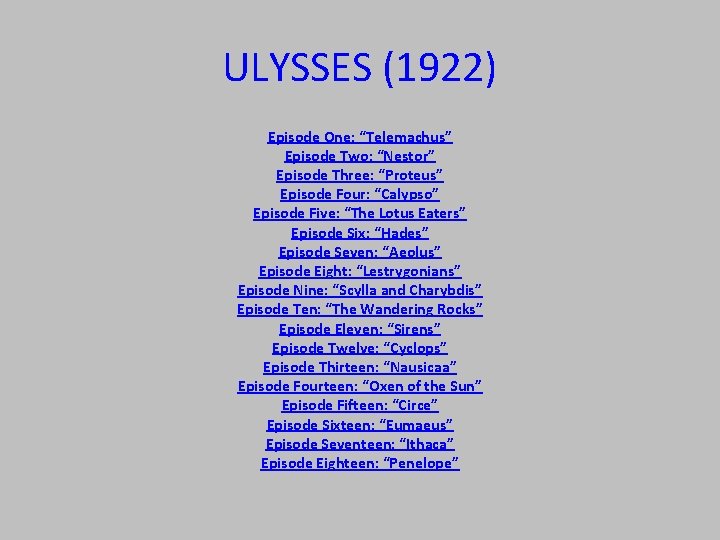
ULYSSES (1922) Episode One: “Telemachus” Episode Two: “Nestor” Episode Three: “Proteus” Episode Four: “Calypso” Episode Five: “The Lotus Eaters” Episode Six: “Hades” Episode Seven: “Aeolus” Episode Eight: “Lestrygonians” Episode Nine: “Scylla and Charybdis” Episode Ten: “The Wandering Rocks” Episode Eleven: “Sirens” Episode Twelve: “Cyclops” Episode Thirteen: “Nausicaa” Episode Fourteen: “Oxen of the Sun” Episode Fifteen: “Circe” Episode Sixteen: “Eumaeus” Episode Seventeen: “Ithaca” Episode Eighteen: “Penelope”
- Slides: 22