
James Case Study James is a 3 rd
- Slides: 13
James Case Study
James is a 3 rd grade student identified with emotional and behavior disorders (E/BD). James is receiving special educational services in a self contained classroom. James struggles academically and does not like school or his teachers. Thoughts and mental processes are within average range Successful working in one-to-one situations Is compliant and can complete his classwork. Additional strengths: athletic ability, positive peer interactions during lunchroom activities, assemblies, recess… James can ignore the inappropriate behavior of other students when he is academically focused. Favorite classes: P. E. , art and music
In addition to Emotional and Behavior Disorder (E/BD), James has been diagnosed with Learning Disability (LD) and Attention Deficit Hyperactivity Disorder (ADHD) The primary teacher, Ms. Butke indicates James exhibits the following challenging behaviors throughout the day: • Hits and kicks adults when confronted for in appropriate behavior • Noncompliant behavior • Off-task behavior • Disrupts the class roaming around the room, distracting students • Throws objects in class • Destructive towards property Ms. Butke has requested staff consultation to deal with James’s disruptive and aggressive behavior.
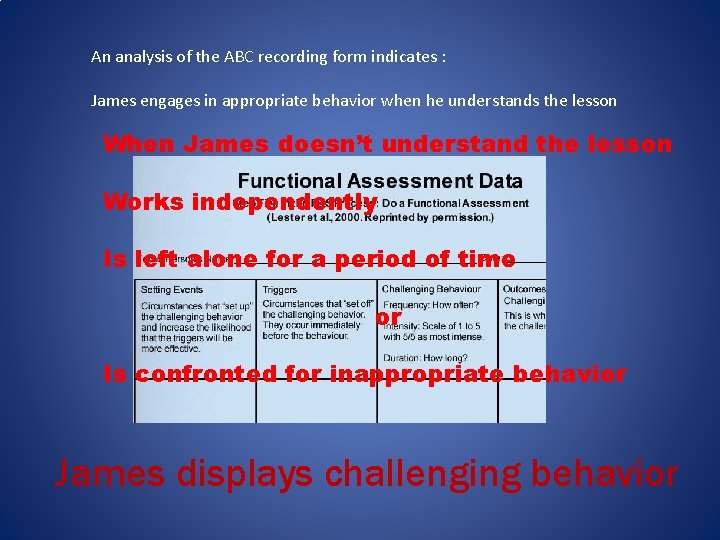
The district’s behavioral consultant observed James: ABC Recording form: page 271
An analysis of the ABC recording form indicates : James engages in appropriate behavior when he understands the lesson When James doesn’t understand the lesson Works independently Is left alone for a period of time or Is confronted for inappropriate behavior James displays challenging behavior
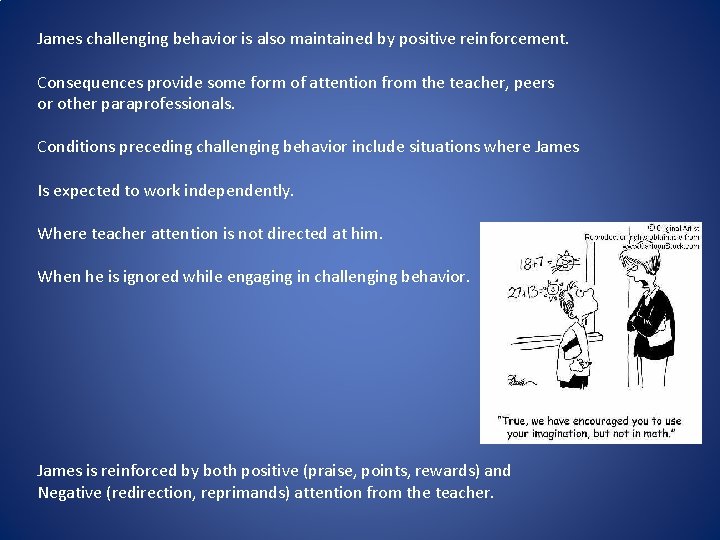
James challenging behavior is also maintained by positive reinforcement. Consequences provide some form of attention from the teacher, peers or other paraprofessionals. Conditions preceding challenging behavior include situations where James Is expected to work independently. Where teacher attention is not directed at him. When he is ignored while engaging in challenging behavior. James is reinforced by both positive (praise, points, rewards) and Negative (redirection, reprimands) attention from the teacher.
The function of James’s challenging behavior is negative reinforcement. Result: escape and avoidance of academic activities James has a chronic history of academic failure. Challenging behavior terminates the academic assignments. Negative reinforcement because James does not engage in these behaviors during social and nonacademic activities.
The behavior consultant and the teaching team designed the intervention and identified the following appropriate replacement behaviors: 1. Asking for assistance when required 2. Complying with teacher directives 3. Raising hand waiting quietly for teacher assistance 4. Following classroom rules 5. Demonstrating anger control techniques
To eliminate challenging behaviors and increase appropriate replacement behaviors, the staff provided praise, points, activity and tangible reinforcers on a continuous schedule. After appropriate behavior was exhibited consistently, reinforcement was delivered on an intermittent schedule. James received praise and a short social break after engaging in independent work on difficult tasks for a specific amount of time. The tasks and breaks were gradually increased/decreased to enable James to work for longer periods of time. Also when James requested assistance in an appropriate manner he received reinforcement. To change the antecedent conditions to trigger appropriate prosocial behavior during difficult tasks, James received teacher , paraprofessional and/or peer assistance.
In addition to reinforcing appropriate behavior to reduce noncompliant, disruptive and aggressive behavior… Corrective Teaching techniques were used: Say something positive. Describe the problem behavior. Give the reason for exhibiting the prosocial behavior. Practice the desired behavior. Praise cooperation and learning. Precision Request strategies: Give a please request. Wait 5 to 10 seconds. If compliant, reinforce If noncompliant, provide a ”You need to” request. Wait 5 to 10 seconds. If compliant, reinforce. If noncompliant, use a reductive technique.
The combination of interventions reduced the frequency and intensity of James‘s challenging behavior and increased appropriate replacement behaviors. The intervention plan included strategies to promote generalizations and maintenance of behavior to prevent recurrence of challenging behavior.
Test 1. Identify the strategies that were used to promote generalization and maintenance during James’s intervention. 1. 2. 3. 4. 5. Asking for assistance when required Complying with teacher directives Raising hand waiting quietly for teacher assistance Following classroom rules Demonstrating anger control techniques
2. Identify the strategies that were used to prevent the recurrence of James’s challenging behavior and to support the development of appropriate replacement behavior. James received praise and a short social break after engaging in independent work on difficult tasks for a specific amount of time. The tasks and breaks were gradually increased/decreased to enable James to work for longer periods of time. When James requested assistance in an appropriate manner he received reinforcement. 3. What additional strategies might be employed to promote generalization and maintenance?