
JAMA Pediatrics Journal Club Slides HHHFNC vs Nasal
JAMA Pediatrics Journal Club Slides: HHHFNC vs Nasal CPAP for Respiratory Distress Syndrome of Prematurity Lavizzari A, Colnaghi M, Ciuffini F, et al. Heated, humidified high-flow nasal cannula vs nasal continuous positive airway pressure for respiratory distress syndrome of prematurity: a randomized clinical noninferiority trial. JAMA Pediatr. Published online August 8, 2016. doi: 10. 1001/jamapediatrics. 2016. 1243. Copyright restrictions may apply
Introduction • Background Heated, humidified high-flow nasal cannula (HHHFNC) has gained increasing popularity as respiratory support for newborn infants thanks to ease of use and improved patient comfort. However, its role as primary therapy for respiratory distress syndrome (RDS) of prematurity needs to be further elucidated by large, randomized clinical trials. • Study Objective To determine whether HHHFNC provides respiratory support noninferior to nasal continuous positive airway pressure (n. CPAP) or bilevel nasal CPAP (Bi. PAP) as a primary approach to RDS in infants older than 28 weeks’ gestational age (GA). Copyright restrictions may apply
Methods • Study Design Unblinded, monocentric, randomized clinical noninferiority trial • Setting Tertiary neonatal intensive care unit (NICU) • Patients – Inborn infants at 29 weeks 0 days to 36 weeks 6 days of GA were eligible if presenting with mild to moderate RDS requiring noninvasive respiratory support. Criteria for starting noninvasive respiratory support were a Silverman score of 5 or higher or a fraction of inspired oxygen higher than 0. 3 for a target saturation of peripheral oxygen of 88% to 93%. – Infants were ineligible if they had major congenital anomalies or severe RDS requiring early intubation. Copyright restrictions may apply
Methods • Intervention Randomization to either HHHFNC at 4 -6 L/min or n. CPAP/Bi. PAP at 4 -6 cm H 2 O. • Outcomes – Primary: Need for mechanical ventilation within 72 hours from the beginning of respiratory support. The absolute risk difference in the primary outcome and its 95% confidence interval were calculated to determine noninferiority. – Secondary: Respiratory outcomes included days receiving respiratory support, days receiving noninvasive respiratory support, and days receiving supplemental oxygen; days receiving caffeine treatment; need for surfactant; rate of air leaks; and rate of bronchopulmonary dysplasia (BPD). Other secondary outcomes were rate of sepsis, necrotizing enterocolitis, patent ductus arteriosus, intraventricular hemorrhage, retinopathy of prematurity, death, and the combined outcome including all the previous outcomes plus rates of air leaks and BPD. Secondary outcomes also included the number of days when full enteral feeding was achieved, body weight at discharge, exclusive breastfeeding at discharge, and length of hospitalization. Copyright restrictions may apply
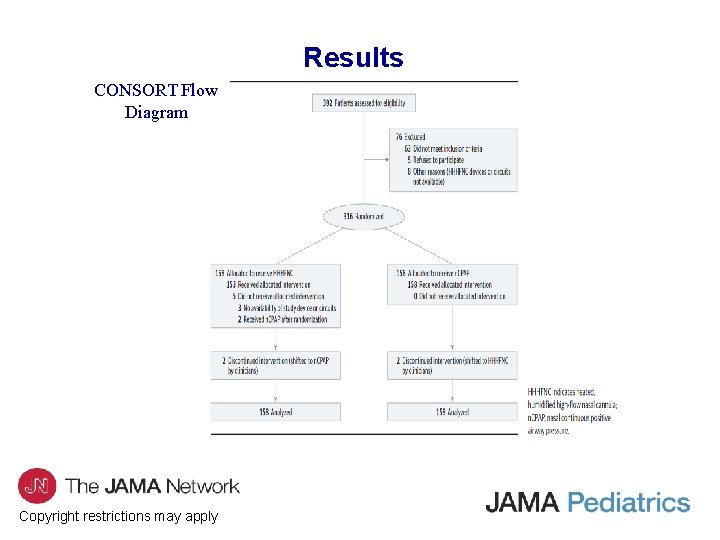
Results CONSORT Flow Diagram Copyright restrictions may apply
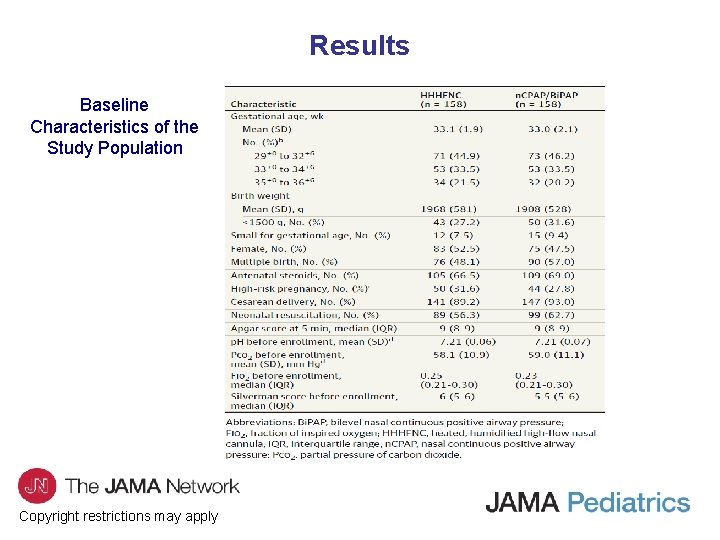
Results Baseline Characteristics of the Study Population Copyright restrictions may apply
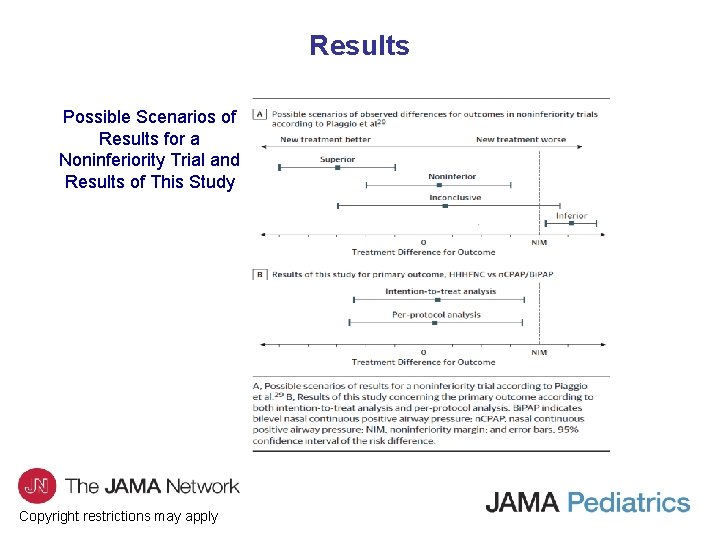
Results Possible Scenarios of Results for a Noninferiority Trial and Results of This Study Copyright restrictions may apply
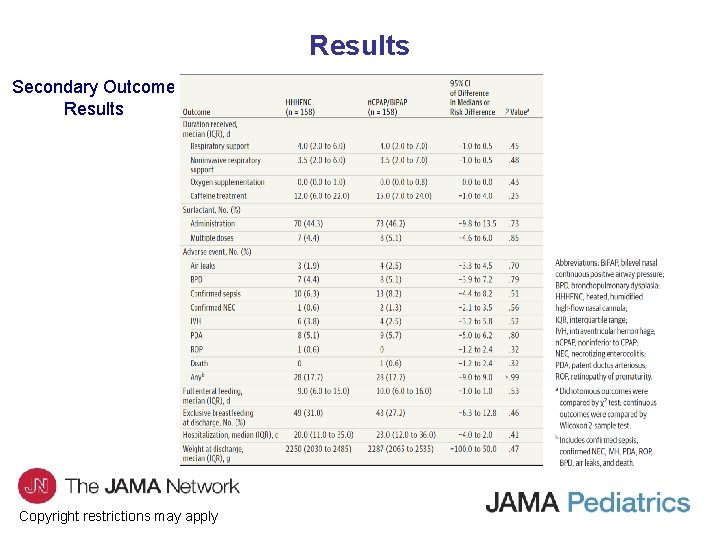
Results Secondary Outcome Results Copyright restrictions may apply
Comment • The use of HHHFNC showed efficacy and safety similar to those of standard n. CPAP or Bi. PAP when applied exclusively as the primary approach to mild to moderate RDS in preterm infants between 29+0 and 36+6 weeks’ GA. • Concerns about the generation of inadvertently elevated pressure have previously limited the use of HHHFNC in NICU. Nonetheless, the 2 groups showed similar results: a similarly low rate of air leaks and no difference in the rate of BPD. Copyright restrictions may apply
Comment • Limitations – Monocentric rather than multicentric trial – Not blinded – Study was conducted in an n. CPAP-oriented NICU – No specific scale to evaluate nasal trauma – No systematic measurement of patients’ comfort Copyright restrictions may apply
Comment • Randomized clinical trials should be conducted to verify the findings concerning the use of HHHFNC in preterm infants with RDS in a wider context. • Further studies are needed to investigate the role of HHHFNC in managing RDS in infants with younger GA and lower weight. • Because a consensus on how to administer HHHFNC is missing, future research should address how to optimize this technique in preterm infants in diverse pathophysiological contexts. Copyright restrictions may apply
Contact Information • If you have questions, please contact the corresponding author: – Anna Lavizzari, MD, Neonatal Intensive Care Unit, Fondazione IRCCS Cà Granda, Ospedale Maggiore Policlinico, Department of Clinical Sciences and Community Health, Università degli Studi di Milano, Via Della Commenda 12, 20122 Milano, Italy (anna. lavizzari@gmail. com). Conflict of Interest Disclosures • None reported. Copyright restrictions may apply
- Slides: 12