
Jake Cashion Jonathan Popa Tommy Than Michelle White

- Slides: 13
Jake Cashion Jonathan Popa Tommy Than Michelle White
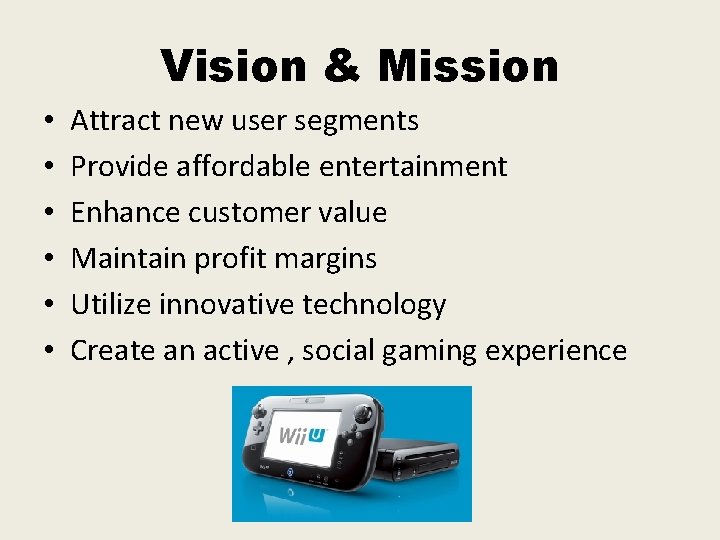
Vision & Mission • • • Attract new user segments Provide affordable entertainment Enhance customer value Maintain profit margins Utilize innovative technology Create an active , social gaming experience
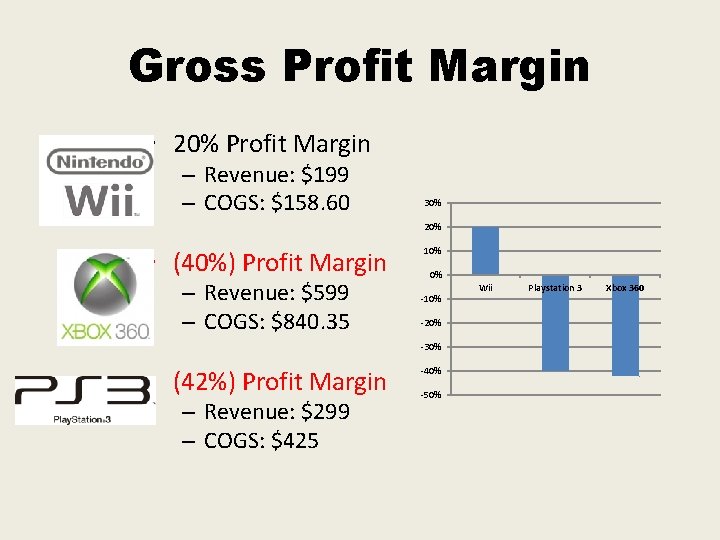
Gross Profit Margin • 20% Profit Margin – Revenue: $199 – COGS: $158. 60 30% 20% • (40%) Profit Margin – Revenue: $599 – COGS: $840. 35 10% 0% -10% -20% -30% • (42%) Profit Margin – Revenue: $299 – COGS: $425 -40% -50% Wii Playstation 3 Xbox 360
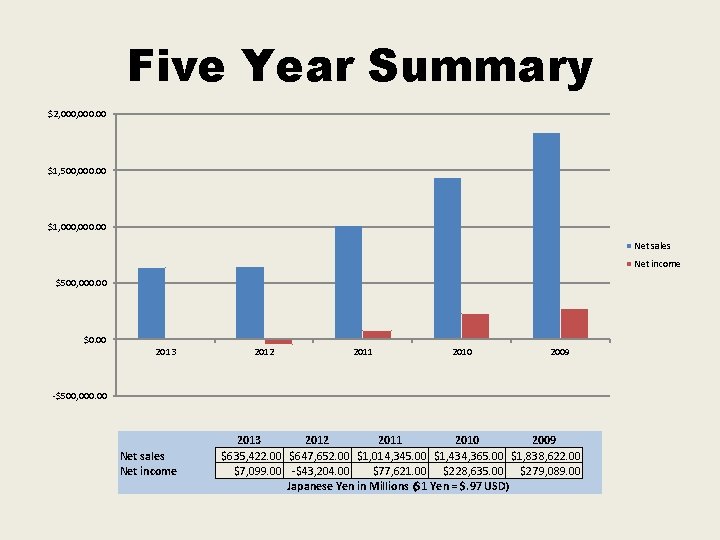
Five Year Summary $2, 000. 00 $1, 500, 000. 00 $1, 000. 00 Net sales Net income $500, 000. 00 $0. 00 2013 2012 2011 2010 2009 -$500, 000. 00 Net sales Net income 2013 2012 2011 2010 2009 $635, 422. 00 $647, 652. 00 $1, 014, 345. 00 $1, 434, 365. 00 $1, 838, 622. 00 $7, 099. 00 -$43, 204. 00 $77, 621. 00 $228, 635. 00 $279, 089. 00 Japanese Yen in Millions ($1 Yen = $. 97 USD)
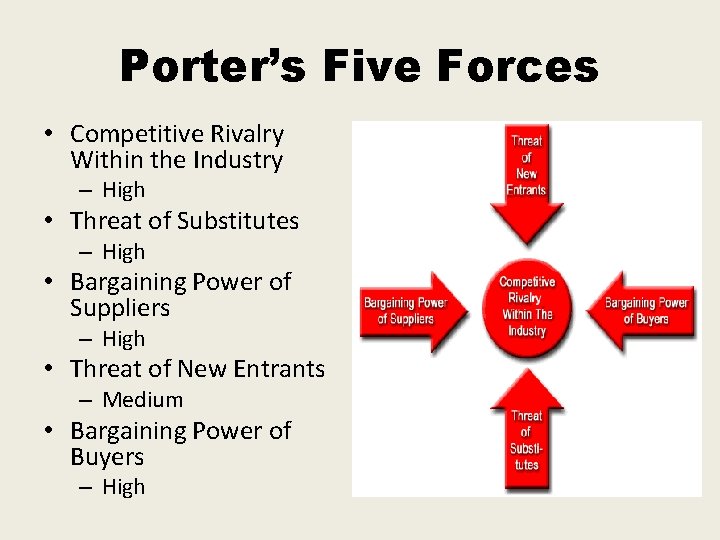
Porter’s Five Forces • Competitive Rivalry Within the Industry – High • Threat of Substitutes – High • Bargaining Power of Suppliers – High • Threat of New Entrants – Medium • Bargaining Power of Buyers – High
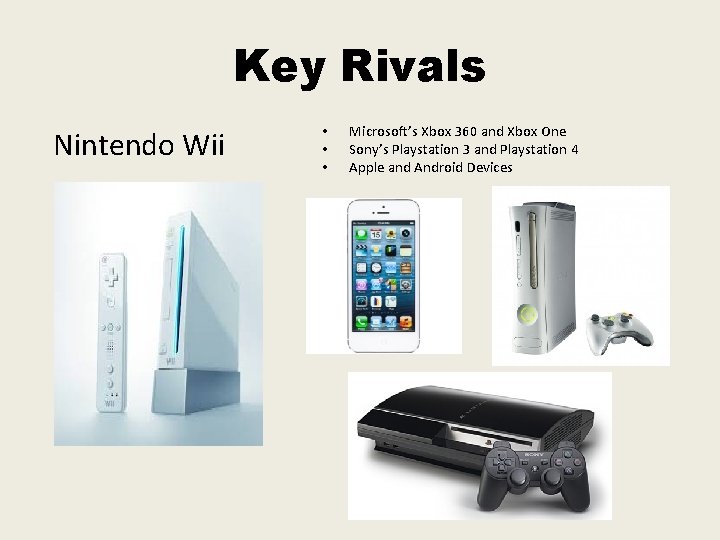
Key Rivals Nintendo Wii • • • Microsoft’s Xbox 360 and Xbox One Sony’s Playstation 3 and Playstation 4 Apple and Android Devices
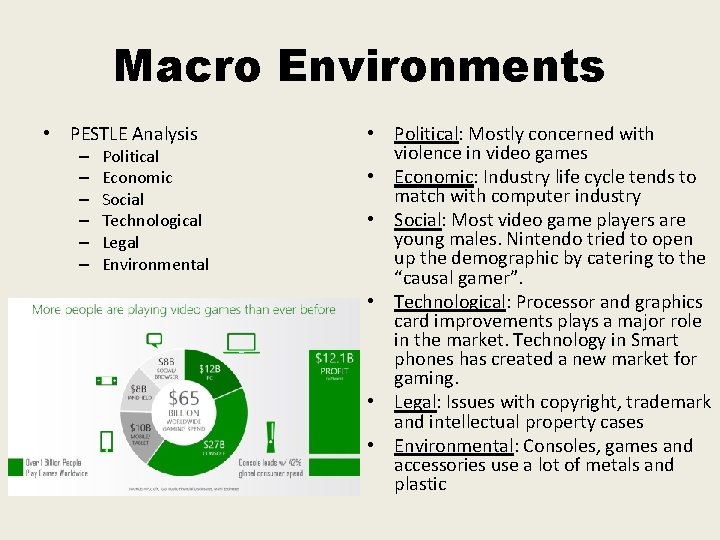
Macro Environments • PESTLE Analysis – – – Political Economic Social Technological Legal Environmental • Political: Mostly concerned with violence in video games • Economic: Industry life cycle tends to match with computer industry • Social: Most video game players are young males. Nintendo tried to open up the demographic by catering to the “causal gamer”. • Technological: Processor and graphics card improvements plays a major role in the market. Technology in Smart phones has created a new market for gaming. • Legal: Issues with copyright, trademark and intellectual property cases • Environmental: Consoles, games and accessories use a lot of metals and plastic
VRIO Analysis The Question of Value • Nintendo’s high stocks and reputation allows them to grow in their product and technology development. The Question of Rare • Resources are built from based users which give the advantage to enhance in their unique wireless and motion experience compared to other consoles. The Question of Imitability • Nintendo games genre is easily imitated, but its reputation and style cannot. The Question of Organization • Nintendo Wii current resources and capabilities in its supply chain are sufficient enough to compete with the largest players in the industry. (Sony and Microsoft)
SWOT Analysis Strength Opportunities • Low cost hardware/software • Unique use of free motion of Wii controller • Large selection of multiplayer games • Leading game console brand image • Leading of “all age” games attracts family and friends play • Attract many consumers because lower unit price sales compared to others Weakness • Limited selection of software • Trailing in online experience opportunities • Weak graphic compared to other consoles Threats • High competitor units in market • Software developers abandoning Wii software development due to low profit projections
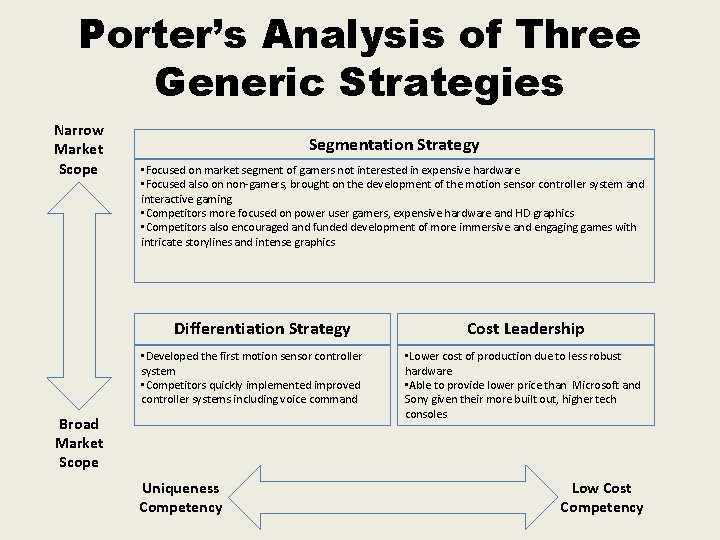
Porter’s Analysis of Three Generic Strategies Narrow Market Scope Segmentation Strategy • Focused on market segment of gamers not interested in expensive hardware • Focused also on non-gamers, brought on the development of the motion sensor controller system and interactive gaming • Competitors more focused on power user gamers, expensive hardware and HD graphics • Competitors also encouraged and funded development of more immersive and engaging games with intricate storylines and intense graphics Differentiation Strategy • Developed the first motion sensor controller system • Competitors quickly implemented improved controller systems including voice command Broad Market Scope Uniqueness Competency Cost Leadership • Lower cost of production due to less robust hardware • Able to provide lower price than Microsoft and Sony given their more built out, higher tech consoles Low Cost Competency
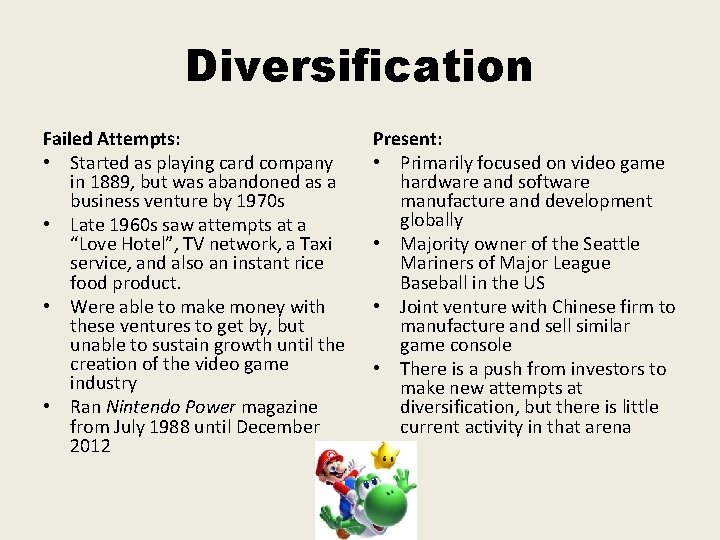
Diversification Failed Attempts: • Started as playing card company in 1889, but was abandoned as a business venture by 1970 s • Late 1960 s saw attempts at a “Love Hotel”, TV network, a Taxi service, and also an instant rice food product. • Were able to make money with these ventures to get by, but unable to sustain growth until the creation of the video game industry • Ran Nintendo Power magazine from July 1988 until December 2012 Present: • Primarily focused on video game hardware and software manufacture and development globally • Majority owner of the Seattle Mariners of Major League Baseball in the US • Joint venture with Chinese firm to manufacture and sell similar game console • There is a push from investors to make new attempts at diversification, but there is little current activity in that arena
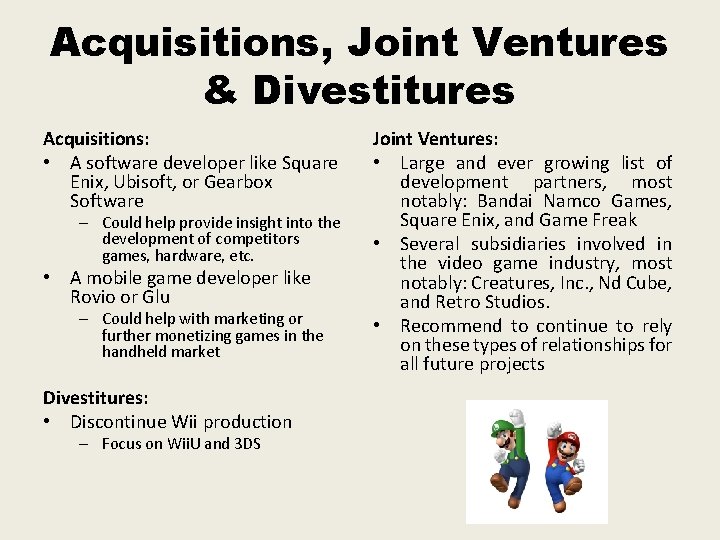
Acquisitions, Joint Ventures & Divestitures Acquisitions: • A software developer like Square Enix, Ubisoft, or Gearbox Software – Could help provide insight into the development of competitors games, hardware, etc. • A mobile game developer like Rovio or Glu – Could help with marketing or further monetizing games in the handheld market Divestitures: • Discontinue Wii production – Focus on Wii. U and 3 DS Joint Ventures: • Large and ever growing list of development partners, most notably: Bandai Namco Games, Square Enix, and Game Freak • Several subsidiaries involved in the video game industry, most notably: Creatures, Inc. , Nd Cube, and Retro Studios. • Recommend to continue to rely on these types of relationships for all future projects
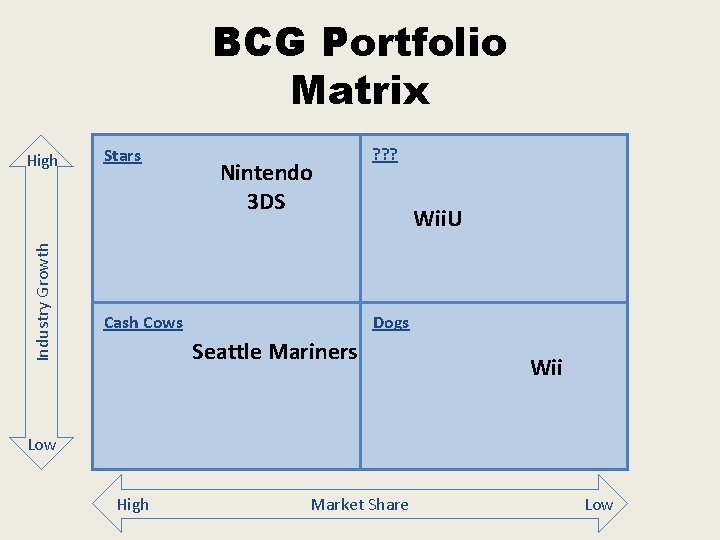
BCG Portfolio Matrix Industry Growth High Stars Nintendo 3 DS ? ? ? Wii. U Dogs Cash Cows Seattle Mariners Wii Low High Market Share Low