
Jails The Drusilla of Institutional Corrections Do not


- Slides: 18
Jails The Drusilla of Institutional Corrections Do not pass go, do not collect $200
Jail History � The oldest form of institutional corrections ◦ European “goals” as early as 1166 (pronounced jail), precursors much earlier �Overseen by the “shire-reeve” �Fee system �John Howard ◦ Colonial America �Earliest built in 1653 (York Village) �Walnut Street Jail (1773) ◦ Used almost exclusively for pre-trial or presentence detainment
The Drusilla of Institutional Corrections � Perhaps the most “under-studied” component of corrections ◦ State prisons as the “rock stars” of institutional corrections
Pre-trial quandary � What should we do with people awaiting trial or sentencing? � Balance community need for safety, justice, with rights of those accused of crime ◦ Preventative Detention (U. S. vs. Salerno, 1987) � Pre-trial release �BOND �ROR �Conditional Release
Do people on pre-trial release behave? � 2006 study of felony cases from large urban counties ◦ 18% rearrested while on pre-trial release ◦ 22% fail to appear for trial �Only 6% remained fugitives
Does being in jail have an impact on trial/sentencing outcomes? � YES ◦ Quicker dispositions ◦ Harsher dispositions �More apt to get prison/jail time �Get longer sentences � HOWEVER…
Pre-trial Services � Stems from “Manhattan Bail Project” ◦ How to limit bail/ensure that people will still show up for court � Variation in what “pre-trial services” means ◦ Investigation ◦ Supervision �P. O. sorts of stuff �Calling to remind of court appearances, etc.
Modern Jails � Roughly 3, 000 ◦ Most small <50 inmates ◦ About 60 “mega-jails” ◦ “Big 4” states hold 1/3 of all jail inmates � 60% for Pretrial detainment ◦ Other sorts of folks? � Differences between jails and prisons?
Who is in Jail? � Over 50% racial or ethnic (Hispanic) minorities � Mostly (87%) male ◦ Female numbers increased over past decade �Over 50% report physical/sexual abuse �Gender-specific concerns � Drug/alcohol ◦ ½ used illicit drugs in month before confinement ◦ ¼ were using when they committed the offense ◦ 2/3 used alcohol regularly, many were drunk during offense
Jails as a volatile place � Incoming offenders as less stable � Turnover much higher ◦ Drug and alcohol, shock of arrest, untreated mental illness… ◦ Programming limited (only 6% get drug/alcohol treatment � Less sophisticated classification--limited � Suicides area of concern ◦ Prevention better now (suicides down markedly) but still two times higher than in general population �Younger or older, white, males, violent record, in smaller jails as most likely to commit suicide
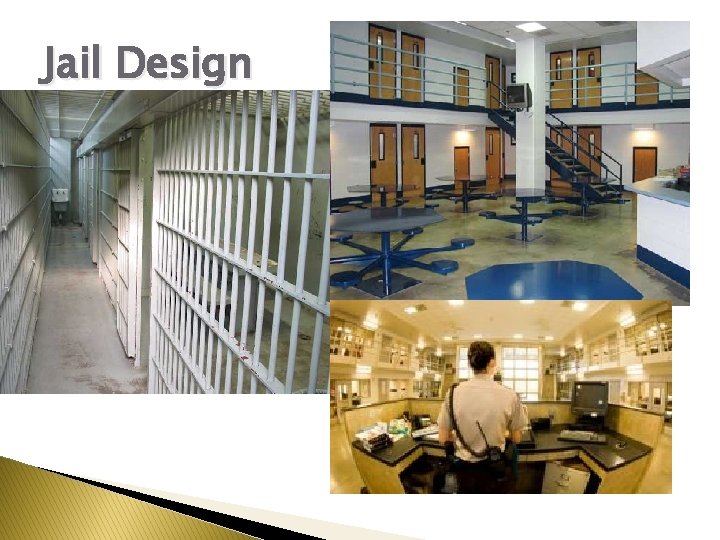
Jail Design
Jail Architecture and Management � Old (first generation) style ◦ Linear facilities ◦ Intermittent supervision � Second generation ◦ Pods + control rooms (indirect supervision) � Third (or “new”) Generation ◦ Pods + direct supervision ◦ Now more about 20% of all facilities—not “new” anymore
Benefits of the New Generation Jails � Cost less to build and maintain � Less opportunity for inmates to engage in nasty stuff, or minor stuff that precedes… � Staff and Inmates more safe ◦ Small groups easier to manage, direct supervision allows “nipping things in the bud, ” staff in “control” of the jail � Staff report better job satisfaction, less burnout � All of this ASSSUMES that training and management are adequate—still need research on this
Limits of the New Generation Jail � Increased cost of training � Principles corrupted by crowding ◦ Staff turnover ◦ Small groups become larger ◦ Pods become cluttered with cots, etc.
Jail Crowding � Thing are better now than 1980 -1990 s, but many are still crowded ◦ Nationally, jails at roughly 90% capacity ◦ 750, 000 jail inmates, or 250/100, 000 as of 2005 �In 1995, 500, 000 inmates � Factors affecting jail populations ◦ More arrests, more short jail sentences (drugs, problem oriented policing, mandatory arrest) ◦ Prison crowding � 5 -10% of jail inmates are waiting for space in prison ◦ De-carceration of mentally ill?
Mental Illness and Jail � Mental Illness in jail is 3 times that of general population ◦ 64% of jail inmates have mental health problem �BUT – not a great predictor of crime or recidivism � What is going on? ◦ Easier to catch, convict, incarcerate M. D. offenders? ◦ Police charity arrest, order maintenance ◦ De-institutionalization � Mental illness + homelessness (poverty) + substance abuse = web of entanglement with jails
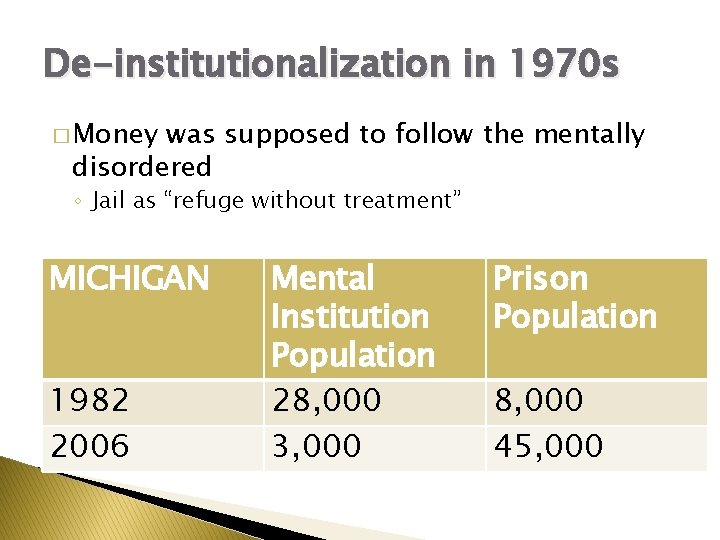
De-institutionalization in 1970 s � Money was supposed to follow the mentally disordered ◦ Jail as “refuge without treatment” MICHIGAN 1982 2006 Mental Institution Population 28, 000 3, 000 Prison Population 8, 000 45, 000
Jail Issues in the new millennium � Privatization ◦ CCA, Wackenhut (Now, the GEO Group) ◦ <3% of jail inmates � Regionalization ◦ From 1 county, 1 jail to regional jails � Change in how jails are staffed ◦ Co-equal staffing ◦ Private contracting, separation from Sheriff