
Jacques Loeb Engineering life and mechanistic biology MBL
Jacques Loeb: “Engineering” life and mechanistic biology MBL History of Biology Seminar “A Century of Engineering Life, ” May 2017 Ute Deichmann
1. Jacques Loeb, Experimentally Controlling ("Engineering") Life, and its Philosophical Background 2. From Controlling Life to Mechanistic Biology 3. Mechanistic Biology and Evolution 4. Mechanism and Anti-Mechanism in Present-Day Systems Biology
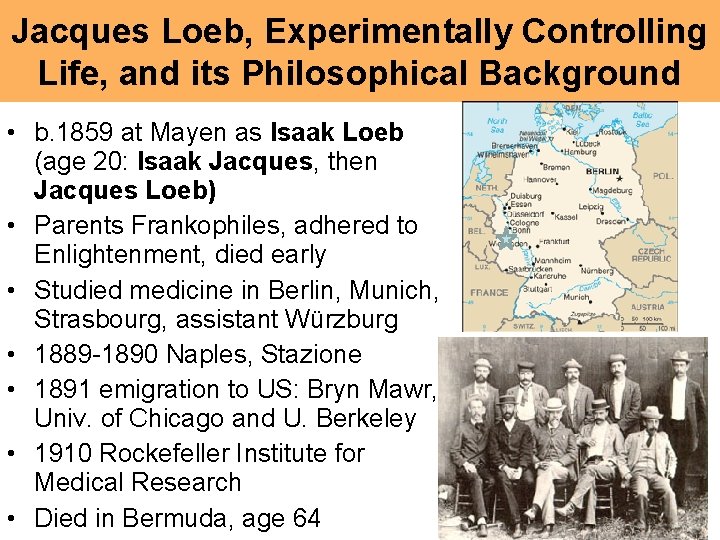
Jacques Loeb, Experimentally Controlling Life, and its Philosophical Background • b. 1859 at Mayen as Isaak Loeb (age 20: Isaak Jacques, then Jacques Loeb) • Parents Frankophiles, adhered to Enlightenment, died early • Studied medicine in Berlin, Munich, Strasbourg, assistant Würzburg • 1889 -1890 Naples, Stazione • 1891 emigration to US: Bryn Mawr, Univ. of Chicago and U. Berkeley • 1910 Rockefeller Institute for Medical Research • Died in Bermuda, age 64
Loeb's early work was in experimental brain physiology. Physiology in Germany • 1800 -1850: A biological orientation – Müller, v. Baer and others developed comprehensive science of life, focusing on embryological development and behaviour within a teleological framework. – Assumption: they are result of a special organismic materialistic organization. – Experiments (e. g. chemical analysis) were central.

• Around 1850: Mainstream physiology shifts from teleological-materialistic to physicalmechanistic approach – Influence of Helmholtz and du Bois Reymond: – Areas such as development and behaviour were abandoned (exceptions: Roux, Pflüger, Goltz) • Physiology: autonomous subject in medical schools • Loeb's education and early work were outside mainstream physiology: – He maintained a broad biological perspective (Naples) – 1886 -8 worked with Julius Sachs in Würzburg: Tropism studies Between 1889 and 1891: He developed program for experimentally controlling biological phenomena.
Philosophical background of Loeb's approach: 19 th century positivism: 1. Ernst Mach's positivist-empiricist epistemology: • All knowledge regarding matters of fact is based on the “positive” data of experience. Accepted a priori truths as a posteriori to that of ancestors. • Anti-mechanist: rejected atomistic view that natural phenomena can be reduced to matter in motion. • Conception of science not as description of nature but as "Economy of Thought"; efficiency and prediction; analysis subordinated to action • Science derived from and subordinate to technology
2. Josef Popper-Lynkeus's engineering view: • Social reformer; believed in cultural importance of technology (1880 s), following the 19 th century technischem Trieb.
Loeb's conception of science around 1890: • Science as a form of action, i. e. biology has to be experimental, not descriptive. • Experimental practice comes first, deeper analysis is subordinated. • Self-understanding as a "Popperian engineer" (Techniker) • Followed Mach in his rejection of the distinction between science and technology (against prevalent views at German universities).
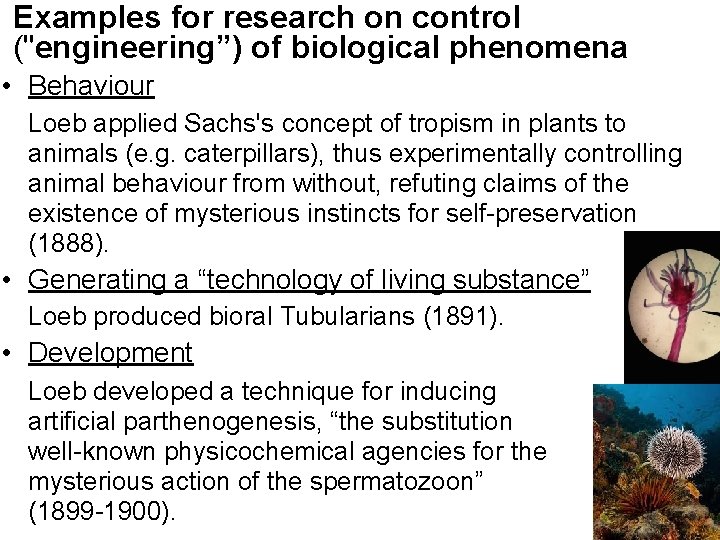
Examples for research on control ("engineering”) of biological phenomena • Behaviour Loeb applied Sachs's concept of tropism in plants to animals (e. g. caterpillars), thus experimentally controlling animal behaviour from without, refuting claims of the existence of mysterious instincts for self-preservation (1888). • Generating a “technology of living substance” Loeb produced bioral Tubularians (1891). • Development Loeb developed a technique for inducing artificial parthenogenesis, “the substitution well-known physicochemical agencies for the mysterious action of the spermatozoon” (1899 -1900). of
Loeb's "engineering" of biological phenomena Is: • Technik, i. e. doing, experimenting • "It is possible to control the 'voluntary' movements of a living animal just as securely and unequivocally as the engineer (Techniker) has been able to control the movements in inanimate nature. " • Directed against metaphysical explanation (e. g. vitalism) and speculation on causes Is not: • Industrial engineering in a narrow sense • Oriented towards applications
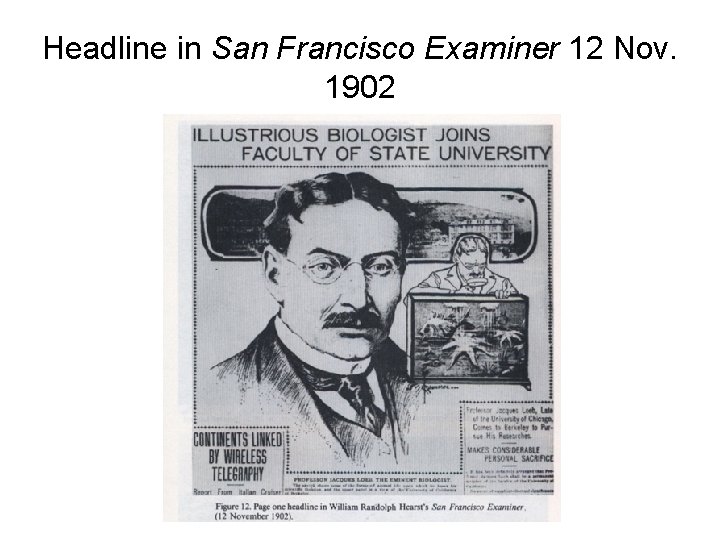
Headline in San Francisco Examiner 12 Nov. 1902
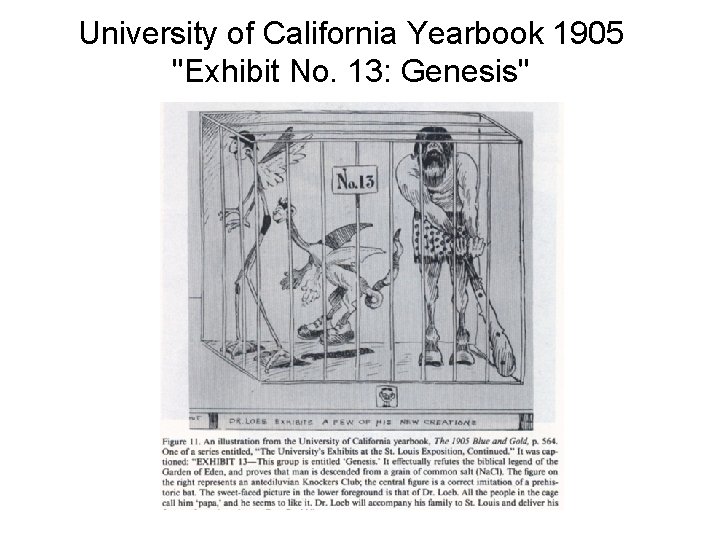
University of California Yearbook 1905 "Exhibit No. 13: Genesis"
Appraisal of Loeb by historians ". . . the German émigré Jacques Loeb, America's emblem of pure wissenschaft. . . " (L. Kay) "By the turn of the century [Loeb] had come to symbolize both the appeal and temptation of open-ended experimentation among biologists in America" (P. Pauly) Sinclair Lewis, Arrowsmith: Max Gottlieb modelled in part after Jacques Loeb
2. From Controlling Life to Mechanistic Biology What is ‘mechanism’ in philosophy of science? The 'corpuscularian' or mechanical philosophy originates in the ancient Greek atomists’ conception of nature: • Notion of a complex world without purpose, design or divine intervention • Causal explanation of the properties of macroscopic bodies by atoms, their movements and interactions Opponents (e. g. Aristotle): • Emphasis on the teleology and rational design • Distinction between form and matter
Later usages of 'mechanism' • Mechanism as world view • Mechanism as functional unit • Mechanism as causal explanation
19 th- and 20 th-century mechanists looked for causal explanations • Physiologists and molecular biologists: Explanation of biological phenomena by means of physics and chemistry; macromolecules. • Developmental mechanists: Causal explanation of development through experiments (Roux) in opposition to the phenomenological research related to Haeckel's biogenetic law. Anti-mechanists • • Vitalists (Bergson, nature philosophers, Driesch) Morphologists, physicalists (d‘Arcy Thompson) Holists and monists (Haeckel) Empiricists, positivists (Mach, Ostwald)
Background of Loeb's turning to mechanism: New scientific developments: • Buchner's demonstration of alcoholic fermentation in cell-free yeast extracts (1897) as a result of the catalytic action of a chemical ferment or enzyme: • Understanding the nature and function of enzymes would enable scientists to understand "how it happens that from the germ of an animal only an animal of the same species. . . can develop. " (Loeb 1898) • 'Rediscovery' of Mendel's rules (1900) • The confirmation of the existence of atoms (1908 -11)
The confirmation of the existence of atoms • Loeb in 1915: • Mach's and Ostwald's opposition to atomism was based on the doubt of the real existence of molecules. • This was removed, among other things, because the Avogadro constant N (the number of particles in a known unit (mole)), namely 6, 05 x 1023 had been arrived at by different physicists by different methods and in entirely different fields of physics.
• Perrin: on the basis of a formula of Einstein for the Brownian movement. • After Helmholtz gave rise to the atomistic theory of electricity. Millikan established the existence of the “atom of electricity” and to measure the value e of one such atom on an oil drop in an electric field of known strength. From this value it follows that N is as stated above. • Rutherford determined N from the measurement of the charge of an alpha particle of radium. (Loeb 1915)
• These and other determinations of the value of N “constitute one of the most wonderful chapters in science. For theory of knowledge and of science, they are epoch-making, since they put the molecular or mechanistic theory on a solid basis. ” (Loeb 1915)
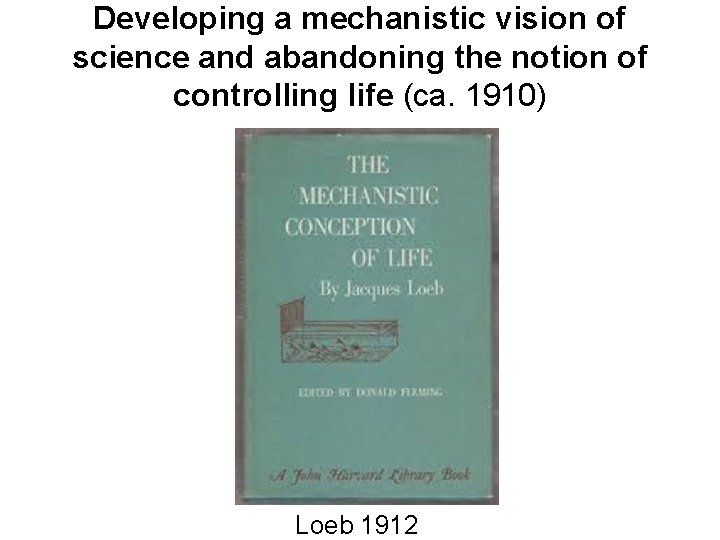
Developing a mechanistic vision of science and abandoning the notion of controlling life (ca. 1910) Loeb 1912
“According to mechanistic science, it should be in the distant future possible to reduce these specific life phenomena to the ultimate elements of all phenomena in nature, that is, motions of electrons, atoms, or molecules. ” Loeb 1915
Example 1: Exploring the physico-chemical basis of heredity • Program of biochemical genetics (1907 -15): – Genes are the determiners for a certain mass of enzymes; – Geneticists should determine “the chemical substances in the chromosomes. . . and the mechanism by which these substances give rise to the hereditary character. ” (1911) • Belief in central role of DNA for heredity: “Nucleic acid synthesis as thread at which we find our way through the labyrinth of the specific life processes, i. e. growth by cell proliferation. ”(1907) • “Mechanism for the continuity of the hereditary substances” identical with the “secret of life” (1909)
Emil Fischer's vision of genetic engineering • With the synthetic approaches to this group [of nucleotides] we are now capable of obtaining numerous compounds that resemble, more or less, natural nucleic acids. How will they affect various living organisms? Will they be rejected or metabolized or will they participate in the construction of the cell nucleus? Only the experiment will give us the answer. I am bold enough to hope that, given the right conditions, the latter may happen and that artificial nucleic acids may be assimilated without degradation of the molecule. Such incorporation should lead to profound changes of the organism, resembling perhaps permanent changes or mutations as they have been observed in nature. Emil Fischer, 1914
Example 2: Fighting biocolloidal scientists' support of non-mechanistic biology: Loeb refutated of the existence of special colloidal laws regarding protein behavior (1917 -1924) Claim of colloidal scientists: • Proteins are colloidal aggregates of small molecules, do not react stoichiometrically (in exact proportions), do not dissolve as single molecules. Colloids form a world of “neglected dimensions, ” follow special “colloid-chemical laws. ” Biological systems cannot be “visualised in mechanistic terms. ” (Wolfgang Ostwald: Die Welt der vernachlässigten Dimensionen, 1915)
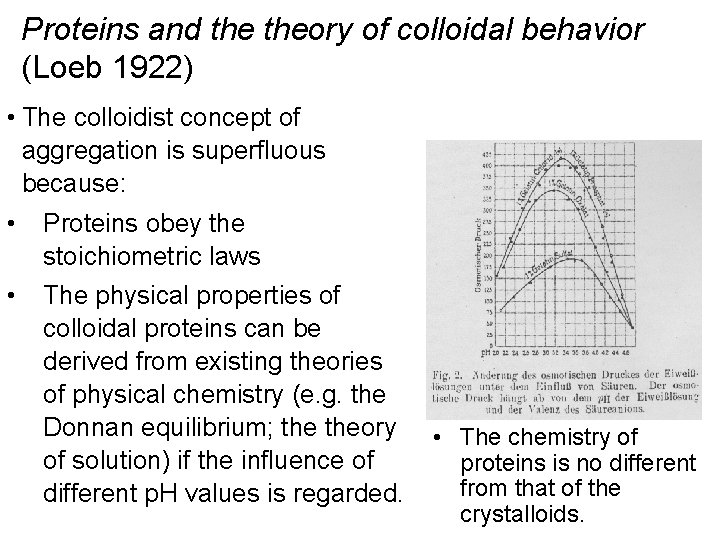
Proteins and theory of colloidal behavior (Loeb 1922) • The colloidist concept of aggregation is superfluous because: • Proteins obey the stoichiometric laws • The physical properties of colloidal proteins can be derived from existing theories of physical chemistry (e. g. the Donnan equilibrium; theory of solution) if the influence of different p. H values is regarded. • The chemistry of proteins is no different from that of the crystalloids.
• Relating science and politics: Loeb, “Mechanistic Science and Metaphysical Romance” (1915): • Wo. Ostwald’s views show links between romantic attitudes in science and militaristic nationalism. • the claim that the ‘neglected’ ‘middle country’ of colloids has a right to exist “paralleled German claims for the defense of ‘middle Europe’. ” • Ostwald’s preface written “from the trenches” in France. • Wo. Ostwald’s efforts at disciplinary propagandizing parallel the cultural imperialism of Wilhelm Ostwald (under the banner of “German organisation”) and his aim of a unification of Europe under German supremacy. • Wolfgang Ostwald's political chemistry during NS: • Visits of cultural propaganda between 1937 and 1941 to England, the US, Yugoslavia, Hungary and Rumania: the purge of Jews from German universities and society resembles a “recrystallisation”, necessary to gain purity.
Loeb on science and humanity: • Scientific reasoning as rational reasoning is the only effective weapon against irrational political currents, e. g. the chauvinist and anti-Semitic propaganda of Dühring and Treitschke. • “The question of whether humanity wishes to be guided by mechanistic science or by metaphysical romance is, therefore, not only of merely academic importance. What progress humanity has made, not only in physical welfare but also in the conquest of superstition and hatred, and in the formation of a correct view of life, it owes directly or indirectly to mechanistic science. ” (1915)
3. Mechanistic Biology and Evolution Why did Loeb turn to questions of evolution? • He appreciated the idea of a non-purposeful evolution. • He rejected contemporary evolutionary biology as unscientific: • The Darwinian explanation for the origin of species was unsatisfactory; in order to solve the problem one had to find "experimental facts which shall establish whether and how species can be transformed. More important: Physiologists shall determine, "whether or not we shall be able to produce living matter artificially. " (1896) • He perceived in new scientific developments the tools with which to tackle evolutionary biology experimentally.
• Loeb's criticism of contemporary evolutionary biology: • Its descriptive and speculative nature (e. g. zoologists‘ attribution of human traits to animals and even a life-like nature to crystals (Haeckel) • 'Progressive evolutionism' (e. g. colleagues at U. Chicago; following Spencer and other neo. Lamarckians): Belief in purposeful development and progress in nature and society. • Closeness of progressive evolution to religion (Protestantism). • Loeb: Progressive evolution is metaphysical, not scientific.
Loeb to Darwin scholars whose arguments he considered unscientific (1899): “In science we could only take things for proven when they were based on quantitative experiments and from this point of view ours was not the era of Darwin but the era of Pasteur. ”
• Incompleteness of theory of natural selection: • Does not generate evolutionary novelties. • Lack of physico-chemical explanations: The theory of selection is “incomplete since it disregards the physicochemical constitution of living matter about which little was known until recently. " (Loeb 1916) • Evolutionary biologists' inability to convincingly explain species transformation and to transform species at will.
Loeb rejected the methodological division of the phenomena of life into ‘biological’ (‘ontological’), e. g. behaviour, development, and evolution, and ‘physiological’. • Compare: Mayr (1962): proximate and ultimate causes; Dobzhansky (1964): Cartesian, (mechanistic) and Darwinian (historical) aspects of biology Loeb: Theories of evolution must be given an experimental basis: Discoveries of Mendel and de Vries (mutations) “place before the experimental biologist the definite task of producing mutations by physico-chemical means”. (1912)
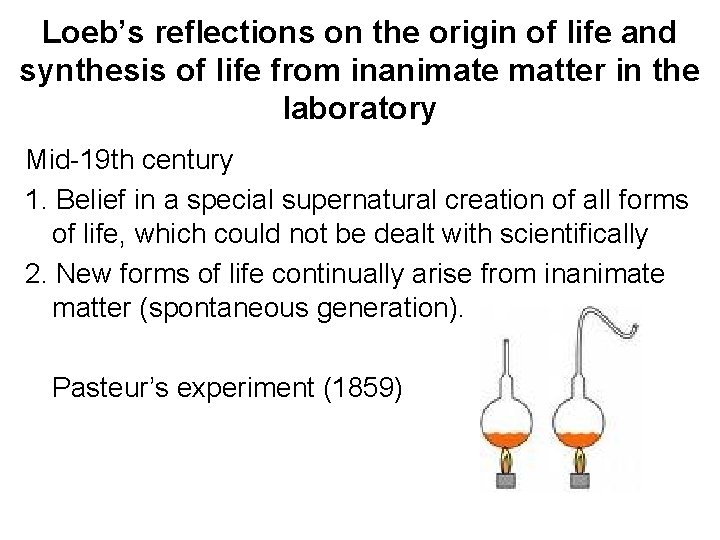
Loeb’s reflections on the origin of life and synthesis of life from inanimate matter in the laboratory Mid-19 th century 1. Belief in a special supernatural creation of all forms of life, which could not be dealt with scientifically 2. New forms of life continually arise from inanimate matter (spontaneous generation). Pasteur’s experiment (1859)
• “Pasteur’s proof that spontaneous generation does not occur in the solution used by him does not prove that a synthesis of living from dead matter is impossible under any conditions. It is at least not inconceivable that in an earlier period of the earth’s history, radioactivity, electrical discharges, and possibly also the action of volcanoes might have furnished the combination of circumstances under which living matter might have been formed. ” (Loeb 1916) To Loeb the question of the origin of life was closely related to that of synthesizing artificial life.
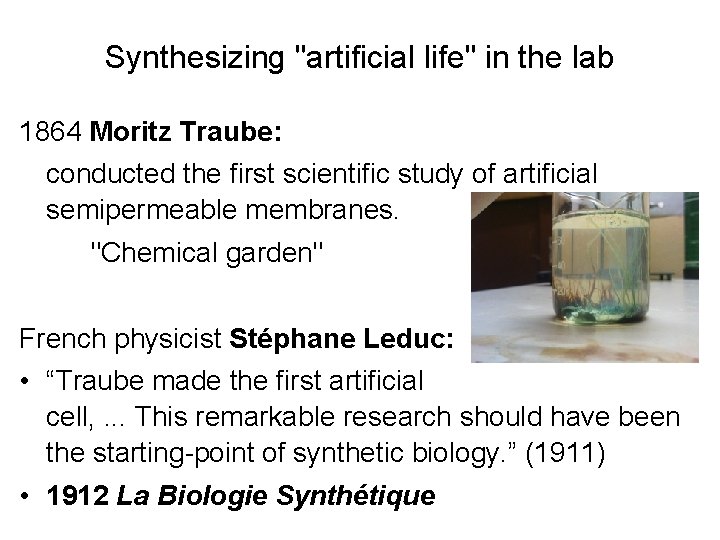
Synthesizing "artificial life" in the lab 1864 Moritz Traube: conducted the first scientific study of artificial semipermeable membranes. "Chemical garden" French physicist Stéphane Leduc: • “Traube made the first artificial cell, . . . This remarkable research should have been the starting-point of synthetic biology. ” (1911) • 1912 La Biologie Synthétique
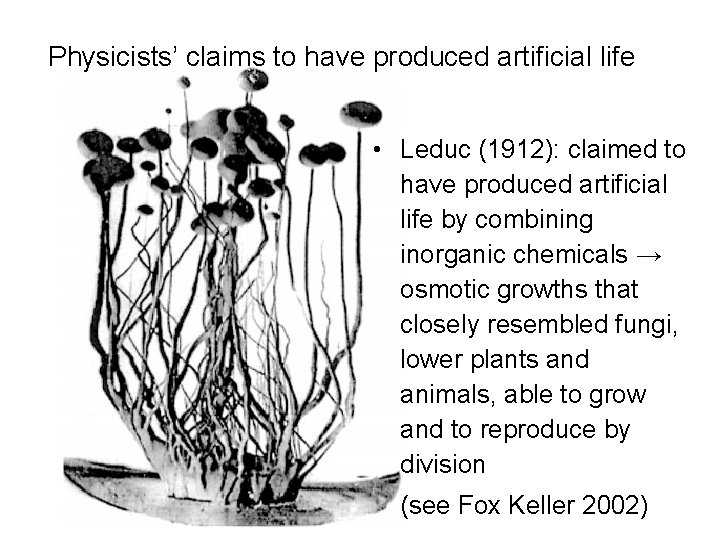
Physicists’ claims to have produced artificial life • Leduc (1912): claimed to have produced artificial life by combining inorganic chemicals → osmotic growths that closely resembled fungi, lower plants and animals, able to grow and to reproduce by division (see Fox Keller 2002)
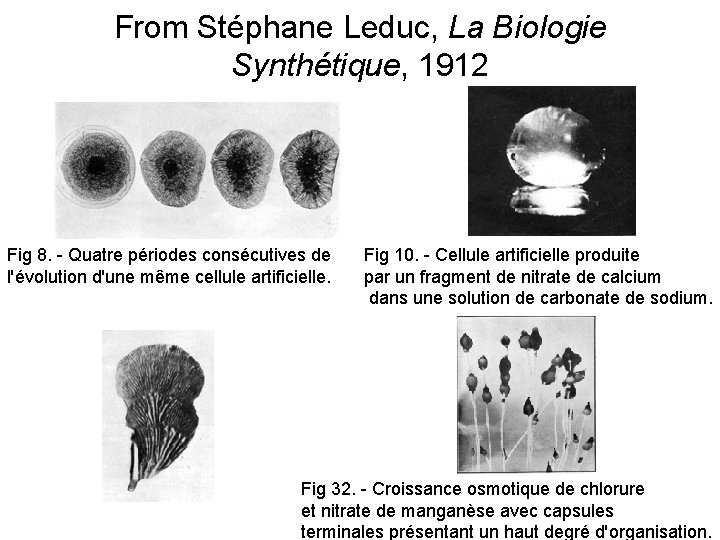
From Stéphane Leduc, La Biologie Synthétique, 1912 Fig 8. - Quatre périodes consécutives de l'évolution d'une même cellule artificielle. Fig 10. - Cellule artificielle produite par un fragment de nitrate de calcium dans une solution de carbonate de sodium. Fig 32. - Croissance osmotique de chlorure et nitrate de manganèse avec capsules terminales présentant un haut degré d'organisation.
Loeb’s criticism of such claims: • “The purely morphological imitations of bacteria or cells which physicists have now and then proclaimed as artificially produced living beings, or the play on words by which, e. g. , the regeneration of broken crystals and the regeneration of lost limbs by a crustacean were declared identical will not appeal to the biologist. • We know that growth and development in animals and plants are determined by definite although complicated series of catenary chemical reactions, which result in the synthesis of a definite compound or group of compounds, namely nucleins. →
• “Whoever claims to have succeeded to making living matter from inanimate will have to prove that he has succeeded in producing nuclear material which acts as a ferment for its own synthesis and thus reproduces itself. Nobody has thus far succeeded in this, although nothing warrants us in taking it for granted that this task is beyond the power of science. ” Loeb 1909
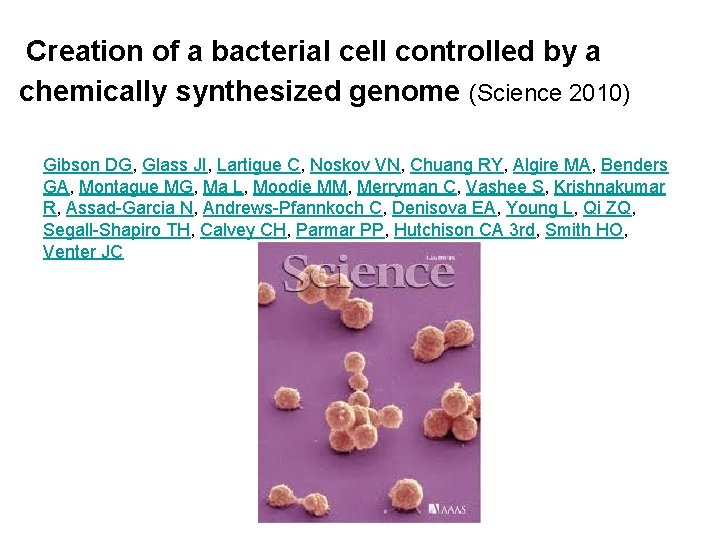
Creation of a bacterial cell controlled by a chemically synthesized genome (Science 2010) xt Gibson DG, Glass JI, Lartigue C, Noskov VN, Chuang RY, Algire MA, Benders GA, Montague MG, Ma L, Moodie MM, Merryman C, Vashee S, Krishnakumar R, Assad-Garcia N, Andrews-Pfannkoch C, Denisova EA, Young L, Qi ZQ, Segall-Shapiro TH, Calvey CH, Parmar PP, Hutchison CA 3 rd, Smith HO, Venter JC
Mechanistic biology and principles of life Loeb‘s mechanism and materialism was accompanied by a deep understanding of principles of life: • Hierarchical organization: "What makes a harmonious whole organism" out of the assortment of elements in the chromosomes? • Specificity: • Individual and species specificity of DNA and proteins • "Synthetic power" of transforming non-specific "building stones" into complicated compounds specific for each organism • Privileged causal role of hereditary material
Loeb’s mechanistic experimental biological research program: • Strongly influenced leading figures of early 20 th century experimental biology, e. g. Warburg, Morgan, Muller • Impacted on the molecular biological approach • Is necessary but insufficient for the explanation of evolutionary changes, which require the integration of molecular program with developmental-genetic research.
4. Mechanism and Anti-Mechanism 4. Experimental Biology and in Present-Day Systems Biology Evolution I. The example of Eric Davidson's mechanistic developmental biology: Davidson (1937 -2015), a world leader in molecular developmental biology, proposed a causalmechanistic explanation for the early development of the sea urchin based on genomic regulation, combining the molecular approach with a systems one.
- Slides: 44