
Jacobs Ladder Reading Comprehension Program A Supplemental Reading
Jacob’s Ladder Reading Comprehension Program: A Supplemental Reading Curriculum to Build Higher. The. Level Thinking College of William & Mary Skills Center for Gifted Education Tamra Stambaugh, Ph. D. tlstam@wm. edu Joyce Van. Tassel-Baska, Ed. D. & Tamra Stambaugh, Ph. D. Editors Drs. Heather French, Tamra Stambaugh, Denise Drain and Paula Ginsburgh, contributing authors
Purpose of Jacob’s Ladder Written for students in Title I schools but used widely and successfully in a variety of settings Purposes – To enhance reading comprehension skills – To build reading skills from lower order to higher order – To promote critical thinking in reading – To enhance student discussion of textual meaning – To promote instructionally sound test preparation – Build scaffolding for students to better employ higher level thinking skills
Getting to Know You Introduce yourself to others at your table and discuss the following: – What characteristics do advanced readers in your classroom exhibit? – Which reading strategies have you found to be effective in your classroom? – How do you know?
Research and Advanced Readers Read fluently and well Read at an early age in many instances Interested in words and word relationships (satire and jokes) Process key ideas about what is read at a more rapid pace Enjoy talking about literature or books
Research and Advanced Readers Write descriptively to communicate stories Read often – inside and outside of class Enjoy verbal puzzles and games Advanced vocabulary for age or cultural population Play with language
Why Supplemental Materials for Reading? Reading reform curriculum does not promote higher level thinking skills or advanced skills beyond reading comprehension – (Tivnan & Hemphill, 2005; AFT, 1998) It’s difficult to work at a level high level without exposure to and practice with higher level materials (Value-Added) Brain Research
Reform Models Research American Federation of Teachers Study (1998) • Exemplary Center for Reading Instruction (ECRI) and Junior Great Books only two reading models with studies disaggregating advance readers with significant results (ECRI limited) • ECRI and JGB also only two to post data on critical thinking as part of curriculum • Cooperative Integrated Reading and Comprehension, Direct Instruction, Multicultural Reading and Thinking, Success for All, Open Court Young Scholars compared) Tivnan & Hemphill, 2005 • compared Building Essential Literary, Literacy Collaborative, and Developing Literacy First. Findings from their study suggest that none of the programs posit strong gains in thinking skills and supplemental programs are necessary
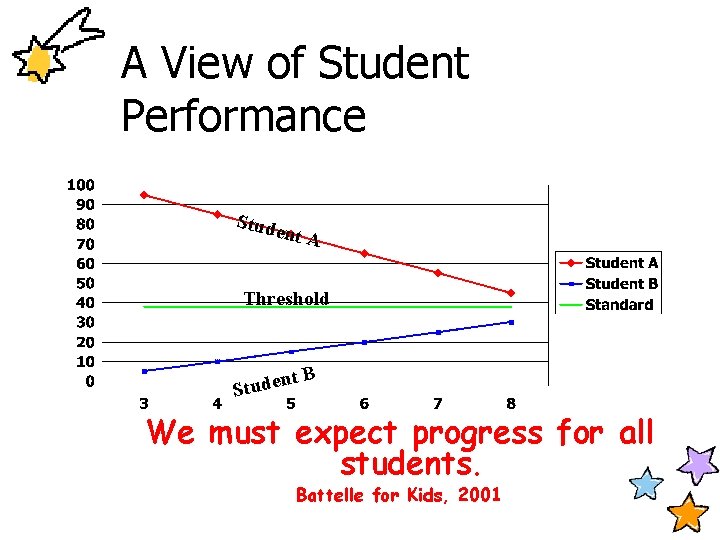
A View of Student Performance Stude nt A Threshold t. B n Stude We must expect progress for all students. Battelle for Kids, 2001
Children of Poverty & Reading Students in Title I schools using reform models do not show gains in higher level thinking skills or meaning construction. – (Tivnan & Hemphill, 2005) Teachers in Title I schools do not use as many higher level thinking questions or discussion options in reading when compared to non-Title I school counter parts. – (Taylor et al, 2000) The most accomplished teachers in Title I schools used small group instruction, independent reading, coaching, higher level questioning, and writing prompts in response to reading. – (Taylor, Pearson, Clark, & Walpole, 2000)
Brain Research “If a student engages in a curriculum that is well beyond that student’s level of readiness, stress results, and the brain over produces key neurotransmitters that impede learning (Koob, Cole, Swerdlow, & le Modal, 1990).
Brain Research (cont. ) Conversely, if the curriculum is redundant for the child – beneath that student’s level of readiness – the brain is not inclined to engage or respond and, consequently, does not release the levels of dopamine, noradrenalin, serotonin, and other neurochemicals needed for optimal learning. The result is apathy. (Shultz, Dayan, & Montague, 1997). ” From Educational Leadership, 1998 Tomlinson & Kalbfleisch
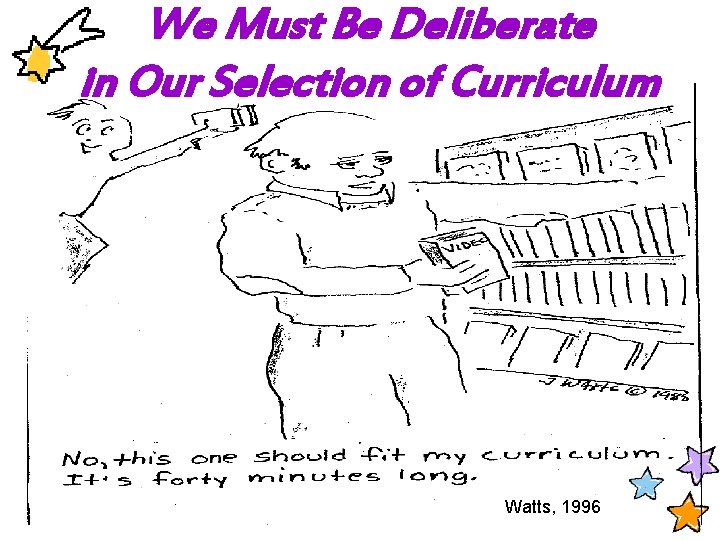
We Must Be Deliberate in Our Selection of Curriculum Watts, 1996
State Assessment Item Categories for Reading Comprehension Categorize and classify ideas Recall details in text Summarize the main idea of a text Analyze character traits Draw a conclusion Analyze details in text Use webs to show understanding
Research Base for Jacob’s Ladder Reading Comprehension Instructional scaffolding that embeds strategy instruction in text reading enhances. Program reading comprehension (Fielding & Pearson, 1994; Villaume & Brabham, 2002) Responding to literature and reading through open-ended comprehensive questions improves test performance (Guthrie, Schafer, & Huang, 2001) Literacy discussions that stress collaborative reasoning foster greater engagement and higher level thinking (Chin, Anderson & Waggoner, 2001; Pressley, 2001; Taylor, Peterson, Pearson, & Rodriguez, 2002) Rereading text improves metacomprehension accuracy (Rawson, Dunlosky, & Thiede, 2000) Teachers who emphasize higher order thinking through questions and tasks promote greater reading growth (Taylor, et al, 2003; Knapp, et al, 1995) Less than 20% of questions teachers ask in language arts are at the advanced levels of Bloom’s Taxonomy (Taylor, et al, 2002) Teacher stance (providing coaching, modeling, & feedback) enhances reading and writing growth (Pressley, et al, 2001; Taylor, et al, 2002)

Why Jacob’s Ladder? The Inside Scoop Designed based on teacher need for scaffolding reading – especially for advanced readers who are capable of reading and interpreting at a higher level but need help getting started Designed to differentiate reading instruction for students based on research-based models Designed to move students from lower order to higher order thinking so they may gain independence in reading and analyzing literature - work consistently at higher levels of achievement
Overview of the Program Includes 10 reading selections of each of the following genres: – Fables/myths (level 1), short stories and Essays (level 2 and 3) – Poetry – Nonfiction NEW! Each reading selection (except poetry in Level I) includes 2 ladders based on best fit with the reading selection
Curriculum Organization Introduction and User Guide – same in each level Appendices – – – Readings and Commensurate Ladders Performance-Based Assessments w/rubric Assessment System Reflection Forms Answer Sets Standards Alignment
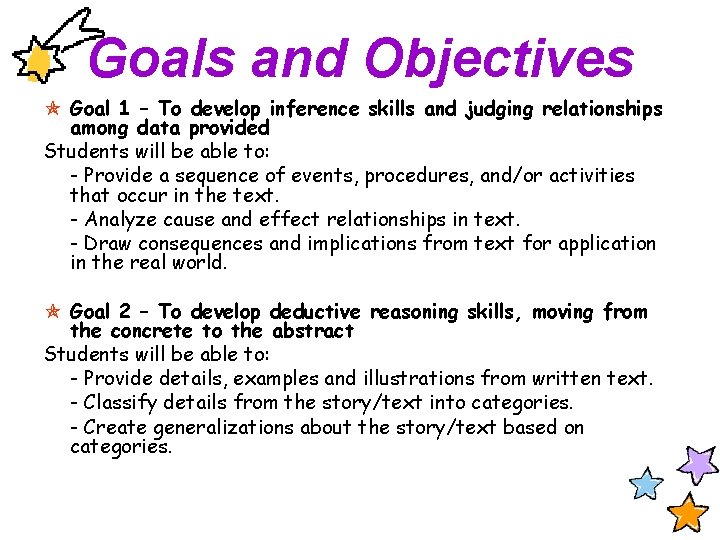
Goals and Objectives Goal 1 – To develop inference skills and judging relationships among data provided Students will be able to: - Provide a sequence of events, procedures, and/or activities that occur in the text. - Analyze cause and effect relationships in text. - Draw consequences and implications from text for application in the real world. Goal 2 – To develop deductive reasoning skills, moving from the concrete to the abstract Students will be able to: - Provide details, examples and illustrations from written text. - Classify details from the story/text into categories. - Create generalizations about the story/text based on categories.
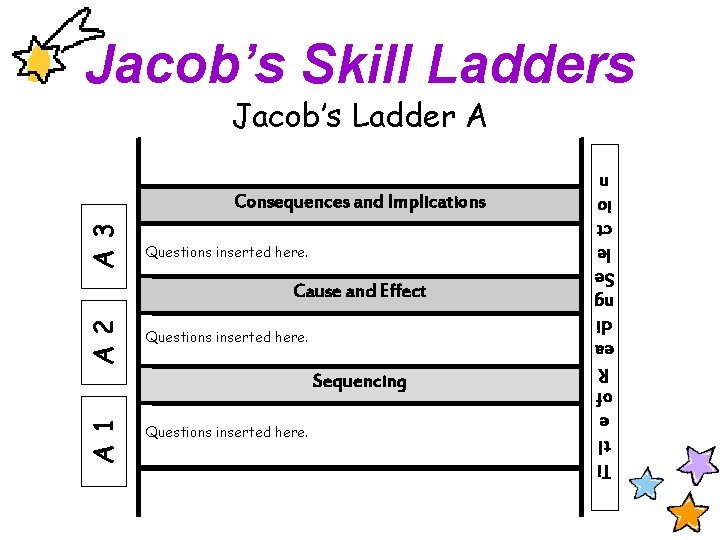
Jacob’s Skill Ladders Jacob’s Ladder A A 3 Questions inserted here. A 2 Cause and Effect Questions inserted here. A 1 Sequencing Questions inserted here. Ti tl e of R ea di ng Se le ct io n Consequences and Implications

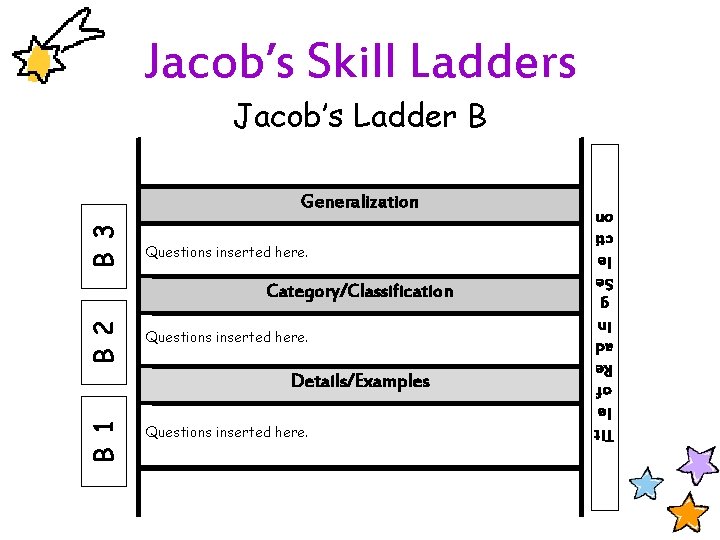
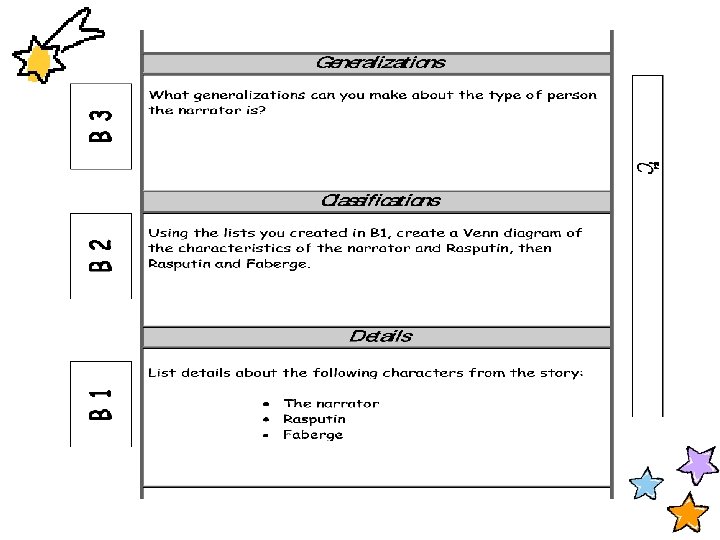
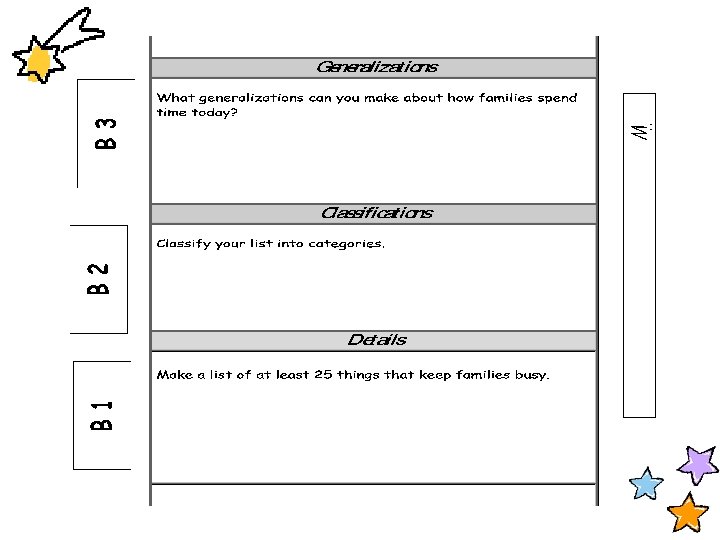
Jacob’s Skill Ladders Jacob’s Ladder B B 3 Questions inserted here. B 2 Category/Classification Questions inserted here. B 1 Details/Examples Questions inserted here. Tit le of Re ad in g Se le cti on Generalization
Goals and Objectives (cont. ) Goal 3 – To develop literary analysis skills, based on understanding literary elements Students will be able to: - Identify character traits and qualities for main characters in a story. - Identify and analyze poetic devices as appropriate. - State the setting or context for the story by place and time. -Make inferences or provide evidence about the story from given data. - State the main ideas or themes of the story. Goal 4 -To develop synthesis skills, moving from restating to creative synthesis -Paraphrase important quotations from the text. -Summarize the main ideas presented in the text and provide support using text-based evidence. -Generate new ideas based on their evaluation of existing ideas.
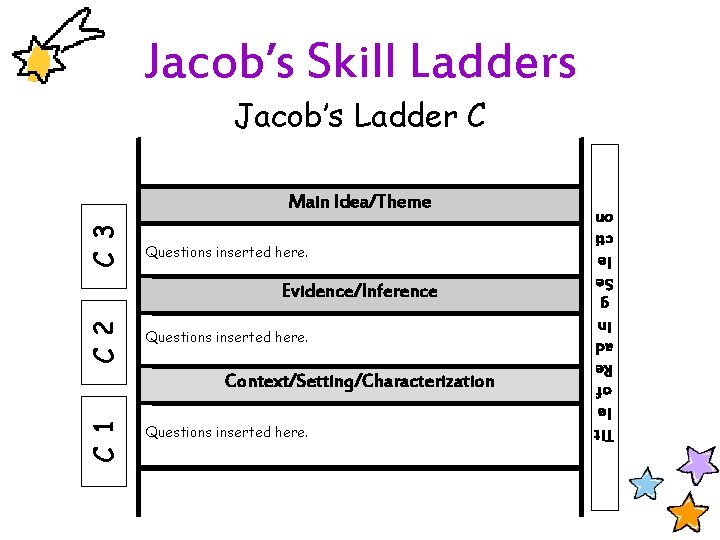
Jacob’s Skill Ladders Jacob’s Ladder C C 3 Questions inserted here. C 2 Evidence/Inference Questions inserted here. C 1 Context/Setting/Characterization Questions inserted here. Tit le of Re ad in g Se le cti on Main Idea/Theme
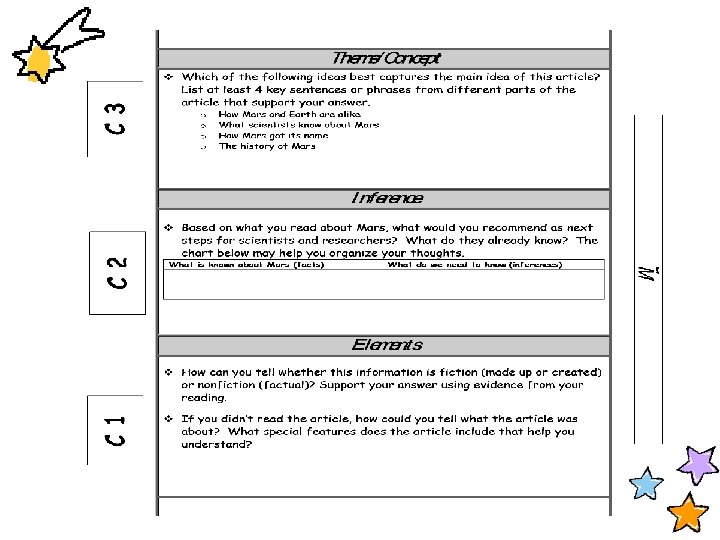
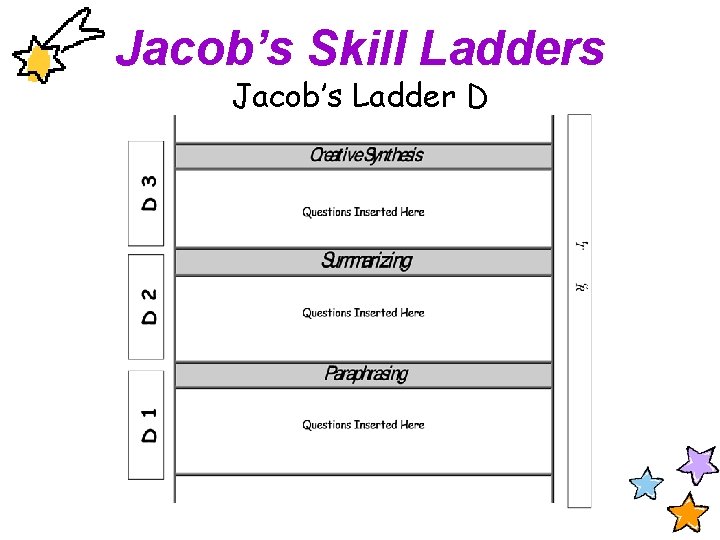
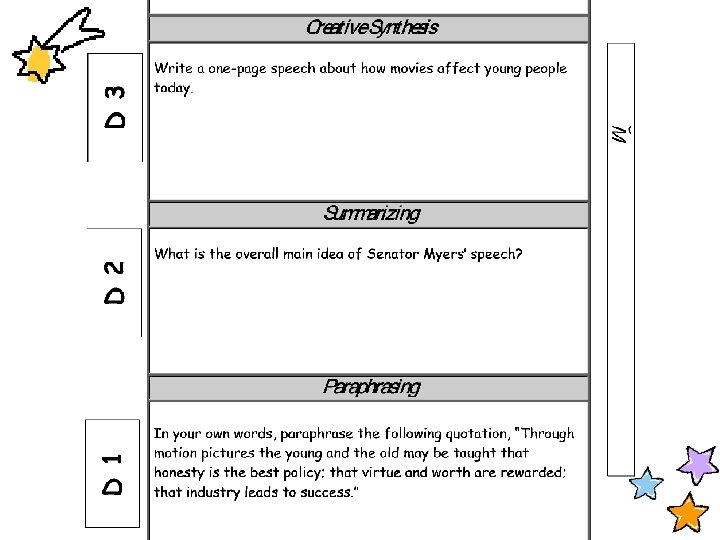
Jacob’s Skill Ladders Jacob’s Ladder D
Goals and Objectives (cont. ) Goal 5 - To promote learning through interaction and discussion of reading material in the classroom Students will be able to: -Articulate their understanding of a reading to a partner. - Solve problems collaboratively. -Engage in a meaningful dialogue about the meaning of a selection. -Use evidence from the text to support their answer.
Teaching Jacob’s Ladder Whole group modeling first After students understand how to complete the Jacob’s Ladder ladders, each student completes the ladder individually and then discusses the answers with a partner Debrief again whole class or in a small reading group
Delilah She has blue eyes like the ocean. Her tongue like a rose. Her nose like a heart. Her tail like a fan. Her black coat like the night sky. By Casey Carroll Grades 4 -5 Honorable Mention Center for Gifted Education Talent Search
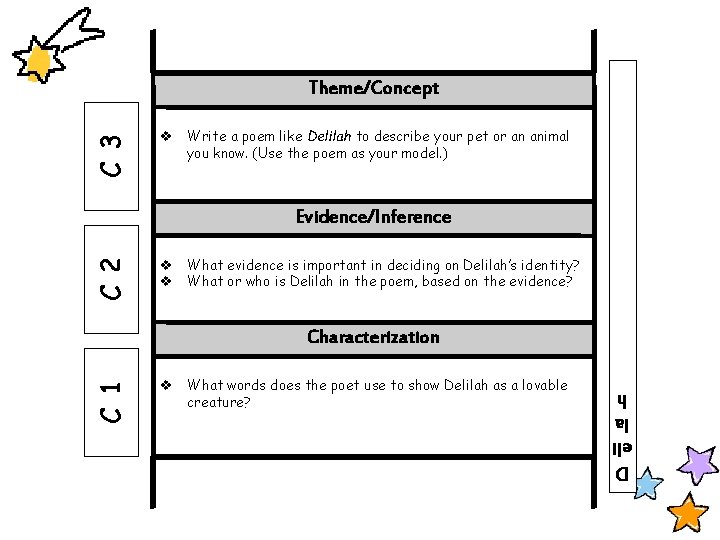
C 3 Theme/Concept Write a poem like Delilah to describe your pet or an animal you know. (Use the poem as your model. ) C 2 Evidence/Inference What evidence is important in deciding on Delilah’s identity? What or who is Delilah in the poem, based on the evidence? What words does the poet use to show Delilah as a lovable creature? D eli la h C 1 Characterization
Building Textual Understanding Underlying Assumption: Discourse that promotes understanding needs direction, focus, and movement towards goal. Marking (focusing) Revoicing (repeating student ideas) Turning back (textual or student-based) Recapping (synthesizing) Modeling (thinking aloud) Annotating (providing information) Beck & Mc. Keown, 1996
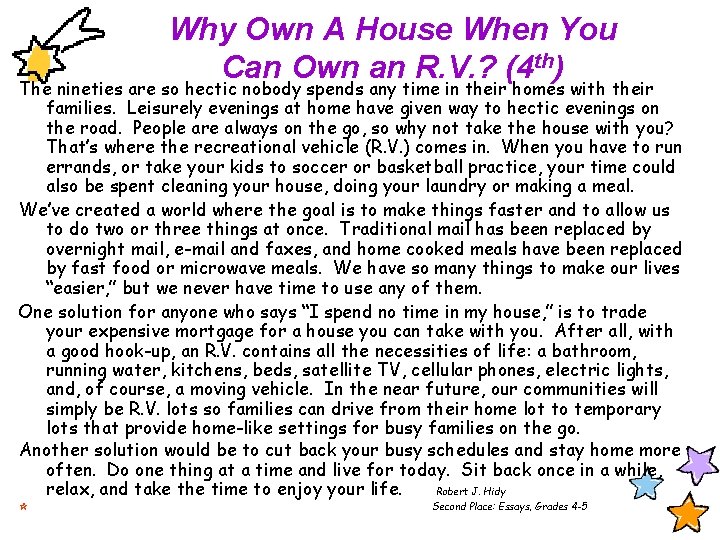
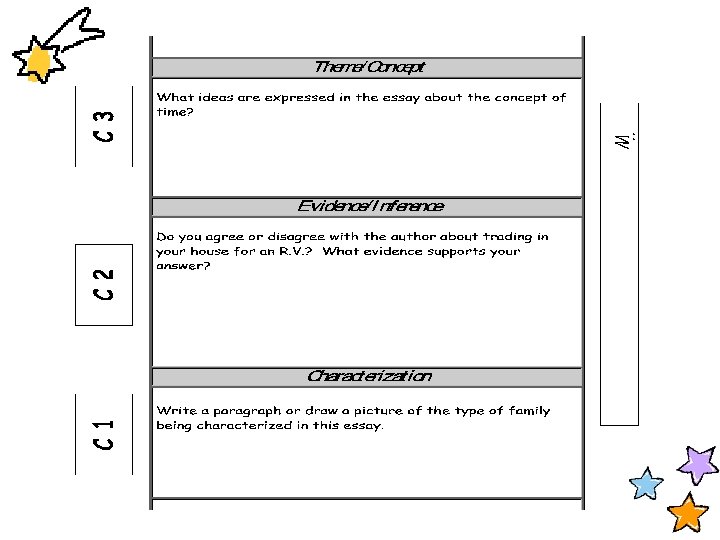
Why Own A House When You Can Own an R. V. ? (4 th) The nineties are so hectic nobody spends any time in their homes with their families. Leisurely evenings at home have given way to hectic evenings on the road. People are always on the go, so why not take the house with you? That’s where the recreational vehicle (R. V. ) comes in. When you have to run errands, or take your kids to soccer or basketball practice, your time could also be spent cleaning your house, doing your laundry or making a meal. We’ve created a world where the goal is to make things faster and to allow us to do two or three things at once. Traditional mail has been replaced by overnight mail, e-mail and faxes, and home cooked meals have been replaced by fast food or microwave meals. We have so many things to make our lives “easier, ” but we never have time to use any of them. One solution for anyone who says “I spend no time in my house, ” is to trade your expensive mortgage for a house you can take with you. After all, with a good hook-up, an R. V. contains all the necessities of life: a bathroom, running water, kitchens, beds, satellite TV, cellular phones, electric lights, and, of course, a moving vehicle. In the near future, our communities will simply be R. V. lots so families can drive from their home lot to temporary lots that provide home-like settings for busy families on the go. Another solution would be to cut back your busy schedules and stay home more often. Do one thing at a time and live for today. Sit back once in a while, relax, and take the time to enjoy your life. Robert J. Hidy Second Place: Essays, Grades 4 -5
Sample Follow-Up Questions That’s interesting. . Does anyone have a different idea? I agree with ---- because… I disagree with --- because. . I thought the passage…. was…. because My idea was different or the same as… I think… because in the story it says…
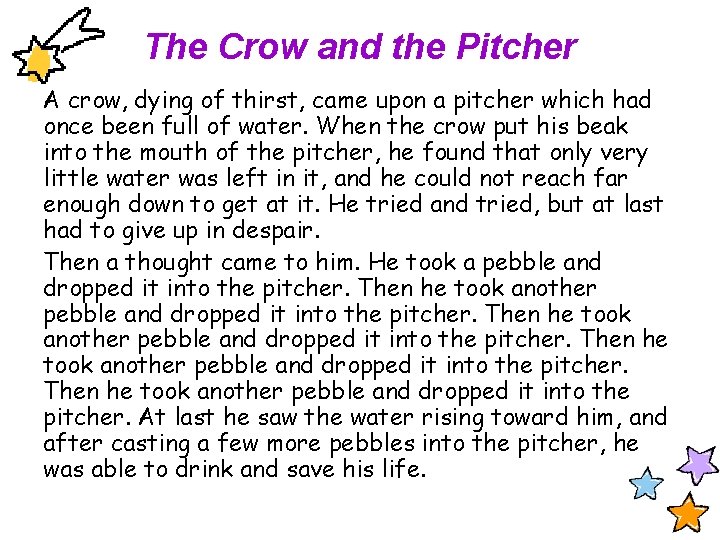
The Crow and the Pitcher A crow, dying of thirst, came upon a pitcher which had once been full of water. When the crow put his beak into the mouth of the pitcher, he found that only very little water was left in it, and he could not reach far enough down to get at it. He tried and tried, but at last had to give up in despair. Then a thought came to him. He took a pebble and dropped it into the pitcher. Then he took another pebble and dropped it into the pitcher. At last he saw the water rising toward him, and after casting a few more pebbles into the pitcher, he was able to drink and save his life.
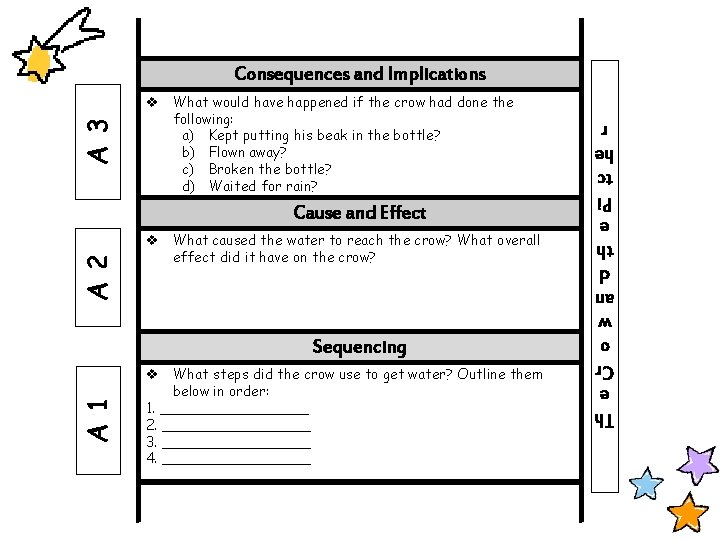
What would have happened if the crow had done the following: a) Kept putting his beak in the bottle? b) Flown away? c) Broken the bottle? d) Waited for rain? A 2 Cause and Effect What caused the water to reach the crow? What overall effect did it have on the crow? A 1 Sequencing What steps did the crow use to get water? Outline them below in order: 1. _________ 2. _________ 3. _________ 4. _________ Th e Cr o w an d th e Pi tc he r A 3 Consequences and Implications
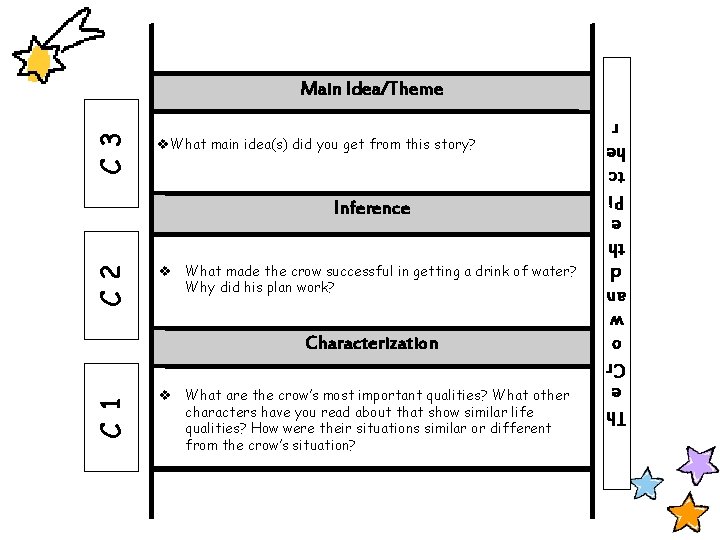
What main idea(s) did you get from this story? C 2 Inference What made the crow successful in getting a drink of water? Why did his plan work? C 1 Characterization What are the crow’s most important qualities? What other characters have you read about that show similar life qualities? How were their situations similar or different from the crow’s situation? Th e Cr o w an d th e Pi tc he r C 3 Main Idea/Theme
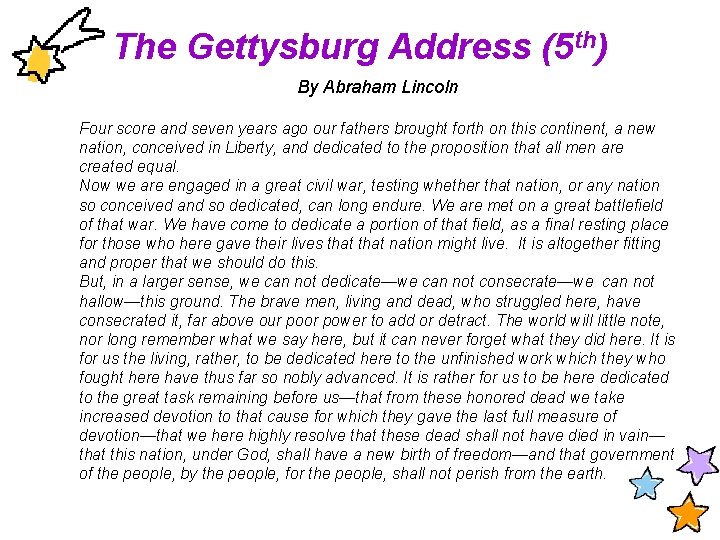
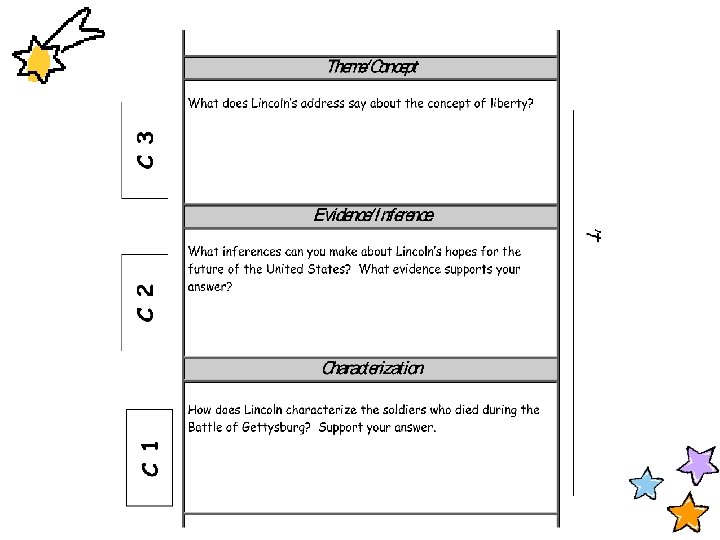
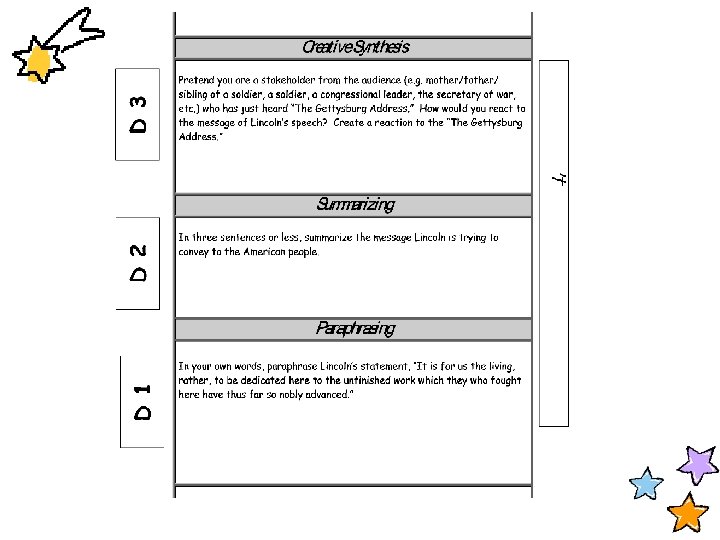
The Gettysburg Address (5 th) By Abraham Lincoln Four score and seven years ago our fathers brought forth on this continent, a new nation, conceived in Liberty, and dedicated to the proposition that all men are created equal. Now we are engaged in a great civil war, testing whether that nation, or any nation so conceived and so dedicated, can long endure. We are met on a great battlefield of that war. We have come to dedicate a portion of that field, as a final resting place for those who here gave their lives that nation might live. It is altogether fitting and proper that we should do this. But, in a larger sense, we can not dedicate—we can not consecrate—we can not hallow—this ground. The brave men, living and dead, who struggled here, have consecrated it, far above our poor power to add or detract. The world will little note, nor long remember what we say here, but it can never forget what they did here. It is for us the living, rather, to be dedicated here to the unfinished work which they who fought here have thus far so nobly advanced. It is rather for us to be here dedicated to the great task remaining before us—that from these honored dead we take increased devotion to that cause for which they gave the last full measure of devotion—that we here highly resolve that these dead shall not have died in vain— that this nation, under God, shall have a new birth of freedom—and that government of the people, by the people, for the people, shall not perish from the earth.
Your Turn Peruse the examples Jacob’s Ladder. Complete at least one ladder in each genre. Be prepared to discuss the following: – How does the Jacob’s Ladder Reading Comprehension Program match or supplement your current curriculum? – What questions do you have as a result of practicing with the curriculum?
Assessing and Managing Jacob’s Ladder
What gets measured gets done.
Examples of Pre-Post Assessments Used in JL Four Questions and a Short Reading – Question One – Implications and Consequences – Question Two – Inference • Analyzing a quote – Question Three – Theme/Generalization – Question Four – Creative Synthesis • Create a new title…
Your Turn In grade level teams, evaluate the pre & post assessment for your grade level using the provided rubric. Score each item individually and then meet with your partner. Be sure to arrive at consensus and justify why you rated the student as you did. Discuss implications for instruction.
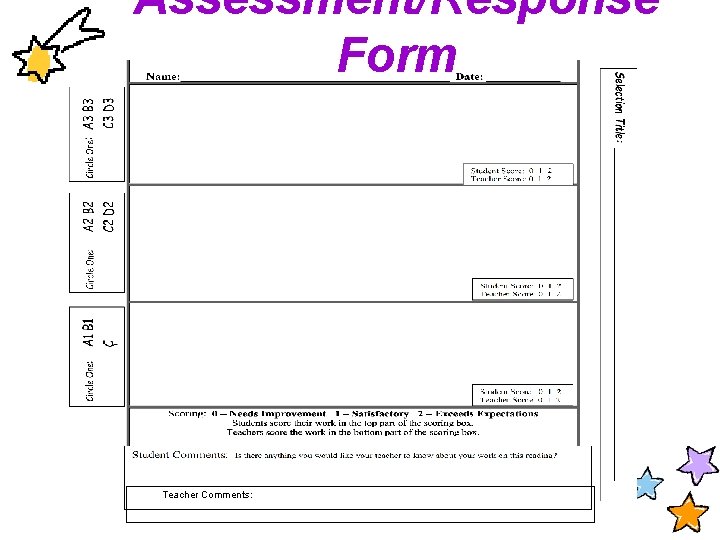
Assessment/Response Form Teacher Comments:
Reflection Form What I did well… What I learned… New ideas I have after discussion… Next time I need to…
Grading Ideas Instead of always using the answer sheet try the following: – Students individually write bulleted responses to the stories for discussion only… Work with a partner to discuss the readings. At end of the ladder discussion require a graded activity such as: – Journal response (highest rung) • Which one word to you think best describes what the Crow and Pitcher is about. Use examples from the story to justify your answer. • What do you think Delilah is? Why? – Activity (see example) • See creative synthesis in Ladder D • Concept map
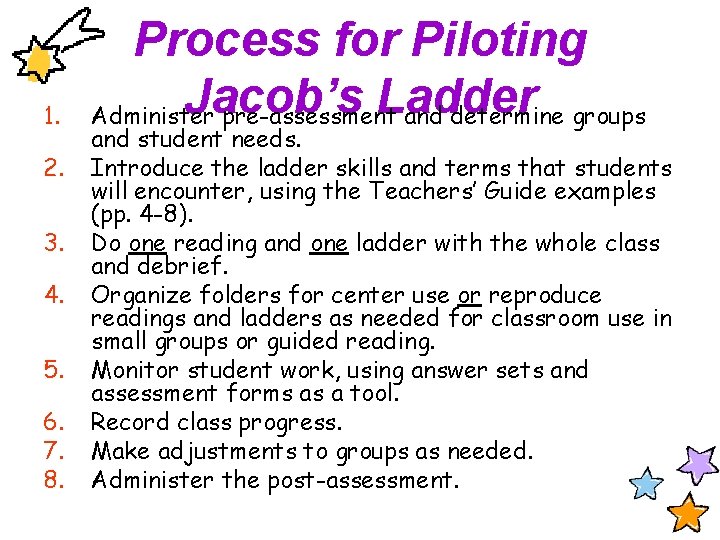
1. 2. 3. 4. 5. 6. 7. 8. Process for Piloting Jacob’s Ladder Administer pre-assessment and determine groups and student needs. Introduce the ladder skills and terms that students will encounter, using the Teachers’ Guide examples (pp. 4 -8). Do one reading and one ladder with the whole class and debrief. Organize folders for center use or reproduce readings and ladders as needed for classroom use in small groups or guided reading. Monitor student work, using answer sets and assessment forms as a tool. Record class progress. Make adjustments to groups as needed. Administer the post-assessment.
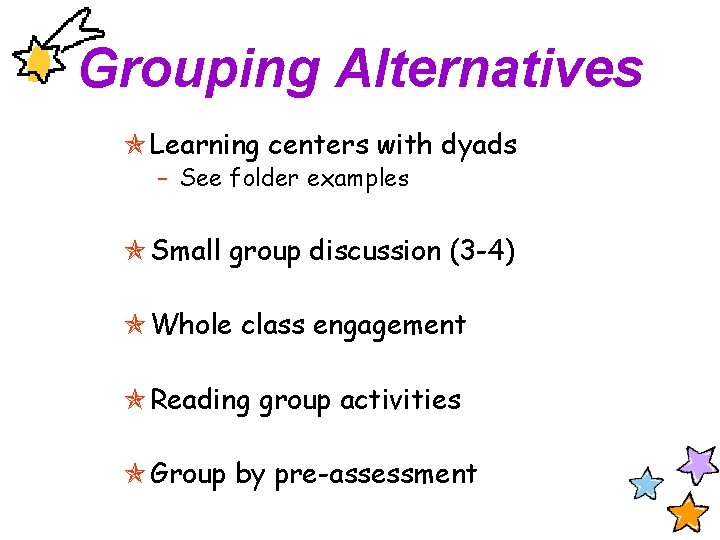
Grouping Alternatives Learning centers with dyads – See folder examples Small group discussion (3 -4) Whole class engagement Reading group activities Group by pre-assessment
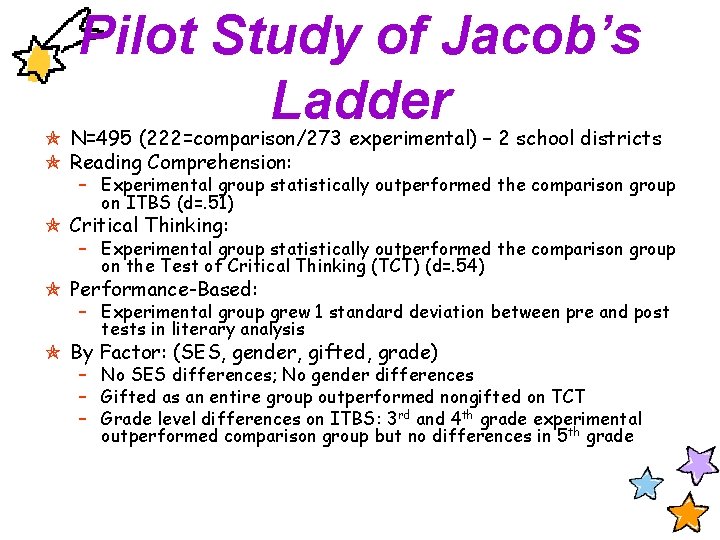
Pilot Study of Jacob’s Ladder N=495 (222=comparison/273 experimental) – 2 school districts Reading Comprehension: – Experimental group statistically outperformed the comparison group on ITBS (d=. 51) Critical Thinking: – Experimental group statistically outperformed the comparison group on the Test of Critical Thinking (TCT) (d=. 54) Performance-Based: – Experimental group grew 1 standard deviation between pre and post tests in literary analysis By Factor: (SES, gender, gifted, grade) – No SES differences; No gender differences – Gifted as an entire group outperformed nongifted on TCT – Grade level differences on ITBS: 3 rd and 4 th grade experimental outperformed comparison group but no differences in 5 th grade
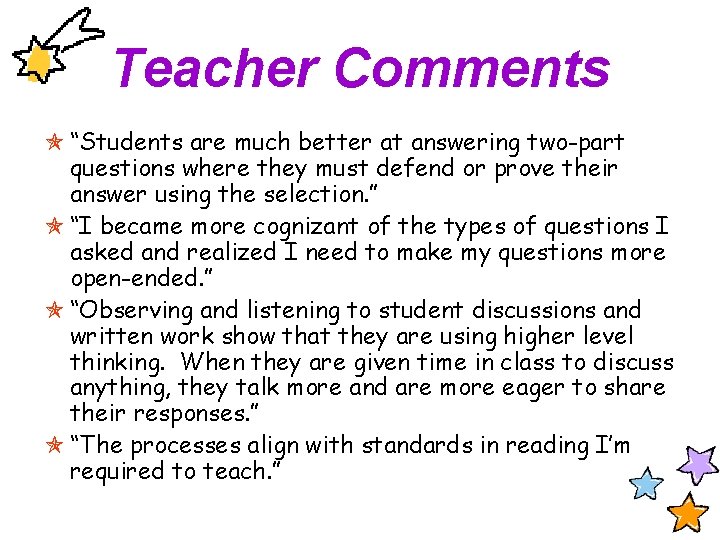
Teacher Comments “Students are much better at answering two-part questions where they must defend or prove their answer using the selection. ” “I became more cognizant of the types of questions I asked and realized I need to make my questions more open-ended. ” “Observing and listening to student discussions and written work show that they are using higher level thinking. When they are given time in class to discuss anything, they talk more and are more eager to share their responses. ” “The processes align with standards in reading I’m required to teach. ”
Quote The most important outcome of education is to help students become independent of formal education. -- Paul E. Gray
- Slides: 55