
Jacob and Esau Jacob and Esau When Isaac

Jacob and Esau
Jacob and Esau: • When Isaac was sixty years old, twin sons were born. • The first one to be born was named "Esau" which means "hairy. " • The younger one reached out and took hold of Esau's heel, and therefore, was named "Jacob" which means "supplanter. "
Jacob and Esau: • Later Jacob showed that he was well named for his character was subtle and he proved to be a deceiver. • In spite of Jacob's deceptive nature, God loved him.
Jacob and Esau: • God loved Jacob and hated Esau. • This is clearly stated in Scripture. • "As it is written, Jacob have I loved, but Esau have I hated" (Romans 9: 13). • Why was this?
Jacob and Esau: • God is no respecter of persons (Acts 10: 34). • There must be a reason why God hated Esau but loved Jacob. • The reason may be stated thus: Esau did not know the value of spiritual and eternal blessings and lived wholly for the natural; Jacob knew the value of eternal blessings.
Jacob and Esau: • Esau was carnally minded; Jacob was spiritually minded. • Esau was a cunning hunter and a man of the field. • Only two men are called "hunters" in the Scriptures: Nimrod and Esau.
Jacob and Esau: • That Esau is linked to Nimrod in this respect is quite significant. • "The field is the world" (Matthew 13: 38). • That Esau was a man of the field would tell us that he was a man of the world.
Jacob and Esau: • Jacob was a plain man dwelling in tents. • The word "plain" comes from the Hebrew word meaning, "perfect, upright. " • That Jacob dwelt in tents would speak of his spiritual nature signifying that he was only a pilgrim in this world.
The Birthright Sold By Esau: • "Thus Esau despised his birthright" (Genesis 25: 34). • The birthright was a most cherished possession. • It was a spiritual heritage and gave the right of being the priest of the family.
The Birthright Sold By Esau: • Esau is described as being a "profane" person (Hebrews 12: 16). • He was profane because he despised his birthright. • To him it was of little value. • Esau came from the field, hungry and faint.
The Birthright Sold By Esau: • He had hunted but returned empty-handed. • Such it always is in the world. • There is nothing in the world to meet man's spiritual needs and he always returns emptyhanded. • Esau was wholly concerned with the gratification of the appetites of the flesh.
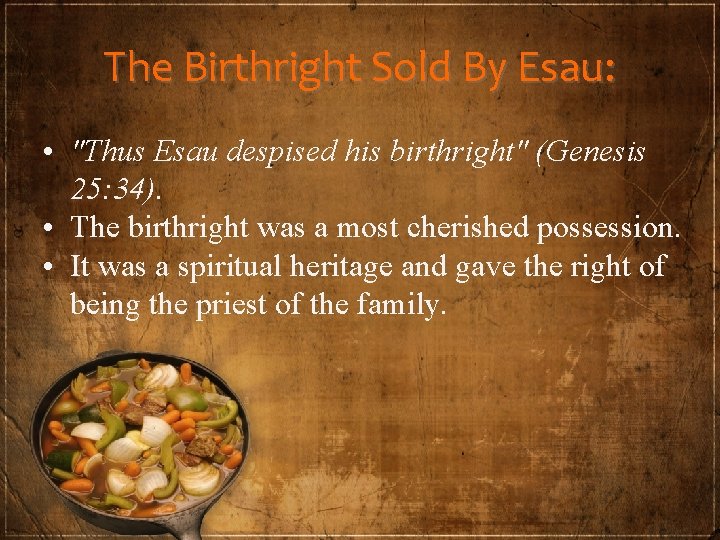
The Birthright Sold By Esau: • Jacob undoubtedly had been waiting for this opportunity and bought the birthright for one morsel of meat. • Esau thought he would die if he did not eat, but like Adam and Eve in the garden, he did die when he ate
The Deception of Rebekah and Jacob: • In Genesis chapter twenty-seven we read the story of how Jacob received the blessing by wrong means. • Sometimes people feel justified in using wrong means to gain a good end. • However, the end never justifies the means.
The Deception of Rebekah and Jacob: • Wrong is always wrong, and there is always a penalty to be paid. • In the story to be studied here, every member of the family was at fault. • Isaac was old and his eyes had begun to fail. • However, he was not near death for he lived forty more years.
The Deception of Rebekah and Jacob: • Because of his favoritism for Esau, he wanted Esau to have the blessing. • He was aware of God's will (Genesis 25: 23) but Isaac wanted to thwart God's plan. • Also Isaac loved the venison Esau brought him and he might have been partly motivated by his desire to have another good meal of venison.
The Deception of Rebekah and Jacob: • Undoubtedly he thought that if he blessed Esau, the matter would be taken care of. • Rebekah was a match for her husband. • She knew that she had to act quickly. • She influenced Jacob to enter into the act of deception.
The Deception of Rebekah and Jacob: • Jacob showed his true character. Instead of being shocked and refusing to sin, he is only concerned with what might be the terrible consequences. • When Rebekah assured him that she would take the curse if any and suffer the consequences, Jacob was quite willing to carry out the plot.
The Deception of Rebekah and Jacob: • In the blessing that was pronounced upon Jacob, he was made lord over his brother. • Anyone who cursed him would be cursed, and those who blessed him would be blessed. • When Isaac discovered the deception, he trembled very exceedingly (Genesis 27: 33).
The Deception of Rebekah and Jacob: • This was due to the fact that he knew he had been trying to overthrow God's plan, but that God had overruled and had not permitted it. • It certainly does not pay to fight against the will of God. • Esau's reaction was what could be expected.
The Deception of Rebekah and Jacob: • He was angry and keenly disappointed. • His plea for also a blessing was heart-rending and tragic. • "Esau lifted up his voice and wept" (Genesis 27: 38).
The Deception of Rebekah and Jacob: • Apparently now Esau had begun to learn the value of spiritual blessings but it was too late. • He could not change his father's mind, nor could he undo what he had done. Esau paid bitterly for his wrong. • Jacob also paid for his sin.
The Deception of Rebekah and Jacob: • He had deceived his father and he in turn was to be deceived and cheated by his Uncle Laban. • Rebekah also paid dearly. • She had led her favorite son into sin and suggested that Jacob should leave for Haran in order to escape Esau's anger.
Bethel: • Genesis chapter twenty- eight • Isaac blessed Jacob and sent him to Haran to find a wife. Both Isaac and Rebekah had been distressed because Esau had taken two heathen wives (Genesis 26: 35). • Rebekah Also had heard Esau threaten to kill Jacob as soon as Isaac died.
Bethel: • Therefore Rebekah influenced Isaac and they sent Jacob away. • Jacob was instructed to travel north to the land of Padan-aram where Haran was located that he might find a wife in his mother's family. • When night came on, Jacob lay down in the open to sleep.
Bethel: • He took some stones for his pillow. • He must have been weary, lonely and somewhat fearful. • Unlike Esau, he was not a man of the field. • This might have been his first experience of sleeping alone in the open.
Bethel: • Certainly Jacob was in a condition that he definitely needed help and encouragement. • During the night the Lord appeared to Jacob and spoke to him through a dream. • The ladder symbolized Jesus Christ in His dual nature, humanity and Deity.
Bethel: • The ladder was set up on the earth and reached to heaven. • This truth is stated in John 1: 51. • The Lord revealed Himself to Jacob and renewed the promise made to and Abraham Isaac concerning the land.
Bethel: • • • He then gave Jacob a four- fold assurance: I am with thee; I will keep thee; I will bring thee again to this land; I will not leave thee. This dream left a great impression upon Jacob.
Bethel: • He erects a memorial and changes the name of the place to "Bethel" which means "the house of God. " • He makes a vow to the Lord, which is typical to his character. • He bargains with God and enters into certain stipulations.
Bethel: • He lays down certain conditions for God to meet. • If these are met: The Lord shall be his God; This stone shall be God's house; He would tithe. • Although this was a wonderful spiritual experience, Jacob had still much to learn.
- Slides: 30