
Jack Mezirow Transformational Learning Isaiah Beekman 2014 Jack
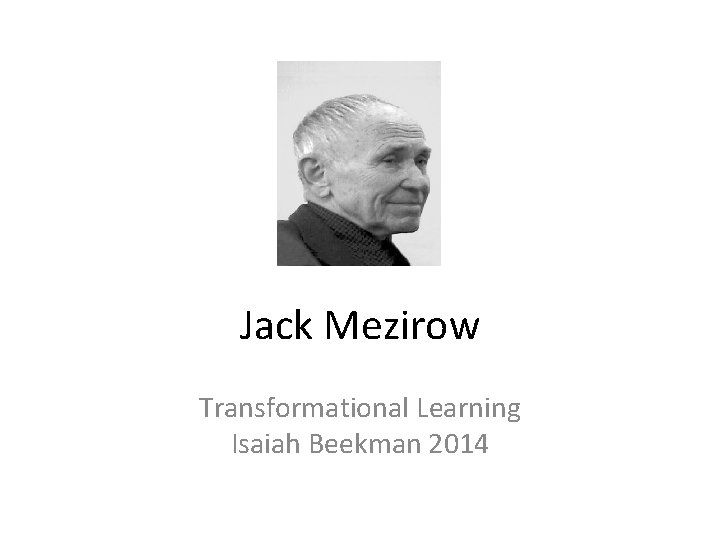
Jack Mezirow Transformational Learning Isaiah Beekman 2014
Jack Mezirow, A short bibliography: • He was born in 1927, and is an American sociologist and Emeritus Professor of Adult and Continuing Education at Teachers College, Columbia University. • Mezirow is influenced by Paulo Freire and Jürgen Habermas. • Mezirow is also widely acknowledged as the founder of the concept of transformative learning.
Knowledge: • One of his main areas of work on transformation learning has been the division of knowledge into three distinct categories: 1. Instrumental 2. Communicative 3. Emancipatory • Instrumental learning is the simple attainment of skills and knowledge.
• Communicative knowledge depends on students understanding the meaning of what is being communicated. • Emancipatory knowledge is much deeper and is based on the idea that everyone has the potential to break free from the limitations of their own situation to transform their own life. • “It ain’t what you do, it’s the way that you do it. . ”
Transformative Learning Theory: • Transformative learning is the process of effective change in a frame of reference. • Adults have acquired a coherent body of experience- associations, concepts, feelings, values, conditioned responses- frames of reference that define their world. Frames of reference are the structures of assumptions through which we understand our experiences.
• They selectively shape and define expectations, perceptions, cognition, and feelings. • According to this theory, they set our “line of action. ” Once set, we automatically move from one specific activity (mental or behavioral) to another. • We have a strong tendency to reject ideas that fail to fit our preconceptions, labeling those ideas as unworthy of consideration.
• When they are able to, transformative learners move toward a frame of reference that is more inclusive, discriminating, selfreflective, and integrative of experience. • The frame of mind includes conative, cognitive, and emotional components. It is made up of two components, habit of mind and point of view.
Habits of Mind • Habits of mind are broad, abstract, orienting, habitual ways of thinking, feeling, and acting influenced by a assumptions that make up a set of codes. • These codes can be cultural, educational, social, economic, political, or psychological. • Habits of mind shape a particular interpretation. • An example of a habit of mind would be ethnocentrism, the predisposition to regard anyone outside of one’s own group as inferior.
Point of View • Points of view are subject to continual change as we reflect on the way we process by which we solve problems and identify the need to modify previous assumptions. • Points of view allow us to try out another’s point of view and use it.
Transformational Learning • We transform our frames of reference through critical reflection on the assumptions upon which our beliefs, interpretations, and habits of mind or point of view are based. • Self-reflection can lead to significant personal transformations. • There are four processes of learning that Mezirow expands on within Transformational learning.
The four ways of learning (In regards to the ethnocentric example earlier) • 1. Elaborate on an existing point of view- We can seek further evidence to support our initial bias regarding a group, and expand the range of our point of views. • 2. Establish new points of view- This can be both positive and negative. If we encounter a new group we might create new negative meanings about them based on our inclination for ethnocentricity. • 3. Transform our point of view- We may have an experience in another culture that causes us to critically reflect on our misconception of this group. This can cause a change in our point of view. • 4. Become aware and critically reflective of our generalized bias. This type of transformation is less common. • We do not make transformative changes in the way we learn unless what we learn does not fit well in our existing frames of reference.
Facilitation of Transformative learning • To facilitate transformative learning, educators need to help learners become aware of their own and other’s assumptions. • Learners need to practice recognizing frames of reference and using their minds to redefine problems from a different perspective. • Learning with this theory is a social process because discourse is necessary to affirm what and how one learns.
• According to Mezirow in order for effective discourse to occur the educator must provide full information to those participating, and that they have equal opportunity to take on different roles of discourse. • For the transformative learning to have meaning, the learner must incorporate new information into their already well-developed frame of reference. • The learner may also need help in transforming their frame of reference.
• Educators need to assume responsibility for setting objectives that include autonomous thinking. This requires experiences designed to foster critically reflectivity and experience through discourse. • The educator needs to frame questions at the learners current level of understanding in order to facilitate learning. • Transformative learning requires that the learner critically reflect on experience in order to frame a new point of view and frame of mind.
• Transformational learning tries to foster selfdirected learning. To do this educators must create an environment in which learners become increasingly good at learning from each other and helping each other in problemsolving groups.
Conclusion • One of the goals of transformative learning is to help the individual become a more autonomous thinker by learning to convey their values, meanings, and purposes rather than uncritically act on others.
Bibliography: • http: //www. esludwig. com/uploads/2/6/1/0/2 6105457/transformative-learning-mezirow 1997. pdf • http: //en. wikipedia. org/wiki/Jack_Mezirow • http: //annwalkerwea. wordpress. com/2013/0 3/05/educational-thinkers-hall-of-fame-jackmezirow-and-transformation-theory/
- Slides: 17