
J Stefan Institute NMR of Demixing and Phase

- Slides: 35
J. Stefan Institute NMR of Demixing and Phase Separation in Liquid Crystals Boštjan ZALAR Andrija LEBAR Blaž ZUPANČIČ Slobodan ŽUMER Daniele FINOTELLO
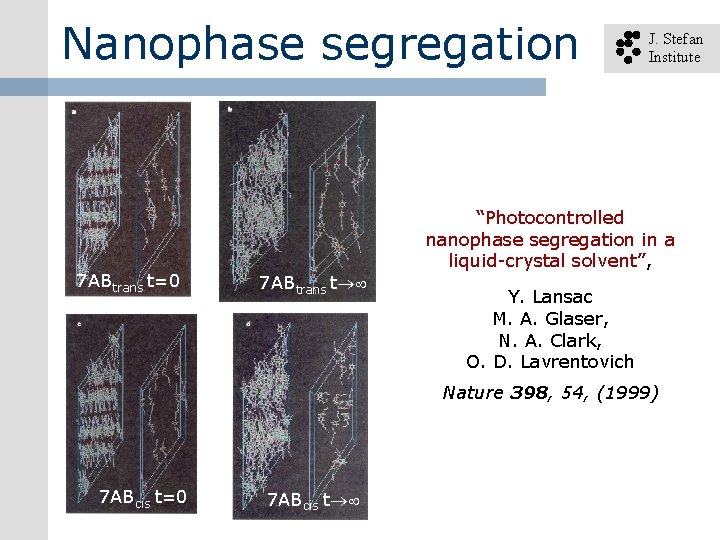
Nanophase segregation 7 ABtrans t=0 J. Stefan Institute “Photocontrolled nanophase segregation in a liquid-crystal solvent”, 7 ABtrans t Y. Lansac M. A. Glaser, N. A. Clark, O. D. Lavrentovich Nature 398, 54, (1999) 7 ABcis t=0 7 ABcis t
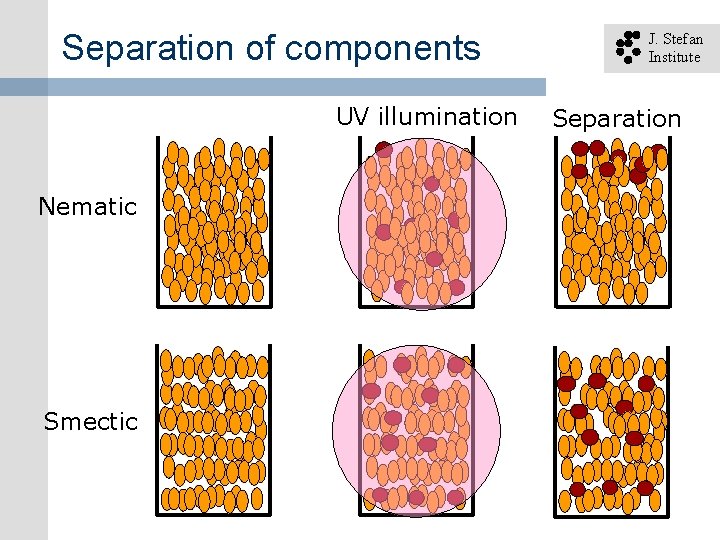
Separation of components UV illumination Nematic Smectic J. Stefan Institute Separation
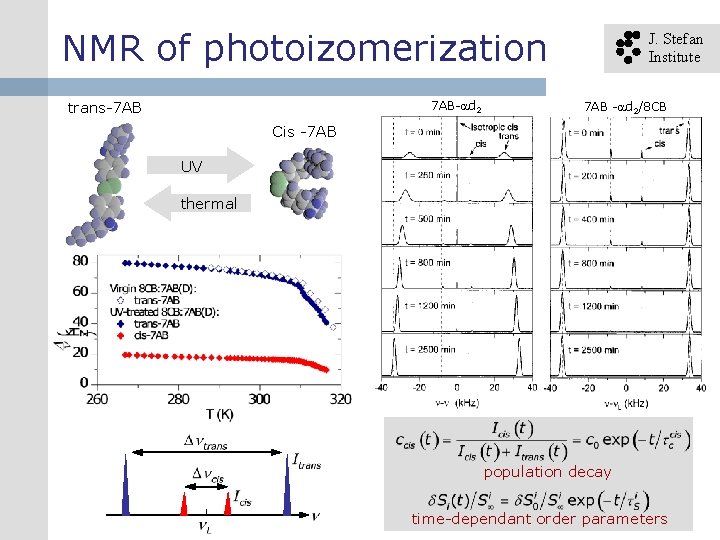
NMR of photoizomerization trans-7 AB 7 AB- d 2 J. Stefan Institute 7 AB - d 2/8 CB Cis -7 AB UV thermal population decay time-dependant order parameters
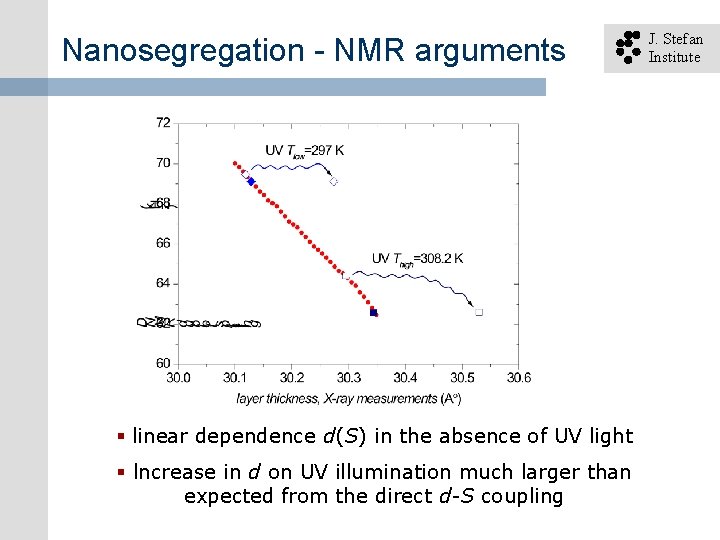
Nanosegregation - NMR arguments § linear dependence d(S) in the absence of UV light § lncrease in d on UV illumination much larger than expected from the direct d-S coupling J. Stefan Institute
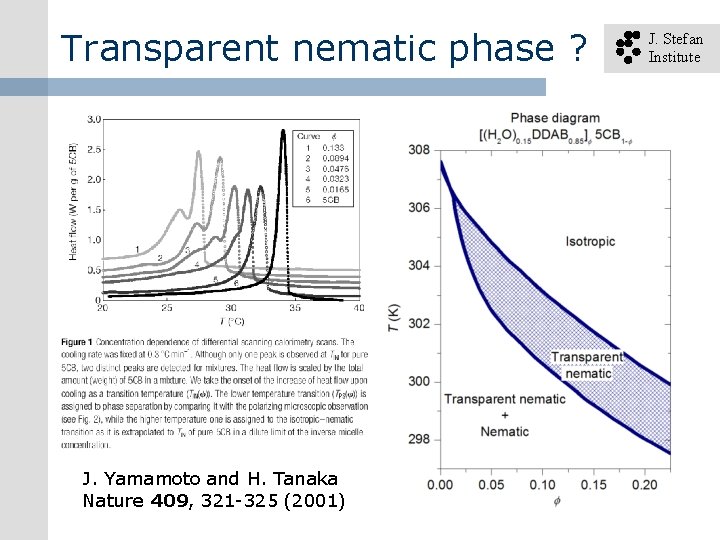
Transparent nematic phase ? J. Yamamoto and H. Tanaka Nature 409, 321 -325 (2001) J. Stefan Institute
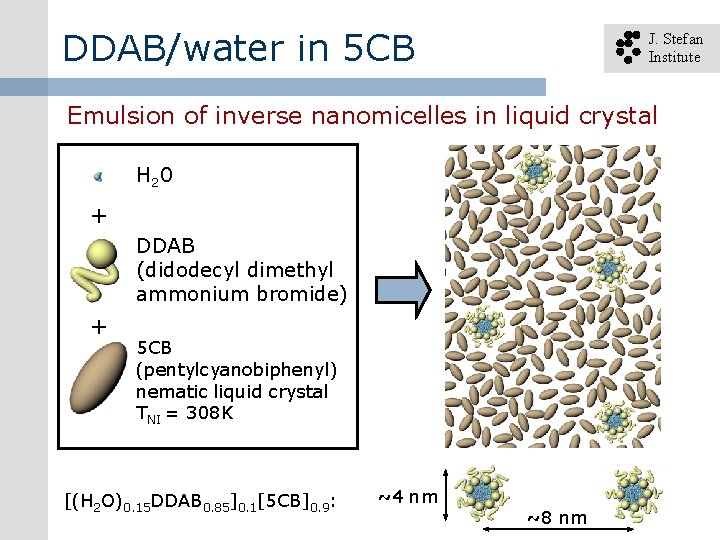
DDAB/water in 5 CB J. Stefan Institute Emulsion of inverse nanomicelles in liquid crystal H 20 + DDAB (didodecyl dimethyl ammonium bromide) + 5 CB (pentylcyanobiphenyl) nematic liquid crystal TNI = 308 K [(H 2 O)0. 15 DDAB 0. 85]0. 1[5 CB]0. 9: ~4 nm ~8 nm
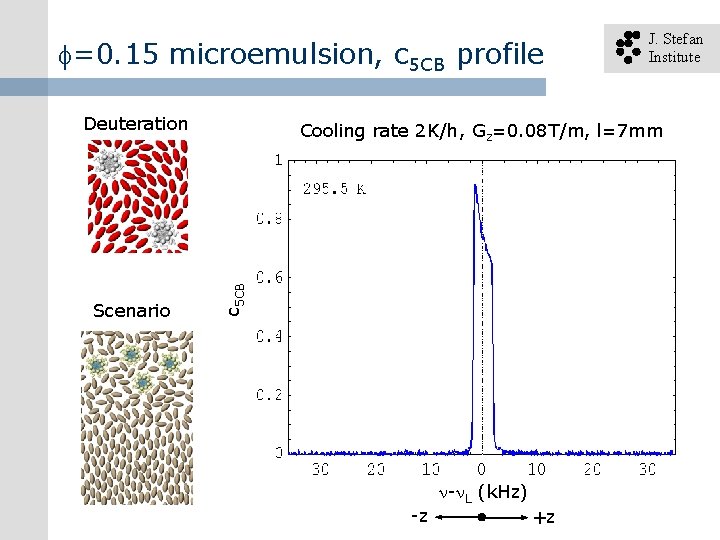
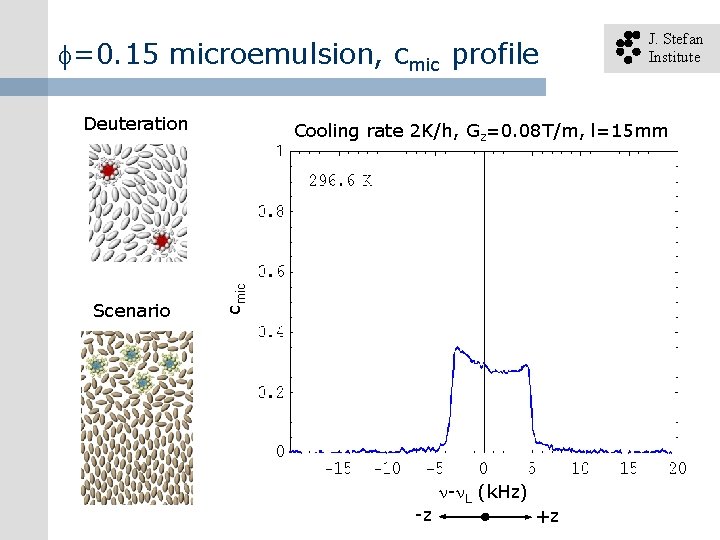
Microemulsion behavior J. Stefan Institute Irreversible seggregation of components Top: micelle-rich region Bottom: micelle-poor region
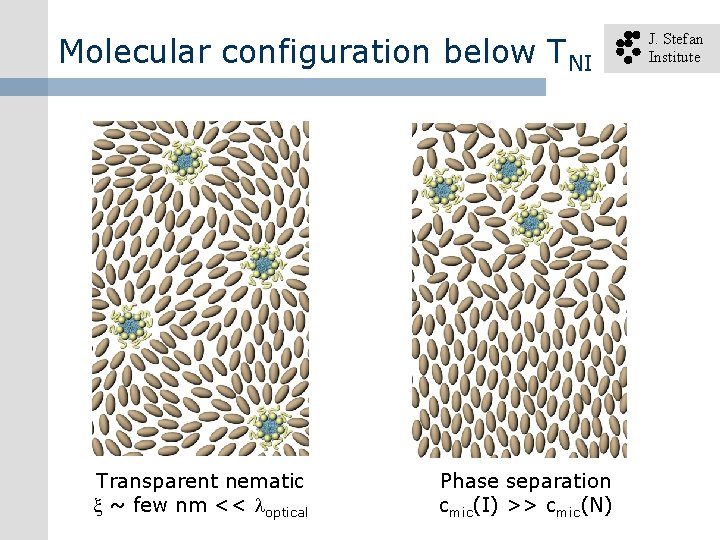
Molecular configuration below TNI Transparent nematic ~ few nm << optical Phase separation cmic(I) >> cmic(N) J. Stefan Institute
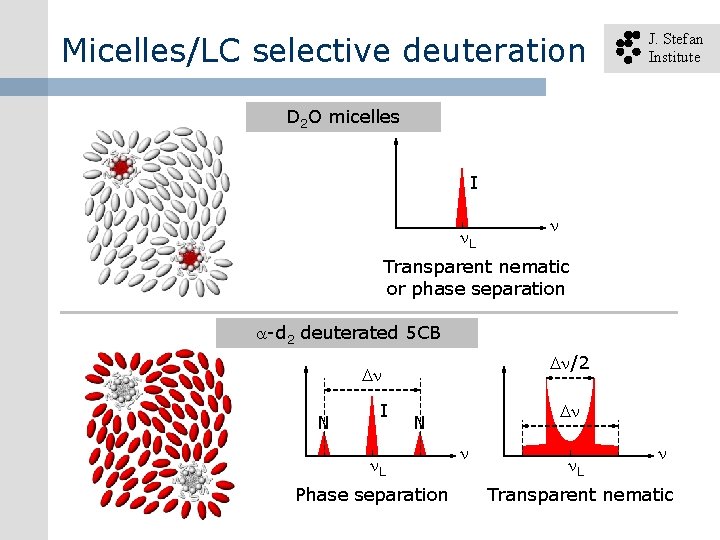
Micelles/LC selective deuteration J. Stefan Institute D 2 O micelles I L Transparent nematic or phase separation -d 2 deuterated 5 CB /2 N I N L Phase separation L Transparent nematic
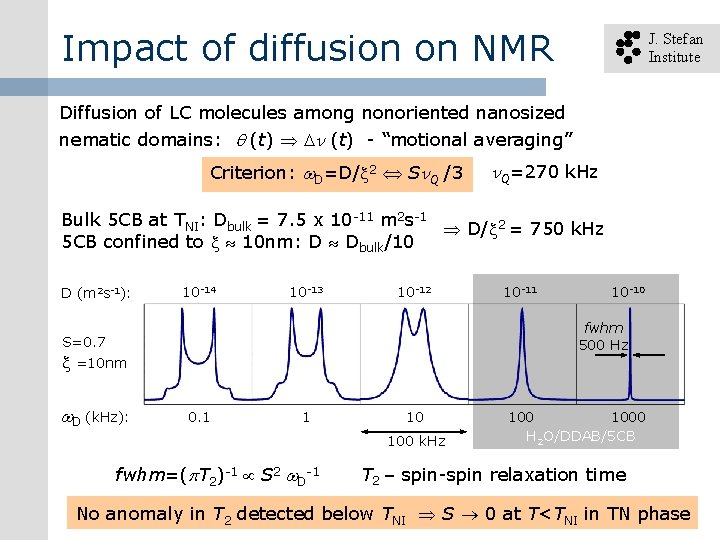
Impact of diffusion on NMR J. Stefan Institute Diffusion of LC molecules among nonoriented nanosized nematic domains: (t) - “motional averaging” Criterion: D=D/ 2 S Q /3 Q=270 k. Hz Bulk 5 CB at TNI: Dbulk = 7. 5 x 10 -11 m 2 s-1 D/ 2 = 750 k. Hz 5 CB confined to 10 nm: D Dbulk/10 D (m 2 s-1): 10 -14 10 -13 10 -12 10 -10 fwhm 500 Hz S=0. 7 =10 nm D (k. Hz): 10 -11 0. 1 1 10 100 k. Hz fwhm=( T 2)-1 S 2 D-1 1000 100 H 2 O/DDAB/5 CB T 2 – spin-spin relaxation time No anomaly in T 2 detected below TNI S 0 at T<TNI in TN phase
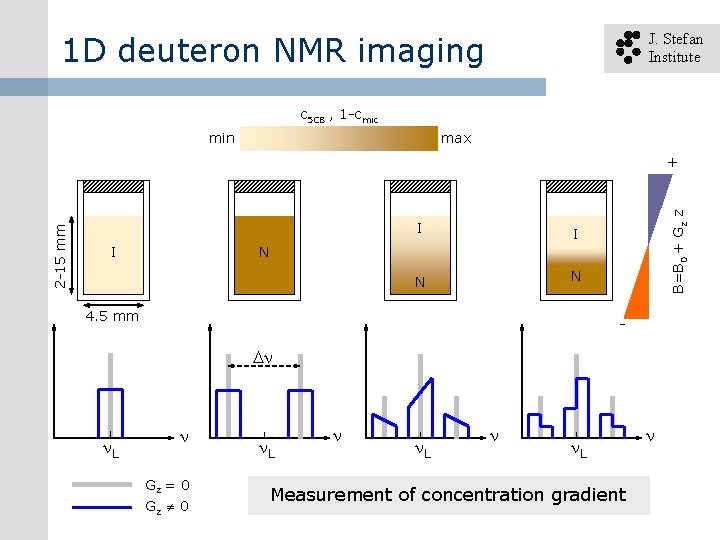
1 D deuteron NMR imaging J. Stefan Institute c 5 CB , 1 -cmic min max I I I N N B=B 0 + Gz z 2 -15 mm + N 4. 5 mm - L Gz = 0 Gz 0 L L L Measurement of concentration gradient
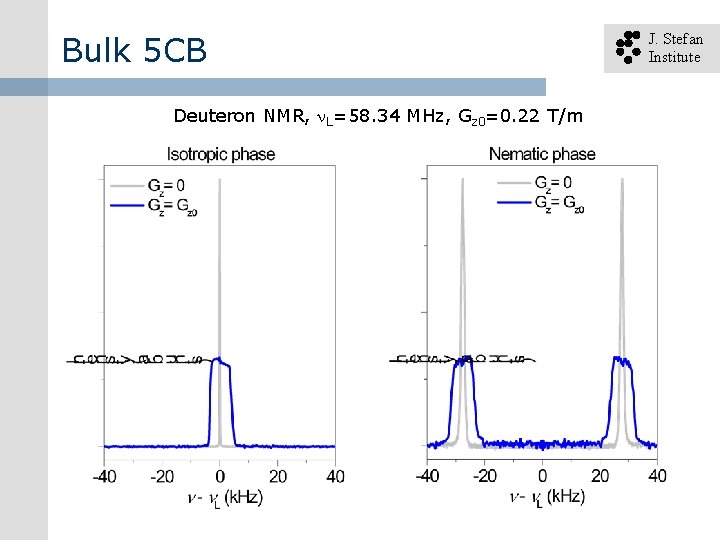
Bulk 5 CB Deuteron NMR, L=58. 34 MHz, Gz 0=0. 22 T/m J. Stefan Institute
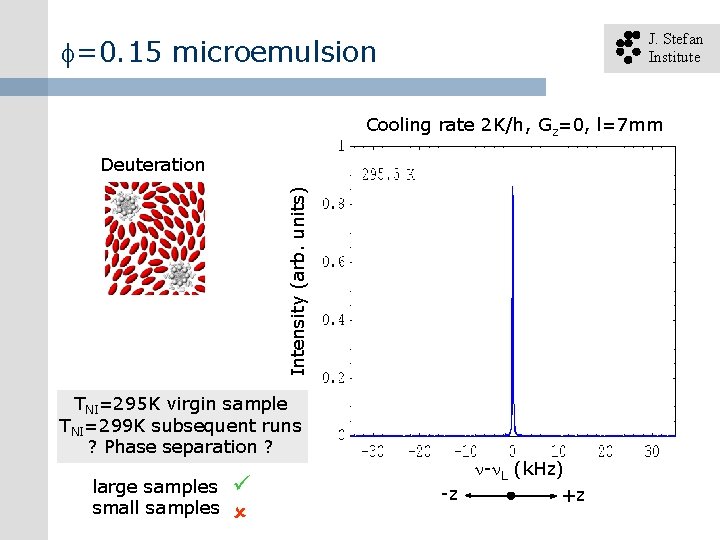
J. Stefan Institute =0. 15 microemulsion Cooling rate 2 K/h, Gz=0, l=7 mm Intensity (arb. units) Deuteration TNI=295 K virgin sample TNI=299 K subsequent runs ? Phase separation ? large samples small samples - L (k. Hz) -z +z
=0. 15 microemulsion, c 5 CB profile Deuteration Cooling rate 2 K/h, Gz=0. 08 T/m, l=7 mm c 5 CB Scenario J. Stefan Institute -z - L (k. Hz) +z
=0. 15 microemulsion, cmic profile Deuteration Cooling rate 2 K/h, Gz=0. 08 T/m, l=15 mm cmic Scenario J. Stefan Institute -z - L (k. Hz) +z
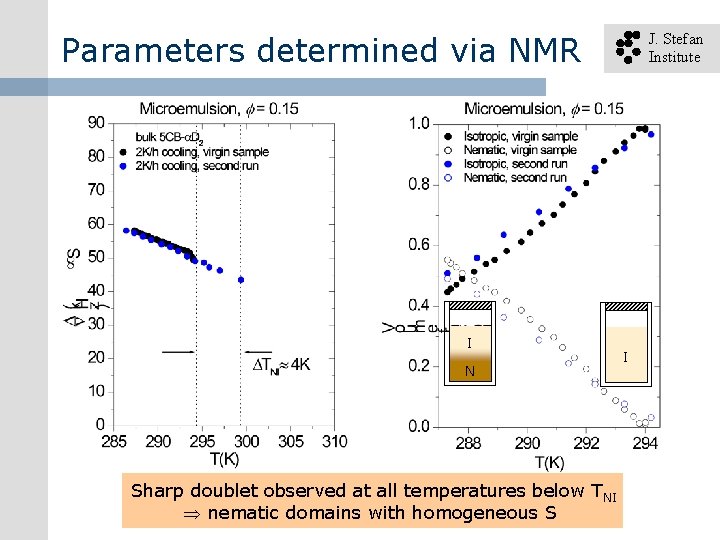
Parameters determined via NMR I N Sharp doublet observed at all temperatures below TNI nematic domains with homogeneous S J. Stefan Institute I
Microemulsions-conclusions n J. Stefan Institute phase separation of inverse micelles n nematic phase (almost pure nematogen) coexists with micelle-rich isotropic phase gravity-driven global phase separation in bulk samples transparent nematic phase not detected
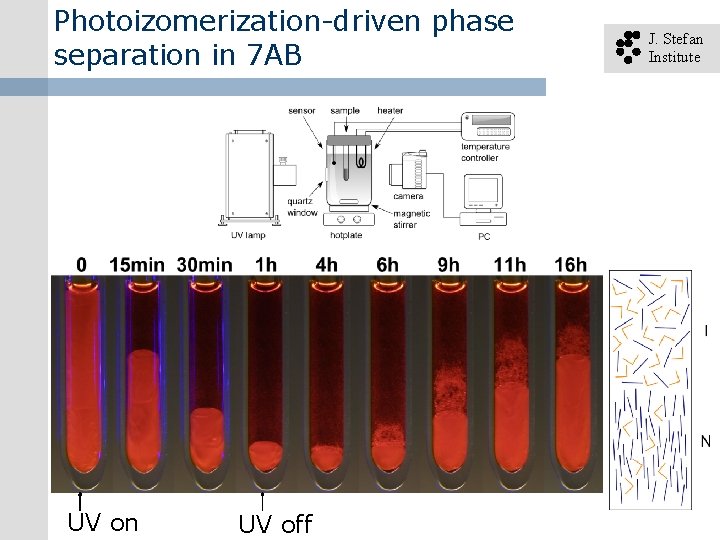
Photoizomerization-driven phase separation in 7 AB UV on UV off J. Stefan Institute
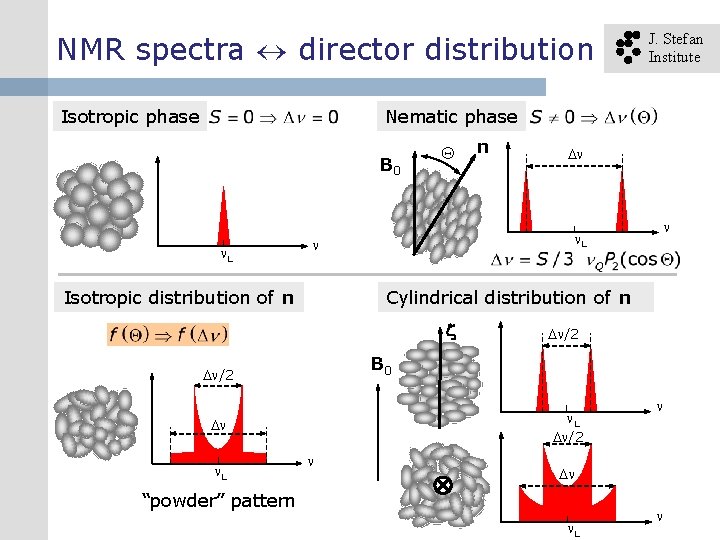
NMR spectra director distribution Isotropic phase J. Stefan Institute Nematic phase B 0 L Cylindrical distribution of n Isotropic distribution of n /2 B 0 /2 L /2 L n “powder” pattern L
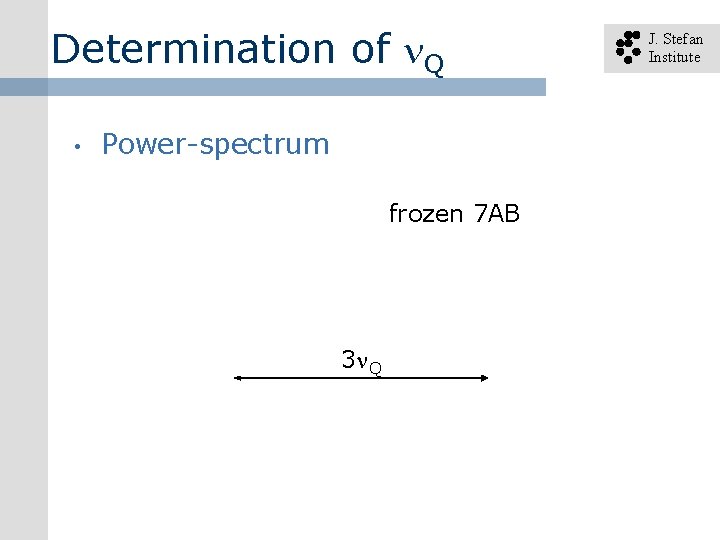
Determination of Q • Power-spectrum frozen 7 AB 3 Q J. Stefan Institute
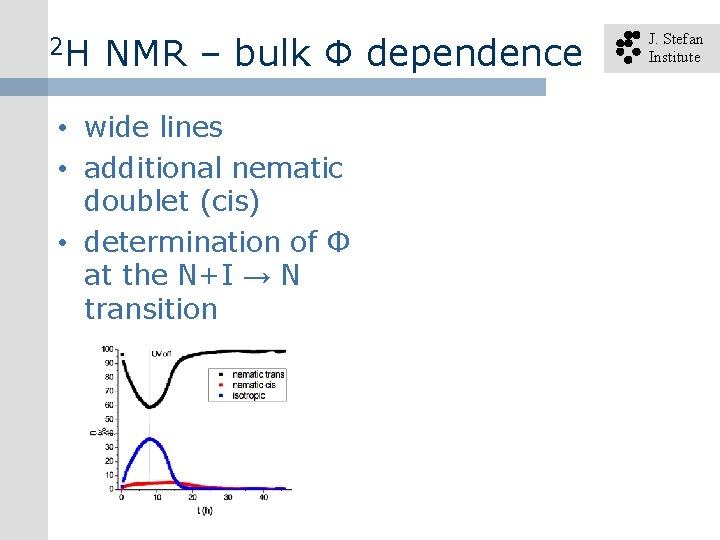
2 H NMR – bulk Φ dependence • wide lines • additional nematic doublet (cis) • determination of Φ at the N+I → N transition J. Stefan Institute
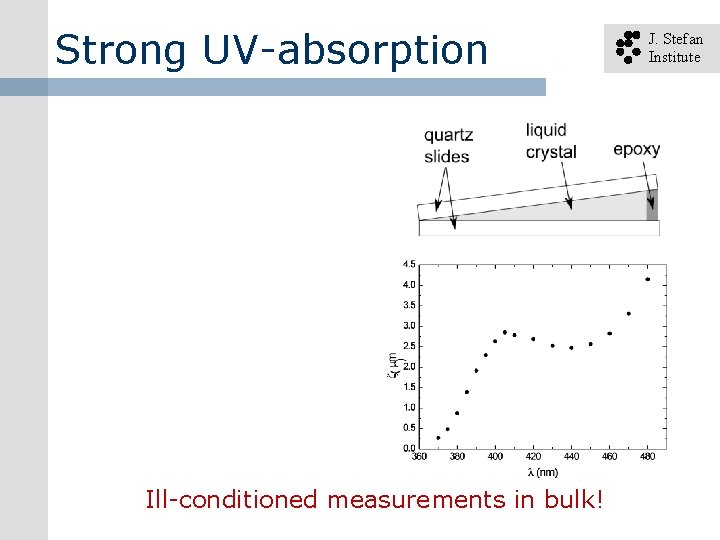
Strong UV-absorption Ill-conditioned measurements in bulk! J. Stefan Institute
NMR in Anopore-confined system • optimal photoisomerization – – – • thin flat samples (60 μm) uniform illumination homogeneous sample large surface-to-volume ratio – • J. Stefan Institute resolvable surface-ordering effects angular dependence – determination of director configuration
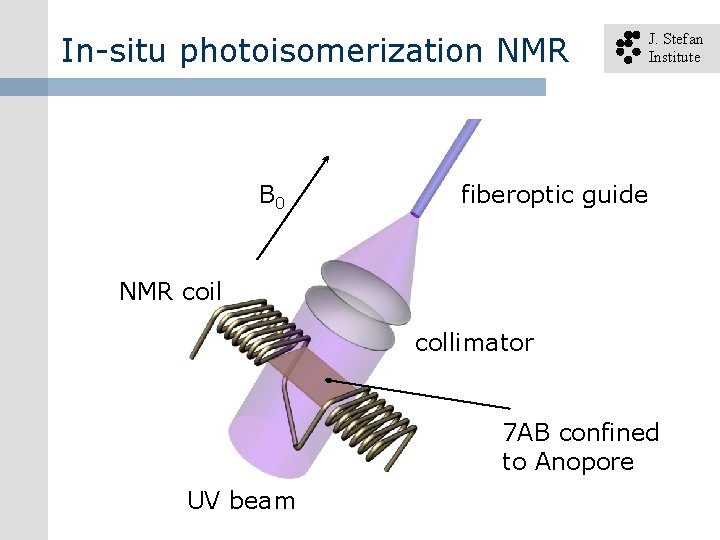
In-situ photoisomerization NMR B 0 J. Stefan Institute fiberoptic guide NMR coil collimator 7 AB confined to Anopore UV beam
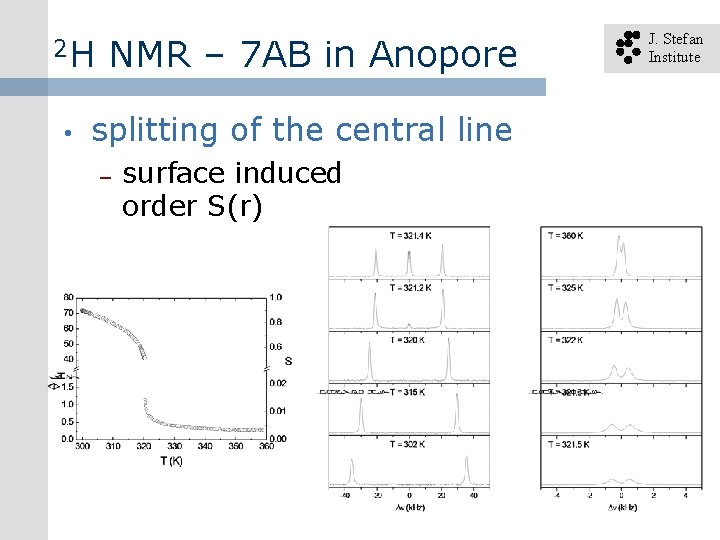
2 H • NMR – 7 AB in Anopore splitting of the central line – surface induced order S(r) J. Stefan Institute
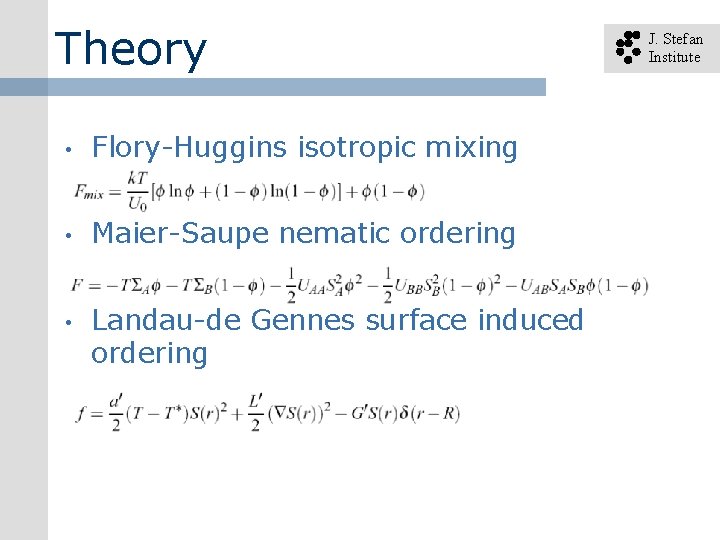
Theory • Flory-Huggins isotropic mixing • Maier-Saupe nematic ordering • Landau-de Gennes surface induced ordering J. Stefan Institute
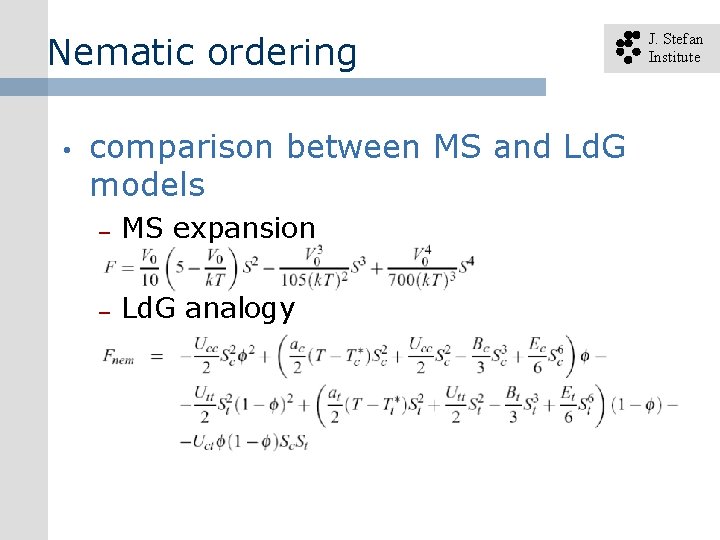
Nematic ordering • comparison between MS and Ld. G models – MS expansion – Ld. G analogy J. Stefan Institute
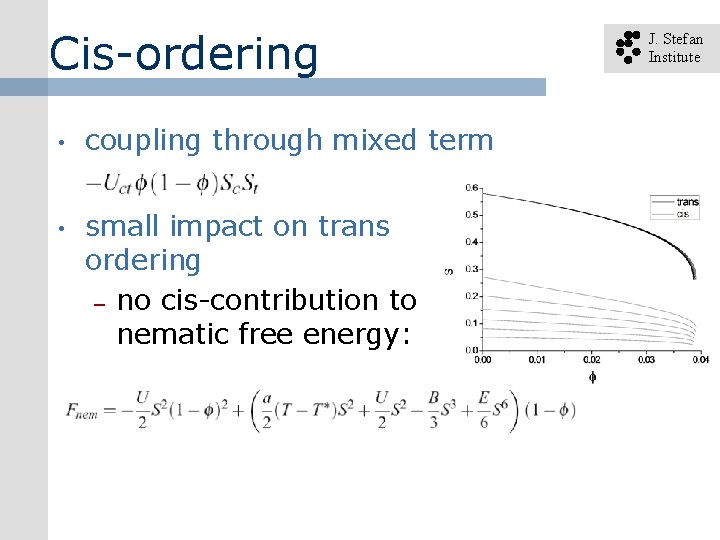
Cis-ordering • coupling through mixed term • small impact on trans ordering – no cis-contribution to nematic free energy: J. Stefan Institute
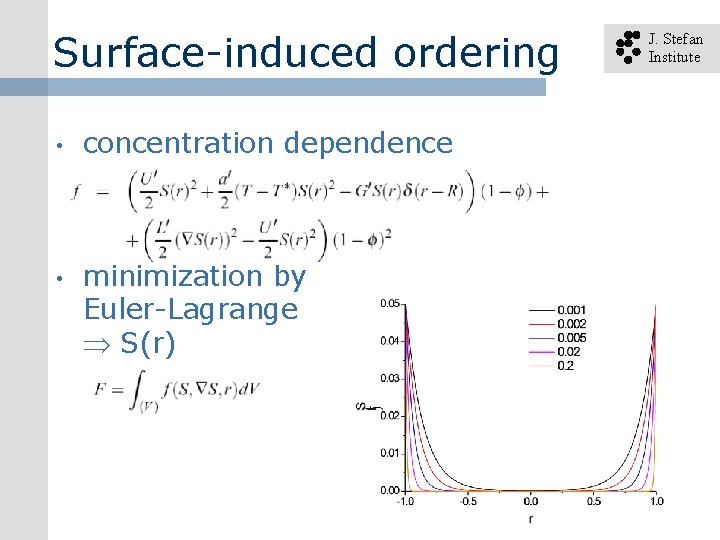
Surface-induced ordering • concentration dependence • minimization by Euler-Lagrange S(r) J. Stefan Institute
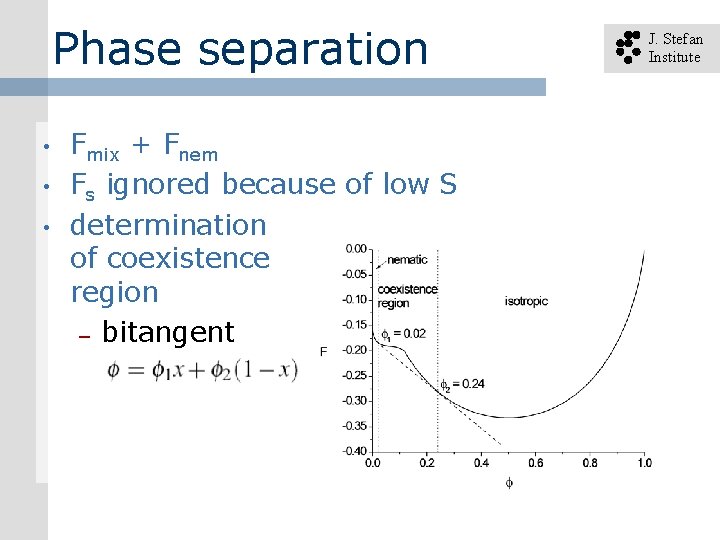
Phase separation • • • Fmix + Fnem Fs ignored because of low S determination of coexistence region – bitangent J. Stefan Institute
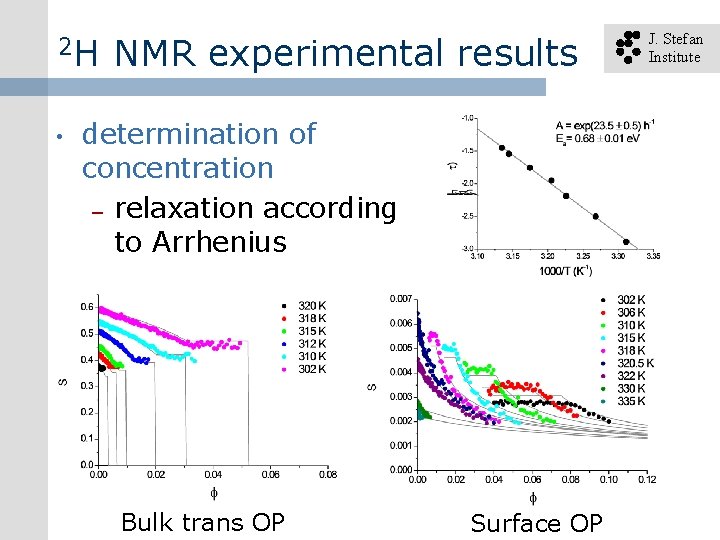
2 H • NMR experimental results determination of concentration – relaxation according to Arrhenius Bulk trans OP Surface OP J. Stefan Institute
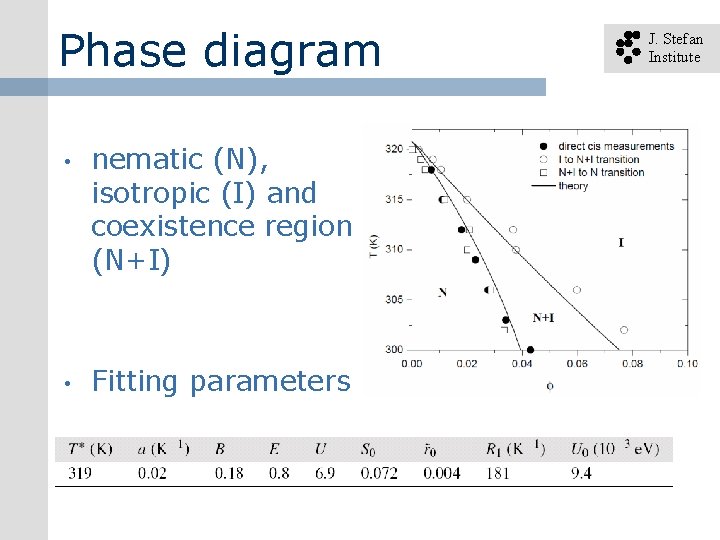
Phase diagram • nematic (N), isotropic (I) and coexistence region (N+I) • Fitting parameters J. Stefan Institute
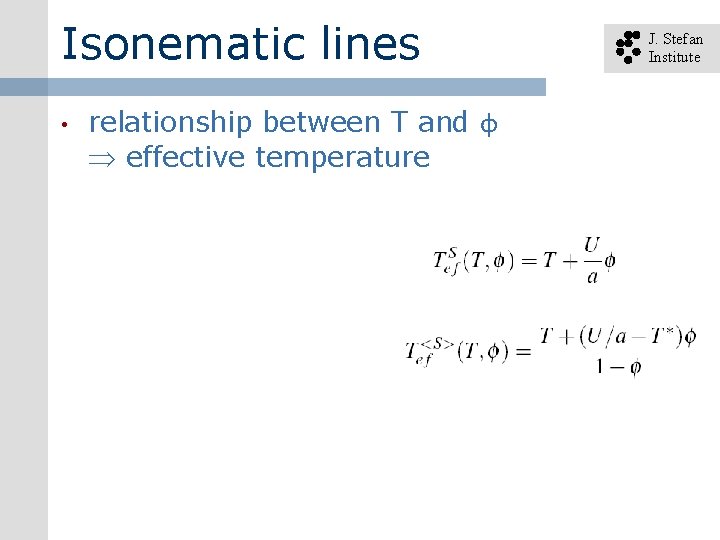
Isonematic lines • relationship between T and φ effective temperature J. Stefan Institute
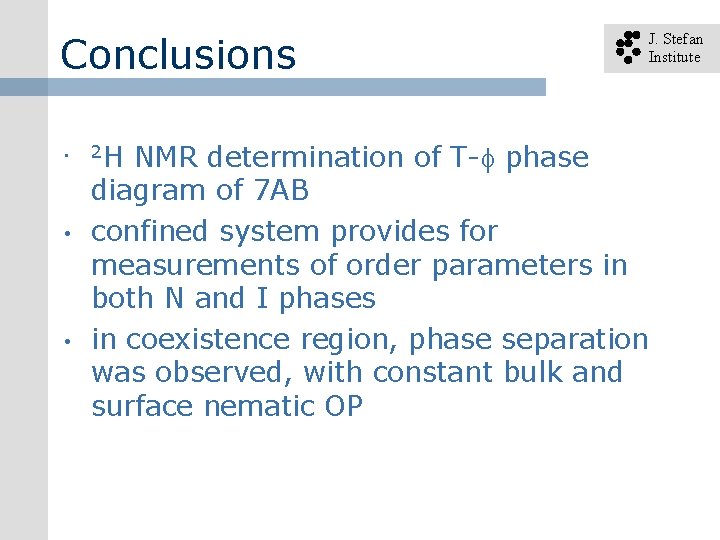
Conclusions • • • 2 H J. Stefan Institute NMR determination of T- phase diagram of 7 AB confined system provides for measurements of order parameters in both N and I phases in coexistence region, phase separation was observed, with constant bulk and surface nematic OP