
J 27 Medical High Observation Area Criteria For
J 27 Medical High Observation Area Criteria For 6 Beds
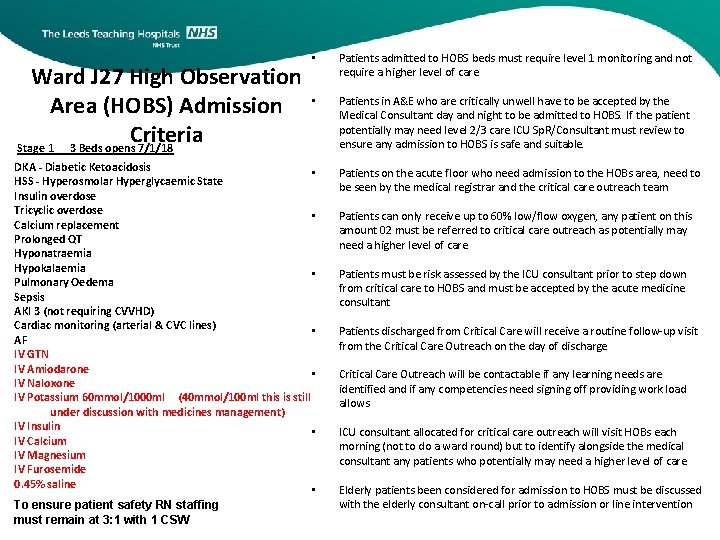
Ward J 27 High Observation Area (HOBS) Admission Criteria Stage 1 3 Beds opens 7/1/18 • Patients admitted to HOBS beds must require level 1 monitoring and not require a higher level of care. • Patients in A&E who are critically unwell have to be accepted by the Medical Consultant day and night to be admitted to HOBS. If the patient potentially may need level 2/3 care ICU Sp. R/Consultant must review to ensure any admission to HOBS is safe and suitable. DKA - Diabetic Ketoacidosis • HSS - Hyperosmolar Hyperglycaemic State Insulin overdose Tricyclic overdose • Calcium replacement Prolonged QT Hyponatraemia Hypokalaemia • Pulmonary Oedema Sepsis AKI 3 (not requiring CVVHD) Cardiac monitoring (arterial & CVC lines) • AF IV GTN IV Amiodarone • IV Naloxone IV Potassium 60 mmol/1000 ml (40 mmol/100 ml this is still under discussion with medicines management) IV Insulin • IV Calcium IV Magnesium IV Furosemide 0. 45% saline • To ensure patient safety RN staffing must remain at 3: 1 with 1 CSW Patients on the acute floor who need admission to the HOBs area, need to be seen by the medical registrar and the critical care outreach team Patients can only receive up to 60% low/flow oxygen, any patient on this amount 02 must be referred to critical care outreach as potentially may need a higher level of care Patients must be risk assessed by the ICU consultant prior to step down from critical care to HOBS and must be accepted by the acute medicine consultant Patients discharged from Critical Care will receive a routine follow-up visit from the Critical Care Outreach on the day of discharge Critical Care Outreach will be contactable if any learning needs are identified and if any competencies need signing off providing work load allows ICU consultant allocated for critical care outreach will visit HOBs each morning (not to do a ward round) but to identify alongside the medical consultant any patients who potentially may need a higher level of care Elderly patients been considered for admission to HOBS must be discussed with the elderly consultant on-call prior to admission or line intervention
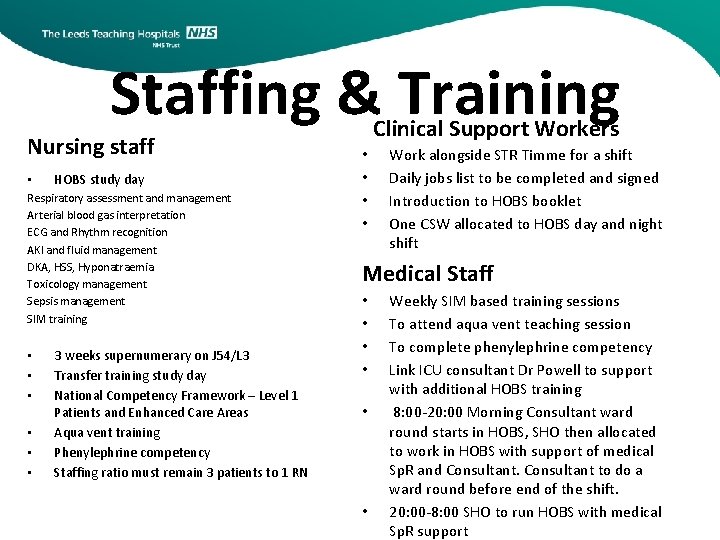
Staffing & Training Nursing staff • HOBS study day Respiratory assessment and management Arterial blood gas interpretation ECG and Rhythm recognition AKI and fluid management DKA, HSS, Hyponatraemia Toxicology management Sepsis management SIM training • • • 3 weeks supernumerary on J 54/L 3 Transfer training study day National Competency Framework – Level 1 Patients and Enhanced Care Areas Aqua vent training Phenylephrine competency Staffing ratio must remain 3 patients to 1 RN Clinical Support Workers • • Work alongside STR Timme for a shift Daily jobs list to be completed and signed Introduction to HOBS booklet One CSW allocated to HOBS day and night shift Medical Staff • • • Weekly SIM based training sessions To attend aqua vent teaching session To complete phenylephrine competency Link ICU consultant Dr Powell to support with additional HOBS training 8: 00 -20: 00 Morning Consultant ward round starts in HOBS, SHO then allocated to work in HOBS with support of medical Sp. R and Consultant to do a ward round before end of the shift. 20: 00 -8: 00 SHO to run HOBS with medical Sp. R support
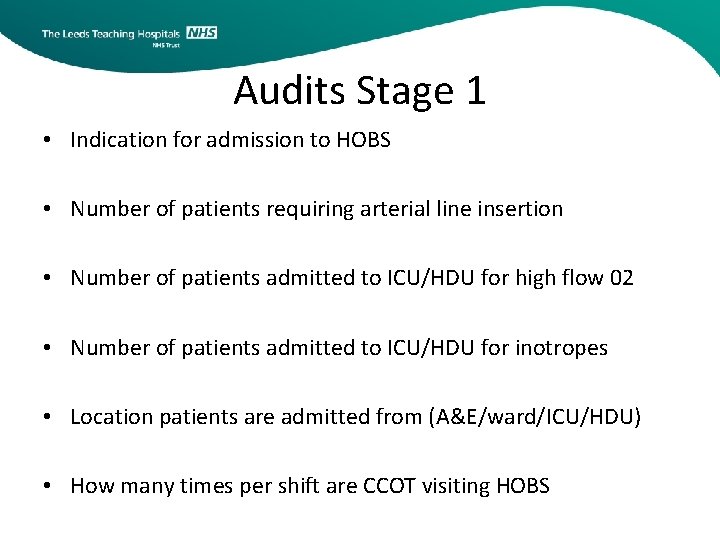
Audits Stage 1 • Indication for admission to HOBS • Number of patients requiring arterial line insertion • Number of patients admitted to ICU/HDU for high flow 02 • Number of patients admitted to ICU/HDU for inotropes • Location patients are admitted from (A&E/ward/ICU/HDU) • How many times per shift are CCOT visiting HOBS
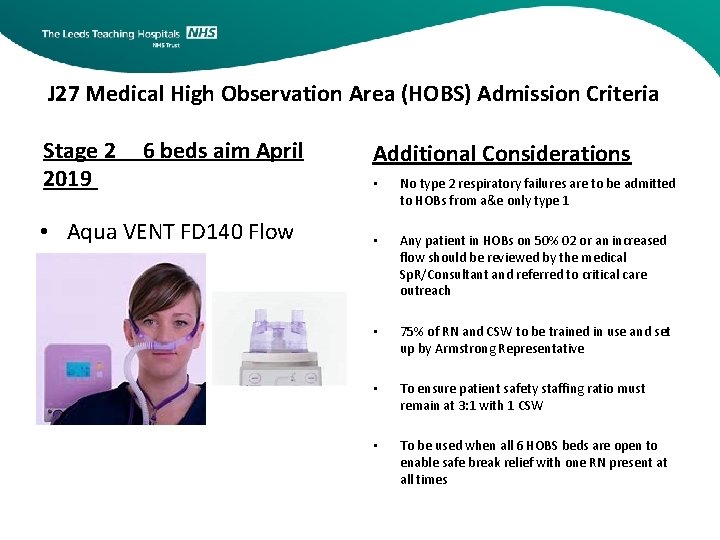
J 27 Medical High Observation Area (HOBS) Admission Criteria Stage 2 2019 6 beds aim April • Aqua VENT FD 140 Flow Driver Additional Considerations • No type 2 respiratory failures are to be admitted to HOBs from a&e only type 1 • Any patient in HOBs on 50% 02 or an increased flow should be reviewed by the medical Sp. R/Consultant and referred to critical care outreach • 75% of RN and CSW to be trained in use and set up by Armstrong Representative • To ensure patient safety staffing ratio must remain at 3: 1 with 1 CSW • To be used when all 6 HOBS beds are open to enable safe break relief with one RN present at all times
J 27 Medical High Observation Area (HOBS) Admission Criteria Stage 3 6 beds aim December 2019 • Phenylephrine 10 mg/100 ml Additional Considerations • • • Phenylephrine (Low dose 0 - 1 mcg/kg/min / high dose up to 10 mcg/kg/min) This agent is a pure alpha agonist which vasoconstricts several important vascular beds including the renal and mesenteric vessels. Phenylephrine is normally used at lower doses only and converted to noradrenaline if the BP response is inadequate or longer term treatment necessary. Unlike other vasopressors there is a good record of safe peripheral administration so long as treatment is not prolonged (>24 hrs), a larger vein is used, and it is well diluted (not >10 mg/100 m. L). If > 24 hours to review can the phenylephrine be weaned or does the patient require a CVP line and noradrenaline • • Any patient receiving inotropes will be reviewed daily by critical care outreach Decisions to commence phenylephrine will be the medical Sp. R/Consultant or the critical care team All RGNs and doctors will have additional training to be able to manage phenylephrine and complete a competency package To ensure patient safety RN staffing must remain at 3: 1 with 1 CSW All patients on phenylephrine will have an arterial line To be used when all 6 HOBS beds are open to enable safe break relief with one RGN present at all times
- Slides: 6