
J 2 EE Design patterns Sharath Sahadevan August
- Slides: 35
J 2 EE Design patterns Sharath Sahadevan August 8 , 2002 St Louis Java SIG
Design Patterns ? • What are Design Patterns ?
Design Patterns ? • “Design Patterns capture solutions that have developed and evolved over time. They reflect untold redesign and recoding as developers have struggled for greater reuse and flexibility in their software. ”- GOF in Design Patterns - Elements of Reusable Object Oriented Software.
Why study patterns ? • Develop better products. • Learn from others experience. • Improve communication with others in the same field. • Don’t reinvent the wheel.
Brief History of Patterns • In 1970, Christopher Alexander documented patterns in Civil Engineering and architecture • Software design patterns popularized by GOF ( Gang of Four )
J 2 EE • Java 2 Platform , Enterprise Edition • Provides a unified platform for developing distributed , server-centric applications.
J 2 EE Patterns · Front Controller · View Helper · Dispatcher View · Service To Worker · Intercepting Filter
J 2 EE patterns · Service Locator · Session Façade · Message Facade · Business Delegate · Value Object
J 2 EE Patterns · Value List Handler · Primary key generation strategies · Data Access Object · Resource Adapter
Front Controller · Provides a centralized controller for managing the handling of a request. · The front controller will look at the request and forward it on to the right handler or jsp. · Good place to have the licensing and security code. · It can be either a jsp or servlet. Preferably a servlet. · Controller sequence diagram
Front Controller • Advantages · Promotes reuse of common code that is needed for all requests. · Promotes flexibility · Easier to maintain
Front Controller · Avoid fat controllers. · Do not restrict site to one controller. · Different subsystems could have their own controllers.
View Helper • View Helpers are Java beans or custom tags that are used to get the data that needs to be presented. • Do not use Servlets for views. • Improves reuse and maintainability. • Reduces scriptlet code. • View Helper sequence
Dispatcher View • Dispatcher is responsible for view management and navigation. • Can be encapsulated within a controller, a view or as a separate component. • Dispatcher view suggests deferring content retrieval to the time of view processing. • Dispatcher sequence
Service To Worker • Similar to dispatcher view , but the dispatcher is more sophisticated. • In Service To Worker the dispatcher will call upon a helper to determine the next view. • Controller takes on significant responsibility. It manages content retrieval , validation, authorization etc. • The data retrieved is stored in a value object for use by the view.
Intercepting Filter • Create Pluggable filters to process common services in a standard manner , without requiring changes to the core request. · Introduced in Servlet specification 2. 3 · Filters allow on the fly transformations of payload and header of both the request into a resource and the response from a resource. · Filters do not generally create a response or respond to a request as servlets do , rather they are used to modify the request or the response.
Intercepting filters · Related to the decorator ( GOF ) pattern · Front controller provides similar functionality , but is better suited to handling core processing. · Examples of filter use - authentication filters , logging & auditing , Image conversion , data compression , encryption …
Intercepting filter • How to write a filter ? · Implement the javax. servlet. Filter interface · Container will call the do. Filter() method. · The do. Filter method will modify the request or response and then call the next filter in the filter chain.
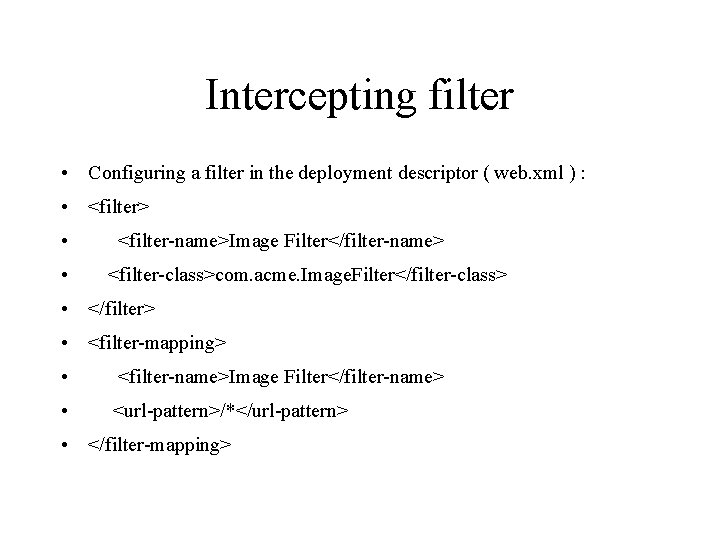
Intercepting filter • Configuring a filter in the deployment descriptor ( web. xml ) : • <filter> • • <filter-name>Image Filter</filter-name> <filter-class>com. acme. Image. Filter</filter-class> • </filter> • <filter-mapping> • <filter-name>Image Filter</filter-name> • <url-pattern>/*</url-pattern> • </filter-mapping>
Session Facade · A façade is usually provided to hide the underlying complexity from the client. · A session bean is used as a session façade to perform coarse grained functionality. · The session bean will probably interact with two or more entity beans. · A session façade combined with a Data Access Object can be used for read only data.
Session Facade • Advantages: · Improved transaction control · Exposes fewer remote interfaces to the client. · Improves performance by reducing the number of fine grained method calls from the client. • Session Façade sequence diagram
Message Facade • Use a message driven bean (MDB) for asynchronous communication. • The client can submit a message on a Java Message Service ( JMS ) Queue or a Topic. • The MDB is configured to listen for any messages. When a message is received , the MDB will pick it up and process the message.
Message Facade · Asynchronous communication - The client can send the message on the JMS destination and is free to continue processing · Guaranteed delivery of message - If some part of the system is down the JMS destination can be configured so that all the messages are persistent. · MDB's do not have return values · MDB's do not propagate exceptions back to the clients. Usually an e-mail is generated to inform the client of success or failure of the use-case. · Message Façade sequence diagram
Business Delegate • Plain Java classes that hide EJB API complexity by encapsulating code required to discover, delegate to and recover from invocations on the session and message façade EJB layers. • Use on large projects where the web team is separate from the EJB team.
Value Object • A value object is an object that encapsulates all the data required by a client. • The client can then call get methods on the value object to get all the data needed by the client. • When a client requests an Entity or a Session bean for business data , the bean should construct a value object and return it to the client. • Value Object Sequence
Data Access Object · Use a Data Access Object ( DAO ) to abstract all access to a data source. · The DAO will help to hide details of access to the data source from the client. · Promotes easier migration from one data source to another. • Data Access Object Sequence
Service Locator • Is a Singleton that is used to reuse code performing the JNDI lookup. · Abstracts complexity · Provides uniform service access to Clients · Improves performance · Sometimes referred to as the EJBHome. Factory ( EJB design patterns ). • Service Locator sequence
Primary Key Generation strategies • How can we generate primary keys for entity beans ? · Sequence Blocks · UUID for EJB · Stored Procedures for Autogenerated keys
Primary Key Generation strategies • Sequence blocks · Uses a stateless session bean and a CMP entity bean. · The CMP entity bean represents a sequence in the database. · A session façade will front the sequence entity bean. It will get blocks of integers at a time and cache them locally.
Primary Key Generation strategies • UUID for EJB • Create primary keys in memory by creating a universally unique identifier (UUID ) that combines enough system information to make it unique. • Very fast.
Primary Key Generation strategies · Stored Procedures for Autogenerated key · Stored procedures are used to insert the data and return the generated key. The stored procedure is called from the entity beans ejb. Create() method. · Uses JDBC Callable. Statement to call the stored procedure.
Value List Handler • Used to retrieve large amounts of data • Provides alternatives to EJB Finders for large queries. • Cache query results on server side. • Value List Handler sequence
Resource Adapter • J 2 EE Connector Architecture • Deploy the Resource Adapter on the application server. • Vendors develop adapters for their systems • Application developers can take advantage of the connection pooling managed by the application server.
Resource Adapter • Resource Adapters are packaged in a. rar file and deployed on the application server. • J 2 EE connector architecture
References • Design Patterns , Elements of Reusable Object-Oriented Software - GOF • Core J 2 EE Patterns, Best Practices and Design Strategies. - Deepak Alur, John Crupi , Dan Malks • EJB Design Patterns - Floyd Marinescu • Enterprise Java Beans - Richard Monson. Haefel