
IZA Data Service Center DDISDMX Workshop Wiesbaden Germany
IZA Data Service Center DDI/SDMX Workshop Wiesbaden, Germany, June 18 th 2008 The Data Documentation Initiative (DDI) Arofan Gregory / Pascal Heus agregory@opendatafoundation. org / pheus@opendatafoundation. org Open Data Foundation
Content • • Background on metadata and XML Metadata and Microdata XML and Microdata: the DDI 2. 0 DDI 3. 0 DDI 2. 0 vs 3. 0 Major stakeholders / initiatives http: //www. opendatafoundation. org info@opendatafoundation. org
Metadata / XML
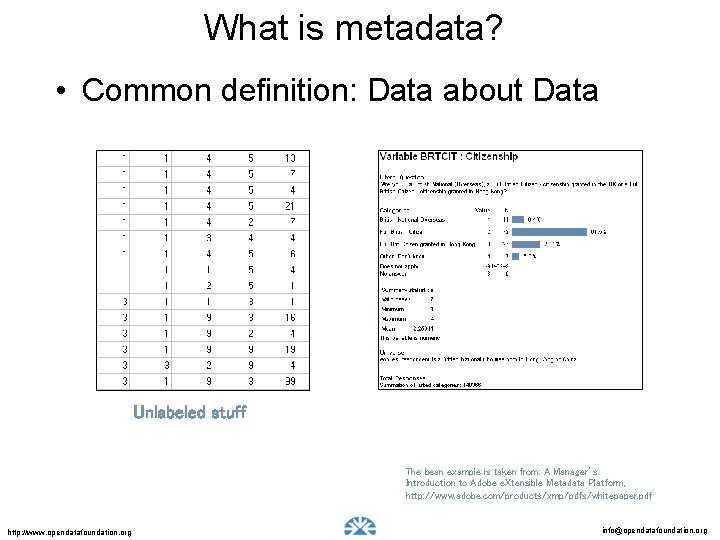
What is metadata? • Common definition: Data about Data Labeled stuff Unlabeled stuff The bean example is taken from: A Manager’s Introduction to Adobe e. Xtensible Metadata Platform, http: //www. adobe. com/products/xmp/pdfs/whitepaper. pdf http: //www. opendatafoundation. org info@opendatafoundation. org
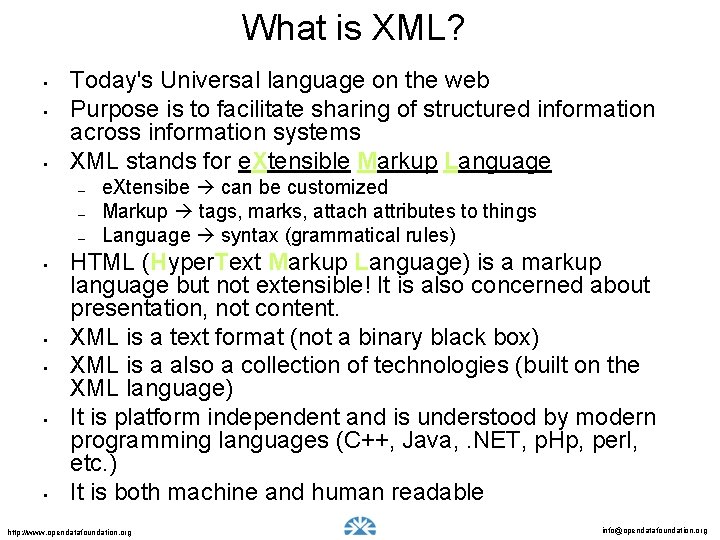
What is XML? • • • Today's Universal language on the web Purpose is to facilitate sharing of structured information across information systems XML stands for e. Xtensible Markup Language – – – • • • e. Xtensibe can be customized Markup tags, marks, attach attributes to things Language syntax (grammatical rules) HTML (Hyper. Text Markup Language) is a markup language but not extensible! It is also concerned about presentation, not content. XML is a text format (not a binary black box) XML is a also a collection of technologies (built on the XML language) It is platform independent and is understood by modern programming languages (C++, Java, . NET, p. Hp, perl, etc. ) It is both machine and human readable http: //www. opendatafoundation. org info@opendatafoundation. org
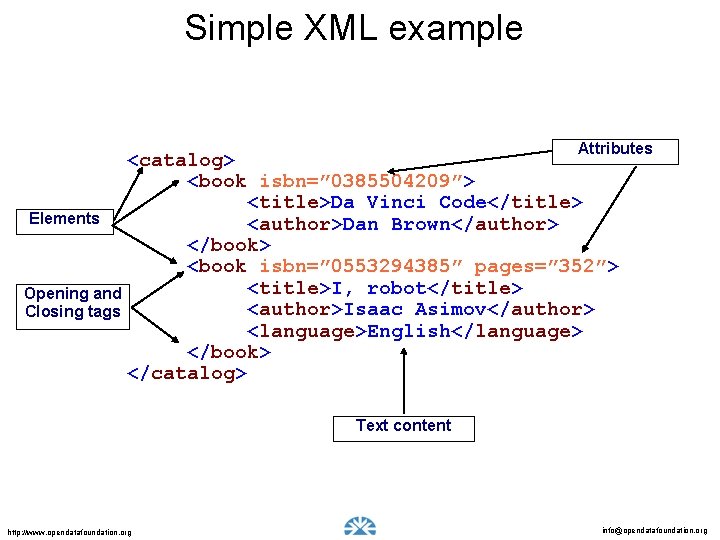
Simple XML example Attributes <catalog> <book isbn=” 0385504209”> <title>Da Vinci Code</title> Elements <author>Dan Brown</author> </book> <book isbn=” 0553294385” pages=” 352”> <title>I, robot</title> Opening and <author>Isaac Asimov</author> Closing tags <language>English</language> </book> </catalog> Text content http: //www. opendatafoundation. org info@opendatafoundation. org
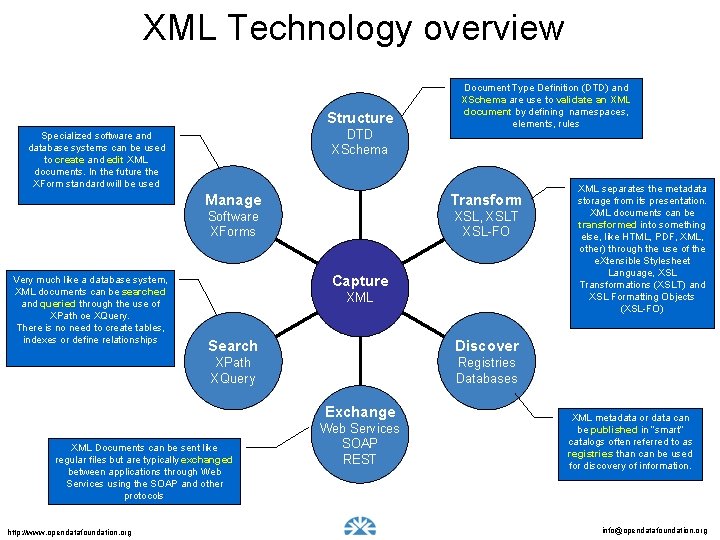
XML Technology overview Structure DTD XSchema Specialized software and database systems can be used to create and edit XML documents. In the future the XForm standard will be used Very much like a database system, XML documents can be searched and queried through the use of XPath oe XQuery. There is no need to create tables, indexes or define relationships Manage Transform Software XForms XSL, XSLT XSL-FO Capture XML Search Discover XPath XQuery Registries Databases Exchange XML Documents can be sent like regular files but are typically exchanged between applications through Web Services using the SOAP and other protocols http: //www. opendatafoundation. org Document Type Definition (DTD) and XSchema are use to validate an XML document by defining namespaces, elements, rules Web Services SOAP REST XML separates the metadata storage from its presentation. XML documents can be transformed into something else, like HTML, PDF, XML, other) through the use of the e. Xtensible Stylesheet Language, XSL Transformations (XSLT) and XSL Formatting Objects (XSL-FO) XML metadata or data can be published in “smart” catalogs often referred to as registries than can be used for discovery of information. info@opendatafoundation. org
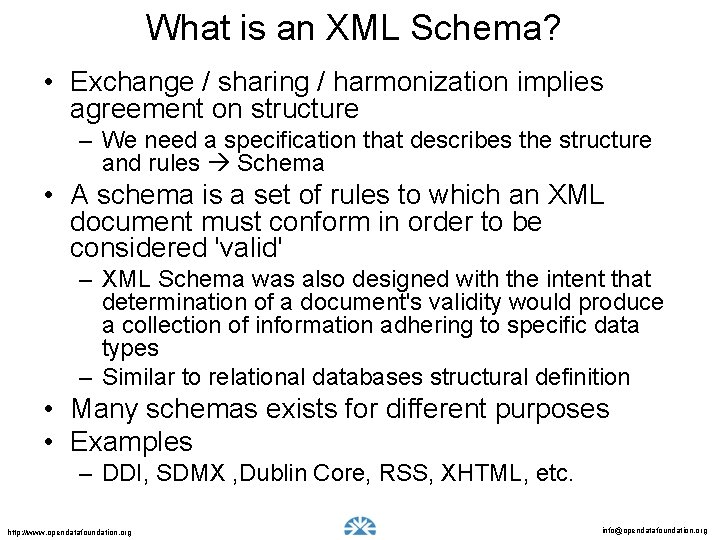
What is an XML Schema? • Exchange / sharing / harmonization implies agreement on structure – We need a specification that describes the structure and rules Schema • A schema is a set of rules to which an XML document must conform in order to be considered 'valid' – XML Schema was also designed with the intent that determination of a document's validity would produce a collection of information adhering to specific data types – Similar to relational databases structural definition • Many schemas exists for different purposes • Examples – DDI, SDMX , Dublin Core, RSS, XHTML, etc. http: //www. opendatafoundation. org info@opendatafoundation. org
Metadata, XML and Microdata
What is a survey? • More than just data…. – A complex process to produce data for the purpose of statistical analysis – Beyond this, a tool to support evidence based policy making and results monitoring • The data is surrounded by a large body of documentation • Survey data often come with limited documention • Note that microdata is intended for experts – – Statisticians / researchers Represents a single point in time and space Need to be aggregated to produce meaningful results It is the beginning of the story http: //www. opendatafoundation. org info@opendatafoundation. org
What is survey metadata? • Survey documentation can be broken down into structured metadata and documents – Structured metadata can be captured using XML – Documents can be described in structured metadata • Example of metadata: – Survey level: Title, country, year, abstract, sampling, agencies, access policy, etc. – Variable level: filename, label, code, questions, instructions, derivation, etc. – Related materials: report, questionnaire, papers, manuals, scripts/programs, photos – Cross-surveys: catalogs, longitudinal, concepts, comparability, etc. http: //www. opendatafoundation. org info@opendatafoundation. org
Importance of survey metadata • Data Quality: – Usefulness = accessibility + coherence + completeness + relevance + timeliness + … – Undocumented data is useless – Partially documented data is risky (misuse) • • • Data discovery and access Preservation Replication standard (Gary King) Information exchange Reduce need to access sensitive data Maintain coherence / linkages across the complete life cycle (from respondent to policy maker) • Reuse http: //www. opendatafoundation. org info@opendatafoundation. org
The Data Documentation Initiative • The Data Documentation Initiative is an XML specification to capture structured metadata about “microdata” (broad sense) • First generation DDI 1. 0… 2. 1 (2000 -2008) – focus on single archived instance • Second generation DDI 3. 0 (2008) – focus on life cycle – go beyond the single survey concept – mutli-purpose http: //www. opendatafoundation. org info@opendatafoundation. org
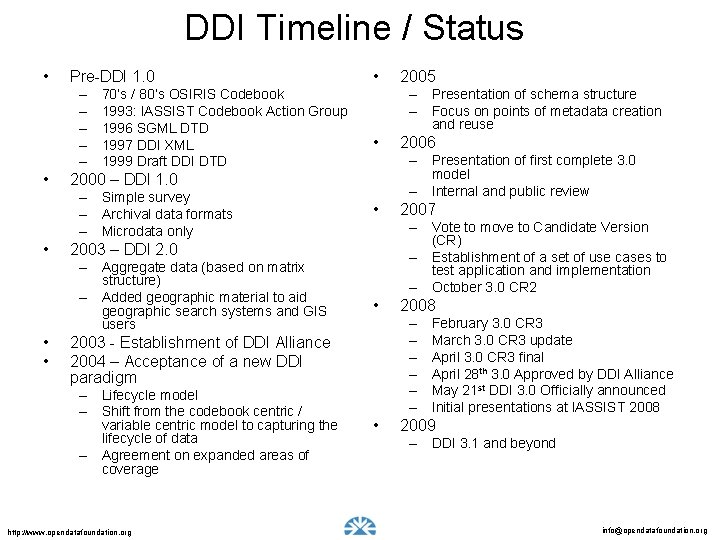
DDI Timeline / Status • Pre-DDI 1. 0 – – – • 70’s / 80’s OSIRIS Codebook 1993: IASSIST Codebook Action Group 1996 SGML DTD 1997 DDI XML 1999 Draft DDI DTD • • http: //www. opendatafoundation. org 2007 – Vote to move to Candidate Version (CR) – Establishment of a set of use cases to test application and implementation – October 3. 0 CR 2 • 2008 – – – 2003 - Establishment of DDI Alliance 2004 – Acceptance of a new DDI paradigm – Lifecycle model – Shift from the codebook centric / variable centric model to capturing the lifecycle of data – Agreement on expanded areas of coverage 2006 – Presentation of first complete 3. 0 model – Internal and public review 2003 – DDI 2. 0 – Aggregate data (based on matrix structure) – Added geographic material to aid geographic search systems and GIS users 2005 – Presentation of schema structure – Focus on points of metadata creation and reuse 2000 – DDI 1. 0 – Simple survey – Archival data formats – Microdata only • • • February 3. 0 CR 3 March 3. 0 CR 3 update April 3. 0 CR 3 final April 28 th 3. 0 Approved by DDI Alliance May 21 st DDI 3. 0 Officially announced Initial presentations at IASSIST 2008 2009 – DDI 3. 1 and beyond info@opendatafoundation. org
DDI 1/2. x
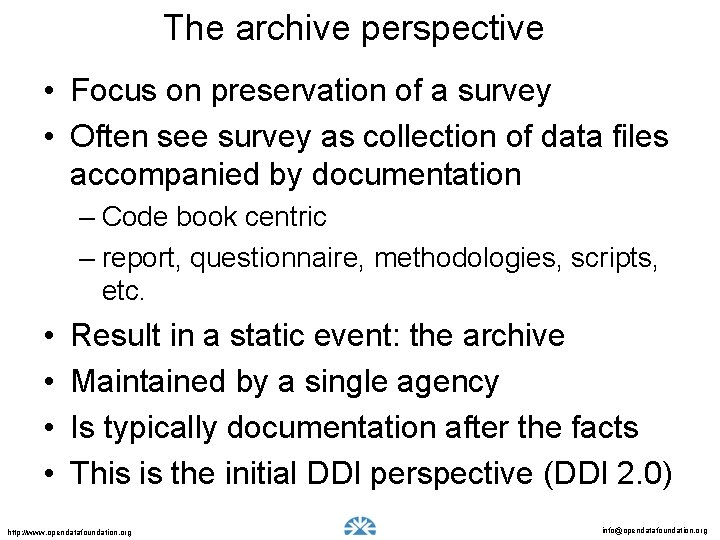
The archive perspective • Focus on preservation of a survey • Often see survey as collection of data files accompanied by documentation – Code book centric – report, questionnaire, methodologies, scripts, etc. • • Result in a static event: the archive Maintained by a single agency Is typically documentation after the facts This is the initial DDI perspective (DDI 2. 0) http: //www. opendatafoundation. org info@opendatafoundation. org
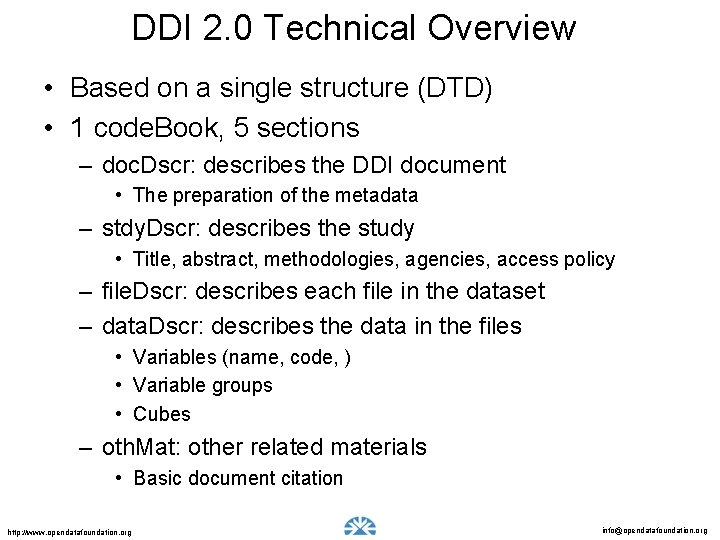
DDI 2. 0 Technical Overview • Based on a single structure (DTD) • 1 code. Book, 5 sections – doc. Dscr: describes the DDI document • The preparation of the metadata – stdy. Dscr: describes the study • Title, abstract, methodologies, agencies, access policy – file. Dscr: describes each file in the dataset – data. Dscr: describes the data in the files • Variables (name, code, ) • Variable groups • Cubes – oth. Mat: other related materials • Basic document citation http: //www. opendatafoundation. org info@opendatafoundation. org
Characteristics of DDI 1. 0/2. 0 • Focuses on the static object of a codebook • Designed for limited uses – End user data discovery via the variable or high level study identification (bibliographic) – Only heavily structured content relates to information used to drive statistical analysis • Coverage is focused on single study, single data file, simple survey and aggregate data files • Variable contains majority of information (question, categories, data typing, physical storage information, statistics) http: //www. opendatafoundation. org info@opendatafoundation. org
Impact of these limitations • Treated as an “add on” to the data collection process • Focus is on the data end product and end users (static) • Limited tools for creation or exploitation • The Variable must exist before metadata can be created • Producers hesitant to take up DDI creation because it is a cost and does not support their development or collection process http: //www. opendatafoundation. org info@opendatafoundation. org
DDI 1/2. x Tools • Nesstar – Nesstar Publisher, Nesstar Server • IHSN – Microdata Management Toolkit – NADA (online catalog for national data archive) – Archivist / Reviewer Guidelines • Other tools – SDA, Harvard/MIT Virtual Data Center (Dataverse) – UKDA DEx. T, ODa. F De. Xtris – http: //tools. ddialliance. org http: //www. opendatafoundation. org info@opendatafoundation. org
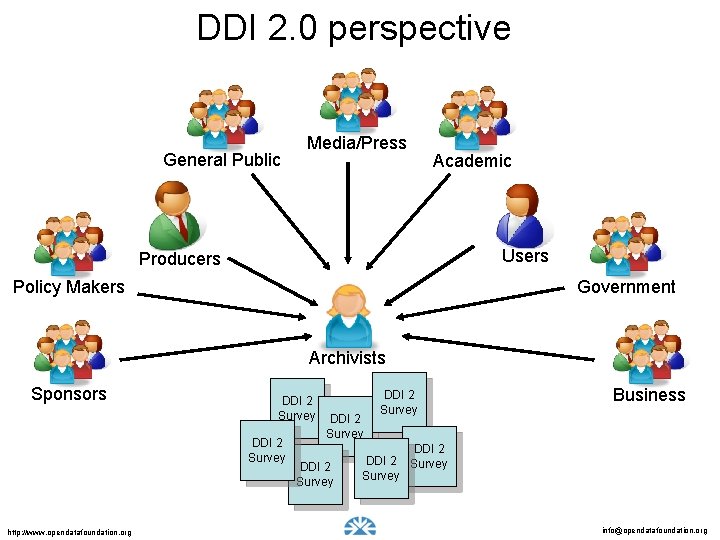
DDI 2. 0 perspective General Public Media/Press Academic Users Producers Policy Makers Government Archivists Sponsors DDI 2 Survey http: //www. opendatafoundation. org DDI 2 Survey Business DDI 2 Survey info@opendatafoundation. org
DDI 3. 0 The life cycle
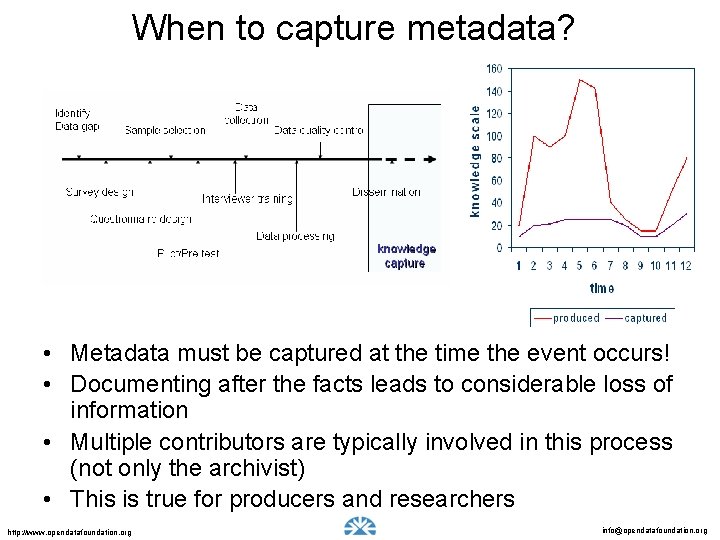
When to capture metadata? • Metadata must be captured at the time the event occurs! • Documenting after the facts leads to considerable loss of information • Multiple contributors are typically involved in this process (not only the archivist) • This is true for producers and researchers http: //www. opendatafoundation. org info@opendatafoundation. org
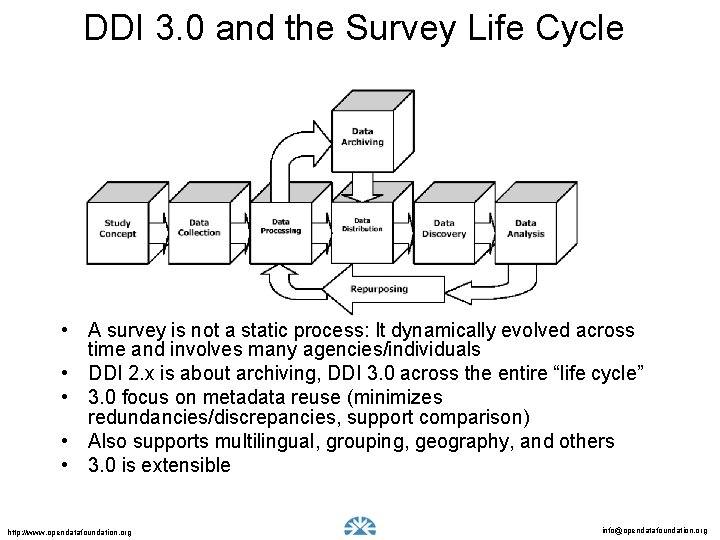
DDI 3. 0 and the Survey Life Cycle • A survey is not a static process: It dynamically evolved across time and involves many agencies/individuals • DDI 2. x is about archiving, DDI 3. 0 across the entire “life cycle” • 3. 0 focus on metadata reuse (minimizes redundancies/discrepancies, support comparison) • Also supports multilingual, grouping, geography, and others • 3. 0 is extensible http: //www. opendatafoundation. org info@opendatafoundation. org
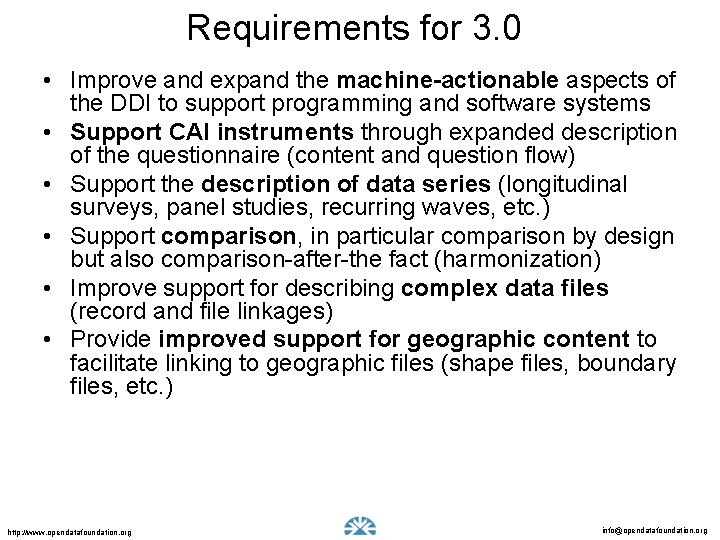
Requirements for 3. 0 • Improve and expand the machine-actionable aspects of the DDI to support programming and software systems • Support CAI instruments through expanded description of the questionnaire (content and question flow) • Support the description of data series (longitudinal surveys, panel studies, recurring waves, etc. ) • Support comparison, in particular comparison by design but also comparison-after-the fact (harmonization) • Improve support for describing complex data files (record and file linkages) • Provide improved support for geographic content to facilitate linking to geographic files (shape files, boundary files, etc. ) http: //www. opendatafoundation. org info@opendatafoundation. org
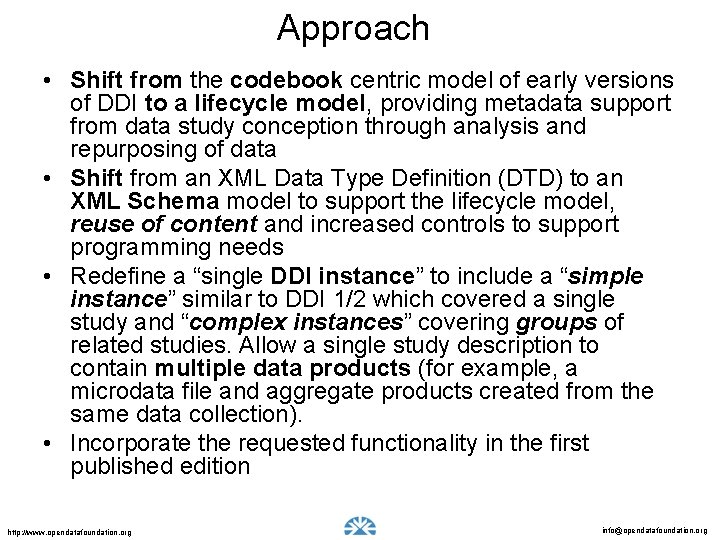
Approach • Shift from the codebook centric model of early versions of DDI to a lifecycle model, providing metadata support from data study conception through analysis and repurposing of data • Shift from an XML Data Type Definition (DTD) to an XML Schema model to support the lifecycle model, reuse of content and increased controls to support programming needs • Redefine a “single DDI instance” to include a “simple instance” similar to DDI 1/2 which covered a single study and “complex instances” covering groups of related studies. Allow a single study description to contain multiple data products (for example, a microdata file and aggregate products created from the same data collection). • Incorporate the requested functionality in the first published edition http: //www. opendatafoundation. org info@opendatafoundation. org
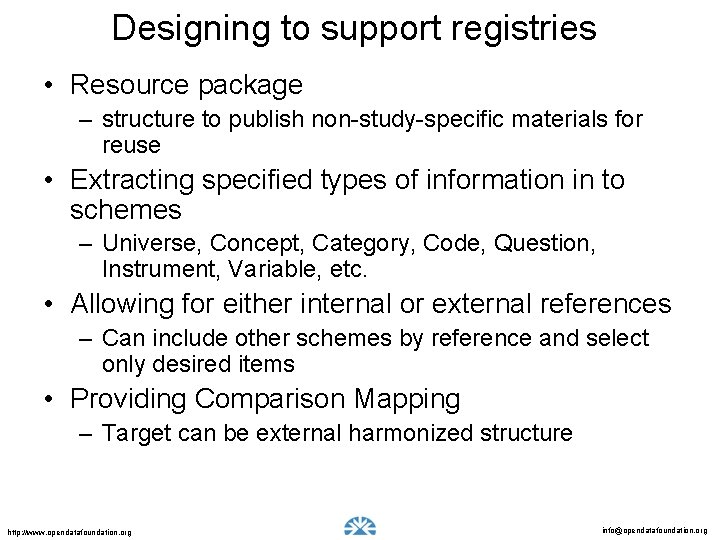
Designing to support registries • Resource package – structure to publish non-study-specific materials for reuse • Extracting specified types of information in to schemes – Universe, Concept, Category, Code, Question, Instrument, Variable, etc. • Allowing for either internal or external references – Can include other schemes by reference and select only desired items • Providing Comparison Mapping – Target can be external harmonized structure http: //www. opendatafoundation. org info@opendatafoundation. org
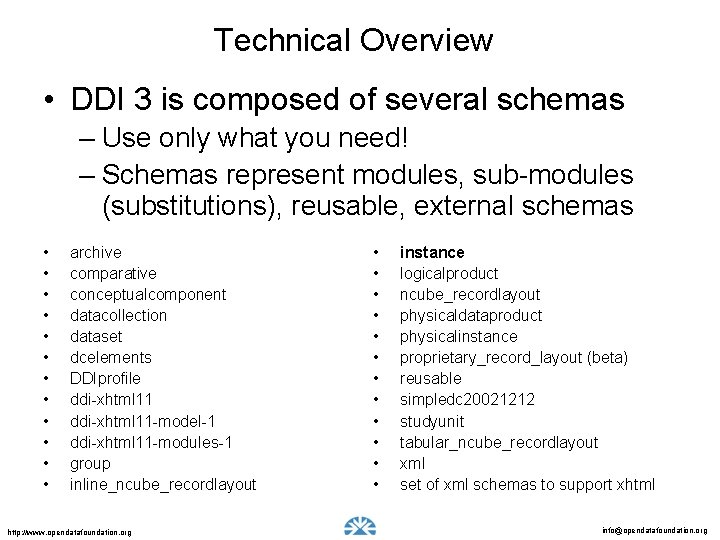
Technical Overview • DDI 3 is composed of several schemas – Use only what you need! – Schemas represent modules, sub-modules (substitutions), reusable, external schemas • • • archive comparative conceptualcomponent datacollection dataset dcelements DDIprofile ddi-xhtml 11 -model-1 ddi-xhtml 11 -modules-1 group inline_ncube_recordlayout http: //www. opendatafoundation. org • • • instance logicalproduct ncube_recordlayout physicaldataproduct physicalinstance proprietary_record_layout (beta) reusable simpledc 20021212 studyunit tabular_ncube_recordlayout xml set of xml schemas to support xhtml info@opendatafoundation. org
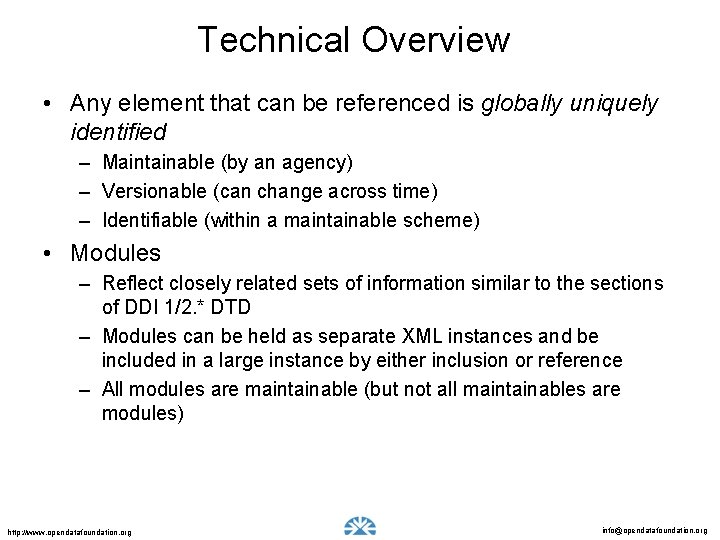
Technical Overview • Any element that can be referenced is globally uniquely identified – Maintainable (by an agency) – Versionable (can change across time) – Identifiable (within a maintainable scheme) • Modules – Reflect closely related sets of information similar to the sections of DDI 1/2. * DTD – Modules can be held as separate XML instances and be included in a large instance by either inclusion or reference – All modules are maintainable (but not all maintainables are modules) http: //www. opendatafoundation. org info@opendatafoundation. org
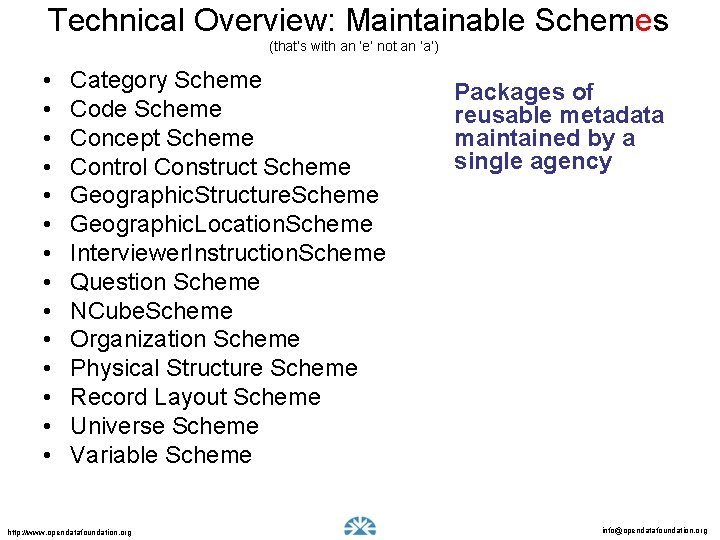
Technical Overview: Maintainable Schemes (that’s with an ‘e’ not an ‘a’) • • • • Category Scheme Code Scheme Concept Scheme Control Construct Scheme Geographic. Structure. Scheme Geographic. Location. Scheme Interviewer. Instruction. Scheme Question Scheme NCube. Scheme Organization Scheme Physical Structure Scheme Record Layout Scheme Universe Scheme Variable Scheme http: //www. opendatafoundation. org Packages of reusable metadata maintained by a single agency info@opendatafoundation. org
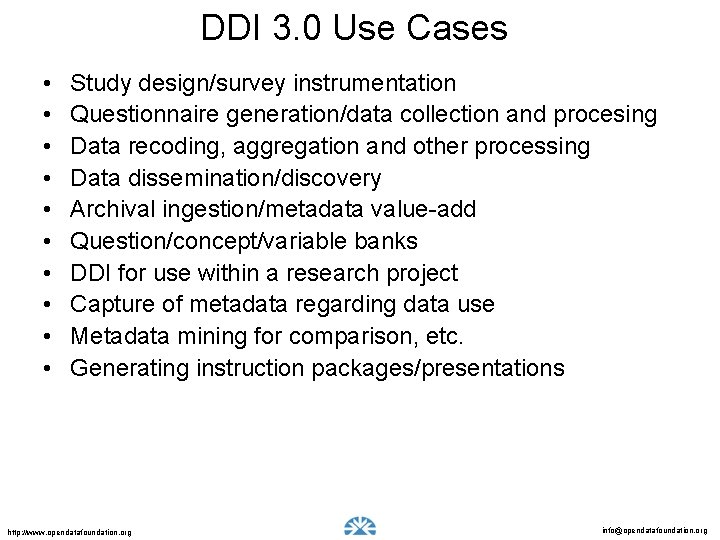
DDI 3. 0 Use Cases • • • Study design/survey instrumentation Questionnaire generation/data collection and procesing Data recoding, aggregation and other processing Data dissemination/discovery Archival ingestion/metadata value-add Question/concept/variable banks DDI for use within a research project Capture of metadata regarding data use Metadata mining for comparison, etc. Generating instruction packages/presentations http: //www. opendatafoundation. org info@opendatafoundation. org
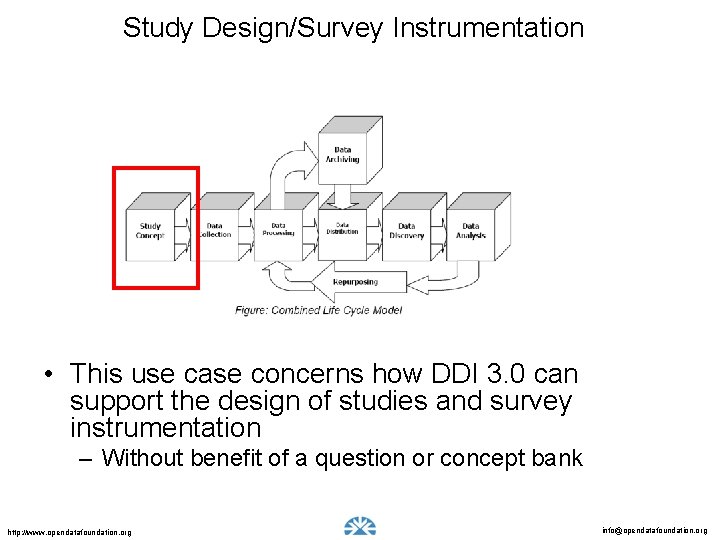
Study Design/Survey Instrumentation • This use case concerns how DDI 3. 0 can support the design of studies and survey instrumentation – Without benefit of a question or concept bank http: //www. opendatafoundation. org info@opendatafoundation. org
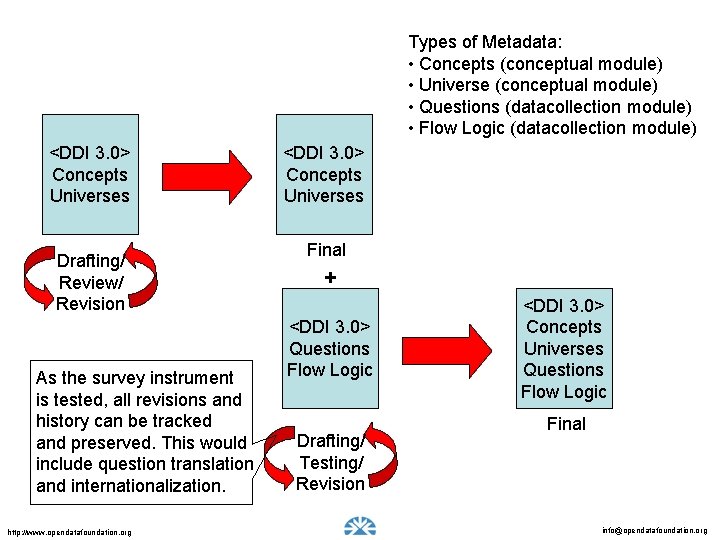
Types of Metadata: • Concepts (conceptual module) • Universe (conceptual module) • Questions (datacollection module) • Flow Logic (datacollection module) <DDI 3. 0> Concepts Universes Drafting/ Review/ Revision As the survey instrument is tested, all revisions and history can be tracked and preserved. This would include question translation and internationalization. http: //www. opendatafoundation. org <DDI 3. 0> Concepts Universes Final + <DDI 3. 0> Questions Flow Logic Drafting/ Testing/ Revision <DDI 3. 0> Concepts Universes Questions Flow Logic Final info@opendatafoundation. org
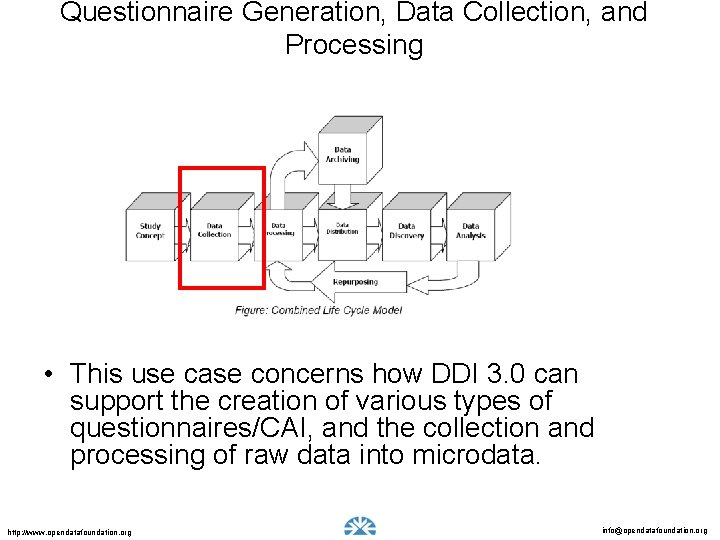
Questionnaire Generation, Data Collection, and Processing • This use case concerns how DDI 3. 0 can support the creation of various types of questionnaires/CAI, and the collection and processing of raw data into microdata. http: //www. opendatafoundation. org info@opendatafoundation. org
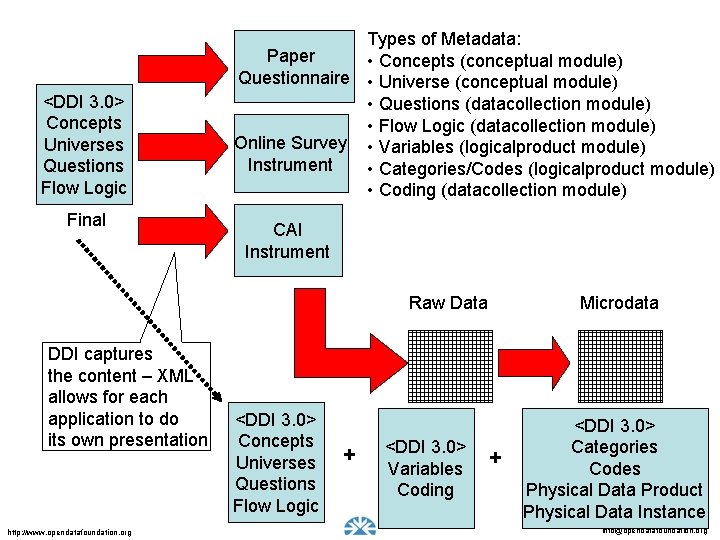
<DDI 3. 0> Concepts Universes Questions Flow Logic Final Types of Metadata: Paper • Concepts (conceptual module) Questionnaire • Universe (conceptual module) • Questions (datacollection module) • Flow Logic (datacollection module) Online Survey • Variables (logicalproduct module) Instrument • Categories/Codes (logicalproduct module) • Coding (datacollection module) CAI Instrument Raw Data DDI captures the content – XML allows for each application to do its own presentation http: //www. opendatafoundation. org <DDI 3. 0> Concepts Universes Questions Flow Logic + <DDI 3. 0> Variables Coding Microdata + <DDI 3. 0> Categories Codes Physical Data Product Physical Data Instance info@opendatafoundation. org
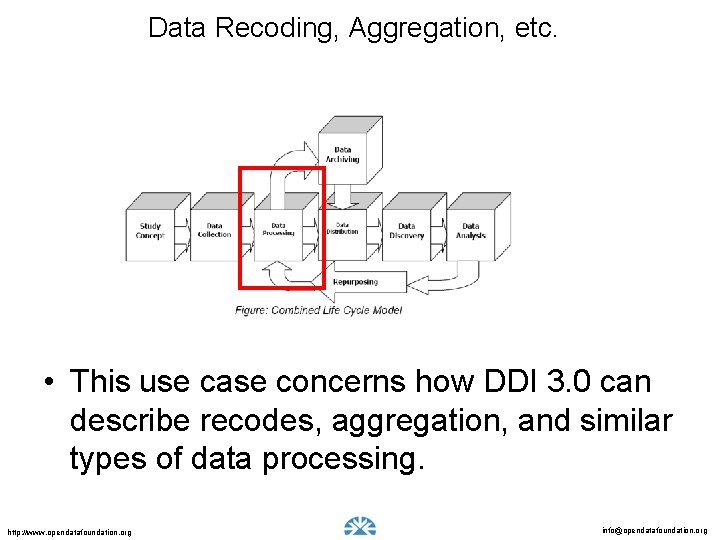
Data Recoding, Aggregation, etc. • This use case concerns how DDI 3. 0 can describe recodes, aggregation, and similar types of data processing. http: //www. opendatafoundation. org info@opendatafoundation. org
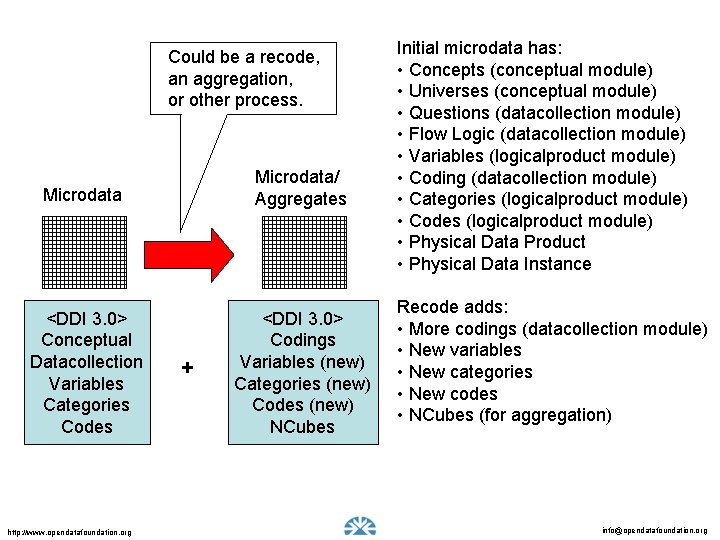
Could be a recode, an aggregation, or other process. Microdata/ Aggregates <DDI 3. 0> Conceptual Datacollection Variables Categories Codes <DDI 3. 0> Codings Variables (new) Categories (new) Codes (new) NCubes http: //www. opendatafoundation. org + Initial microdata has: • Concepts (conceptual module) • Universes (conceptual module) • Questions (datacollection module) • Flow Logic (datacollection module) • Variables (logicalproduct module) • Coding (datacollection module) • Categories (logicalproduct module) • Codes (logicalproduct module) • Physical Data Product • Physical Data Instance Recode adds: • More codings (datacollection module) • New variables • New categories • New codes • NCubes (for aggregation) info@opendatafoundation. org
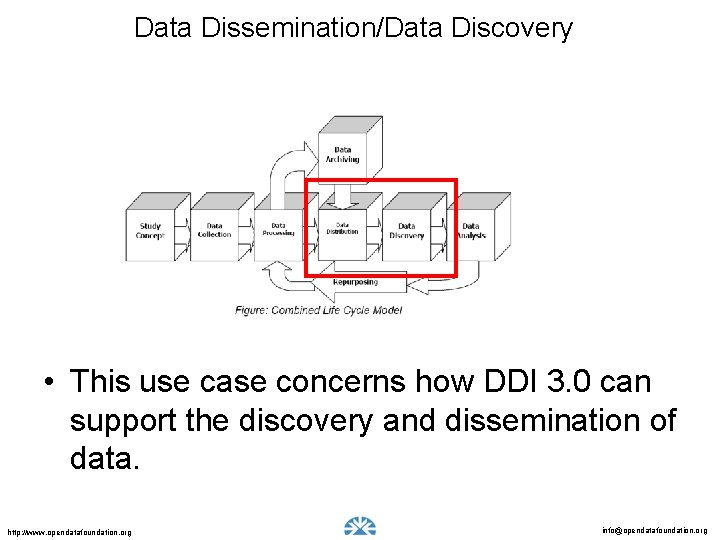
Data Dissemination/Data Discovery • This use case concerns how DDI 3. 0 can support the discovery and dissemination of data. http: //www. opendatafoundation. org info@opendatafoundation. org
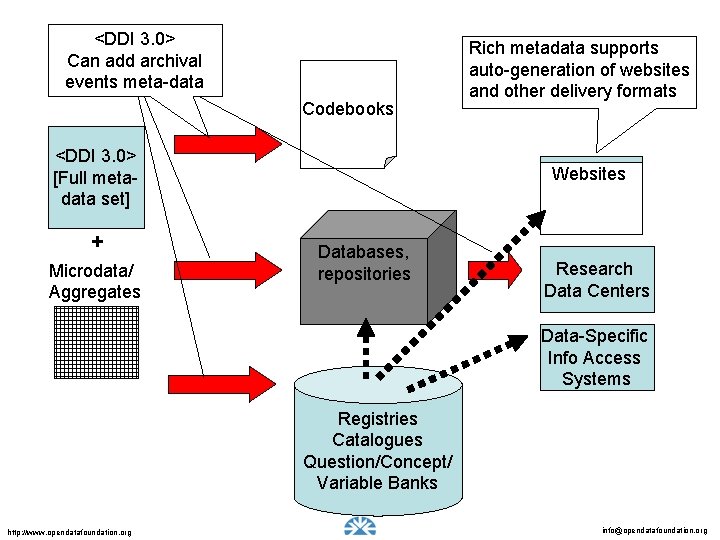
<DDI 3. 0> Can add archival events meta-data Codebooks <DDI 3. 0> [Full metadata set] + Microdata/ Aggregates Rich metadata supports auto-generation of websites and other delivery formats Websites Databases, repositories Research Data Centers Data-Specific Info Access Systems Registries Catalogues Question/Concept/ Variable Banks http: //www. opendatafoundation. org info@opendatafoundation. org
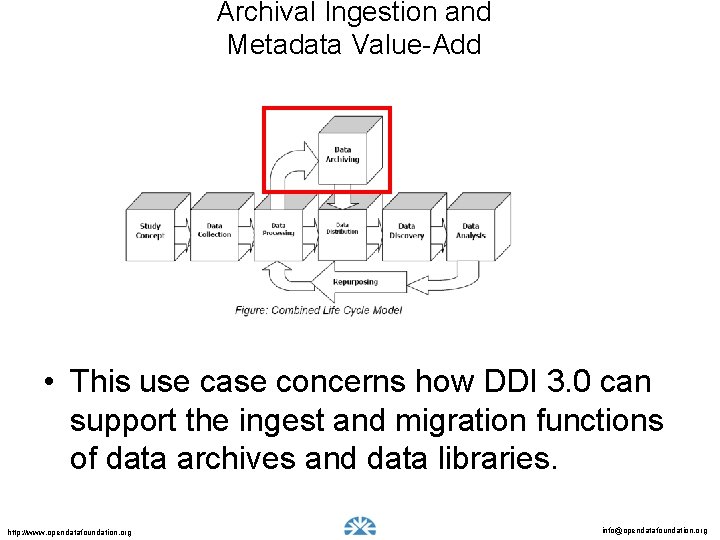
Archival Ingestion and Metadata Value-Add • This use case concerns how DDI 3. 0 can support the ingest and migration functions of data archives and data libraries. http: //www. opendatafoundation. org info@opendatafoundation. org
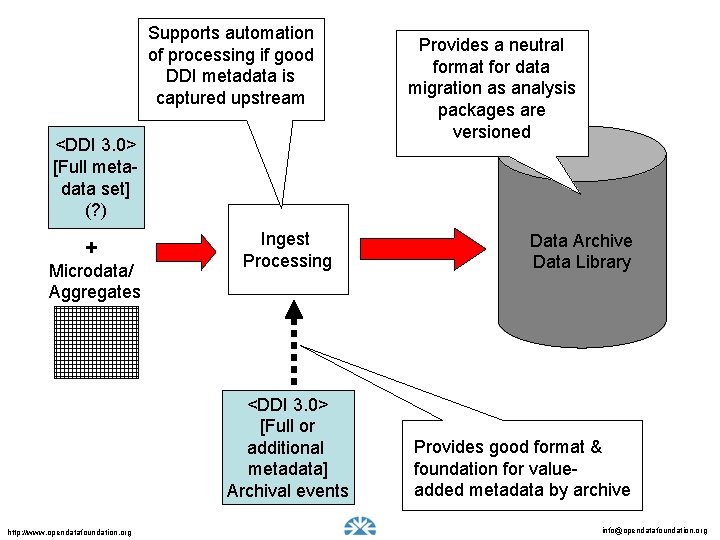
Supports automation of processing if good DDI metadata is captured upstream <DDI 3. 0> [Full metadata set] (? ) + Microdata/ Aggregates Ingest Processing <DDI 3. 0> [Full or additional metadata] Archival events http: //www. opendatafoundation. org Provides a neutral format for data migration as analysis packages are versioned Data Archive Data Library Provides good format & foundation for valueadded metadata by archive info@opendatafoundation. org
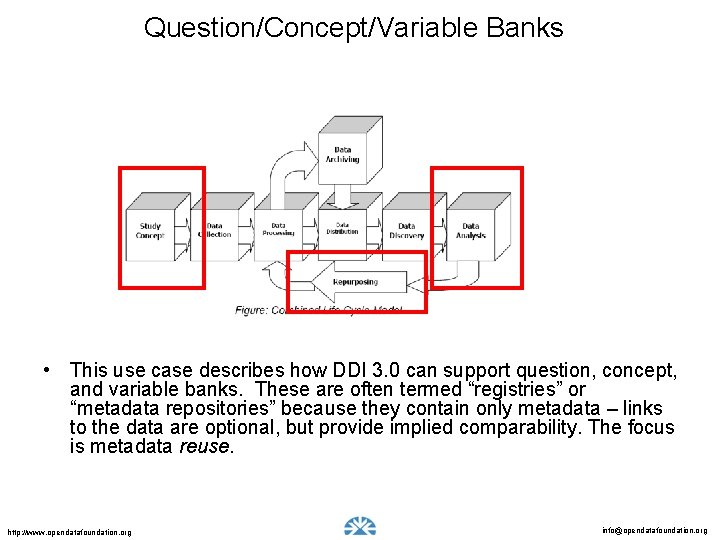
Question/Concept/Variable Banks • This use case describes how DDI 3. 0 can support question, concept, and variable banks. These are often termed “registries” or “metadata repositories” because they contain only metadata – links to the data are optional, but provide implied comparability. The focus is metadata reuse. http: //www. opendatafoundation. org info@opendatafoundation. org
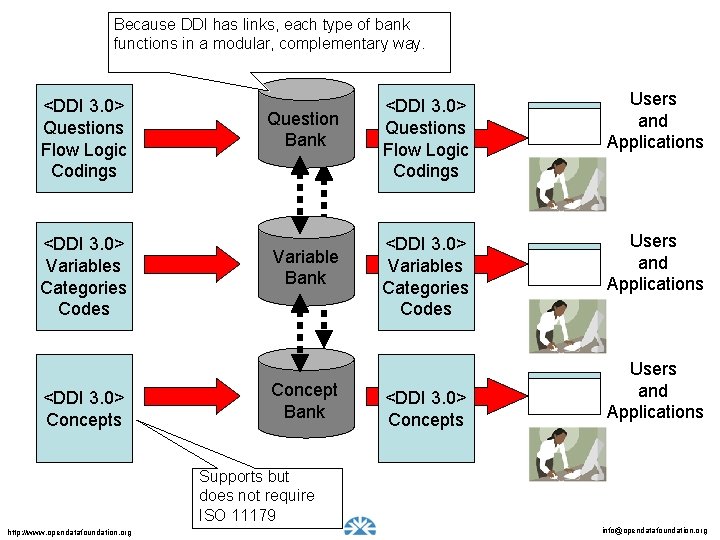
Because DDI has links, each type of bank functions in a modular, complementary way. <DDI 3. 0> Questions Flow Logic Codings <DDI 3. 0> Variables Categories Codes <DDI 3. 0> Concepts Question Bank Variable Bank Concept Bank <DDI 3. 0> Questions Flow Logic Codings Users and Applications <DDI 3. 0> Variables Categories Codes Users and Applications <DDI 3. 0> Concepts Users and Applications Supports but does not require ISO 11179 http: //www. opendatafoundation. org info@opendatafoundation. org
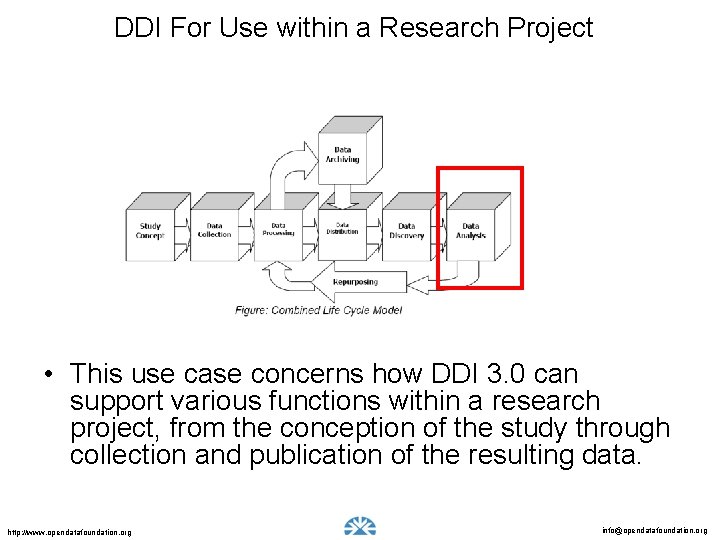
DDI For Use within a Research Project • This use case concerns how DDI 3. 0 can support various functions within a research project, from the conception of the study through collection and publication of the resulting data. http: //www. opendatafoundation. org info@opendatafoundation. org
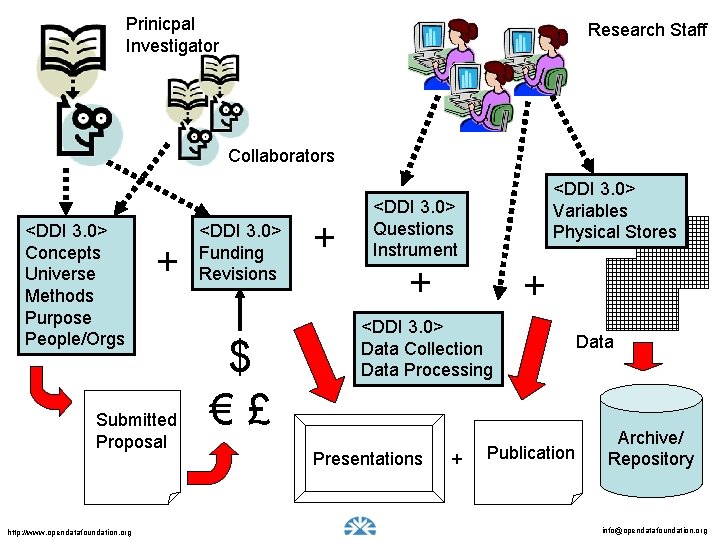
Prinicpal Investigator Research Staff Collaborators <DDI 3. 0> Concepts Universe Methods Purpose People/Orgs + Submitted Proposal http: //www. opendatafoundation. org <DDI 3. 0> Funding Revisions $ €£ + <DDI 3. 0> Variables Physical Stores <DDI 3. 0> Questions Instrument + + <DDI 3. 0> Data Collection Data Processing Presentations + Publication Data Archive/ Repository info@opendatafoundation. org
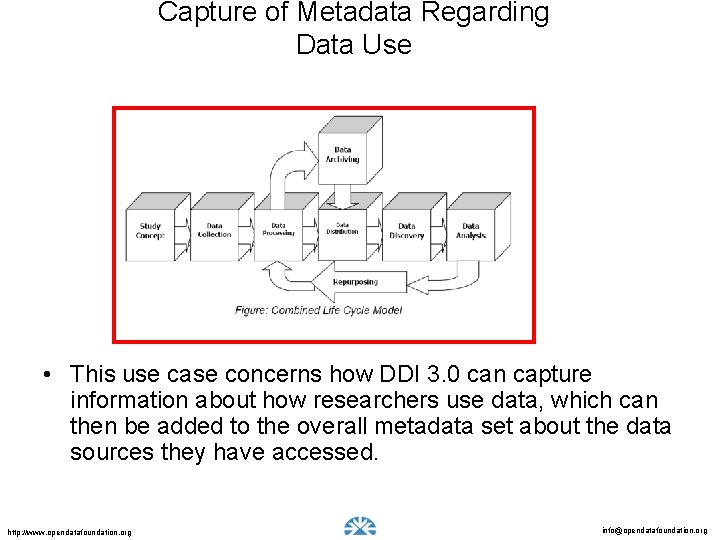
Capture of Metadata Regarding Data Use • This use case concerns how DDI 3. 0 can capture information about how researchers use data, which can then be added to the overall metadata set about the data sources they have accessed. http: //www. opendatafoundation. org info@opendatafoundation. org
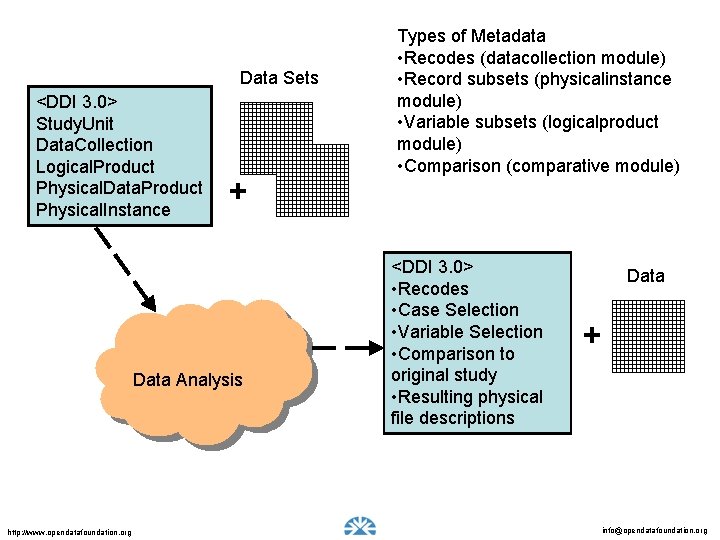
Data Sets <DDI 3. 0> Study. Unit Data. Collection Logical. Product Physical. Data. Product Physical. Instance + Data Analysis http: //www. opendatafoundation. org Types of Metadata • Recodes (datacollection module) • Record subsets (physicalinstance module) • Variable subsets (logicalproduct module) • Comparison (comparative module) <DDI 3. 0> • Recodes • Case Selection • Variable Selection • Comparison to original study • Resulting physical file descriptions Data + info@opendatafoundation. org
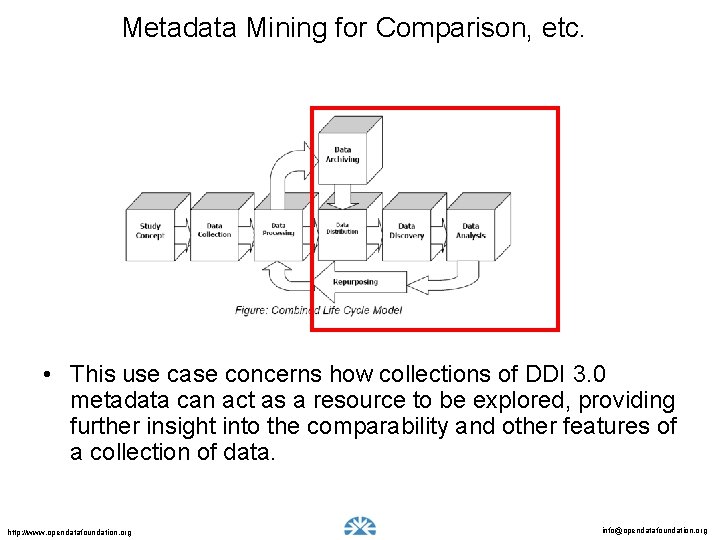
Metadata Mining for Comparison, etc. • This use case concerns how collections of DDI 3. 0 metadata can act as a resource to be explored, providing further insight into the comparability and other features of a collection of data. http: //www. opendatafoundation. org info@opendatafoundation. org
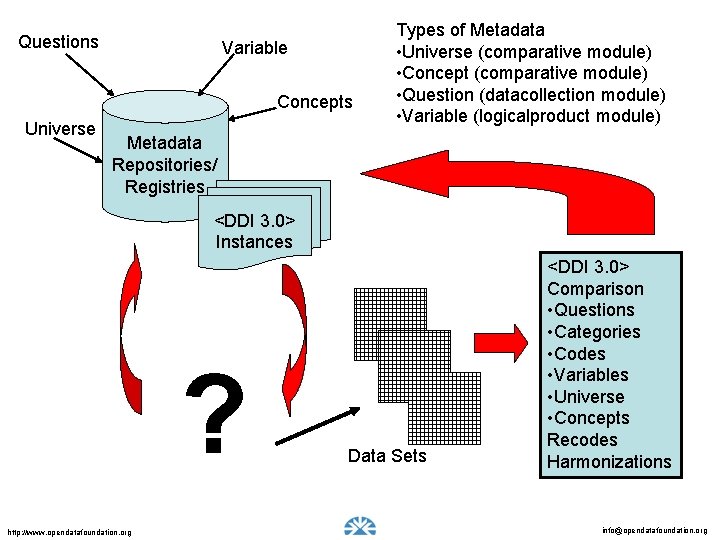
Questions Variable Concepts Universe Types of Metadata • Universe (comparative module) • Concept (comparative module) • Question (datacollection module) • Variable (logicalproduct module) Metadata Repositories/ Registries <DDI 3. 0> Instances ? http: //www. opendatafoundation. org Data Sets <DDI 3. 0> Comparison • Questions • Categories • Codes • Variables • Universe • Concepts Recodes Harmonizations info@opendatafoundation. org
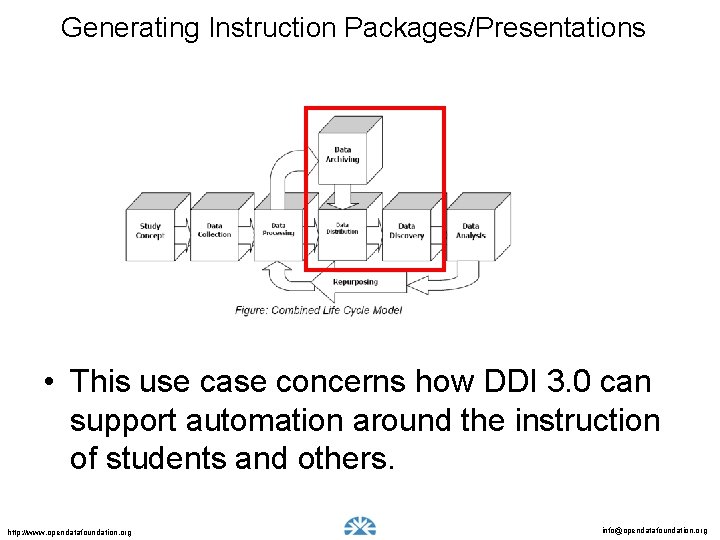
Generating Instruction Packages/Presentations • This use case concerns how DDI 3. 0 can support automation around the instruction of students and others. http: //www. opendatafoundation. org info@opendatafoundation. org
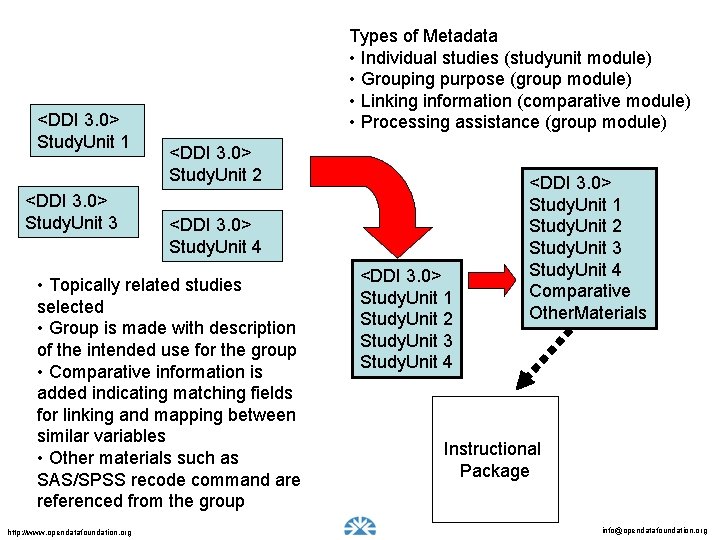
<DDI 3. 0> Study. Unit 1 <DDI 3. 0> Study. Unit 3 Types of Metadata • Individual studies (studyunit module) • Grouping purpose (group module) • Linking information (comparative module) • Processing assistance (group module) <DDI 3. 0> Study. Unit 2 <DDI 3. 0> Study. Unit 4 • Topically related studies selected • Group is made with description of the intended use for the group • Comparative information is added indicating matching fields for linking and mapping between similar variables • Other materials such as SAS/SPSS recode command are referenced from the group http: //www. opendatafoundation. org <DDI 3. 0> Study. Unit 1 Study. Unit 2 Study. Unit 3 Study. Unit 4 Comparative Other. Materials Instructional Package info@opendatafoundation. org
DDI 3. 0 Tools • Under developments • DDI Foundation Tools Program – Road Map – XML Beans, validation, – DDI DEx. T, DDI 2 Stats. Progs • Other tools – R SPSS Export, Algenta Survey. Viz, others presented at IASSIST • DDI Editing Suite – Proposed as extension of DDI-FTP – Plan for generic editor in 6 -9 months • DDI 3. 0 related projects / initiatives – RDC Canada, Germany RDC / EURASI, DANS MIXED, NORC http: //www. opendatafoundation. org info@opendatafoundation. org
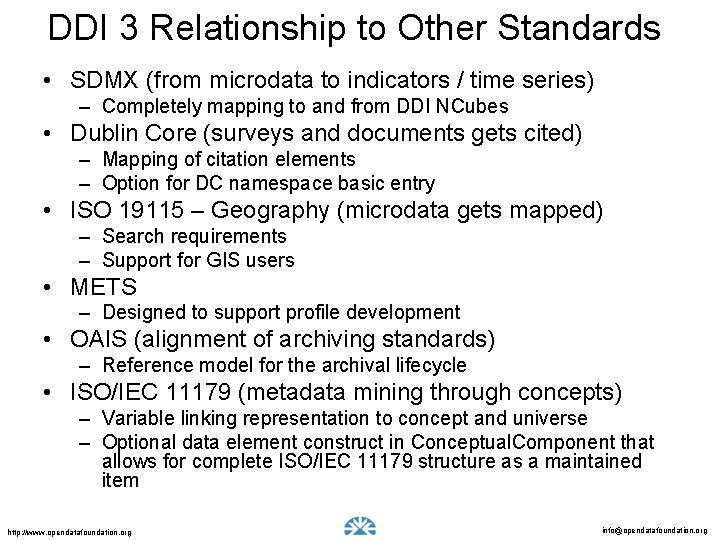
DDI 3 Relationship to Other Standards • SDMX (from microdata to indicators / time series) – Completely mapping to and from DDI NCubes • Dublin Core (surveys and documents gets cited) – Mapping of citation elements – Option for DC namespace basic entry • ISO 19115 – Geography (microdata gets mapped) – Search requirements – Support for GIS users • METS – Designed to support profile development • OAIS (alignment of archiving standards) – Reference model for the archival lifecycle • ISO/IEC 11179 (metadata mining through concepts) – Variable linking representation to concept and universe – Optional data element construct in Conceptual. Component that allows for complete ISO/IEC 11179 structure as a maintained item http: //www. opendatafoundation. org info@opendatafoundation. org
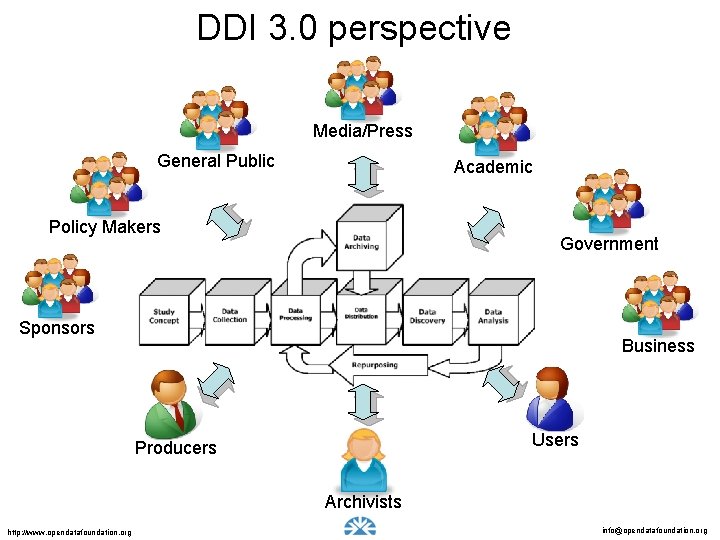
DDI 3. 0 perspective Media/Press General Public Academic Policy Makers Government Sponsors Business Users Producers Archivists http: //www. opendatafoundation. org info@opendatafoundation. org
DDI 2. 0 and DDI 3. 0
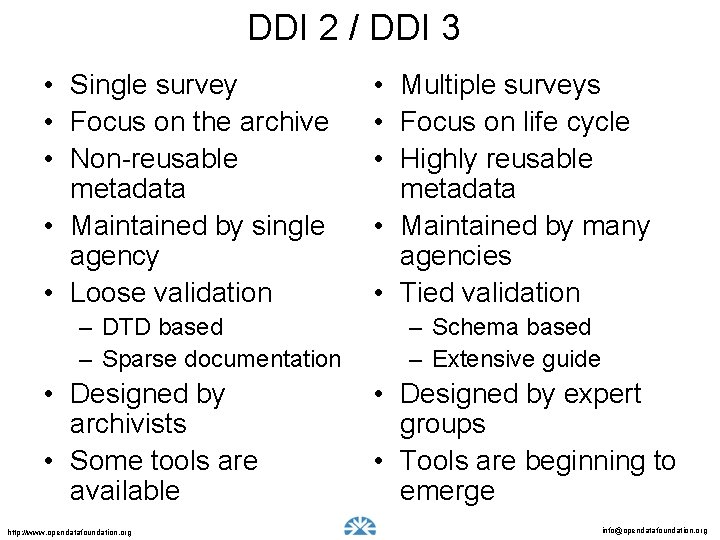
DDI 2 / DDI 3 • Single survey • Focus on the archive • Non-reusable metadata • Maintained by single agency • Loose validation – DTD based – Sparse documentation • Designed by archivists • Some tools are available http: //www. opendatafoundation. org • Multiple surveys • Focus on life cycle • Highly reusable metadata • Maintained by many agencies • Tied validation – Schema based – Extensive guide • Designed by expert groups • Tools are beginning to emerge info@opendatafoundation. org
What 3. 0 can do for you • • • Manage multi-surveys Support multiple contributors Support many different perspectives Support many different use cases Maintain metadata integrity across the life cycle Connect to other metadata spaces Metadata reuse Publication in registries Backward compatibility with 2. 0 http: //www. opendatafoundation. org info@opendatafoundation. org
DDI Community
DDI Organizations/ Agencies • DDI Alliance (http: //www. ddialliance. org) • Interuniversity Consortium for Political and Social Research (ICPSR) (http: //icpsr. umich. edu) • International Association for Social Science Infromation Service & Technology (IASSIST) (http: //www. iassistdata. org) • International Household Survey Network (IHSN) (http: //www. surveynetwork. org) • Open Data Foundation (ODa. F) (http: //www. opendatafoundation. org) • National Opinion Research Center Data Enclave (NORC) (http: //dataenclave. norc. org) • Metadata Technology (http: //www. metadatatechnology. com) http: //www. opendatafoundation. org info@opendatafoundation. org
IZA Data Service Center DDI/SDMX Workshop Wiesbaden, Germany, June 18 th 2008 The Statistical Data and Metadata Exchange Standard (SDMX): An Introduction Arofan Gregory / Pascal Heus agregory@opendatafoundation. org / pheus@opendatafoundation. org Open Data Foundation
Overview of the Session • • SDMX Background and Goals SDMX and Data SDMX and Metadata SDMX and Best Practices: The Content. Oriented Guidelines • The SDMX Information Model • SDMX and Web Services – The SDMX Registry – SDMX Data Services • Tools and Resources http: //www. opendatafoundation. org info@opendatafoundation. org
SDMX Background and Goals
What is SDMX? • The problem space: – Statistical collection, processing, and exchange is time-consuming and resourceintensive – Focus on aggregate data (esp. time series) – Various international and national organisations have individual approaches for their constituencies – Uncertainties about how to proceed with new technologies (XML, web services …) http: //www. opendatafoundation. org info@opendatafoundation. org
What is SDMX? The Statistical Data and Metadata Exchange (SDMX) initiative is taking steps to address these challenges and opportunities that have just been mentioned: – By focusing on business practices in the field of statistical information – By identifying more efficient processes for exchange and sharing of data and metadata using modern technology and open standards http: //www. opendatafoundation. org info@opendatafoundation. org
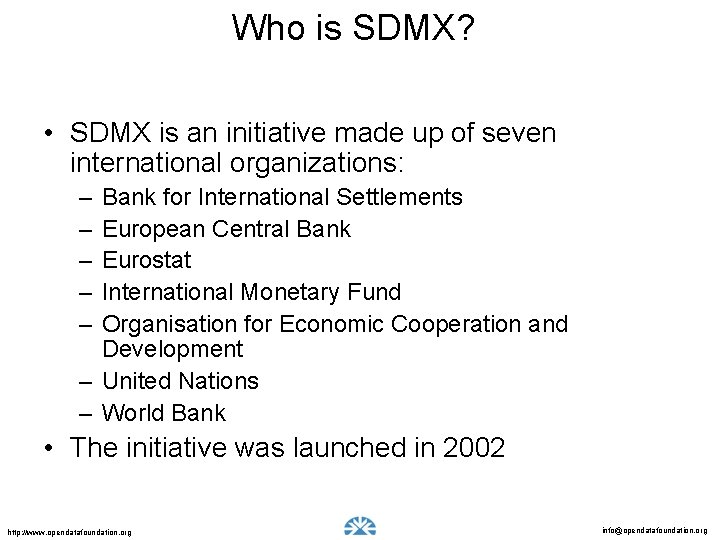
Who is SDMX? • SDMX is an initiative made up of seven international organizations: – – – Bank for International Settlements European Central Bank Eurostat International Monetary Fund Organisation for Economic Cooperation and Development – United Nations – World Bank • The initiative was launched in 2002 http: //www. opendatafoundation. org info@opendatafoundation. org
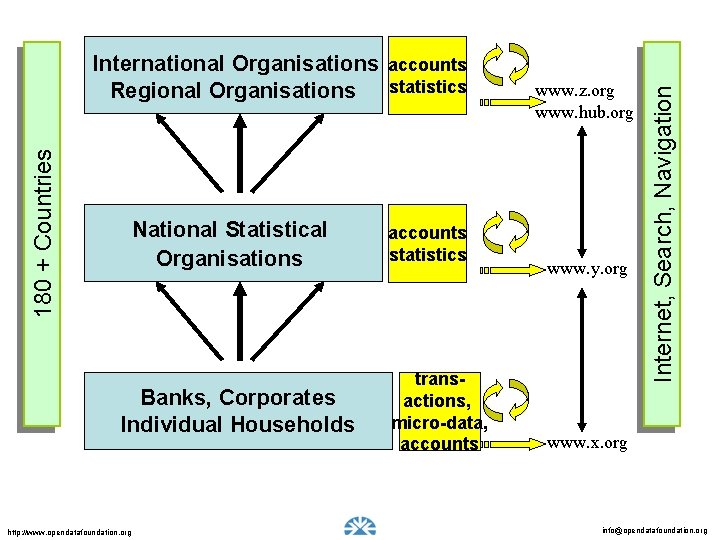
National Statistical Organisations Banks, Corporates Individual Households http: //www. opendatafoundation. org accounts statistics transactions, micro-data, accounts www. z. org www. hub. org www. y. org Internet, Search, Navigation 180 + Countries International Organisations accounts Regional Organisations statistics www. x. org info@opendatafoundation. org
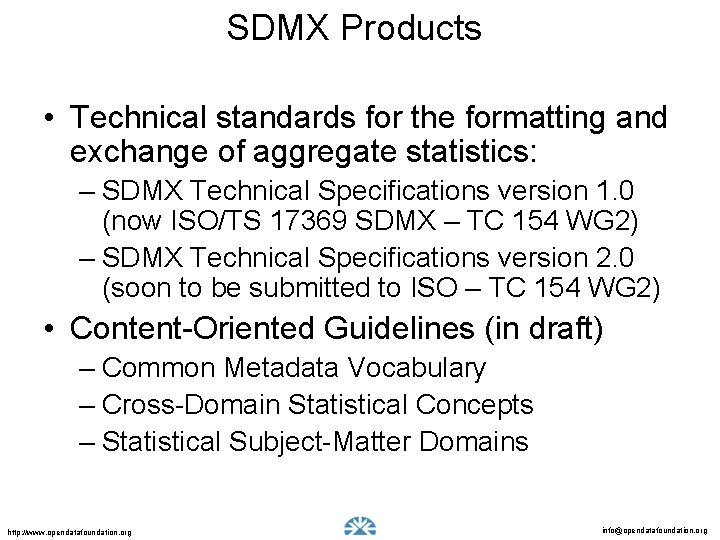
SDMX Products • Technical standards for the formatting and exchange of aggregate statistics: – SDMX Technical Specifications version 1. 0 (now ISO/TS 17369 SDMX – TC 154 WG 2) – SDMX Technical Specifications version 2. 0 (soon to be submitted to ISO – TC 154 WG 2) • Content-Oriented Guidelines (in draft) – Common Metadata Vocabulary – Cross-Domain Statistical Concepts – Statistical Subject-Matter Domains http: //www. opendatafoundation. org info@opendatafoundation. org
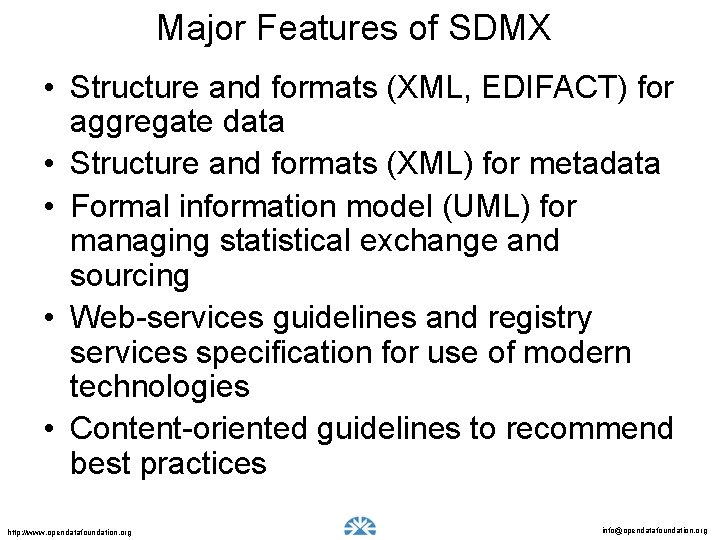
Major Features of SDMX • Structure and formats (XML, EDIFACT) for aggregate data • Structure and formats (XML) for metadata • Formal information model (UML) for managing statistical exchange and sourcing • Web-services guidelines and registry services specification for use of modern technologies • Content-oriented guidelines to recommend best practices http: //www. opendatafoundation. org info@opendatafoundation. org
Recent Events • Jan 2007 – Launch meeting at the World Bank for SDMX 2. 0 Technical Specifications • February 2007 – Endorsement of SDMX by EU’s Statistical Programme Committee • March 2008 – SDMX becomes the preferred standard for data and metadata of the UN Statistical Commission – Other standards were mentioned – DDI and XBRL specifically http: //www. opendatafoundation. org info@opendatafoundation. org
Adopters/Interest • The following are known adopters (or planning to adopt): – – – – – – US Federal Reserve Board and Bank of New York European Central Bank Joint External Debt Hub (WB, IMF, OECD, BIS) UN/TRADECOM at UN Statistical Division NAAWE (National Accounts from OECD/Eurostat) SODI (Eurostat and European Governments) Mexican Federal System Vietnamese Ministry of Planning and Investment Qatar Information Exchange IMF (BOP, SNA, SDDS/GDDS) Food and Agriculture Organization Millenium Development Goals (UN System, others) International Labor Organization Bank for International Settlements OECD World Bank Marchioness Islands (Spanish/Portugese Statistical Region) UNESCO (Education) Australian Bureau of Statistics Canada There are many others not listed or which we are not aware of http: //www. opendatafoundation. org info@opendatafoundation. org
Rate of Adoption • Between January 2007 and January 2008, adoption has doubled • We anticipate a similar rate of growth for the coming year – Tools are becoming available – UNSC recommendation makes it a safe course to follow for risk-averse institutions – Training courses are in increasing demand (Eurostat, Metadata Technology) – Standard data and metadata structures for many domains are being developed http: //www. opendatafoundation. org info@opendatafoundation. org
SDMX and Data
SDMX and Data Formats • SDMX provides a format for describing the structure of data (“structural metadata”) – EDIFACT (was GESMES/TS, now SDMX-EDI) – XML (SDMX-ML) • SDMX provides formats for transmission and processing of data – EDIFACT (1 message) – XML (4 different equivalent flavors for different functions) • Data is tabulated, aggregate data (eg, multidimensional/OLAP cubes) – Can be any aggregate data! • Most data formats are derived from the structural metadata (eg, XML schemas are generated for each type of structure according to the business rules) http: //www. opendatafoundation. org info@opendatafoundation. org
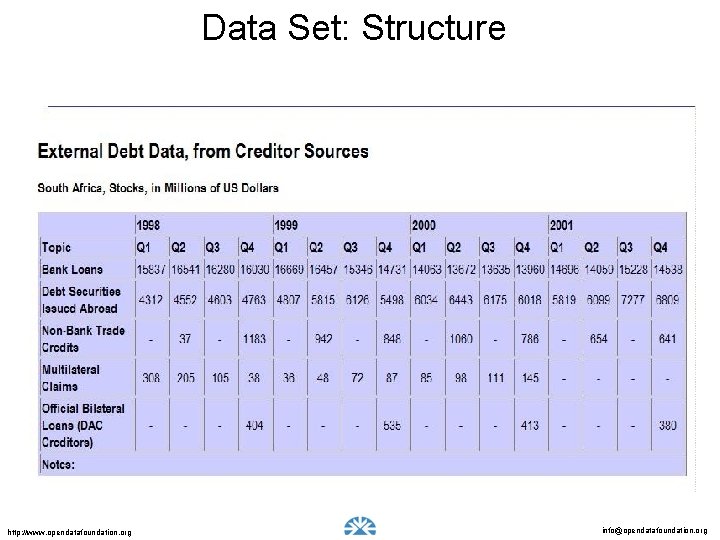
Data Set: Structure http: //www. opendatafoundation. org info@opendatafoundation. org
First: Identify the Concepts • A statistical concept is a characteristic of a time series or an observation (MCV) • A concept is a unit of knowledge created by a unique combination of characteristics (SDMX Information Model) • Whatever the definition, statistical concepts are the DNA of the key family – Their usage (type, structure, sequence) define the structure of the data http: //www. opendatafoundation. org info@opendatafoundation. org
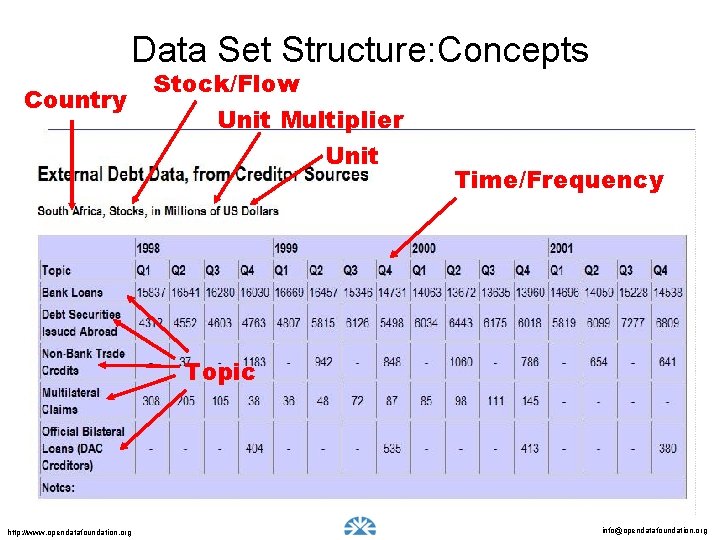
Data Set Structure: Concepts Country Stock/Flow Unit Multiplier Unit Time/Frequency Computers need structure of data • Concepts • Code lists • Data values Topic • How these fit together http: //www. opendatafoundation. org info@opendatafoundation. org
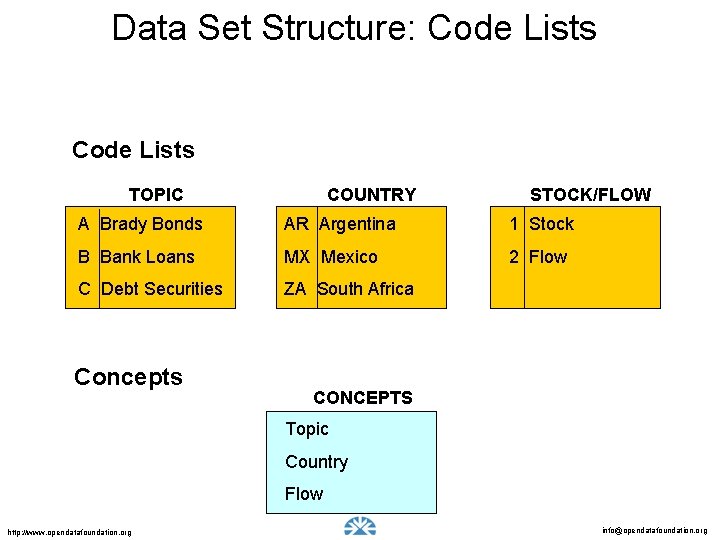
Data Set Structure: Code Lists TOPIC COUNTRY STOCK/FLOW A Brady Bonds AR Argentina 1 Stock B Bank Loans MX Mexico 2 Flow C Debt Securities ZA South Africa Concepts CONCEPTS Topic Country Flow http: //www. opendatafoundation. org info@opendatafoundation. org
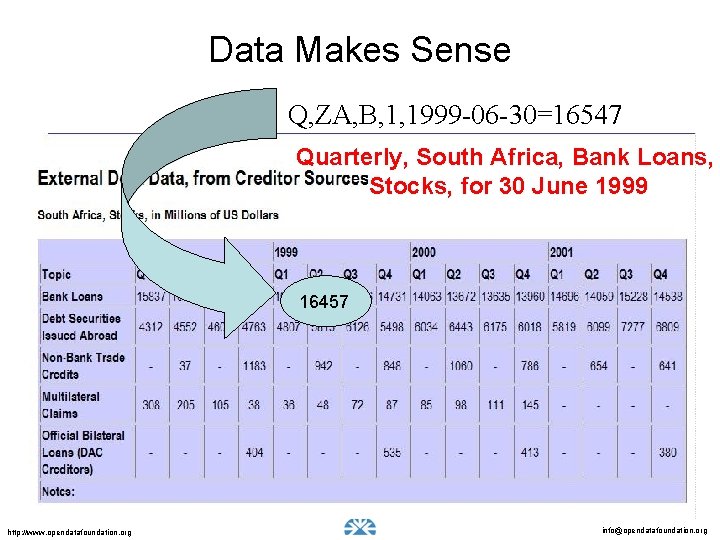
Data Makes Sense Q, ZA, B, 1, 1999 -06 -30=16547 Quarterly, South Africa, Bank Loans, Stocks, for 30 June 1999 16457 http: //www. opendatafoundation. org info@opendatafoundation. org
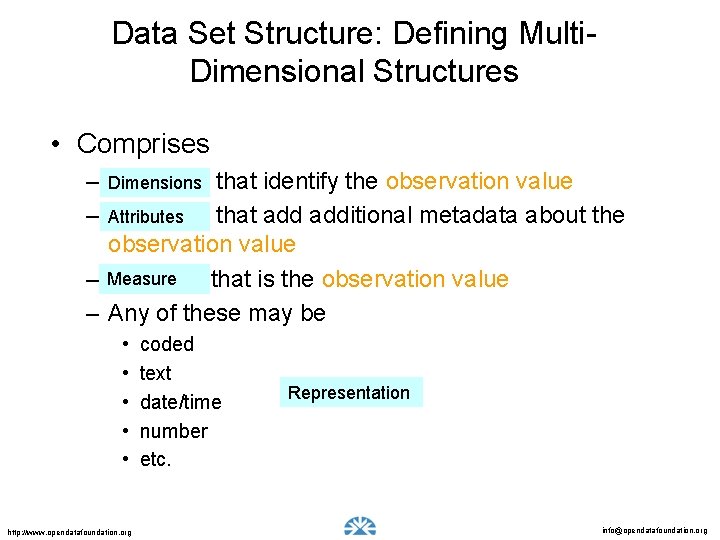
Data Set Structure: Defining Multi. Dimensional Structures • Comprises – Dimensions Concepts that identify the observation value – Attributes Concepts that additional metadata about the observation value – Measure Concept that is the observation value – Any of these may be • • • http: //www. opendatafoundation. org coded text date/time number etc. Representation info@opendatafoundation. org
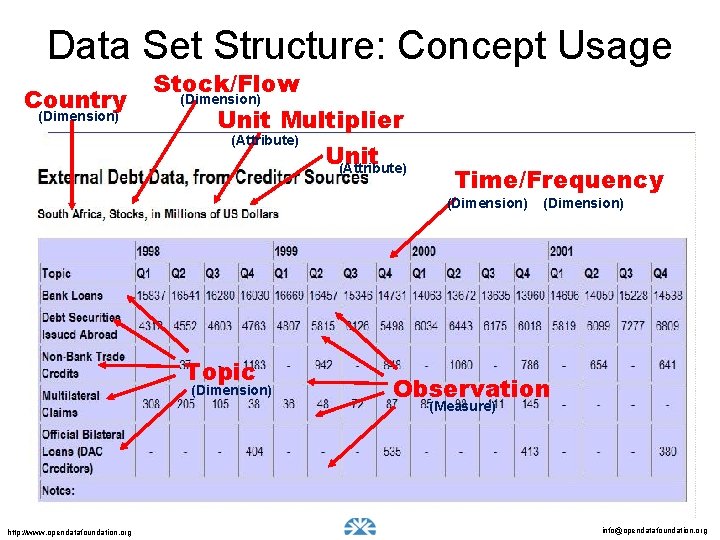
Data Set Structure: Concept Usage Country (Dimension) Stock/Flow (Dimension) Unit Multiplier (Attribute) Unit (Attribute) Time/Frequency (Dimension) Topic (Dimension) Observation (Measure) http: //www. opendatafoundation. org info@opendatafoundation. org
SDMX and Metadata
SDMX and Metadata • SDMX provides for several types of metadata – Structural (describes structures of data sets and metadata sets and related items) – Provisioning (describes the sourcing of data between departments and organizations) – “Reference” metadata – all other types of metadata (footnotes, methodology, quality, etc. Can be specified by the user!) • Reference metadata is the most important one – it is what we typically think of as metadata http: //www. opendatafoundation. org info@opendatafoundation. org
SDMX Metadata Sets • Version 2. 0 of the SDMX Technical Specifications provides XML formats for metadata sets (SDMX-ML) – To describe their structure – To exchange metadata in XML • This is based on concepts (similar to the data formats) – SDMX supports any metadata concepts the users wishes to report/exchange/process – May be flat lists or hierarchical – Definitions provided by users, but recommendations exist for many common concepts • Metadata sets are attached to a formal object in the information model (an organization, a data set, a codelist, etc. ) http: //www. opendatafoundation. org info@opendatafoundation. org
SDMX and Metadata • This is a very powerful feature of SDMX – It can be used to integrate/mimic other metadata standards! • Provides very good support for standard exchange of metadata which cannot be anticipated by the designers of systems/standards – Must be based on common agreements about the meaning of metadata concepts – Often, concepts are taken from other metadata models/standards such as DDI, Dublin Core, etc. http: //www. opendatafoundation. org info@opendatafoundation. org
The SDMX Information Model
The SDMX Information Model • A formal, documented conceptual model of statistical exchange, management, and sourcing • Expressed as a UML model • Used as the basis of all SDMX implementation – XML – EDIFACT – Any other programming language/platform • Provides consistency between implementations • Based on analysis of many statistical processing systems – Describes existing business practices in a generic way http: //www. opendatafoundation. org info@opendatafoundation. org
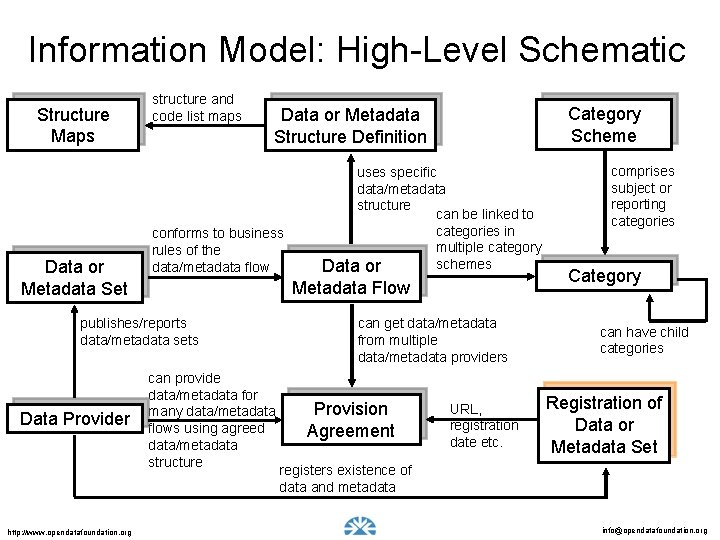
Information Model: High-Level Schematic Structure Maps Data or Metadata Set structure and code list maps conforms to business rules of the data/metadata flow http: //www. opendatafoundation. org uses specific data/metadata structure can be linked to categories in multiple category schemes Data or Metadata Flow publishes/reports data/metadata sets Data Provider Category Scheme Data or Metadata Structure Definition can provide data/metadata for many data/metadata flows using agreed data/metadata structure can get data/metadata from multiple data/metadata providers Provision Agreement URL, registration date etc. comprises subject or reporting categories Category can have child categories Registration of Data or Metadata Set registers existence of data and metadata info@opendatafoundation. org
SDMX and Best Practices: The Content-Oriented Guidelines
SDMX Content-Oriented Guidelines • There is a long history of discussion about what is best practice in the collection of statistics • SDMX decided to define the technical basis for statistical exchange, and then engage in this debate – It makes reaching agreements between organizations easier! • These documents build on many years of work defining statistical concepts, terms, and classifications • Although described as “statistical”, much of what is here also applies to social science (and other) research http: //www. opendatafoundation. org info@opendatafoundation. org
SDMX Content-Oriented Guidelines • Four main documents: – Overview – Metadata Common Vocabulary (annex) – Cross-Domain Concepts (2 annexes) – Statistical Subject-Matter Domains (annex) • These will not become ISO specifications, but will evolve as publications of the SDMX Initiative • They are now available in their first official release at www. sdmx. org http: //www. opendatafoundation. org info@opendatafoundation. org
Common Metadata Vocabulary • A set of terms and definitions for the different parts of the SDMX technical standards, and many common concepts used in data and metadata structures • Does not replace other major vocabularies in this space (such as the OECD glossary) but references these other works http: //www. opendatafoundation. org info@opendatafoundation. org
Cross-Domain Concepts • Includes concepts which are common across many statistical domains – Names & Definitions – Representations • Approximately 130 concepts, some with recommended representations (codelists) • These are concepts which support both data and metadata structures – Emphasis on quality frameworks for reference metadata concepts http: //www. opendatafoundation. org info@opendatafoundation. org
Statistical Subject-Matter Domains • Based on the UN/ECE classification of statistical activities • Provides a classification system for use in exchanging statistics across domain boundaries • Provides a breakdown of the various domains within official statistics http: //www. opendatafoundation. org info@opendatafoundation. org
SDMX and Web Services
Web-Services Components of SDMX • Web-Services Guidelines – Part of the Technical Specifications package • SDMX Query message – Part of SDMX-ML • SDMX Registry Services – Part of version 2. 0 Technical Specifications – Interfaces are in SDMX-ML – Document describes implementation rules http: //www. opendatafoundation. org info@opendatafoundation. org
Web Services Guidelines • Recommends use of WSS 1. 1 for web services which use SOAP, WSDL • Provides standard function names for many typical web-services functions – Querying for data – Querying for metadata – Querying for structural information http: //www. opendatafoundation. org info@opendatafoundation. org
SDMX Query Message • An XML Query to support two-way webservices calls using XML messages • Designed to support: – Queries for structural information from online databases/repositories – Queries for data from online databases – Queries for metadata from online databases • Part of SDMX-ML – Very similar to the SQL query language supported by all database packages – Specific to SDMX objects http: //www. opendatafoundation. org info@opendatafoundation. org
SDMX Registry Services • A “registry” is a common type of technology – Every Windows machine has a “Windows registry” to let applications know what other applications are on that machine, and where they are located – Web services registries do the same thing on a network – Functions like a card catalogue in a print library – you can look up resources and find out how to obtain them • A registry provides a single place on the Internet where everyone can discover the data, metadata, and structures that other organizations use/publish – They do not contain the data and metadata – it just indexes it and links to it http: //www. opendatafoundation. org info@opendatafoundation. org
SDMX Registry Services (cont. ) • SDMX Registry Services are based on generic, standard web-services registry technology – ISO 15000 eb. XML Registry/Repository – OASIS UDDI Registry (part of. NET, etc. ) • SDMX Registry Services are not generic – They are specific to SDMX exchanges of data and metadata, etc. • There is not one central “SDMX Registry” – Each domain will have its own registry for its members – The registries can be linked (“federated”) http: //www. opendatafoundation. org info@opendatafoundation. org
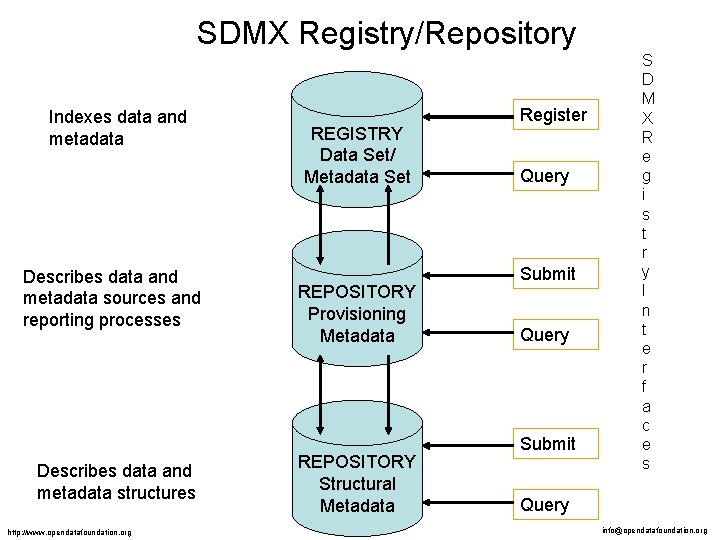
SDMX Registry/Repository Indexes data and metadata Describes data and metadata sources and reporting processes Describes data and metadata structures http: //www. opendatafoundation. org REGISTRY Data Set/ Metadata Set REPOSITORY Provisioning Metadata REPOSITORY Structural Metadata Register Query Submit S D M X R e g i s t r y I n t e r f a c e s Query info@opendatafoundation. org
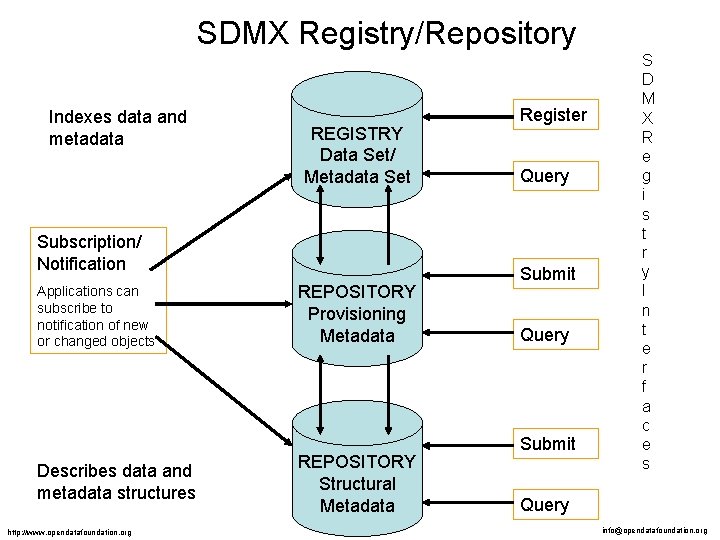
SDMX Registry/Repository Indexes data and metadata REGISTRY Data Set/ Metadata Set Subscription/ Notification Applications can subscribe to notification of new or changed objects Describes data and metadata structures http: //www. opendatafoundation. org REPOSITORY Provisioning Metadata REPOSITORY Structural Metadata Register Query Submit S D M X R e g i s t r y I n t e r f a c e s Query info@opendatafoundation. org
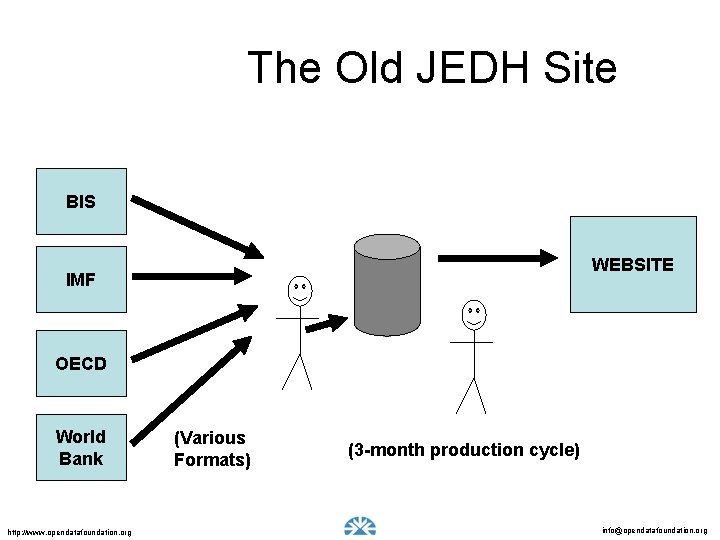
The Old JEDH Site BIS WEBSITE IMF OECD World Bank http: //www. opendatafoundation. org (Various Formats) (3 -month production cycle) info@opendatafoundation. org
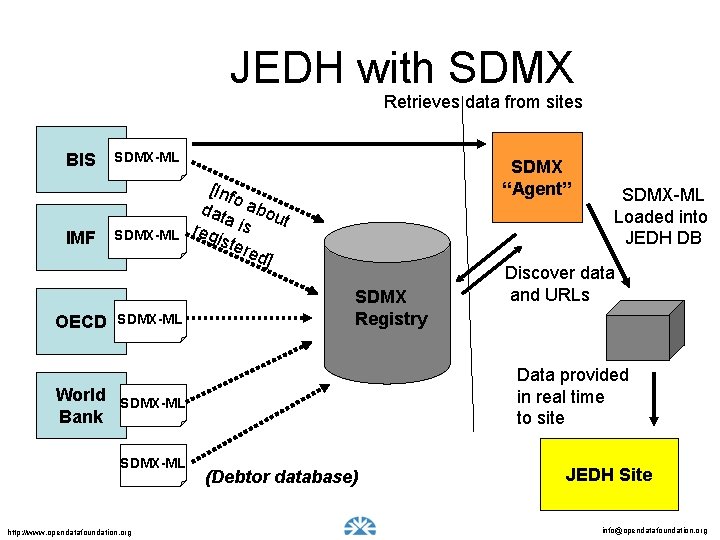
JEDH with SDMX Retrieves data from sites BIS IMF OECD World Bank SDMX-ML SDMX “Agent” [Inf o dat abou a t reg is iste red ] SDMX Registry http: //www. opendatafoundation. org Discover data and URLs Data provided in real time to site SDMX-ML Loaded into JEDH DB (Debtor database) JEDH Site info@opendatafoundation. org
Recent and On-Going Developments • Many organizations using SDMX have been implementing web services • There is growing interest in forming a working group to further extend the specification for use with web-services technology – Standard error messages – Expanded function calls – Standard WSDLs • If you are interested in this, please tell me! http: //www. opendatafoundation. org info@opendatafoundation. org
Tools and Resources
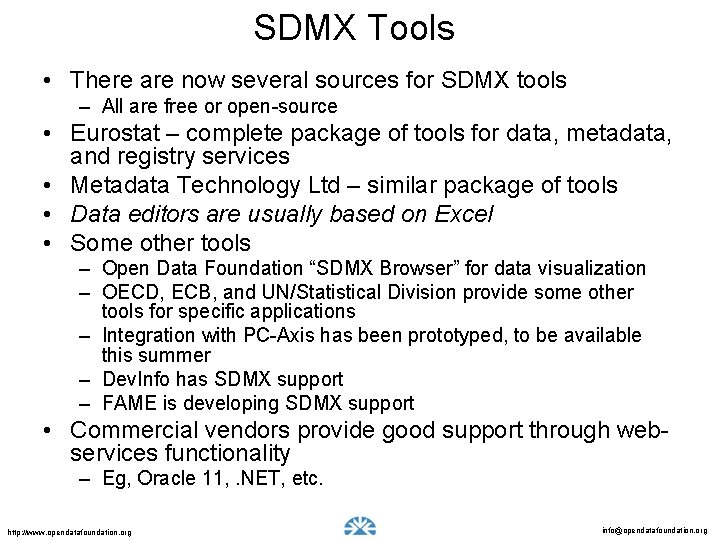
SDMX Tools • There are now several sources for SDMX tools – All are free or open-source • Eurostat – complete package of tools for data, metadata, and registry services • Metadata Technology Ltd – similar package of tools • Data editors are usually based on Excel • Some other tools – Open Data Foundation “SDMX Browser” for data visualization – OECD, ECB, and UN/Statistical Division provide some other tools for specific applications – Integration with PC-Axis has been prototyped, to be available this summer – Dev. Info has SDMX support – FAME is developing SDMX support • Commercial vendors provide good support through webservices functionality – Eg, Oracle 11, . NET, etc. http: //www. opendatafoundation. org info@opendatafoundation. org
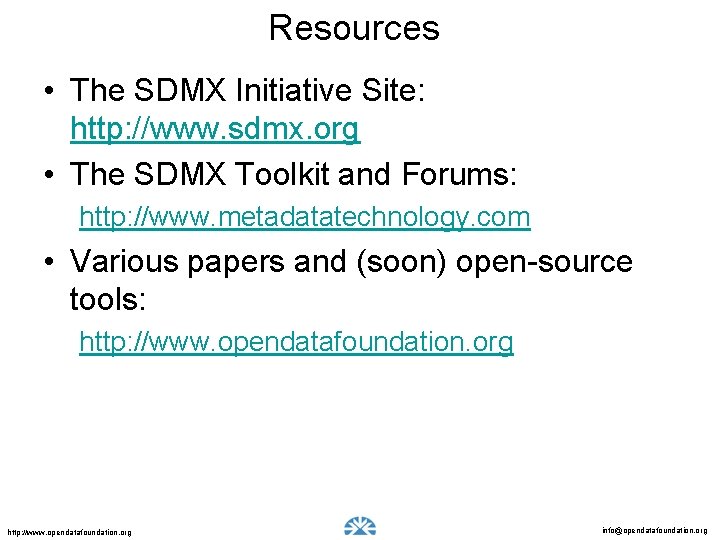
Resources • The SDMX Initiative Site: http: //www. sdmx. org • The SDMX Toolkit and Forums: http: //www. metadatatechnology. com • Various papers and (soon) open-source tools: http: //www. opendatafoundation. org info@opendatafoundation. org
IZA Data Service Center DDI/SDMX Workshop Wiesbaden, Germany, June 18 th 2008 SDMX, DDI, and Other Standards Arofan Gregory / Pascal Heus agregory@opendatafoundation. org / pheus@opendatafoundation. org Open Data Foundation
Overview of the Session • DDI/SDMX: Philosophy and Timing of Standards Development • DDI/SDMX: Points of Functional Overlap • DDI/SDMX: Direct Mappings • DDI/SDMX: Integration Approaches • Other Related Standards and On-Going Work http: //www. opendatafoundation. org info@opendatafoundation. org
DDI/SDMX: Philosophy and Timing of Development
Development Philosophies/Timing • Unlike many standards bodies, both the SDMX Initiative and the DDI Alliance have attempted to create standards which do not duplicate existing efforts – There is an awareness that users need to deal with several different standards – DDI (3. 0) and SDMX were both intentionally aligned with other, related standards • DDI 1. */2. * existed before SDMX – It was largely self-contained • SDMX was created before DDI 3. 0 existed – Created with an awareness of DDI 1. */2. * • DDI 3. 0 benefited from having SDMX as a published specification – Actively aligned with SDMX and many other standards http: //www. opendatafoundation. org info@opendatafoundation. org
SDMX Design • SDMX was intentionally designed to accommodate integration of standards which are used with the inputs to aggregate data – This included DDI and XBRL – Mechanism for integration is generic • The key point for this integration is the SDMX Registry – It provides links between aggregate (SDMX) data sets, and also to source data and metadata http: //www. opendatafoundation. org info@opendatafoundation. org
DDI/SDMX: Points of Functional Overlap
SDMX and DDI as Complementary • DDI is designed to document micro-data – 1. */2. * versions were archival, after-the-fact documentation – 3. 0 version covers entire life cycle, but still has an after-the fact function • SDMX is designed as a standard for processing and automation – It is not documentary, but is aimed at automation of statistical systems and exchanges • These purposes are related, but not duplicative – SDMX and DDI can both do useful things within a single system http: //www. opendatafoundation. org info@opendatafoundation. org
Examples • DDI could be used to document SDMX-based aggregates more completely for archival purposes • DDI could be used to document the micro-data on which aggregates are based – As soon as tabulation occurs, SDMX can be used to describe and format the data – SDMX can describe micro-data, but it is not very useful – DDI can be used to automate processing of multidimensional data cubes, but it is more difficult than with SDMX • SDMX can be used to link DDI instances with other types of standard data and metadata (including both SDMX and DDI) http: //www. opendatafoundation. org info@opendatafoundation. org
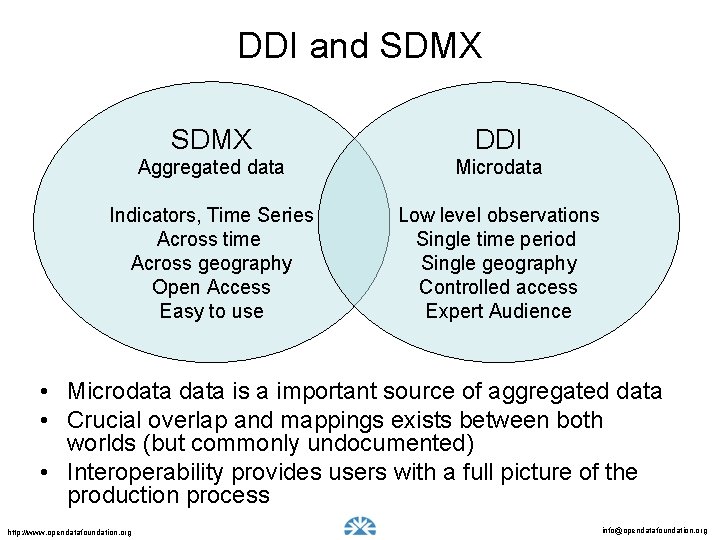
DDI and SDMX DDI Aggregated data Microdata Indicators, Time Series Across time Across geography Open Access Easy to use Low level observations Single time period Single geography Controlled access Expert Audience • Microdata is a important source of aggregated data • Crucial overlap and mappings exists between both worlds (but commonly undocumented) • Interoperability provides users with a full picture of the production process http: //www. opendatafoundation. org info@opendatafoundation. org
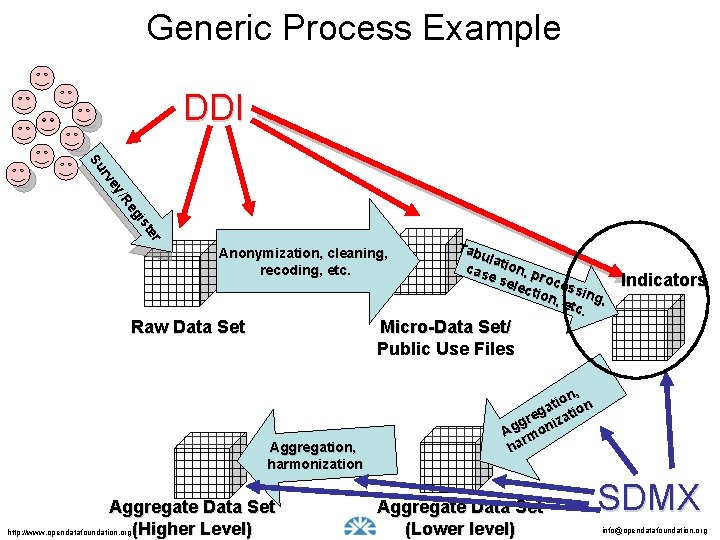
Generic Process Example DDI ve r Su eg R y/ is r te Anonymization, cleaning, recoding, etc. Raw Data Set Tab ula cas tion, p e se r lect ocess in ion , etc g, . Indicators Micro-Data Set/ Public Use Files Aggregation, harmonization Aggregate Data Set http: //www. opendatafoundation. org (Higher Level) , on n i t a o reg izati g Ag mon r ha Aggregate Data Set (Lower level) SDMX info@opendatafoundation. org
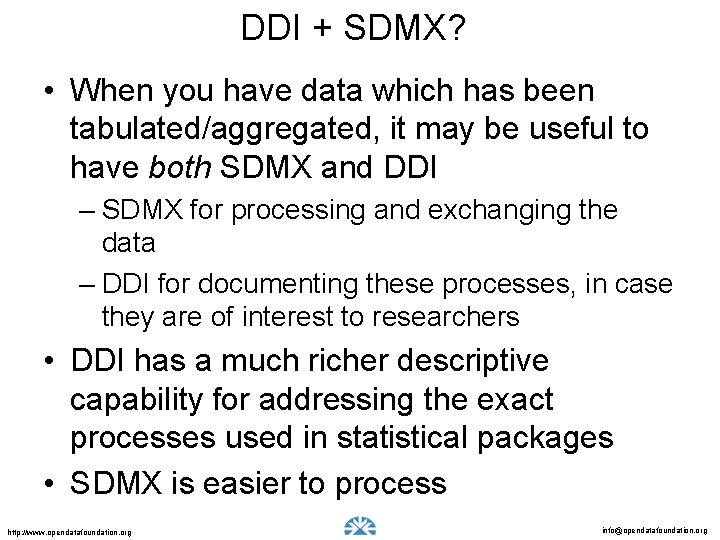
DDI + SDMX? • When you have data which has been tabulated/aggregated, it may be useful to have both SDMX and DDI – SDMX for processing and exchanging the data – DDI for documenting these processes, in case they are of interest to researchers • DDI has a much richer descriptive capability for addressing the exact processes used in statistical packages • SDMX is easier to process http: //www. opendatafoundation. org info@opendatafoundation. org
DDI/SDMX: Direct Mappings
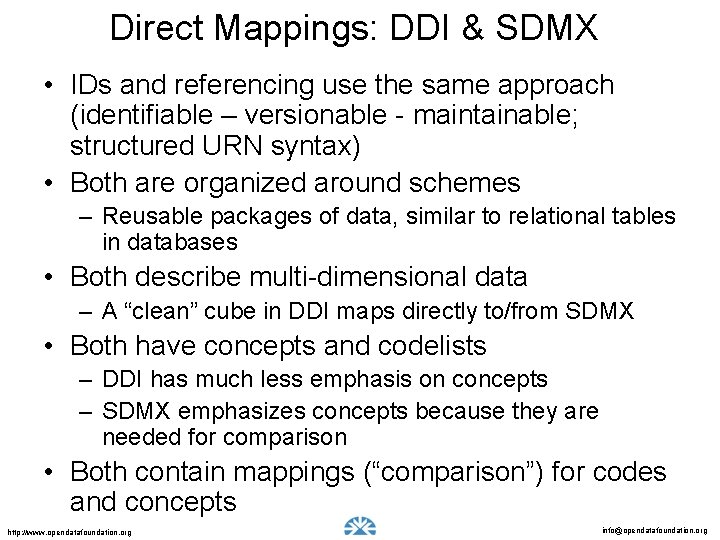
Direct Mappings: DDI & SDMX • IDs and referencing use the same approach (identifiable – versionable - maintainable; structured URN syntax) • Both are organized around schemes – Reusable packages of data, similar to relational tables in databases • Both describe multi-dimensional data – A “clean” cube in DDI maps directly to/from SDMX • Both have concepts and codelists – DDI has much less emphasis on concepts – SDMX emphasizes concepts because they are needed for comparison • Both contain mappings (“comparison”) for codes and concepts http: //www. opendatafoundation. org info@opendatafoundation. org
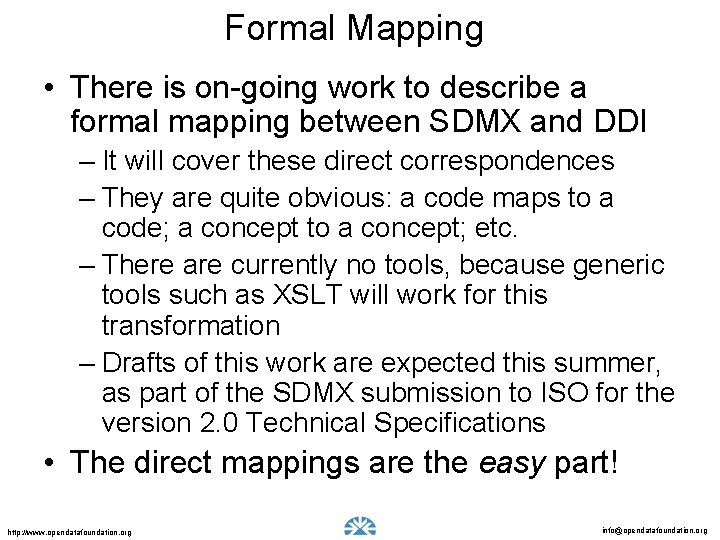
Formal Mapping • There is on-going work to describe a formal mapping between SDMX and DDI – It will cover these direct correspondences – They are quite obvious: a code maps to a code; a concept to a concept; etc. – There are currently no tools, because generic tools such as XSLT will work for this transformation – Drafts of this work are expected this summer, as part of the SDMX submission to ISO for the version 2. 0 Technical Specifications • The direct mappings are the easy part! http: //www. opendatafoundation. org info@opendatafoundation. org
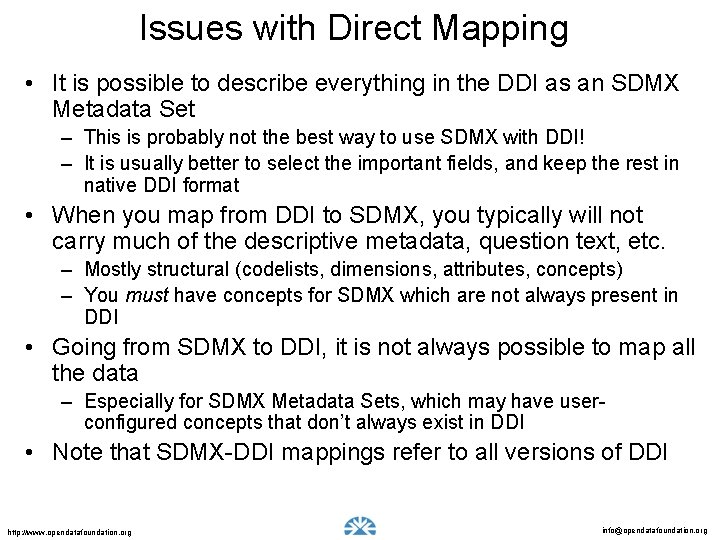
Issues with Direct Mapping • It is possible to describe everything in the DDI as an SDMX Metadata Set – This is probably not the best way to use SDMX with DDI! – It is usually better to select the important fields, and keep the rest in native DDI format • When you map from DDI to SDMX, you typically will not carry much of the descriptive metadata, question text, etc. – Mostly structural (codelists, dimensions, attributes, concepts) – You must have concepts for SDMX which are not always present in DDI • Going from SDMX to DDI, it is not always possible to map all the data – Especially for SDMX Metadata Sets, which may have userconfigured concepts that don’t always exist in DDI • Note that SDMX-DDI mappings refer to all versions of DDI http: //www. opendatafoundation. org info@opendatafoundation. org
DDI/SDMX: Integration Approaches
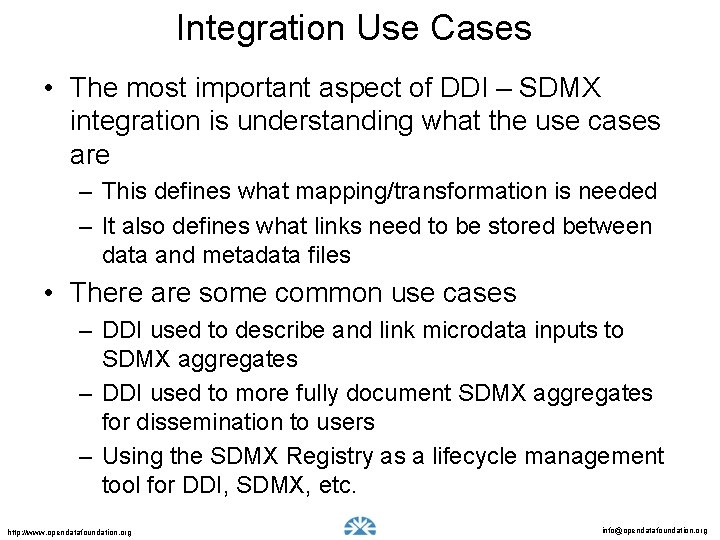
Integration Use Cases • The most important aspect of DDI – SDMX integration is understanding what the use cases are – This defines what mapping/transformation is needed – It also defines what links need to be stored between data and metadata files • There are some common use cases – DDI used to describe and link microdata inputs to SDMX aggregates – DDI used to more fully document SDMX aggregates for dissemination to users – Using the SDMX Registry as a lifecycle management tool for DDI, SDMX, etc. http: //www. opendatafoundation. org info@opendatafoundation. org
Linking Source Data and Aggregates • DDI provides a wealth of information about the micro-data which serves as an input to SDMX aggregates – It is possible to capture these links in SDMX, at the cell level or higher, to provide automated access to source data – An SDMX registry can be used to provide easy access to these links – The user/collector of aggregate data can access the rich DDI metadata, and possibly the data (if they have access rights) • It is possible to automatically generate SDMX output from the DDI metadata describing tabulation of micro-data – This may not be useful if the desired SDMX target is a standard cube structure described by another organization – It may make transformation to the standard cube easier, however • The SDMX Registry provides a good tool for managing links – Links between SDMX and DDI files are stored as Metadata Reports http: //www. opendatafoundation. org info@opendatafoundation. org
Demo: SDMX – DDI Source Links http: //www. opendatafoundation. org info@opendatafoundation. org
DDI + SDMX for Dissemination • Typically, the full DDI documentation is not provided on web-sites which publish aggregates/indicators • SDMX is becoming a popular dissemination format for these data – It has been shown to increase the use of data on the Web • If the DDI documentation is available, this could also be delivered as additional documentation – Especially useful at study level – Links could be directly embedded in SDMX data files as attributes or stored in an SDMX Registry, or both http: //www. opendatafoundation. org info@opendatafoundation. org
The SDMX Registry for Lifecycle Management • The SDMX Registry provides a tool for tracking the sources of data for aggregates • It can also track the transformation of versions of DDI as the data moves through the lifecycle • There is an SDMX model for processes – This can be used to describe the DDI lifecycle model – SDMX Metadata Reports can be used to link DDI metadata to specific stages of the DDI lifecycle, and to each other • Applications could query the SDMX Registry to discover all of the DDI metadata produced upstream, as micro-data is collected and processed http: //www. opendatafoundation. org info@opendatafoundation. org
Demos • SDMX Metadata Report used to express DDI metadata • SDMX Metadata Report used to link DDI instances http: //www. opendatafoundation. org info@opendatafoundation. org
Other Related Standards and On. Going Work
Many Related Standards • DDI • SDMX • ISO/IEC 11179 – concept management and semantic modelling • ISO 19115 – Geographical metadata • METS – packaging/archiving of digital objects • PREMIS – Archival lifecycle metadata • XBRL – business reporting • Dublin Core – citation metadata • Standard mappings are being defined by people from many different organizations (see presentation from METIS 2008 in Luxembourg) http: //www. opendatafoundation. org info@opendatafoundation. org
ISO/IEC 11179 • ISO/IEC 11179 is used to describe the meanings and representations of terms and concepts • Both SDMX and DDI are aligned with ISO/IEC 11179 – SDMX and DDI concepts can be defined using the ISO/IEC 11179 attributes – Codelists and categories can be directly mapped (and other representations) – ISO/IEC 11179 can be implemented with DDI (directly, for concepts) and/or with SDMX (as a Metadata Report) – ISO/IEC 11179 has no standard expression in XML – it is just a model http: //www. opendatafoundation. org info@opendatafoundation. org
ISO 19115 Geographical Metadata • ISO 19115 describes geographies (bounding boxes for countries, etc. ) • DDI uses the ISO 19115 model in its own XML – It does not use the standard ISO 19115 XML format, but there is a 1 -to-1 mapping • SDMX could model ISO 19115 if desired – Linking to DDI or ISO 19115 XML is probably more useful, using the standard SDMX mechanism – Most geographies in SDMX aggregate data sets are coded, not directly described http: //www. opendatafoundation. org info@opendatafoundation. org
METS • METS is used to package a set of files which work together as a digital object • Both DDI and SDMX metadata could be placed inside a METS wrapper – They would be “metadata sections” – The primary use case would be for archiving of a set of related data and metadata files, possibly with other related materials such as research publications http: //www. opendatafoundation. org info@opendatafoundation. org
PREMIS • PREMIS allows for the capture of administrative metadata as a collection is placed and managed within the archive • DDI and SDMX files would be treated like any other files forming part of the collection – Both may contain metadata which can be extracted and used to populate PREMIS instances (access levels, confidentiality, etc. ) http: //www. opendatafoundation. org info@opendatafoundation. org
XBRL • XBRL is used by business to report required information to national supervisory bodies – This includes banking supervision and other economic data – XBRL is a source format for some aggregate statistics • XBRL International and the SDMX Sponsors are working together to define a cross-walk between the two standards http: //www. opendatafoundation. org info@opendatafoundation. org
Dublin Core • Dublin Core is used to capture citationtype metadata for resources on the Internet and elsewhere – It is widely used in digital repositories for research papers • DDI has the basic Dublin Core XML format as an integral part of the DDI 3. 0 specification • Dublin Core can be easily mimicked as an SDMX Metadata Report [Demo] http: //www. opendatafoundation. org info@opendatafoundation. org
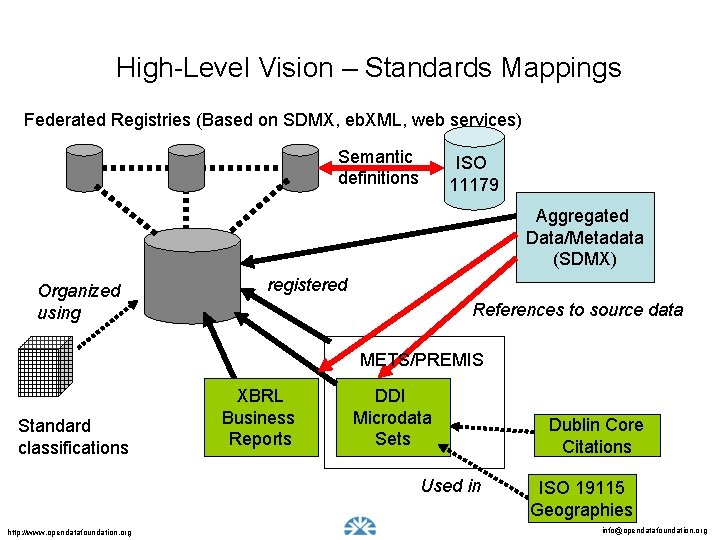
High-Level Vision – Standards Mappings Federated Registries (Based on SDMX, eb. XML, web services) Semantic definitions ISO 11179 Aggregated Data/Metadata (SDMX) Organized using registered References to source data METS/PREMIS Standard classifications XBRL Business Reports DDI Microdata Sets Used in http: //www. opendatafoundation. org Dublin Core Citations ISO 19115 Geographies info@opendatafoundation. org
- Slides: 138