
IX cerebrum 83 of total brain mass A
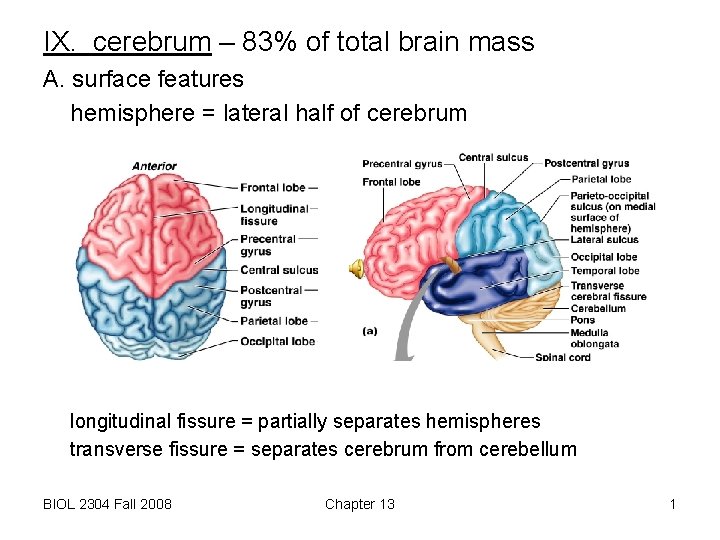
IX. cerebrum – 83% of total brain mass A. surface features hemisphere = lateral half of cerebrum longitudinal fissure = partially separates hemispheres transverse fissure = separates cerebrum from cerebellum BIOL 2304 Fall 2008 Chapter 13 1
convolutions - increase surface area of cerebral cortex sulcus/sulci = grooves on surface of cerebrum gyrus/gyri = ridges between sulci BIOL 2304 Fall 2008 Chapter 13 2
lobes = 5 major divisions of cerebral cortex frontal, parietal , temporal , occipital , insula (deep) central sulcus separates frontal and parietal lobes parieto-occipital sulcus separates parietal and occipital lobes lateral sulcus separates temporal lobe from frontal and parietal lobes BIOL 2304 Fall 2008 Chapter 13 3
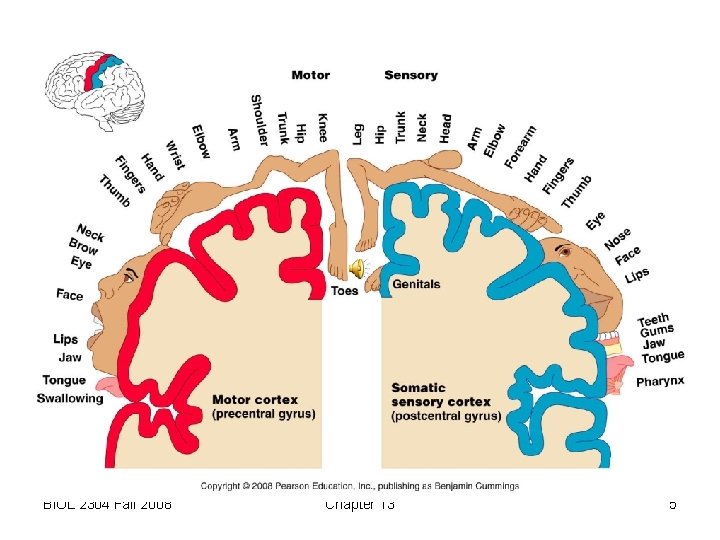
B. layers: 1. cerebral cortex • 2 -4 mm thick • 6 layers of cell bodies and dendrites • 40% of brain mass • subdivided into functional areas (refer to handout) • sensory areas allow perception of sensation • association areas integrate and store information • motor areas control voluntary movement • some areas show spatial organization (somatotopy) primary motor cortex primary somatosensory cortex size of cortical area associated with body area represents motor: degree of innervation, precision of control sensory: sensitivity or accuracy BIOL 2304 Fall 2008 Chapter 13 4
BIOL 2304 Fall 2008 Chapter 13 5
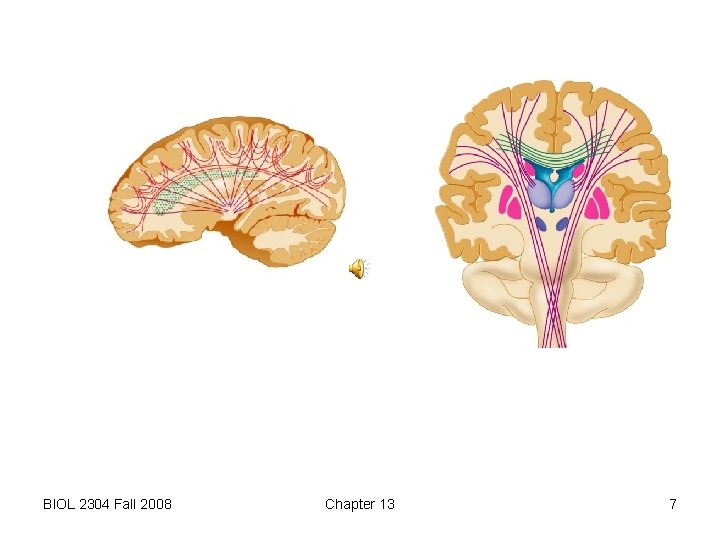
2. cerebral white matter • • • deep to cortex mostly superficial to basal nuclei made of myelinated axons form tracts that connect different areas three types of tracts: association commissural example: corpus callosum passes superior to lateral ventricles connects cerebral hemispheres projection example: internal capsule passes between thalamus and basal nuclei contains sensory and motor tracts BIOL 2304 Fall 2008 Chapter 13 6
BIOL 2304 Fall 2008 Chapter 13 7
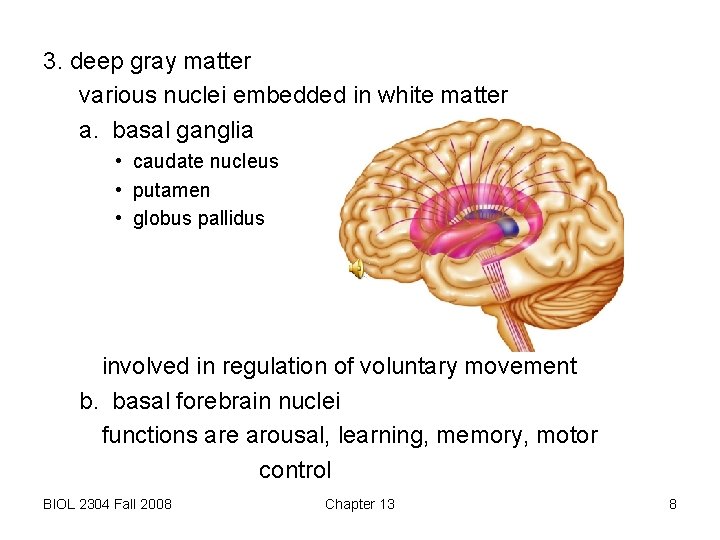
3. deep gray matter various nuclei embedded in white matter a. basal ganglia • caudate nucleus • putamen • globus pallidus involved in regulation of voluntary movement b. basal forebrain nuclei functions are arousal, learning, memory, motor control BIOL 2304 Fall 2008 Chapter 13 8
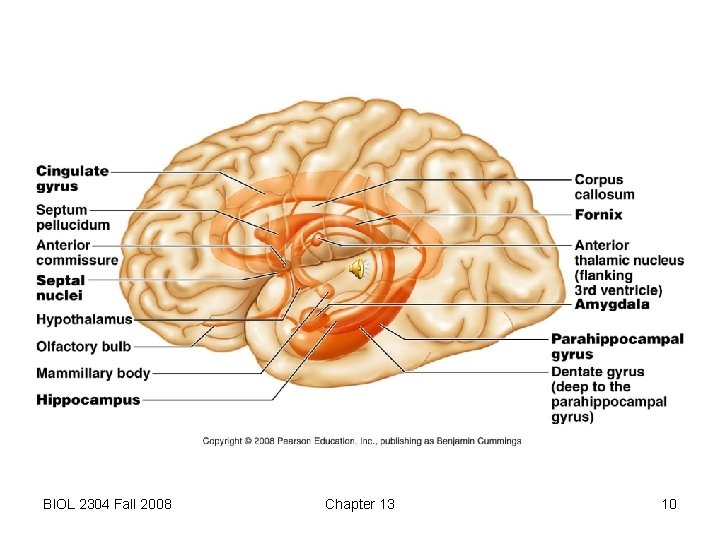
X. functional brain systems A. limbic system = emotional brain • interconnected structures in cerebrum and diencephalon: o fornix – links components together o amygdala – response to fear o hippocampal formation (hippocampus + parahippocampal gyrus) • encodes, consolidates and retrieves memories of facts and events • output is through hypothalamus and reticular formation • causes physical response to emotion • modulated by prefrontal cortex BIOL 2304 Fall 2008 Chapter 13 9
BIOL 2304 Fall 2008 Chapter 13 10
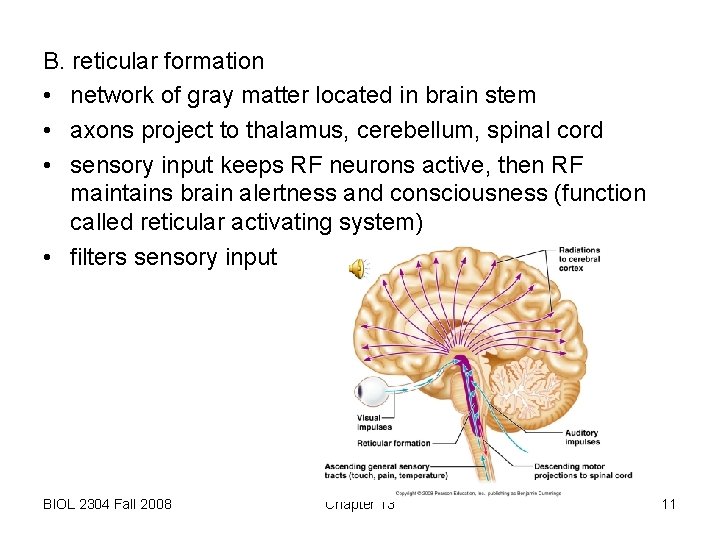
B. reticular formation • network of gray matter located in brain stem • axons project to thalamus, cerebellum, spinal cord • sensory input keeps RF neurons active, then RF maintains brain alertness and consciousness (function called reticular activating system) • filters sensory input BIOL 2304 Fall 2008 Chapter 13 11
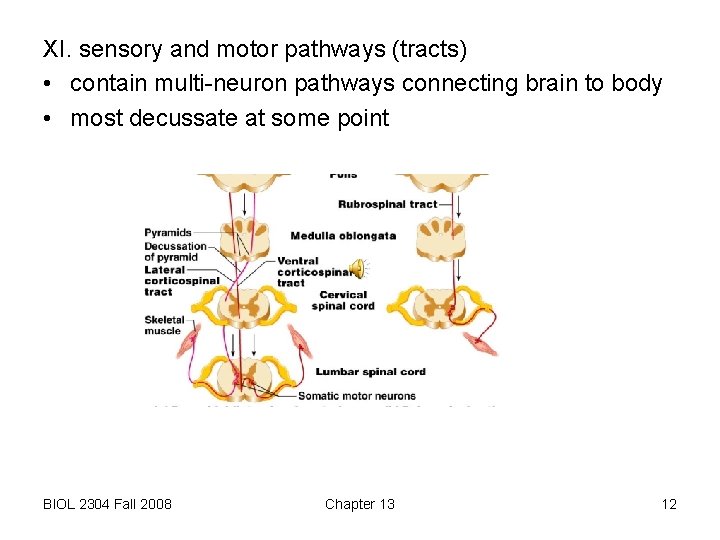
XI. sensory and motor pathways (tracts) • contain multi-neuron pathways connecting brain to body • most decussate at some point BIOL 2304 Fall 2008 Chapter 13 12
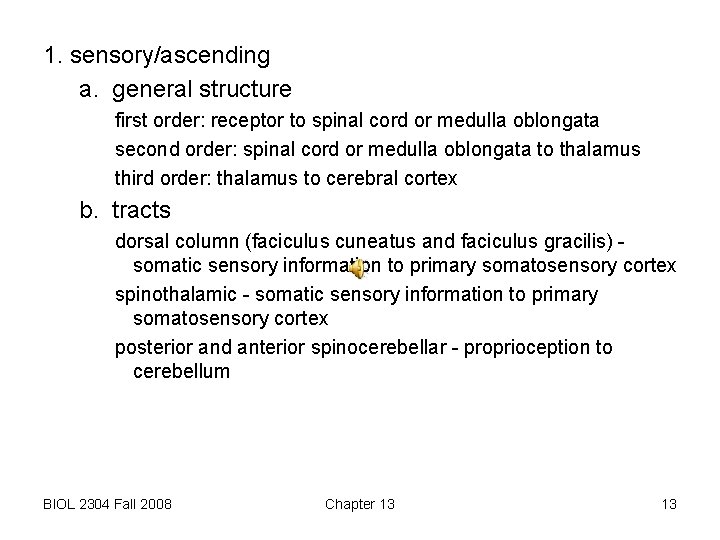
1. sensory/ascending a. general structure first order: receptor to spinal cord or medulla oblongata second order: spinal cord or medulla oblongata to thalamus third order: thalamus to cerebral cortex b. tracts dorsal column (faciculus cuneatus and faciculus gracilis) - somatic sensory information to primary somatosensory cortex spinothalamic - somatic sensory information to primary somatosensory cortex posterior and anterior spinocerebellar - proprioception to cerebellum BIOL 2304 Fall 2008 Chapter 13 13
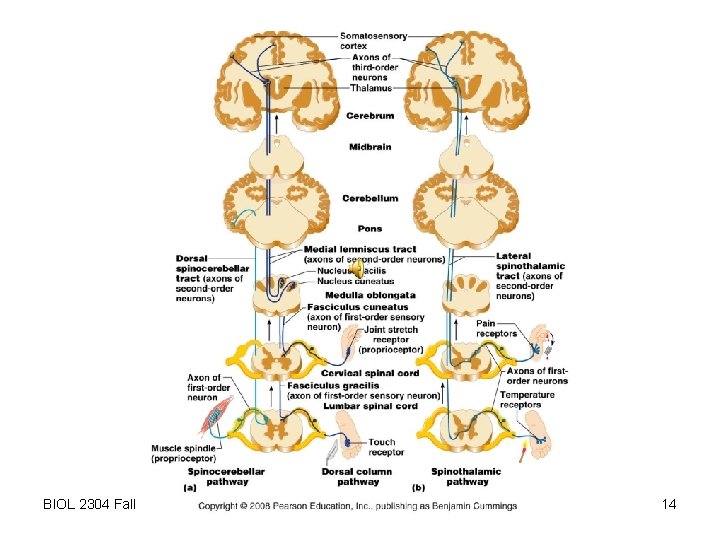
BIOL 2304 Fall 2008 Chapter 13 14
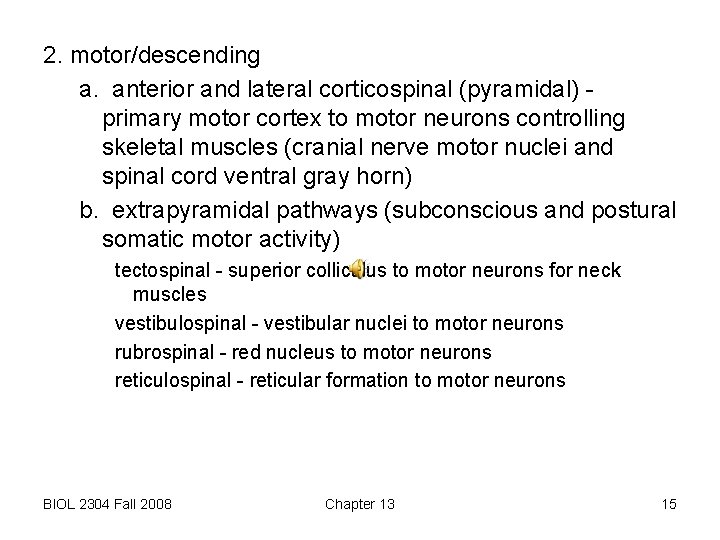
2. motor/descending a. anterior and lateral corticospinal (pyramidal) - primary motor cortex to motor neurons controlling skeletal muscles (cranial nerve motor nuclei and spinal cord ventral gray horn) b. extrapyramidal pathways (subconscious and postural somatic motor activity) tectospinal - superior colliculus to motor neurons for neck muscles vestibulospinal - vestibular nuclei to motor neurons rubrospinal - red nucleus to motor neurons reticulospinal - reticular formation to motor neurons BIOL 2304 Fall 2008 Chapter 13 15
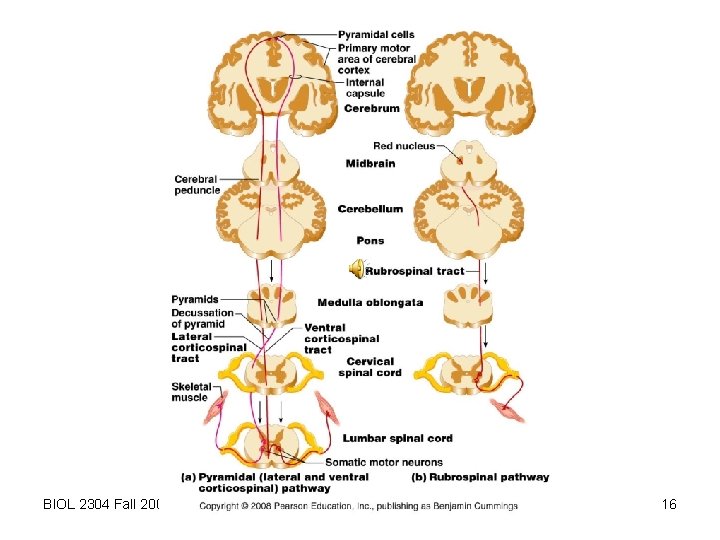
BIOL 2304 Fall 2008 Chapter 13 16
drawing of a motor pathway (corticospinal) BIOL 2304 Fall 2008 Chapter 13 17
- Slides: 17