
IWMP Strategies and Approaches in Planning and Implementation
- Slides: 16
IWMP Strategies and Approaches in Planning and Implementation of NRM works
NRM • Natural Resource Management refers to the management of natural resources such as land, water, soil, plants and animals, with a particular focus on how management affects the quality of life for both present and future generations
NRM - Objectives • To conserve & rejuvenate natural resource like soil, water & biomass • To protect fertile top soil through micro level scientific interventions • To reduce the volume & velocity of surface and sub surface runoff • To harvest rainwater so as to replenish the ground water storage • To enhance vegetative cover for mitigating drought
• To create environment friendly models in development activities • To promote & utilise indigenous knowledge and skills • Taking up activities in both private & common lands on a water shed approach • Conservation of wet lands like ponds, paddy fields, back waters and protection of mangrove forests, sacred groves, springs etc
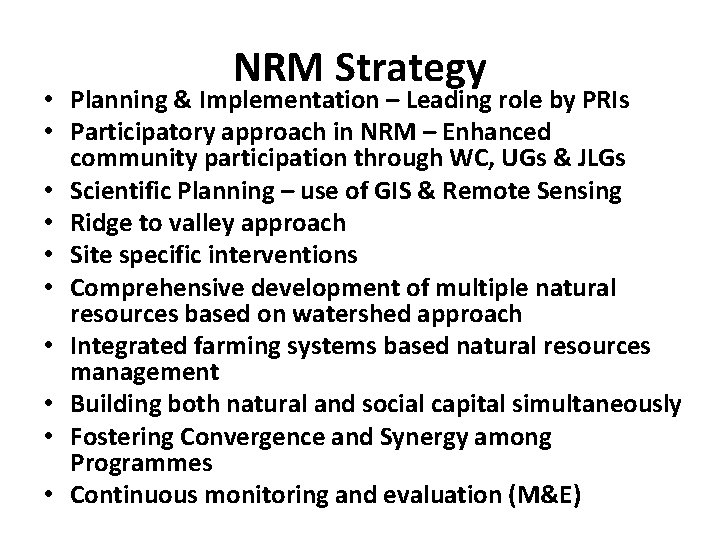
NRM Strategy • Planning & Implementation – Leading role by PRIs • Participatory approach in NRM – Enhanced community participation through WC, UGs & JLGs • Scientific Planning – use of GIS & Remote Sensing • Ridge to valley approach • Site specific interventions • Comprehensive development of multiple natural resources based on watershed approach • Integrated farming systems based natural resources management • Building both natural and social capital simultaneously • Fostering Convergence and Synergy among Programmes • Continuous monitoring and evaluation (M&E)
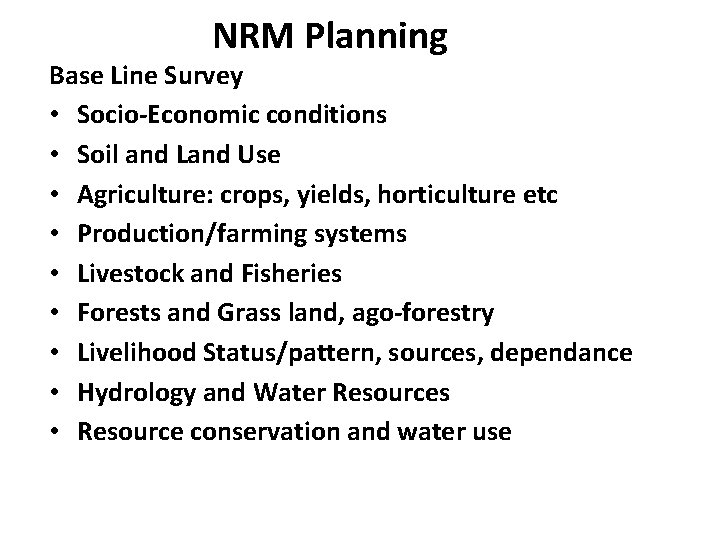
NRM Planning Base Line Survey • Socio-Economic conditions • Soil and Land Use • Agriculture: crops, yields, horticulture etc • Production/farming systems • Livestock and Fisheries • Forests and Grass land, ago-forestry • Livelihood Status/pattern, sources, dependance • Hydrology and Water Resources • Resource conservation and water use
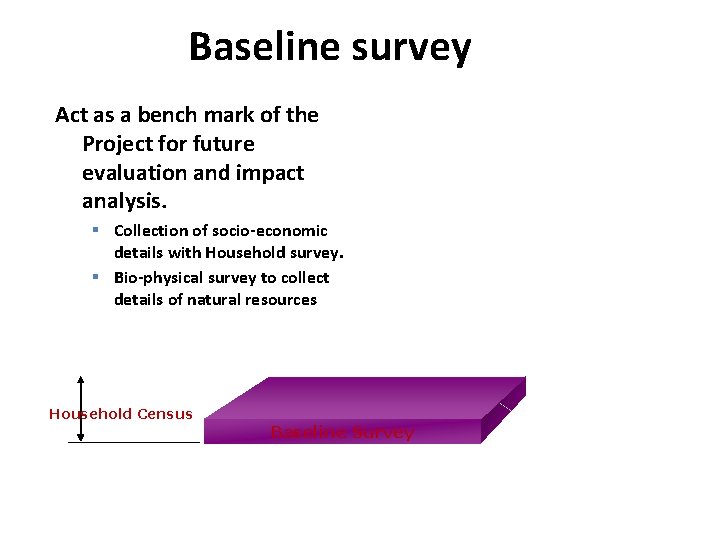
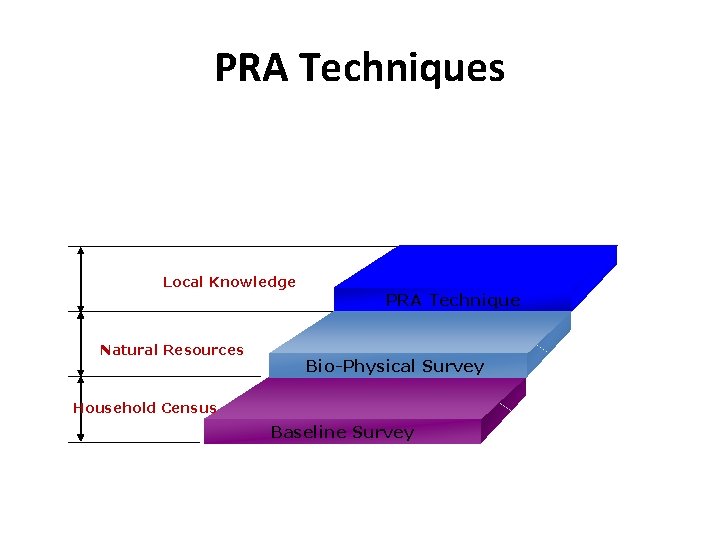
Baseline survey Act as a bench mark of the Project for future evaluation and impact analysis. § Collection of socio-economic details with Household survey. § Bio-physical survey to collect details of natural resources Household Census Baseline Survey
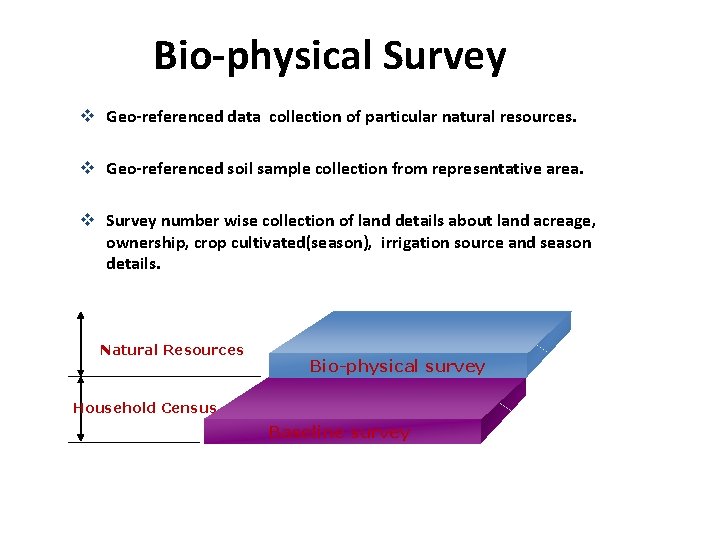
Bio-physical Survey v Geo-referenced data collection of particular natural resources. v Geo-referenced soil sample collection from representative area. v Survey number wise collection of land details about land acreage, ownership, crop cultivated(season), irrigation source and season details. Natural Resources Bio-physical survey Household Census Baseline survey
PRA Techniques Local Knowledge Natural Resources PRA Technique Bio-Physical Survey Household Census Baseline Survey
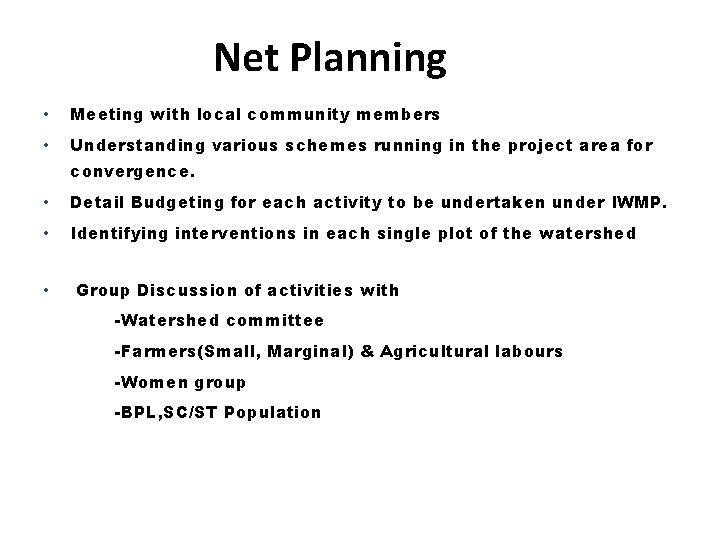
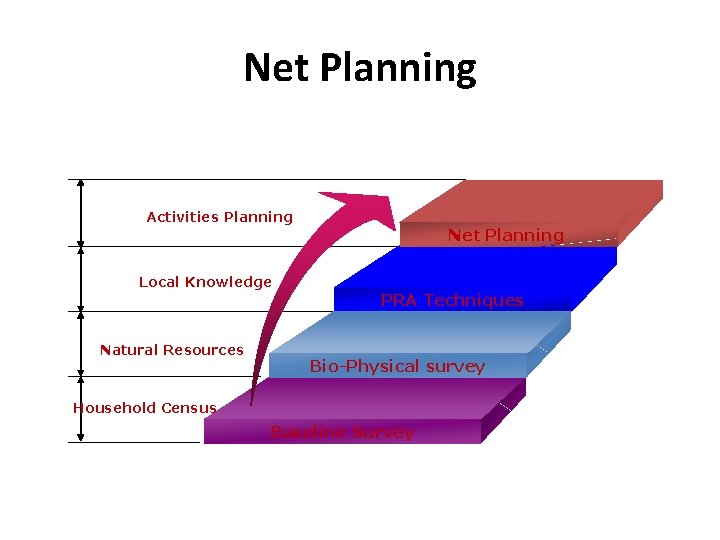
Net Planning • Meeting with local community members • Understanding various schemes running in the project area for convergence. • Detail Budgeting for each activity to be undertaken under IWMP. • Identifying interventions in each single plot of the watershed • Group Discussion of activities with -Watershed committee -Farmers(Small, Marginal) & Agricultural labours -Women group -BPL, SC/ST Population
Net Planning Activities Planning Local Knowledge Natural Resources Net Planning PRA Techniques Bio-Physical survey Household Census Baseline Survey
NRM activities envisaged in IWMP • • • Afforestation Staggered trenching Contour and graded bunding Bench terracing Land development Vegetative reinforcement Live fencing Mulching Agro-forestry
Drainage line treatment with a combination of vegetative and engineering structures • Earthen checks • Brushwood checks • Gully plugs • Loose boulder checks • Gabion structures • Underground dykes
Development of water harvesting structures • Low-cost farm ponds • Check-dams • Percolation tanks/pits • Pond Renovation • Ground water recharge through wells, bore wells, and other measures • Rain water harvesting structures
NRM Implementation • Works in common land – by UGs • In private land – by the individual beneficiaries coordinated by beneficiary groups • Estimates by WDT Engineers • TS & Check Measurement by LSGD Engineers • Approved rates of PWD/Soil Conservation/Agriculture/Forest or Local rates
• TS & Check Measurement is not required for those works taken up under approved unit cost • Mobilization advance & part payments for UGs • WDF for works in private land • All financial transactions only with the approval of WCs • Documentation of works in all stages • Information Boards should be exhibited at worksite • Social Audit by Grama Sabha