
IV UNIT CONTOURS TOPO SHEET 2112022 2 2112022



- Slides: 54
IV UNIT CONTOURS
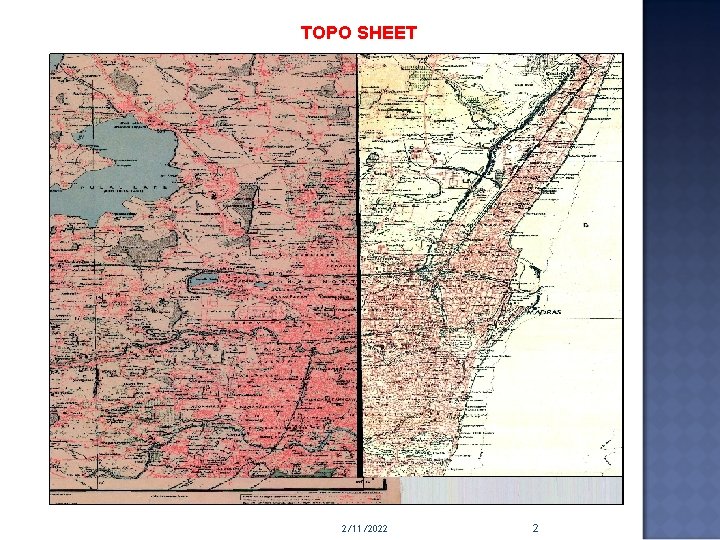
TOPO SHEET 2/11/2022 2
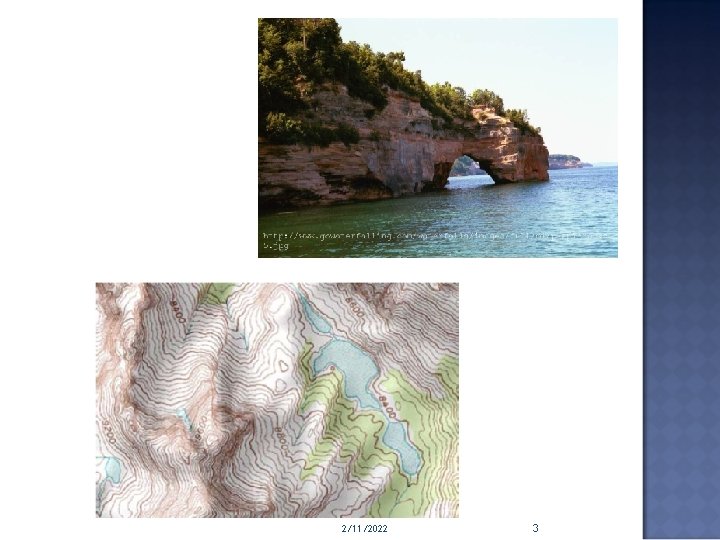
2/11/2022 3
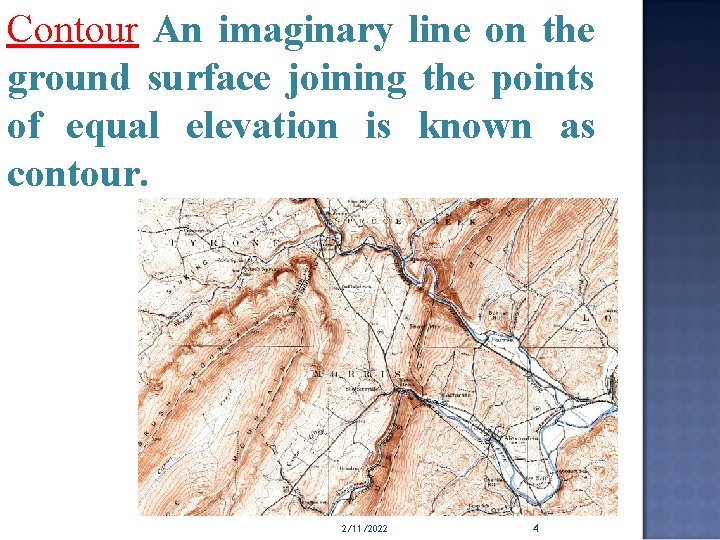
Contour An imaginary line on the ground surface joining the points of equal elevation is known as contour. 2/11/2022 4
Contour line This line on the map represents a contour is called contour line. Contour Map A map showing contour lines is known as Contour map. A contour map gives an idea of the altitudes of the surface features as well as their relative positions in plan serves the purpose of both, a plan and a section. Contouring The process of tracing contour lines on the surface of the earth is called Contouring. 2/11/2022 5
PURPOSE OF CONTOURING Contour survey is carried out at the starting of any engineering project such as a road, a railway, a canal, a dam, a building etc. i) For preparing contour maps in order to select the most economical or suitable site. ii) To locate the alignment of a canal so that it should follow a ridge line. iii) To mark the alignment of roads and railways so that the quantity of earthwork both in cutting and filling should be minimum. 2/11/2022 6
PURPOSE OF CONTOURING (contd. ) iv) For getting information about the ground whether it is flat, undulating or mountainous. v) To find the capacity of a reservoir and volume of earthwork especially in a mountainous region. vi) To trace out the given grade of a particular route. vii)To locate the physical features of the ground such as a pond depression, hill, steep or small slopes. 2/11/2022 7
CONTOUR INTERVAL The constant vertical distance between two consecutive contours is called the contour interval. HORIZONTAL EQUIVALENT The horizontal distance between any two adjacent contours is called as horizontal equivalent. The contour interval is constant between the consecutive contours while the horizontal equivalent is variable and depends upon the slope of the ground. 2/11/2022 8
FACTORS ON WHICH CONTOUR INTERVAL DEPENDS The contour interval depends upon the following factors: i) The Nature of the Ground In flat and uniformly sloping country, the contour interval is small , but in broken and mountainous region the contour interval should be large otherwise the contours will come too close to each other. 2/11/2022 9
FACTORS ON WHICH CONTOUR -INTERVAL DEPENDS ii) The Purpose and extent of the survey. Contour interval is small if the area to be surveyed is small and the maps are required to be used for the design work or for determining the quantities of earth work etc. while wider interval shall have to be kept for large areas and comparatively less important works. 2/11/2022 10
FACTORS ON WHICH CONTOUR INTERVAL DEPENDS iii) The Scale of the Map. The contour interval should be in the inverse ratio to the scale of the map i. e. the smaller the scale, the greater is the contour interval. iv) Time and Expense of Field and Office work. The smaller the interval, the greater is the amount of field-work and plotting work. 2/11/2022 11
COMMON VALUES OF THE CONTOUR INTERVAL The following are the common values of the contour interval adopted for various purposes: - i) For large scale maps of flat country, for building sites, for detailed design work and for calculation of quantities of earth work; 0. 2 to 0. 5 m. 2/11/2022 12
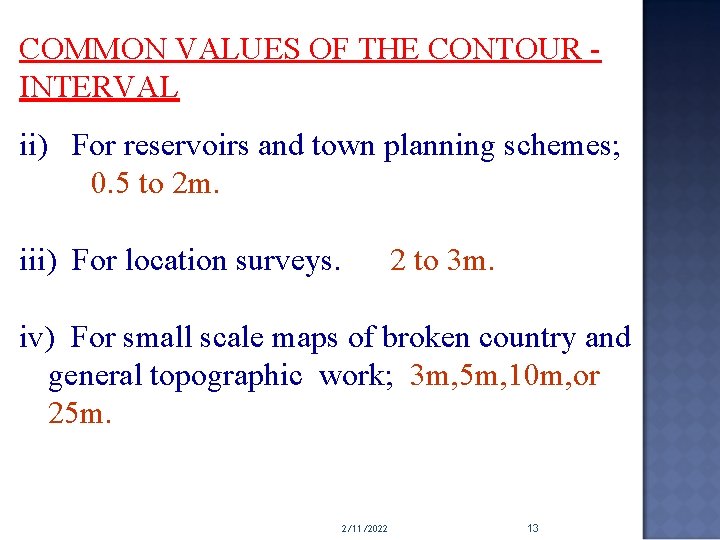
COMMON VALUES OF THE CONTOUR INTERVAL ii) For reservoirs and town planning schemes; 0. 5 to 2 m. iii) For location surveys. 2 to 3 m. iv) For small scale maps of broken country and general topographic work; 3 m, 5 m, 10 m, or 25 m. 2/11/2022 13
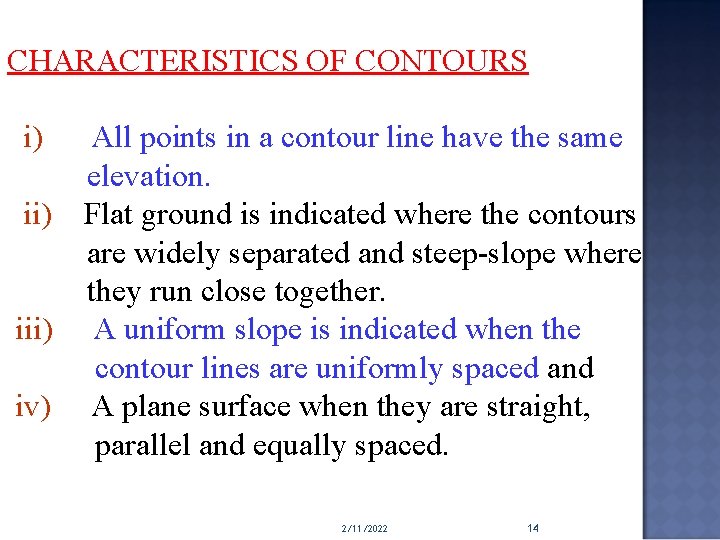
CHARACTERISTICS OF CONTOURS i) All points in a contour line have the same elevation. ii) Flat ground is indicated where the contours are widely separated and steep-slope where they run close together. iii) A uniform slope is indicated when the contour lines are uniformly spaced and iv) A plane surface when they are straight, parallel and equally spaced. 2/11/2022 14
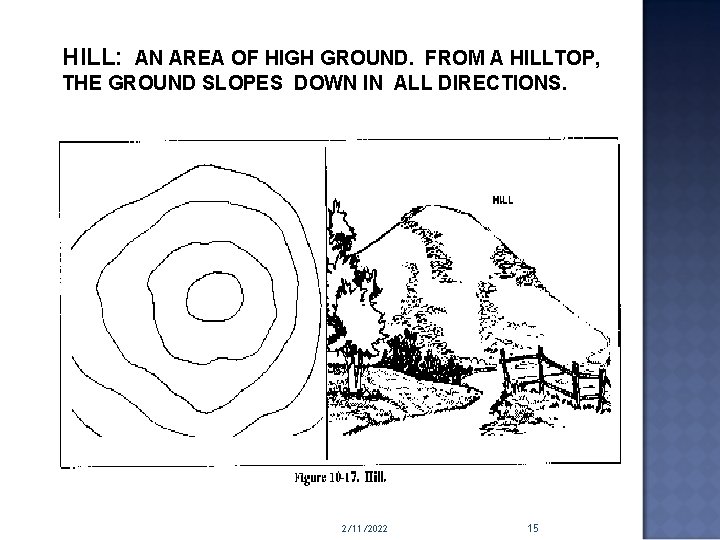
HILL: AN AREA OF HIGH GROUND. FROM A HILLTOP, THE GROUND SLOPES DOWN IN ALL DIRECTIONS. 2/11/2022 15
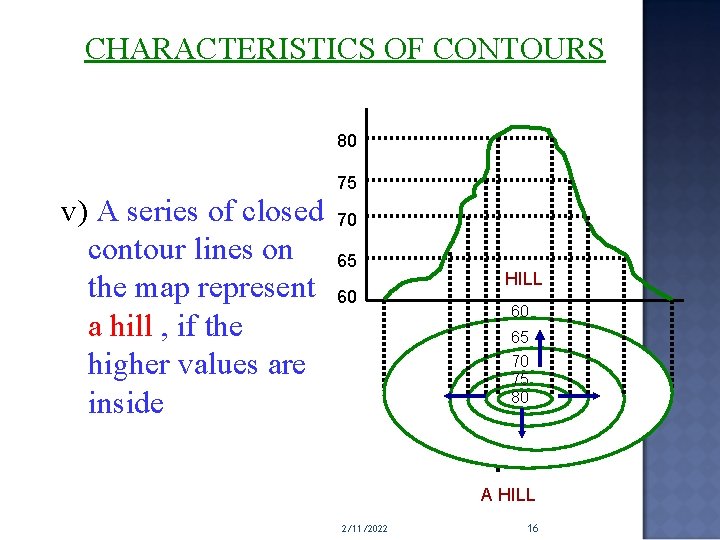
CHARACTERISTICS OF CONTOURS 80 v) A series of closed contour lines on the map represent a hill , if the higher values are inside 75 70 65 60 HILL 60 65 70 75 80 A HILL 2/11/2022 16
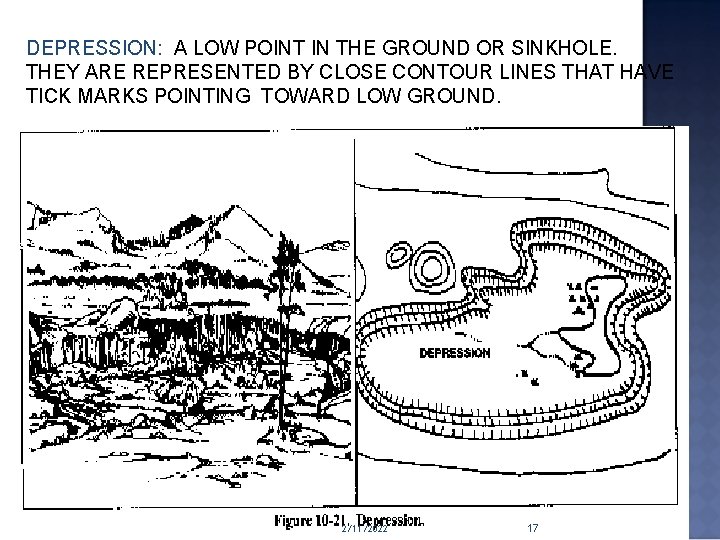
DEPRESSION: A LOW POINT IN THE GROUND OR SINKHOLE. THEY ARE REPRESENTED BY CLOSE CONTOUR LINES THAT HAVE TICK MARKS POINTING TOWARD LOW GROUND. 2/11/2022 17
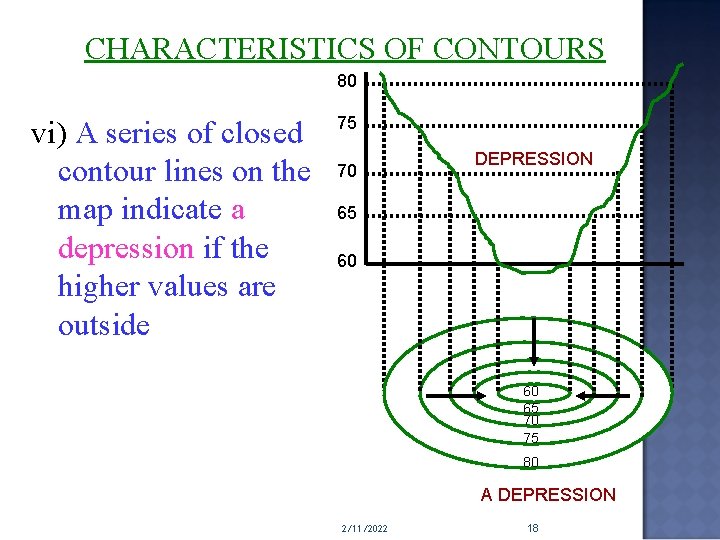
CHARACTERISTICS OF CONTOURS 80 vi) A series of closed contour lines on the map indicate a depression if the higher values are outside 75 70 DEPRESSION 65 60 70 60 65 70 75 80 A DEPRESSION 2/11/2022 18
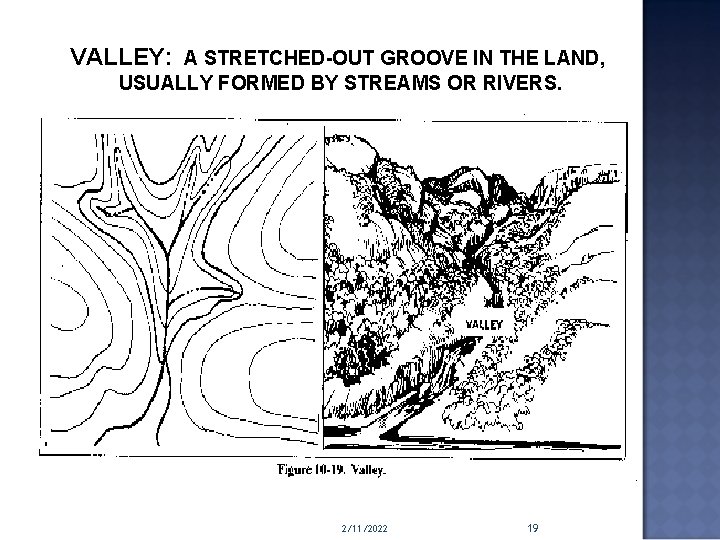
VALLEY: A STRETCHED-OUT GROOVE IN THE LAND, USUALLY FORMED BY STREAMS OR RIVERS. 2/11/2022 19
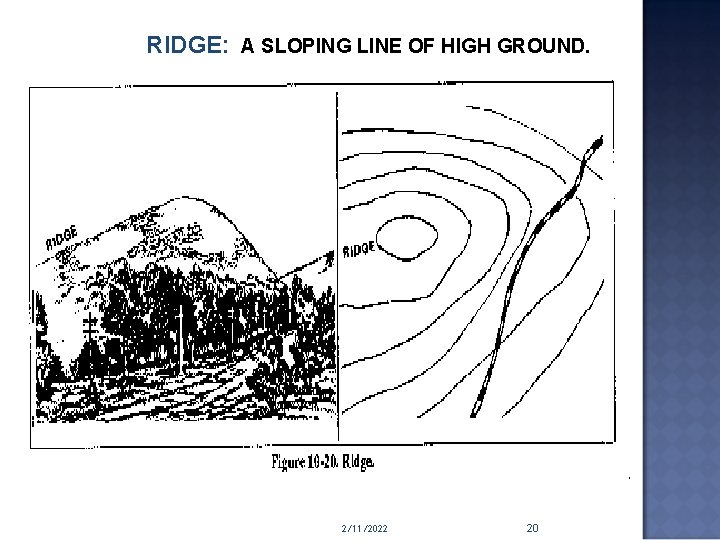
RIDGE: A SLOPING LINE OF HIGH GROUND. 2/11/2022 20
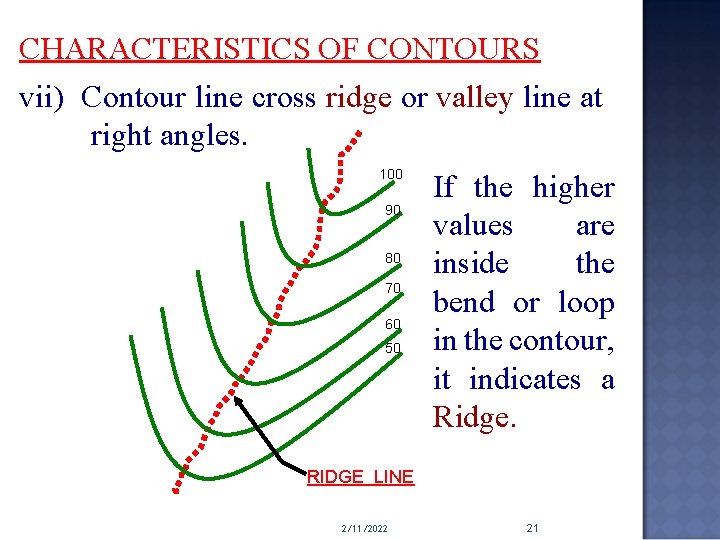
CHARACTERISTICS OF CONTOURS vii) Contour line cross ridge or valley line at right angles. 100 90 80 70 60 50 If the higher values are inside the bend or loop in the contour, it indicates a Ridge. RIDGE LINE 2/11/2022 21
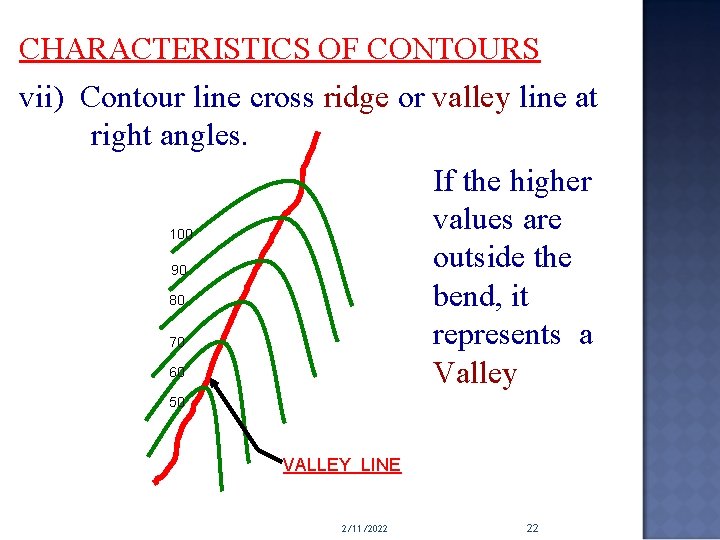
CHARACTERISTICS OF CONTOURS vii) Contour line cross ridge or valley line at right angles. If the higher values are 100 outside the 90 80 bend, it represents a 70 60 Valley 50 VALLEY LINE 2/11/2022 22
CHARACTERISTICS OF CONTOURS viii) Contours cannot end anywhere but close on themselves either within or outside the limits of the map. 2/11/2022 23
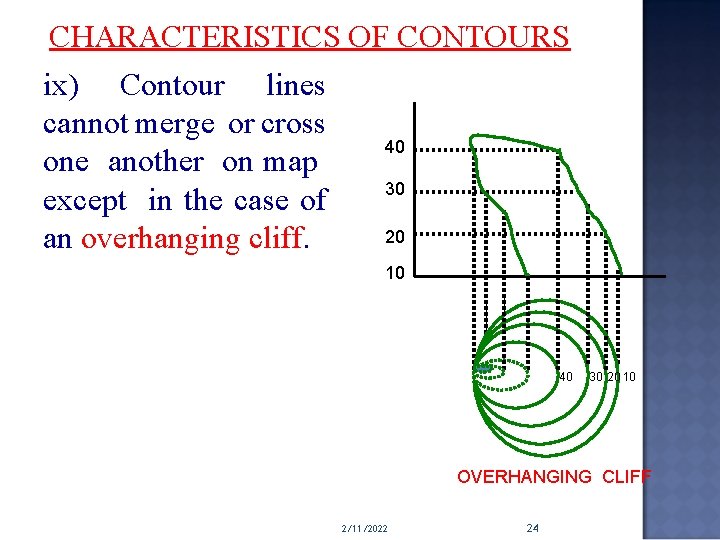
CHARACTERISTICS OF CONTOURS ix) Contour lines cannot merge or cross 40 one another on map 30 except in the case of 20 an overhanging cliff. 10 40 30 20 10 OVERHANGING CLIFF 2/11/2022 24
CHARACTERISTICS OF CONTOURS x) Contour lines never run into one another except in the case of a vertical cliff. In this case, several contours coincide and the horizontal equivalent becomes zero. 50 40 VERTICA 30 CLIFF 20 10 10 20 30 40 5050 OVERHANGING CLIFF 2/11/2022 25
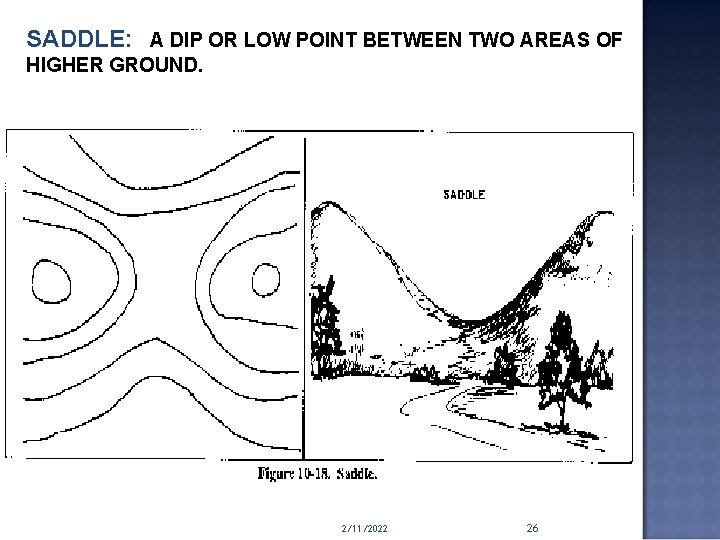
SADDLE: A DIP OR LOW POINT BETWEEN TWO AREAS OF HIGHER GROUND. 2/11/2022 26
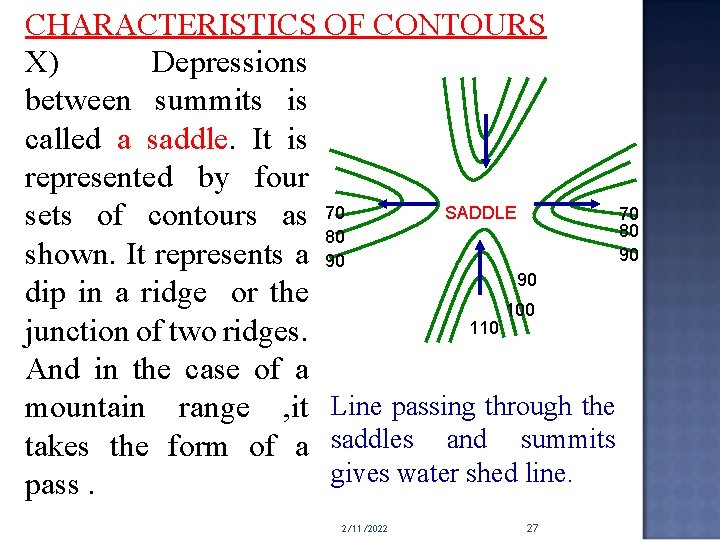
CHARACTERISTICS OF CONTOURS X) Depressions between summits is called a saddle. It is represented by four SADDLE 70 sets of contours as 70 80 80 90 shown. It represents a 90 90 dip in a ridge or the 100 110 junction of two ridges. And in the case of a mountain range , it Line passing through the takes the form of a saddles and summits gives water shed line. pass. 2/11/2022 27
METHODS OF CONTOURING �The location of point in topographic survey involves both horizontal as well as vertical control. �The methods of locating contours, therefore, depend upon the instrument used. �In general, the field method may be divided into two classes: �The direct method. �The indirect method. 2/11/2022 28
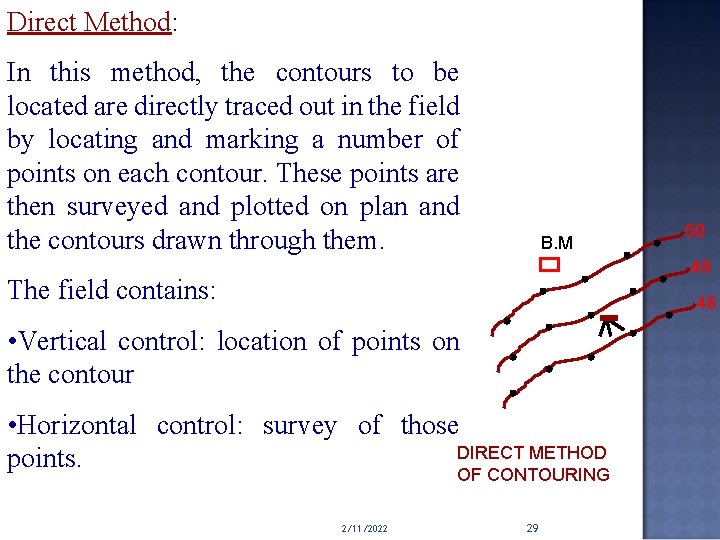
Direct Method: In this method, the contours to be located are directly traced out in the field by locating and marking a number of points on each contour. These points are then surveyed and plotted on plan and the contours drawn through them. B. M 50 48 The field contains: 46 • Vertical control: location of points on the contour • Horizontal control: survey of those DIRECT METHOD points. OF CONTOURING 2/11/2022 29
METHODS OF CONTOURING Direct Method: • This method is most accurate but very slow and tedious as a lot of time is wasted in searching points of the same elevation for a contour. • This is suitable for small area and where great accuracy is required 2/11/2022 30 23
Procedure: To start with, a temporary B. M is established near the area to be surveyed with reference to a permanent B. M by fly leveling. The level is then set up in such a position so that the maximum number of points can be commanded from the instrument station. The height of instrument is determined by taking a back sight on the B. M. and adding it to the R. L. of bench mark. The staff reading required to fix points on the various contours is determined by subtracting the R. L. of each of the contours from the height of instrument 2/11/2022 31
Example: If the height of instrument is 82. 48 m. , then the staff readings required to locate 82, 81 and 80 m contours are 0. 48, 1. 48 and 2. 48 m respectively. The staff is held on an approximate position of point and then moved up and down the slope until the desired reading is obtained. The point is marked with a peg. 2/11/2022 32
Similarly various other points are marked on each contour. The line joining all these points give the required contour. It may be noted that one contour is located at a time. Having fixed the contours within the range of the instrument, the level is shifted and set up in a new position. 2/11/2022 33
The new height of instrument and the required staff readings are then calculated in a similar manner and the process repeated till all the contours are located. The positions of the contour points are located suitably either simultaneous with levelling or afterwards. A theodolite , a compass or a plane table traversing is usually adopted for locating these points. The points are then plotted on the plan and the contours drawn by joining the corresponding points by dotted curved lines. 2/11/2022 34
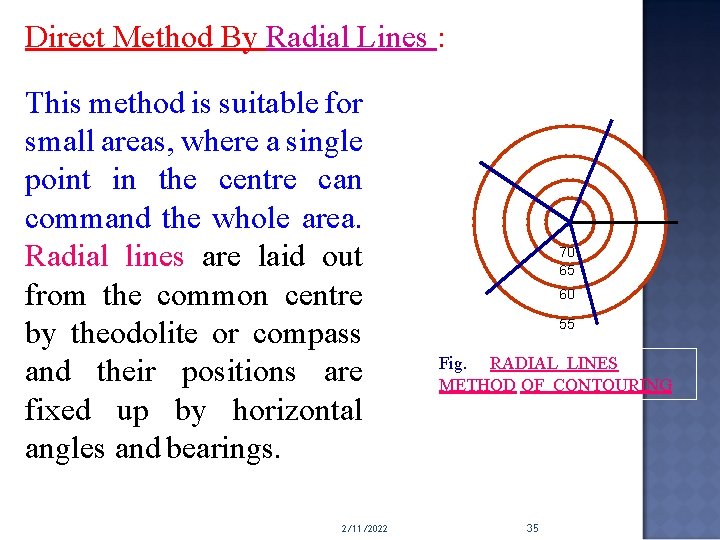
Direct Method By Radial Lines : This method is suitable for small areas, where a single point in the centre can command the whole area. Radial lines are laid out from the common centre by theodolite or compass and their positions are fixed up by horizontal angles and bearings. 2/11/2022 70 65 60 55 Fig. RADIAL LINES METHOD OF CONTOURING 35
Direct Method By Radial Lines (contd. ): Temporary bench marks are first established at the centre and near the ends of the radial lines. The contour points are then located and marked on these lines and their positions are determined by measuring their distances along the radial lines. They are then plotted on the plan and the contours drawn by joining all the corresponding points with the help of a plane table instrument. 2/11/2022 36
2. Indirect Method: In this method the points located and surveyed are not necessarily on the contour lines but the spot levels are taken along the series of lines laid out over the area. The spot levels of the several representative points representing hills, depressions, ridge and valley lines and the changes in the slope all over the area to be contoured are also observed. Their positions are then plotted on the plan and the contours drawn by interpolation. This method of contouring is also known as contouring by spot levels. 2/11/2022 37
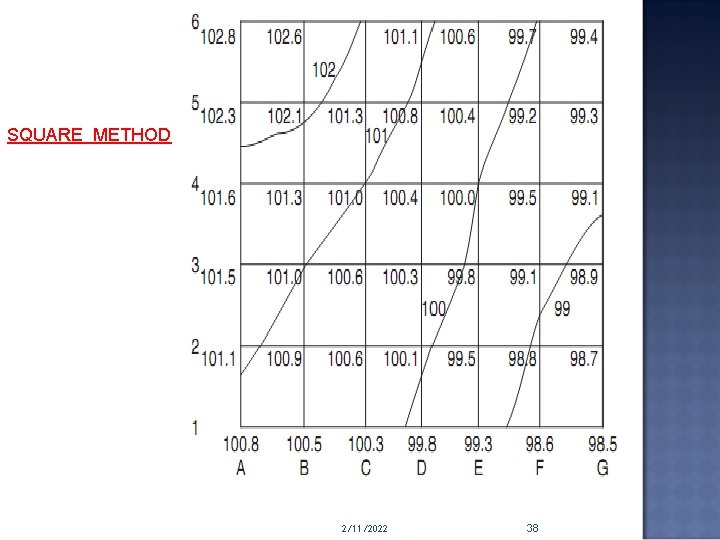
SQUARE METHOD 2/11/2022 38
This method is commonly employed in all kinds of surveys as this is cheaper, quicker and less tedious as compared to direct method. There are mainly three method of contouring in indirect method: (i) By Squares. In this method, the whole area is divided into number of squares, the side of which may vary from 5 m to 30 m depending upon the nature of the ground and the contour interval. The square need not be of the same size throughout. 2/11/2022 39
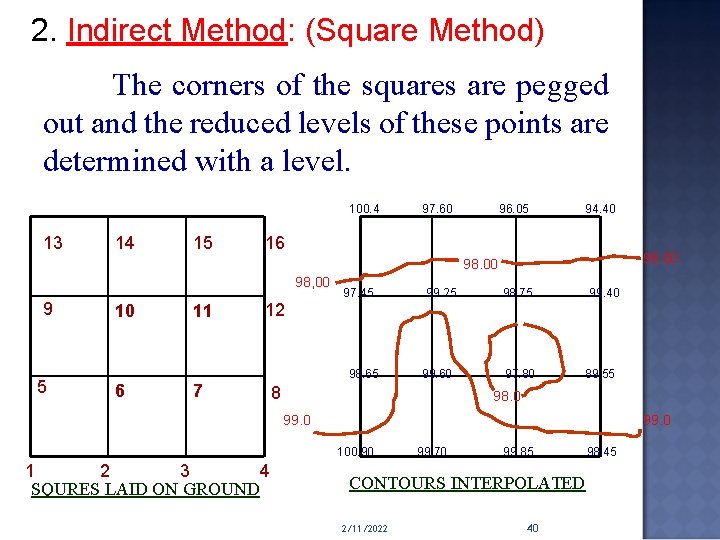
2. Indirect Method: (Square Method) The corners of the squares are pegged out and the reduced levels of these points are determined with a level. 100. 4 13 14 15 97. 60 96. 05 94. 40 16 98. 00 98, 00 9 5 10 11 97. 45 98. 75 99. 40 12 98. 65 6 99. 25 7 99. 60 8 97. 80 89. 55 98. 0 99. 0 100. 90 1 2 3 4 SQURES LAID ON GROUND 99. 70 99. 85 CONTOURS INTERPOLATED 2/11/2022 40 98. 45
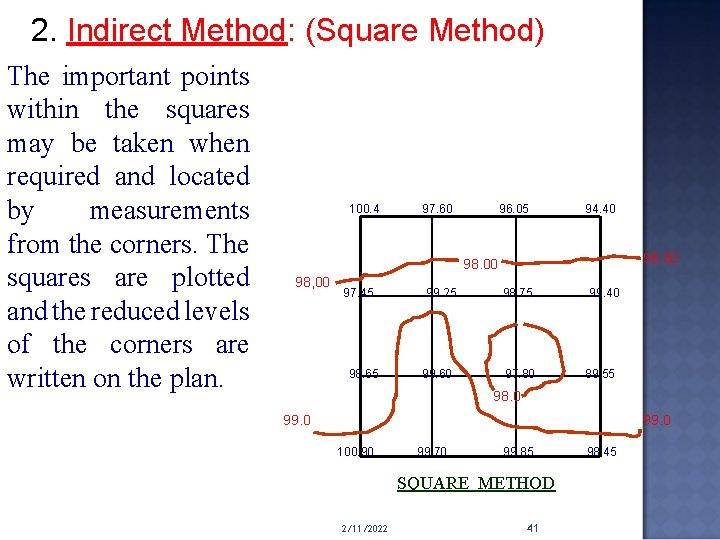
2. Indirect Method: (Square Method) The important points within the squares may be taken when required and located by measurements from the corners. The squares are plotted and the reduced levels of the corners are written on the plan. 100. 4 97. 60 96. 05 94. 40 98. 00 98, 00 97. 45 98. 65 99. 25 99. 60 98. 75 97. 80 99. 40 89. 55 98. 0 99. 0 100. 90 99. 70 99. 85 SQUARE METHOD 2/11/2022 41 98. 45
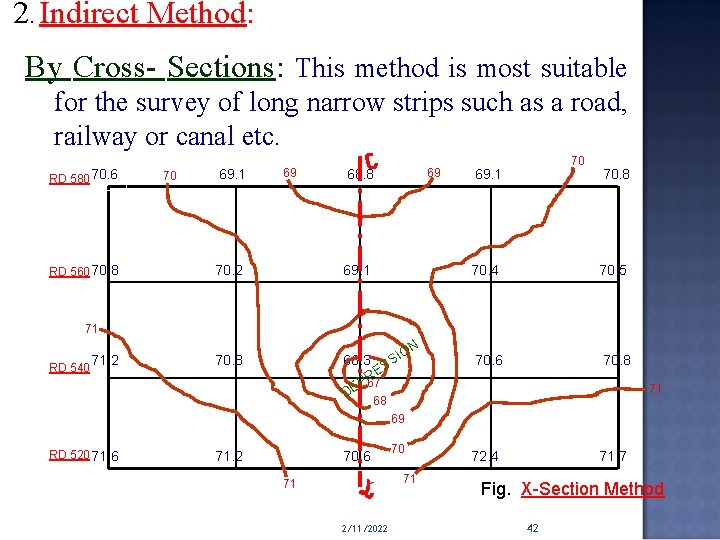
2. Indirect Method: By Cross- Sections: This method is most suitable for the survey of long narrow strips such as a road, railway or canal etc. RD 580 70. 6 RD 560 70. 8 70 69. 1 69 70. 2 69 68. 8 69. 1 70. 8 70. 4 70. 5 70. 6 70. 8 71 RD 540 71. 2 N O SI 70. 8 66. 3 S RE P 67 DE 68 71 69 RD 520 71. 6 71. 2 70. 6 70 71 71 2/11/2022 72. 4 71. 7 Fig. X-Section Method 42
2. Indirect Method: By Cross- Sections: This method is most suitable for the surveys of long narrow strips such as a road, railway or canal etc. Cross sections are run transverse to the centre line of the work and representative points are marked along the lines of cross-section. The cross-section lines need not necessarily be at right angles to the centre line of the work. This may be inclined at any angle to the centre line if necessary. The spacing of the cross-sections depends upon the topography of the country and the nature of the survey. 2/11/2022 43
2. Indirect Method: By Cross- Sections: The common value is 20 to 30 m in hilly country and 100 m in flat country. The levels of the points along the section lines are plotted on the plan and the contours are then interpolated as usual as shown in the fig. 2/11/2022 44
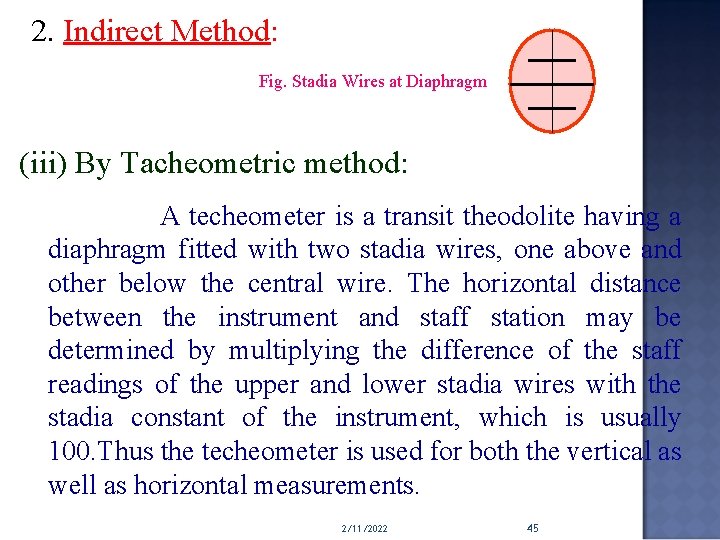
2. Indirect Method: Fig. Stadia Wires at Diaphragm (iii) By Tacheometric method: A techeometer is a transit theodolite having a diaphragm fitted with two stadia wires, one above and other below the central wire. The horizontal distance between the instrument and staff station may be determined by multiplying the difference of the staff readings of the upper and lower stadia wires with the stadia constant of the instrument, which is usually 100. Thus the techeometer is used for both the vertical as well as horizontal measurements. 2/11/2022 45
2. Indirect Method: iii) By Tacheometric method (contd…): This method is most suitable in hilly areas as the number of stations which can be commanded by a techeometer is far more than those by a level and thus the number of instrument settings are considerably reduced. A number of radial lines are laid out at a known angular interval and representative points are marked by pegs along these radial lines. Their elevations and distances are then calculated and plotted on the plan and the contour lines are then interpolated. 2/11/2022 46
INTERPOLATION OF CONTOURS The process of spacing the contours proportionally between the plotted ground – points is termed as interpolation of contours. This becomes necessary in the case of indirect contouring as only the spot levels are taken in this method. While interpolation of contours the ground between any two points is assumed to be uniformly sloping. 2/11/2022 47
INTERPOLATION OF CONTOURS There are three main methods of interpolation: i) By Estimation: The position of the contour points between ground - points are estimated roughly and the contours are then drawn through these points. This is a rough method and is suitable for small scale maps. ii) By arithmetical calculation: This is very tedious but accurate method and is used for small areas where accurate results are necessary. The contours are interpolated as under: 2/11/2022 48
INTERPOLATION OF CONTOURS ii) By arithmetical calculation: Suppose A and B are two points at a distance of 30 m and the reduced level of A and B are 25. 45 m and 27. 54 m respectively. Taking the contour interval as 1 m, 26 and 27 m contours may be interpolated in between A and B. The difference of level between A and B is 2. 09 m. the difference of level between A and 26 m, and A and 27 m is 0. 55 mand 1. 55 m respectively. Therefore the horizontal distance between A and 26 m contour =0. 55/2. 09 x 30 m and Between A and 27 m contour =1. 55/2. 09 x 30 m. These distances are then plotted to scale on the map. 2/11/2022 49
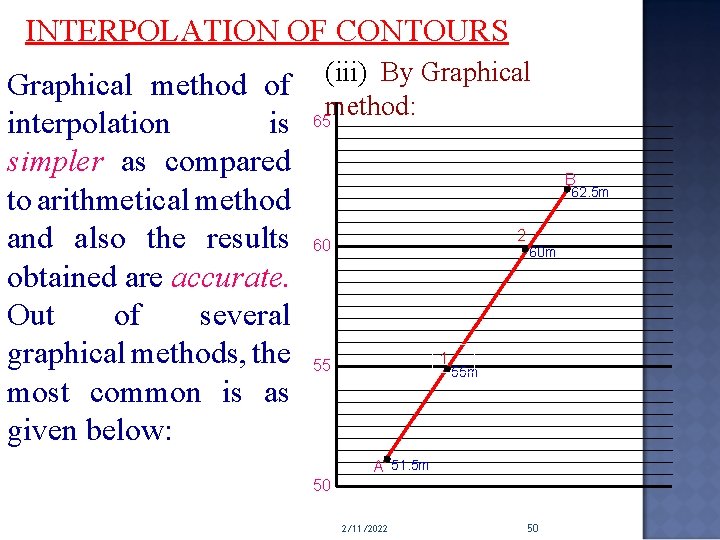
INTERPOLATION OF CONTOURS Graphical method of interpolation is simpler as compared to arithmetical method and also the results obtained are accurate. Out of several graphical methods, the most common is as given below: (iii) By Graphical method: 65 B 62. 5 m 2 60 60 m 1 55 55 m A 51. 5 m 50 2/11/2022 50
Graphical method: As shown in the fig. suppose the contour interval is 5 m, then on a piece of tracing cloth, a number of parallel lines spaced at 0. 5 m (usually 1/10 th of the contour interval) are drawn. Every tenth line being made thick. Suppose it is required to interpolate contours between two points A and B of elevation 51. 5 m and 62. 5 m respectively. 2/11/2022 51
INTERPOLATION OF CONTOURS (iii) By Graphical method: If the bottom line represents an elevation of 50 m. Then the successive thick lines will represent 55 m, 60 m and 65 m, etc. Place the tracing cloth so that the point A is on the third line from the bottom, now move the tracing cloth until B is on the fifth line above the 60 m thick line. The intersection of the thick lines 1 and 2 representing elevations of 55 m and 60 m and the line AB give the position of the points on the 55 m and 60 m contours respectively and are pricked through on the plan with a pin. 2/11/2022 52
DRAWING THE CONTOUR LINES Contour lines are drawn as fine and smooth free hand curved lines. Sometimes they are represented by broken lines. They are inked in either in black or brown colour. A drawing pen gives a better line than a writing pen and French curves should be used as much as possible. Every fifth contour is made thicker than the rest. The elevation of contours must be written in a uniform manner, either on the higher side or in a gap left in the line. When the contour lines are very long, their elevations are written at two or three places along the contour. In the case of small scale maps, it is sufficient to figure every fifth contour. 2/11/2022 53
USES OF CONTOUR MAP (i) A contour map furnishes information regarding the features of the ground , whether it is flat, undulating or mountainous. (ii) From a contour map , sections may be easily drawn in any direction (iii) Intervisibility between two ground points plotted on map can be ascertained (iv) It enables an engineer to approximately select the most economical or suitable site for an engineering project such as a road, a railway, a canal or a pipe line etc. (v) A route of a given grade can be traced on the map. (vi) Catchment area and capacity of a reservoir may be determined from the contour map. (vii) Contour map may be used to determine the quantities of earth work. 2/11/2022 54