
IV The Divisions of the Brain Slide 1
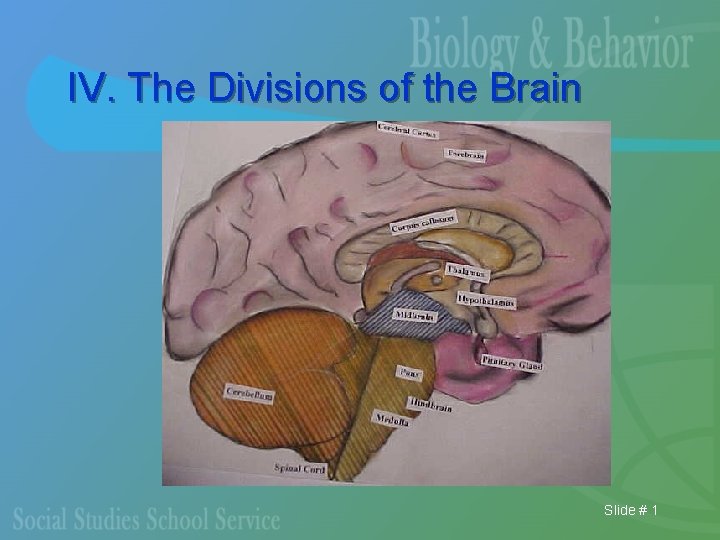
IV. The Divisions of the Brain Slide # 1
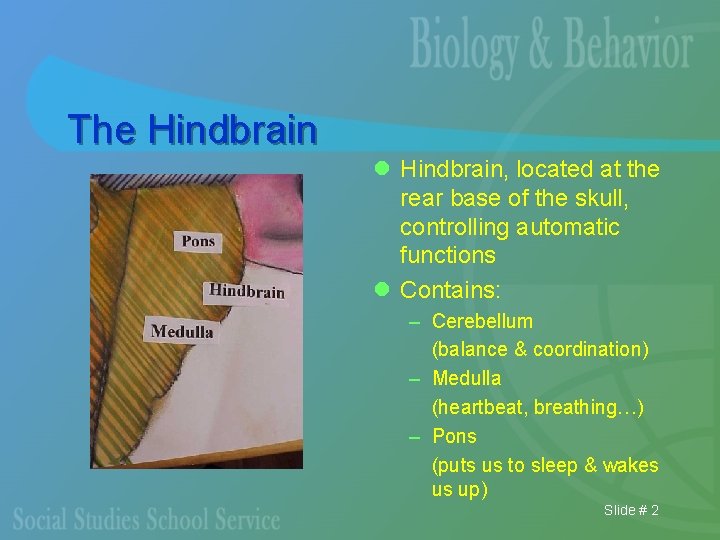
The Hindbrain l Hindbrain, located at the rear base of the skull, controlling automatic functions l Contains: – Cerebellum (balance & coordination) – Medulla (heartbeat, breathing…) – Pons (puts us to sleep & wakes us up) Slide # 2
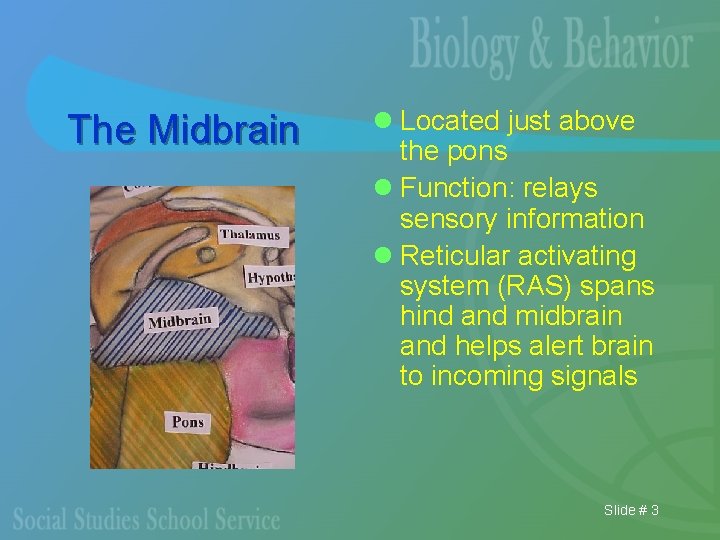
The Midbrain l Located just above the pons l Function: relays sensory information l Reticular activating system (RAS) spans hind and midbrain and helps alert brain to incoming signals Slide # 3
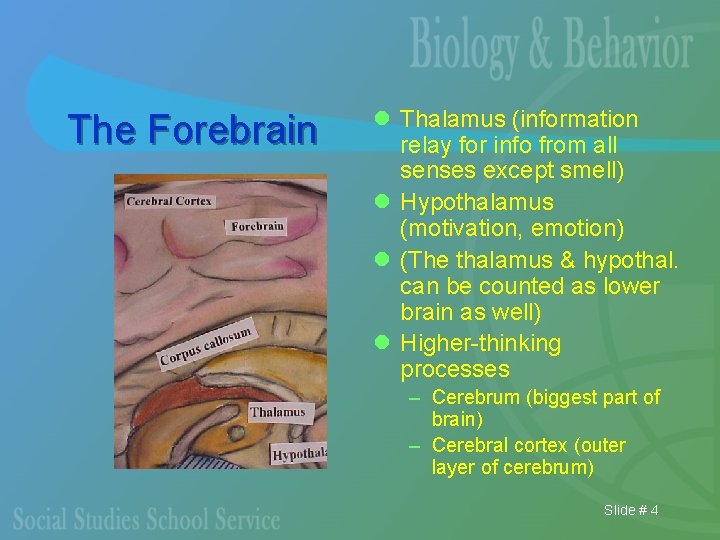
The Forebrain l Thalamus (information relay for info from all senses except smell) l Hypothalamus (motivation, emotion) l (The thalamus & hypothal. can be counted as lower brain as well) l Higher-thinking processes – Cerebrum (biggest part of brain) – Cerebral cortex (outer layer of cerebrum) Slide # 4
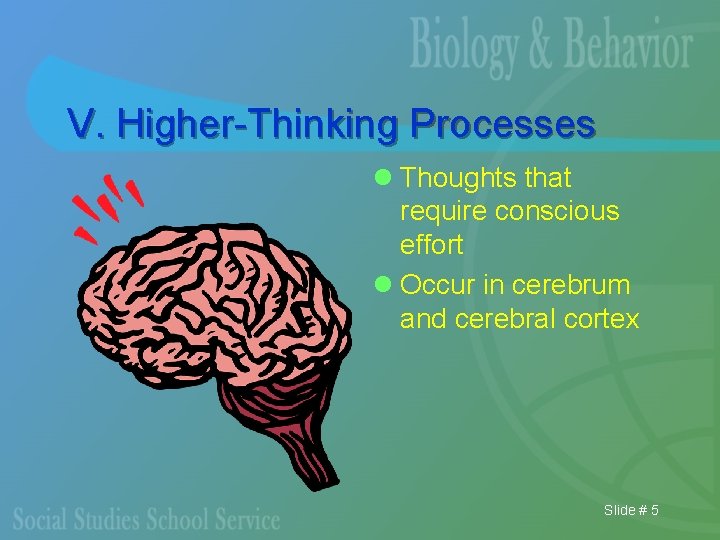
V. Higher-Thinking Processes l Thoughts that require conscious effort l Occur in cerebrum and cerebral cortex Slide # 5
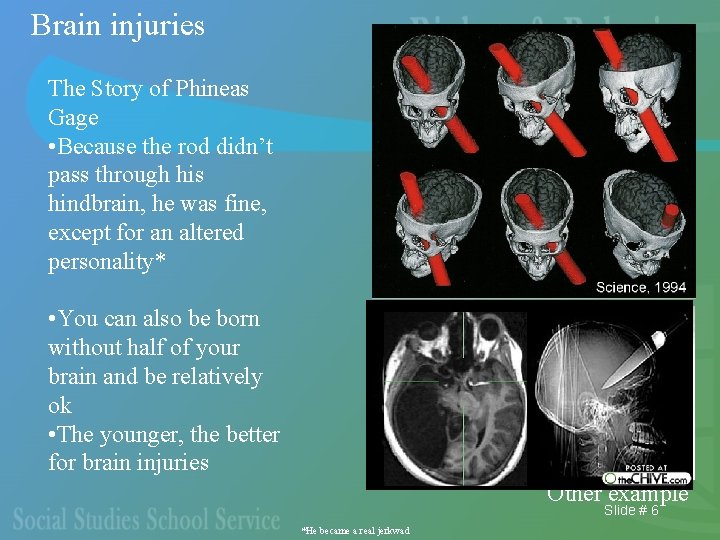
Brain injuries The Story of Phineas Gage • Because the rod didn’t pass through his hindbrain, he was fine, except for an altered personality* • You can also be born without half of your brain and be relatively ok • The younger, the better for brain injuries Other example Slide # 6 *He became a real jerkwad
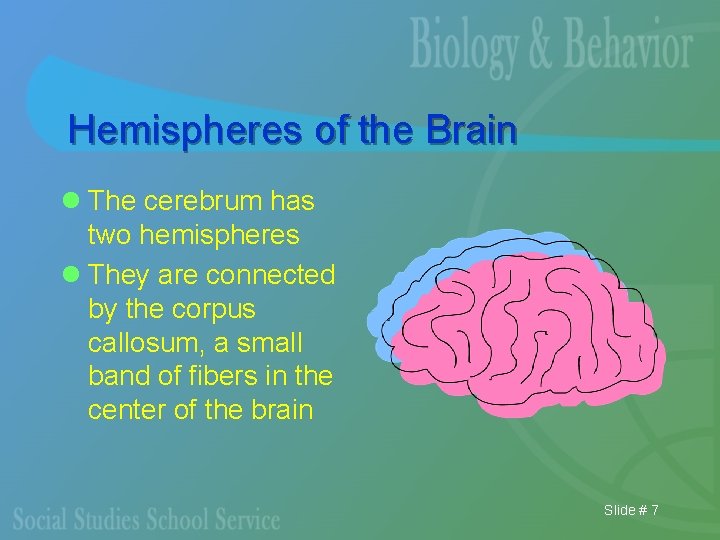
Hemispheres of the Brain l The cerebrum has two hemispheres l They are connected by the corpus callosum, a small band of fibers in the center of the brain Slide # 7
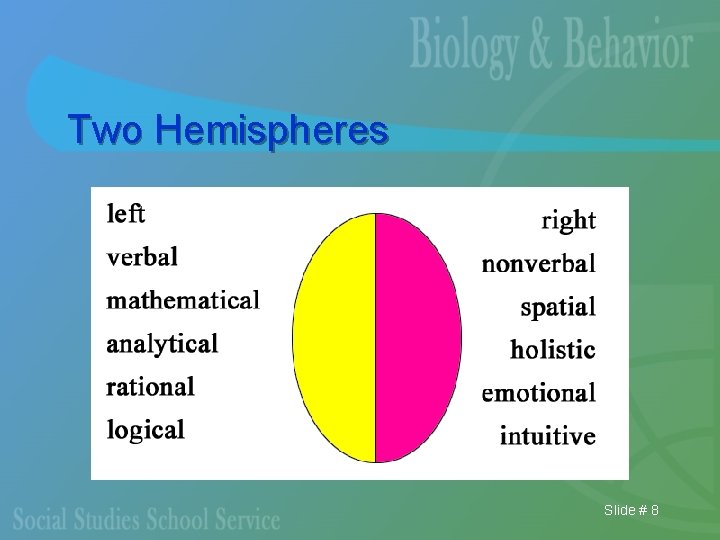
Two Hemispheres Slide # 8
Righthanded vs. Lefthanded l Your left hemisphere controls the right half of your body, and vice versa l 90% of people in the U. S. are righthanded l Theories: environmental vs. genetic Slide # 9
Problems Associated With Being a Lefty l Autism and dyslexia l Schizophrenia l Mental retardation l Alcoholism l Life expectancy – (Out of 5000 people, age 10 – 15% are lefthanded, 50 – 5%, 80 – <1%) Slide # 10
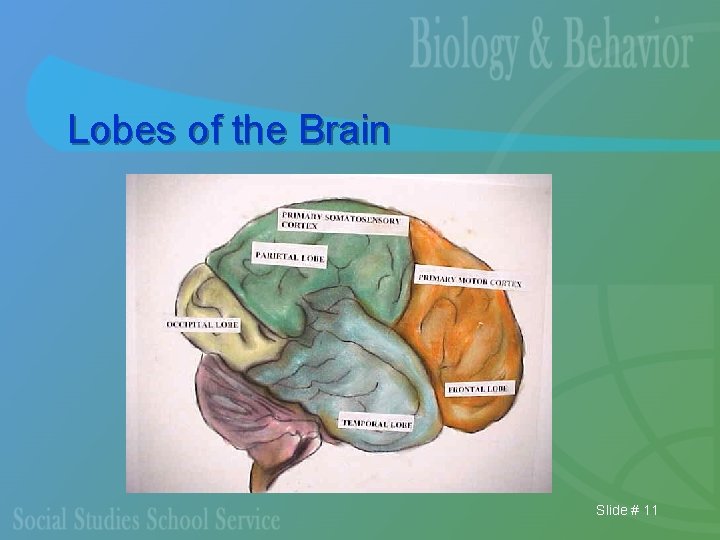
Lobes of the Brain Slide # 11
Lobes and their Functions l Frontal: planning of movements, working memory l Temporal: hearing, advanced visual processing, memory l Occipital: vision l Parietal: body sensations Slide # 12
l Primary motor cortex: strip of frontal lobe that controls voluntary mvmnts. l Sensory cortex: strip in parietal that registers & processes body sensations – If lose a finger or sight, that area branches out & makes others more sensitive l Visual cortex: back of occipital lobe – can “see” things if stimulated w/electrode l Auditory cortex: in temporal lobe – can “hear” sounds if stimulated w/electrode l The rest of the brain? Integrates sensory info w/memories – Myth: we only use 10% of our brains Slide # 13
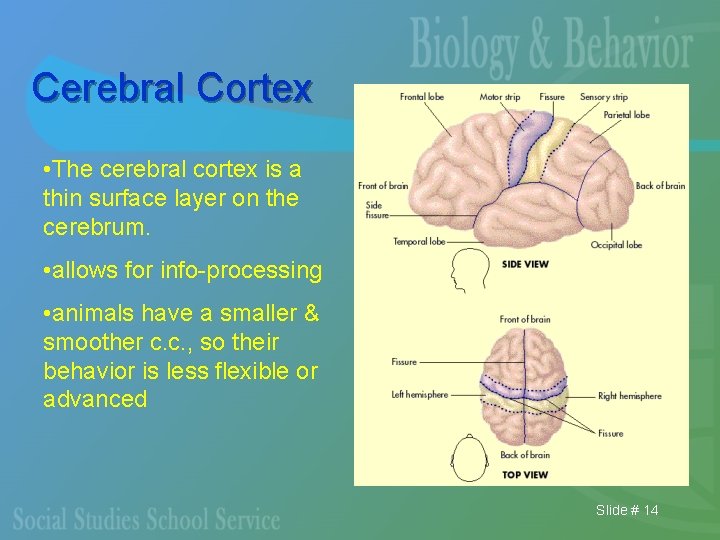
Cerebral Cortex • The cerebral cortex is a thin surface layer on the cerebrum. • allows for info-processing • animals have a smaller & smoother c. c. , so their behavior is less flexible or advanced Slide # 14
The Limbic System Slide # 15
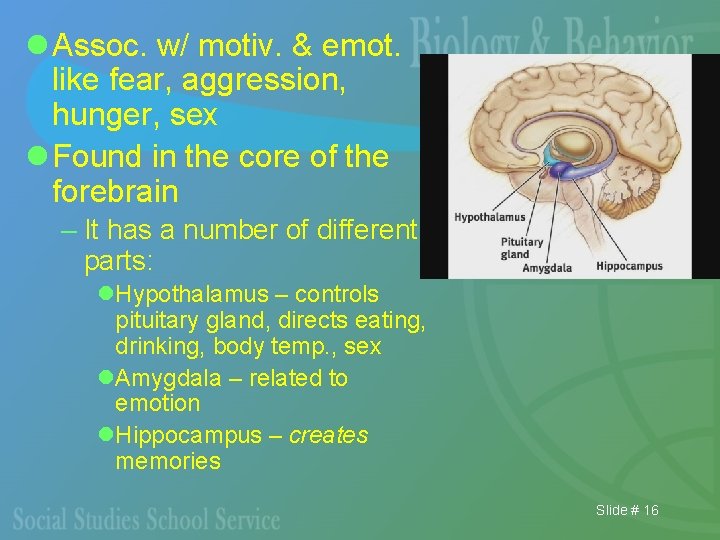
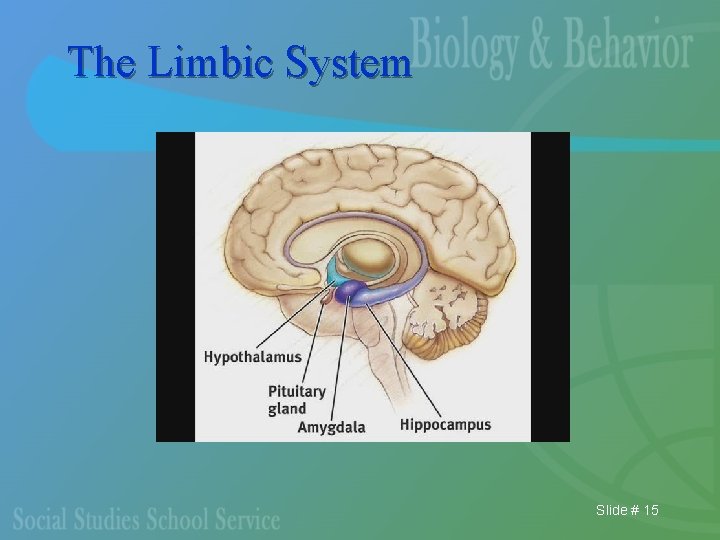
l Assoc. w/ motiv. & emot. like fear, aggression, hunger, sex l Found in the core of the forebrain – It has a number of different parts: l. Hypothalamus – controls pituitary gland, directs eating, drinking, body temp. , sex l. Amygdala – related to emotion l. Hippocampus – creates memories Slide # 16
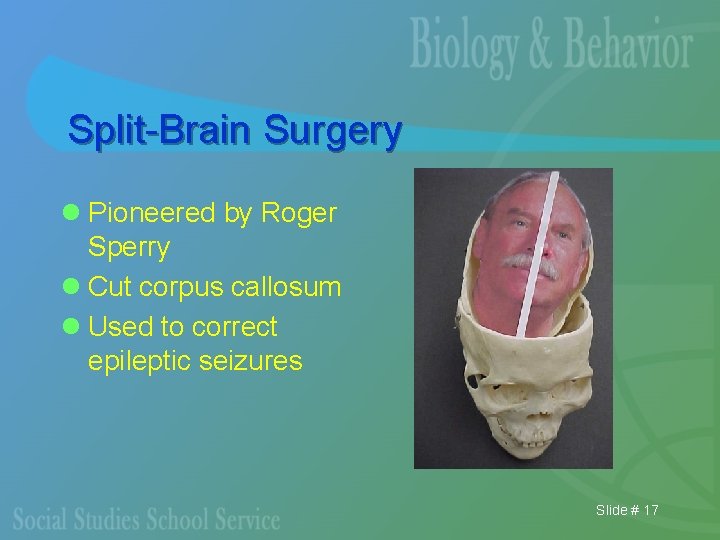
Split-Brain Surgery l Pioneered by Roger Sperry l Cut corpus callosum l Used to correct epileptic seizures Slide # 17
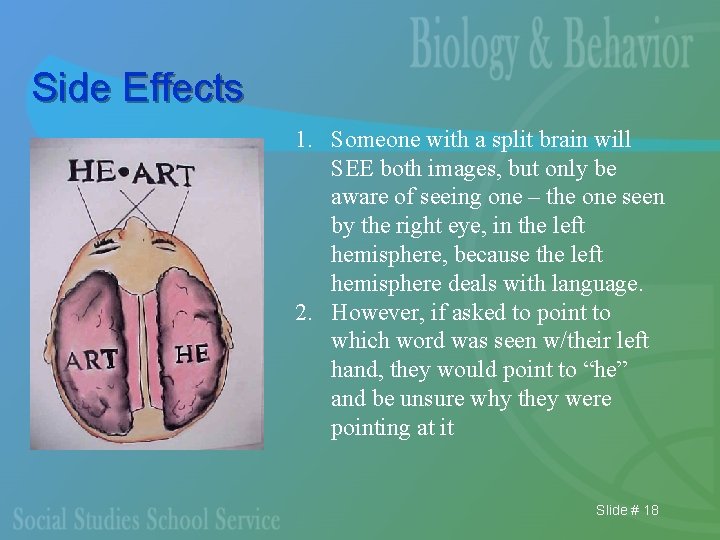
Side Effects 1. Someone with a split brain will SEE both images, but only be aware of seeing one – the one seen by the right eye, in the left hemisphere, because the left hemisphere deals with language. 2. However, if asked to point to which word was seen w/their left hand, they would point to “he” and be unsure why they were pointing at it Slide # 18
III. Brain Imaging Techniques l EEG (electro-encephalograph) l CT (computerized tomography) scans l PET (positron emission tomography) scans l MRI (magnetic resonance imaging) scans Slide # 19
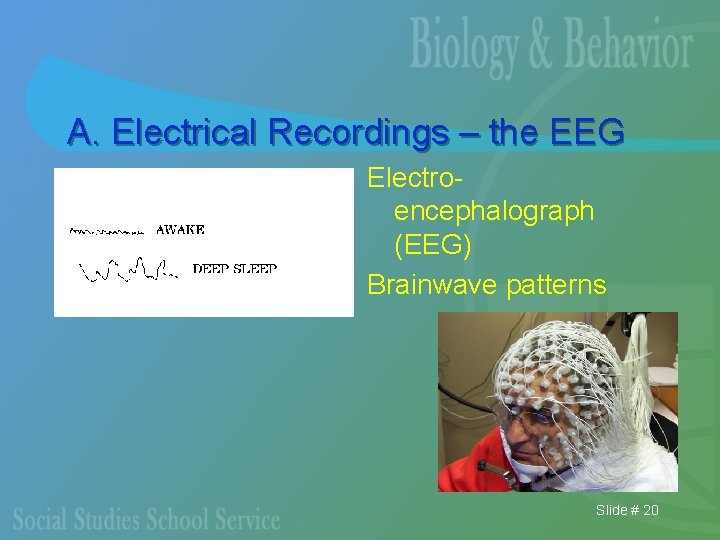
A. Electrical Recordings – the EEG Electroencephalograph (EEG) Brainwave patterns Slide # 20
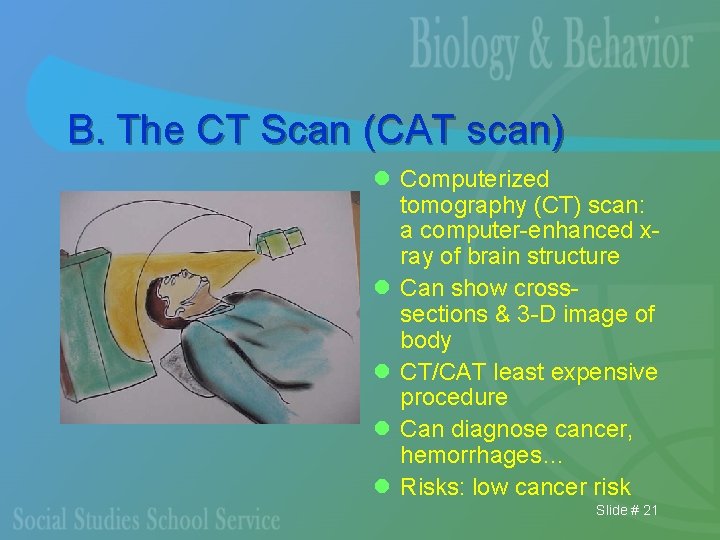
B. The CT Scan (CAT scan) l Computerized tomography (CT) scan: a computer-enhanced xray of brain structure l Can show crosssections & 3 -D image of body l CT/CAT least expensive procedure l Can diagnose cancer, hemorrhages… l Risks: low cancer risk Slide # 21
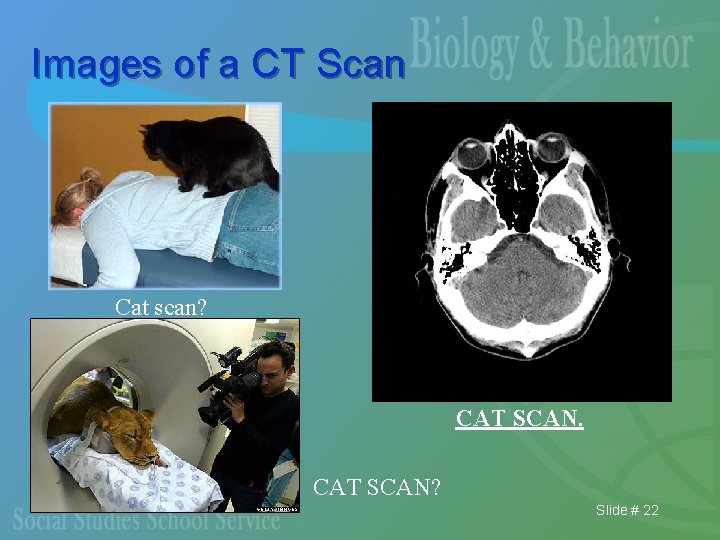
Images of a CT Scan Cat scan? CAT SCAN? Slide # 22
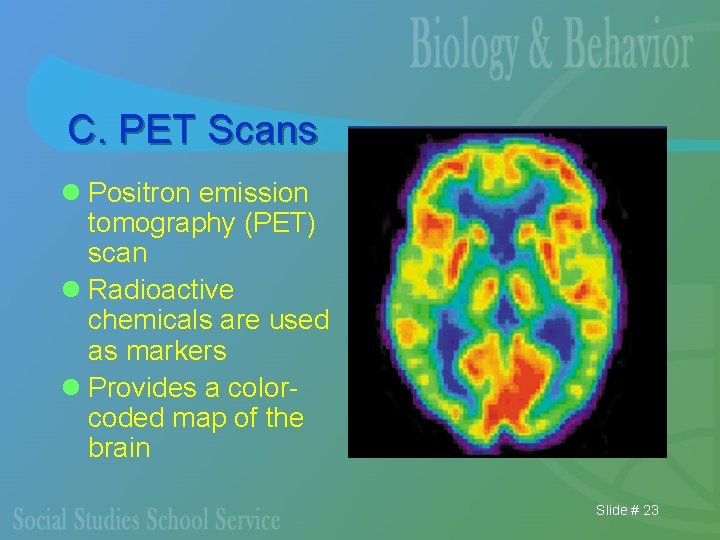
C. PET Scans l Positron emission tomography (PET) scan l Radioactive chemicals are used as markers l Provides a colorcoded map of the brain Slide # 23
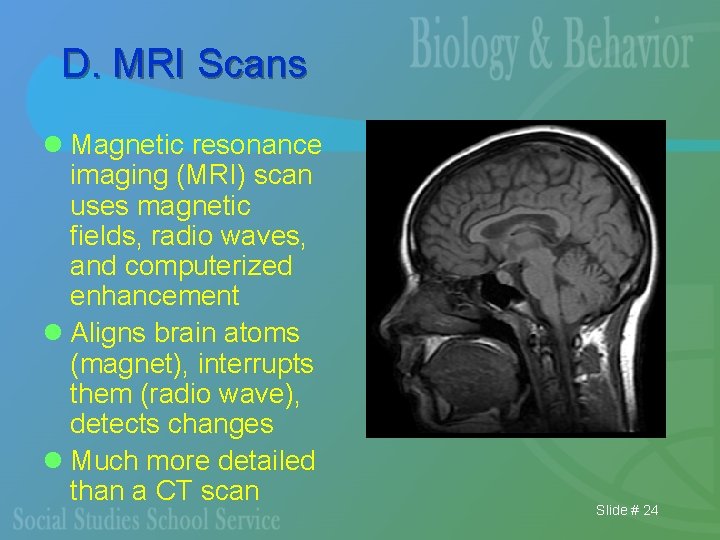
D. MRI Scans l Magnetic resonance imaging (MRI) scan uses magnetic fields, radio waves, and computerized enhancement l Aligns brain atoms (magnet), interrupts them (radio wave), detects changes l Much more detailed than a CT scan Slide # 24
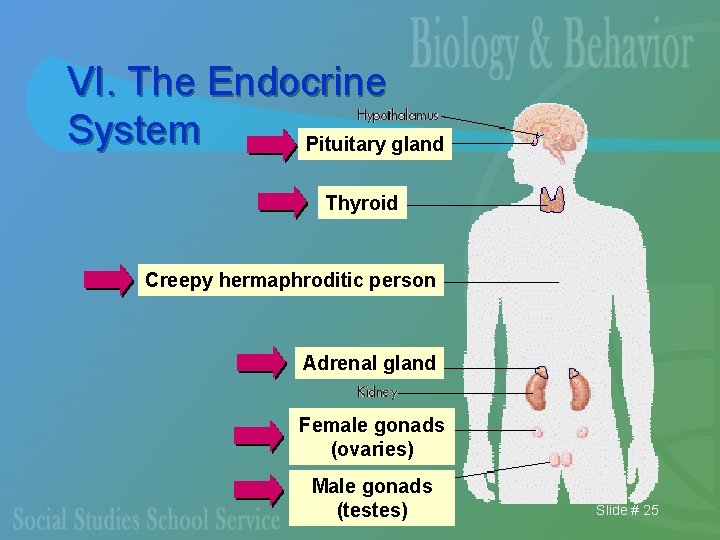
VI. The Endocrine System Pituitary gland Thyroid Creepy hermaphroditic person Adrenal gland Female gonads (ovaries) Male gonads (testes) Slide # 25
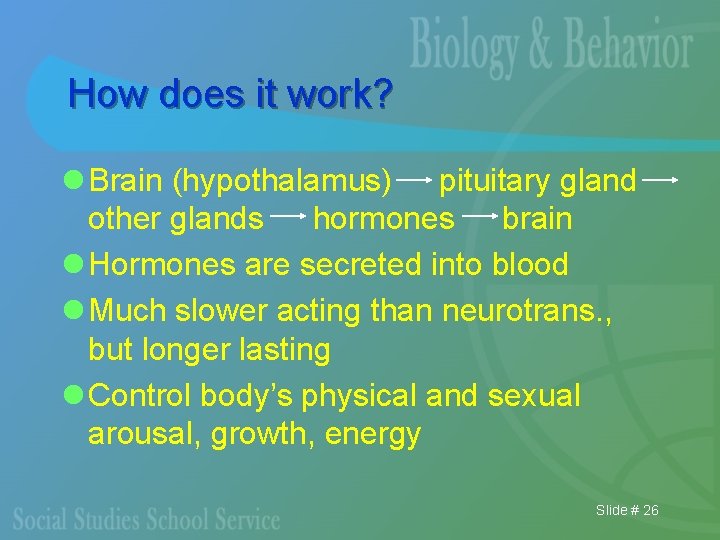
How does it work? l Brain (hypothalamus) pituitary gland other glands hormones brain l Hormones are secreted into blood l Much slower acting than neurotrans. , but longer lasting l Control body’s physical and sexual arousal, growth, energy Slide # 26
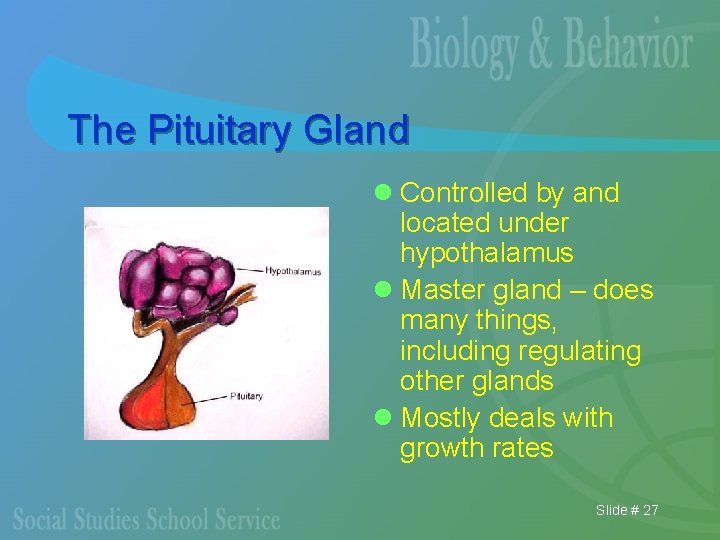
The Pituitary Gland l Controlled by and located under hypothalamus l Master gland – does many things, including regulating other glands l Mostly deals with growth rates Slide # 27
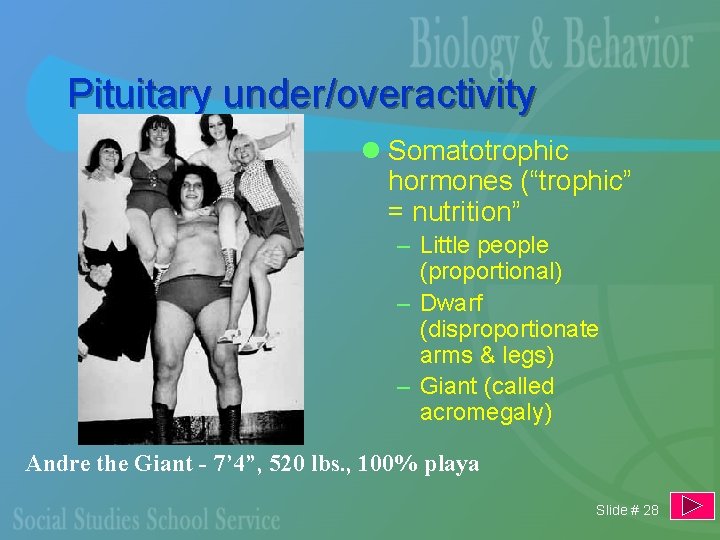
Pituitary under/overactivity l Somatotrophic hormones (“trophic” = nutrition” – Little people (proportional) – Dwarf (disproportionate arms & legs) – Giant (called acromegaly) Andre the Giant - 7’ 4”, 520 lbs. , 100% playa Slide # 28
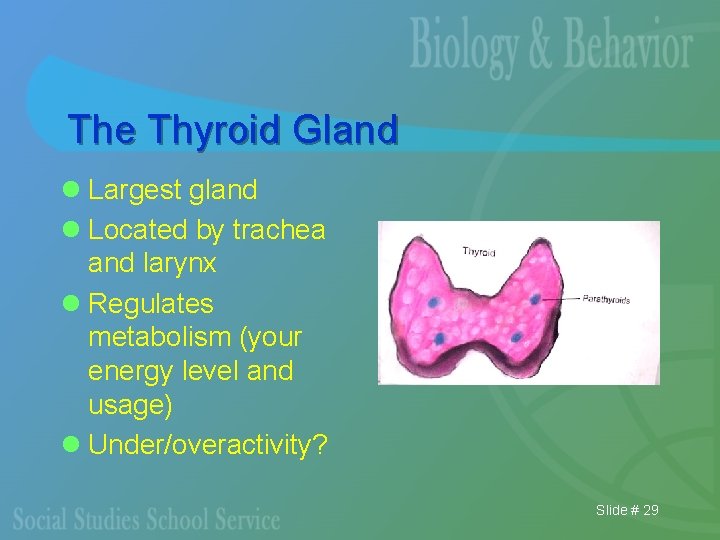
The Thyroid Gland l Largest gland l Located by trachea and larynx l Regulates metabolism (your energy level and usage) l Under/overactivity? Slide # 29
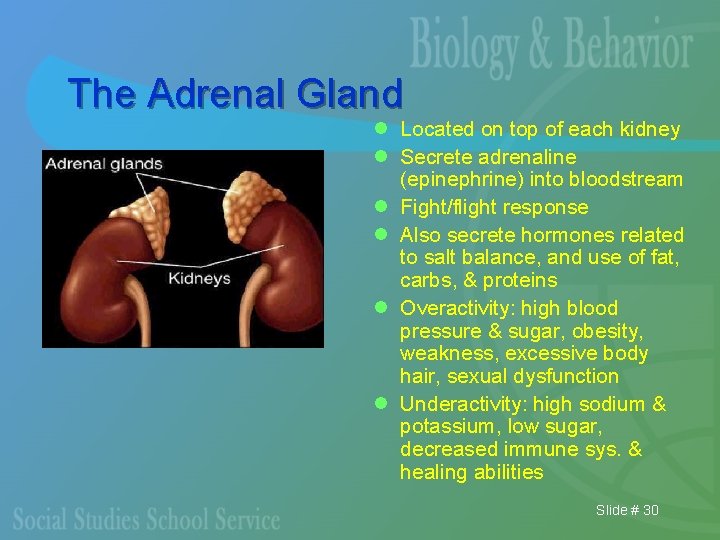
The Adrenal Gland l Located on top of each kidney l Secrete adrenaline (epinephrine) into bloodstream l Fight/flight response l Also secrete hormones related to salt balance, and use of fat, carbs, & proteins l Overactivity: high blood pressure & sugar, obesity, weakness, excessive body hair, sexual dysfunction l Underactivity: high sodium & potassium, low sugar, decreased immune sys. & healing abilities Slide # 30
- Slides: 30