
IV Milky Way Local Group Tomography The stellar

- Slides: 39
IV: Milky Way / Local Group Tomography The stellar distribution in the Milky Way is not smooth. What can it tell us bout its formation history? Hans-Walter Rix MPI for Astronomy Heidelberg HWR Princeton 2005
1. “Substructure”: Signposts of Hierarchical Formation • The motions of stars (or groups) still reflect their formation history after many dynamical periods. • In collissionless systems, the phase-space density/distribution is preserved. • Phase mixing may lead to a smooth appearance in r or v space. HWR Princeton 2005
HWR Princeton 2005
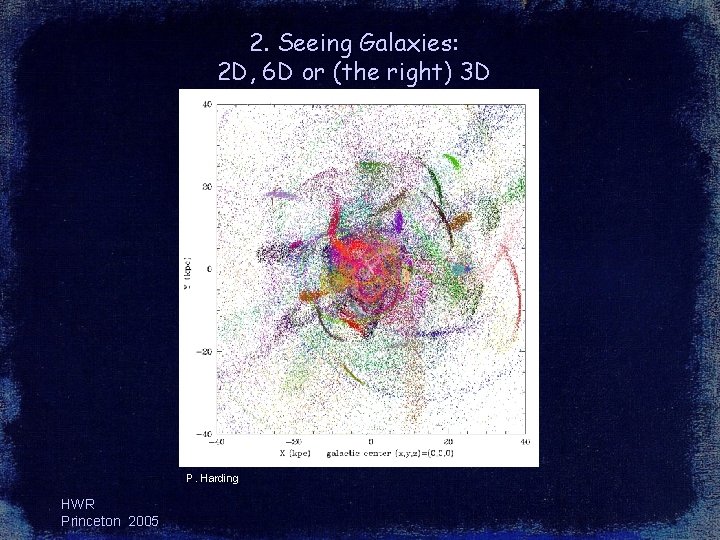
2. Seeing Galaxies: 2 D, 6 D or (the right) 3 D P. Harding HWR Princeton 2005
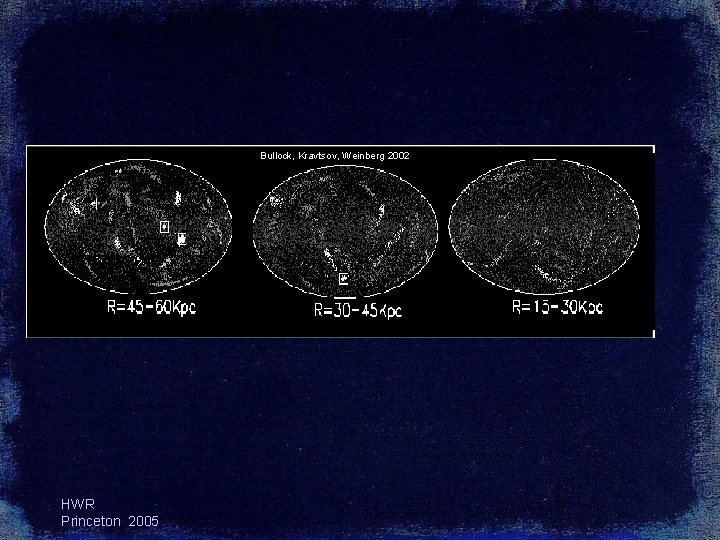
Bullock, Kravtsov, Weinberg 2002 HWR Princeton 2005
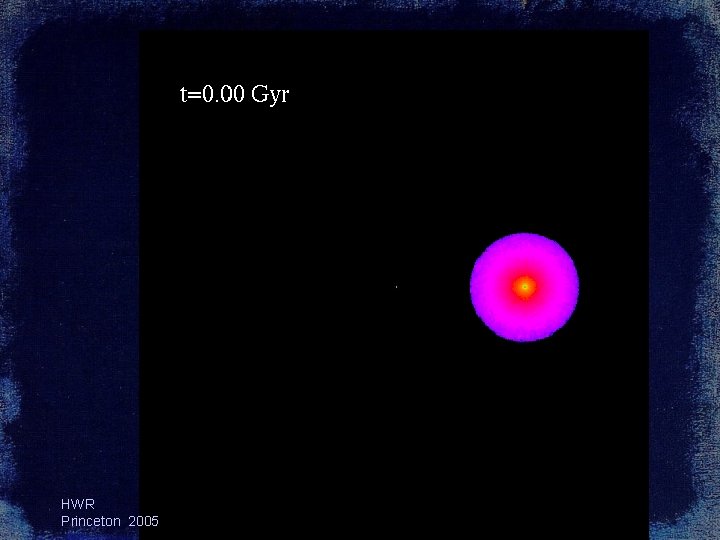
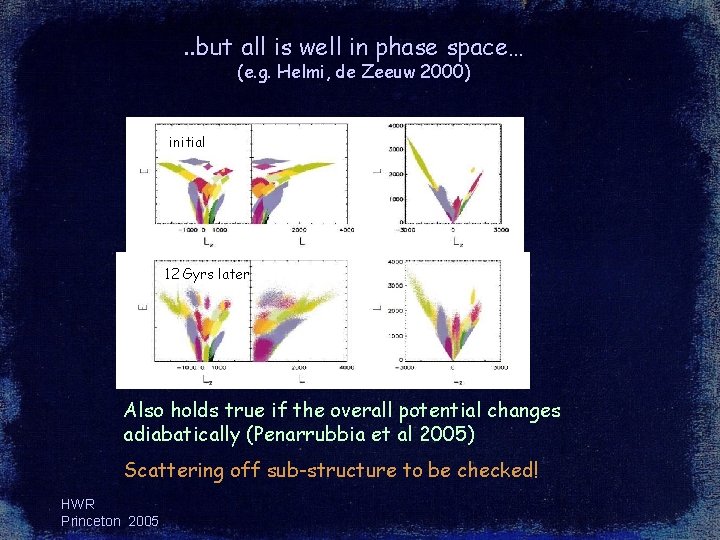
. . but all is well in phase space… (e. g. Helmi, de Zeeuw 2000) initial 12 Gyrs later Also holds true if the overall potential changes adiabatically (Penarrubbia et al 2005) Scattering off sub-structure to be checked! HWR Princeton 2005
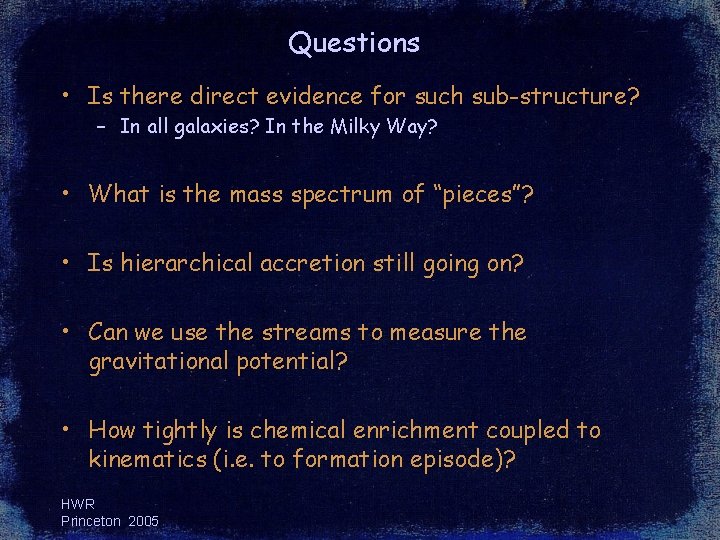
Questions • Is there direct evidence for such sub-structure? – In all galaxies? In the Milky Way? • What is the mass spectrum of “pieces”? • Is hierarchical accretion still going on? • Can we use the streams to measure the gravitational potential? • How tightly is chemical enrichment coupled to kinematics (i. e. to formation episode)? HWR Princeton 2005
Is (sub-)structure of the phasespace distribution observable in galaxies with unresolved stellar populations? HWR Princeton 2005
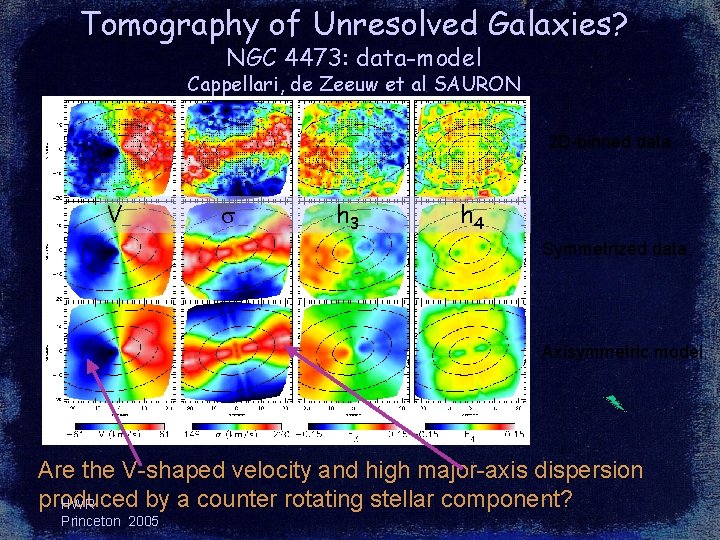
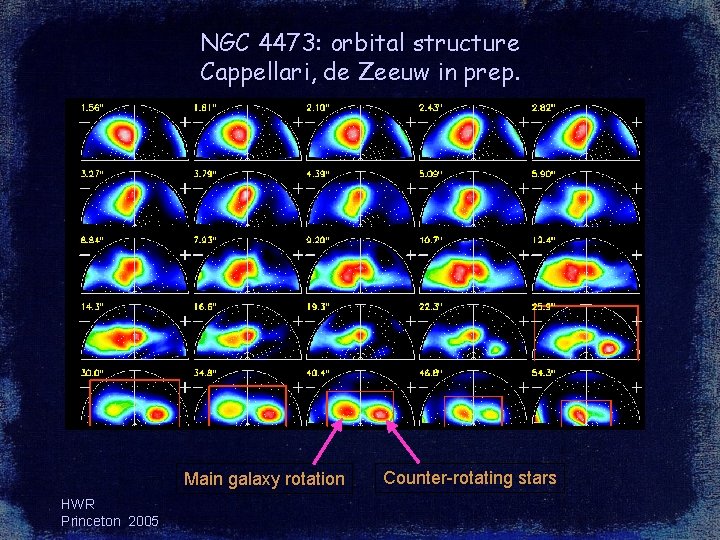
Tomography of Unresolved Galaxies? NGC 4473: data-model Cappellari, de Zeeuw et al SAURON 2 D-binned data V s h 3 h 4 Symmetrized data Axisymmetric model Are the V-shaped velocity and high major-axis dispersion produced by a counter rotating stellar component? HWR Princeton 2005
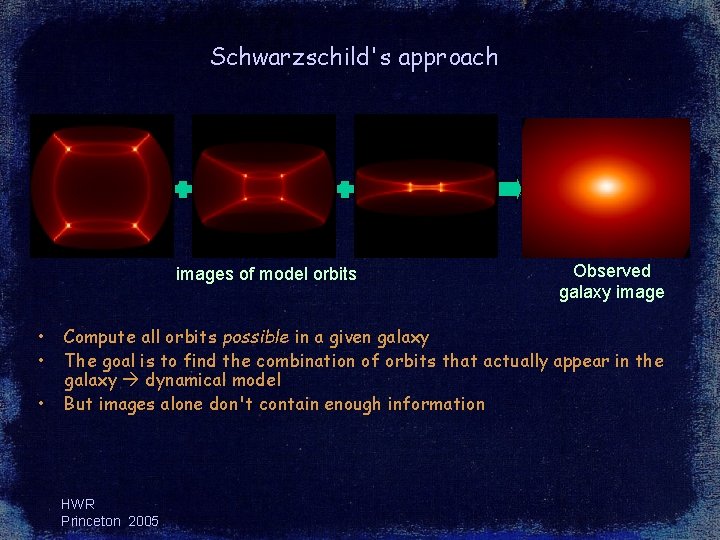
Schwarzschild's approach images of model orbits • • • Observed galaxy image Compute all orbits possible in a given galaxy The goal is to find the combination of orbits that actually appear in the galaxy dynamical model But images alone don't contain enough information HWR Princeton 2005
NGC 4473: orbital structure Cappellari, de Zeeuw in prep. Main galaxy rotation HWR Princeton 2005 Counter-rotating stars
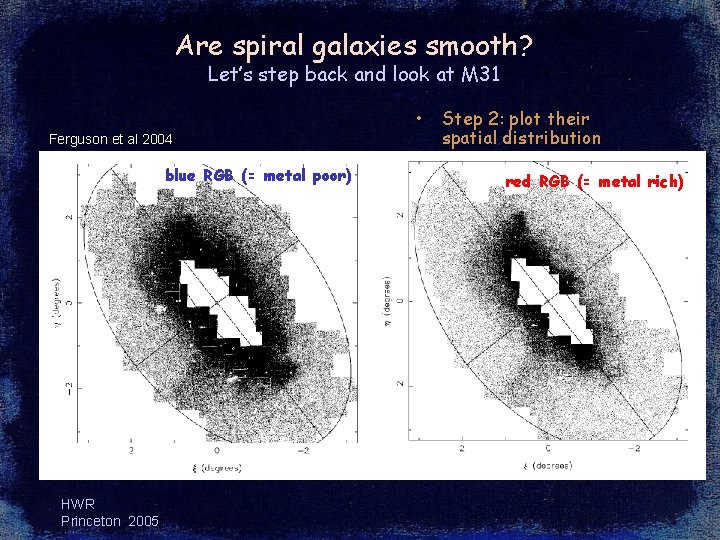
Are spiral galaxies smooth? Let’s step back and look at M 31 • Ferguson et al 2004 • Step 1: select stars in blue RGB (= metal poor) color-magnitude space HWR Princeton 2005 Step 2: plot their spatial distribution red RGB (= metal rich)
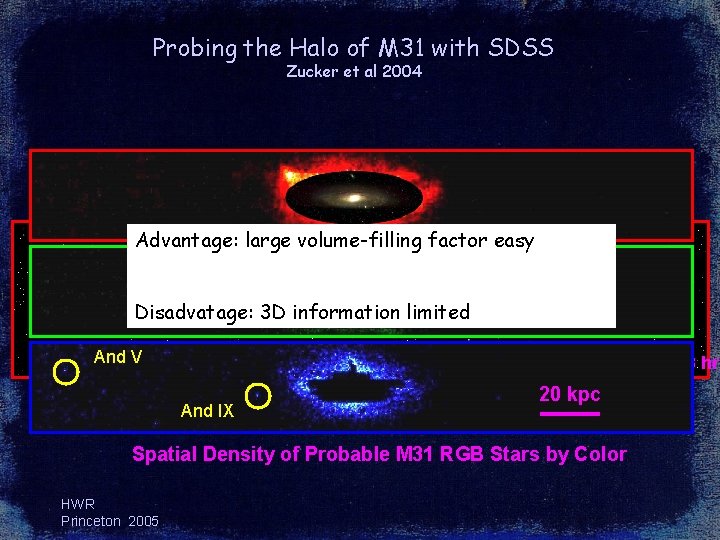
Probing the Halo of M 31 with SDSS Zucker et al 2004 Advantage: large volume-filling factor easy And NE Disadvatage: 3 D information limited And V SDSS Scan of M 31: 45 sq. deg. in 3 hr And IX 20 kpc Spatial Density of Probable M 31 RGB Stars by Color HWR Princeton 2005
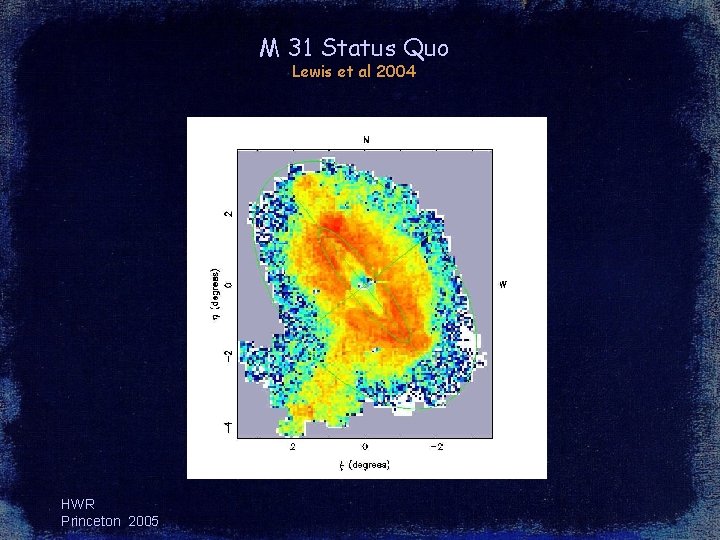
M 31 Status Quo Lewis et al 2004 HWR Princeton 2005
4. Substructure in the Milky Way Halo • How to find it? • Status quo • How to interpret what has been found? HWR Princeton 2005
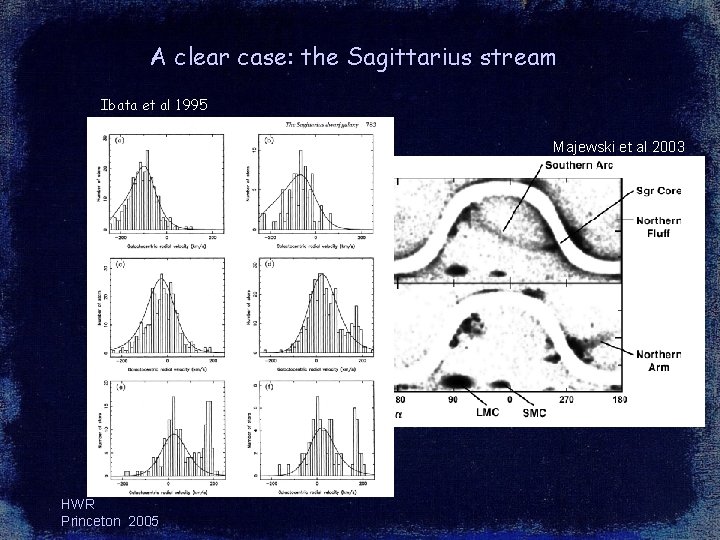
A clear case: the Sagittarius stream Ibata et al 1995 Majewski et al 2003 HWR Princeton 2005
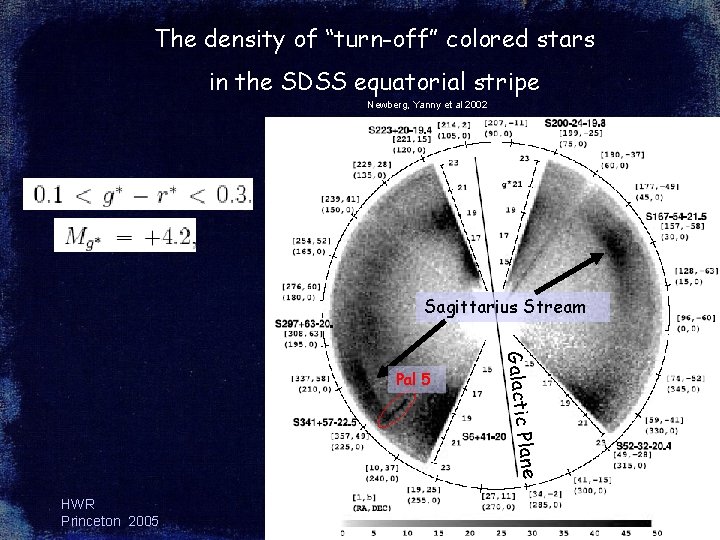
The density of “turn-off” colored stars in the SDSS equatorial stripe Newberg, Yanny et al 2002 Sagittarius Stream lane Galactic P Pal 5 HWR Princeton 2005
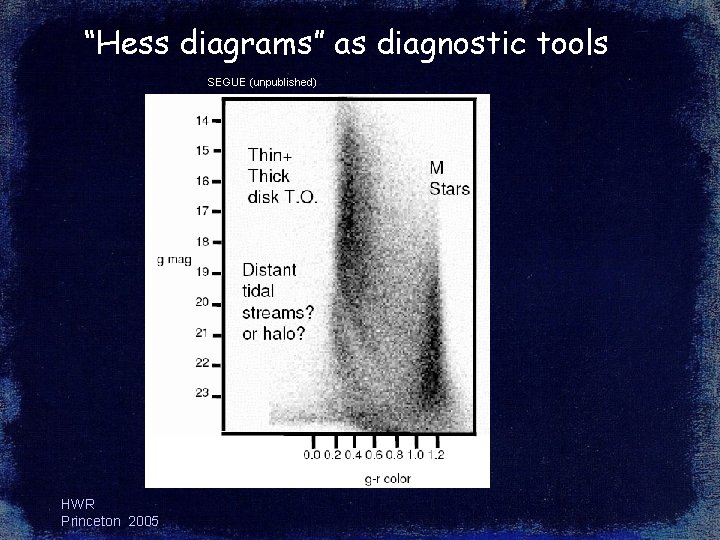
“Hess diagrams” as diagnostic tools SEGUE (unpublished) HWR Princeton 2005
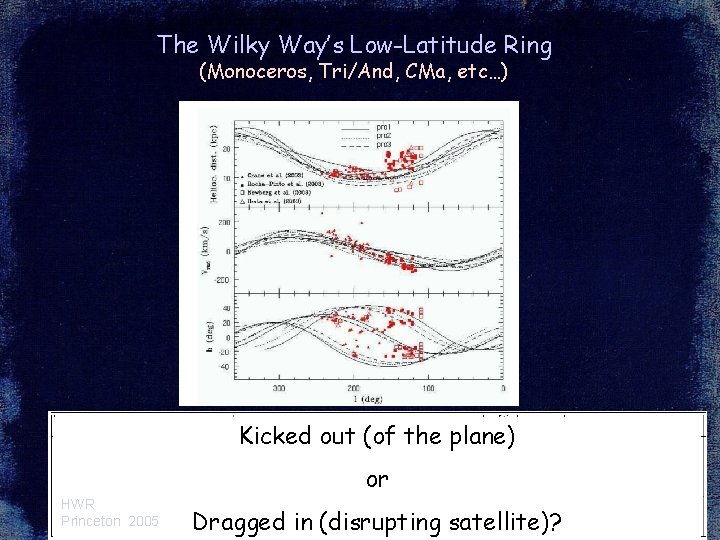
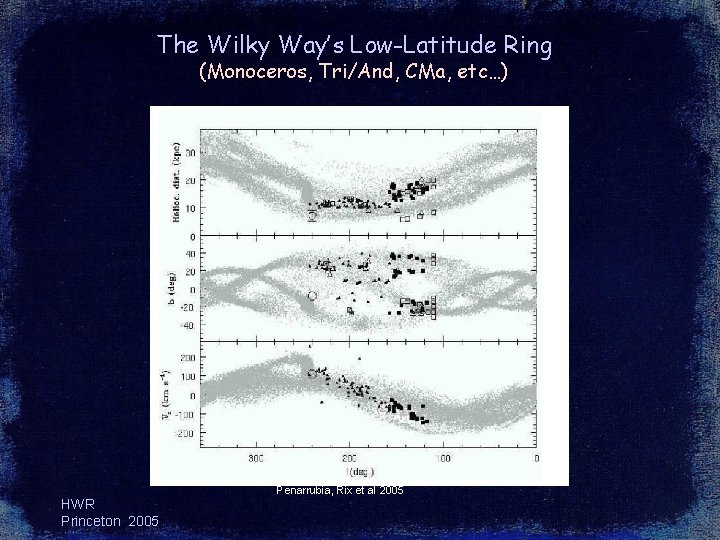
The Wilky Way’s Low-Latitude Ring (Monoceros, Tri/And, CMa, etc…) Kicked out (of the plane) or HWR Princeton 2005 Dragged in (disrupting satellite)?
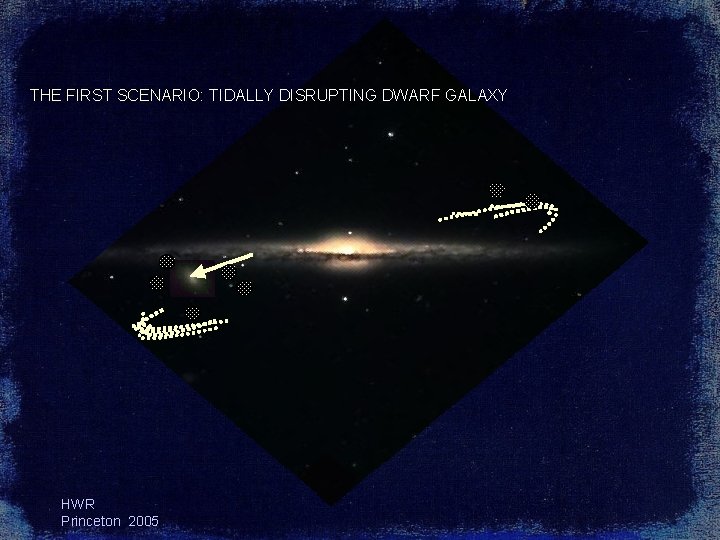
THE FIRST SCENARIO: TIDALLY DISRUPTING DWARF GALAXY HWR Princeton 2005
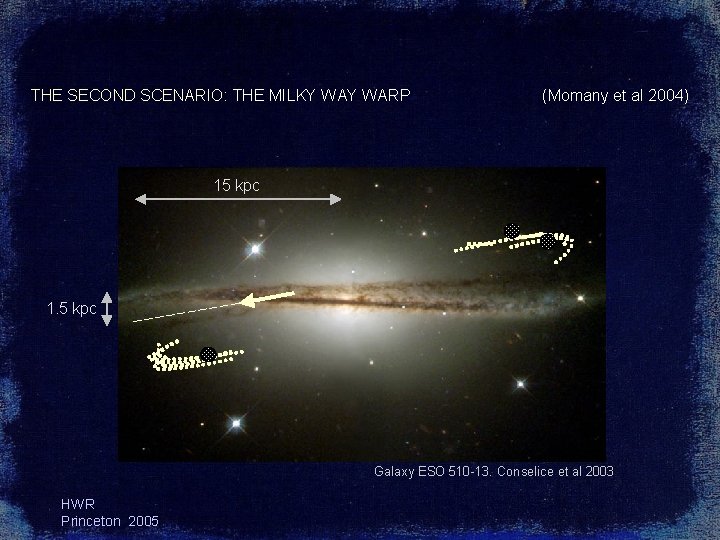
THE SECOND SCENARIO: THE MILKY WARP (Momany et al 2004) 15 kpc 1. 5 kpc Galaxy ESO 510 -13. Conselice et al 2003 HWR Princeton 2005
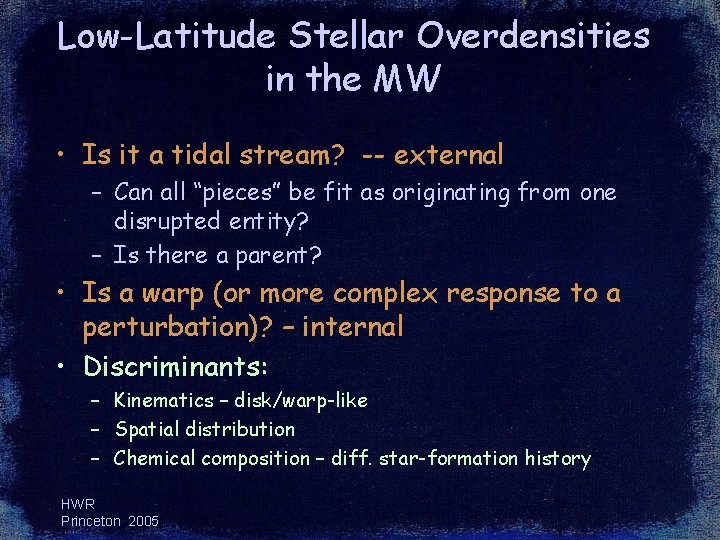
Low-Latitude Stellar Overdensities in the MW • Is it a tidal stream? -- external – Can all “pieces” be fit as originating from one disrupted entity? – Is there a parent? • Is a warp (or more complex response to a perturbation)? – internal • Discriminants: – Kinematics – disk/warp-like – Spatial distribution – Chemical composition – diff. star-formation history HWR Princeton 2005
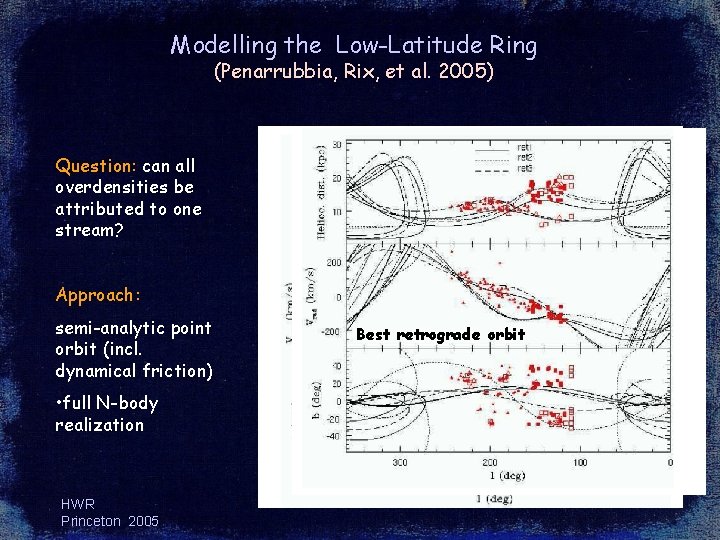
Modelling the Low-Latitude Ring (Penarrubbia, Rix, et al. 2005) Question: can all overdensities be attributed to one stream? Approach: semi-analytic point orbit (incl. dynamical friction) • full N-body realization HWR Princeton 2005 Best retrograde orbit Best prograde semi-analytic orbit
The Wilky Way’s Low-Latitude Ring (Monoceros, Tri/And, CMa, etc…) HWR Princeton 2005 Penarrubia, Rix et al 2005
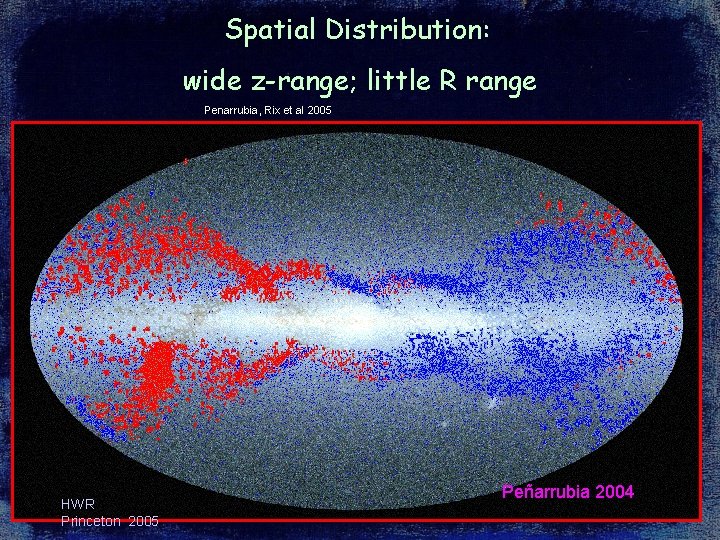
Spatial Distribution: wide z-range; little R range Penarrubia, Rix et al 2005 HWR Princeton 2005 ? Not a warp Peñarrubia 2004
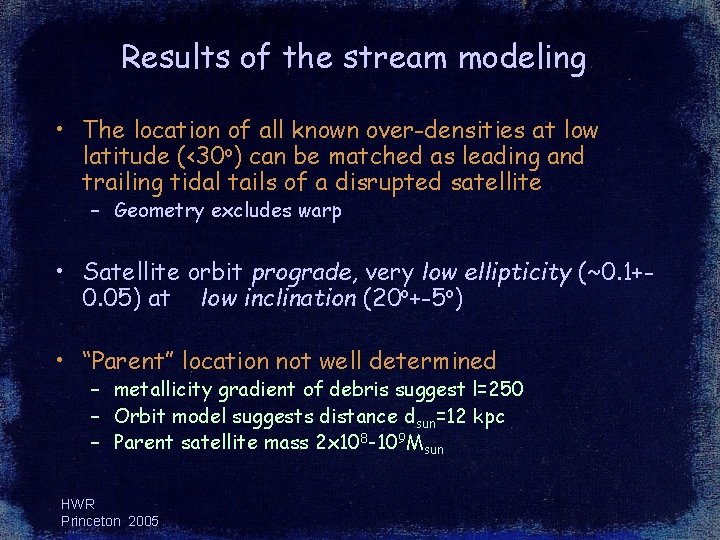
Results of the stream modeling • The location of all known over-densities at low latitude (<30 o) can be matched as leading and trailing tidal tails of a disrupted satellite – Geometry excludes warp • Satellite orbit prograde, very low ellipticity (~0. 1+0. 05) at low inclination (20 o+-5 o) • “Parent” location not well determined – metallicity gradient of debris suggest l=250 – Orbit model suggests distance dsun=12 kpc – Parent satellite mass 2 x 10⁸ -109 Msun HWR Princeton 2005
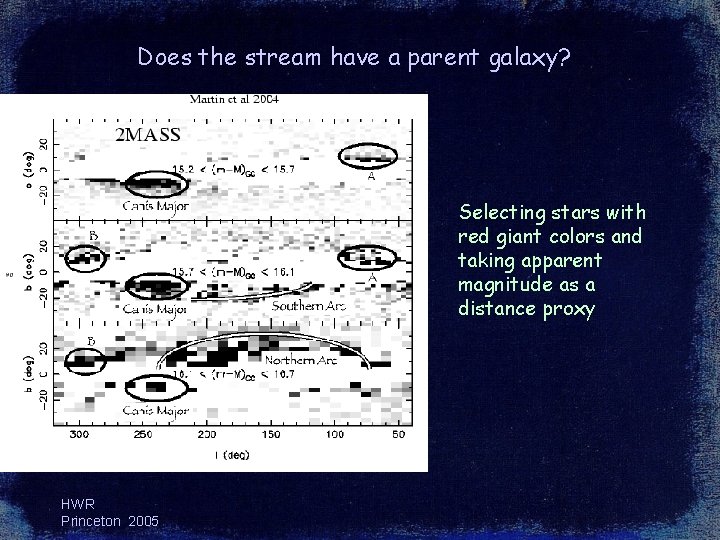
Does the stream have a parent galaxy? Selecting stars with red giant colors and taking apparent magnitude as a distance proxy HWR Princeton 2005
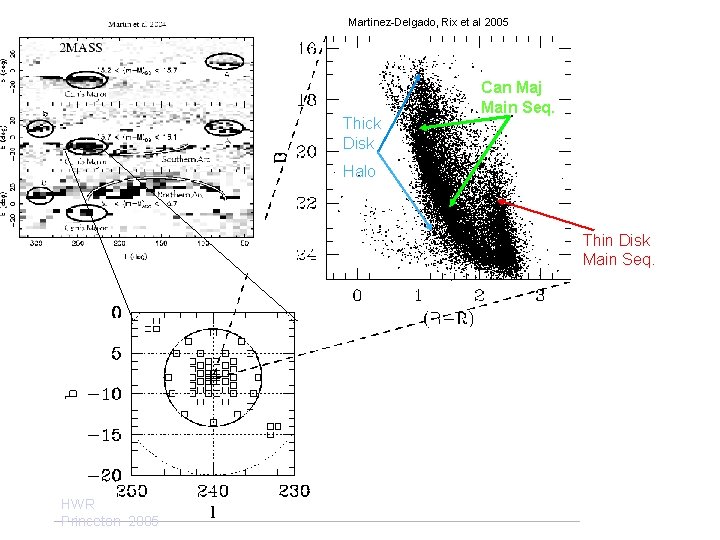
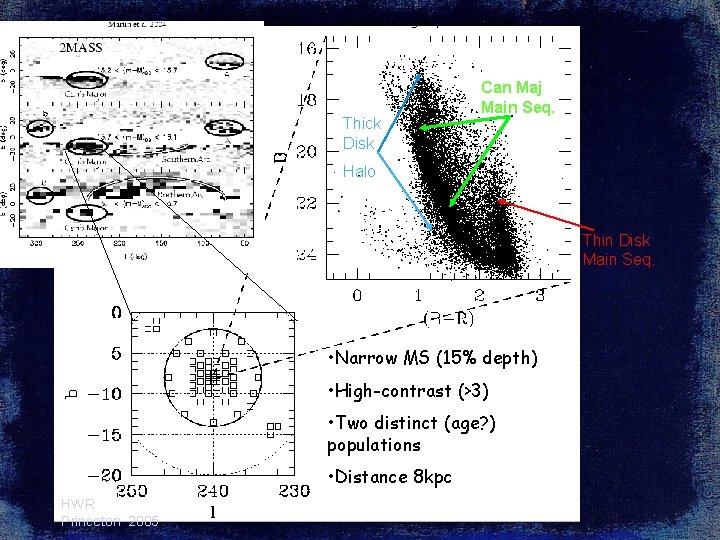
Martinez-Delgado, Rix et al 2005 Thick Disk Can Maj Main Seq. Halo Thin Disk Main Seq. HWR Princeton 2005
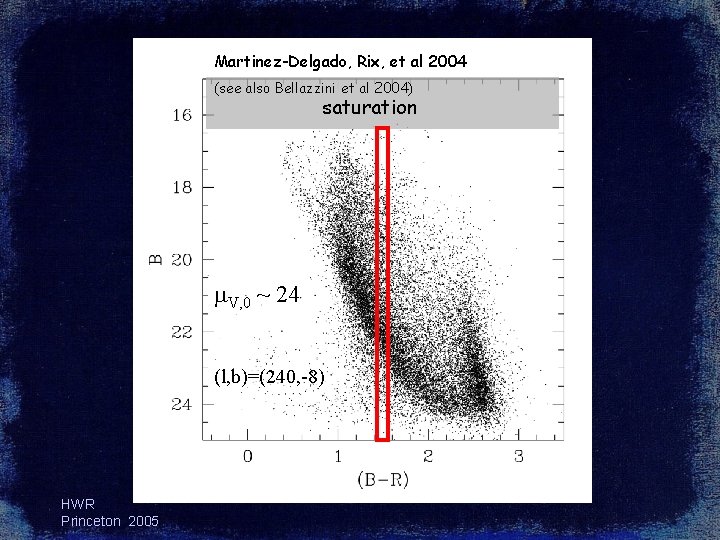
Martinez-Delgado, Rix, et al 2004 (see also Bellazzini et al 2004) saturation m. V, 0 ~ 24 (l, b)=(240, -8) HWR Princeton 2005
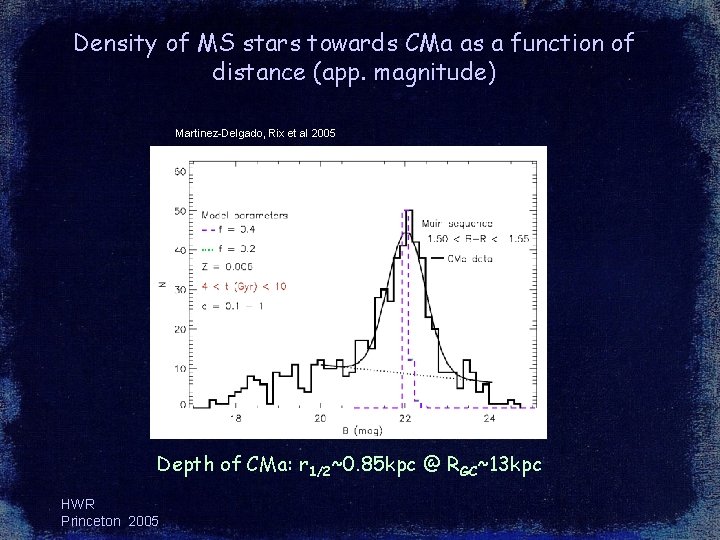
Density of MS stars towards CMa as a function of distance (app. magnitude) Martinez-Delgado, Rix et al 2005 Depth of CMa: r 1/2~0. 85 kpc @ RGC~13 kpc HWR Princeton 2005
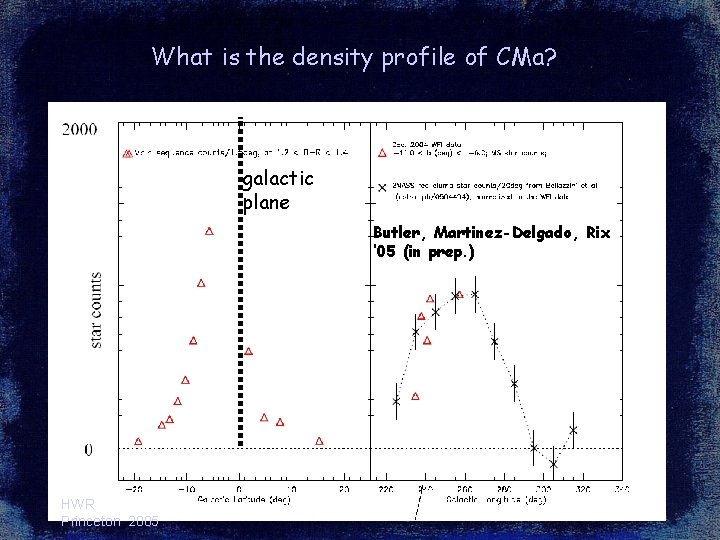
What is the density profile of CMa? galactic plane Butler, Martinez-Delgado, Rix ’ 05 (in prep. ) HWR Princeton 2005
Martinez-Delgado, Rix et al 2005 Thick Disk Can Maj Main Seq. Halo Thin Disk Main Seq. • Narrow MS (15% depth) • High-contrast (>3) • Two distinct (age? ) populations • Distance 8 kpc HWR Princeton 2005
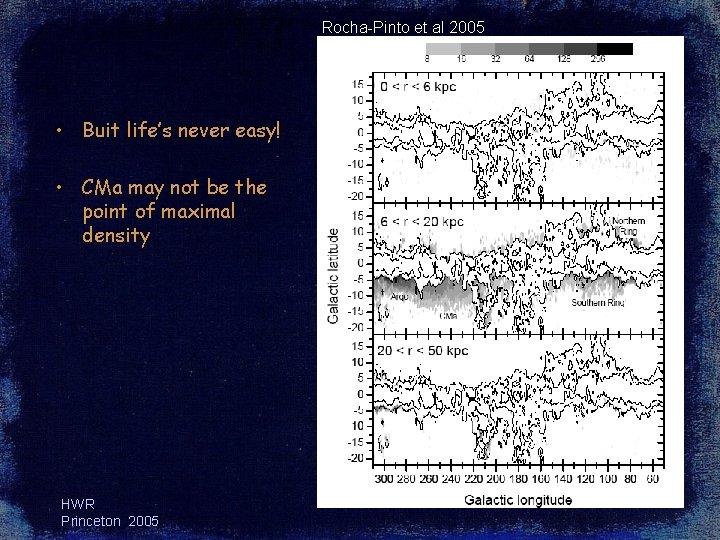
Rocha-Pinto et al 2005 • Buit life’s never easy! • CMa may not be the point of maximal density HWR Princeton 2005
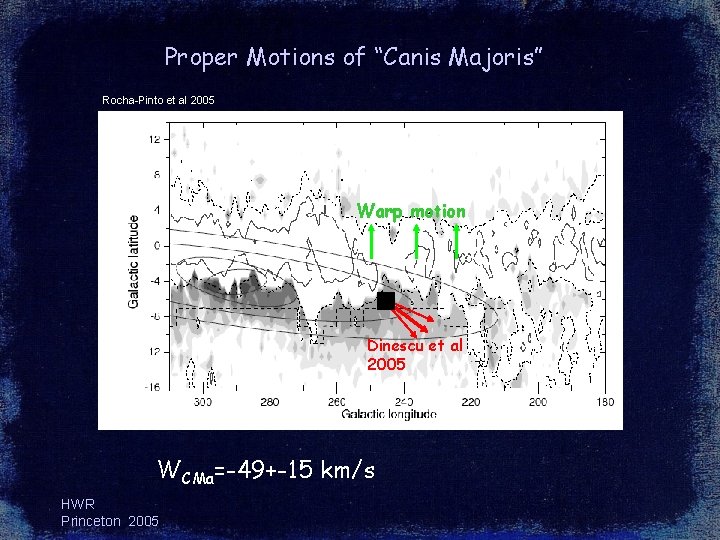
Proper Motions of “Canis Majoris” Rocha-Pinto et al 2005 Warp motion Dinescu et al 2005 WCMa=-49+-15 km/s HWR Princeton 2005
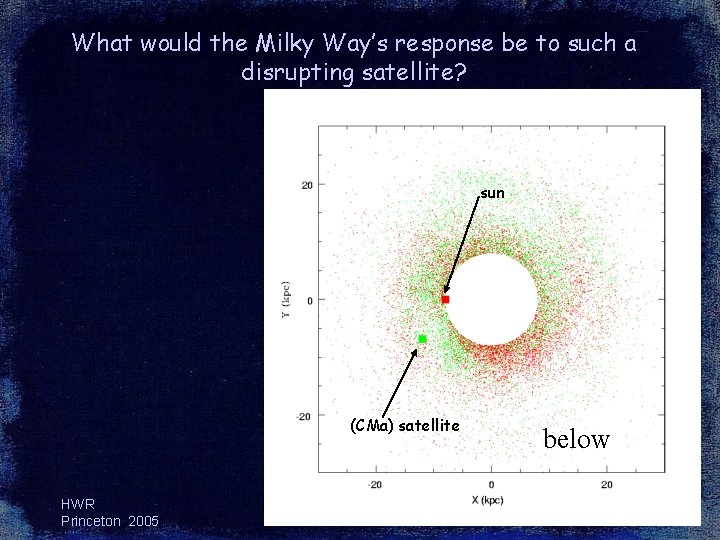
What would the Milky Way’s response be to such a disrupting satellite? sun (CMa) satellite HWR Princeton 2005 below
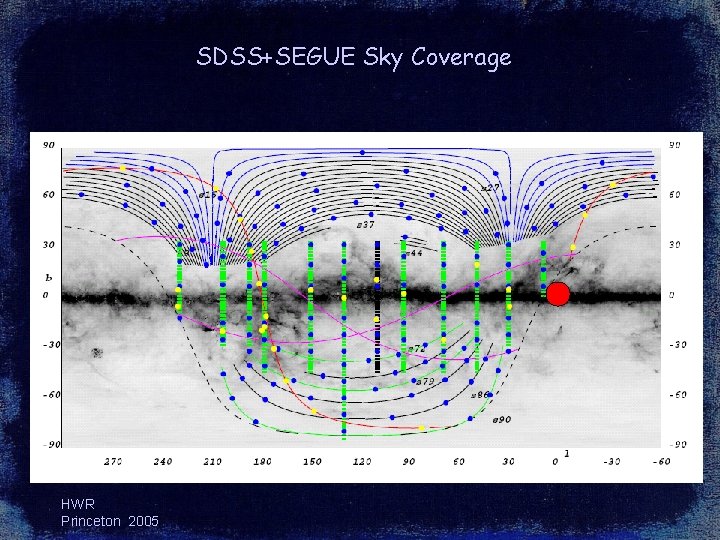
SDSS+SEGUE Sky Coverage HWR Princeton 2005
Near–Term Future Astrometry • PRIMA: differential astrometry with VLTI – 2008 – 10 mas @ 17 mag across 30” HWR Princeton 2005
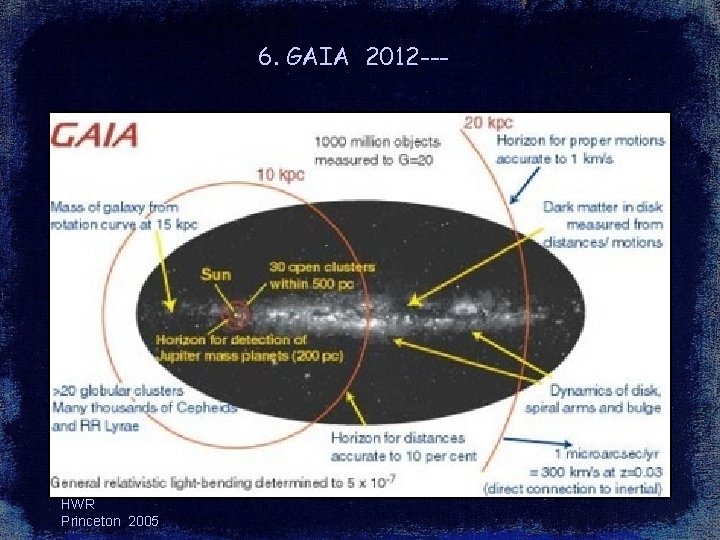
6. GAIA 2012 --- HWR Princeton 2005
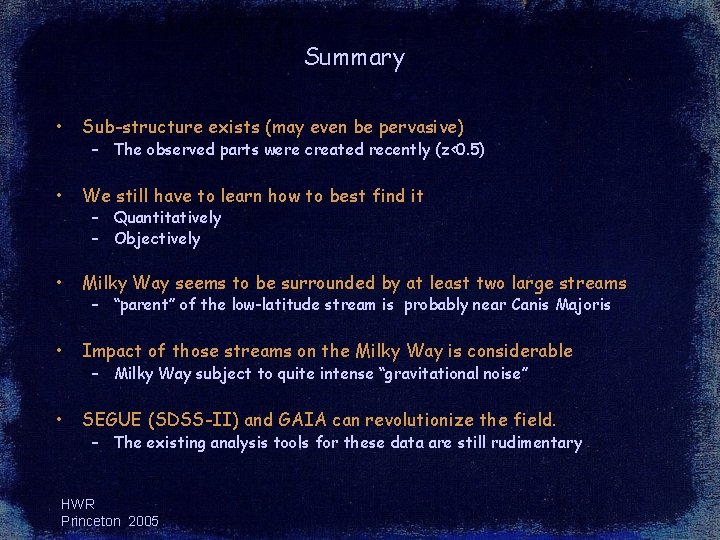
Summary • Sub-structure exists (may even be pervasive) • We still have to learn how to best find it • Milky Way seems to be surrounded by at least two large streams • Impact of those streams on the Milky Way is considerable • SEGUE (SDSS-II) and GAIA can revolutionize the field. – The observed parts were created recently (z<0. 5) – Quantitatively – Objectively – “parent” of the low-latitude stream is probably near Canis Majoris – Milky Way subject to quite intense “gravitational noise” – The existing analysis tools for these data are still rudimentary HWR Princeton 2005