
IV Determinants of Market Structure 1 Economies of

- Slides: 34
(IV) Determinants of Market Structure: -1. Economies of Scale -2. Mergers -3. Capital Markets -4. Other Determinants
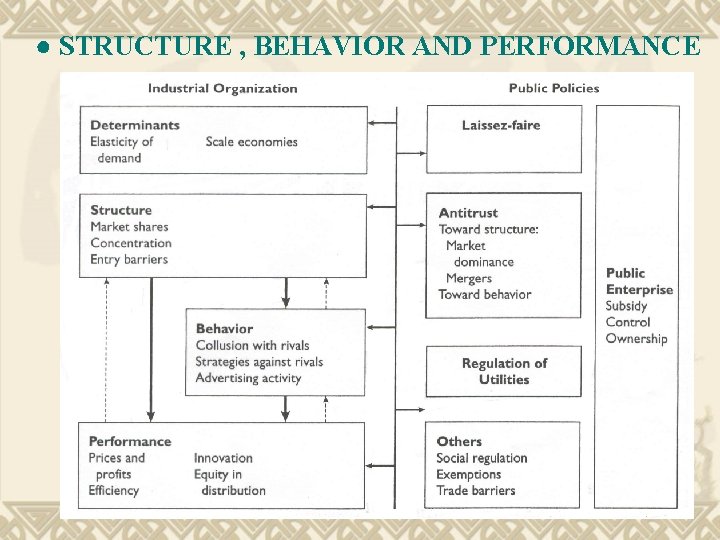
● STRUCTURE , BEHAVIOR AND PERFORMANCE
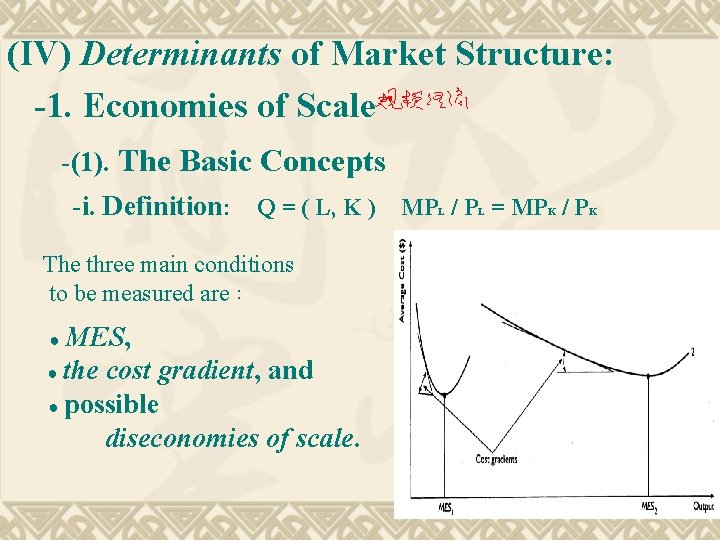
(IV) Determinants of Market Structure: -1. Economies of Scale -(1). The Basic Concepts -i. Definition: Q = ( L, K ) MP / P = MP / P L The three main conditions to be measured are: ● MES, ● the cost gradient, and ● possible diseconomies of scale. L K K
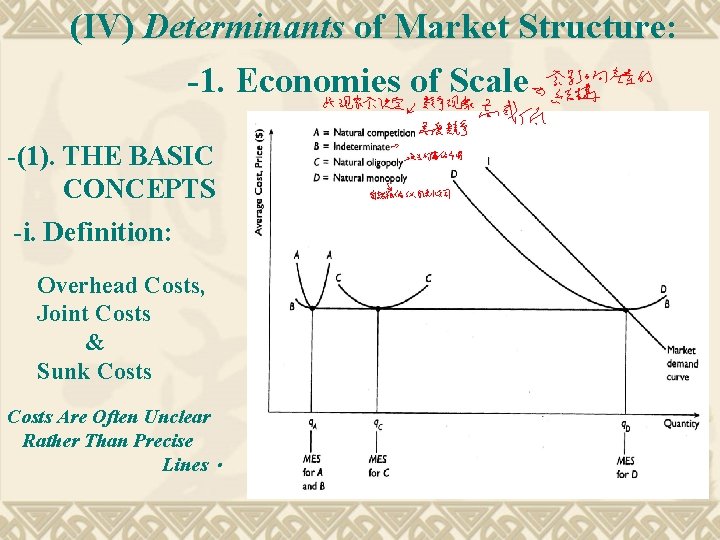
(IV) Determinants of Market Structure: -1. Economies of Scale -(1). THE BASIC CONCEPTS -i. Definition: Overhead Costs, Joint Costs & Sunk Costs Are Often Unclear Rather Than Precise Lines.
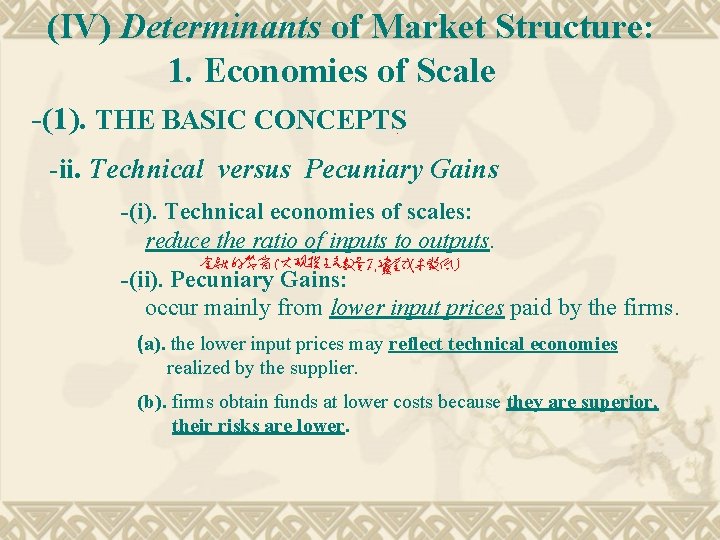
(IV) Determinants of Market Structure: 1. Economies of Scale -(1). THE BASIC CONCEPTS -ii. Technical versus Pecuniary Gains -(i). Technical economies of scales: reduce the ratio of inputs to outputs. -(ii). Pecuniary Gains: occur mainly from lower input prices paid by the firms. (a). the lower input prices may reflect technical economies realized by the supplier. (b). firms obtain funds at lower costs because they are superior, their risks are lower.
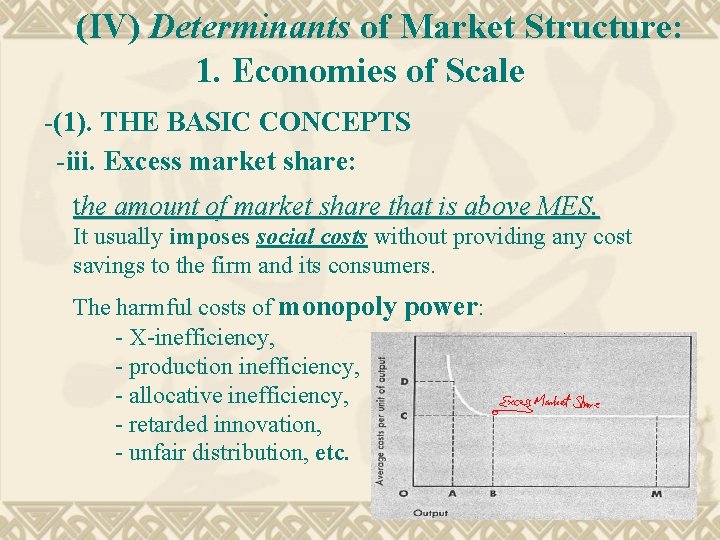
(IV) Determinants of Market Structure: 1. Economies of Scale -(1). THE BASIC CONCEPTS -iii. Excess market share: the amount of market share that is above MES. It usually imposes social costs without providing any cost savings to the firm and its consumers. The harmful costs of monopoly power: - X-inefficiency, - production inefficiency, - allocative inefficiency, - retarded innovation, - unfair distribution, etc.
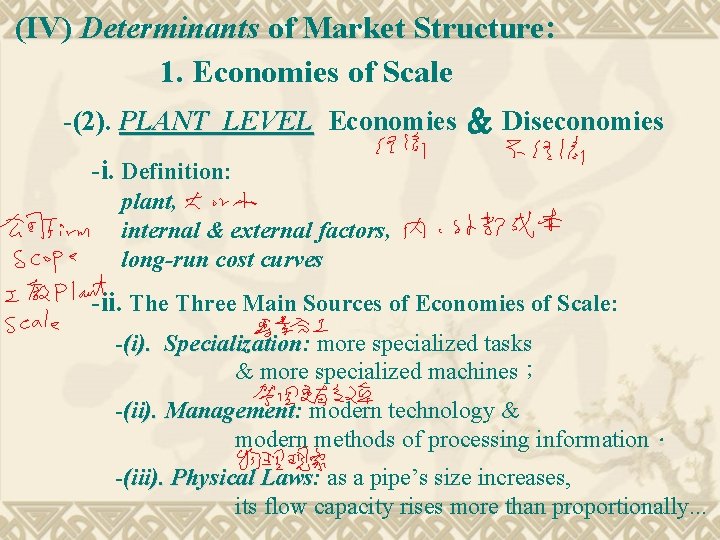
(IV) Determinants of Market Structure: 1. Economies of Scale -(2). PLANT LEVEL Economies & Diseconomies -i. Definition: plant, internal & external factors, long-run cost curves -ii. The Three Main Sources of Economies of Scale: -(i). Specialization: Specialization more specialized tasks & more specialized machines; -(ii). Management: Management modern technology & modern methods of processing information. -(iii). Physical Laws: Laws as a pipe’s size increases, its flow capacity rises more than proportionally. . .
(IV) Determinants of Market Structure: 1. Economies of Scale -(2). PLANT LEVEL Economies & Diseconomies -iii. Sources of Diseconomies: if the same sources are pushed too far. . -(i). Specialization: workers’ alienation, careless work and frequent breakdown. -(ii). Physical Laws: too-large pipes will burst. -(iii). Management: increasing size dilutes a manager’s ability, bureaucracy.
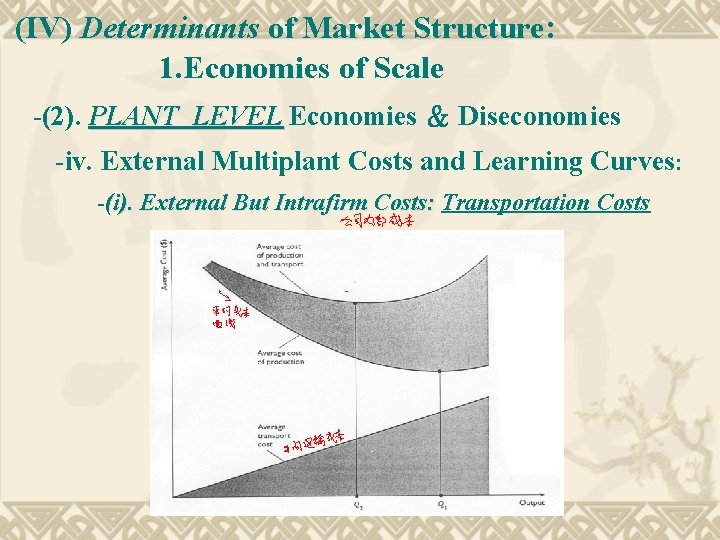
(IV) Determinants of Market Structure: 1. Economies of Scale -(2). PLANT LEVEL Economies & Diseconomies -iv. External Multiplant Costs and Learning Curves: -(i). External But Intrafirm Costs: Transportation Costs
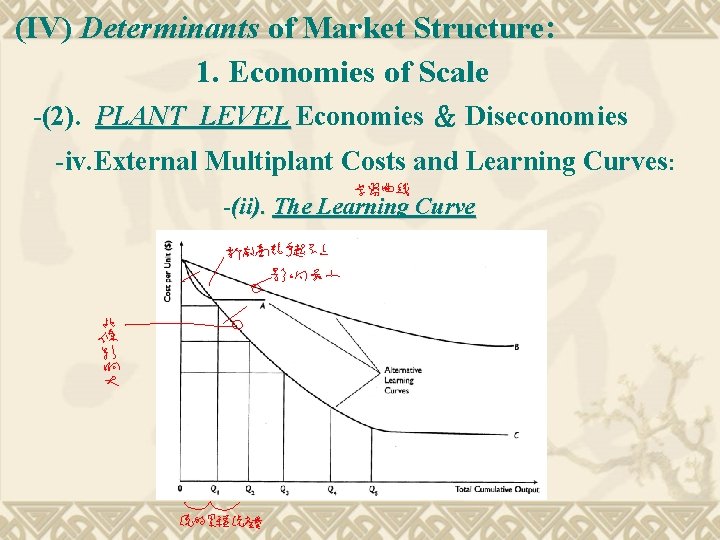
(IV) Determinants of Market Structure: 1. Economies of Scale -(2). PLANT LEVEL Economies & Diseconomies -iv. External Multiplant Costs and Learning Curves: -(ii). The Learning Curve
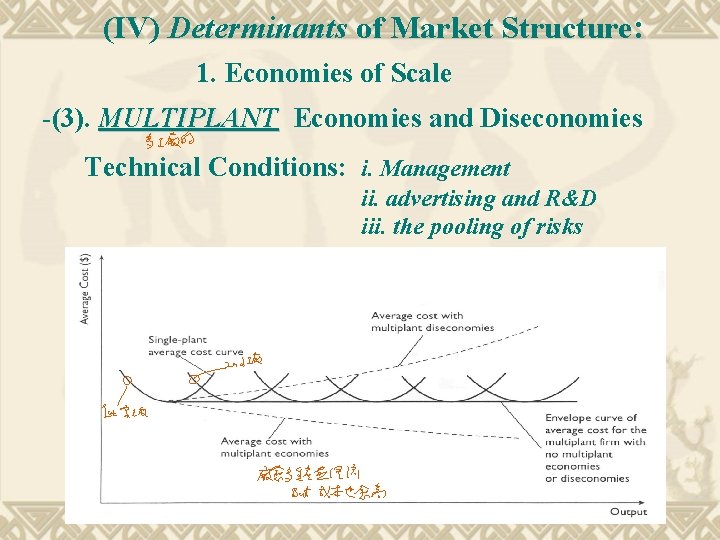
(IV) Determinants of Market Structure: 1. Economies of Scale -(3). MULTIPLANT Economies and Diseconomies Technical Conditions: i. Management ii. advertising and R&D iii. the pooling of risks
(IV) Determinants of Market Structure: 1. Economies of Scale -(4). Method of Research & Empirical Findings All pecuniary elements would of course be filtered out. Yet it is very difficult to factor out pecuniary elements. -i. Cross-section Analysis and Time-series Analysis: the first effort starting in 1930 s.
(IV) Determinants of Market Structure: 1. Economies of Scale -(4). Method of Research & Empirical Findings -ii. Engineering Estimates: Bain (1956). -(i). Advantages, -(ii). Problems, -(iii). Bain’s Results: In most of the 20 industries, optimal plant size was a small percentage of total industry size, the cost gradients were small, and multiplant economies were slight. Actual concentration in most of the industries contained a lot of excess market share.
(IV) Determinants of Market Structure: 1. Economies of Scale -(4). Method of Research & Empirical Findings iii. Survival Techniques: advanced by George J. Stigler in 1958. ( fast and objective ) ○ The plant in the size range X are surviving or increasing their share then they must be efficient in all essential activities. ○ Limits to its usefulness: (i). it automatically includes pecuniary economies. (ii). the technique does not clarify the shape of the cost curve (iii). the Census Bureau bases its plant data on the number of workers, not on output. MES appears to be less than 2% of the industry’s total size in most cases.
(IV) Determinants of Market Structure: 1. Economies of Scale -(4). Method of Research & Empirical Findings -iv. Existing Size Distribution: used by some analysts. The present size of plants give a possible hint of what the optimal size is. -v. Accounting Profitability Approach
(IV) Determinants of Market Structure: 1. Economies of Scale -(4). Method of Research & Empirical Findings vi. An Antitrust Dilemma: it is true or imaginary? A 10% market share is quite consistent with effective competition. Market shares above 20% will usually embody a substaintial degree of excess market share. . There has been virtually no important antitrust trade-off. ( New-Chicago school’s efficient-structure hypotheses )
(IV) Determinants of Market Structure: 2. Mergers
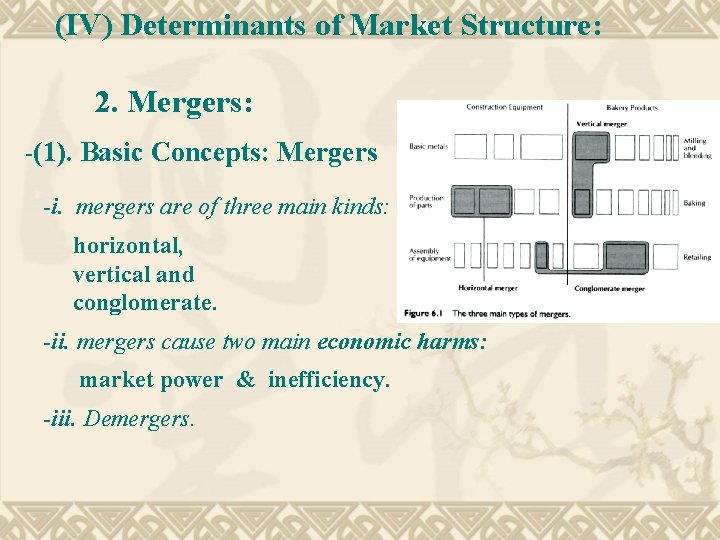
(IV) Determinants of Market Structure: 2. Mergers: -(1). Basic Concepts: Mergers -i. mergers are of three main kinds: horizontal, vertical and conglomerate. -ii. mergers cause two main economic harms: market power & inefficiency. -iii. Demergers.
(IV) Determinants of Market Structure: 2. Mergers: -(2). Motives for Mergers: (151) -i. Straight Market Power & Profits: Horizontal mergers: market power↑. Vertical mergers: a matter of debate. Conglomerate mergers: no increase in market power, the scope of strategies is enlarged.
(IV) Determinants of Market Structure: -2. Mergers: -(2). Motives for Mergers: (151) - ii. Technical Economies: Horizontal mergers: economies of scale. Vertical mergers: � Coase 1936� vertical economies— energy costs, transportation costs & transaction costs↓. Conglomerate mergers: economies of diversificationstability, less risks, synergy results. (reverse synergy ) * The other two ways to achieve technical economies: 1. Internal growth, 2. Long-term contracts. ( 20 -year contracts… ) ( technical gains from mergers: small, 0 or< 0. )
(IV) Determinants of Market Structure: 2. Mergers: -(2). Motives for Mergers: (151) -iii. Pecuniary Economies: Lower input prices, Tax laws & Promotional advantages.
(IV) Determinants of Market Structure: 2. Mergers: -(3). The Effects of Mergers (157) Ravenscraft & Sherer (1980) find that: merger activity 1950 -1977 Operating efficiency↓, The disciplining effect on management did not show through, the synergies did not develop. Airline industry (after 1980): dominance↑, concentration↑. (little systematic evidence) Impacts on Rivals: New-Chicago school’s hypothesis: but there are no imperfections ?
(IV) Determinants of Market Structure: 3. Capital Markets
(IV) Determinants of Market Structure: 3. Capital Markets -(1). The Roles of Capital Markets (143) -i. Types of Capital Markets: Two main parts of the financial sectors (i)-1 loan and debt, which are provided by commercial banks & bond underwriters, & (i)-2 equity securities, which are handled by investment bankers and brokers. -ii. Three Functions: Credit- The Supply of Capital, Counsel- Advice, Connections, and Support, and Control- Enforcing Efficiency. ( Capital Markets as Taskmaster )
(IV) Determinants of Market Structure: 3. Capital Markets -(1). The Roles of Capital Markets -iii. The Control System and Enforcer of Efficiency. Capital-market supervision tends to enforce efficiency throughout the economy. The evaluation process is perspective & comprehensive. -iv. Perfect Capital Markets: All firms would have equal access to funds. This process would reduce market power to the bare minimum dictated by technology.
(IV) Determinants of Market Structure: 3. Capital Markets -(2). Banking and Equity Markets The Replication Hypothesis (148) -In seeking good risks, banks inevitably offer favorable terms to more attractive clients. -The link gives advantages for both the bank and the firm. -The situation is circular. -Banking structure tends to replicate itself throughout other markets. Perfectly competitive capital markets are essential to the new-Chicago efficient-structure hypothesis.
(IV) Determinants of Market Structure: 3. Capital Markets -(3). International Comparisons (149) -i. Banking Structure: tighter. -ii. Banking Relationship: tighter. -iii. Stock Markets: manipulations are more common abroad. (insider problems) If financial markets are competitive, that promotes competitive structure in all other markets. ■ But market power in finance can foster monopoly elsewhere. ■
(IV) Determinants of Market Structure: 4. Other Determinants
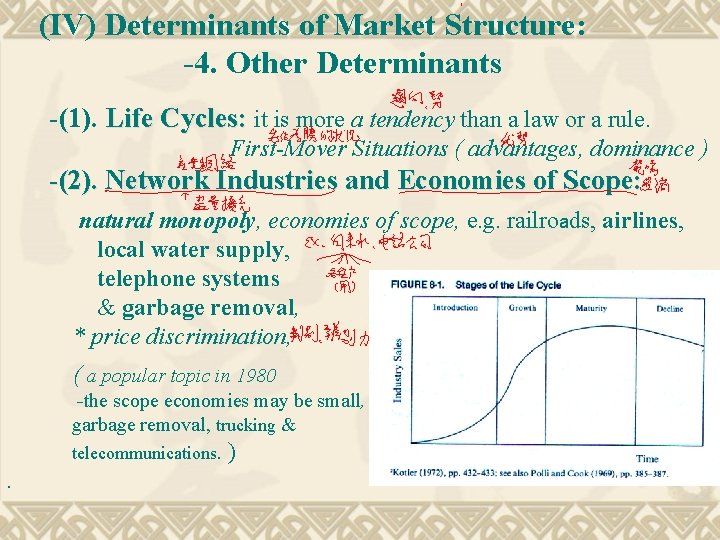
(IV) Determinants of Market Structure: -4. Other Determinants -(1). Life Cycles: it is more a tendency than a law or a rule. First-Mover Situations ( advantages, dominance ) -(2). Network Industries and Economies of Scope: natural monopoly, economies of scope, e. g. railroads, airlines, local water supply, telephone systems & garbage removal, * price discrimination, ( a popular topic in 1980 -the scope economies may be small, garbage removal, trucking & telecommunications. ) .
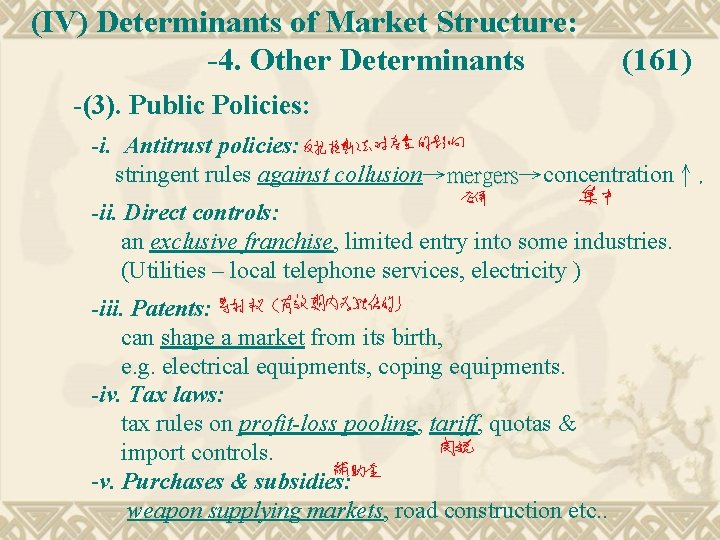
(IV) Determinants of Market Structure: -4. Other Determinants (161) -(3). Public Policies: -i. Antitrust policies: stringent rules against collusion→mergers→concentration↑. mergers -ii. Direct controls: an exclusive franchise, limited entry into some industries. (Utilities – local telephone services, electricity ) -iii. Patents: can shape a market from its birth, e. g. electrical equipments, coping equipments. -iv. Tax laws: tax rules on profit-loss pooling, tariff, quotas & import controls. -v. Purchases & subsidies: weapon supplying markets, road construction etc. .
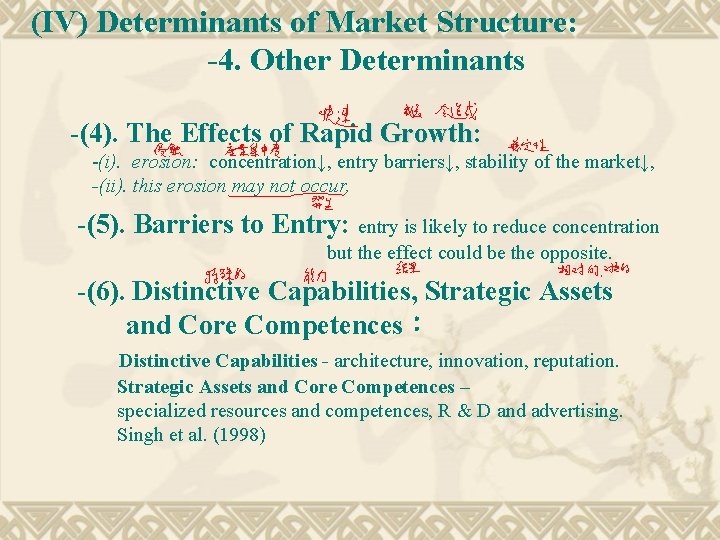
(IV) Determinants of Market Structure: -4. Other Determinants -(4). The Effects of Rapid Growth: Growth -(i). erosion: concentration↓, entry barriers↓, stability of the market↓, -(ii). this erosion may not occur, -(5). Barriers to Entry: entry is likely to reduce concentration but the effect could be the opposite. -(6). Distinctive Capabilities, Strategic Assets and Core Competences: Distinctive Capabilities - architecture, innovation, reputation. Strategic Assets and Core Competences – specialized resources and competences, R & D and advertising. Singh et al. (1998)
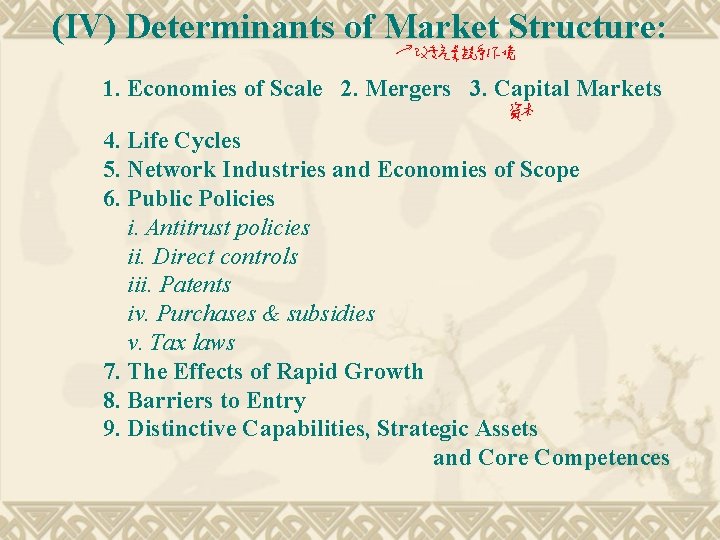
(IV) Determinants of Market Structure: 1. Economies of Scale 2. Mergers 3. Capital Markets 4. Life Cycles 5. Network Industries and Economies of Scope 6. Public Policies i. Antitrust policies ii. Direct controls iii. Patents iv. Purchases & subsidies v. Tax laws 7. The Effects of Rapid Growth 8. Barriers to Entry 9. Distinctive Capabilities, Strategic Assets and Core Competences
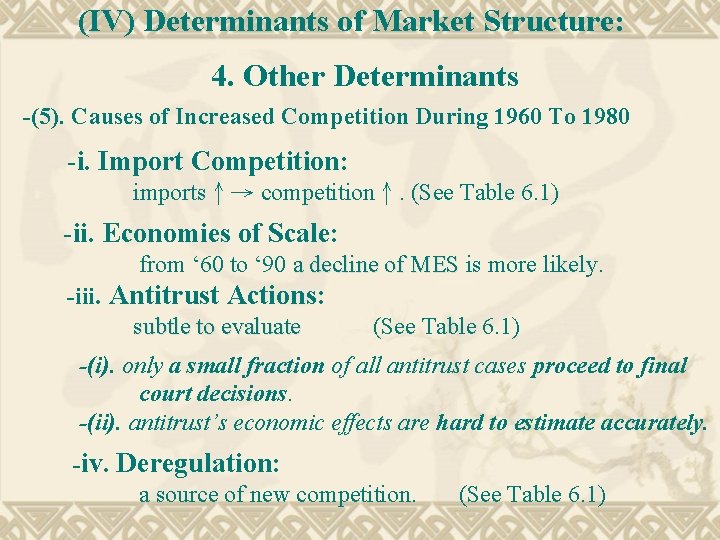
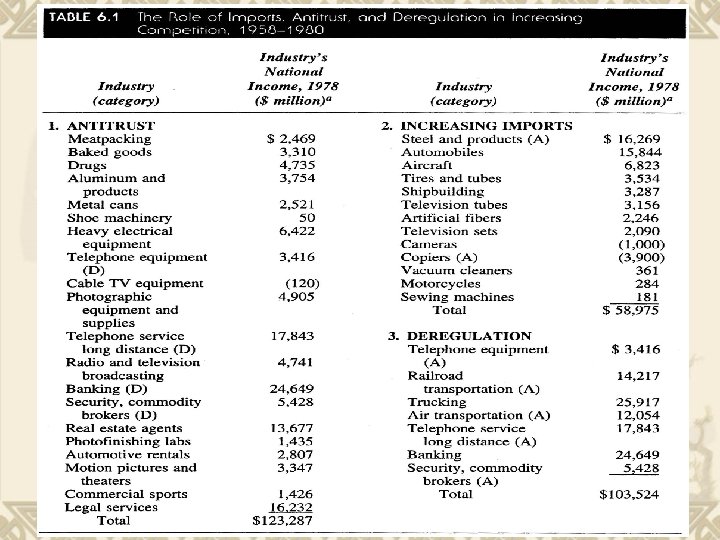
(IV) Determinants of Market Structure: 4. Other Determinants -(5). Causes of Increased Competition During 1960 To 1980 -i. Import Competition: imports↑→ competition↑. (See Table 6. 1) -ii. Economies of Scale: from ‘ 60 to ‘ 90 a decline of MES is more likely. -iii. Antitrust Actions: subtle to evaluate (See Table 6. 1) -(i). only a small fraction of all antitrust cases proceed to final court decisions. -(ii). antitrust’s economic effects are hard to estimate accurately. -iv. Deregulation: a source of new competition. (See Table 6. 1)