
IV C Changes Challenges to PoliticalTerritorial Arrangements Debra
IV. C. Changes & Challenges to Political-Territorial Arrangements Debra Coram Troxell, NBCT
Political Geography is Power • Pre-1970 s – “Spatial Determinism” (traditional Political Geography) • Today – Goal is to overcome “Spatial Determinism” – States and borders exert less influence in terms of people, politics and places • ISIS, al-Qaeda, UN, EU, transnational corporations, gerrymandering (GIS)

1. Changing Nature of Sovereignty • Early People: Tribes behaved territorially but not exclusively – held sway over people but no collective agreement among rulers about how territory would be organized or what rulers could do within their respective domains (de. Blij 241) • Westphalian System: 1648 Treaty of Westphalia gave rise of politicalterritorial power – Instead of societies defining territories; Territories define societies • “These new countries are artificial units, geographic expressions carved on the map by European imperialists. These are the units we have tried to turn into nations. ” -Julius Nyerere, president of Tanzania 1971 • Globalists_supr article in polit. Folder on EU being close to global governance

1. Changing Nature of Sovereignty Globalization has changed the face of sovereignty, with companies, people, and ideas now interacting across borders at a pace never seen before. With emerging intergovernmental organizations, such as the European Union, the definition of sovereignty is in flux. http: //digitalcommons. hamline. edu/dhp/14/ 1. Globalization of economies, transnational corps. , outsourcing 2. International and supranational institutions 1. 2. 3. 4. 5. Trade blocs WTO EU NGOs International Migration and effective communication undermines the state as a cultural community Increased nationalist and separatist movements in “culturally composite states”
2 b. Unification • East Germany – West Germany • Hong Kong – China • North Korea – South Korea
2 c. Cooperation • Due to “economic globalization” & international cooperation – Some of sovereign state’s traditional responsibilities and authorities are being diluted by • • Higher-order political and economic organizations Transnational corporations Non-governmental organizations (NGOs) Which operate outside of nation-state jurisdiction – Transnationals corps. Limit the economic influence of individual countries – Internet & Cyberspace are not controlled
3. Supranationalism & International Alliances
Supranational Political Bodies • Associations of three or more states created for mutual benefit and to achieve shared objectives. • Supranational organizations come into being when countries give up a portion of their sovereignty (willingly) in order to gain the advantages of having a closer relationship with their neighboring countries, politically, economically or culturally.
Goals of International Organizations • Political & Military – United Nations – North Atlantic Treaty Organization (NATO) – Warsaw Pact (1955 – 1991) – Organization of American States (OAS) – African Union (AU)
Goals of International Organizations • Economic – European Union (EU) – Council for Mutual Economic Assistance (COMECON) – communist countries (1949 – 1991) – North American Free Trade Agreement (NAFTA) (1994 - )
Political & Military Organizations
United Nations • 1945 – original 49 members • 2014 – 193 members
The United Nations • The United Nations System is based on five active principal organizations: • • • UN General Assembly UN Security Council UN Economic and Social Council UN Secretariat International Court of Justice
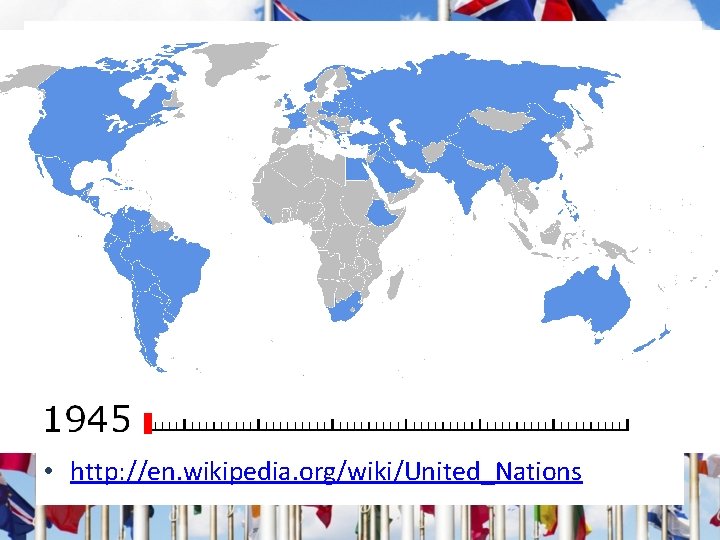
• http: //en. wikipedia. org/wiki/United_Nations
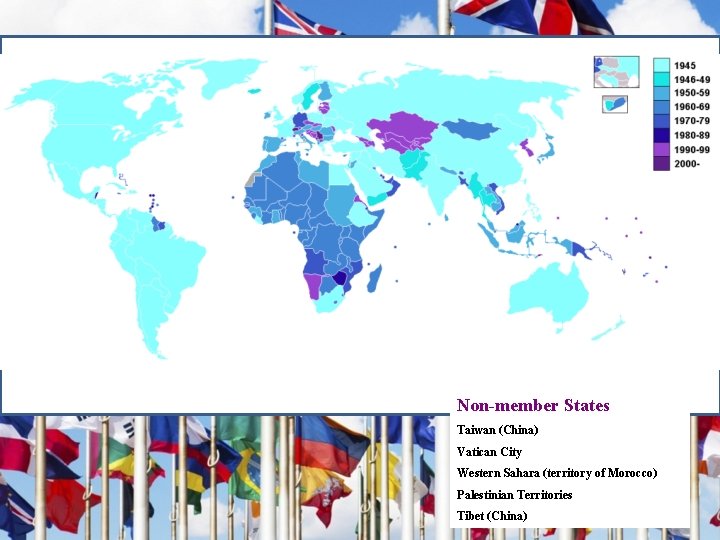
Non-member States Taiwan (China) Vatican City Western Sahara (territory of Morocco) Palestinian Territories Tibet (China)
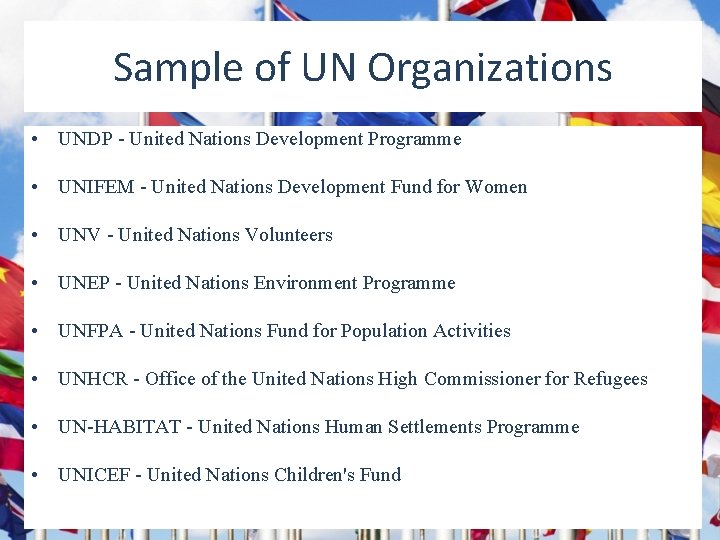
Sample United Organizations Sample of Nations UN Organizations • UNDP - United Nations Development Programme • UNIFEM - United Nations Development Fund for Women • UNV - United Nations Volunteers • UNEP - United Nations Environment Programme • UNFPA - United Nations Fund for Population Activities • UNHCR - Office of the United Nations High Commissioner for Refugees • UN-HABITAT - United Nations Human Settlements Programme • UNICEF - United Nations Children's Fund
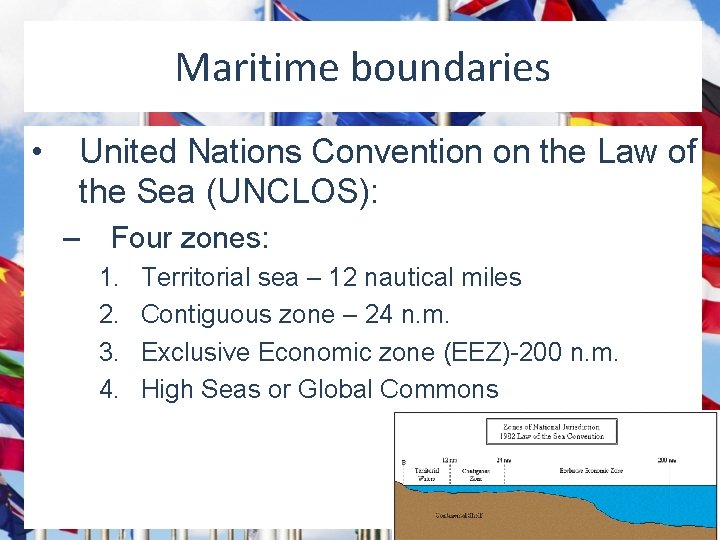
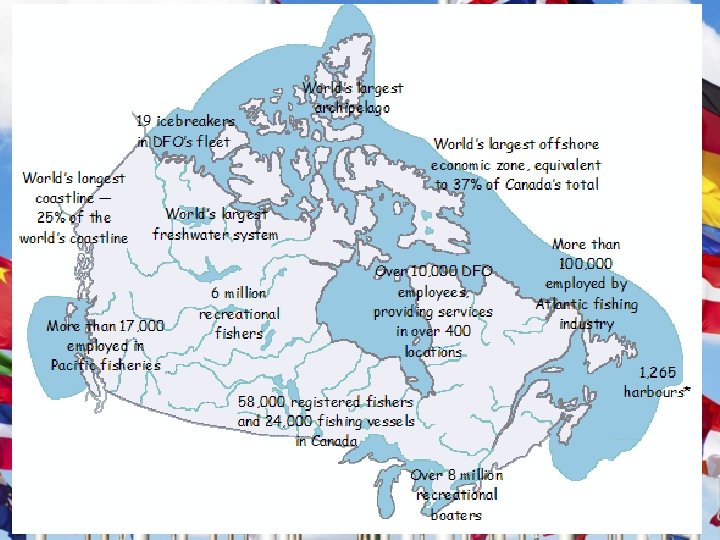
Maritime boundaries • United Nations Convention on the Law of the Sea (UNCLOS): – Four zones: 1. 2. 3. 4. Territorial sea – 12 nautical miles Contiguous zone – 24 n. m. Exclusive Economic zone (EEZ)-200 n. m. High Seas or Global Commons
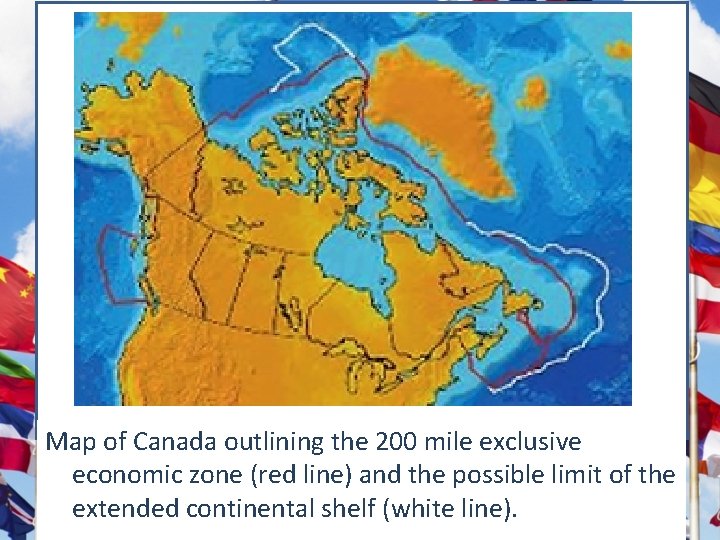
Map of Canada outlining the 200 mile exclusive economic zone (red line) and the possible limit of the extended continental shelf (white line).
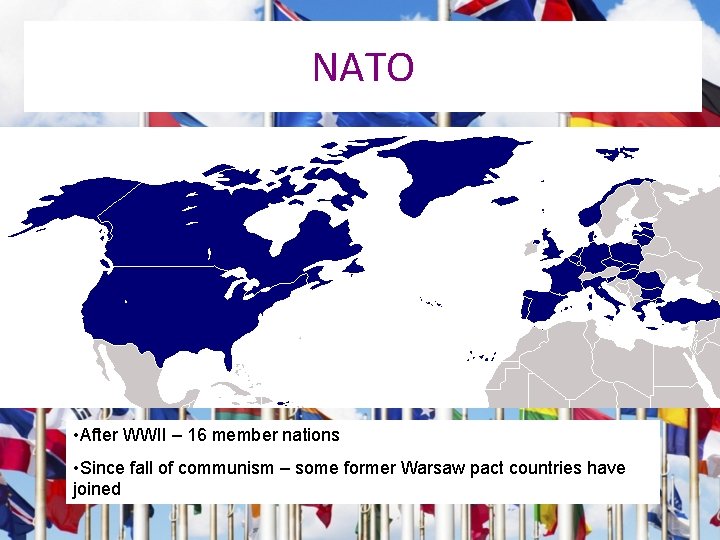
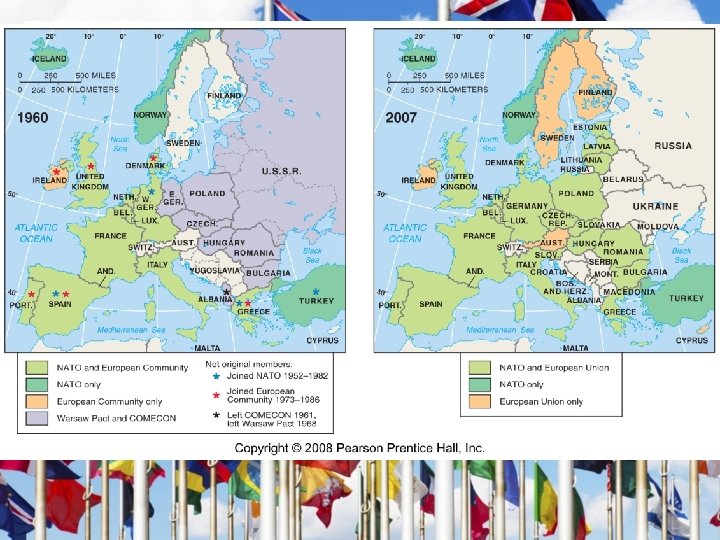
NATO • After WWII – 16 member nations • Since fall of communism – some former Warsaw pact countries have joined
European Union • Began as European Economic Community (EEC), – 1957. – Stronger in 1994 – 10 new members, joined, 2004 – 2015: 28 members • Turkey wants to join but have faced resistance. – Greece objects due to Cyprus – Objections due to human rights abuses of Kurds – Not “European” enough
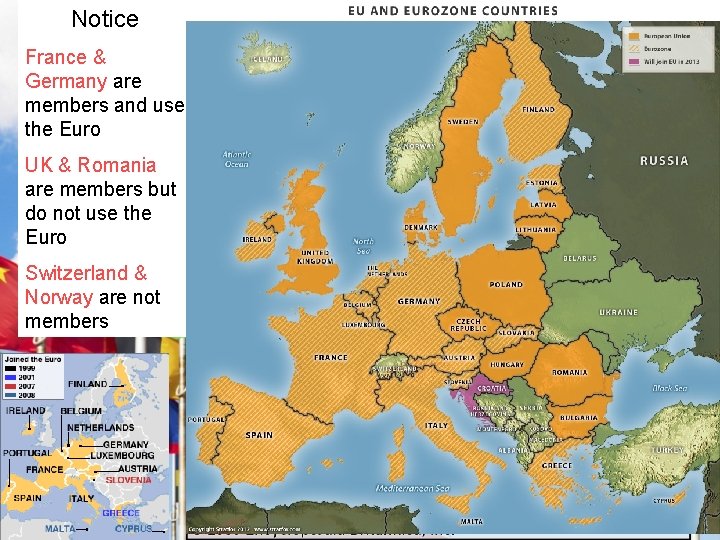
Notice France & Germany are members and use the Euro UK & Romania are members but do not use the Euro Switzerland & Norway are not members
EU: Federal or Confederate? • Almost one-half of the total annual legislation in the United Kingdom now comes from the European Union. • Power of Place: EU
Economic Organizations
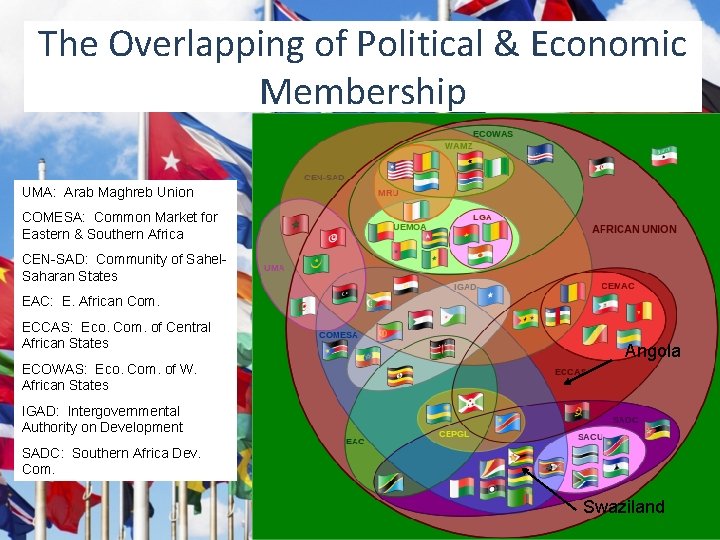
The Overlapping of Political & Economic Membership UMA: Arab Maghreb Union COMESA: Common Market for Eastern & Southern Africa CEN-SAD: Community of Sahel. Saharan States EAC: E. African Com. ECCAS: Eco. Com. of Central African States Angola ECOWAS: Eco. Com. of W. African States IGAD: Intergovernmental Authority on Development SADC: Southern Africa Dev. Com. Swaziland
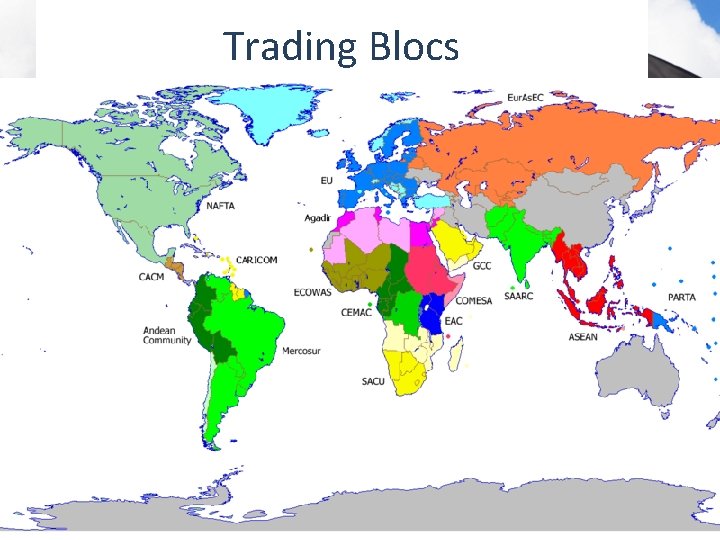
Trading Blocs
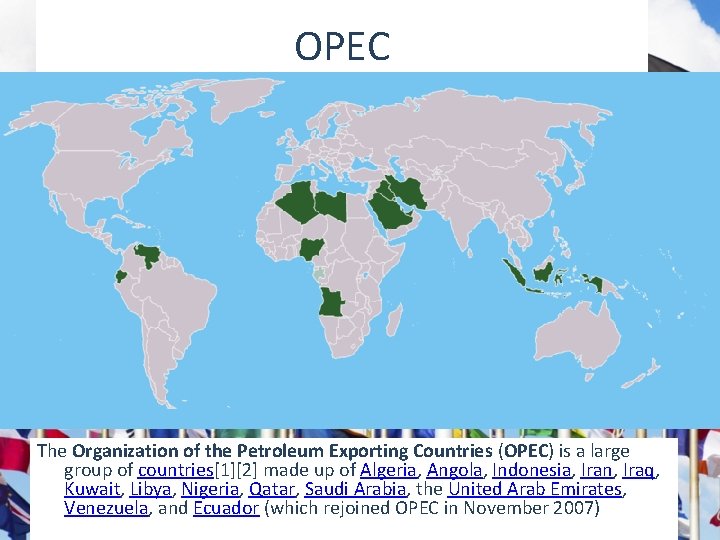
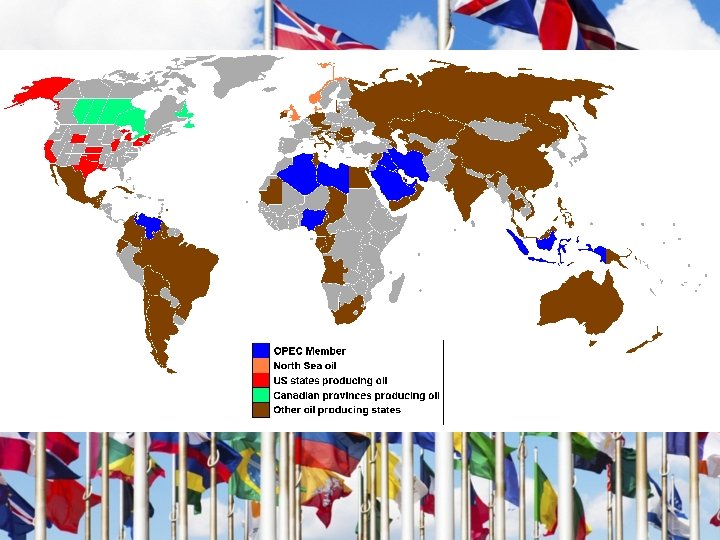
OPEC The Organization of the Petroleum Exporting Countries (OPEC) is a large group of countries[1][2] made up of Algeria, Angola, Indonesia, Iran, Iraq, Kuwait, Libya, Nigeria, Qatar, Saudi Arabia, the United Arab Emirates, Venezuela, and Ecuador (which rejoined OPEC in November 2007)
NAFTA • 1993 • Designed to converge wealth between Canada, US, & Mexico • Increase in wealth for elite, decline in income for Mex. farmers, and job loss for US workers • Increase in maquiladoras
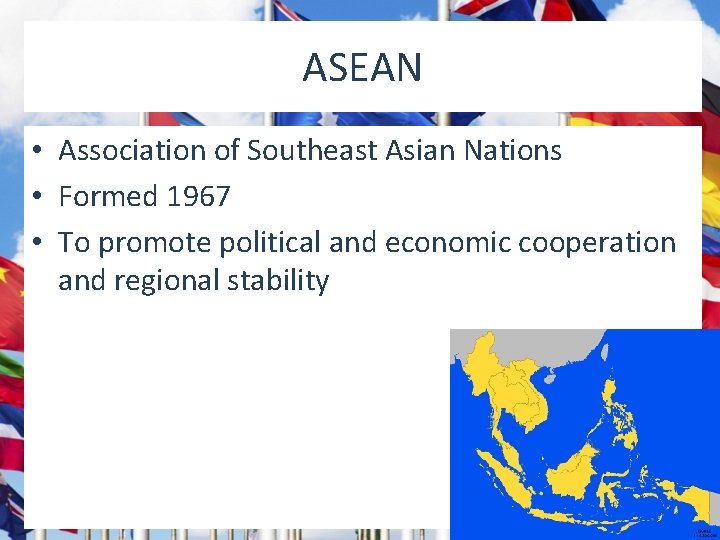
ASEAN • Association of Southeast Asian Nations • Formed 1967 • To promote political and economic cooperation and regional stability
ASEAN • Components – Political-Security Community • Intergovernmental Commission on Human Rights • Defence Ministers Meeting, etc. – Economic Community • Free Trade Area • Ministers on Energy Meeting • Ministerial Meeting on Agriculture and Forestry, etc. – Socio-Cultural Community • Ministers Responsible for Culture & Arts • Education Ministers Meeting
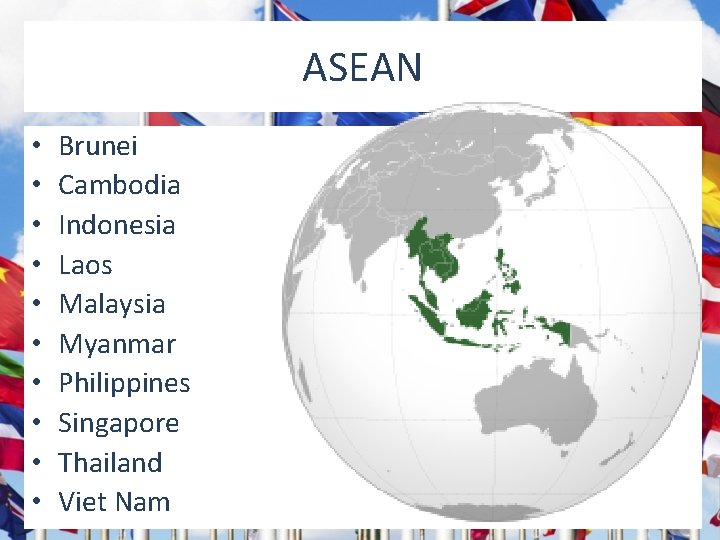
ASEAN • • • Brunei Cambodia Indonesia Laos Malaysia Myanmar Philippines Singapore Thailand Viet Nam
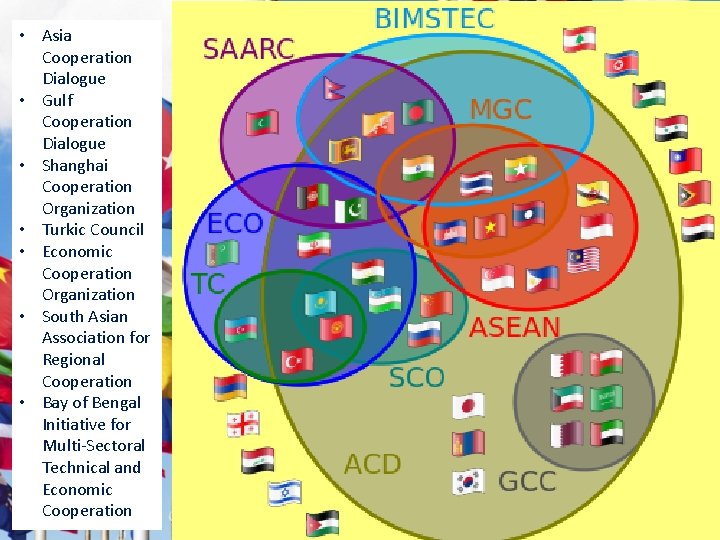
• Asia Cooperation Dialogue • Gulf Cooperation Dialogue • Shanghai Cooperation Organization • Turkic Council • Economic Cooperation Organization • South Asian Association for Regional Cooperation • Bay of Bengal Initiative for Multi-Sectoral Technical and Economic Cooperation
3 b. International Alliances • “NATO, ASEAN, NAFTA and European Union”
4 a. Centripetal & Centrifugal Forces
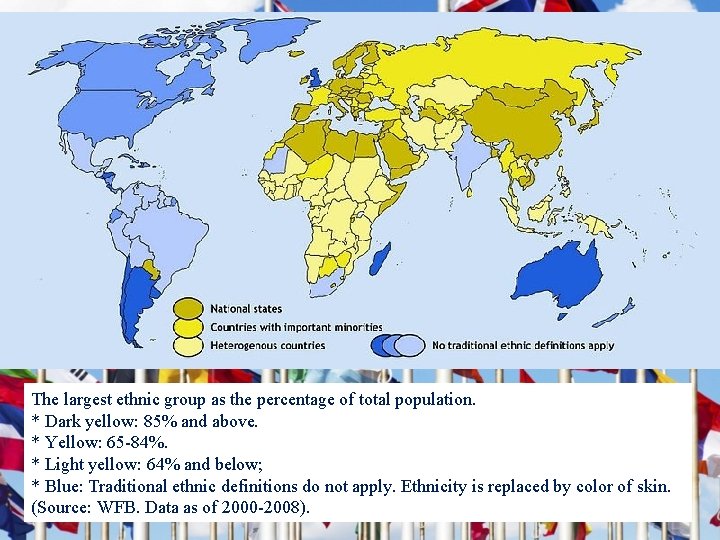
The largest ethnic group as the percentage of total population. * Dark yellow: 85% and above. * Yellow: 65 -84%. * Light yellow: 64% and below; * Blue: Traditional ethnic definitions do not apply. Ethnicity is replaced by color of skin. (Source: WFB. Data as of 2000 -2008).
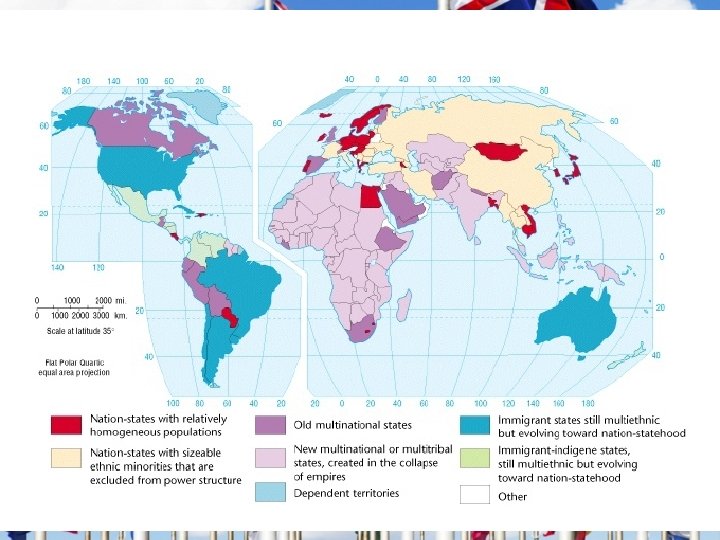
Centripetal forces • • Forces that promote national unity and solidarity. The ultimate centripetal force is the nation’s raison d’être: v Its ‘reason for being’ v Every state must have a reason to exist: v Defending a culture or ideology v Standing up to a common enemy v Special status in the world v States that don’t have a raison d’etre try to create one to unify the people.
Centripetal forces 1. Raison d’etre 2. Nationalism 3. Unifying institutions: schools, the armed forces and state churches. *Organization and administration of the government. 4. Transportation and communication – strong core area 5. A perceived threat to a group’s sense of identity.
Examples of centripetal forces • Nationalism is the primary source of group identity in the modern state. – It is the idea that a person derives a significant part of his identity from a sense of belonging to a nation. – States try to create allegiance to keep country stable: want their populace to accept the ideology, adhere to laws, participate in its operation. – Icons—flags, national sports teams, holidays, statues
Centrifugal forces • Forces that disrupt internal order and further the destruction of a country. – – – Ethnic conflicts; competing claims among ethnic groups. Religion Poorly run government and/or transportation systems. A dissident minority seeking autonomy Large population in frontier area Devolution: transfer of power from the state’s central government. to separate political subdivisions within its territory.
Government systems and Cultural Diversity • Homogenous populations with similar languages, religions and shared history—a single identity—are best governed as unitary states. Reaction by the people against unitary rule can generate strong centrifugal forces. • Heterogeneous populations are best governed as federal states. Allowing people to govern themselves close to home can generate strong centripetal forces.
Size and shape • Can influence the viability of a state. • The size may encourage unity or division • The shape may also encourage unity or division Thus either size or shape have the potential to generate centrifugal or centripetal forces.
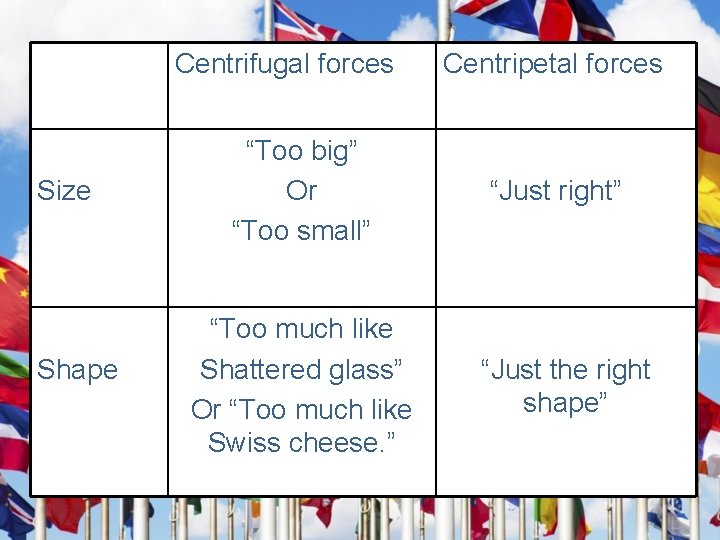
Centrifugal forces Size Shape “Too big” Or “Too small” “Too much like Shattered glass” Or “Too much like Swiss cheese. ” Centripetal forces “Just right” “Just the right shape”
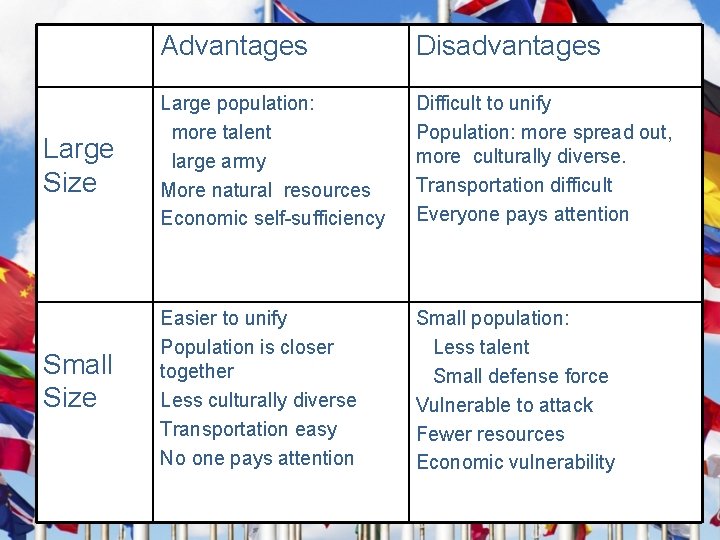
Advantages Disadvantages Large Size Large population: more talent large army More natural resources Economic self-sufficiency Difficult to unify Population: more spread out, more culturally diverse. Transportation difficult Everyone pays attention Small Size Easier to unify Population is closer together Less culturally diverse Transportation easy No one pays attention Small population: Less talent Small defense force Vulnerable to attack Fewer resources Economic vulnerability
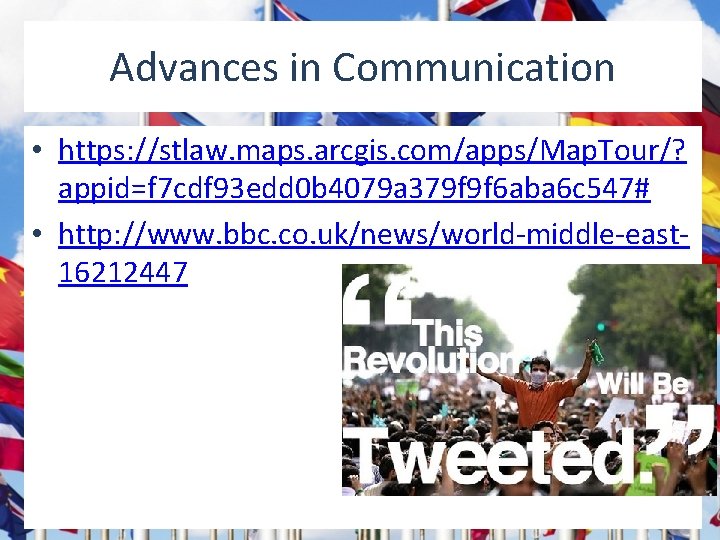
Advances in Communication • https: //stlaw. maps. arcgis. com/apps/Map. Tour/? appid=f 7 cdf 93 edd 0 b 4079 a 379 f 9 f 6 aba 6 c 547# • http: //www. bbc. co. uk/news/world-middle-east 16212447
#Revolution • Advances in Communication have facilitated devolution, supranationalism, democratization • Arab Spring, 2010 – Egyptian Pres. Resigns tweets balloon from 23, 000/day to 230, 000/day – Top 23 videos received almost 5. 5 million views – The Region engaged in an extend conversation
2 a. Fragmentation • “indigenous areas” • “autonomous lands affect political, social and economic processes”
4 b. Devolution • “ethnic separatism” • Time Permitting: Devolution hw (devolution_act) ESPN • Power of Place: Velvet Divorce
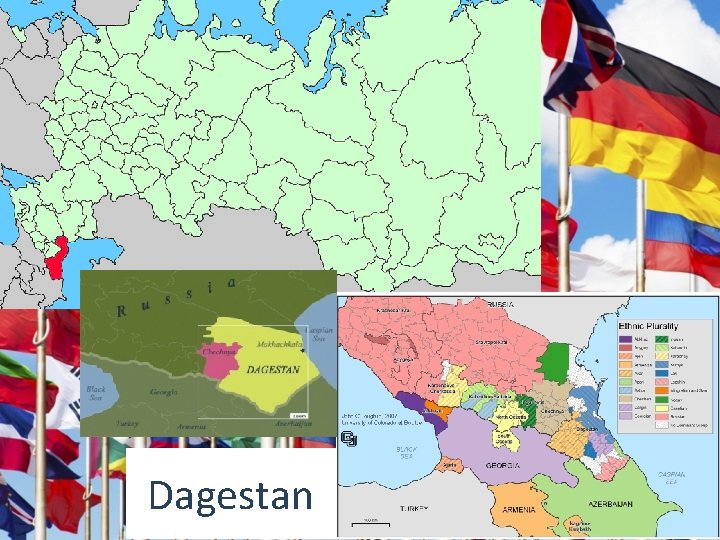
Dagestan
6 a. Armed Conflicts - War • Ethnic Conflicts/Genocide • Acquisition of Territory/Resources – Russia – Ukraine – Iraq – Kuwait and oil – Falkland Islands
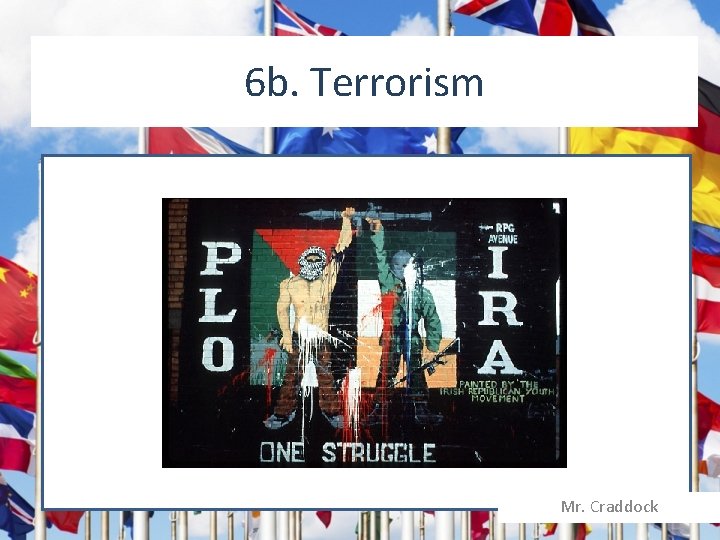
6 b. Terrorism Mr. Craddock
What is Terrorism • US: premeditated, politically motivated violence perpetrated against noncombatant targets by subnational groups or clandestine agents • UN: intention to cause death or serious bodily harm to civilians or non-combatants with the purpose of intimidating a population or compelling a government or an international organization to do or abstain from doing any act.
Terrorism? • Terrorism or Acts of Violence or War Activity
Terrorism or Acts of Violence or War v North Ossetia v Lebanon v Sri Lanka v Pakistan v India v France v Dagestan, Russia v Burma v New York v Istanbul, Turkey v Elazig Province, Turkey v Texas v Guinea v Blacksburg v Seattle v Uzbekistan v Grozny, Russia v Kosovo v Cote d’Ivoire v Yemen
Definition cont. • Terrorism generally can be confined to three concepts – Violence – Fear – Intimidation • It is almost always targeted in the most public way against civilians in order to draw attention to the act
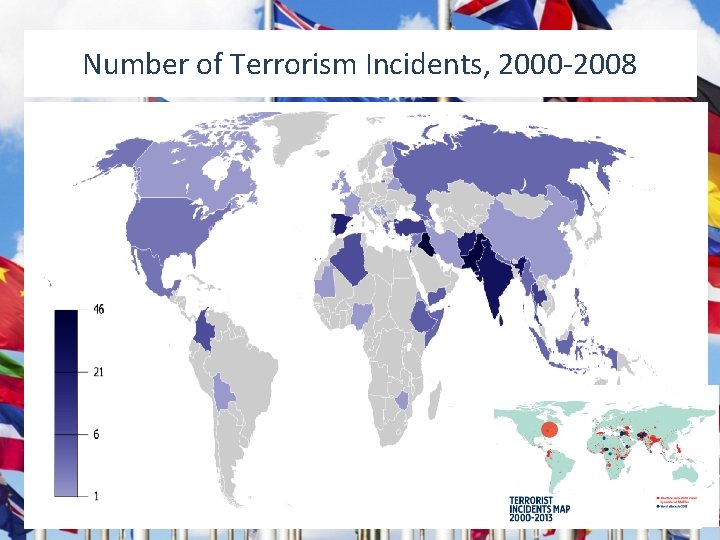
Number of Terrorism Incidents, 2000 -2008
Types of Terrorism • Domestic – acts against one’s own country (Oklahoma City) • International – acts that transcend national boundaries (9/11) • Subnational – acts committed by nongovernmental groups (Chechnya) • State – acts committed by agents of the government (Syria – before ISIS, “passive support” of HAMAS, Hezbollah, Palestinian Islamic Jihad)
Major Terrorist Incidents • • • 9/11 (2001) Munich Olympic Massacre (1972) Iran Hostage Crisis (1979 -1981) Beirut Bombing (1983) Mumbai (2008) School Hostages in Russia (2004)
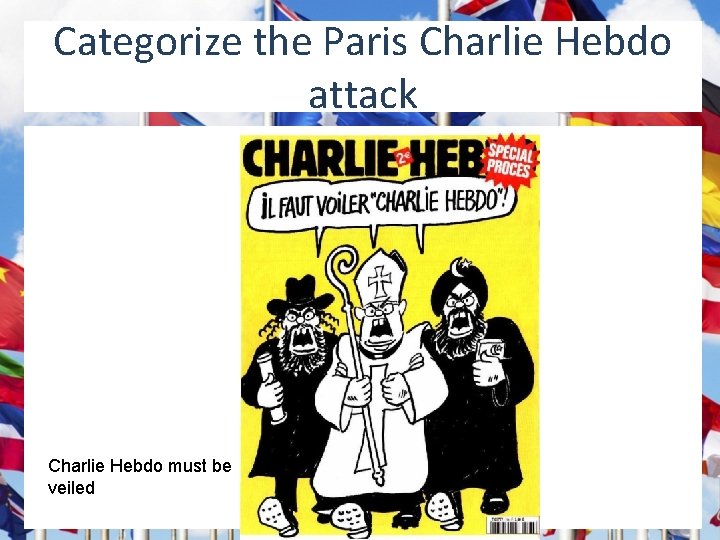
Categorize the Paris Charlie Hebdo attack Charlie Hebdo must be veiled
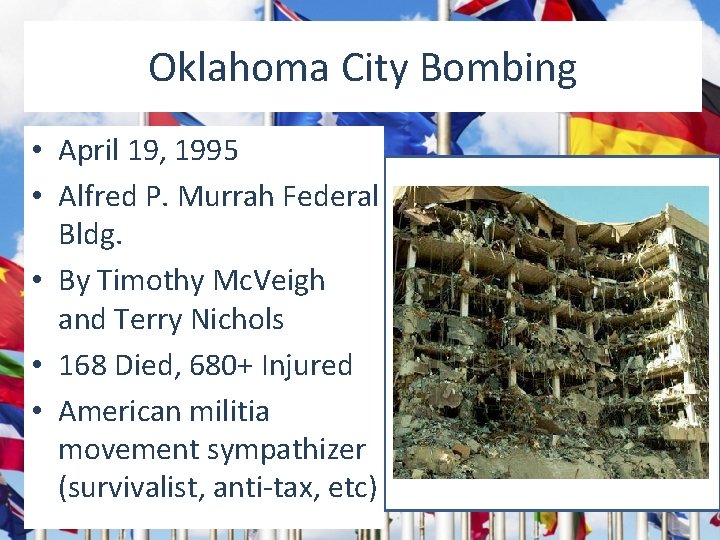
Oklahoma City Bombing • April 19, 1995 • Alfred P. Murrah Federal Bldg. • By Timothy Mc. Veigh and Terry Nichols • 168 Died, 680+ Injured • American militia movement sympathizer (survivalist, anti-tax, etc)
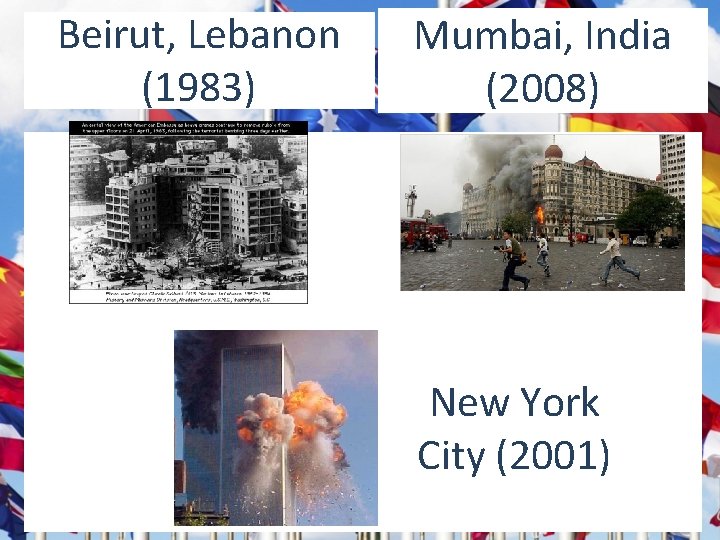
Beirut, Lebanon (1983) Mumbai, India (2008) New York City (2001)
Types of Terrorism cont. • Bioterrorism – intentional release of toxic biological agents for the intent of terrorism • Cyberterrorism – usually an attack on information technology to disrupt an organization • Ecoterrorism – attacking disruptors of the environment in order to protect the environment.
Terrorist Groups • • Basque Fatherland Liberty (Spain) Irish Republican Army (N. Ireland) HAMAS (Palestine) Hezbollah (Lebanon; to resist Israeli occupation) Palestinian Liberation Front (Palestine) Sikh Terrorism (India) Boko Haram (Nigeria)
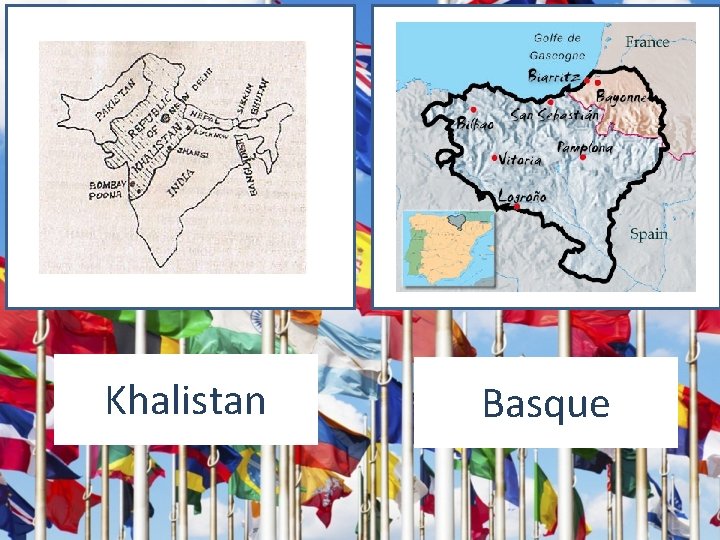
Khalistan Basque
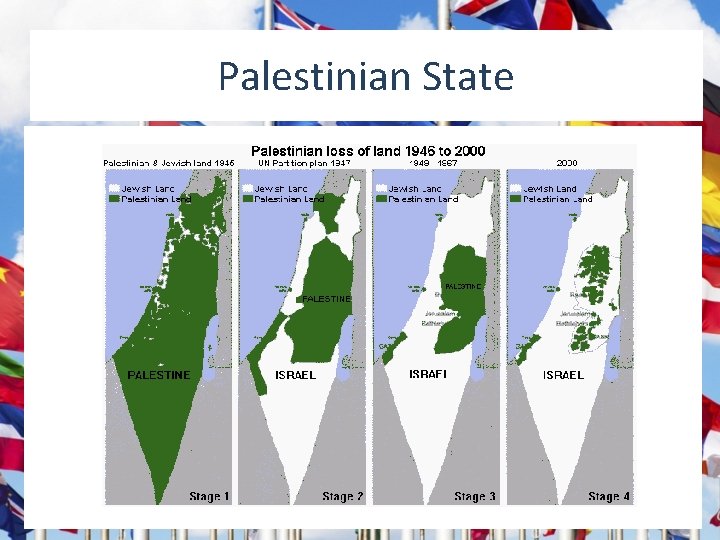
Palestinian State
Al Qaeda • Established in 1989 by Osama bin Laden • Is a fundamentalist organization seeking to rid Muslim nations of Westernization and secularism and replace with Theocracies. • Operates out of individual cells instead of as a formal organization.
Reactions to Terrorist Attacks • Reducing or addressing the cause of terrorism (Basque Spain) • Increasing international cooperation in surveillance of subnational groups (Arab Gulf States) • Increasing security measures within the country (United States) • Using military means against terrorism (United States)
Ukraine Case Study? • NATO eastward expansion, • the splintering of the EU over sanctions, • and the idea of two Ukraines divided by language, religion, and economic development. • centripetal and centrifugal forces, • ethnic conflict, • core/periphery tensions, and • supranationalism vs devolution in contemporary Europe.
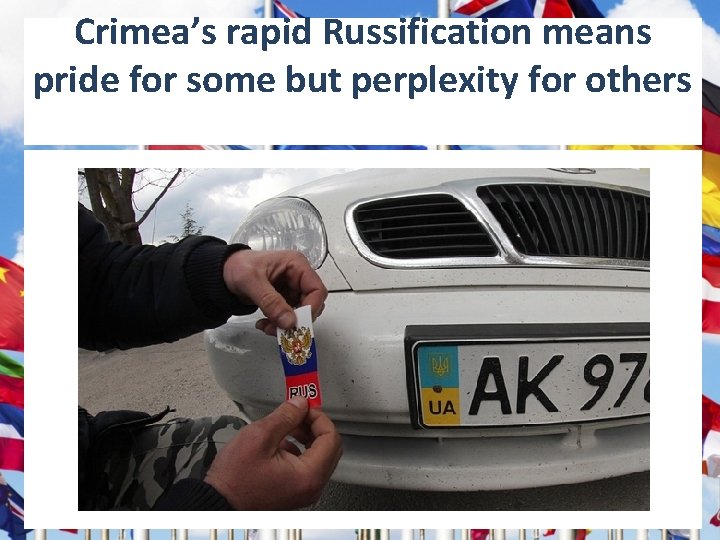
Crimea’s rapid Russification means pride for some but perplexity for others
- Slides: 71