
IUP Liberal Studies Dr Edel Reilly Director of
IUP Liberal Studies Dr. Edel Reilly Director of Liberal Studies
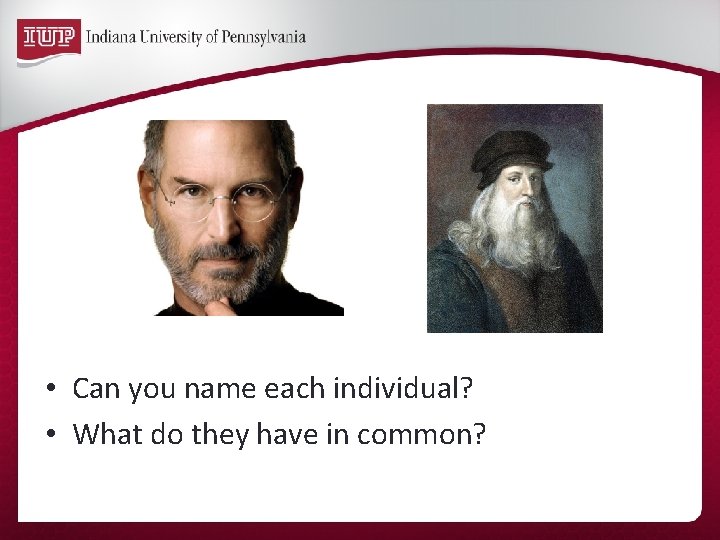
• Can you name each individual? • What do they have in common?
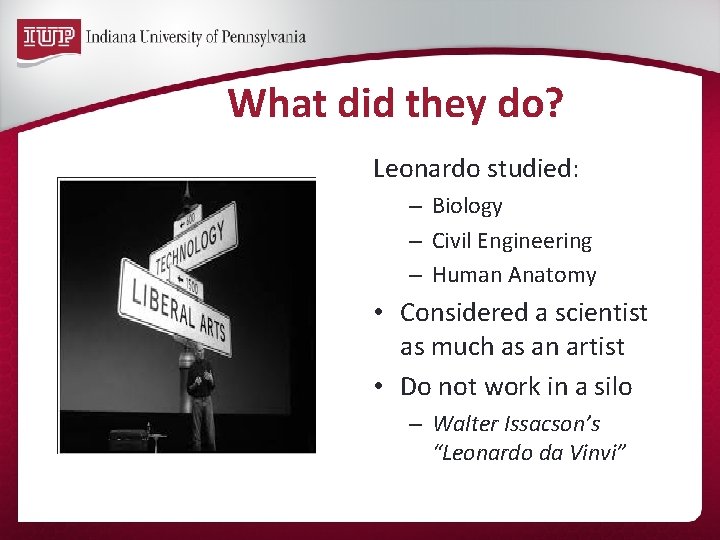
What did they do? Leonardo studied: – Biology – Civil Engineering – Human Anatomy • Considered a scientist as much as an artist • Do not work in a silo – Walter Issacson’s “Leonardo da Vinvi”
What is Liberal Studies? • Liberal studies is a common core curriculum required by all undergraduates that include courses related to the humanities, arts, and sciences. • Liberal studies courses allow students to synthesize what they learn into a coherent whole that serves life goals. • Liberal studies courses will allow students to gain marketability using required Liberal Studies coursework.
What does Liberal Studies add to a program? • Professional behavior includes commitment to learning, interpersonal skills, communication skills, effective use of time and resources, use of constructive feedback, problem solving, responsibility, critical thinking, and stress management. Jette D. U. , & Portney, L. G (2003) • Provides the basis for developing essential learning outcomes.
Brief Overview of IUP’s Liberal Studies Curriculum • Students at IUP must take a minimum of 40 credits and a maximum of 48 credits depending on their program. PASSHE’s Board of Governors Policy 1990 -06 A • Divided into three areas: – Learning Skills – Knowledge Areas – Electives
Learning Skills • English Composition (6 cr) – ENGL 101 (freshman) – ENGL 202 (sophomore) 3 cr • Mathematics (3 -4 cr) – MATH course to be taken depends on student’s major.
Knowledge Areas • Humanities (9 cr) Learn how to think critically and creatively, to reason, and ask questions. Learn to value different cultures, preserve accomplishments of the past, understand our world today, and provide tools to navigate the future. – History – Literature – Philosophy or Religious Studies • Fine Arts (3 cr) Provides a cultural heritage. Promotes self-esteem, motivation, aesthetic awareness, cultural exposure, creativity, improved emotional expression, as well as social harmony and appreciation of diversity. – Introduction to Art, Dance, Fine Arts, Music, or Theater
• Natural Science: (7 -8 cr) A process of learning about the natural world and the parts of science that affect our lives. Science relies on testing ideas with evidence gathered from the natural world. Should satisfy a natural curiosity. • Social Sciences: (9 cr) The study of society and the relationship among individuals within society. Social science covers a wide spectrum of subjects, including economics, political science, sociology, journalism, geography, anthropology, and criminology. ü Global and Multicultural Awareness: develop attitudes and understandings necessary to live in a world in which contact between cultures is increasingly important
Knowledge Areas • Dimension of Wellness: (3 -4 cr) – The primary focus of this course requirement is upon one of the following dimensions of wellness: emotional, financial, intellectual, occupational, physical, social or spiritual.
Writing Across the Curriculum – effectively communicate in writing, be able to respond critically and analytically to materials and sources relevant to the course, and discuss/critique his or her own writing – Writing Intensive Versus Writing Plans

Liberal Studies Electives (3 -6 cr) • Courses with content that addresses one or more of the following six competencies: – global citizenship, – information literacy, – scientific literacy, -- quantitative reasoning, -- oral communication, -- technological literacy • The goal of these competencies is to strengthen those aspects of the Liberal Studies Curriculum that ensure that our students will become lifelong learners and be able to contribute in an active way to their communities.
Student Learning Outcomes versus EUSLO (pronounced you-slow)
Student Learning Outcomes (SLO) • Every course and program at IUP should have student learning outcomes. • They should focus on a smaller number of essential outcomes. • They should be as specific, focused, and clear as possible—general outcomes are hard to measure.
How to get started: • Ask: What is the most important thing a student should know, be able to do or demonstrate after successfully completing my class/program? • Make a list of these and try to write them as SLO statements. – The student will be able to…
Action Verbs • Action verbs result in overt behavior that can be observed and measured. – Bloom’s Taxonomy • Certain verbs are unclear and call for covert, internal behavior which cannot be observed or measured. These types of verbs should be avoided: – appreciate, become aware of, become familiar with, know, learn, understand
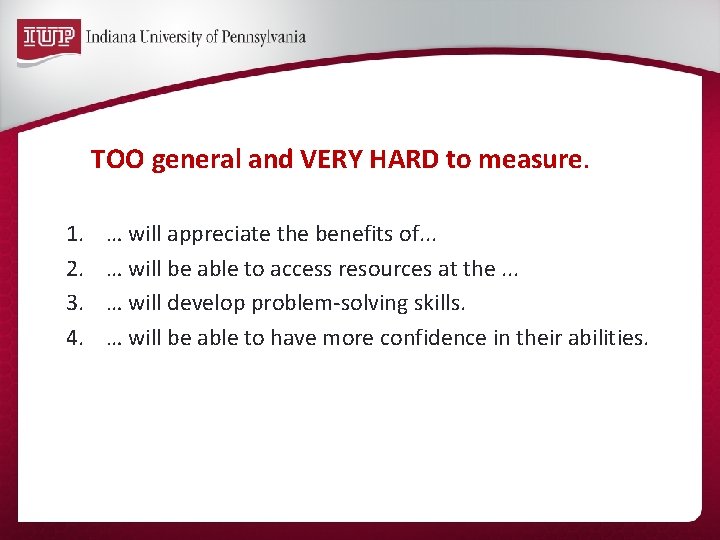
TOO general and VERY HARD to measure. 1. 2. 3. 4. … will appreciate the benefits of. . . … will be able to access resources at the. . . … will develop problem-solving skills. … will be able to have more confidence in their abilities.
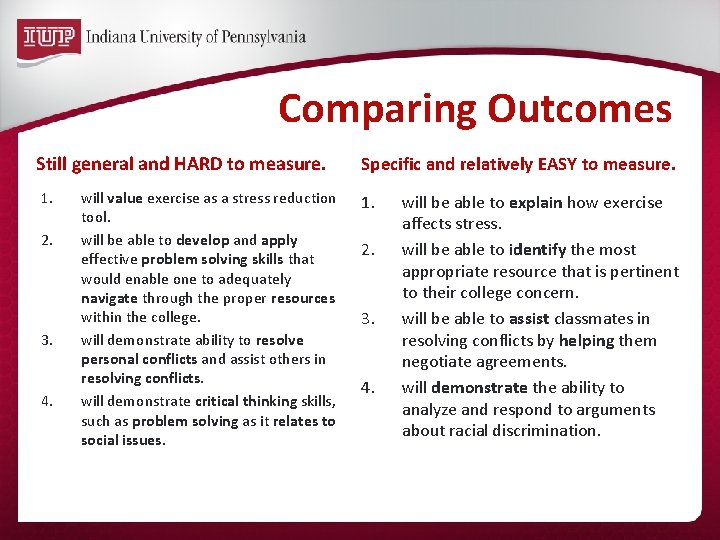
Comparing Outcomes Still general and HARD to measure. Specific and relatively EASY to measure. 1. 2. 3. 4. will value exercise as a stress reduction tool. will be able to develop and apply effective problem solving skills that would enable one to adequately navigate through the proper resources within the college. will demonstrate ability to resolve personal conflicts and assist others in resolving conflicts. will demonstrate critical thinking skills, such as problem solving as it relates to social issues. 2. 3. 4. will be able to explain how exercise affects stress. will be able to identify the most appropriate resource that is pertinent to their college concern. will be able to assist classmates in resolving conflicts by helping them negotiate agreements. will demonstrate the ability to analyze and respond to arguments about racial discrimination.
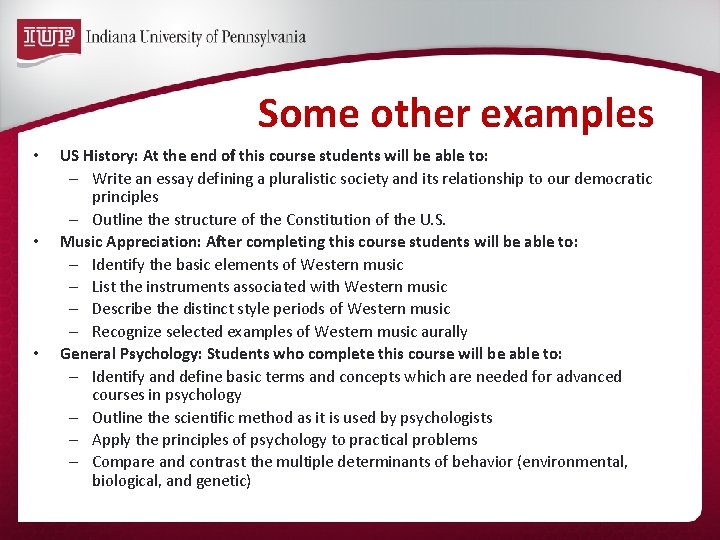
Some other examples • • • US History: At the end of this course students will be able to: – Write an essay defining a pluralistic society and its relationship to our democratic principles – Outline the structure of the Constitution of the U. S. Music Appreciation: After completing this course students will be able to: – Identify the basic elements of Western music – List the instruments associated with Western music – Describe the distinct style periods of Western music – Recognize selected examples of Western music aurally General Psychology: Students who complete this course will be able to: – Identify and define basic terms and concepts which are needed for advanced courses in psychology – Outline the scientific method as it is used by psychologists – Apply the principles of psychology to practical problems – Compare and contrast the multiple determinants of behavior (environmental, biological, and genetic)
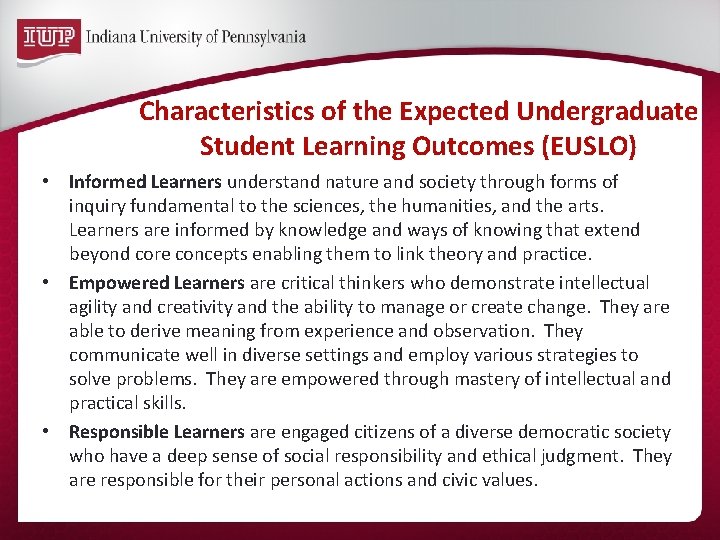
Characteristics of the Expected Undergraduate Student Learning Outcomes (EUSLO) • Informed Learners understand nature and society through forms of inquiry fundamental to the sciences, the humanities, and the arts. Learners are informed by knowledge and ways of knowing that extend beyond core concepts enabling them to link theory and practice. • Empowered Learners are critical thinkers who demonstrate intellectual agility and creativity and the ability to manage or create change. They are able to derive meaning from experience and observation. They communicate well in diverse settings and employ various strategies to solve problems. They are empowered through mastery of intellectual and practical skills. • Responsible Learners are engaged citizens of a diverse democratic society who have a deep sense of social responsibility and ethical judgment. They are responsible for their personal actions and civic values.
EUSLO Categories • • Diversity Communication Civic Engagement and Social Justice Problem Solving Information Literacy Critical Thinking and Reasoning Skills Global Citizenship
What is happening now? • Most Liberal Studies courses do have a syllabi of record that has an explicit discussion of how the learning objectives relate to the EUSLO characteristics. • Departments are currently “mapping” the course outcomes to the EUSLO. • Departments are implementing a tool to measure how the course outcomes are to be met.
NURS 202 1. Describe the components and functions of selected body systems. – The students will be required to review a Power. Point with note pages on each body system. 2. Explain the changes in selected systems during growth and development. – The students will participate in a D 2 L assignment to evaluate their learning. 3. Identify characteristics of common childhood illnesses. – The students will be required to participate in a D 2 L assignment along with conversing through the D 2 L discussion board. 4. Discuss appropriate management of sick children in day care. – The students will take a 25 point quiz to evaluate their learning. 5. Identify current health promotion activities for each age group. – The students will research one topic from a list provided by the instructor. They will be required to complete a Power. Point presentation and post it on D 2 L.
Questions?
- Slides: 25