
IUCD Timing Insertion and Removal Adverse Effects and

- Slides: 18
IUCD Timing, Insertion and Removal, Adverse Effects and Management PRESENTER: NWANKWO HELEN RN/RM, BSCPH, MPH candidate University of Rwanda, SONM
Learning Objectives • Describe the appropriate timing of IUCD insertion • State the steps for IUCD insertion and removal • Discuss the adverse effects of IUCD • Describe management options for adverse effects of IUCD
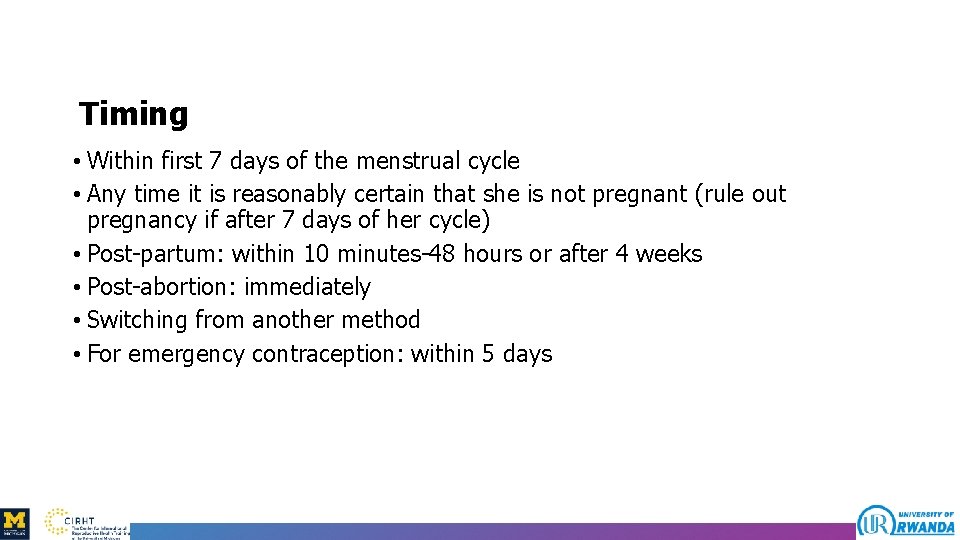
Timing • Within first 7 days of the menstrual cycle • Any time it is reasonably certain that she is not pregnant (rule out pregnancy if after 7 days of her cycle) • Post-partum: within 10 minutes-48 hours or after 4 weeks • Post-abortion: immediately • Switching from another method • For emergency contraception: within 5 days
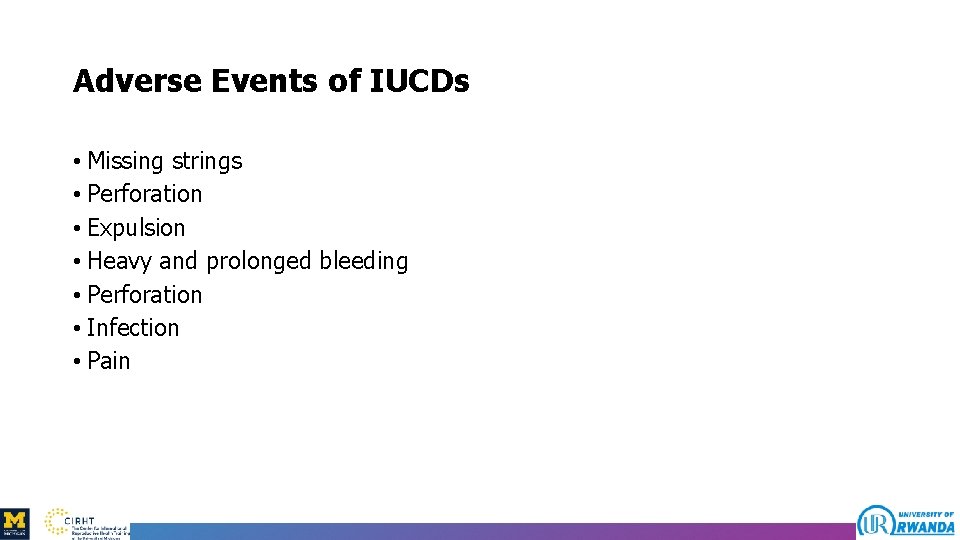
Adverse Events of IUCDs • Missing strings • Perforation • Expulsion • Heavy and prolonged bleeding • Perforation • Infection • Pain
Management of Missing Strings of IUCD Missing string scenarios • IUCD is in situ, but the strings are curled and retracted or broken • Uterine enlargement: Fibroids or pregnancy • Rotation of the IUCD • IUCD has been expelled • IUCD has perforated the uterus and is in the myometrium or abdomen
Management of Missing Strings of IUCD • Exclude pregnancy • If not pregnant: • Confirm it is intrauterine • If the client needs it, leave in-situ • If not in situ, remove the IUCD and replace with new
Management of Missing Strings of IUCD Pregnancy excluded: • Probe strings with cytobrush or forceps • IUCD not located, do ultrasound: In cavity, leave it unless the woman wants to discontinue • If removal is chosen, ultrasound guided removal or dilate cervix and remove • If not visible on ultrasound, do abdominal and pelvic x-ray (AP and lateral): not visible, confirm expulsion • If x-ray shows IUCD is located outside uterine cavity, a perforation has occurred
Heavy and Prolonged Bleeding • Reassure the women using IUDs experience heavy or prolonged bleeding. • For modest short-term relief she can try NSAIDs except aspirin • Provide iron tablets and eat foods containing • If heavy or prolonged bleeding continues or starts after several months, consider underlying conditions unrelated to method use
Management of Perforation • Occurs during IUCD insertion in 1/1000 or less • Risk factors: Clinician inexperience, a retroverted uterus, and the presence of a myometrial defect • Usually recognized immediately • Sign and Symptoms: shortening/missing string, mild abdominal pain and/or bleeding
Management of Perforation • Dx: Ultrasound, if not visible, X-ray • Management: • Removal by laparoscopy or laparotomy • If embedded in myometrium: hysterescopic removal
Management of Infection • Greatest risk in the first 20 days after insertion (Contamination) • Existing STI at time of insertion: Risk of PID Management: • Initiate treatment with the IUCD in place • If no response in 72 hrs or other complications like tubo-ovarian abscess is suspected: Remove IUCD and treat
Management of Pain • Pain: • New severe cramping or abdominal tenderness evaluate for pelvic inflammatory disease, ectopic pregnancy, threatened or incomplete abortion, and IUCD expulsion or perforation. • Dysmenorrhea: • worse in the first few cycles after insertion, can mostly be treated with NSAIDs. • Partner feeling the string: • If strings are cut too short, should be 3 to 4 cm from the os. • Management: • counseling - very critical in management
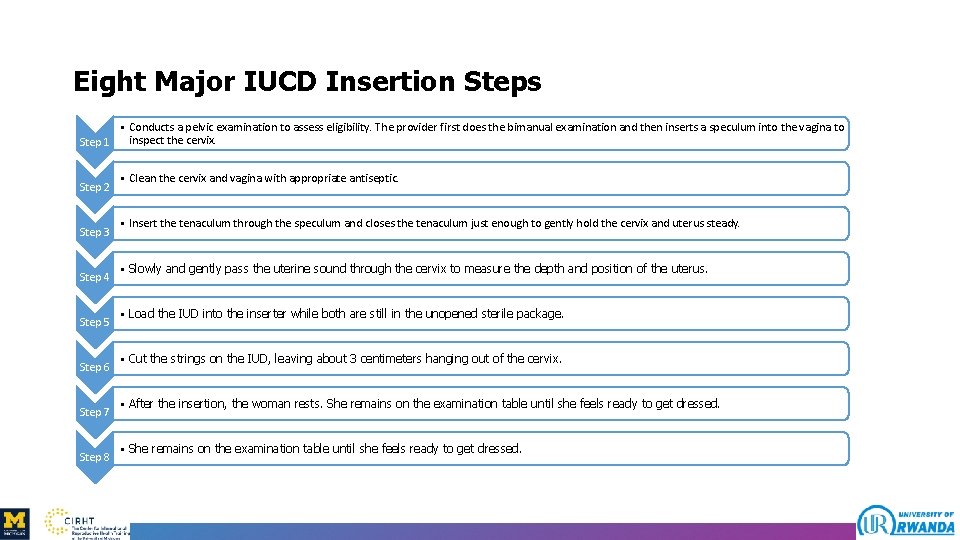
Eight Major IUCD Insertion Steps • Conducts a pelvic examination to assess eligibility. The provider first does the bimanual examination and then inserts a speculum into the vagina to inspect the cervix. Step 1 Step 2 Step 3 Step 4 Step 5 Step 6 Step 7 Step 8 • Clean the cervix and vagina with appropriate antiseptic. • Insert the tenaculum through the speculum and closes the tenaculum just enough to gently hold the cervix and uterus steady. • Slowly and gently pass the uterine sound through the cervix to measure the depth and position of the uterus. • Load the IUD into the inserter while both are still in the unopened sterile package. • Cut the strings on the IUD, leaving about 3 centimeters hanging out of the cervix. • After the insertion, the woman rests. She remains on the examination table until she feels ready to get dressed. • She remains on the examination table until she feels ready to get dressed.
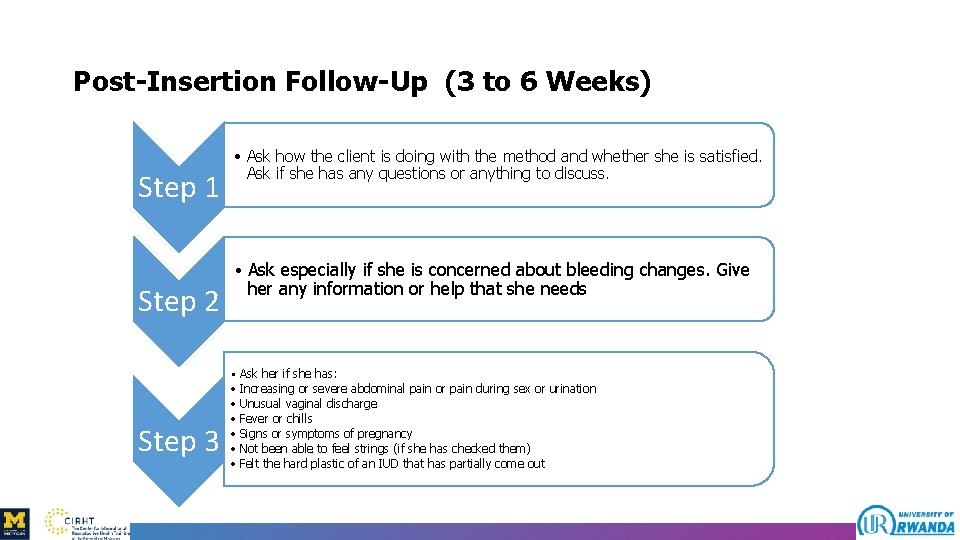
Post-Insertion Follow-Up (3 to 6 Weeks) Step 1 Step 2 Step 3 • Ask how the client is doing with the method and whether she is satisfied. Ask if she has any questions or anything to discuss. • Ask especially if she is concerned about bleeding changes. Give her any information or help that she needs • Ask her if she has: • Increasing or severe abdominal pain or pain during sex or urination • Unusual vaginal discharge • Fever or chills • Signs or symptoms of pregnancy • Not been able to feel strings (if she has checked them) • Felt the hard plastic of an IUD that has partially come out
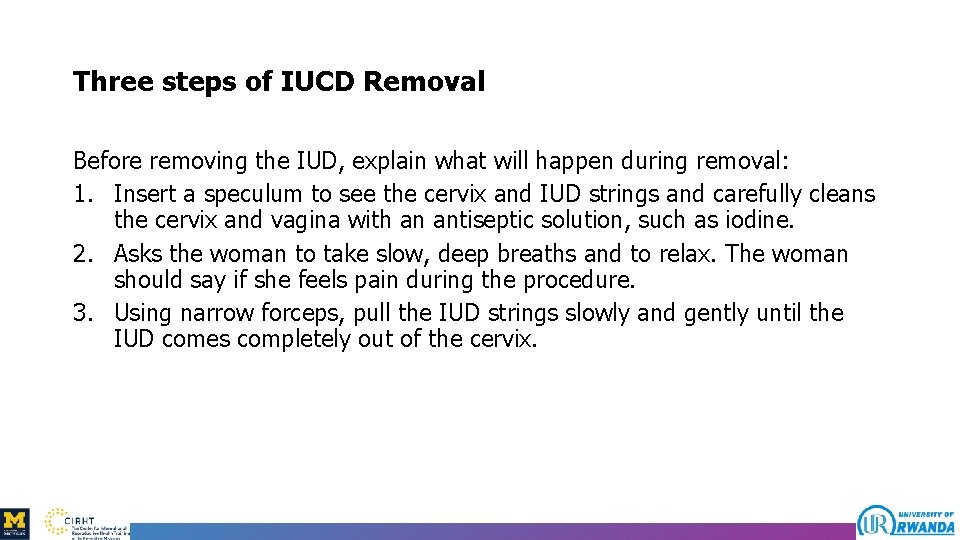
Three steps of IUCD Removal Before removing the IUD, explain what will happen during removal: 1. Insert a speculum to see the cervix and IUD strings and carefully cleans the cervix and vagina with an antiseptic solution, such as iodine. 2. Asks the woman to take slow, deep breaths and to relax. The woman should say if she feels pain during the procedure. 3. Using narrow forceps, pull the IUD strings slowly and gently until the IUD comes completely out of the cervix.
IUCD video
Summary IUCDs are: • Safe, effective, convenient, reversible, long acting, cost effective, easy-to-use Providers can ensure safety by: • Careful screening • Informative counseling • Good infection prevention • Proper follow-up • Good timing and management of adverse effects
Thank you