
ITU Workshop 09 December 2002 EMS Satellite Networks
ITU Workshop 09 December 2002
EMS Satellite Networks Introduction Division of EMS Technologies Inc (NASDAQ: ELMG) u ~US$300 M revenues in 2002; 1700 employees Satellite broadband IP is our core business u 30+ years of satellite communications experience in both satellite manufacturing and ground systems; Interest in Ka slot at 91°W u Supplier of DVB-RCS systems to multiple satellite operators and service providers in Europe, North America and Asia. One of the founders of the DVB-RCS standard u First-to-market, with systems in operation for almost 3 years, and direct experience with several business cases
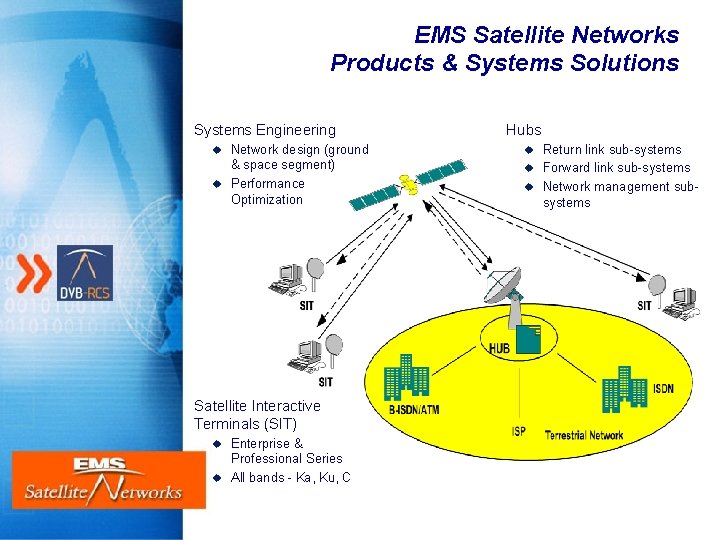
EMS Satellite Networks Products & Systems Solutions Systems Engineering u u Network design (ground & space segment) Performance Optimization Satellite Interactive Terminals (SIT) u u Enterprise & Professional Series All bands - Ka, Ku, C Hubs u u u Return link sub-systems Forward link sub-systems Network management subsystems
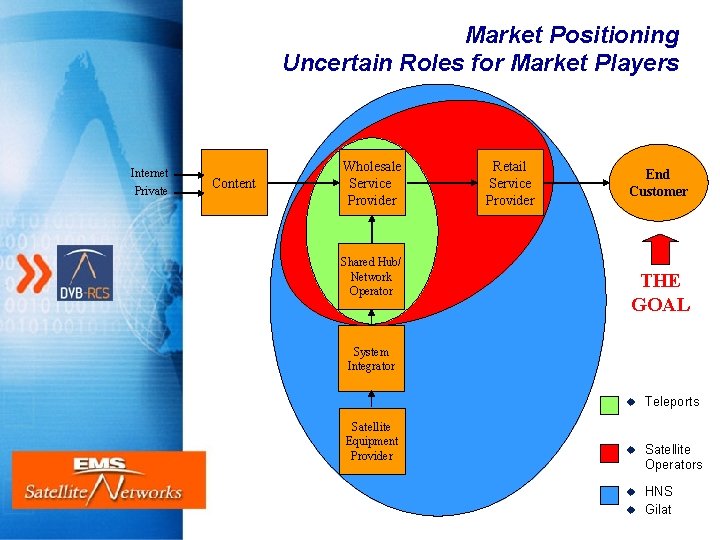
Market Positioning Uncertain Roles for Market Players Internet Private Content Wholesale Service Provider Shared Hub/ Network Operator Retail Service Provider End Customer THE GOAL System Integrator Satellite Equipment Provider u Teleports u Satellite Operators u HNS Gilat u
Target Markets Customer vs. Technology-Lead Enterprise, Consumer or Both? u Start with enterprise, then as costs drop with volume, enter consumer n The bubble has burst – “quantum leap” to consumer solution has failed n Build market one enterprise niche at a time; target a niche, then serve it! Technology or customer, which comes first? u Same technology can serve both; ongoing debate is a distraction the industry cannot afford n Need some combination of Ka, spot beams, and more bits/Hz (eg. 8 PSK) n Industry needs open standard to drive economies of scale, reduce costs, expand the market, and finally reach consumer price points n DVB-RCS will do the job – get on with it.
DVB-RCS Momentum Virtually all major satellite operators are now involved in DVB -RCS trials or procurements: n Eutelsat n New Skies n France Telecom n Panamsat n Hispasat Intelsat JSAT Loral Skynet n SES-Americom SES-Astra Telesat n n n Most major ground segment suppliers now actively involved: n Incumbents: HNS and Gilat are positioning in DVB-RCS n Entrants: EMS, Nera and Newtec pioneered DVB-RCS n Other notables are actively involved: Alcatel, Infineon, Raytheon, ST Micro, Viasat Continued ESA funding for DVB-RCS (eg. chipsets, interoperability, applications) n First Interoperability commitments from EMS, Nera & Newtec
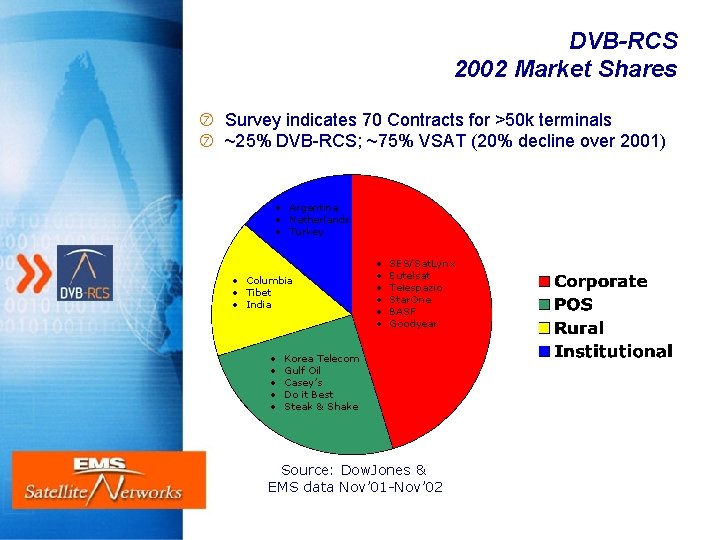
DVB-RCS 2002 Market Shares Survey indicates 70 Contracts for >50 k terminals ~25% DVB-RCS; ~75% VSAT (20% decline over 2001) • Argentina • Netherlands • Turkey • Columbia • Tibet • India • • • SES/Sat. Lynx Eutelsat Telespazio Star. One BASF Goodyear Korea Telecom Gulf Oil Casey’s Do it Best Steak & Shake Source: Dow. Jones & EMS data Nov’ 01 -Nov’ 02
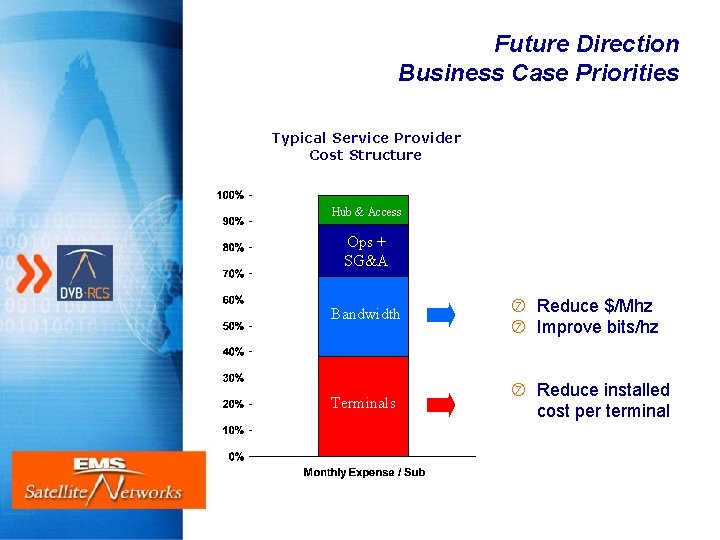
Future Direction Business Case Priorities Typical Service Provider Cost Structure Hub & Access Ops + SG&A Bandwidth Reduce $/Mhz Improve bits/hz Terminals Reduce installed cost per terminal
Future Direction Key Success Factors Industry must: u Adopt DVB-RCS open standard & realize interoperability u Invest R&D in key technologies (eg. Ka, spot beams, 8 PSK, terminal cost reduction) Satellite operators must: u Continue deploying satellite broadband IP technologies u Build core infrastructure for satellite broadband IP worldwide u Support retail service entry into target markets
- Slides: 9