
ITU compliance regulatory process for small satellite systems

- Slides: 36
ITU compliance: regulatory process for small satellite systems Example for a small satellite in the Earth Exploration-Satellite Service Chuen Chern Loo Space Publication and Registration Division SSD, Radiocommunication Bureau International Telecommunication Union www. itu. int chuen-chern. loo@itu. int
Contents • What frequency to use? • Introduction to Radio Regulations, frequency allocations • How to register? • ITU regulatory procedures • What info are required for EESS • Appendix 4 • How to submit? • Software, web submission system • What happens next? • Comments, notifications • Some relevant WRC-19 decisions 2
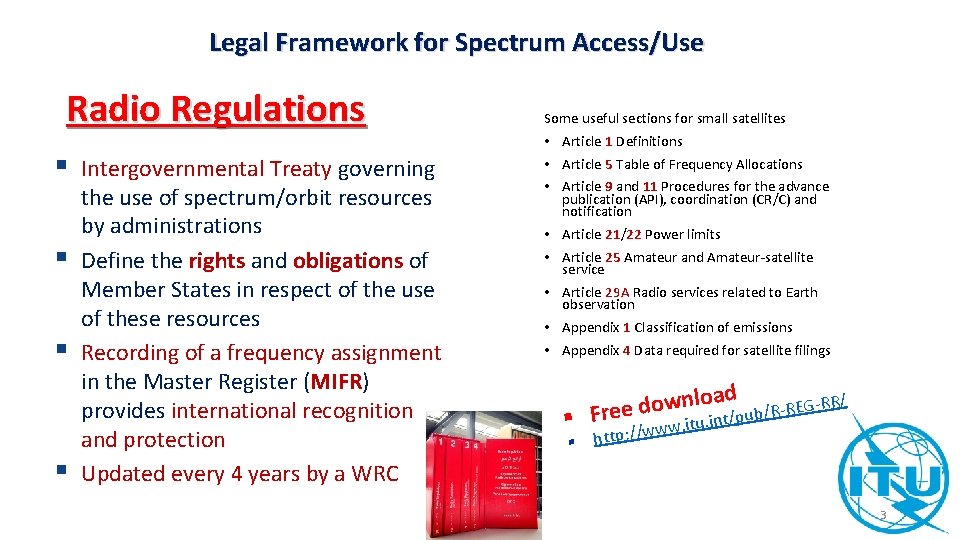
Legal Framework for Spectrum Access/Use Radio Regulations § § Intergovernmental Treaty governing the use of spectrum/orbit resources by administrations Define the rights and obligations of Member States in respect of the use of these resources Recording of a frequency assignment in the Master Register (MIFR) provides international recognition and protection Updated every 4 years by a WRC Some useful sections for small satellites • Article 1 Definitions • Article 5 Table of Frequency Allocations • Article 9 and 11 Procedures for the advance publication (API), coordination (CR/C) and notification • Article 21/22 Power limits • Article 25 Amateur and Amateur-satellite service • Article 29 A Radio services related to Earth observation • Appendix 1 Classification of emissions • Appendix 4 Data required for satellite filings oad l n w G-RR/ o E d R e R / e b r § F. int/pu u t i. w w w // § http: 3
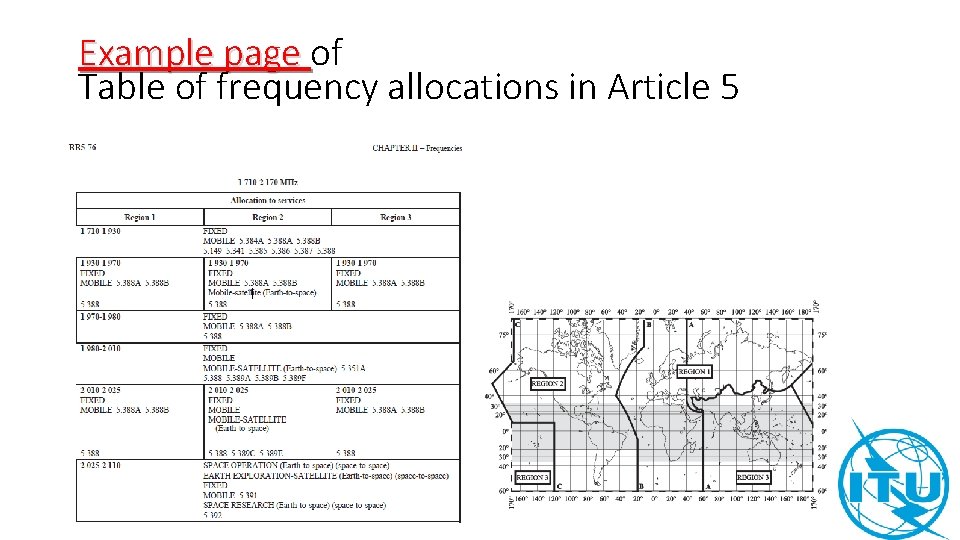
What frequency to use? • Start with determining the main service E. g. Earth exploration-satellite service • Check definitions of the various services in Article 1 of the RR • Select an appropriate frequency allocation to this service in the Radio Regulations • Check the Table of frequency allocation in Article 5 of the RR and the corresponding footnotes for that specific service • For TT&C, can use frequency allocation either for the main service or for the space operation service • Take note of all conditions of the utilization of the frequency • Check whether it is primary or secondary allocation, check the corresponding footnotes, PFD limits in Article 21 etc. • Look up the SRS database on the BRIFIC or SNS online to understand the utilization of the desired frequency band by other satellite networks
Example page of Table of frequency allocations in Article 5
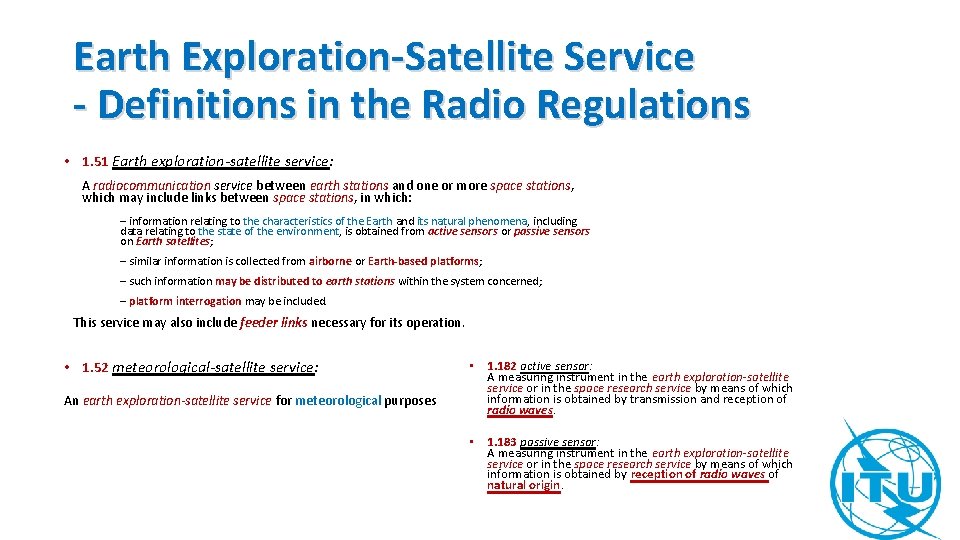
Earth Exploration-Satellite Service - Definitions in the Radio Regulations • 1. 51 Earth exploration-satellite service: A radiocommunication service between earth stations and one or more space stations, which may include links between space stations, in which: – information relating to the characteristics of the Earth and its natural phenomena, including data relating to the state of the environment, is obtained from active sensors or passive sensors on Earth satellites; – similar information is collected from airborne or Earth-based platforms; – such information may be distributed to earth stations within the system concerned; – platform interrogation may be included. This service may also include feeder links necessary for its operation. • 1. 52 meteorological-satellite service: An earth exploration-satellite service for meteorological purposes • 1. 182 active sensor: A measuring instrument in the earth exploration-satellite service or in the space research service by means of which information is obtained by transmission and reception of radio waves. • 1. 183 passive sensor: A measuring instrument in the earth exploration-satellite service or in the space research service by means of which information is obtained by reception of radio waves of natural origin.
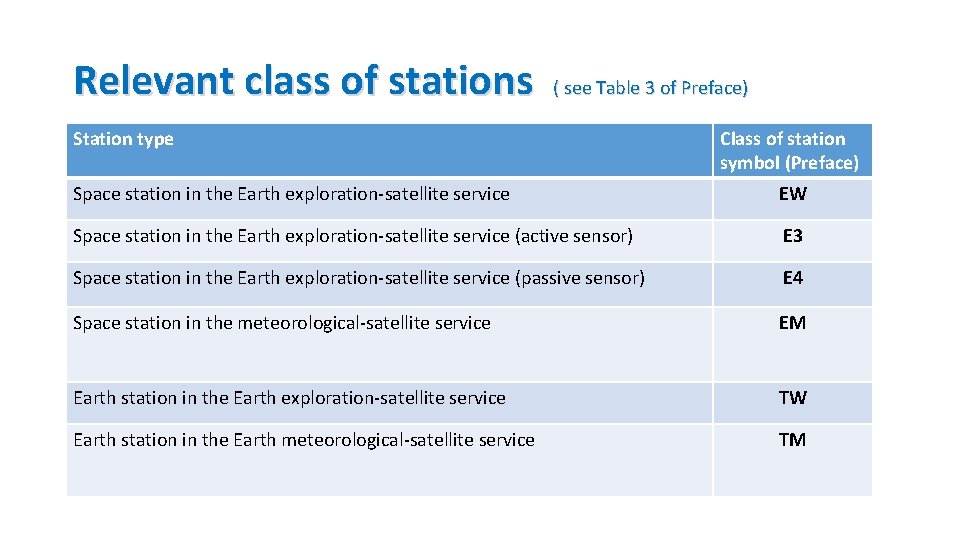
Relevant class of stations ( see Table 3 of Preface) Station type Class of station symbol (Preface) Space station in the Earth exploration-satellite service EW Space station in the Earth exploration-satellite service (active sensor) E 3 Space station in the Earth exploration-satellite service (passive sensor) E 4 Space station in the meteorological-satellite service EM Earth station in the Earth exploration-satellite service TW Earth station in the Earth meteorological-satellite service TM
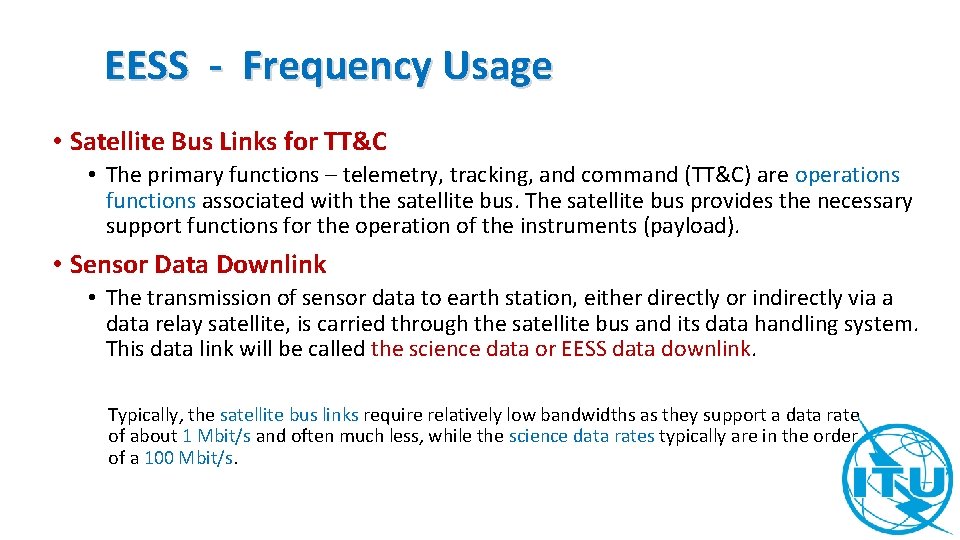
EESS - Frequency Usage • Satellite Bus Links for TT&C • The primary functions – telemetry, tracking, and command (TT&C) are operations functions associated with the satellite bus. The satellite bus provides the necessary support functions for the operation of the instruments (payload). • Sensor Data Downlink • The transmission of sensor data to earth station, either directly or indirectly via a data relay satellite, is carried through the satellite bus and its data handling system. This data link will be called the science data or EESS data downlink. Typically, the satellite bus links require relatively low bandwidths as they support a data rate of about 1 Mbit/s and often much less, while the science data rates typically are in the order of a 100 Mbit/s.
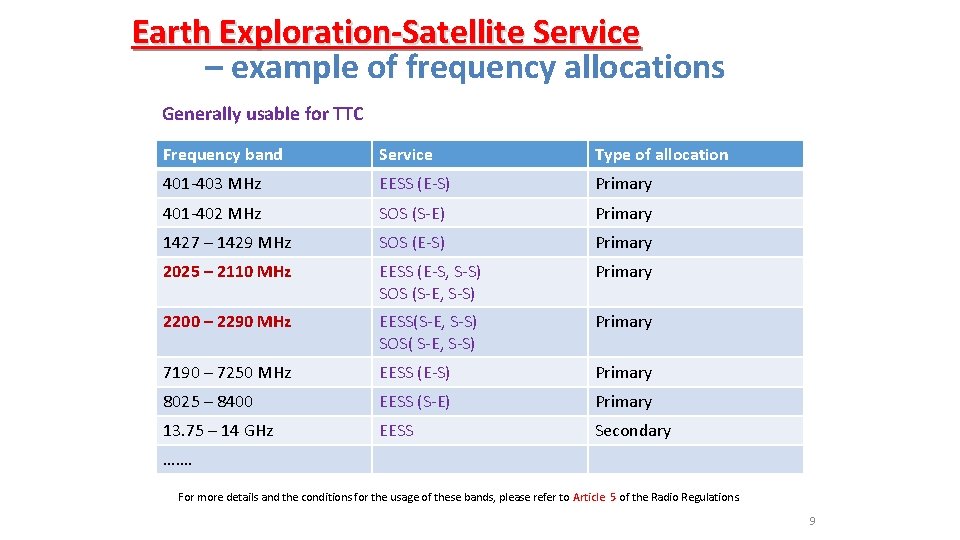
Earth Exploration-Satellite Service – example of frequency allocations Generally usable for TTC Frequency band Service Type of allocation 401 -403 MHz EESS (E-S) Primary 401 -402 MHz SOS (S-E) Primary 1427 – 1429 MHz SOS (E-S) Primary 2025 – 2110 MHz EESS (E-S, S-S) SOS (S-E, S-S) Primary 2200 – 2290 MHz EESS(S-E, S-S) SOS( S-E, S-S) Primary 7190 – 7250 MHz EESS (E-S) Primary 8025 – 8400 EESS (S-E) Primary 13. 75 – 14 GHz EESS Secondary ……. For more details and the conditions for the usage of these bands, please refer to Article 5 of the Radio Regulations. 9
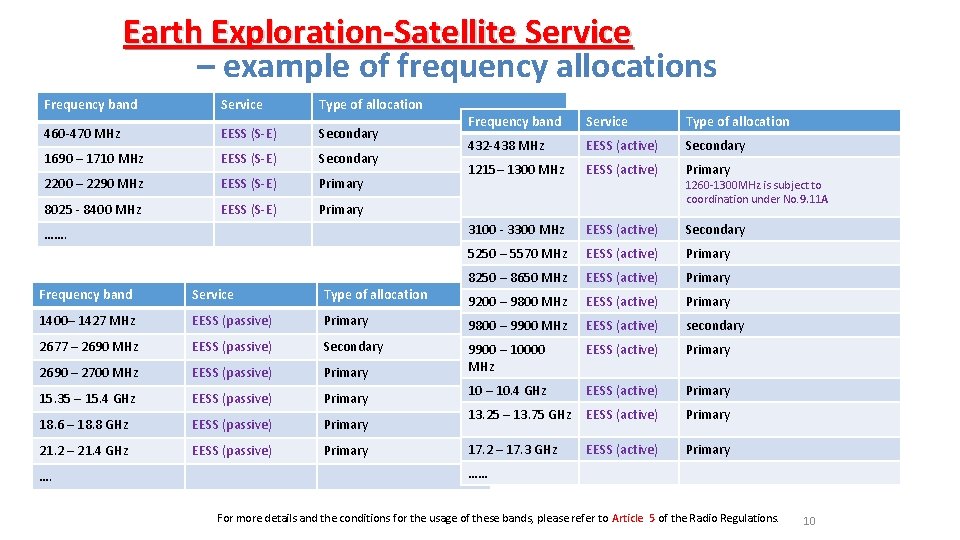
Earth Exploration-Satellite Service – example of frequency allocations Frequency band Service Type of allocation 460 -470 MHz EESS (S-E) Secondary 1690 – 1710 MHz EESS (S-E) Secondary 2200 – 2290 MHz EESS (S-E) Primary 8025 - 8400 MHz EESS (S-E) Primary ……. Frequency band Service Type of allocation 432 -438 MHz EESS (active) Secondary 1215– 1300 MHz EESS (active) Primary 3100 - 3300 MHz EESS (active) Secondary 5250 – 5570 MHz EESS (active) Primary 8250 – 8650 MHz EESS (active) Primary 9200 – 9800 MHz EESS (active) Primary 1260 -1300 MHz is subject to coordination under No. 9. 11 A Frequency band Service Type of allocation 1400– 1427 MHz EESS (passive) Primary 9800 – 9900 MHz EESS (active) secondary 2677 – 2690 MHz EESS (passive) Secondary EESS (active) Primary 2690 – 2700 MHz EESS (passive) Primary 9900 – 10000 MHz 15. 35 – 15. 4 GHz EESS (passive) Primary 10 – 10. 4 GHz EESS (active) Primary 18. 6 – 18. 8 GHz EESS (passive) Primary 13. 25 – 13. 75 GHz EESS (active) Primary 21. 2 – 21. 4 GHz EESS (passive) Primary 17. 2 – 17. 3 GHz EESS (active) Primary …. …… For more details and the conditions for the usage of these bands, please refer to Article 5 of the Radio Regulations. 10
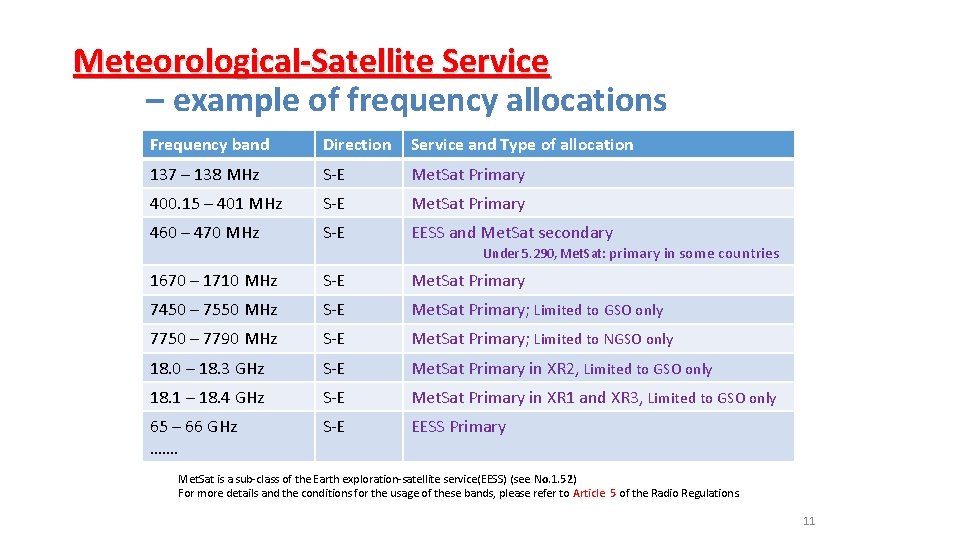
Meteorological-Satellite Service – example of frequency allocations Frequency band Direction Service and Type of allocation 137 – 138 MHz S-E Met. Sat Primary 400. 15 – 401 MHz S-E Met. Sat Primary 460 – 470 MHz S-E EESS and Met. Sat secondary 1670 – 1710 MHz S-E Met. Sat Primary 7450 – 7550 MHz S-E Met. Sat Primary; Limited to GSO only 7750 – 7790 MHz S-E Met. Sat Primary; Limited to NGSO only 18. 0 – 18. 3 GHz S-E Met. Sat Primary in XR 2, Limited to GSO only 18. 1 – 18. 4 GHz S-E Met. Sat Primary in XR 1 and XR 3, Limited to GSO only 65 – 66 GHz ……. S-E EESS Primary Under 5. 290, Met. Sat: primary in some countries Met. Sat is a sub-class of the Earth exploration-satellite service(EESS) (see No. 1. 52) For more details and the conditions for the usage of these bands, please refer to Article 5 of the Radio Regulations. 11
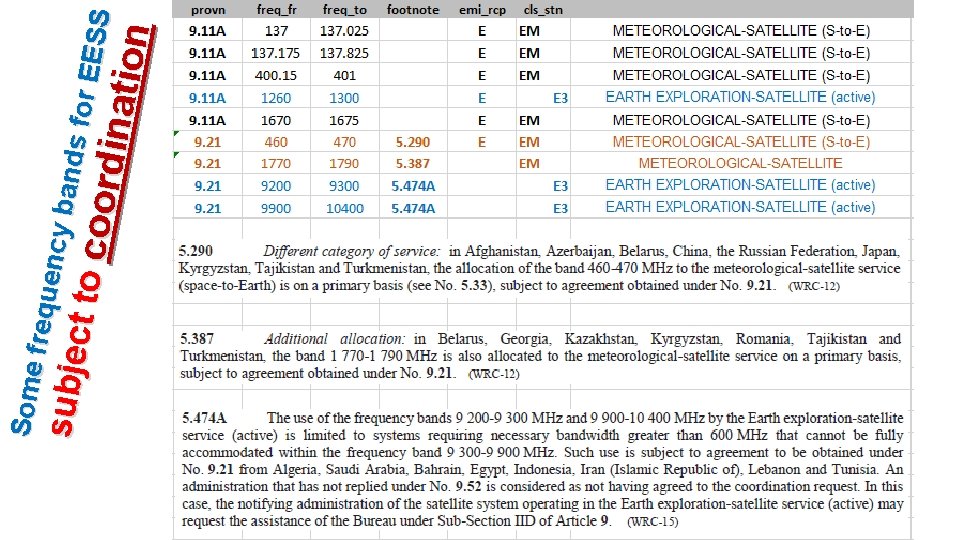
i nat io n So me fre que nc y ba subje c nds fo t to c r EES S oord
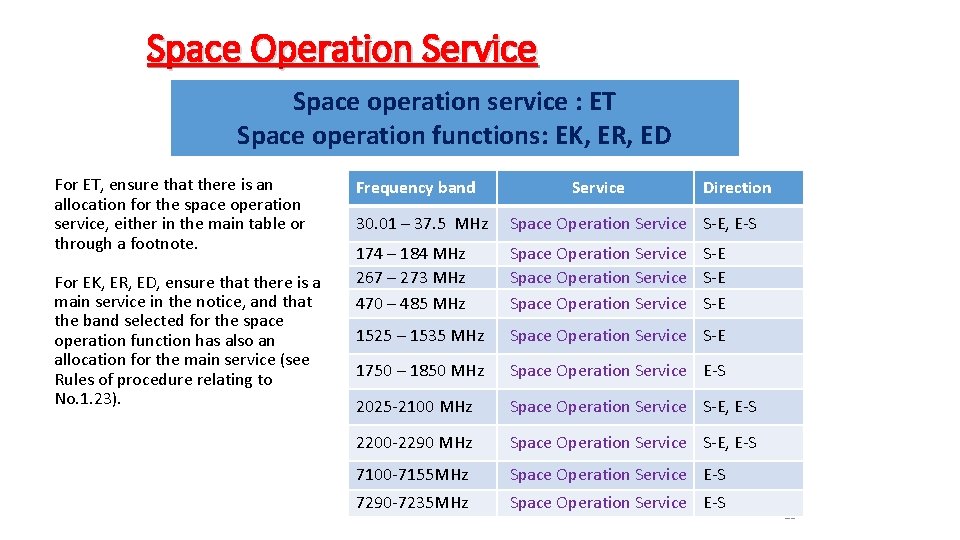
Space Operation Service Space operation service : ET Space operation functions: EK, ER, ED For ET, ensure that there is an allocation for the space operation service, either in the main table or through a footnote. For EK, ER, ED, ensure that there is a main service in the notice, and that the band selected for the space operation function has also an allocation for the main service (see Rules of procedure relating to No. 1. 23). Frequency band Service Direction 30. 01 – 37. 5 MHz Space Operation Service S-E, E-S 174 – 184 MHz 267 – 273 MHz 470 – 485 MHz Space Operation Service S-E 1525 – 1535 MHz Space Operation Service S-E 1750 – 1850 MHz Space Operation Service E-S 2025 -2100 MHz Space Operation Service S-E, E-S 2200 -2290 MHz Space Operation Service S-E, E-S 7100 -7155 MHz Space Operation Service E-S 7290 -7235 MHz Space Operation Service E-S 13
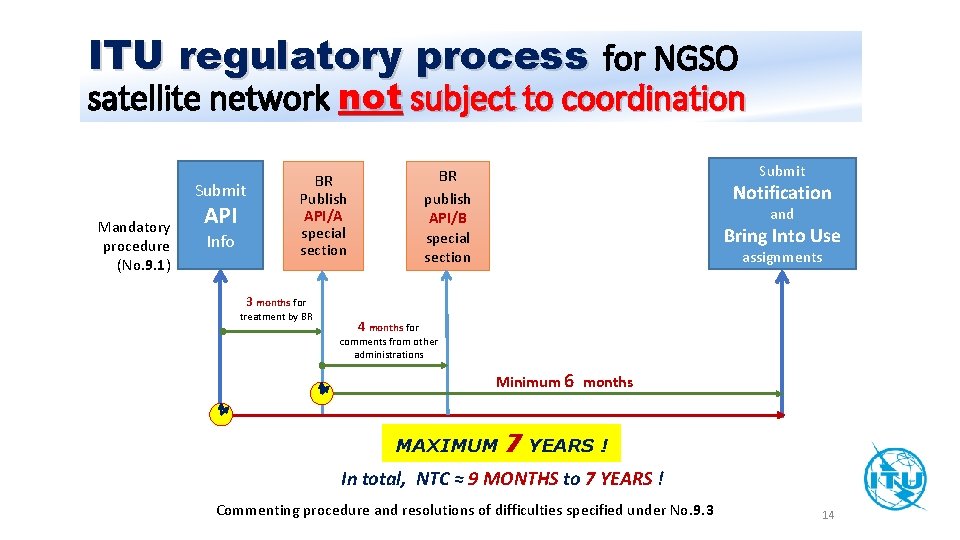
ITU regulatory process for NGSO satellite network not subject to coordination Submit Mandatory procedure (No. 9. 1) API Info 3 months for treatment by BR Submit BR publish API/B special section BR Publish API/A special section Notification and Bring Into Use assignments 4 months for comments from other administrations Minimum 6 months MAXIMUM 7 YEARS ! In total, NTC ≈ 9 MONTHS to 7 YEARS ! Commenting procedure and resolutions of difficulties specified under No. 9. 3 14
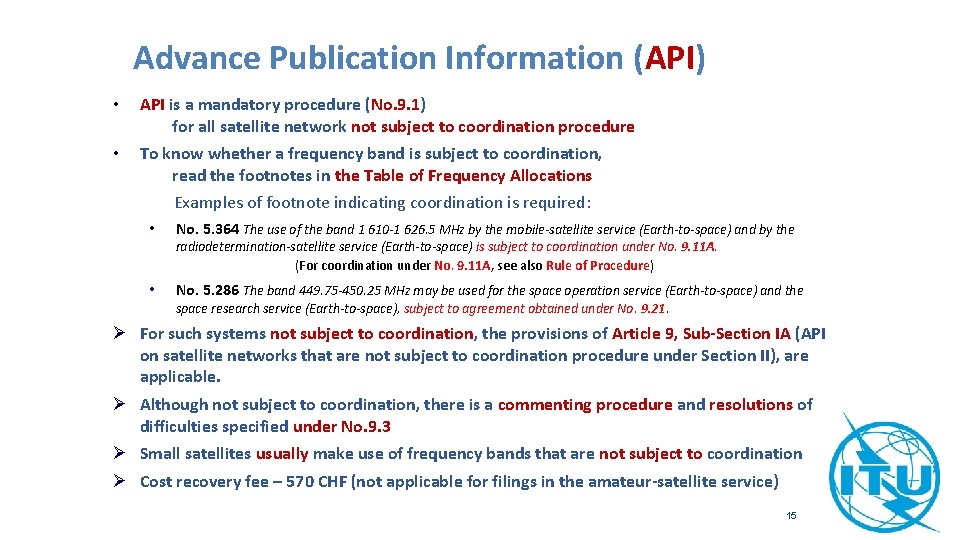
Advance Publication Information (API) • API is a mandatory procedure (No. 9. 1) for all satellite network not subject to coordination procedure • To know whether a frequency band is subject to coordination, read the footnotes in the Table of Frequency Allocations Examples of footnote indicating coordination is required: • No. 5. 364 The use of the band 1 610 -1 626. 5 MHz by the mobile-satellite service (Earth-to-space) and by the radiodetermination-satellite service (Earth-to-space) is subject to coordination under No. 9. 11 A. (For coordination under No. 9. 11 A, see also Rule of Procedure) • No. 5. 286 The band 449. 75 -450. 25 MHz may be used for the space operation service (Earth-to-space) and the space research service (Earth-to-space), subject to agreement obtained under No. 9. 21. Ø For such systems not subject to coordination, the provisions of Article 9, Sub-Section IA (API on satellite networks that are not subject to coordination procedure under Section II), are applicable. Ø Although not subject to coordination, there is a commenting procedure and resolutions of difficulties specified under No. 9. 3 Ø Small satellites usually make use of frequency bands that are not subject to coordination Ø Cost recovery fee – 570 CHF (not applicable for filings in the amateur-satellite service) 15
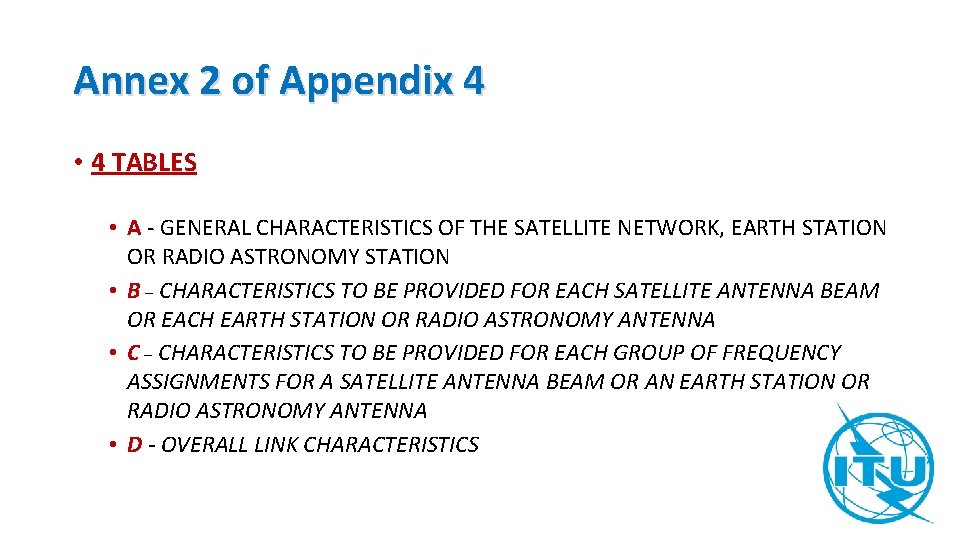
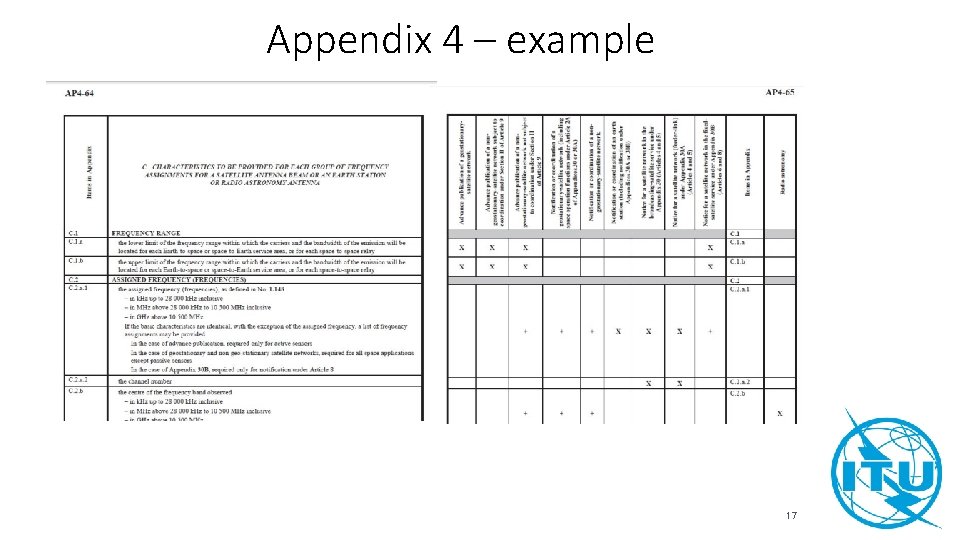
Annex 2 of Appendix 4 • 4 TABLES • A - GENERAL CHARACTERISTICS OF THE SATELLITE NETWORK, EARTH STATION OR RADIO ASTRONOMY STATION • B _ CHARACTERISTICS TO BE PROVIDED FOR EACH SATELLITE ANTENNA BEAM OR EACH EARTH STATION OR RADIO ASTRONOMY ANTENNA • C _ CHARACTERISTICS TO BE PROVIDED FOR EACH GROUP OF FREQUENCY ASSIGNMENTS FOR A SATELLITE ANTENNA BEAM OR AN EARTH STATION OR RADIO ASTRONOMY ANTENNA • D - OVERALL LINK CHARACTERISTICS
Appendix 4 – example 17
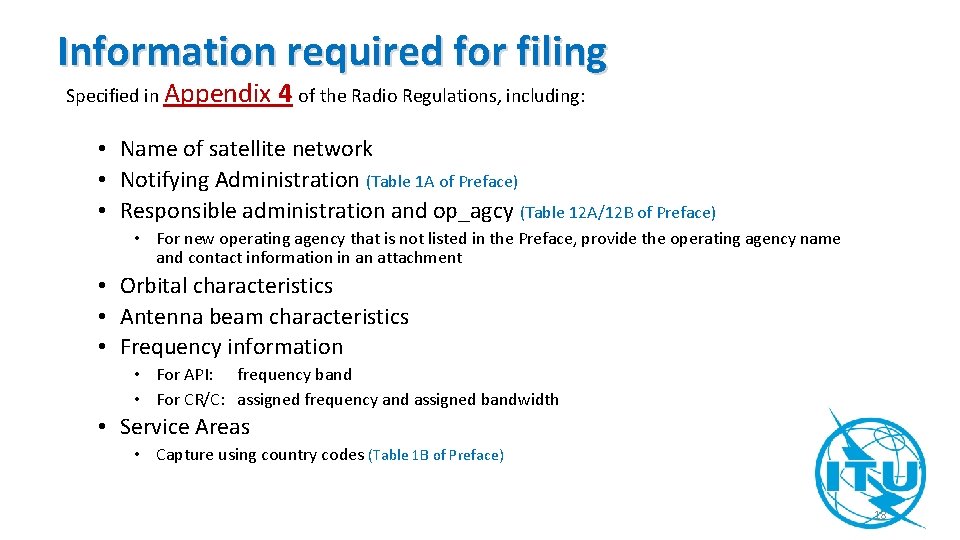
Information required for filing Specified in Appendix 4 of the Radio Regulations, including: • Name of satellite network • Notifying Administration (Table 1 A of Preface) • Responsible administration and op_agcy (Table 12 A/12 B of Preface) • For new operating agency that is not listed in the Preface, provide the operating agency name and contact information in an attachment • Orbital characteristics • Antenna beam characteristics • Frequency information • For API: frequency band • For CR/C: assigned frequency and assigned bandwidth • Service Areas • Capture using country codes (Table 1 B of Preface) 18
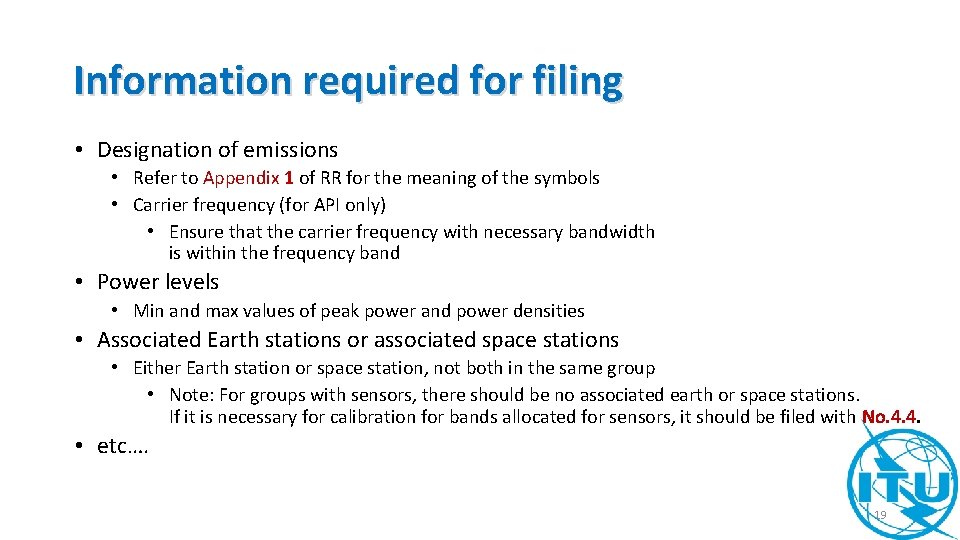
Information required for filing • Designation of emissions • Refer to Appendix 1 of RR for the meaning of the symbols • Carrier frequency (for API only) • Ensure that the carrier frequency with necessary bandwidth is within the frequency band • Power levels • Min and max values of peak power and power densities • Associated Earth stations or associated space stations • Either Earth station or space station, not both in the same group • Note: For groups with sensors, there should be no associated earth or space stations. If it is necessary for calibration for bands allocated for sensors, it should be filed with No. 4. 4. • etc…. 19
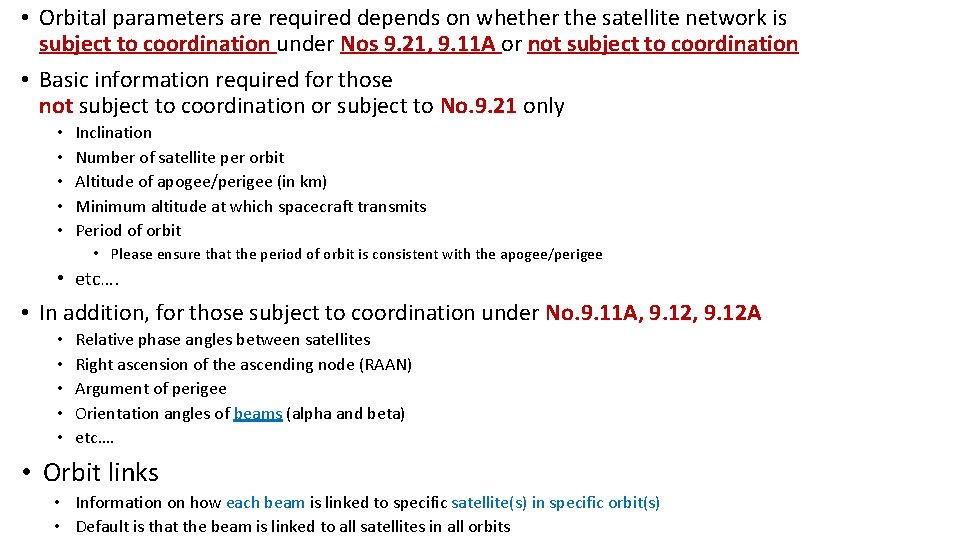
• Orbital parameters are required depends on whether the satellite network is subject to coordination under Nos 9. 21, 9. 11 A or not subject to coordination • Basic information required for those not subject to coordination or subject to No. 9. 21 only • • • Inclination Number of satellite per orbit Altitude of apogee/perigee (in km) Minimum altitude at which spacecraft transmits Period of orbit • Please ensure that the period of orbit is consistent with the apogee/perigee • etc…. • In addition, for those subject to coordination under No. 9. 11 A, 9. 12 A • • • Relative phase angles between satellites Right ascension of the ascending node (RAAN) Argument of perigee Orientation angles of beams (alpha and beta) etc…. • Orbit links • Information on how each beam is linked to specific satellite(s) in specific orbit(s) • Default is that the beam is linked to all satellites in all orbits
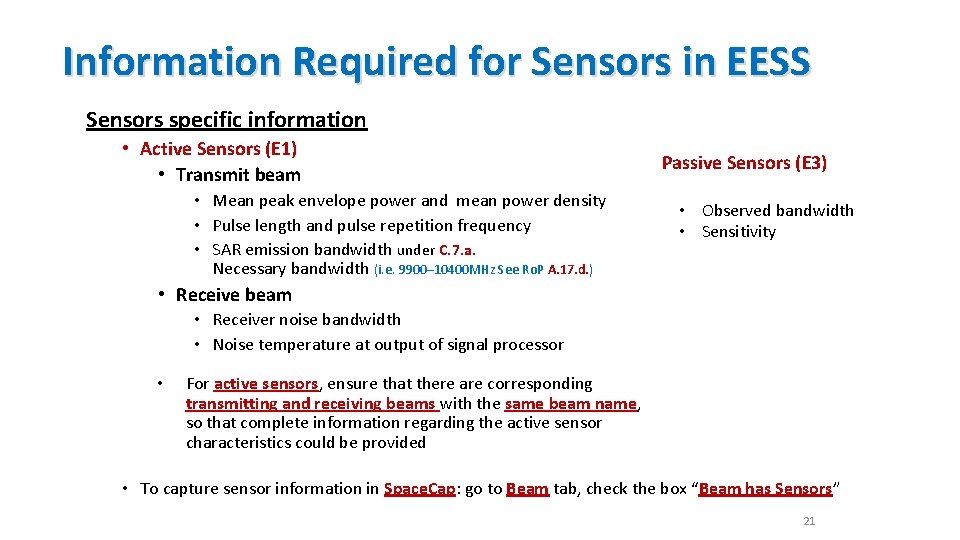
Information Required for Sensors in EESS Sensors specific information • Active Sensors (E 1) • Transmit beam • Mean peak envelope power and mean power density • Pulse length and pulse repetition frequency • SAR emission bandwidth under C. 7. a. Necessary bandwidth (i. e. 9900– 10400 MHz See Ro. P A. 17. d. ) Passive Sensors (E 3) • Observed bandwidth • Sensitivity • Receive beam • Receiver noise bandwidth • Noise temperature at output of signal processor • For active sensors, ensure that there are corresponding transmitting and receiving beams with the same beam name, so that complete information regarding the active sensor characteristics could be provided • To capture sensor information in Space. Cap: go to Beam tab, check the box “Beam has Sensors” 21
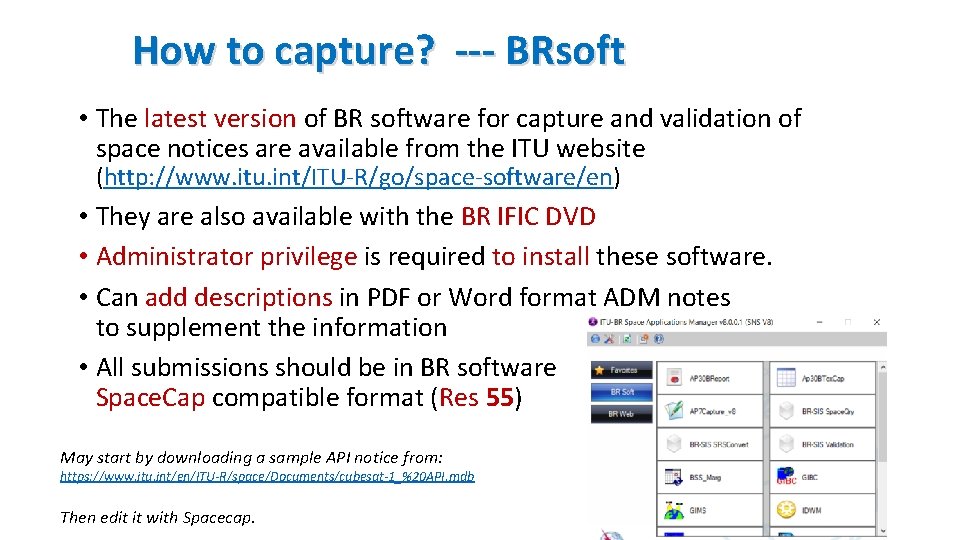
How to capture? --- BRsoft • The latest version of BR software for capture and validation of space notices are available from the ITU website (http: //www. itu. int/ITU-R/go/space-software/en) • They are also available with the BR IFIC DVD • Administrator privilege is required to install these software. • Can add descriptions in PDF or Word format ADM notes to supplement the information • All submissions should be in BR software Space. Cap compatible format (Res 55) May start by downloading a sample API notice from: https: //www. itu. int/en/ITU-R/space/Documents/cubesat-1_%20 API. mdb Then edit it with Spacecap. 22
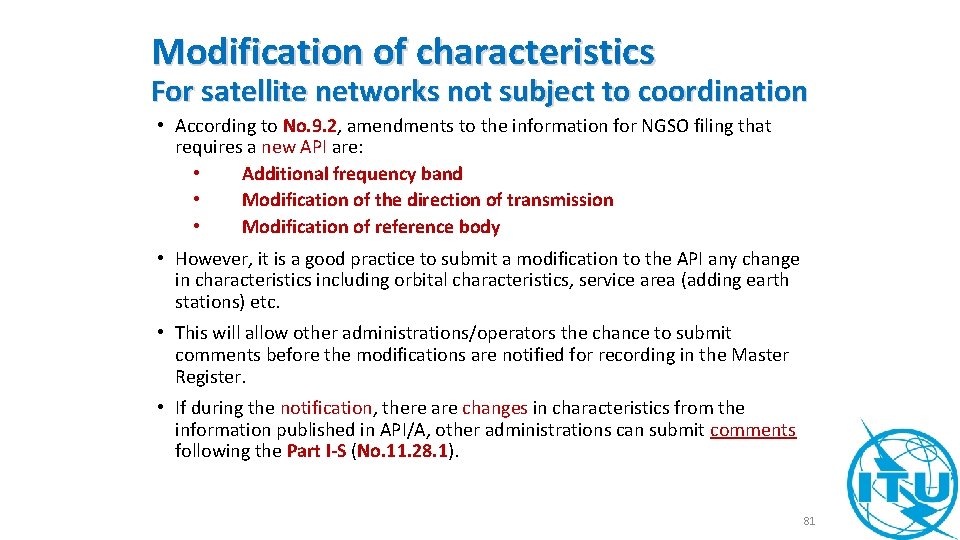
Modification of characteristics For satellite networks not subject to coordination • According to No. 9. 2, amendments to the information for NGSO filing that requires a new API are: • Additional frequency band • Modification of the direction of transmission • Modification of reference body • However, it is a good practice to submit a modification to the API any change in characteristics including orbital characteristics, service area (adding earth stations) etc. • This will allow other administrations/operators the chance to submit comments before the modifications are notified for recording in the Master Register. • If during the notification, there are changes in characteristics from the information published in API/A, other administrations can submit comments following the Part I-S (No. 11. 28. 1). 81
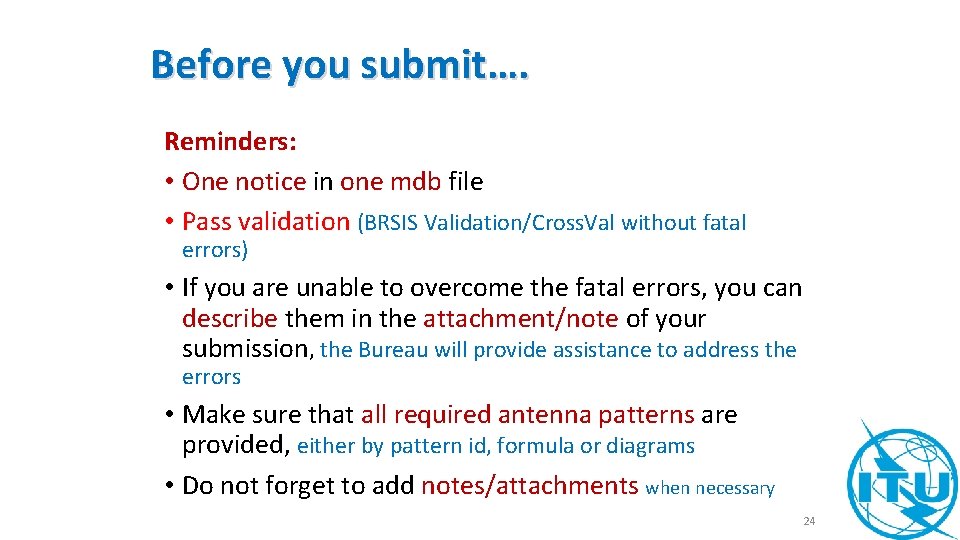
Before you submit…. Reminders: • One notice in one mdb file • Pass validation (BRSIS Validation/Cross. Val without fatal errors) • If you are unable to overcome the fatal errors, you can describe them in the attachment/note of your submission, the Bureau will provide assistance to address the errors • Make sure that all required antenna patterns are provided, either by pattern id, formula or diagrams • Do not forget to add notes/attachments when necessary 24
Submission of notices to ITU • All notices for satellite networks shall be submitted to the Bureau in electronic format which is compatible with the BR electronic notice form capture software (Space. Cap) and comments/objections software (Space. Com), using the ITU web interface “e-Submission of satellite network filings” available at https: //www. itu. int/itu-r/go/space-submission. • Receipt of notices related to space services shall be acknowledged immediately by ITU/BR e-mail. • Notices submitted using “e-Submission of satellite network filings” for space services do not require any separate confirmation by telefax or mail. • Notices are treated by date of receipt order. • To request for access to the e-Submission system, TIES account is required (available to ITU member organizations), and must be granted access by the manager roles in the Administration.
Validation with BRSIS-Validation • The latest version of the validation software (BRSIS-Validation) available to administrations is used by the Bureau when assessing the completeness of Appendix 4 forms of notice. • Administrations are encouraged to run the validation software themselves in order to overcome any difficulties in the notices before they are submitted to the Bureau. • In e-submissions for satellite network filings, when the notice is submitted to bureau, BRSIS-Validation will be executed on the notice. • If any fatal error is found, fix it before submission, otherwise, user will have to enter the reason why they think they would submit despite the fatal error.
ROP: Further clarifications on a notice • If the Bureau finds that further clarification is required concerning the correctness of the mandatory data submitted, it shall request the administration responsible for the station or network to provide the clarification within 30 days, otherwise it shall establish the formal date of receipt. • If the information or clarification is provided within that period of 30 days, the date of receipt will be retained. • If the information or clarification is not provided within the above period of 30 days, the submission shall be considered incomplete and the Bureau will establish no formal date of receipt. A new formal date of receipt will be established when the complete information is received. • Nevertheless, for replies received within the above period of 30 days, a new formal date of receipt is established in those cases where the information submitted subsequently is outside the scope and beyond the objective of the Bureau’s enquiry, if the new or modified data has impact on the regulatory and technical examination, irrespective of whether the newly provided information adds new affected administrations or not.
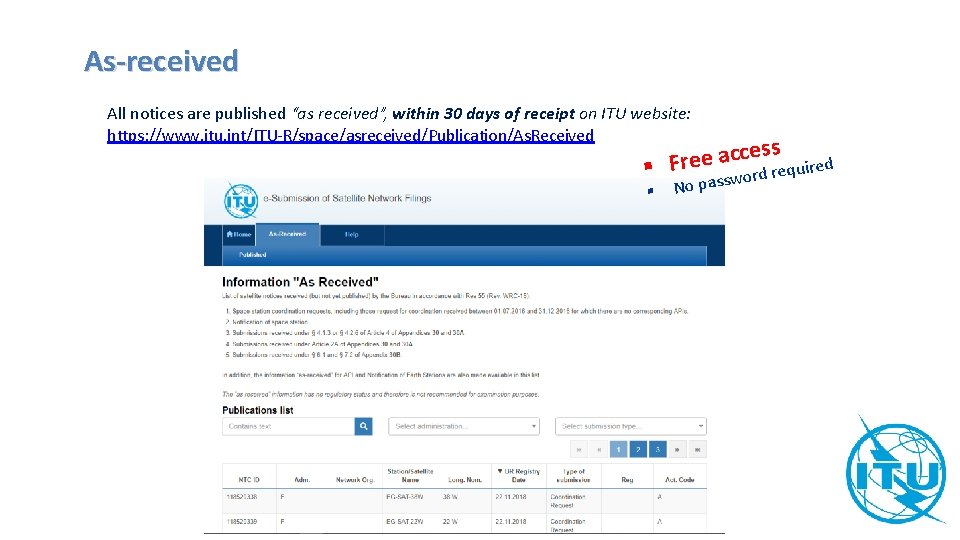
As-received All notices are published “as received”, within 30 days of receipt on ITU website: https: //www. itu. int/ITU-R/space/asreceived/Publication/As. Received ss e c c a e e § Fr sword required as § No p
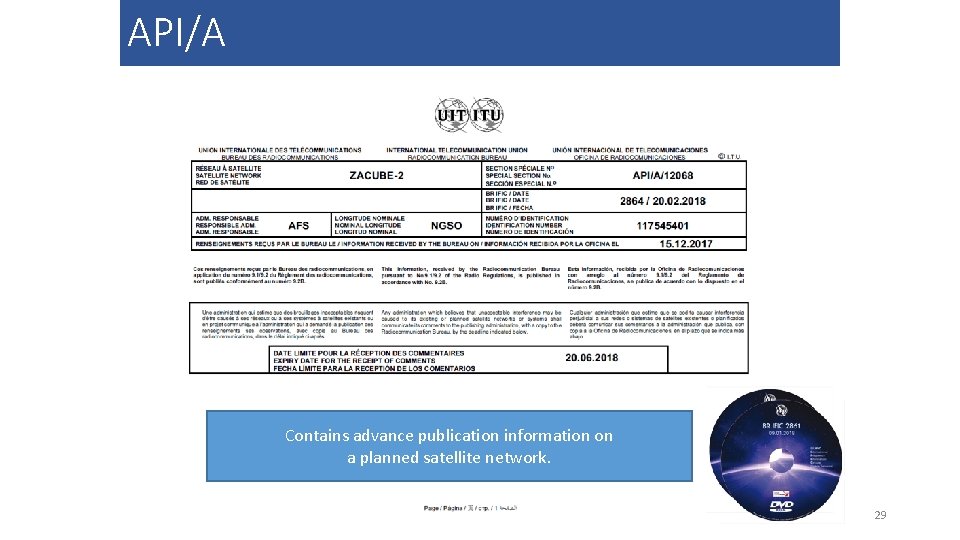
API/A Contains advance publication information on a planned satellite network. 29
Regulatory procedures for comments and resolution of difficulties • Commenting procedures • Comments to an API/A shall within 4 months of the date o 564151 f publication of the BR IFIC communicate to the publishing administration, copy to the BR (No. 9. 3) • Comments to be captured using Space. Com software (RES 55) • The Bureau publishes the list of administrations which have sent comments in an API/B Special Section in a BR IFIC (No. 9. 5) • Resolution of difficulties • • • (No. 9. 3, No. 9. 4) Both administrations shall endeavor to cooperate in joint efforts to resolve any difficulties and shall exchange any additional relevant information that may be available Either party can request for the assistance of the Radiocommunication Bureau In case of difficulties, the administration responsible for the planned satellite network shall explore all possible means to resolve the difficulties without considering the possibility of adjustment to networks of other administrations If no such means can be found, it may request the other administrations to explore all possible means to meet its requirements The administrations concerned shall make every possible effort to resolve the difficulties by means of mutually acceptable adjustments to their networks 30
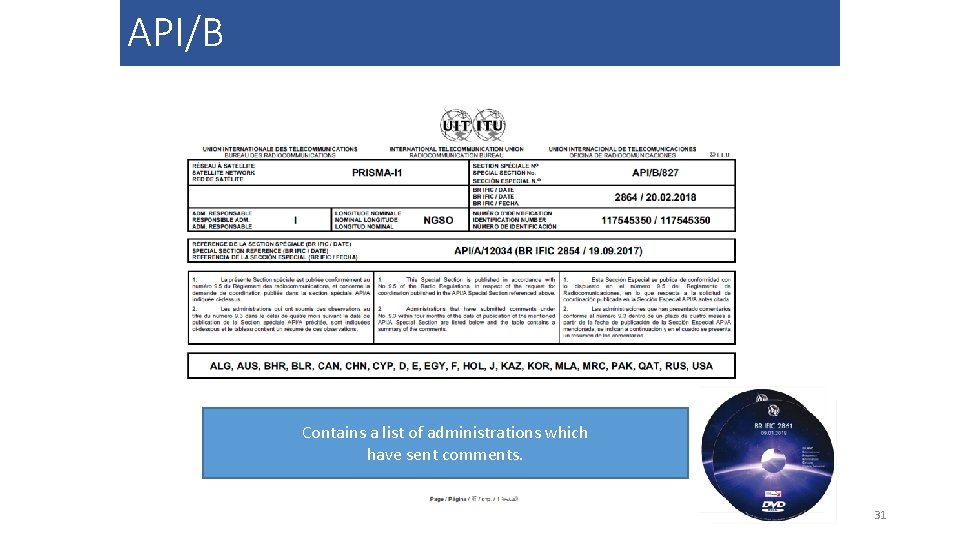
API/B Contains a list of administrations which have sent comments. 31
Notification for recording in the MIFR • All satellite networks must be notified for recording in the MIFR, even for those assignments that are applying 4. 4, even for those using bands for the amateur satellite service • Notification is receivable from 6 months after the date of publication of the API • This is to ensure that the commenting and resolution of difficulties procedures of No. 9. 3 are applied • If submitted before the launch, ensure that date of bringing into use is not more than 3 years after the date of submission • Latest date for submission of notification is 7 years after the date of receipt of the API. • Ensure that the frequency bands in the notification notice is fully covered by the API • Use Spacecap tool for converting API to notification • Make sure to capture the frequency information after the conversion • Fill in the special section number of the corresponding API • Capture the date of bringing into use • Bureau will examine the notification according to the relevant provisions of the Radio Regulations, publish the findings in the BRIFIC DVD, and if the findings are favorable, the assignments are recorded in the MIFR
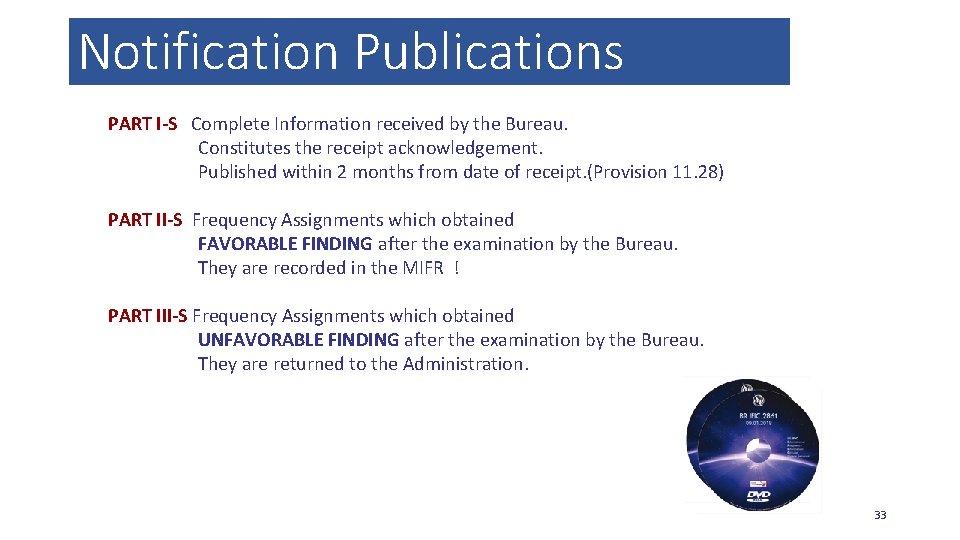
Notification Publications PART I-S Complete Information received by the Bureau. Constitutes the receipt acknowledgement. Published within 2 months from date of receipt. (Provision 11. 28) PART II-S Frequency Assignments which obtained FAVORABLE FINDING after the examination by the Bureau. They are recorded in the MIFR ! PART III-S Frequency Assignments which obtained UNFAVORABLE FINDING after the examination by the Bureau. They are returned to the Administration. 33
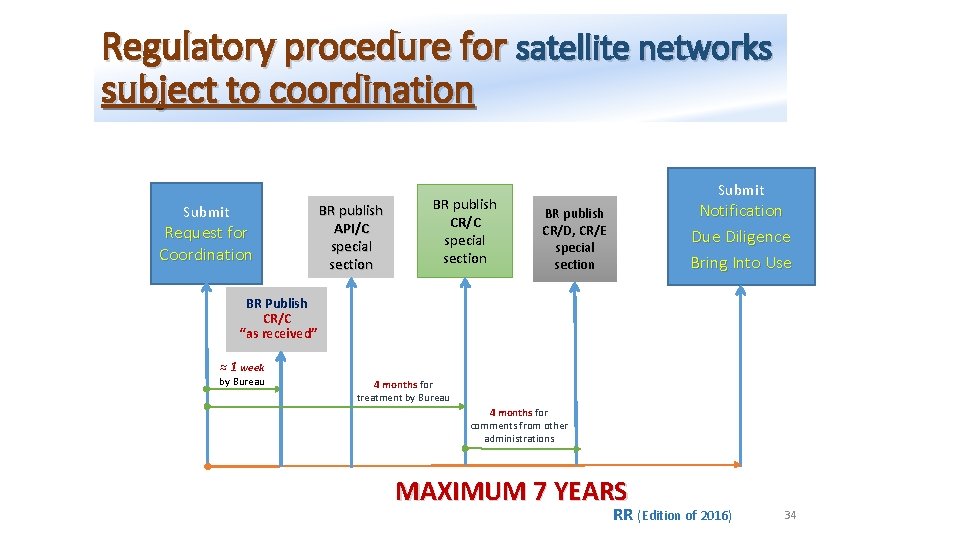
Regulatory procedure for satellite networks subject to coordination Submit Request for Coordination BR publish API/C special section BR publish CR/C special section Submit Notification Due Diligence Bring Into Use BR publish CR/D, CR/E special section BR Publish CR/C “as received” ≈ 1 week by Bureau 4 months for treatment by Bureau 4 months for comments from other administrations MAXIMUM 7 YEARS RR (Edition of 2016) 34
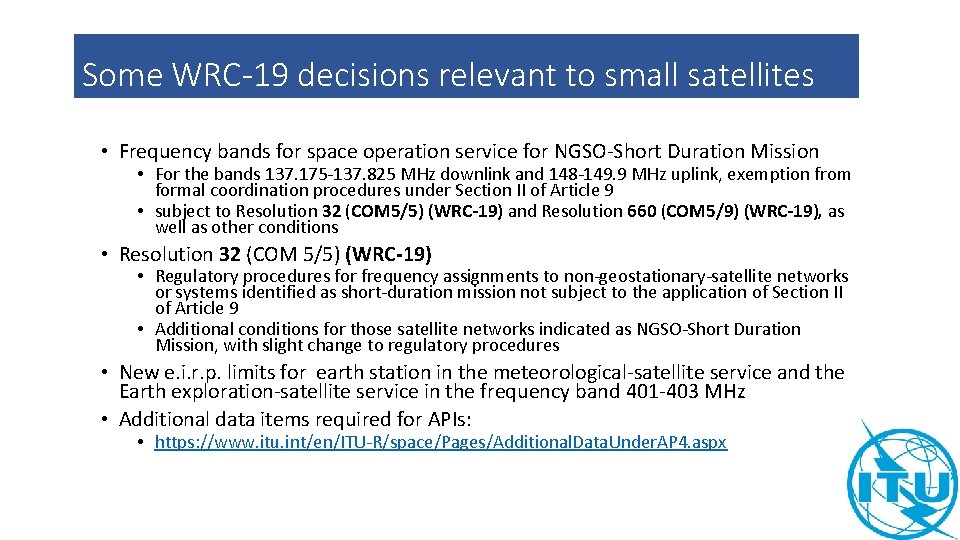
Some WRC-19 decisions relevant to small satellites • Frequency bands for space operation service for NGSO-Short Duration Mission • For the bands 137. 175 -137. 825 MHz downlink and 148 -149. 9 MHz uplink, exemption from formal coordination procedures under Section II of Article 9 • subject to Resolution 32 (COM 5/5) (WRC-19) and Resolution 660 (COM 5/9) (WRC-19), as well as other conditions • Resolution 32 (COM 5/5) (WRC-19) • Regulatory procedures for frequency assignments to non-geostationary-satellite networks or systems identified as short-duration mission not subject to the application of Section II of Article 9 • Additional conditions for those satellite networks indicated as NGSO-Short Duration Mission, with slight change to regulatory procedures • New e. i. r. p. limits for earth station in the meteorological-satellite service and the Earth exploration-satellite service in the frequency band 401 -403 MHz • Additional data items required for APIs: • https: //www. itu. int/en/ITU-R/space/Pages/Additional. Data. Under. AP 4. aspx
Questions ? https: //www. itu. int/en/ITU-R/space/Pages/support. Small. Sat. aspx International Telecommunication Union