
ITT TECHNICAL INSTITUTE SCHOOL OF HEALTH SCIENCES Nursing
- Slides: 16
ITT TECHNICAL INSTITUTE SCHOOL OF HEALTH SCIENCES Nursing Department Mandatory Tuberculosis Education Mrs. Kreisel MSN, RN Adult Nursing 130
WHAT IS TB? • TB is short for a disease called Mycobacterium Tuberculosis
How can TB spread? • The TB bacteria are put into the air (airborne) when a person with active TB disease of the lungs or throat coughs, sneezes, speaks, or sings.
How to be exposed • A person is considered to be exposed if there is shared breathing space with someone with infectious pulmonary or laryngeal tuberculosis at a time when the infectious person is not wearing a mask and the other person is not wearing an N 95 respirator.
What to do if I am exposed • If you are exposed to someone with infectious tuberculosis and have never had a positive reaction to the tuberculin (TB) skin test, you should have a baseline test within 3 months prior to the exposure date. If you have not had a test result documented within the past 3 months you should have one placed as soon as possible after the exposure, preferably within two weeks. This skin test should be read in 48 -72 hours. If it is negative, you should repeat this process three months after the exposure.
Incubation Period • From infection to development of a positive TB skin test reaction (the incubation period) is approximately 2 to 12 weeks. The risk for developing active disease is the highest in the first two years after infection and development of a positive TB skin test reaction.
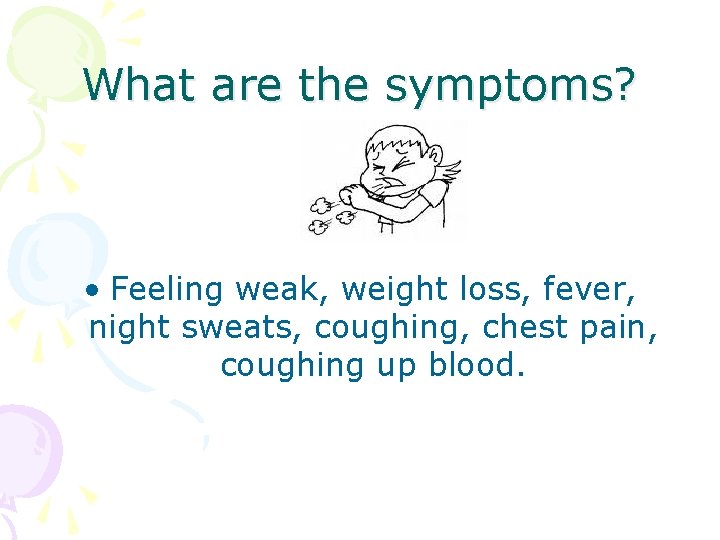
What are the symptoms? • Feeling weak, weight loss, fever, night sweats, coughing, chest pain, coughing up blood.
What to do if exposed • Notify the charge nurse/Nurse Manager ASAP (nursing instructor) • Report to infection control • Medical Follow up.
What do I do if I am exposed? • Tell your charge nurse, and go to the employee health nurse, or your physician. • They will do a mantoux test, and decide if treatment is needed.
Latent TB • Many times these people have no symptoms. • They may be treated to try to keep them from developing the active disease. • They are not infectious unless the disease becomes active in that person.
What is latent TB? • A person with latent TB has infection dormant in their body, and are not contagious unless the infection becomes active in their body.
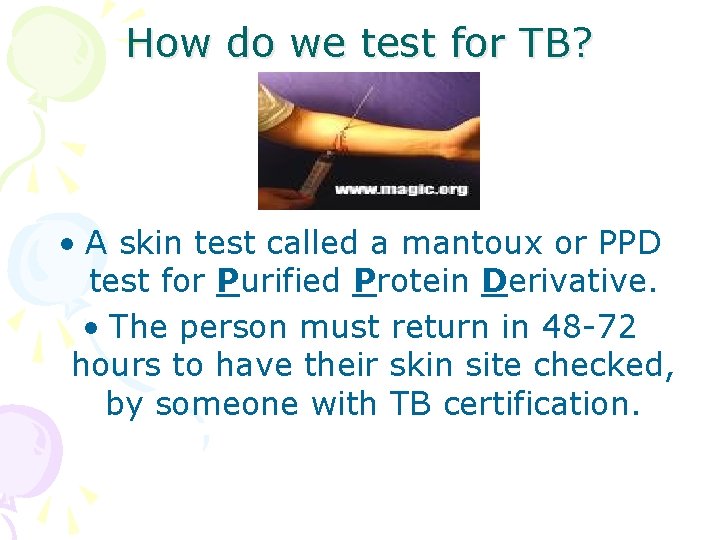
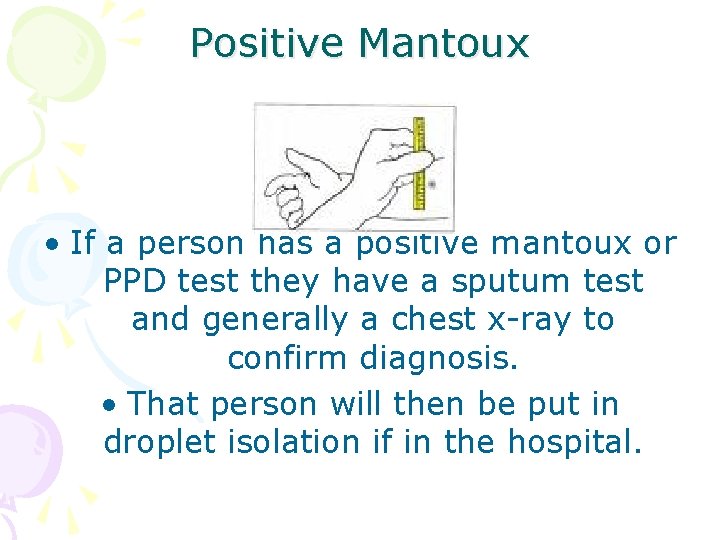
How do we test for TB? • A skin test called a mantoux or PPD test for Purified Protein Derivative. • The person must return in 48 -72 hours to have their skin site checked, by someone with TB certification.
Positive Mantoux • If a person has a positive mantoux or PPD test they have a sputum test and generally a chest x-ray to confirm diagnosis. • That person will then be put in droplet isolation if in the hospital.
Treatment • The treatment is several drugs that the physician prescribes for 6 -12 months. • These drugs must be taken exactly as directed. • If the person stops taking the medication without the physicians approval, they may become sick and/or develop TB.
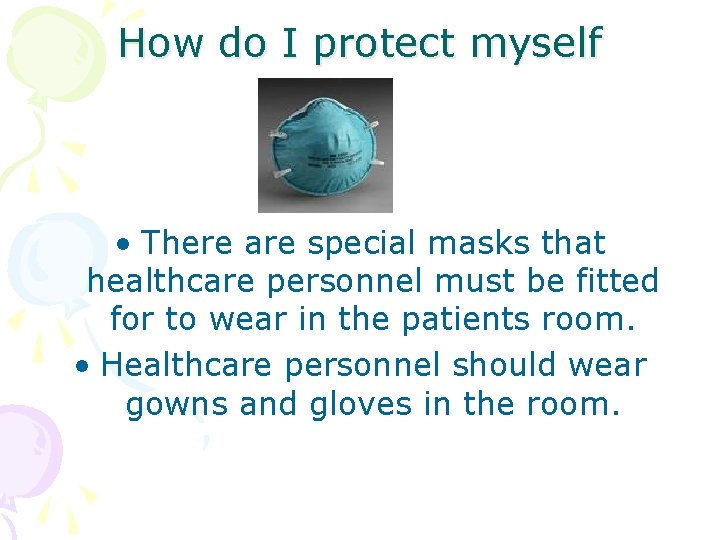
How do I protect myself • There are special masks that healthcare personnel must be fitted for to wear in the patients room. • Healthcare personnel should wear gowns and gloves in the room.
You Cannot get TB: • Clothes • Drinking glass • Eating utensils • Handshake • Toilet • Other surfaces