
Its not the What its the Why Motivational
- Slides: 18
It’s not the What, it’s the Why: Motivational Strategies for Health Behaviors Dr. Diane E. Whaley Colby Sawyer Exercise & Sport Sciences & Athletics Symposium March 21, 2011 http: //curry. virginia. edu/academics/areas-of-study/educationalpsychology
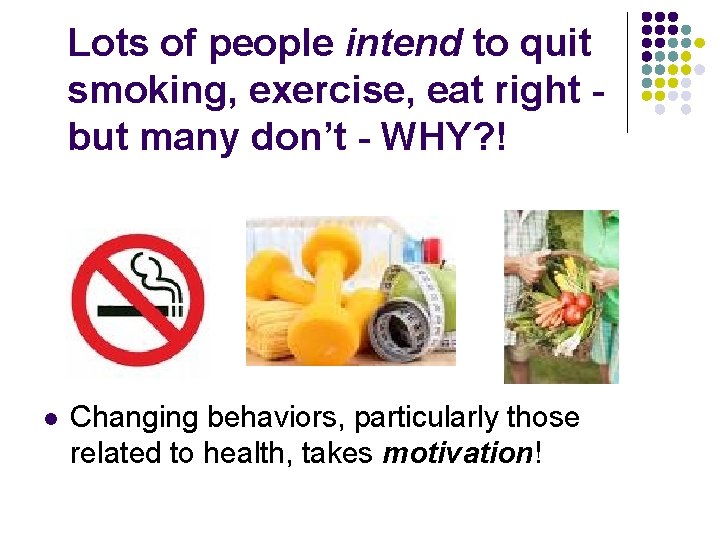
Lots of people intend to quit smoking, exercise, eat right but many don’t - WHY? ! l Changing behaviors, particularly those related to health, takes motivation!
Motivation Defined l Motivation includes: l the preference for choosing exercise or other health behaviors over other choices l the persistence one displays in sticking with an activity l the intensity one exhibits when participating in the activity
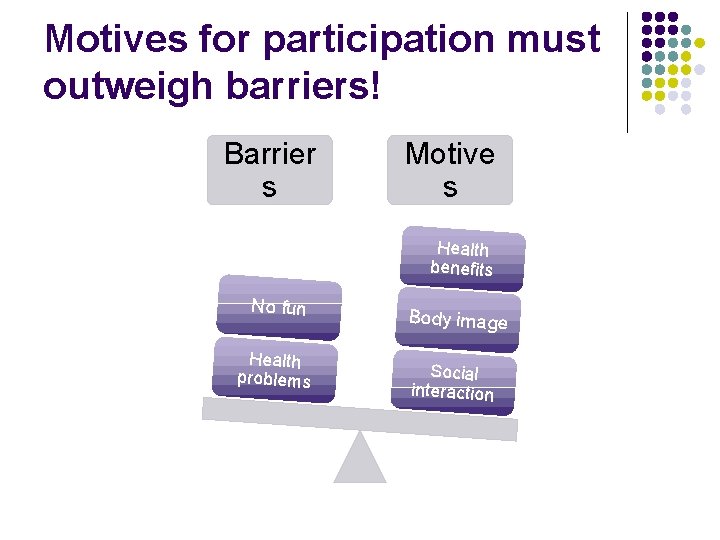
Motives for participation must outweigh barriers! Barrier s Motive s Health benefits No fun Health problems Body image Social interaction
Strategies for meeting these motives: l l l Relate exercise specifically to the potential health benefits (future-oriented goals) Enhance enjoyment - provide variety and high involvement Allow participants some control Increase opportunities for social interaction De-emphasize body image issues Teach self-regulation
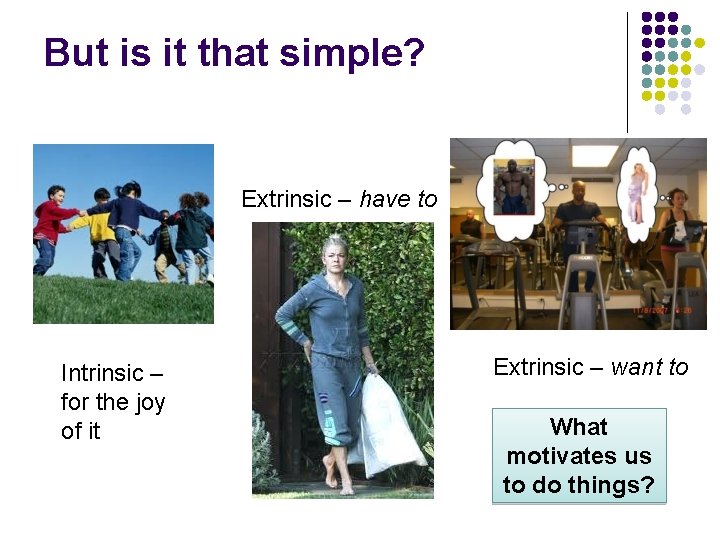
But is it that simple? Extrinsic – have to Intrinsic – for the joy of it Extrinsic – want to What motivates us to do things?
Theories of Motivation l Many theories exist, but a few concepts cut across most of them: l l l Have to feel capable of the behavior in question Have to feel that the behavior achieves some purpose; that is, it’s important or relevant Have to feel like you have some control over the behavior or the environment
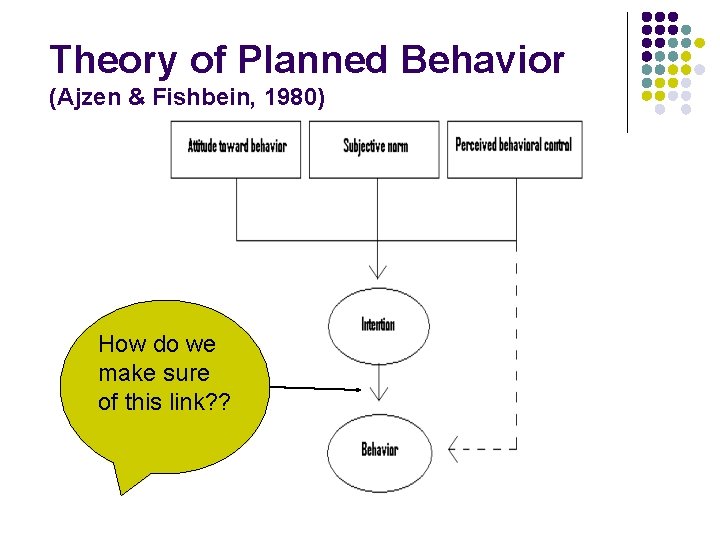
Theory of Planned Behavior (Ajzen & Fishbein, 1980) How do we make sure of this link? ?
Keys to Behavior Change l Intention must be converted to action! l First step in behavior change is recognizing what we do, what we don’t do, and what we think about those behaviors l l We call this self-awareness Self-awareness in turn leads to self-regulation l CRITICAL for helping to maintain behaviors over the long term!
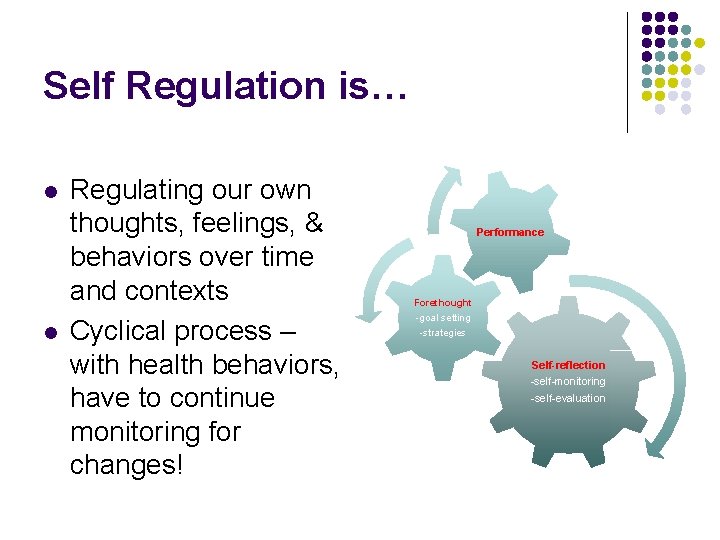
Self Regulation is… l l Regulating our own thoughts, feelings, & behaviors over time and contexts Cyclical process – with health behaviors, have to continue monitoring for changes! Performance Forethought -goal setting -strategies Self-reflection -self-monitoring -self-evaluation
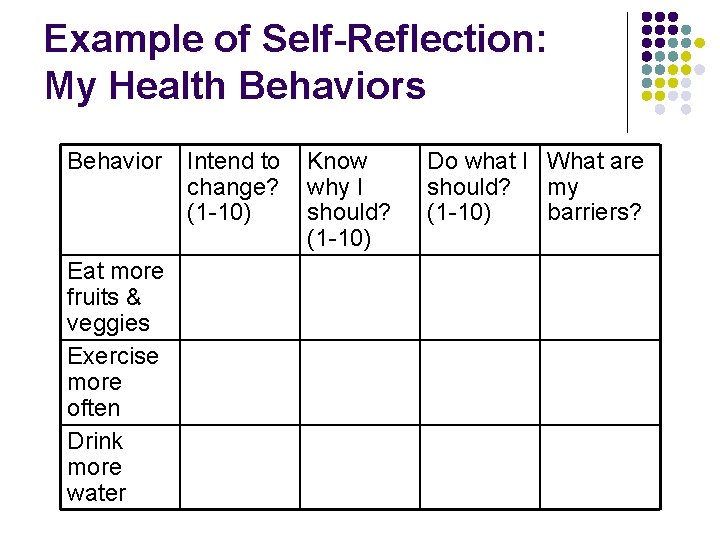
Example of Self-Reflection: My Health Behaviors Behavior Eat more fruits & veggies Exercise more often Drink more water Intend to change? (1 -10) Know why I should? (1 -10) Do what I What are should? my (1 -10) barriers?
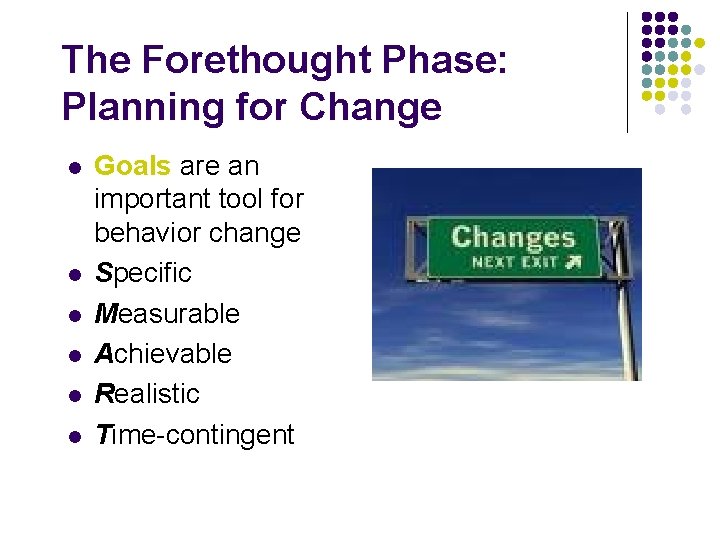
The Forethought Phase: Planning for Change l l l Goals are an important tool for behavior change Specific Measurable Achievable Realistic Time-contingent
Goal: “Exercise More Often” l Make it SMART! l “I WILL GO TO THE GYM 3 X THIS WEEK AT 4 PM FOR 1 HOUR” What might be barriers to achieving this goal? What strategies can I use to help me maintain this goal over the longer term? l l
Are Goals Enough? Listening to Our inner dialogue l Sometimes, we can be our own best friend OR worst enemy when it comes to behavior change. l l What we say to and about ourselves - our selftalk, can either support or thwart our plans. Again, the first step is awareness l Do you know what you say? ?
Irrational or distorted self-talk (“I must/have to…” statements) l l Perfectionism (“I must do this perfectly”) Catastrophizing (“I missed my exercise session – I knew I couldn’t last”) Personalization (“If I had just made that goal, we would have won”) Blaming (“If there were better food in the dining halls I would eat healthier”)
Techniques to improve selftalk l l Thought stoppage - consciously recognize negative thought (trigger - i. e. , snap fingers) Changing negative self-talk to positive or instructional self-talk Countering assumptions - necessary when you still believe the negative thought. Uses facts to counter negative thought Reframing – creating alternative frames of reference - change your perspective!
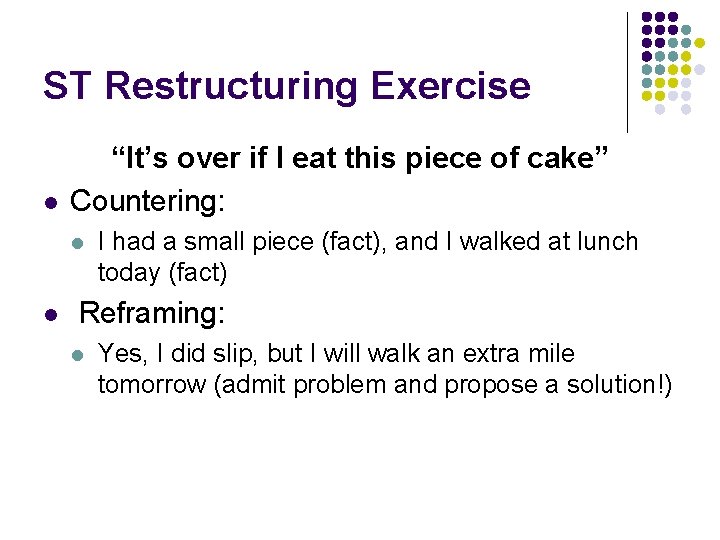
ST Restructuring Exercise l “It’s over if I eat this piece of cake” Countering: l l I had a small piece (fact), and I walked at lunch today (fact) Reframing: l Yes, I did slip, but I will walk an extra mile tomorrow (admit problem and propose a solution!)
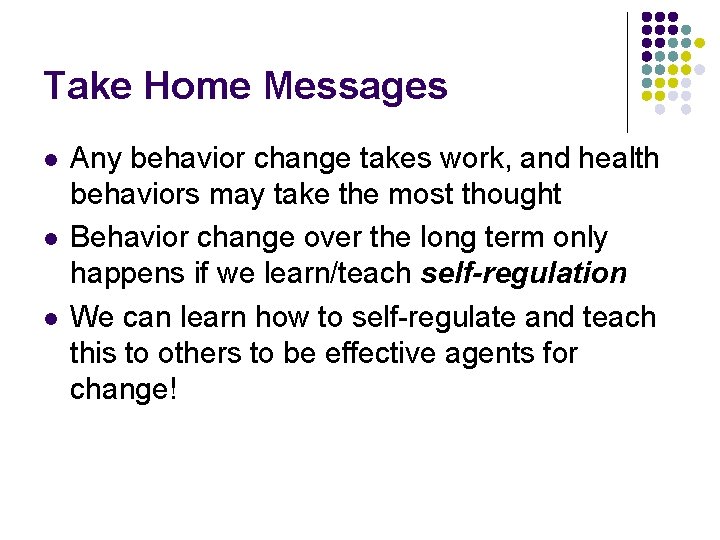
Take Home Messages l l l Any behavior change takes work, and health behaviors may take the most thought Behavior change over the long term only happens if we learn/teach self-regulation We can learn how to self-regulate and teach this to others to be effective agents for change!