
Its All in the Archives Describing and Discovering
It’s All in the Archives: Describing and Discovering Archival Material 2013 ASSOCIATION OF RECORDED SOUND COLLECTIONS PRE-CONFERENCE WORKSHOP DISCOVERY ACCESS METHODS FOR SOUND RECORDING COLLECTIONS MAY 15, 2013 JOANNE ARCHER SPECIAL COLLECTIONS LIBRARIAN UNIVERSITY OF MARYLAND LIBRARIES
Outline �Introduction �Archival Principles and Practices �Arrangement and Description of Archival Material Exercise: common arrangement schemes �Access and Discovery of Archival Material Standards and Best Practices Discovery Tools and Methods
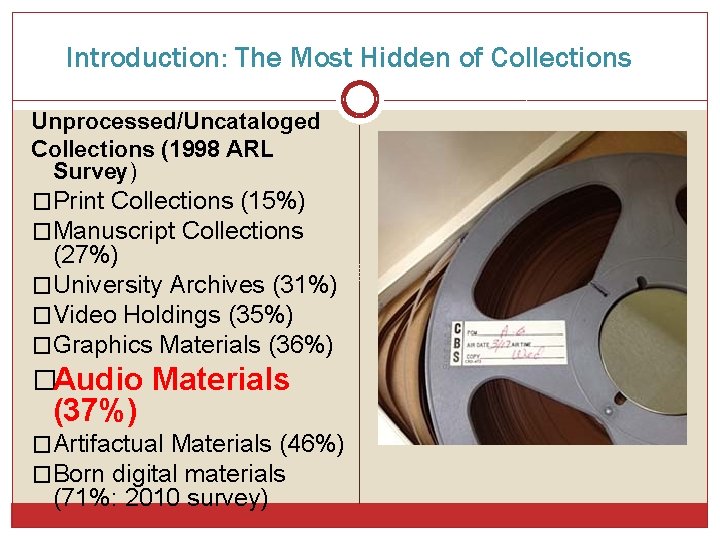
Introduction: The Most Hidden of Collections Unprocessed/Uncataloged Collections (1998 ARL Survey) �Print Collections (15%) �Manuscript Collections (27%) �University Archives (31%) �Video Holdings (35%) �Graphics Materials (36%) �Audio Materials (37%) �Artifactual Materials (46%) �Born digital materials (71%: 2010 survey)
Introduction: More Product, Less Process (MPLP) �Mark Greene and Dennis Meissner “More Product, Less Process: Revamping Traditional Archival Processing” (American Archivist, 2005) Collection Level records Minimal Finding Aids Change the definition of processing to privilege users and flexibility, “describe everything in general before describing anything in detail” Goal is to do just enough arrangement and description so that user can successfully locate and use material.
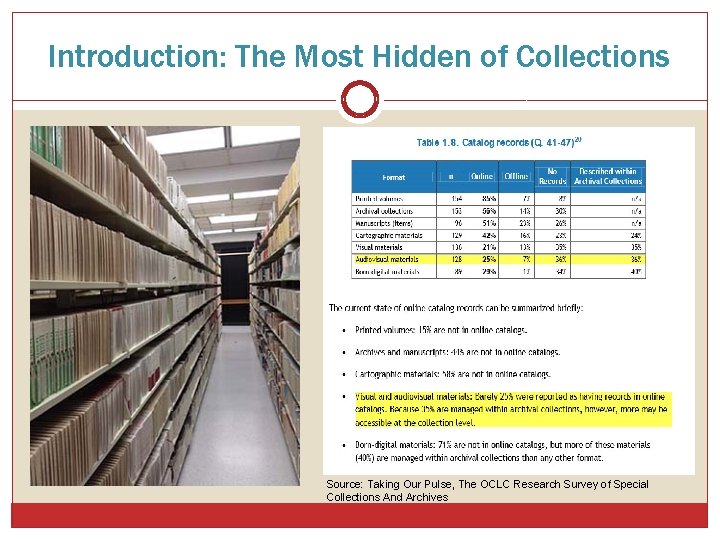
Introduction: The Most Hidden of Collections Source: Taking Our Pulse, The OCLC Research Survey of Special Collections And Archives
Introduction: The Most Hidden of Collections �Why are audio visual materials most overlooked in archival collections? Many archivists not equipped to deal with materials Doesn’t fit neatly into standards and practices developed for paper based materials Format and lack of easily accessible descriptive information make materials particularly challenging for non specialists
Outline �Introduction �Archival Principles and Practices �Arrangement and Description of Archival Material Exercise: common arrangement schemes �Access and Discovery of Archival Material Standards and Best Practices Discovery Tools and Methods
Archival Principles �Provenance “Information regarding the origins, custody, and ownership of an item or collection. ” �Original Order “The organization and sequence of records established by the creator of the records. ” All definitions take from the Society of American Archivists, Glossary of Archival and Records Terminology
Archival Principles: Provenance �Discourages the mixing of collection materials �Refers to the creator rather then the donor if the two are different �Benefits: Accepts the creator or source as the system of organization which makes work much simpler Preserves key information about the collection as a whole �Drawbacks No uniformity of arrangement across collections Can be more difficult for users unaware of this practice
Archival Principles: Original Order �The order in which materials were kept when in active use �Original order is preserved unless use is impossible. �Time saving measure—rearrangement is time consuming and subjective
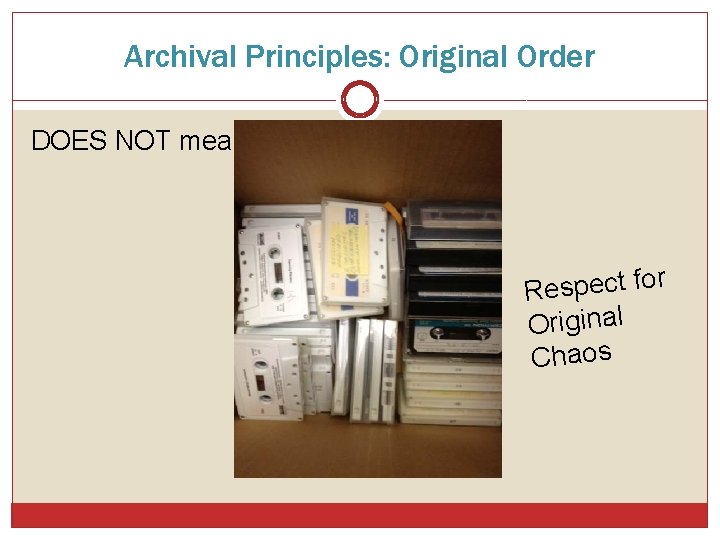
Archival Principles: Original Order DOES NOT mean: r o f t c e p s e R Original Chaos
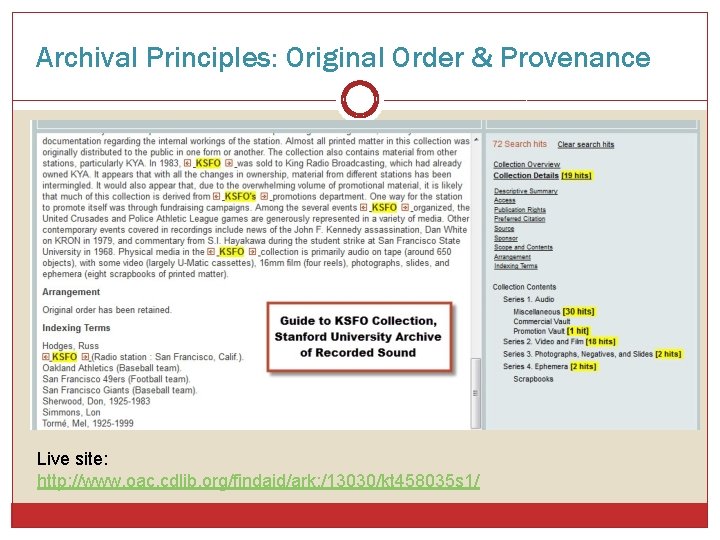
Archival Principles: Original Order & Provenance Live site: http: //www. oac. cdlib. org/findaid/ark: /13030/kt 458035 s 1/

Outline �Introduction �Archival Principles and Practices �Arrangement and Description of Archival Material Exercise: common arrangement schemes �Access and Discovery of Archival Material Standards and Best Practices Discovery Tools and Methods

Arrangement and Description Goals of archival arrangement and description: �To know what we have and where it is �To make material accessible to users �To explain the context of the creation and use of records “Good Descriptive Practices Facilitate Good End- User Access” Prom and Frusciano, Archival Arrangement and Description
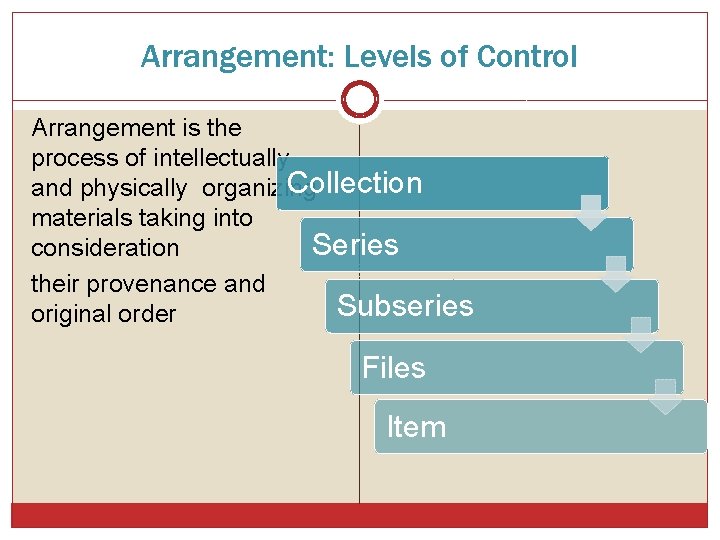
Arrangement: Levels of Control Arrangement is the process of intellectually Collection and physically organizing materials taking into Series consideration their provenance and Subseries original order Files Item
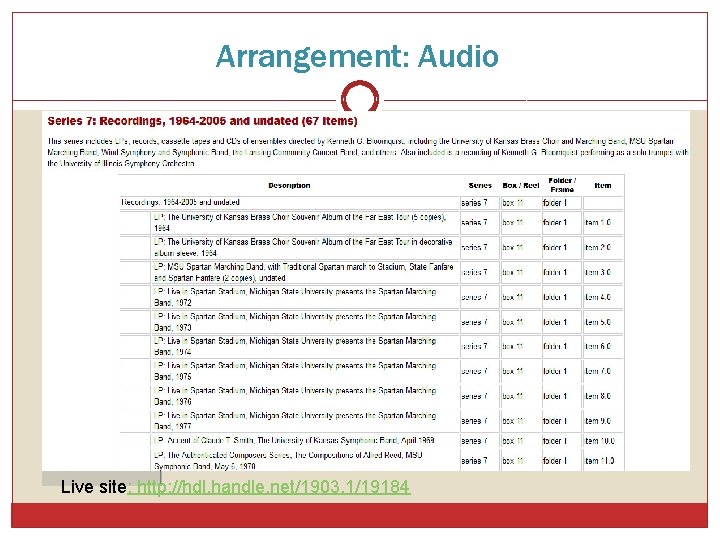
Arrangement: Audio Live site: http: //hdl. handle. net/1903. 1/19184
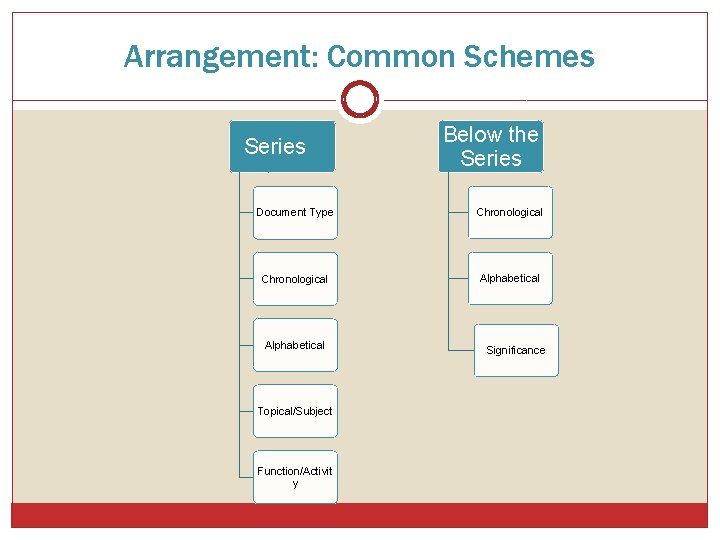
Arrangement: Common Schemes Series Below the Series Document Type Chronological Alphabetical Topical/Subject Function/Activit y Significance
Arrangement Exercise: Part 1 �What series would you propose? �What factors did you take into consideration? �How do you imagine you would arrange material within the series? Link to arrangement exercise Link to WAMU finding aid: jpeg /live
Arrangement Exercise: Part 2 �How would you arrange this material within an audio series? �What factors would you consider in determining this arrangement? �What are the benefits and drawbacks to your arrangement scheme? Link to arrangement spreadsheet Link to final version of inventory
Description Archival description is: “The process of analyzing, organizing, and recording details about the formal elements of a record or collection of records, such as creator, title, dates, extent, and contents, to facilitate the work's identification, management, and understanding” From the Society of American Archivist’s Glossary of Archival and Records Terminology
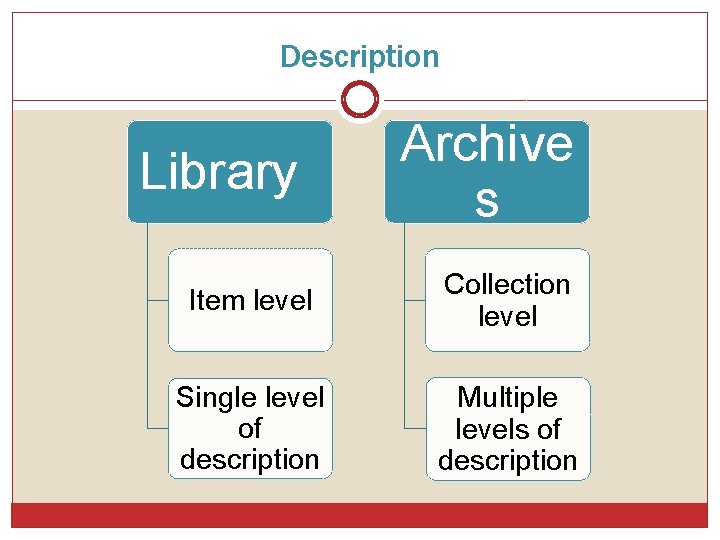
Description Library Archive s Item level Collection level Single level of description Multiple levels of description
Description: Finding Aids Finding aids are indexes to archival and manuscript collections. A finding aid can be as simple as a listing of folders (often called an inventory or preliminary inventory), but it can also be a complex document that places materials in context by consolidating information about the collection, such as a history or biographical note and a description of the arrangement of the collection. Finding aid example: jpeg / live
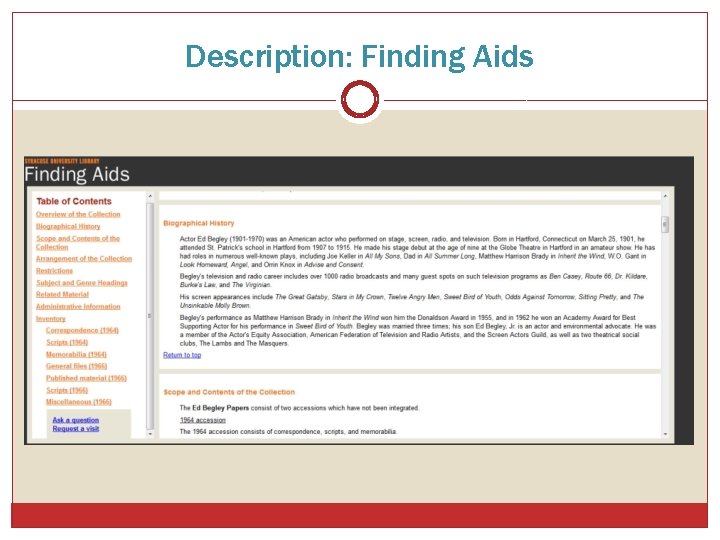
Description: Finding Aids
Outline �Introduction �Archival Principles and Practices �Arrangement and Description of Archival Material Exercise: common arrangement schemes �Access and Discovery of Archival Material Standards and Best Practices Discovery Tools and Methods
Standards: Who cares? �Enable efficient production, description, and use of objects and information �Break down description into a set of common elements �Helps with consistency and helps users know what to expect �Increases discoverability by creating structured data that can be shared across systems
Standards �Data Structure Standards MARC, EAD, EAC-CPF �Data Content Standards DACS, AACR 2, RDA, APPM, IASA �Data Value Standards Library of Congress Name Authority Files (LCNAF), Library of Congress Subject Headings (LCSH), �Metadata/companion standards Main standards are Dublin Core (often used at the item level), MODS, and METS (structural metadata), and PREMIS (administrative metadata)
Standards: Data Structure Standards �MARC (Machine Readable Cataloging) Designed for print materials with data elements such as title, author, date, and subject Not flexible or detailed enough for describing context of archival materials but allowed users to find print, archival, and other materials in one system. Large number of tools available for creating and managing MARC and for converting to other formats
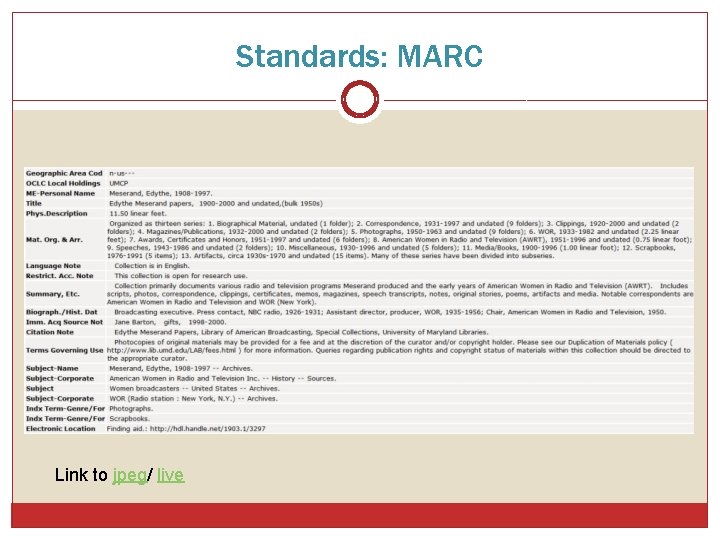
Standards: MARC Link to jpeg/ live
Standards: Data Structure �Encoded Archival Description (EAD) 1 st data structure standard created by the archival community (1997); current version last updated in 2002 XML-based data structure standard for encoding archival finding aids �Benefits of EAD was designed to put archival finding aids online; preserves the hierarchical structure of collections Flexible; as long as a document includes required elements is it valid. This allows institutions to choose appropriate levels of description for their institution Allows standardized search across and within finding aids
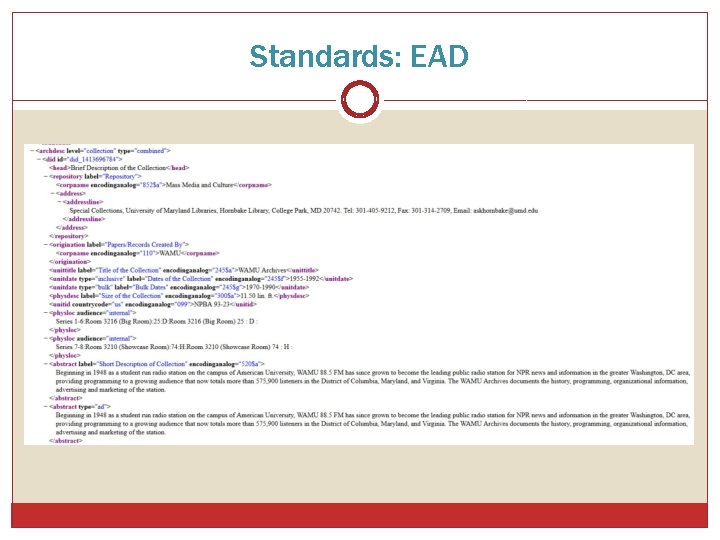
Standards: EAD
Standards: EAD �Drawbacks to EAD: a 2008 survey found that nearly 50% or respondents have not adopted EAD. Barriers to adoption include: Lack of funding/resources Lack of technical skills/support �Tools exist to support this work: Regional consortia that host EAD repositories and can even help with encoding etc. Open sources tools such as Archivist’s Toolkit that export/create EAD Templates/EAD Cookbook (for style sheets)
Standards: Data Content �Describing Archives: A Content Standard (DACS) Adopted in 2004 (revision expected in 2013) Provides detailed instruction on how content should be formulated with specific descriptive elements. (25 elements total) Can be used at any level of description Designed to be compatible with data structure standards such as MARC and EAD
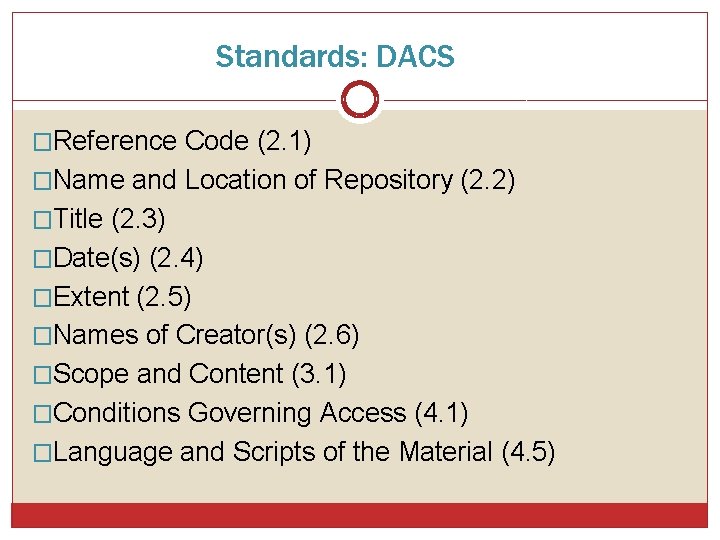
Standards: DACS �Reference Code (2. 1) �Name and Location of Repository (2. 2) �Title (2. 3) �Date(s) (2. 4) �Extent (2. 5) �Names of Creator(s) (2. 6) �Scope and Content (3. 1) �Conditions Governing Access (4. 1) �Language and Scripts of the Material (4. 5)
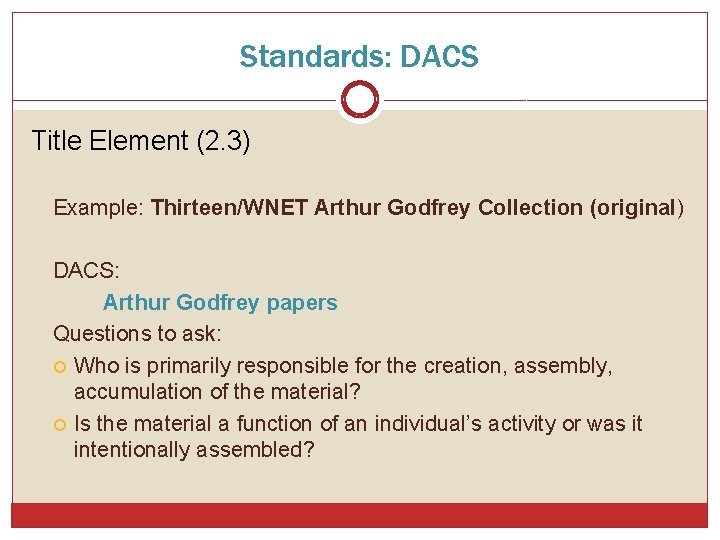
Standards: DACS Title Element (2. 3) Example: Thirteen/WNET Arthur Godfrey Collection (original) DACS: Arthur Godfrey papers Questions to ask: Who is primarily responsible for the creation, assembly, accumulation of the material? Is the material a function of an individual’s activity or was it intentionally assembled?
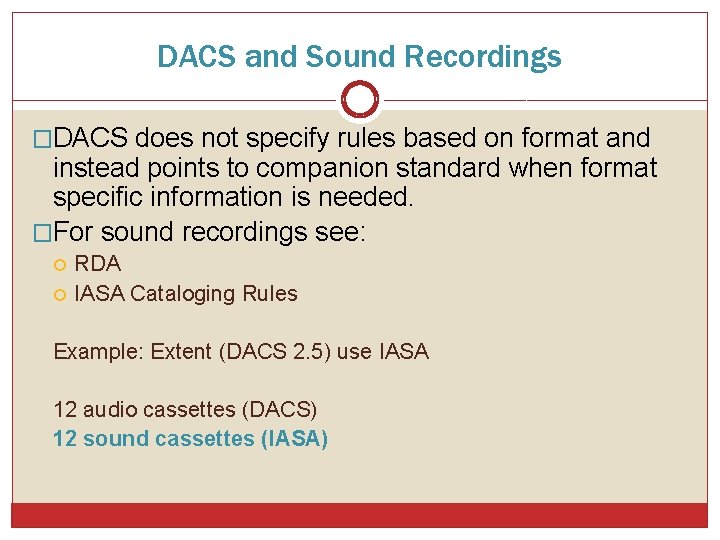
DACS and Sound Recordings �DACS does not specify rules based on format and instead points to companion standard when format specific information is needed. �For sound recordings see: RDA IASA Cataloging Rules Example: Extent (DACS 2. 5) use IASA 12 audio cassettes (DACS) 12 sound cassettes (IASA)
Outline �Introduction �Archival Principles and Practices �Arrangement and Description of Archival Material Exercise: common arrangement schemes �Access and Discovery of Archival Material Standards and Best Practices Discovery Tools and Methods
Discovery & Access or Where Can I Find Archival Material? �Library Catalogs �EAD delivery systems �Databases �Websites �Digital Collections “Use is the end of all archival effort” Theodore Schellenberg
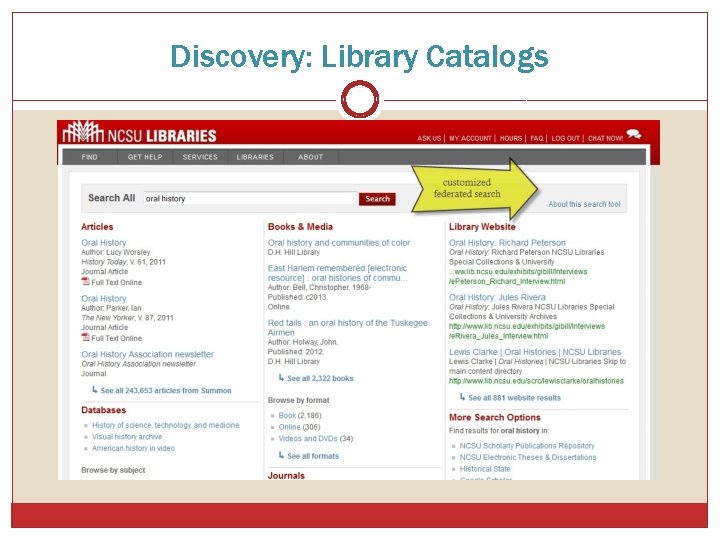
Discovery: Library Catalogs
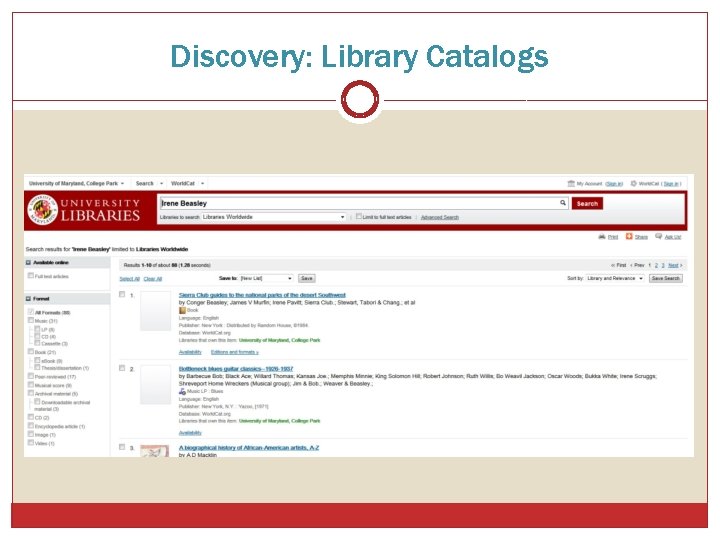
Discovery: Library Catalogs
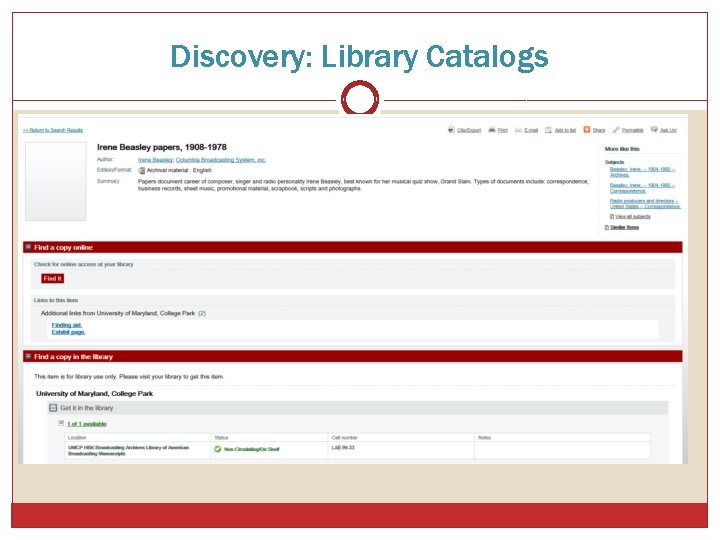
Discovery: Library Catalogs
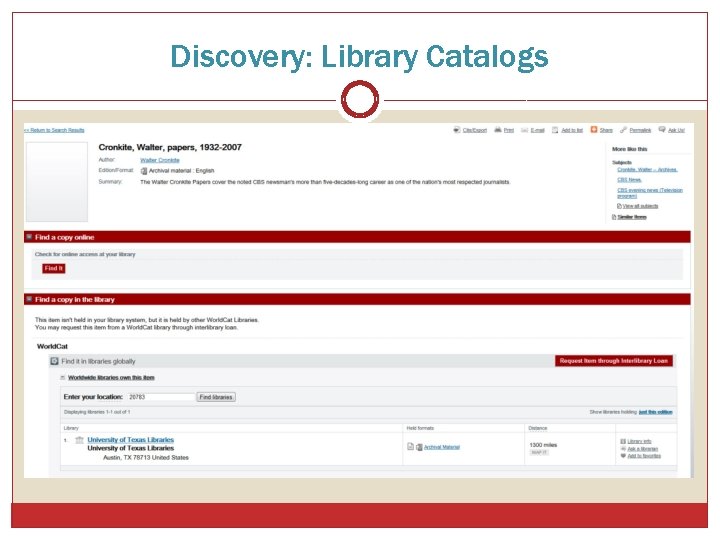
Discovery: Library Catalogs
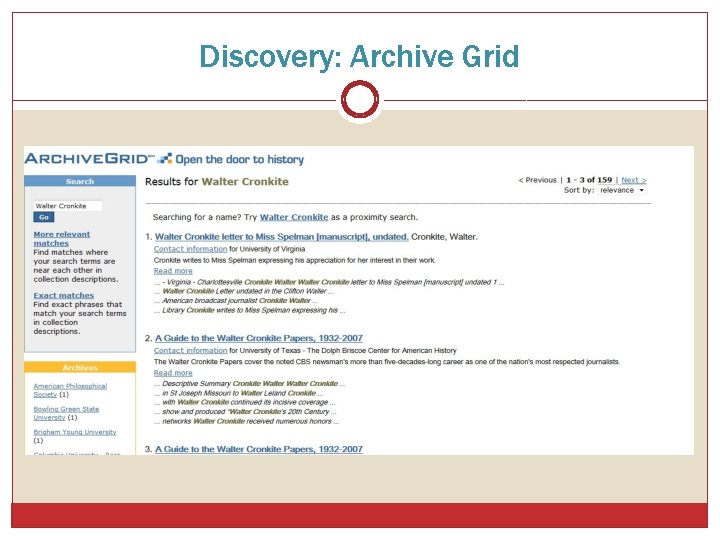
Discovery: Archive Grid
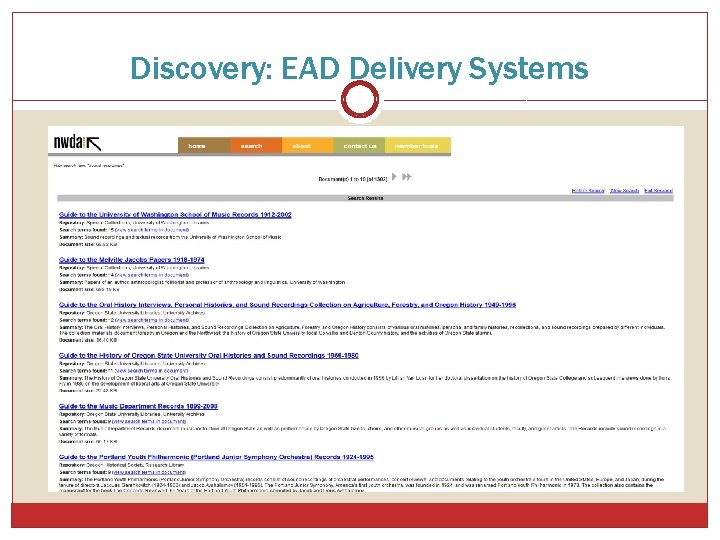
Discovery: EAD Delivery Systems
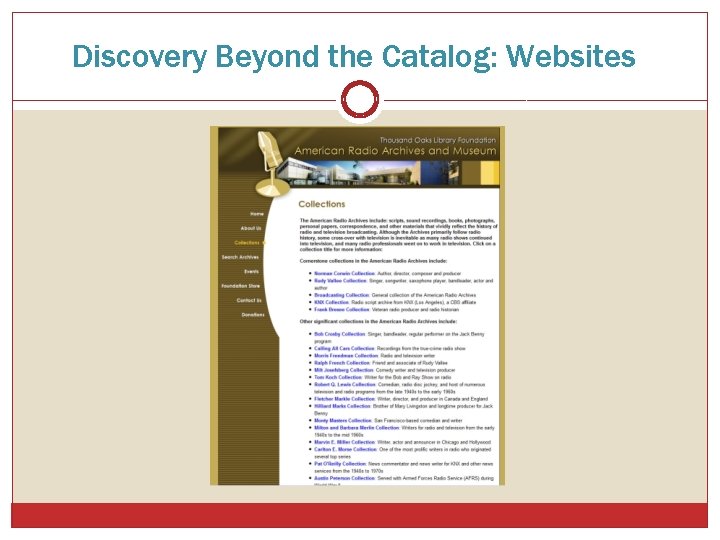
Discovery Beyond the Catalog: Websites
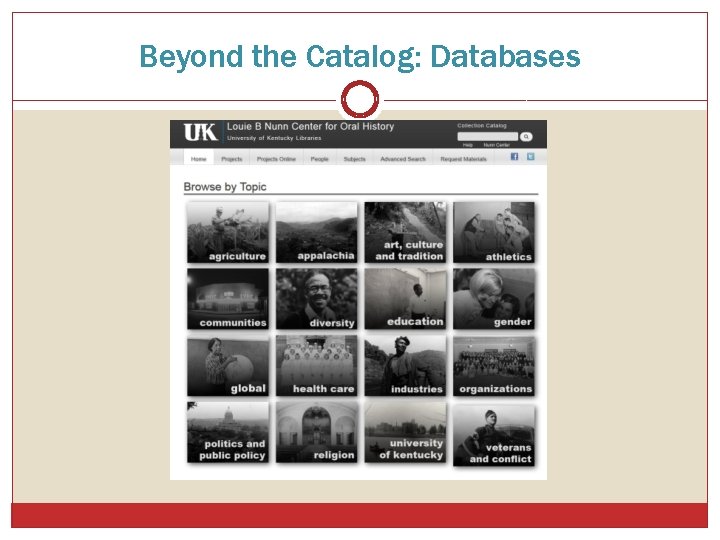
Beyond the Catalog: Databases
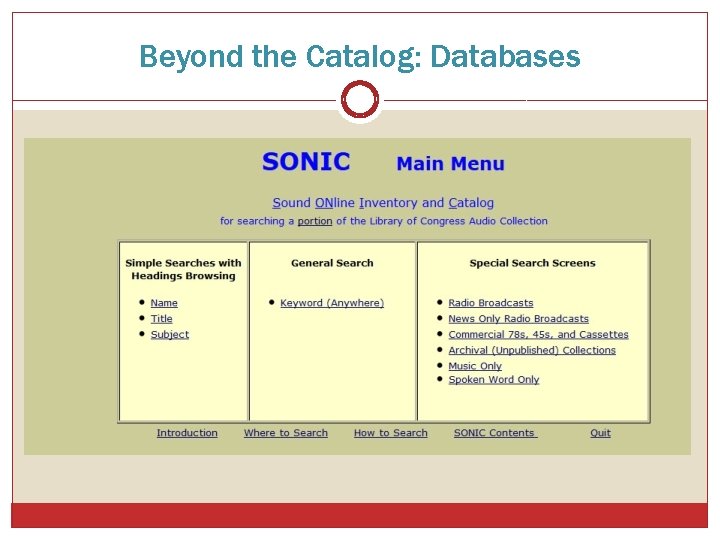
Beyond the Catalog: Databases
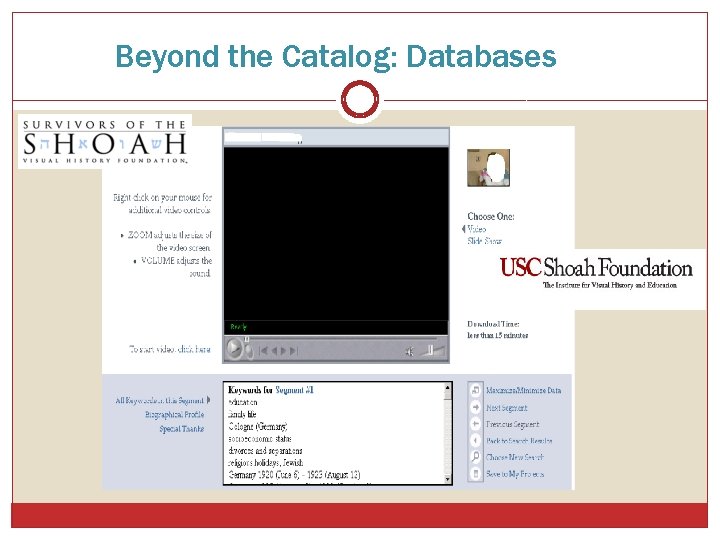
Beyond the Catalog: Databases
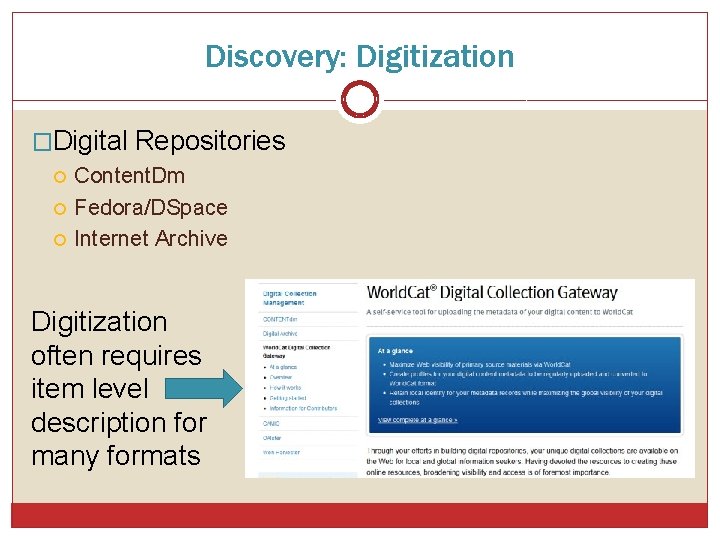
Discovery: Digitization �Digital Repositories Content. Dm Fedora/DSpace Internet Archive Digitization often requires item level description for many formats
Conclusion �Backlogs are with us for the long-term �Determine priorities for processing based on research value and needs of collection �Decide policy on descriptive levels and standards Processing manuals: University of Maryland; Yale University; Wright State University �Develop criteria for when further processing is needed
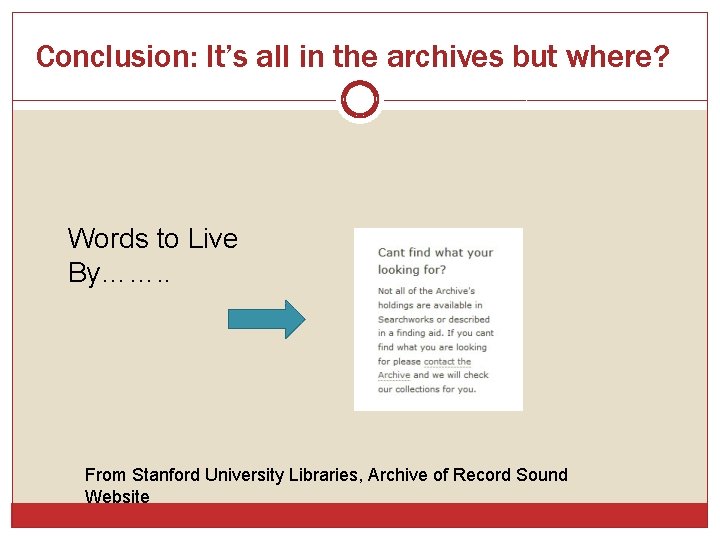
Conclusion: It’s all in the archives but where? Words to Live By……. . From Stanford University Libraries, Archive of Record Sound Website
- Slides: 50