
Its All About the Risk Planning for Trunk
It’s All About the Risk: Planning for Trunk Sewers Using the RAMCAP J 100 Risk Standards David J. Kerr | GHD
Introduction Risk taking is part of everyday life both work and personal: • When we make decisions we consider the possibility of what could happen and the potential consequences • Sometimes we do robust evaluations of both, but • Most of the time we just wing it!
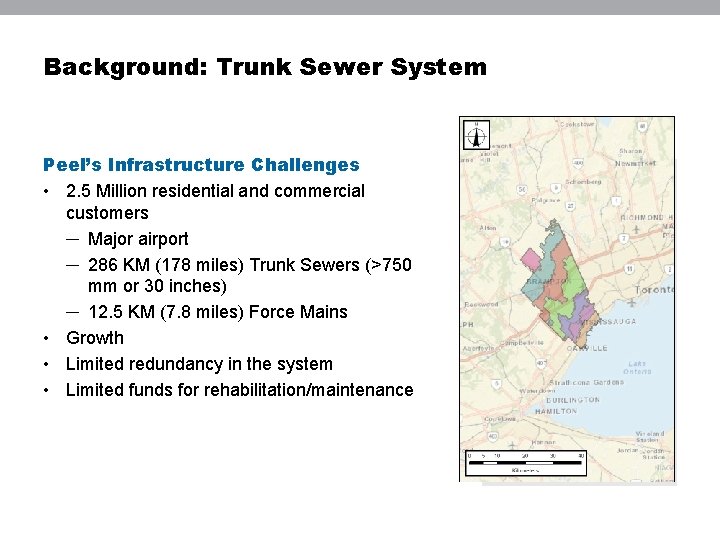
Background: Trunk Sewer System Peel’s Infrastructure Challenges • 2. 5 Million residential and commercial customers ─ Major airport ─ 286 KM (178 miles) Trunk Sewers (>750 mm or 30 inches) ─ 12. 5 KM (7. 8 miles) Force Mains • Growth • Limited redundancy in the system • Limited funds for rehabilitation/maintenance Image placeholder
Corporate Asset Management Planning • Initiative supported by CAO and Regional Council • Conducted a risk assessment of all Regional assets and defined Level of Service to customers • Provide recommendations for funding for asset management at a department level Goal: Improve planning and prioritization of infrastructure across the organization Image placeholder
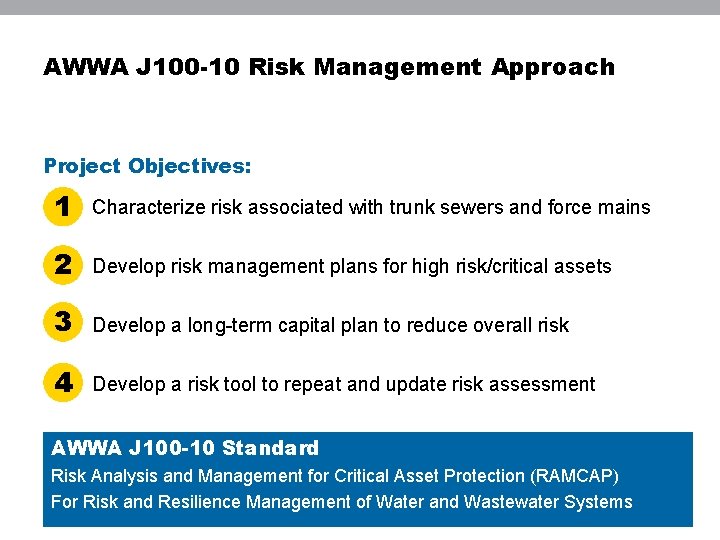
AWWA J 100 -10 Risk Management Approach Project Objectives: 1. 1 Characterize risk associated with trunk sewers and force mains 2. 2 Develop risk management plans for high risk/critical assets 3 3. Develop a long-term capital plan to reduce overall risk 4. 4 Develop a risk tool to repeat and update risk assessment AWWA J 100 -10 Standard Risk Analysis and Management for Critical Asset Protection (RAMCAP) For Risk and Resilience Management of Water and Wastewater Systems
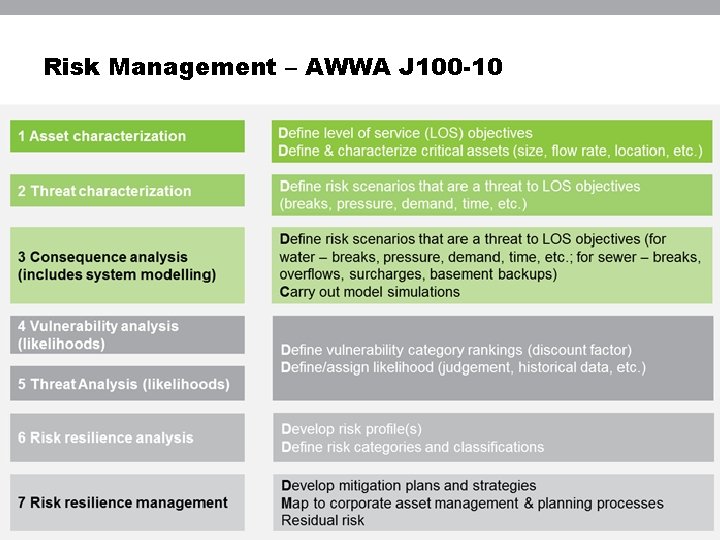
Risk Management – AWWA J 100 -10
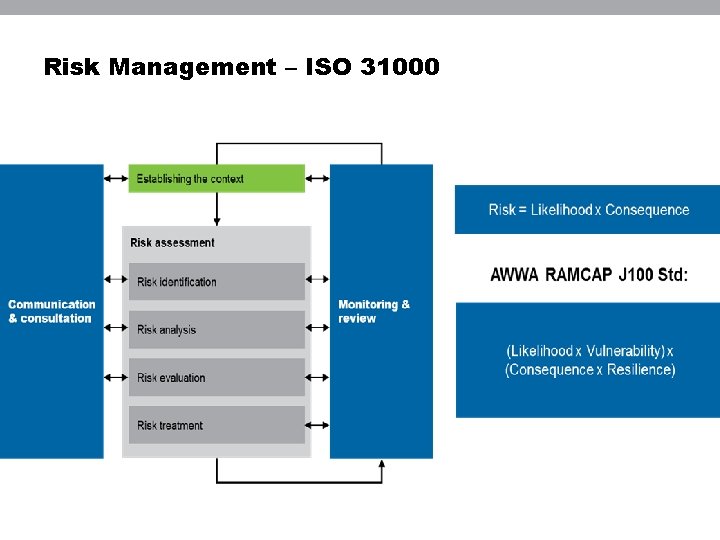
Risk Management – ISO 31000
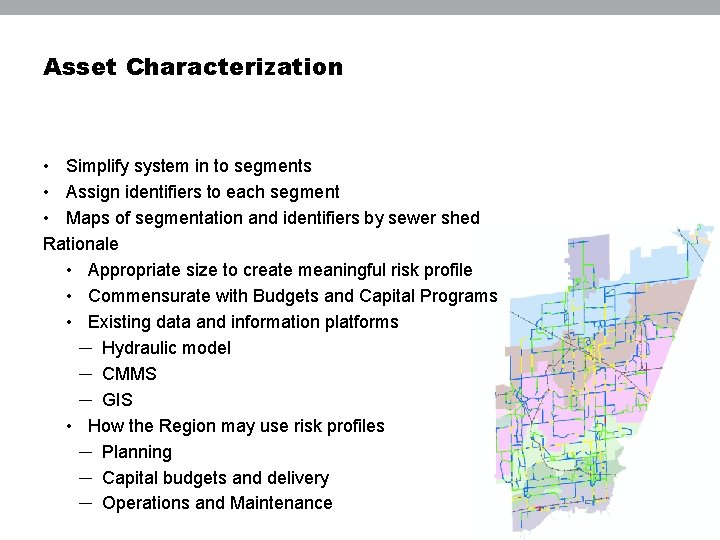
Asset Characterization • Simplify system in to segments • Assign identifiers to each segment • Maps of segmentation and identifiers by sewer shed Rationale • Appropriate size to create meaningful risk profile • Commensurate with Budgets and Capital Programs • Existing data and information platforms ─ Hydraulic model ─ CMMS ─ GIS • How the Region may use risk profiles ─ Planning ─ Capital budgets and delivery ─ Operations and Maintenance
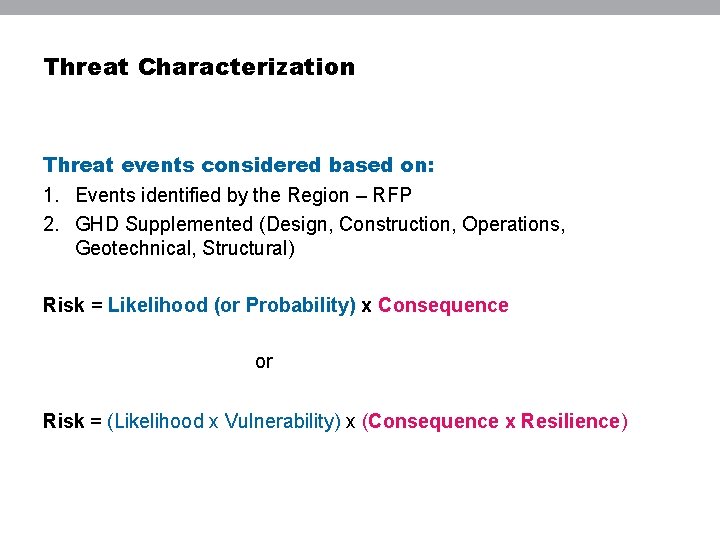
Threat Characterization Threat events considered based on: 1. Events identified by the Region – RFP 2. GHD Supplemented (Design, Construction, Operations, Geotechnical, Structural) Risk = Likelihood (or Probability) x Consequence or Risk = (Likelihood x Vulnerability) x (Consequence x Resilience)
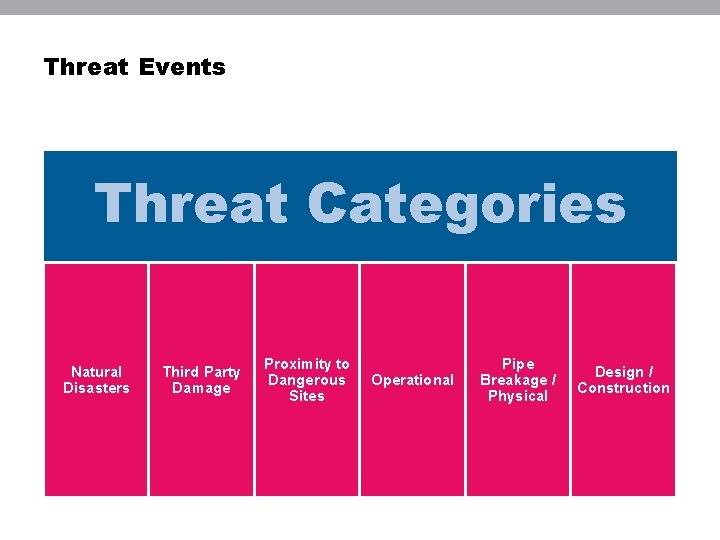
Threat Events Threat Categories Natural Disasters Third Party Damage Proximity to Dangerous Sites Operational Pipe Breakage / Physical Design / Construction
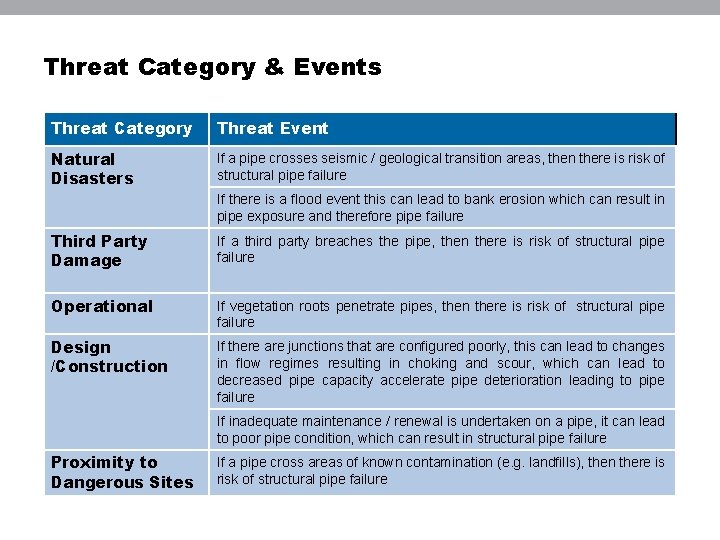
Threat Category & Events Threat Category Threat Event Natural Disasters If a pipe crosses seismic / geological transition areas, then there is risk of structural pipe failure If there is a flood event this can lead to bank erosion which can result in pipe exposure and therefore pipe failure Third Party Damage If a third party breaches the pipe, then there is risk of structural pipe failure Operational If vegetation roots penetrate pipes, then there is risk of structural pipe failure Design /Construction If there are junctions that are configured poorly, this can lead to changes in flow regimes resulting in choking and scour, which can lead to decreased pipe capacity accelerate pipe deterioration leading to pipe failure If inadequate maintenance / renewal is undertaken on a pipe, it can lead to poor pipe condition, which can result in structural pipe failure Proximity to Dangerous Sites If a pipe cross areas of known contamination (e. g. landfills), then there is risk of structural pipe failure
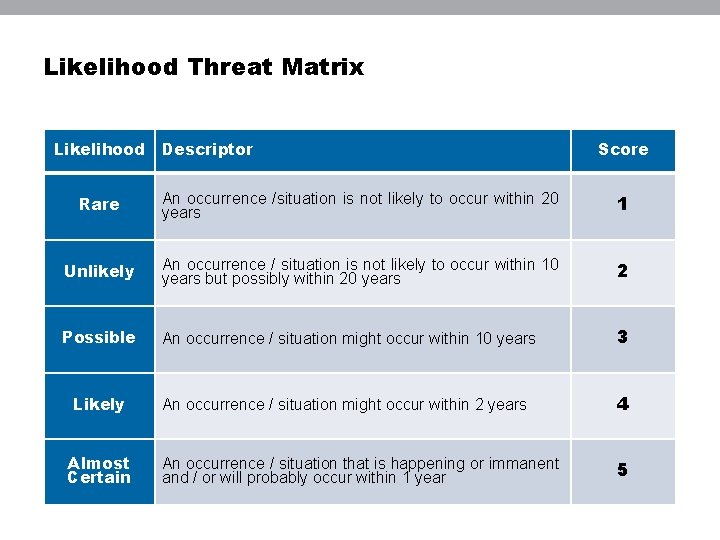
Likelihood Threat Matrix Likelihood Descriptor Score Rare An occurrence /situation is not likely to occur within 20 years 1 Unlikely An occurrence / situation is not likely to occur within 10 years but possibly within 20 years 2 Possible An occurrence / situation might occur within 10 years 3 Likely An occurrence / situation might occur within 2 years 4 An occurrence / situation that is happening or immanent and / or will probably occur within 1 year 5 Almost Certain
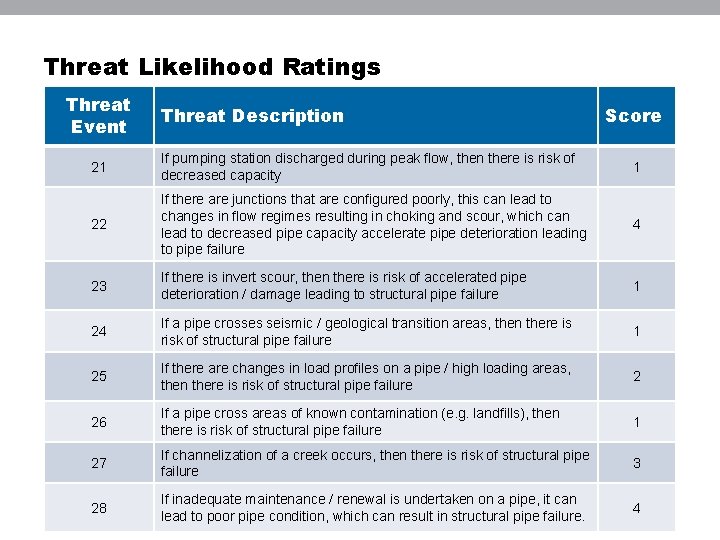
Threat Likelihood Ratings Threat Event Threat Description Score 21 If pumping station discharged during peak flow, then there is risk of decreased capacity 1 22 If there are junctions that are configured poorly, this can lead to changes in flow regimes resulting in choking and scour, which can lead to decreased pipe capacity accelerate pipe deterioration leading to pipe failure 4 23 If there is invert scour, then there is risk of accelerated pipe deterioration / damage leading to structural pipe failure 1 24 If a pipe crosses seismic / geological transition areas, then there is risk of structural pipe failure 1 25 If there are changes in load profiles on a pipe / high loading areas, then there is risk of structural pipe failure 2 26 If a pipe cross areas of known contamination (e. g. landfills), then there is risk of structural pipe failure 1 27 If channelization of a creek occurs, then there is risk of structural pipe failure 3 28 If inadequate maintenance / renewal is undertaken on a pipe, it can lead to poor pipe condition, which can result in structural pipe failure. 4
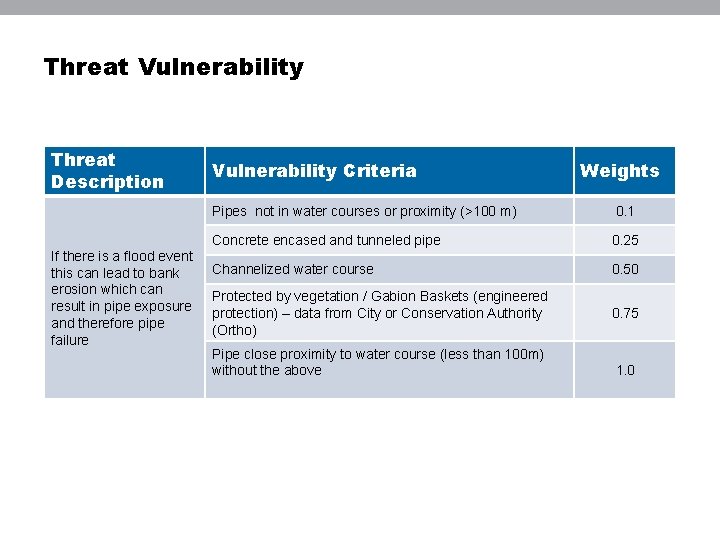
Threat Vulnerability Threat Description If there is a flood event this can lead to bank erosion which can result in pipe exposure and therefore pipe failure Vulnerability Criteria Weights Pipes not in water courses or proximity (>100 m) 0. 1 Concrete encased and tunneled pipe 0. 25 Channelized water course 0. 50 Protected by vegetation / Gabion Baskets (engineered protection) – data from City or Conservation Authority (Ortho) 0. 75 Pipe close proximity to water course (less than 100 m) without the above 1. 0
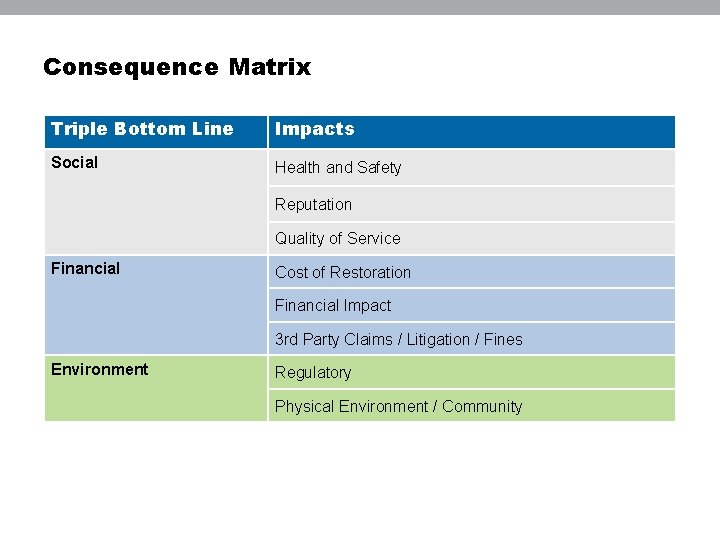
Consequence Matrix Triple Bottom Line Impacts Social Health and Safety Reputation Quality of Service Financial Cost of Restoration Financial Impact 3 rd Party Claims / Litigation / Fines Environment Regulatory Physical Environment / Community
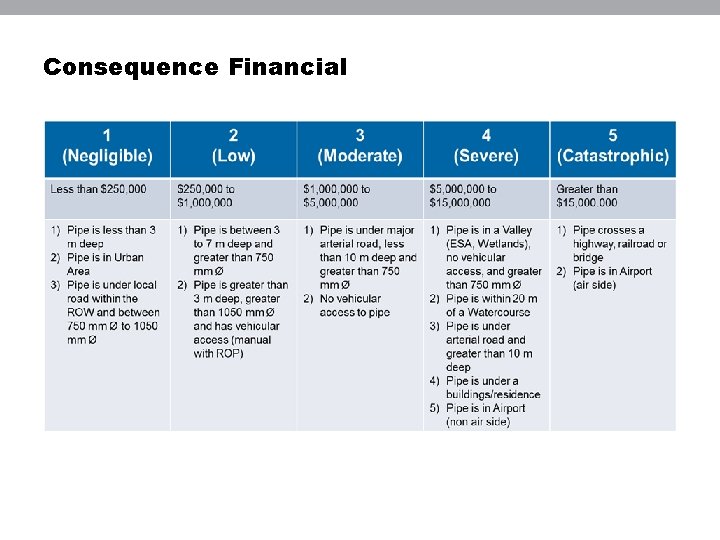
Consequence Financial
Modeling Methodology Info. Works • Utilized model previously developed • Simulated 25 year return storm • Current System • Used model output to asess probability of failure d/D Velocity Flow Rate Froude Number Capacity Number of customers upstream
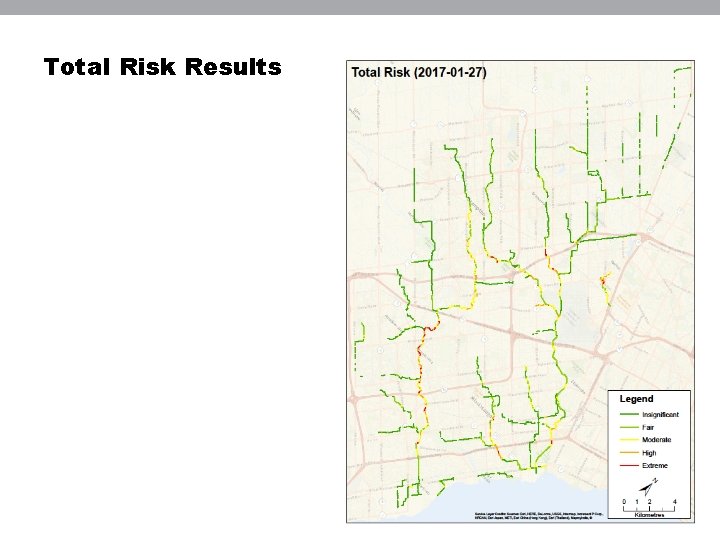
Total Risk Results
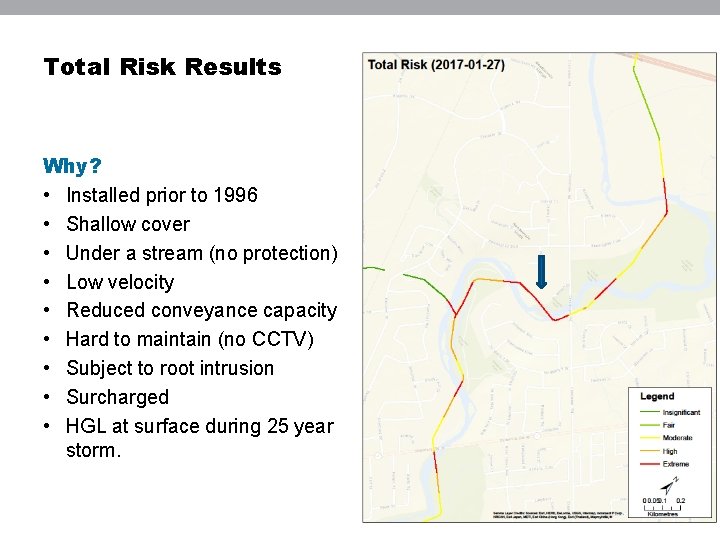
Total Risk Results Why? • Installed prior to 1996 • Shallow cover • Under a stream (no protection) • Low velocity • Reduced conveyance capacity • Hard to maintain (no CCTV) • Subject to root intrusion • Surcharged • HGL at surface during 25 year storm.
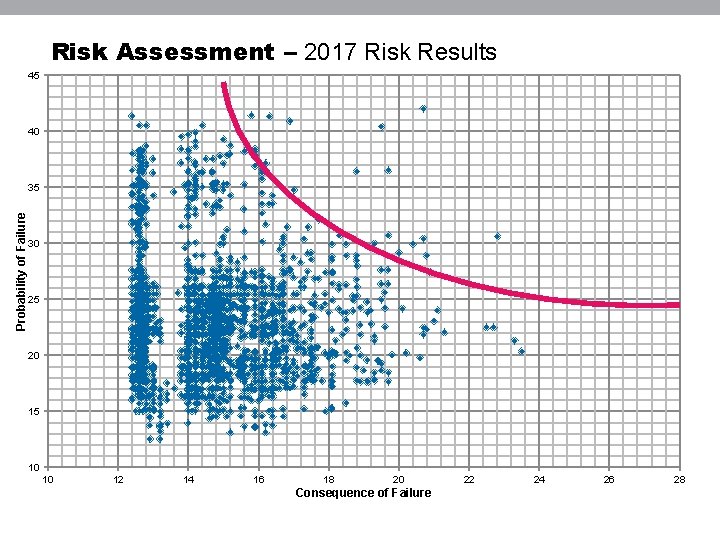
Risk Assessment – 2017 Risk Results 45 40 Probability of Failure 35 30 25 20 15 10 10 12 14 16 18 20 Consequence of Failure 22 24 26 28
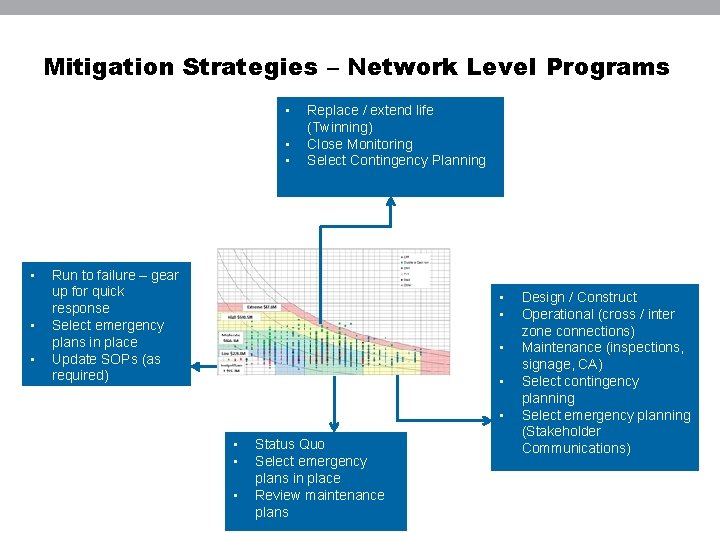
Mitigation Strategies – Network Level Programs • • • Replace / extend life (Twinning) Close Monitoring Select Contingency Planning Run to failure – gear up for quick response Select emergency plans in place Update SOPs (as required) • • Status Quo Select emergency plans in place Review maintenance plans Design / Construct Operational (cross / inter zone connections) Maintenance (inspections, signage, CA) Select contingency planning Select emergency planning (Stakeholder Communications)
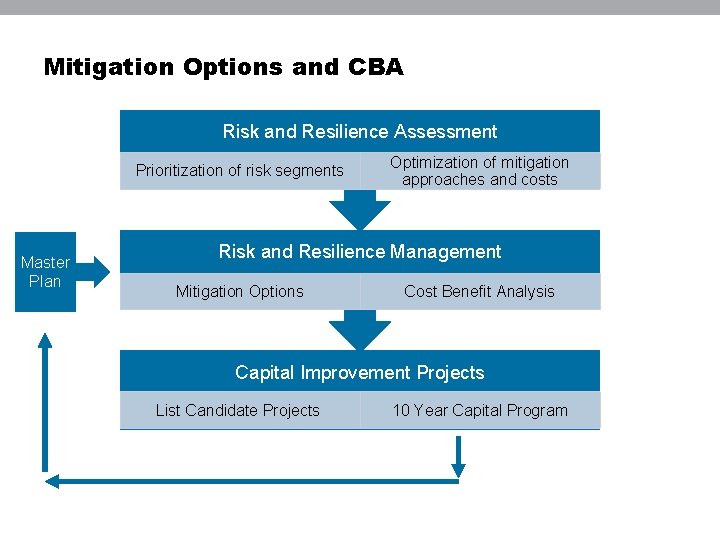
Mitigation Options and CBA Risk and Resilience Assessment Prioritization of risk segments Master Plan Optimization of mitigation approaches and costs Risk and Resilience Management Mitigation Options Cost Benefit Analysis Capital Improvement Projects List Candidate Projects 10 Year Capital Program
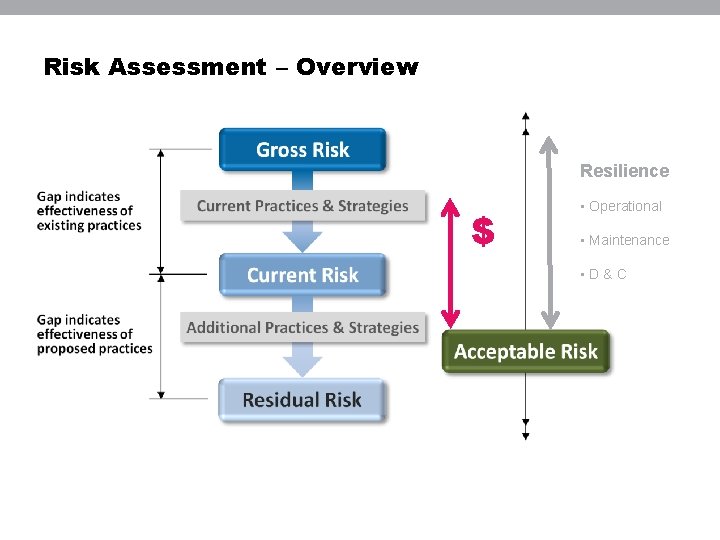
Risk Assessment – Overview Resilience $ • Operational • Maintenance • D&C
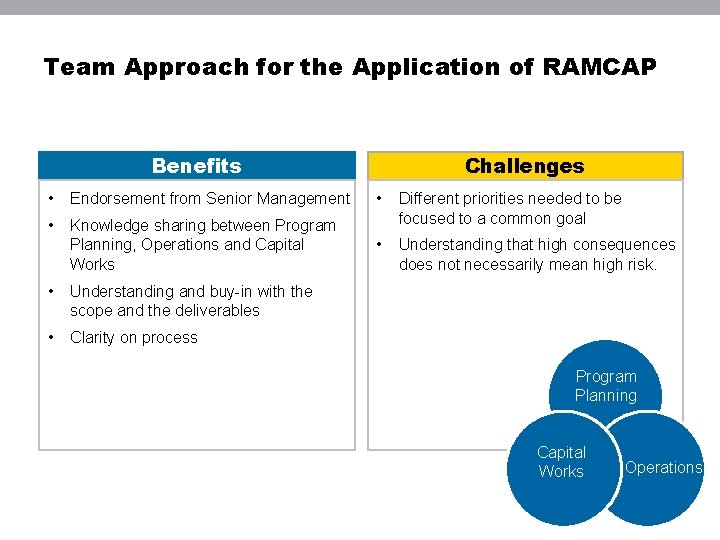
Team Approach for the Application of RAMCAP Benefits Challenges • Endorsement from Senior Management • • Knowledge sharing between Program Planning, Operations and Capital Works Different priorities needed to be focused to a common goal • Understanding that high consequences does not necessarily mean high risk. • Understanding and buy-in with the scope and the deliverables • Clarity on process Program Planning Capital Works Operations
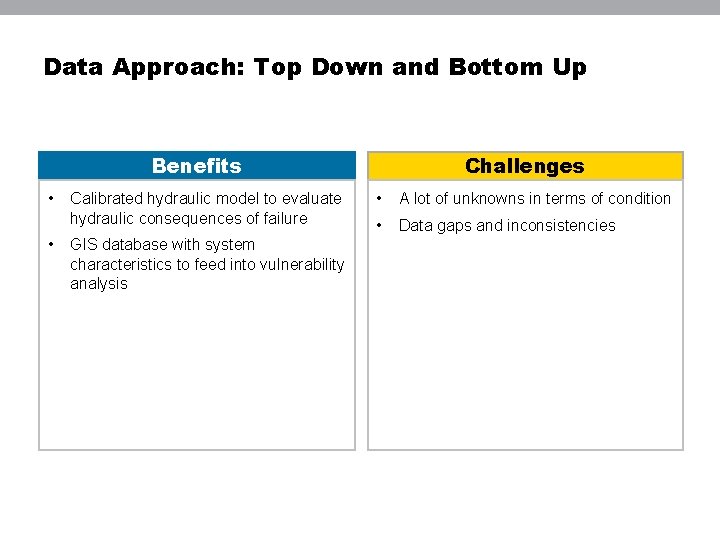
Data Approach: Top Down and Bottom Up Benefits • • Calibrated hydraulic model to evaluate hydraulic consequences of failure GIS database with system characteristics to feed into vulnerability analysis Challenges • A lot of unknowns in terms of condition • Data gaps and inconsistencies
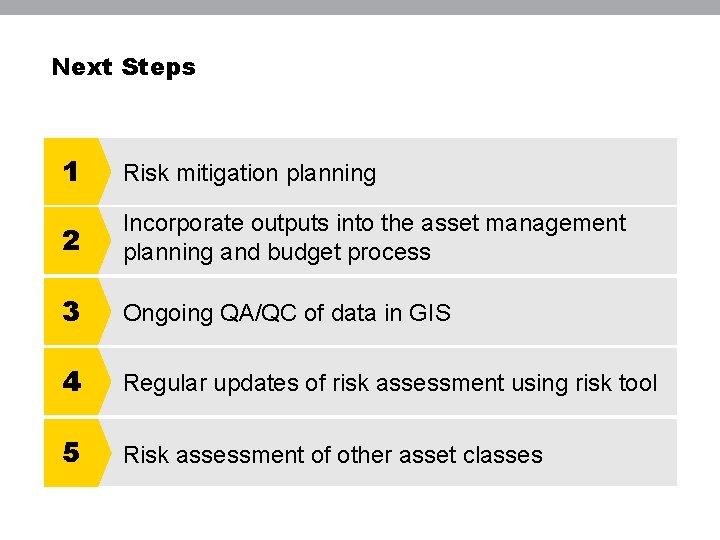
Next Steps 1 Risk mitigation planning 2 Incorporate outputs into the asset management planning and budget process 3 Ongoing QA/QC of data in GIS 4 Regular updates of risk assessment using risk tool 5 Risk assessment of other asset classes
Take-Aways • Analysis is scalable to small and large utilities • Can be done incrementally over time Risk without modeling Hydraulic modeling With & without GIS • Key step towards a full asset management plan • Defendable and repeatable • Emphasizes the need for good data • Can help unify different groups within your organization

Q&A David J. Kerr | david. kerr@ghd. com
- Slides: 28