
Its all about the Learning St Josephs College
It’s all about the Learning St Joseph’s College, Lucan.
Context Background Before AFL • Dublin school • All-girls’ Catholic Secondary School • 900 students • 66 Staff • Mix academic, cultural & socio-economic backgrounds • 39 nationalities • 2012 school at a crossroads in planning • Evaluated life in the school through questionnaire • All unhappy with student learning and their lack of responsibility to it • Teachers felt they were doing all the work
LEARNING • What do I want the students to learn? • How am I going to get them to learn? • How can I get them to improve their learning? • How am I going to assess their learning?
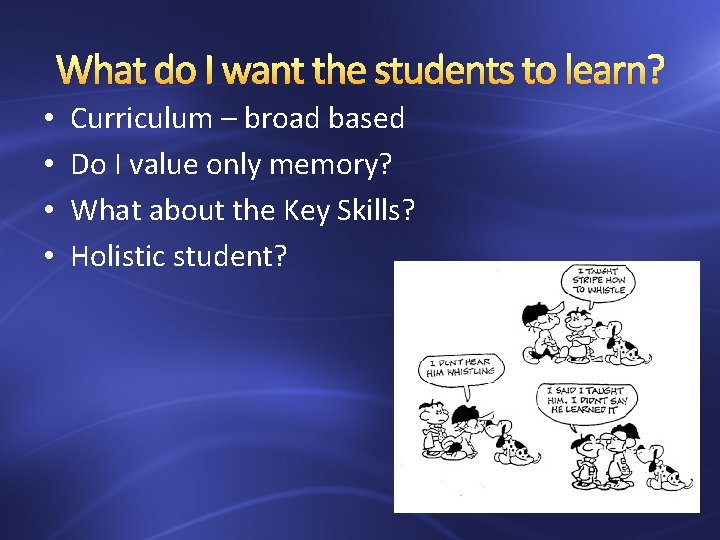
What do I want the students to learn? • • Curriculum – broad based Do I value only memory? What about the Key Skills? Holistic student?
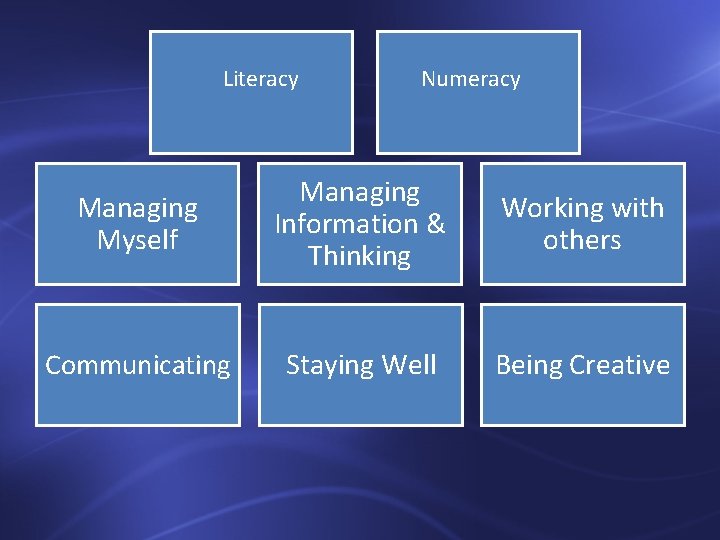
Literacy Numeracy Managing Myself Managing Information & Thinking Working with others Communicating Staying Well Being Creative
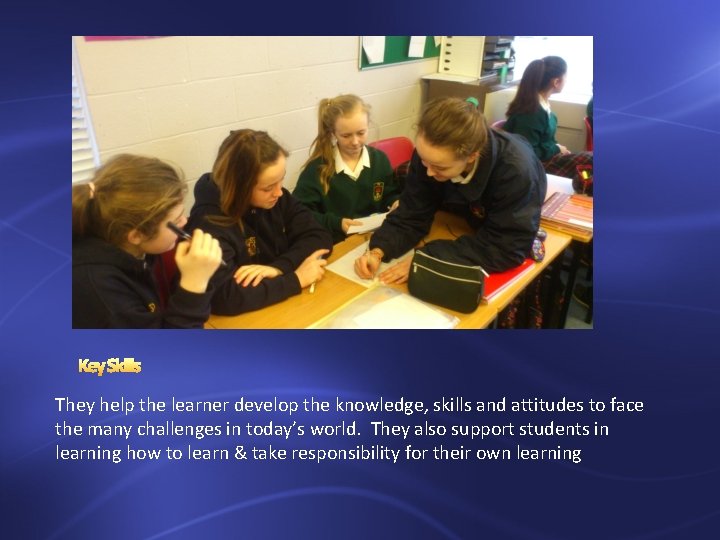
Key Skills They help the learner develop the knowledge, skills and attitudes to face the many challenges in today’s world. They also support students in learning how to learn & take responsibility for their own learning
What do you want YOUR students to learn?

HOW AM I GOING TO GET THEM TO LEARN?
for Learning (Af. L) Assessment for Enables teachers and students to focus on three key questions - 1. Where are students now in their learning? 2. Where are students going in their learning? 3. How will students get to the next point in their learning? NCCA Assessment Guidelines p 9.
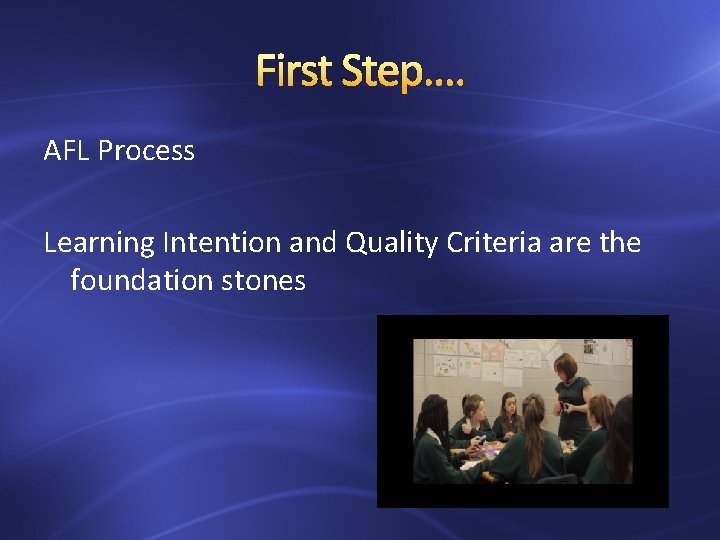
First Step. . AFL Process Learning Intention and Quality Criteria are the foundation stones
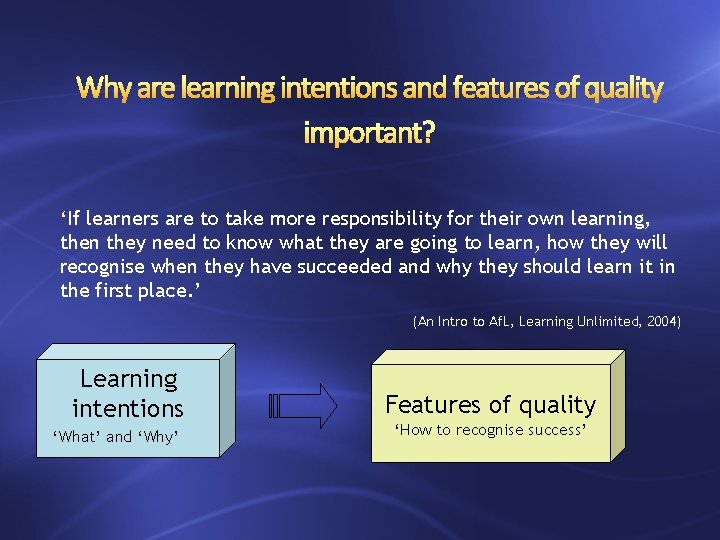
Why are learning intentions and features of quality important? ‘If learners are to take more responsibility for their own learning, then they need to know what they are going to learn, how they will recognise when they have succeeded and why they should learn it in the first place. ’ (An Intro to Af. L, Learning Unlimited, 2004) Learning intentions ‘What’ and ‘Why’ Features of quality ‘How to recognise success’
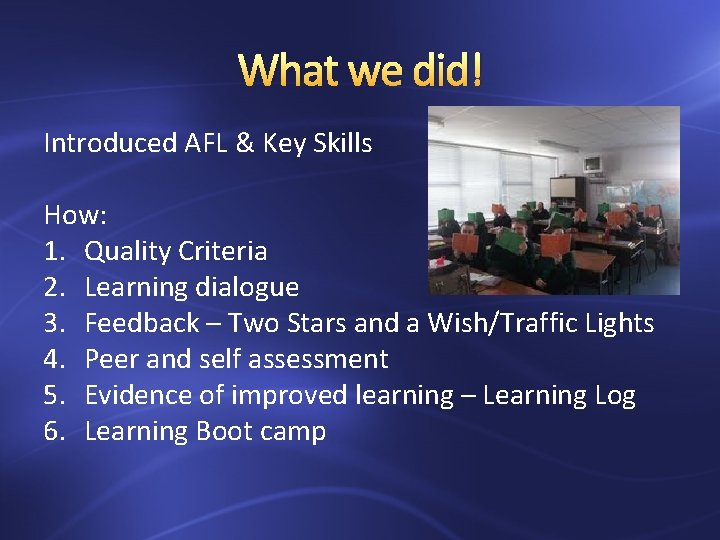
What we did! Introduced AFL & Key Skills How: 1. Quality Criteria 2. Learning dialogue 3. Feedback – Two Stars and a Wish/Traffic Lights 4. Peer and self assessment 5. Evidence of improved learning – Learning Log 6. Learning Boot camp
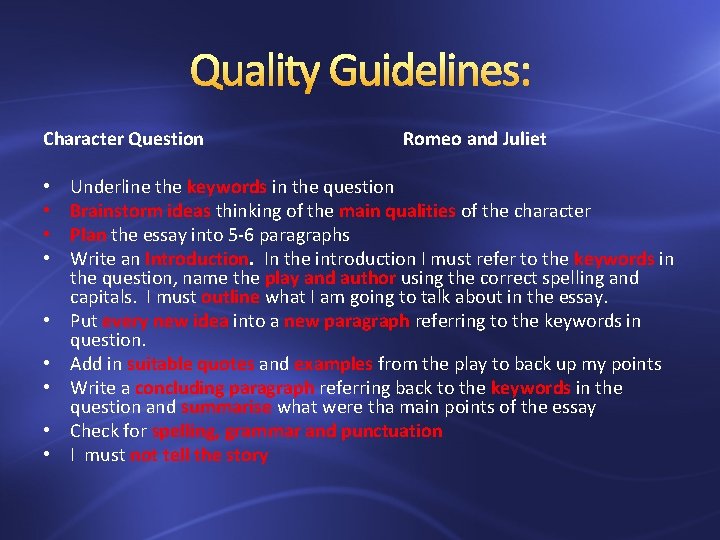
Quality Guidelines: Character Question • • • Romeo and Juliet Underline the keywords in the question Brainstorm ideas thinking of the main qualities of the character Plan the essay into 5 -6 paragraphs Write an Introduction. In the introduction I must refer to the keywords in the question, name the play and author using the correct spelling and capitals. I must outline what I am going to talk about in the essay. Put every new idea into a new paragraph referring to the keywords in question. Add in suitable quotes and examples from the play to back up my points Write a concluding paragraph referring back to the keywords in the question and summarise what were tha main points of the essay Check for spelling, grammar and punctuation I must not tell the story
• Quality Criteria act as scaffolding for learning & Key Skills
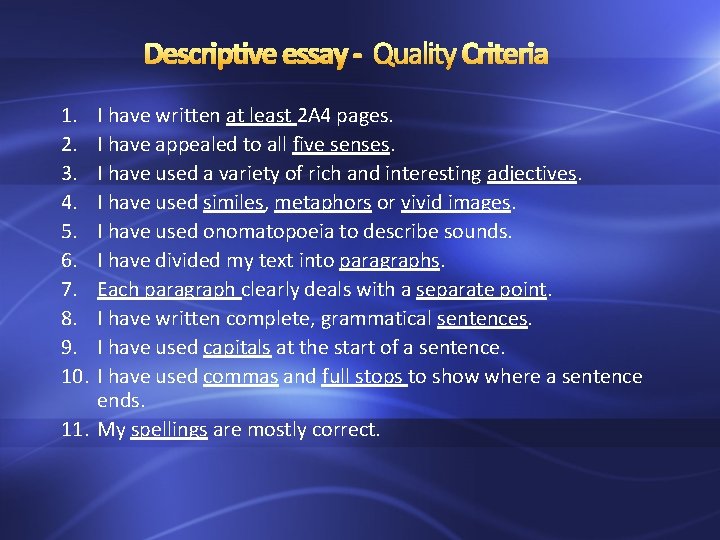
Descriptive essay - Quality Criteria 1. 2. 3. 4. 5. 6. 7. 8. 9. 10. I have written at least 2 A 4 pages. I have appealed to all five senses. I have used a variety of rich and interesting adjectives. I have used similes, metaphors or vivid images. I have used onomatopoeia to describe sounds. I have divided my text into paragraphs. Each paragraph clearly deals with a separate point. I have written complete, grammatical sentences. I have used capitals at the start of a sentence. I have used commas and full stops to show where a sentence ends. 11. My spellings are mostly correct.
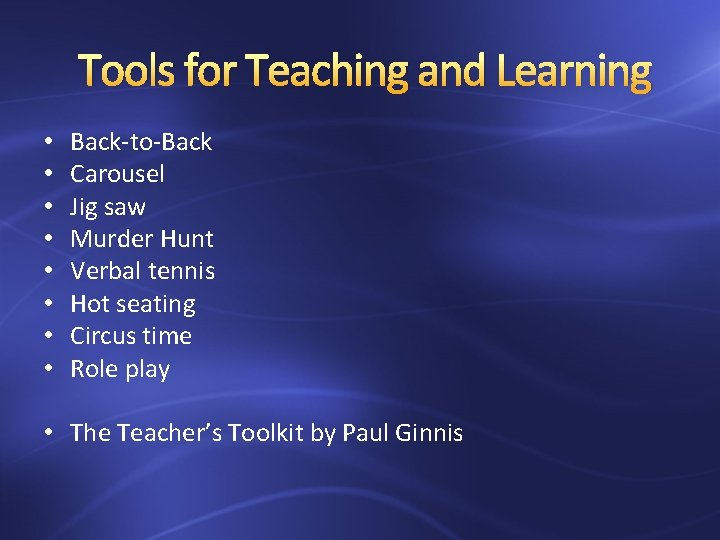
Tools for Teaching and Learning • • Back-to-Back Carousel Jig saw Murder Hunt Verbal tennis Hot seating Circus time Role play • The Teacher’s Toolkit by Paul Ginnis
• All these methodologies lead to learning dialogue between the students and the teacher • The teacher adapts her lesson to meet the learning concerns – Traffic Lights • Building a growth mindset • Changes the pupil-teacher relationship
How am I going to improve learning? Feedback The main goal of feedback is to reduce the gap between the current understanding and performance and a goal. (Hattie) The only good feedback is feedback that is acted upon. The relationship between the student and teacher is paramount.
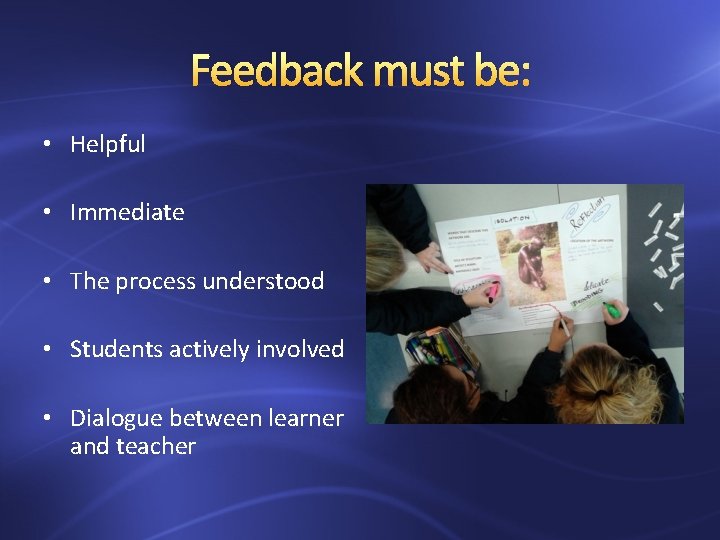
Feedback must be: • Helpful • Immediate • The process understood • Students actively involved • Dialogue between learner and teacher
3 Questions: 1. Feed Up – Where am I going? What are the goals? 2. Feedback – How am I going? What progress is being made towards the goals? 3. Feed Forward – Where to next? What activities need to be undertaken to make better progress?
Best Practice: • • Break assignment into stages Provisional grade – oral dialogue Withhold the grade – comment only Peer assessment Self assessment Group work on feedback comments Oral Feedback Staggering feedback • Two Stars and a Wish - Handout
What we concentrated on: • Teacher corrects using “Two stars and a Wish”. • Peer and Self Assessment • Offers exemplars of work • Comment only marking for First Years • Conversational marking • No personal comments – we kept to the task
Feed back / Feed forward • • • Show Me Boards – teacher can assess whole class Wait time No hands up Bouncing Drafting and redrafting Hard on content, soft on people • Growth Mind set & Key Skills
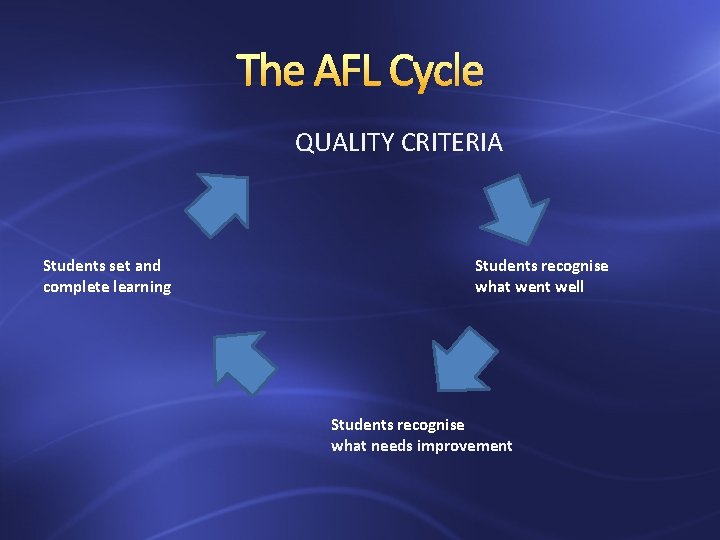
The AFL Cycle QUALITY CRITERIA Students set and complete learning Students recognise what went well Students recognise what needs improvement
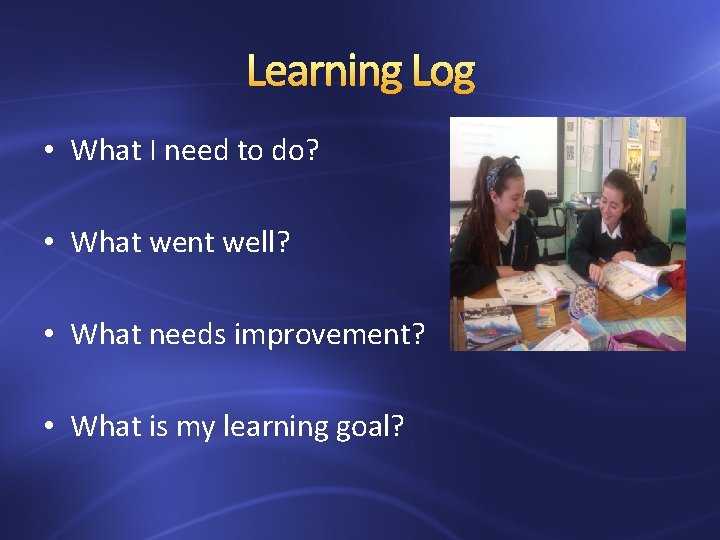
Learning Log • What I need to do? • What went well? • What needs improvement? • What is my learning goal?
Joey’s Boot Camp Time to get tough with our 6 steps to achieving your goals!
‘Learning How to do a proper ‘Learning Workout’ in school and at home • A proper learning ‘workout’ helps you achieve your specific learning goals • With a well-thought-out plan it’s easy to create effective learning
Step 1. Preparation • Have you got the right ‘gear’ for class? • The right ‘gear’ consists of all the books, copies, etc. you will need for each class • So be prepared, you cannot do a proper learning ‘workout’ without the right gear!

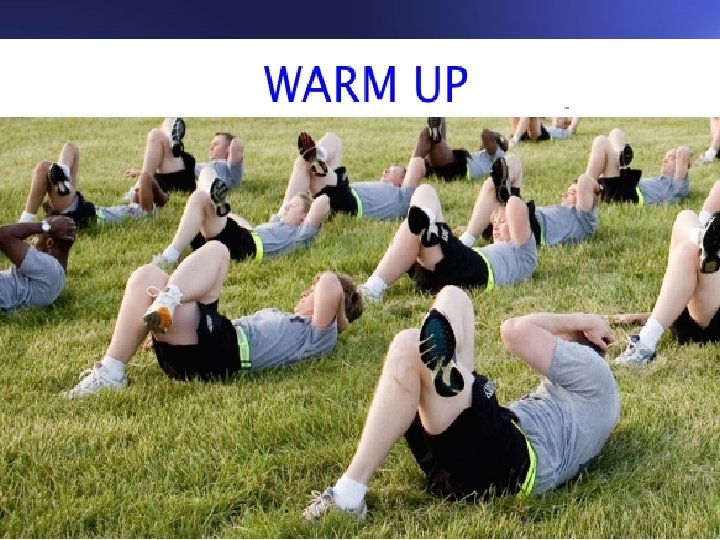
Step 2. Warm up • Are you ready to learn? • A good warm up routine helps you to concentrate on the learning to come • Warm up routines vary in each class but generally involve roll call, getting books out, correcting homework, recalling the work of a previous class
Step 3. Core Learning Exercises • Focus and Listen to your instructor (teacher) • Do you know what you are about to learn in this lesson? – Learning Intention • Do you know what you are to do during the lesson? – Success Criteria

Step 4. High-Intensity Learning Exercises • Are you actively engaging in and learning from the lesson? • Are you adding to the lesson by sharing prior knowledge or asking pertinent questions? • Are you fully partaking in class discussion and activities?

Step 5. Hydration • Revision refreshes & hydrates your mind • Did you take notes during and after the lesson? • Did you go over and learn those notes? • Did you do your homework to practice what you learned?
HYDRATION = REFRESH
Step 6. Cool Down Routine How have you done so far? – Self Evaluation What are your learning strengths? Are you achieving your learning targets? What areas of your learning do you need to improve to reach your learning targets? • Deskercise (revision) every weekend is the perfect cool down routine! • •
Have you got YOUR learning plan activated? Get down, Get dirty, Get involved.
HOW AM I GOING TO ASSESS THE LEARNING?
Assessment Of Learning Do our assessment practices give students enough feedback and targets for improvement? Do they encourage continuous hard work and responsibility from the student? Are they consistent across all subjects?
Change • Christmas Exams Term Exams in November • Class tests Ongoing Assessment 20% Juniors/30% Seniors • Revision list of chapters covered • Report with comment Task criteria given Report with Learning advice and literacy

New Report Card • See handout in file
Possible changes this year 100% for on-going assessment Use of Distinction, Merit, Pass, Not Working. . . 100% for Term Exams Students not taking assignments seriously unless they were on-going assessment grades • Fear of inflating the marks when combined at Senior level • Gives greater flexibility to teacher • Each Subject department decides common assessment. • •
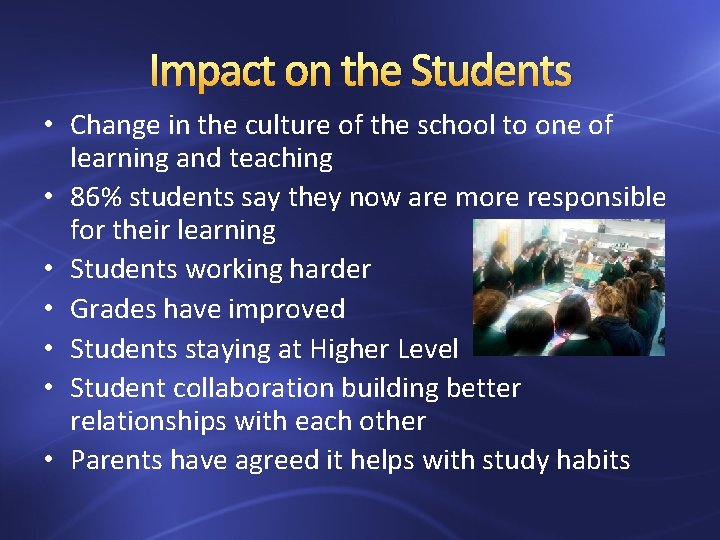
Impact on the Students • Change in the culture of the school to one of learning and teaching • 86% students say they now are more responsible for their learning • Students working harder • Grades have improved • Students staying at Higher Level • Student collaboration building better relationships with each other • Parents have agreed it helps with study habits
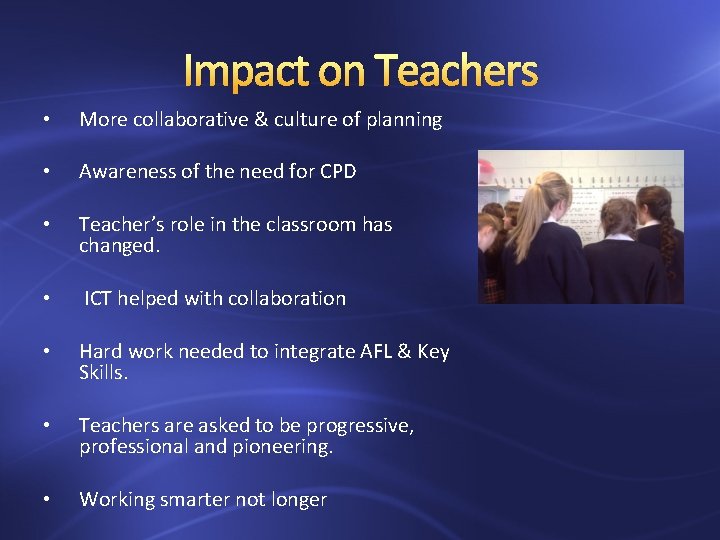
Impact on Teachers • More collaborative & culture of planning • Awareness of the need for CPD • Teacher’s role in the classroom has changed. • ICT helped with collaboration • Hard work needed to integrate AFL & Key Skills. • Teachers are asked to be progressive, professional and pioneering. • Working smarter not longer
Impact -Negatives • Stress levels were initially very high for students and teachers • Quality criteria and class planning takes a lot of time • Teachers unsure of how to give effective feedback • Assessment is complex
Trying to deal with the work: • • Learning Pauses ICT – sharing and collaboration Croke Park hours are very subject based Lots of CPD from outside and inside. Staff doing CPD on-line Health flag – staff well being MLL gave us all a positive lift SSE helps us to see if there is progress Evaluating and tweaking
SSE How do we know we have improved learning? Tracking literacy and numeracy Showed above the national average Questionnaires and Focus group interviews Noted students who needed assessments and extra help with learning • Found lack of consistency in correcting exam papers and need for moderation • •
Student of the Future • • • Knows their learning strengths Believes in a growth mind set Values collaboration and working with others ICT competent Stays confident and well Peer and self evaluation is a natural process Communicates with ease and confidence Finds meaning and purpose in life Skilled at thinking for themselves in a creative way
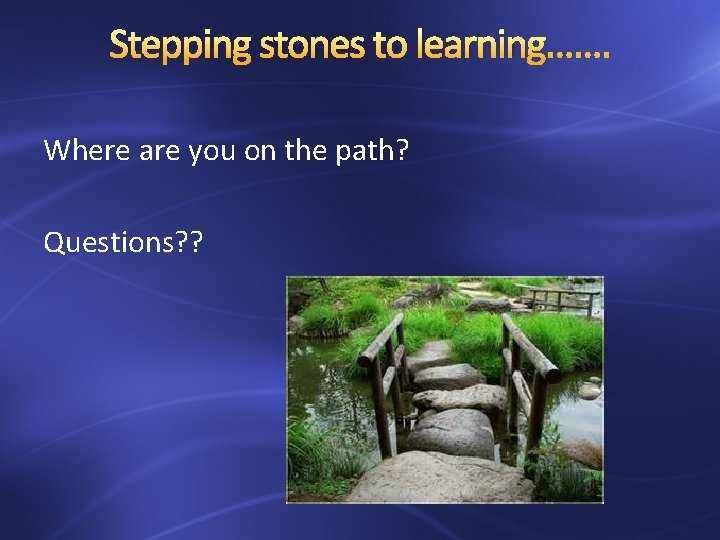
Stepping stones to learning. . . . Where are you on the path? Questions? ?
- Slides: 53