
ITK330 Chemical Reaction Engineering Introduction Dicky Dermawan www
- Slides: 28
ITK-330 Chemical Reaction Engineering Introduction Dicky Dermawan www. dickydermawan. net 78. net dickydermawan@gmail. com
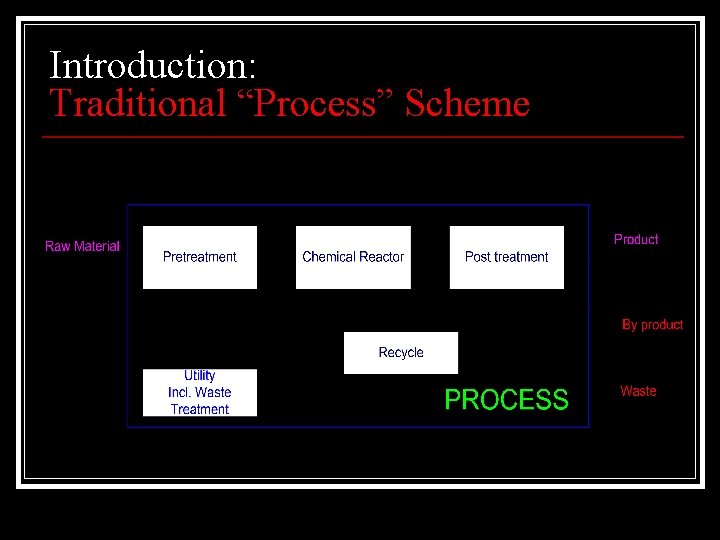
Introduction: Traditional “Process” Scheme
References Fogler HS, Elements of Chemical Reaction Engineering, 4 th ed. , Prentice (1999) Levenspiel O, Chemical Reaction Engineering, 2 nd ed. , Wiley (1972)
Material Covered by ITK-330 n Fundamental understanding: n n n Mole Balance Conversion & Reactor Sizing Rate Laws & Stoichiometry Isothermal Reactor Design More on…. . n n Multiple Reaction Steady State Heat Effect
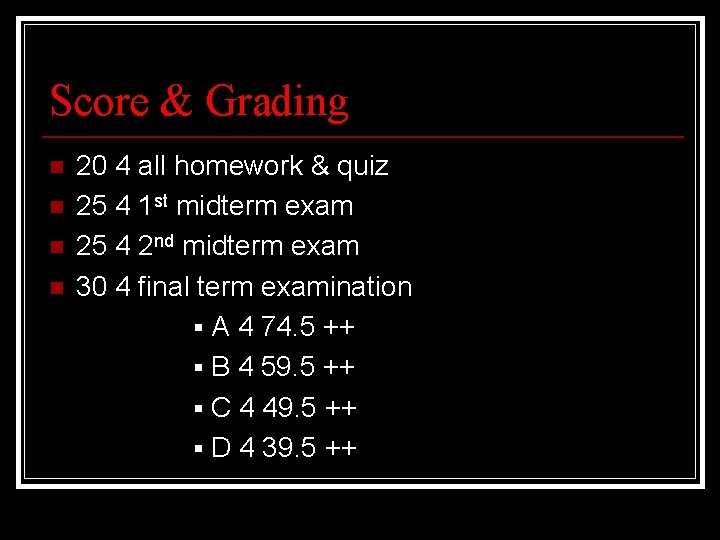
Score & Grading n n 20 4 all homework & quiz 25 4 1 st midterm exam 25 4 2 nd midterm exam 30 4 final term examination § A 4 74. 5 ++ § B 4 59. 5 ++ § C 4 49. 5 ++ § D 4 39. 5 ++
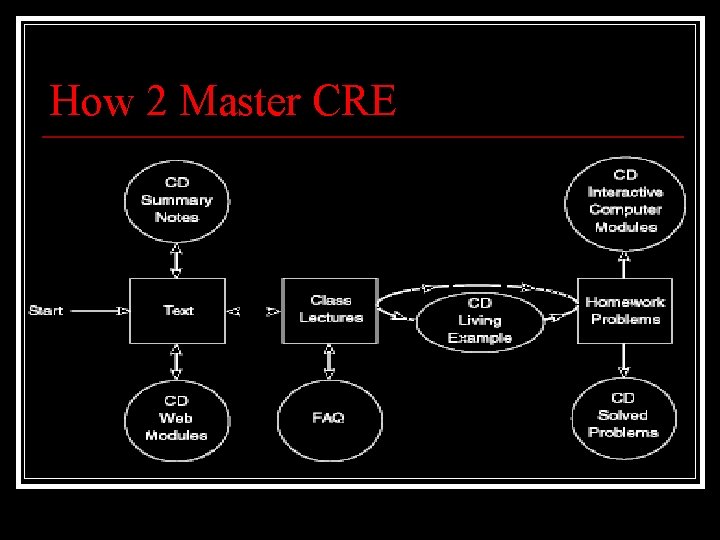
How 2 Master CRE
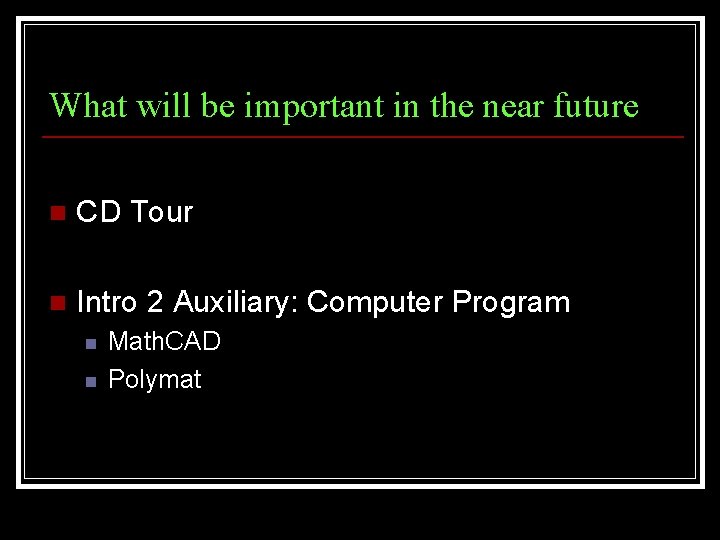
What will be important in the near future n CD Tour n Intro 2 Auxiliary: Computer Program n n Math. CAD Polymat
ITK-330 Chemical Reaction Engineering Basic Concepts Dicky Dermawan
1 Mole Balance In – Out + Generation = Accumulation
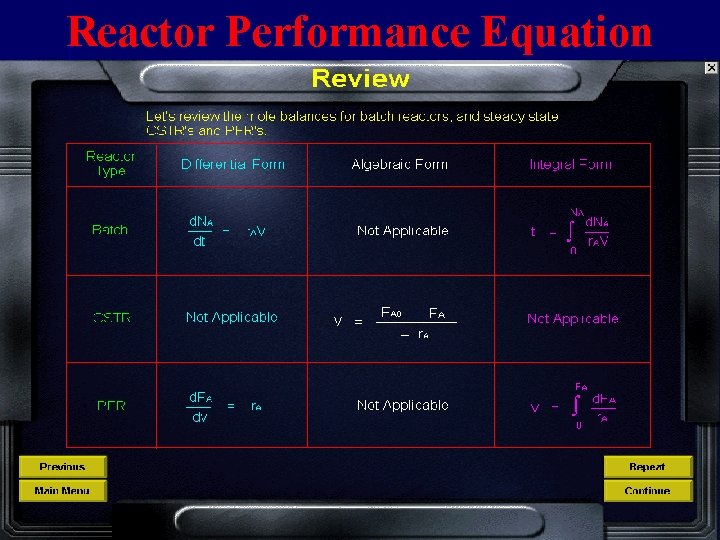
Reactor Performance Equation
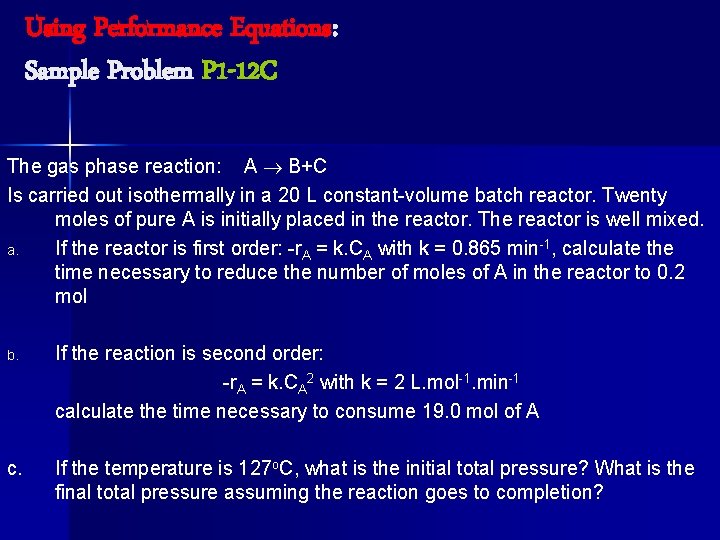
Using Performance Equations: Sample Problem P 1 -12 C The gas phase reaction: A B+C Is carried out isothermally in a 20 L constant-volume batch reactor. Twenty moles of pure A is initially placed in the reactor. The reactor is well mixed. a. If the reactor is first order: -r. A = k. CA with k = 0. 865 min-1, calculate the time necessary to reduce the number of moles of A in the reactor to 0. 2 mol b. If the reaction is second order: -r. A = k. CA 2 with k = 2 L. mol-1. min-1 calculate the time necessary to consume 19. 0 mol of A c. If the temperature is 127 o. C, what is the initial total pressure? What is the final total pressure assuming the reaction goes to completion?
2 Conversion & Reactor Sizing
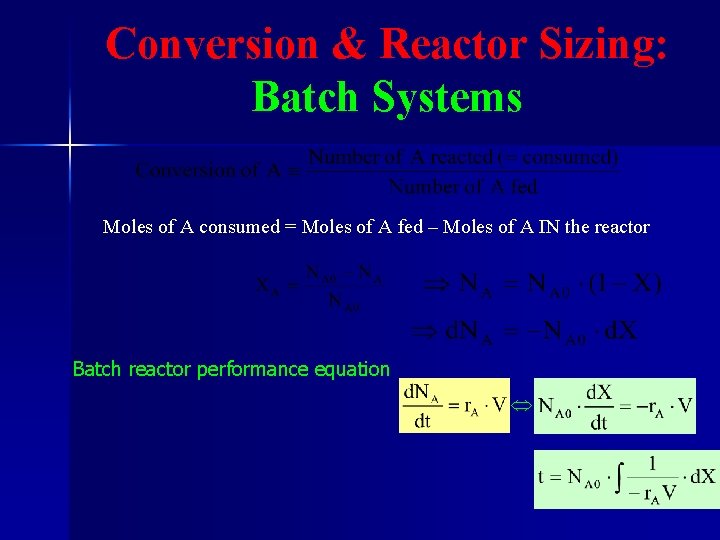
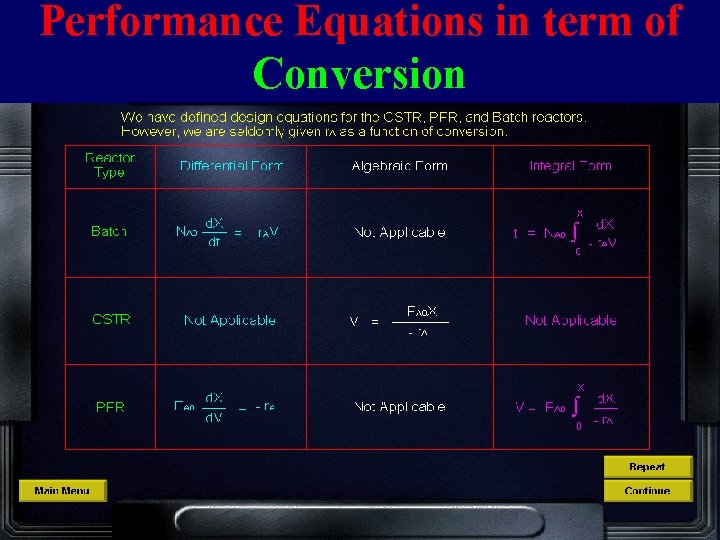
Conversion & Reactor Sizing: Batch Systems Moles of A consumed = Moles of A fed – Moles of A IN the reactor Batch reactor performance equation
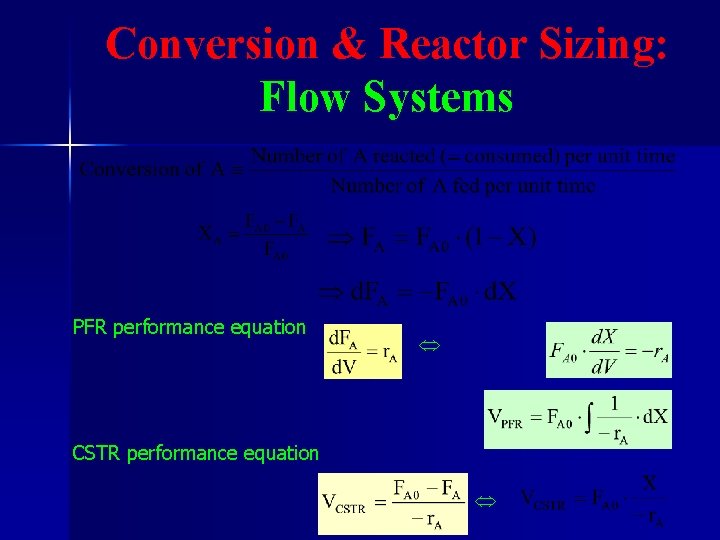
Conversion & Reactor Sizing: Flow Systems PFR performance equation CSTR performance equation
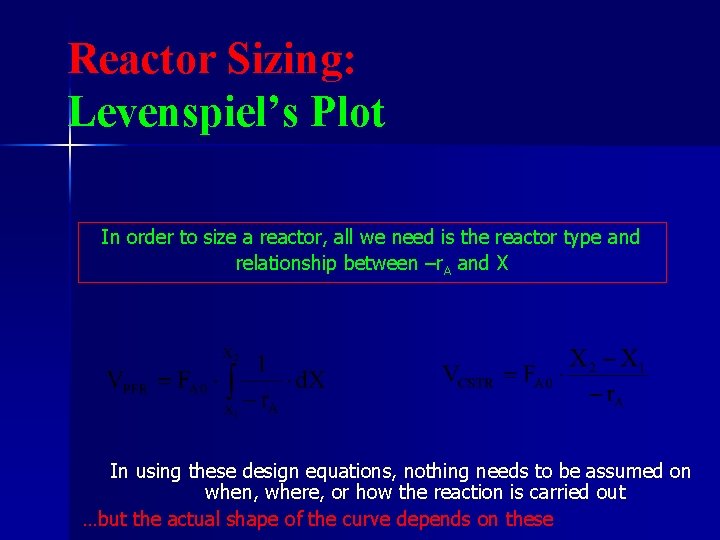
Reactor Sizing: Levenspiel’s Plot In order to size a reactor, all we need is the reactor type and relationship between –r. A and X In using these design equations, nothing needs to be assumed on when, where, or how the reaction is carried out …but the actual shape of the curve depends on these
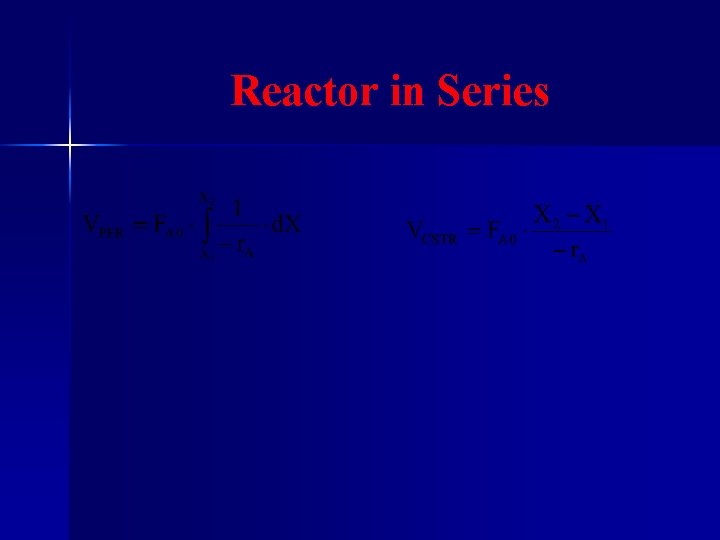
Reactor in Series
Performance Equations in term of Conversion
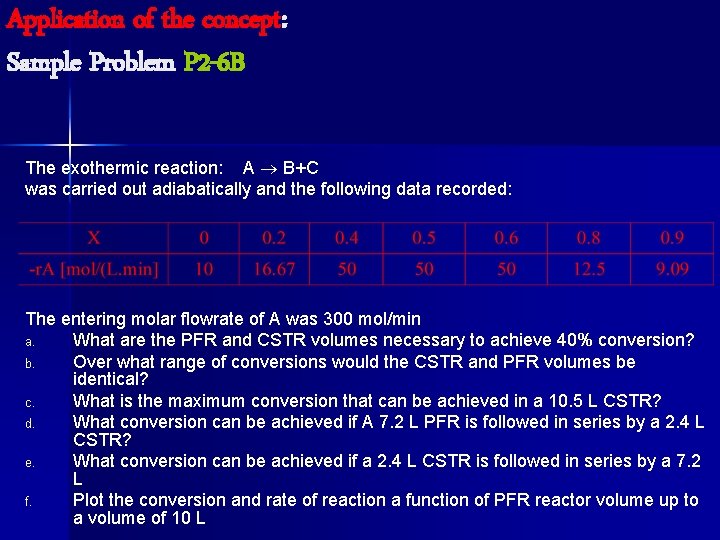
Application of the concept: Sample Problem P 2 -6 B The exothermic reaction: A B+C was carried out adiabatically and the following data recorded: The entering molar flowrate of A was 300 mol/min a. What are the PFR and CSTR volumes necessary to achieve 40% conversion? b. Over what range of conversions would the CSTR and PFR volumes be identical? c. What is the maximum conversion that can be achieved in a 10. 5 L CSTR? d. What conversion can be achieved if A 7. 2 L PFR is followed in series by a 2. 4 L CSTR? e. What conversion can be achieved if a 2. 4 L CSTR is followed in series by a 7. 2 L f. Plot the conversion and rate of reaction a function of PFR reactor volume up to a volume of 10 L
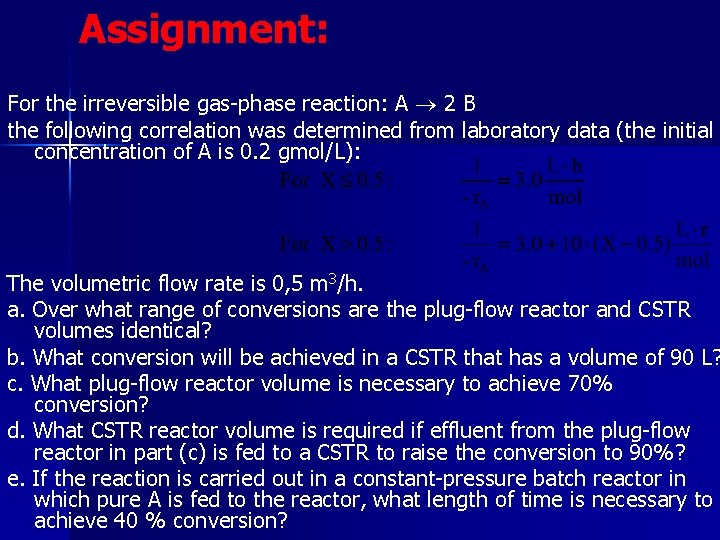
Assignment: For the irreversible gas-phase reaction: A 2 B the following correlation was determined from laboratory data (the initial concentration of A is 0. 2 gmol/L): The volumetric flow rate is 0, 5 m 3/h. a. Over what range of conversions are the plug-flow reactor and CSTR volumes identical? b. What conversion will be achieved in a CSTR that has a volume of 90 L? c. What plug-flow reactor volume is necessary to achieve 70% conversion? d. What CSTR reactor volume is required if effluent from the plug-flow reactor in part (c) is fed to a CSTR to raise the conversion to 90%? e. If the reaction is carried out in a constant-pressure batch reactor in which pure A is fed to the reactor, what length of time is necessary to achieve 40 % conversion?
3 Rate Law & Stoichiometry
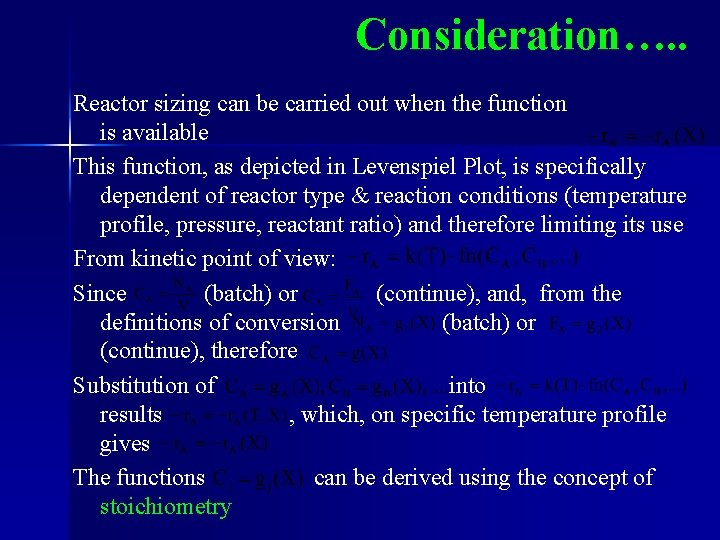
Consideration…. . Reactor sizing can be carried out when the function is available This function, as depicted in Levenspiel Plot, is specifically dependent of reactor type & reaction conditions (temperature profile, pressure, reactant ratio) and therefore limiting its use From kinetic point of view: Since (batch) or (continue), and, from the definitions of conversion (batch) or (continue), therefore Substitution of into results , which, on specific temperature profile gives The functions can be derived using the concept of stoichiometry
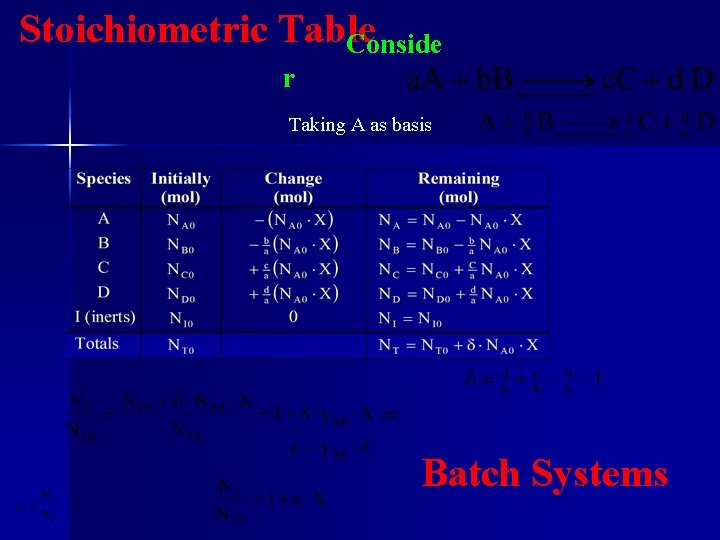
Stoichiometric Table Conside r Taking A as basis Batch Systems
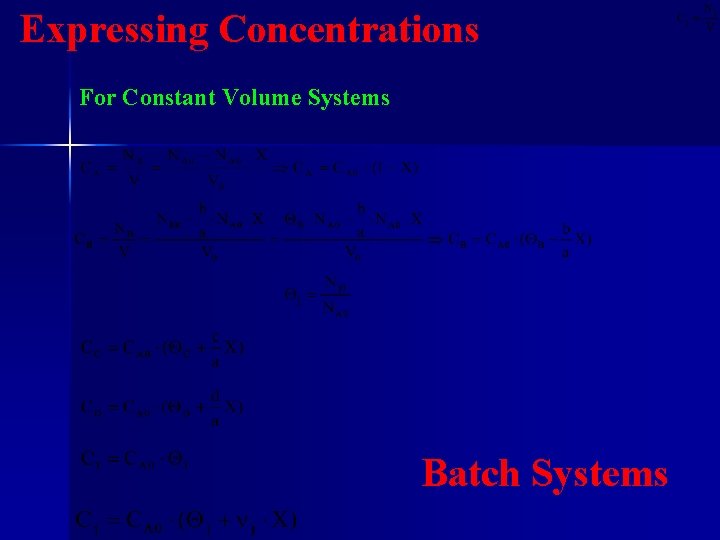
Expressing Concentrations For Constant Volume Systems Batch Systems
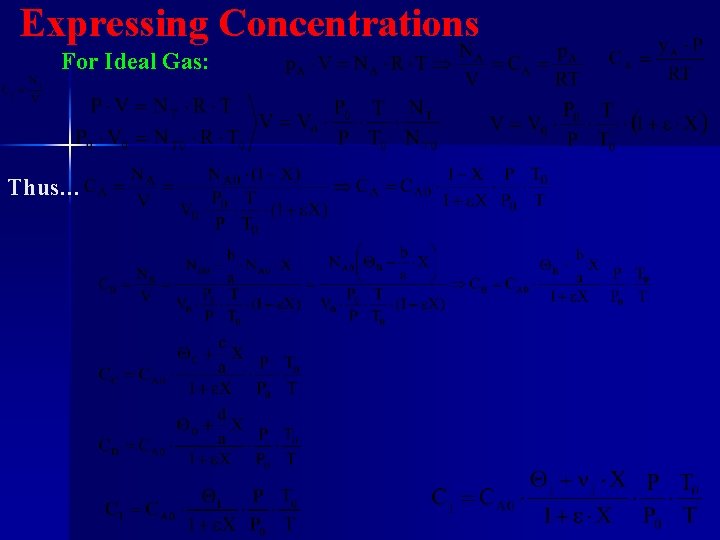
Expressing Concentrations For Ideal Gas: Thus…
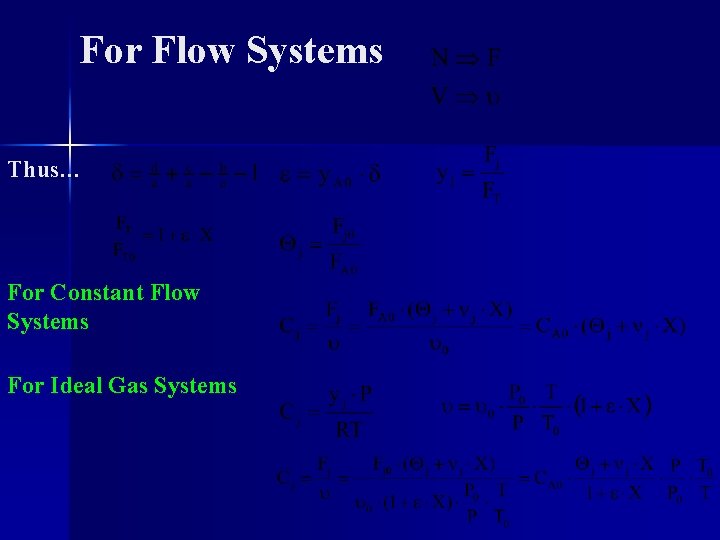
For Flow Systems Thus… For Constant Flow Systems For Ideal Gas Systems
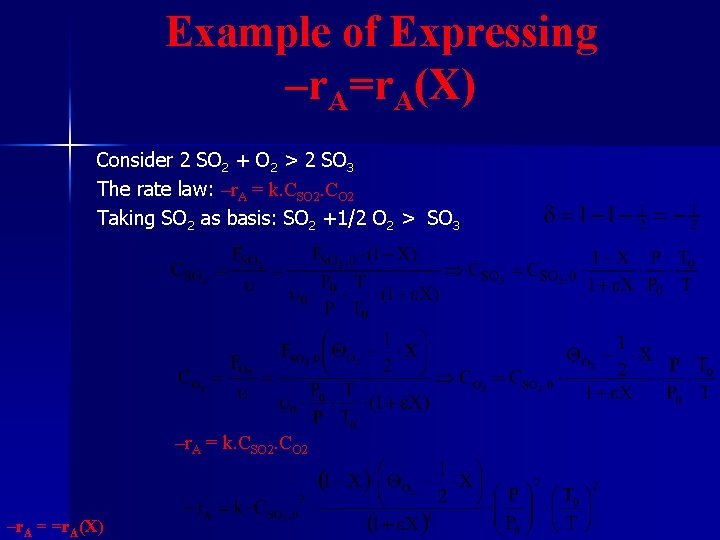
Example of Expressing –r. A=r. A(X) Consider 2 SO 2 + O 2 > 2 SO 3 The rate law: –r. A = k. CSO 2. CO 2 Taking SO 2 as basis: SO 2 +1/2 O 2 > SO 3 –r. A = k. CSO 2. CO 2 –r. A = =r. A(X)
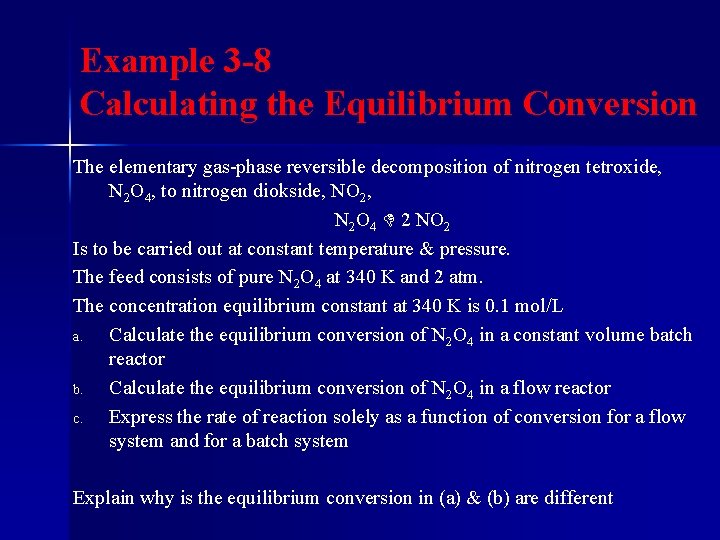
Example 3 -8 Calculating the Equilibrium Conversion The elementary gas-phase reversible decomposition of nitrogen tetroxide, N 2 O 4, to nitrogen diokside, NO 2, N 2 O 4 2 NO 2 Is to be carried out at constant temperature & pressure. The feed consists of pure N 2 O 4 at 340 K and 2 atm. The concentration equilibrium constant at 340 K is 0. 1 mol/L a. Calculate the equilibrium conversion of N 2 O 4 in a constant volume batch reactor b. Calculate the equilibrium conversion of N 2 O 4 in a flow reactor c. Express the rate of reaction solely as a function of conversion for a flow system and for a batch system Explain why is the equilibrium conversion in (a) & (b) are different
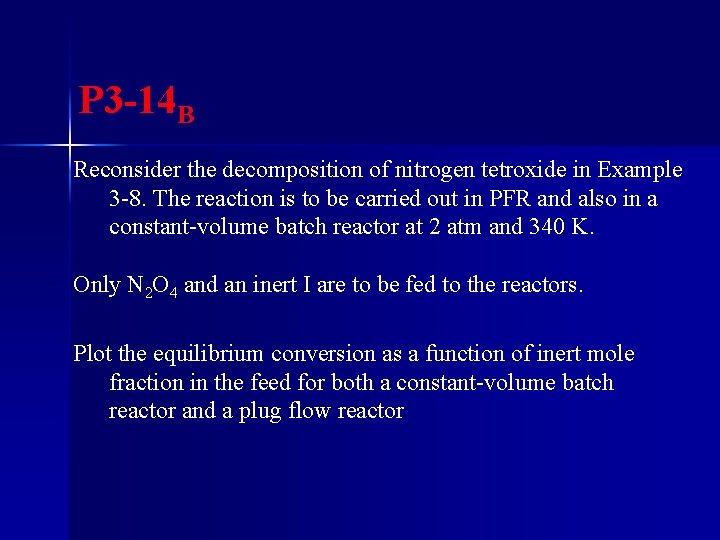
P 3 -14 B Reconsider the decomposition of nitrogen tetroxide in Example 3 -8. The reaction is to be carried out in PFR and also in a constant-volume batch reactor at 2 atm and 340 K. Only N 2 O 4 and an inert I are to be fed to the reactors. Plot the equilibrium conversion as a function of inert mole fraction in the feed for both a constant-volume batch reactor and a plug flow reactor