
ITK329 Kinetika Katalisis Chapter 3 Interpretation The Use
- Slides: 16
ITK-329 Kinetika & Katalisis Chapter 3 Interpretation & The Use of Rate Law Dicky Dermawan www. dickydermawan. net 78. net dickydermawan@gmail. com 49
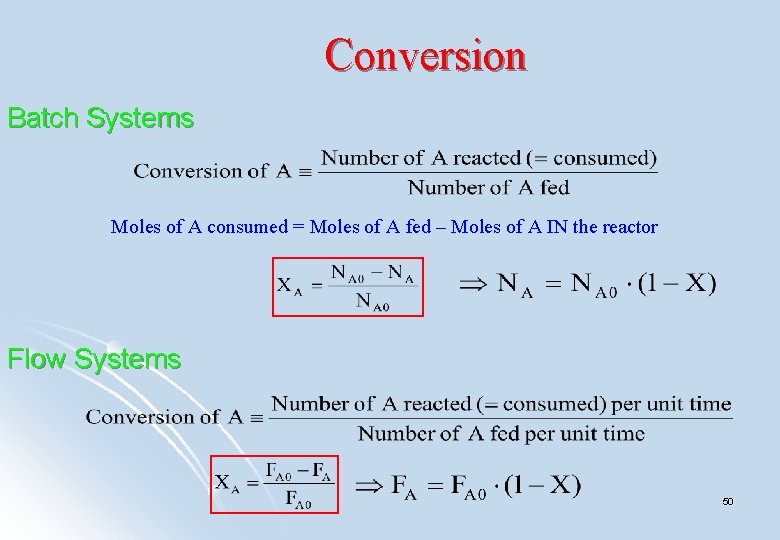
Conversion Batch Systems Moles of A consumed = Moles of A fed – Moles of A IN the reactor Flow Systems 50
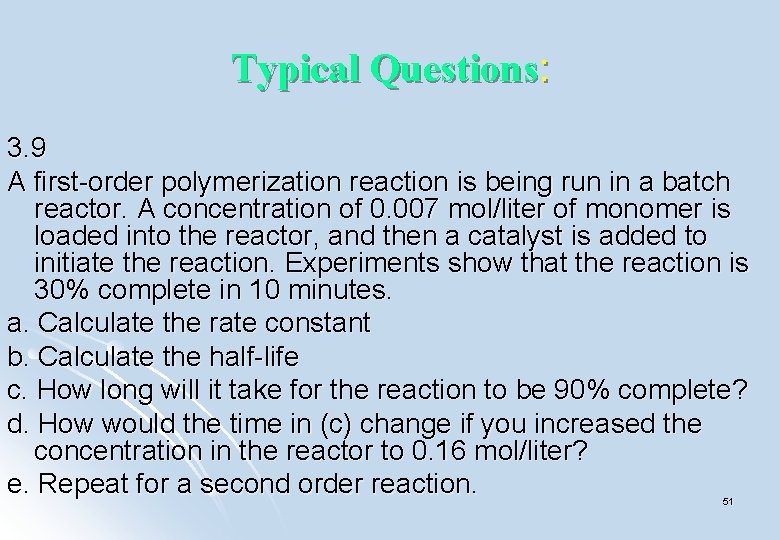
Typical Questions: 3. 9 A first-order polymerization reaction is being run in a batch reactor. A concentration of 0. 007 mol/liter of monomer is loaded into the reactor, and then a catalyst is added to initiate the reaction. Experiments show that the reaction is 30% complete in 10 minutes. a. Calculate the rate constant b. Calculate the half-life c. How long will it take for the reaction to be 90% complete? d. How would the time in (c) change if you increased the concentration in the reactor to 0. 16 mol/liter? e. Repeat for a second order reaction. 51
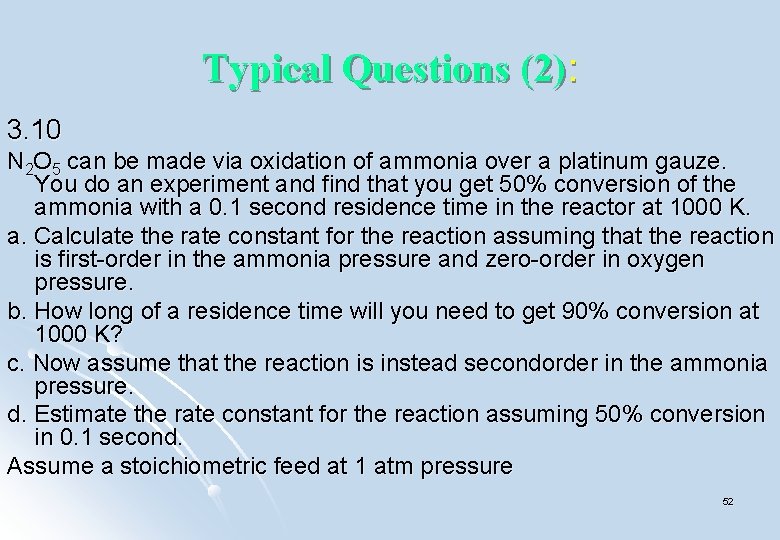
Typical Questions (2): 3. 10 N 2 O 5 can be made via oxidation of ammonia over a platinum gauze. You do an experiment and find that you get 50% conversion of the ammonia with a 0. 1 second residence time in the reactor at 1000 K. a. Calculate the rate constant for the reaction assuming that the reaction is first-order in the ammonia pressure and zero-order in oxygen pressure. b. How long of a residence time will you need to get 90% conversion at 1000 K? c. Now assume that the reaction is instead secondorder in the ammonia pressure. d. Estimate the rate constant for the reaction assuming 50% conversion in 0. 1 second. Assume a stoichiometric feed at 1 atm pressure 52
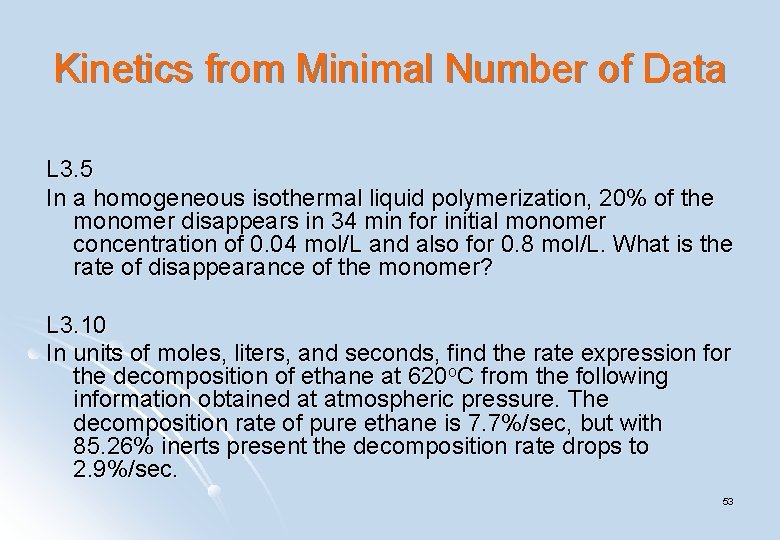
Kinetics from Minimal Number of Data L 3. 5 In a homogeneous isothermal liquid polymerization, 20% of the monomer disappears in 34 min for initial monomer concentration of 0. 04 mol/L and also for 0. 8 mol/L. What is the rate of disappearance of the monomer? L 3. 10 In units of moles, liters, and seconds, find the rate expression for the decomposition of ethane at 620 o. C from the following information obtained at atmospheric pressure. The decomposition rate of pure ethane is 7. 7%/sec, but with 85. 26% inerts present the decomposition rate drops to 2. 9%/sec. 53
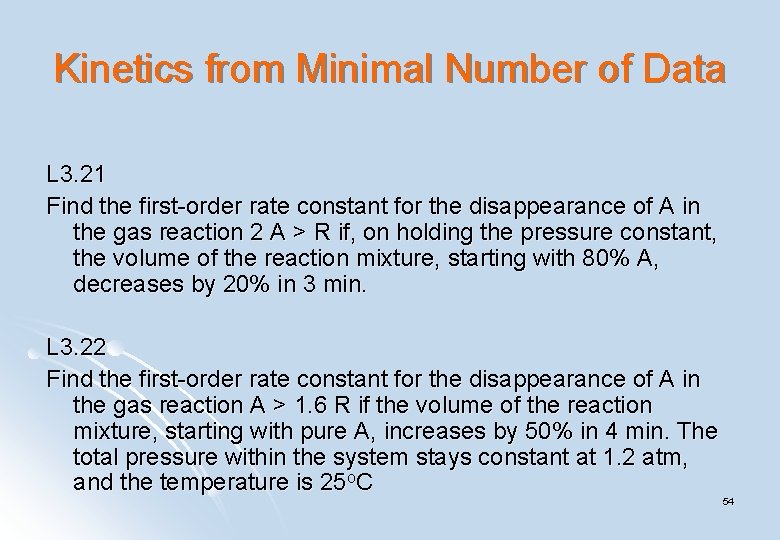
Kinetics from Minimal Number of Data L 3. 21 Find the first-order rate constant for the disappearance of A in the gas reaction 2 A > R if, on holding the pressure constant, the volume of the reaction mixture, starting with 80% A, decreases by 20% in 3 min. L 3. 22 Find the first-order rate constant for the disappearance of A in the gas reaction A > 1. 6 R if the volume of the reaction mixture, starting with pure A, increases by 50% in 4 min. The total pressure within the system stays constant at 1. 2 atm, and the temperature is 25 o. C 54
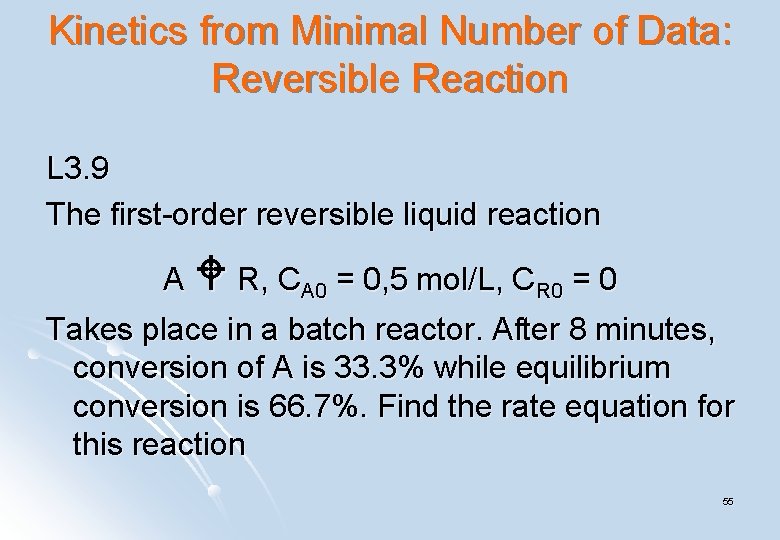
Kinetics from Minimal Number of Data: Reversible Reaction L 3. 9 The first-order reversible liquid reaction A R, CA 0 = 0, 5 mol/L, CR 0 = 0 Takes place in a batch reactor. After 8 minutes, conversion of A is 33. 3% while equilibrium conversion is 66. 7%. Find the rate equation for this reaction 55
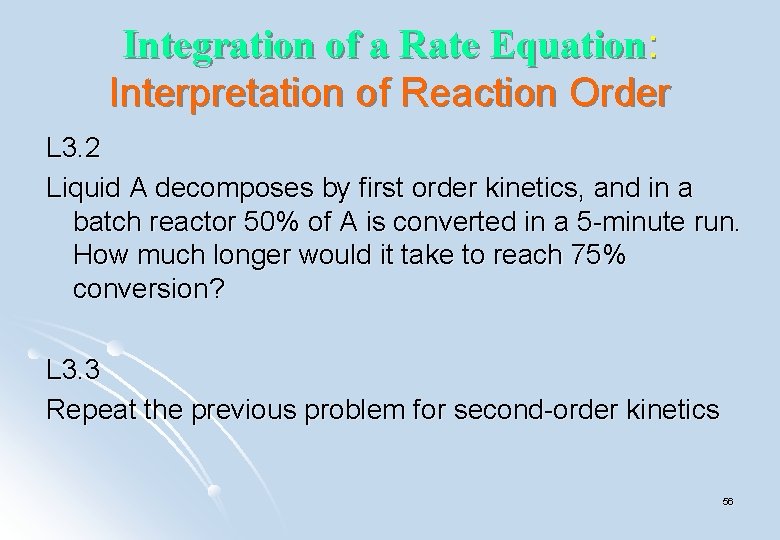
Integration of a Rate Equation: Interpretation of Reaction Order L 3. 2 Liquid A decomposes by first order kinetics, and in a batch reactor 50% of A is converted in a 5 -minute run. How much longer would it take to reach 75% conversion? L 3. 3 Repeat the previous problem for second-order kinetics 56
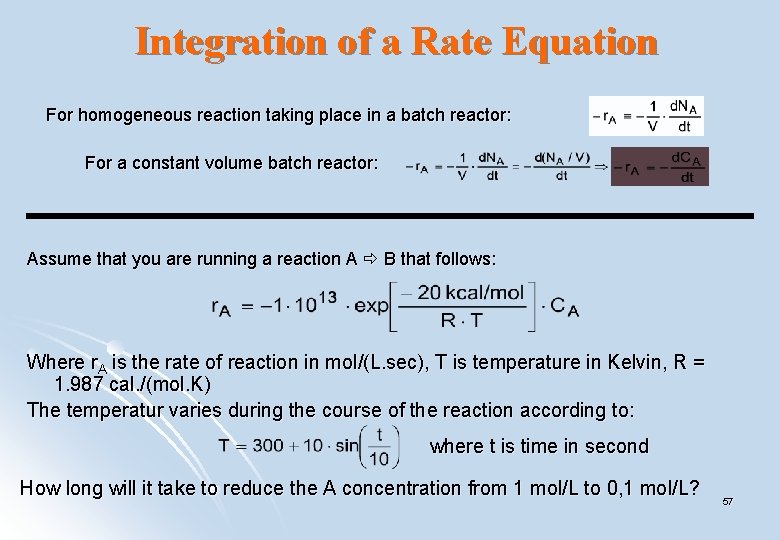
Integration of a Rate Equation For homogeneous reaction taking place in a batch reactor: For a constant volume batch reactor: Assume that you are running a reaction A B that follows: Where r. A is the rate of reaction in mol/(L. sec), T is temperature in Kelvin, R = 1. 987 cal. /(mol. K) The temperatur varies during the course of the reaction according to: where t is time in second How long will it take to reduce the A concentration from 1 mol/L to 0, 1 mol/L? 57
Integration of a Rate Equation: Interpretation of Reaction Order L 3. 4 A 10 -minute experimental run shows that 75% of liquid reactant is converted to product by a ½ order rate. What would be the amount converted in a half-hour run? 58
Integration of a Rate Equation: Constant Volume vs Constant Pressure Batch Reactor L 3. 23 A zero-order homogeneous gas reaction A r. R Proceeds in a constant-volume bomb, 20% inerts, and the pressure rises from 1 to 1. 3 atm in 2 min. If the same reaction takes place in a constant-pressure batch reactor, what is the fractional volume change in 4 min if the feed is at 3 atm and consist of 40% inerts? 59
Integration of a Rate Equation: Constant Volume vs Constant Pressure Batch Reactor L 3. 24 A zero-order homogeneous gas reaction A r. R Proceeds in a constant-volume bomb, P = 1 at t = 0, and P = 1. 5 when t = 1. If the same reaction, same feed composition, and initial pressure proceeds in a constant-pressure setup, find V at t = 1 if V = 1 at t = 0 60
Integration of a Rate Equation: Constant Volume vs Constant Pressure Batch Reactor L 3. 25 The first-order homogeneous gaseous decomposition A 2. 5 R Is carried out in an isothermal batch reactor at 2 atm with 20% inerts present, and the volume increases by 60% in 20 min. In a constant-volume reactor, find the time required for the pressure to reach 8 atm if the initial pressure is 5 atm, 2 atm of which consist of inerts. 61
Integration of a Rate Equation: Constant Volume vs Constant Pressure Batch Reactor L 3. 26 The gas reaction 2 A R+2 S Is approximately second order with respect to A. When pure A is introduced at 1 atm into a constant-volume batch reactor, the pressure rises 40% in 3 min. For a constant-pressure batch reactor, find: a. the time required for the same conversion b. The fractional increase in volume at that time. 62
Multiple Reactions L 3. 16 Nitrogen pentoxide decomposes as follows: N 2 O 5 ½ O 2 + N 2 O 4 –r. N 2 O 5 = (2. 2 x 10 -3 min-1). CN 2 O 5 N 2 O 4 2 NO 2 Kp = 45 mm. Hg Find the partial pressures of the contents of a constantvolume bomb after 6. 5 hours if we start with pure at atmospheric pressure 63
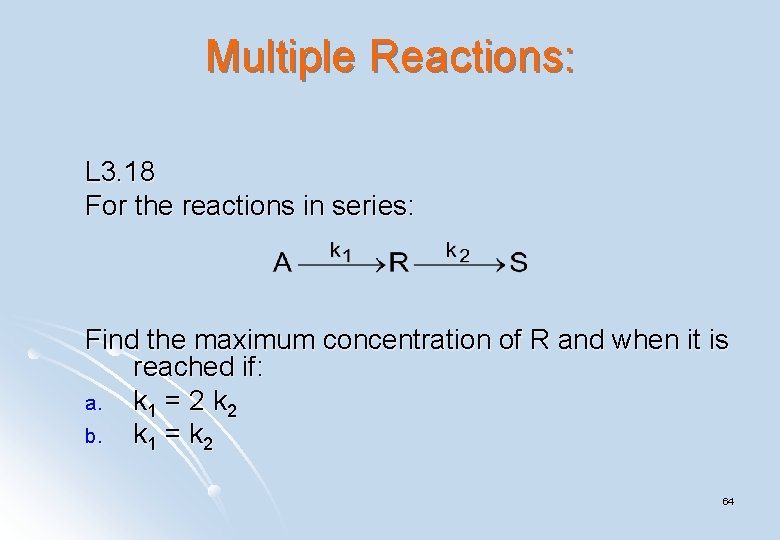
Multiple Reactions: L 3. 18 For the reactions in series: Find the maximum concentration of R and when it is reached if: a. k 1 = 2 k 2 b. k 1 = k 2 64