
ITIL What is it Why you should use




- Slides: 37
ITIL: What is it? Why you should use it? How to use it? Tampa Bay Technology Leadership Association August 9, 2007 T. C. Kaiser Senior Customer Solution Architect CA, Inc.
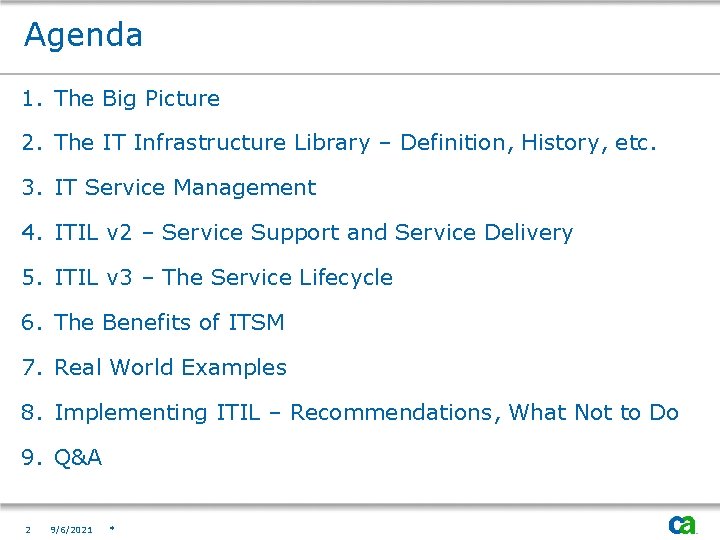
Agenda 1. The Big Picture 2. The IT Infrastructure Library – Definition, History, etc. 3. IT Service Management 4. ITIL v 2 – Service Support and Service Delivery 5. ITIL v 3 – The Service Lifecycle 6. The Benefits of ITSM 7. Real World Examples 8. Implementing ITIL – Recommendations, What Not to Do 9. Q&A 2 9/6/2021 *
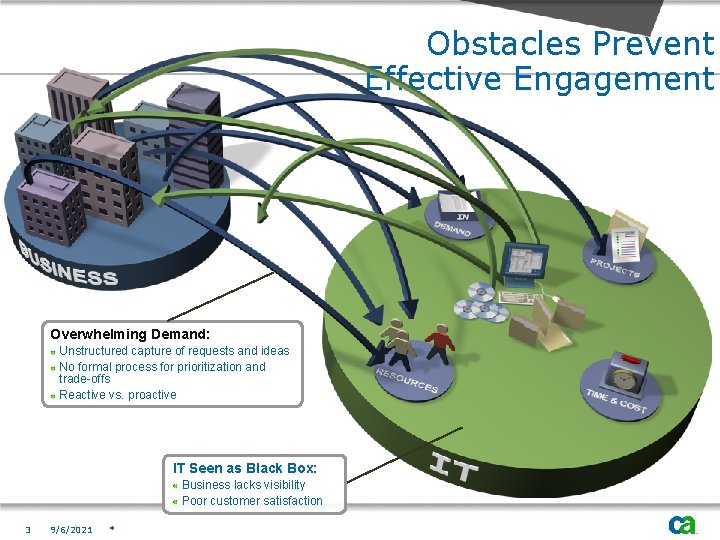
Obstacles Prevent Effective Engagement Overwhelming Demand: Unstructured capture of requests and ideas No formal process for prioritization and trade-offs Reactive vs. proactive IT Seen as Black Box: Business lacks visibility Poor customer satisfaction 3 9/6/2021 *
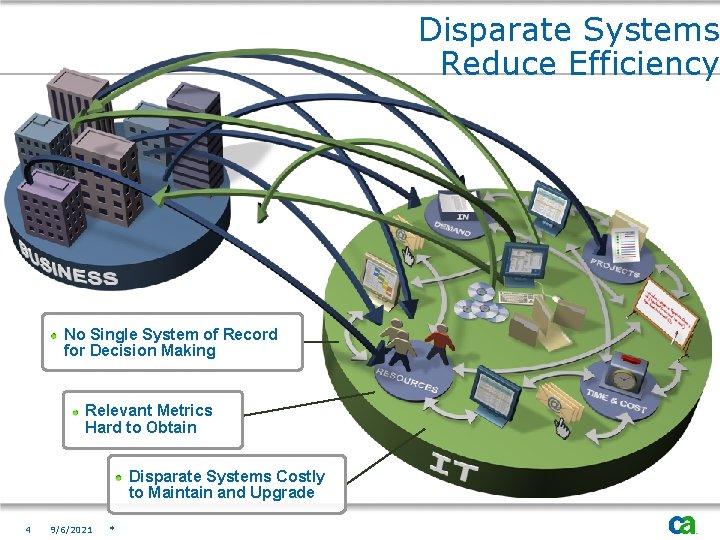
Disparate Systems Reduce Efficiency No Single System of Record for Decision Making Relevant Metrics Hard to Obtain Disparate Systems Costly to Maintain and Upgrade 4 9/6/2021 *
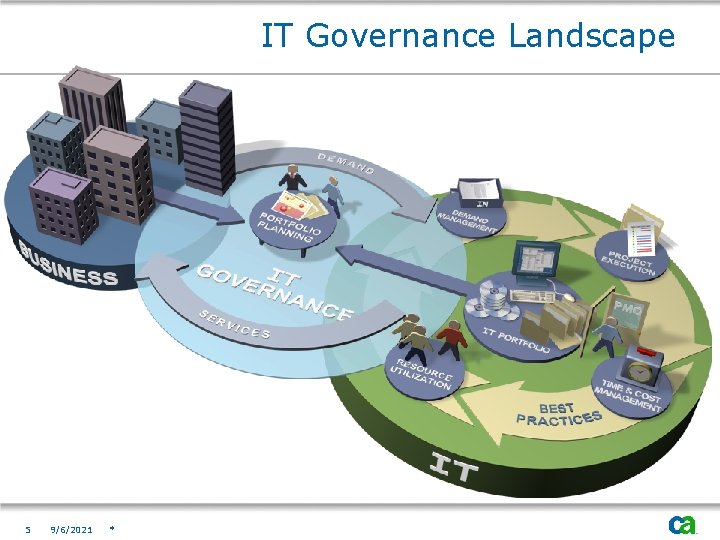
IT Governance Landscape 5 9/6/2021 *
What is the Information Technology Infrastructure Library (ITIL)? History and Definitions
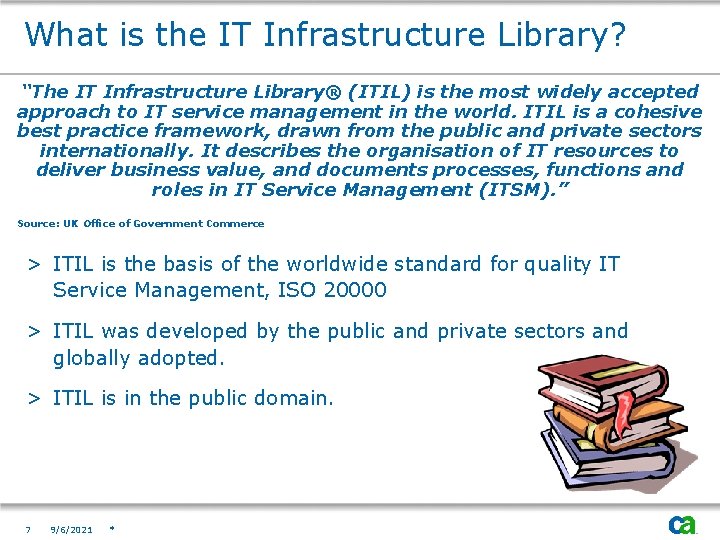
What is the IT Infrastructure Library? “The IT Infrastructure Library® (ITIL) is the most widely accepted approach to IT service management in the world. ITIL is a cohesive best practice framework, drawn from the public and private sectors internationally. It describes the organisation of IT resources to deliver business value, and documents processes, functions and roles in IT Service Management (ITSM). ” Source: UK Office of Government Commerce > ITIL is the basis of the worldwide standard for quality IT Service Management, ISO 20000 > ITIL was developed by the public and private sectors and globally adopted. > ITIL is in the public domain. 7 9/6/2021 *
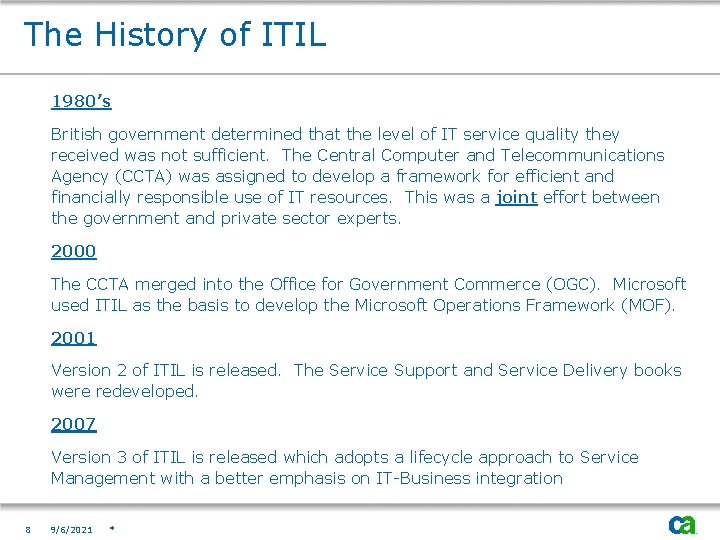
The History of ITIL 1980’s British government determined that the level of IT service quality they received was not sufficient. The Central Computer and Telecommunications Agency (CCTA) was assigned to develop a framework for efficient and financially responsible use of IT resources. This was a joint effort between the government and private sector experts. 2000 The CCTA merged into the Office for Government Commerce (OGC). Microsoft used ITIL as the basis to develop the Microsoft Operations Framework (MOF). 2001 Version 2 of ITIL is released. The Service Support and Service Delivery books were redeveloped. 2007 Version 3 of ITIL is released which adopts a lifecycle approach to Service Management with a better emphasis on IT-Business integration 8 9/6/2021 *
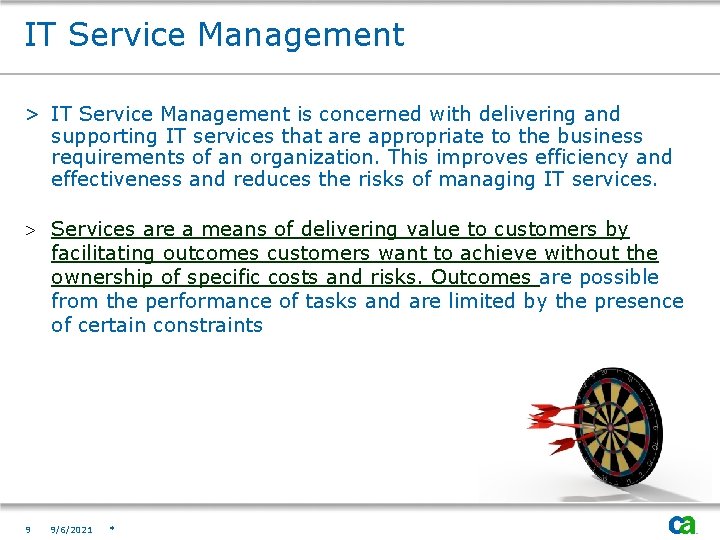
IT Service Management > IT Service Management is concerned with delivering and supporting IT services that are appropriate to the business requirements of an organization. This improves efficiency and effectiveness and reduces the risks of managing IT services. > Services are a means of delivering value to customers by facilitating outcomes customers want to achieve without the ownership of specific costs and risks. Outcomes are possible from the performance of tasks and are limited by the presence of certain constraints 9 9/6/2021 *
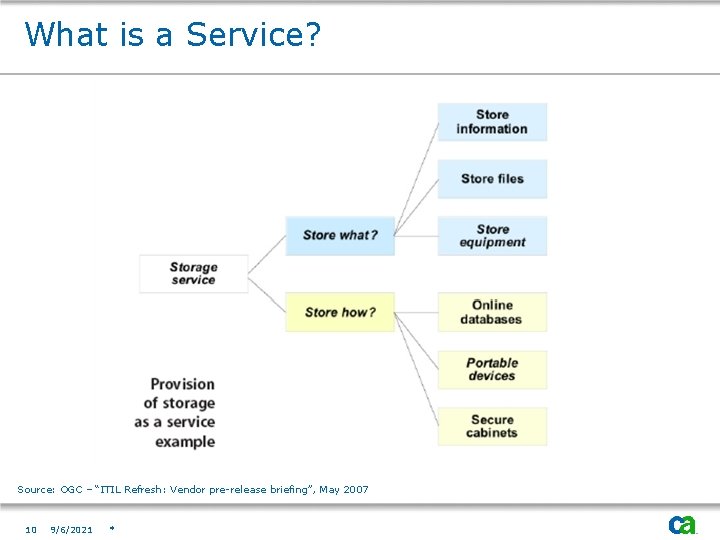
What is a Service? Source: OGC – “ITIL Refresh: Vendor pre-release briefing”, May 2007 10 9/6/2021 *
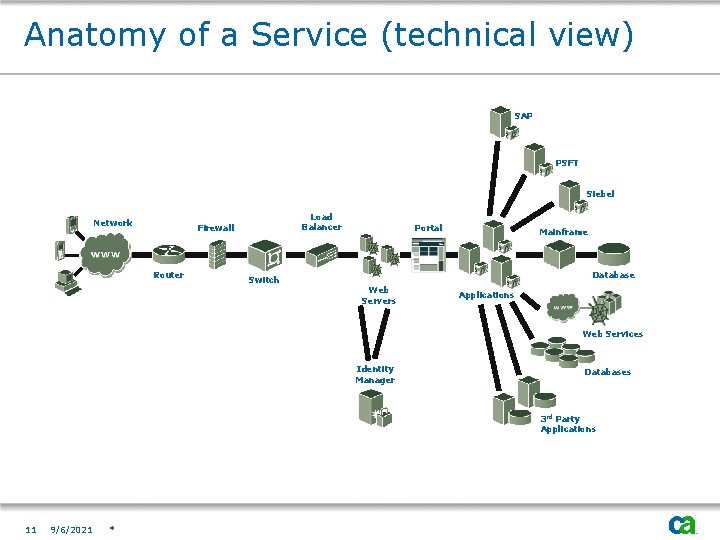
Anatomy of a Service (technical view) SAP PSFT Siebel Network Load Balancer Firewall Router Switch Portal Mainframe Database Web Servers Applications Web Services Identity Manager Databases 3 rd Party Applications 11 9/6/2021 *
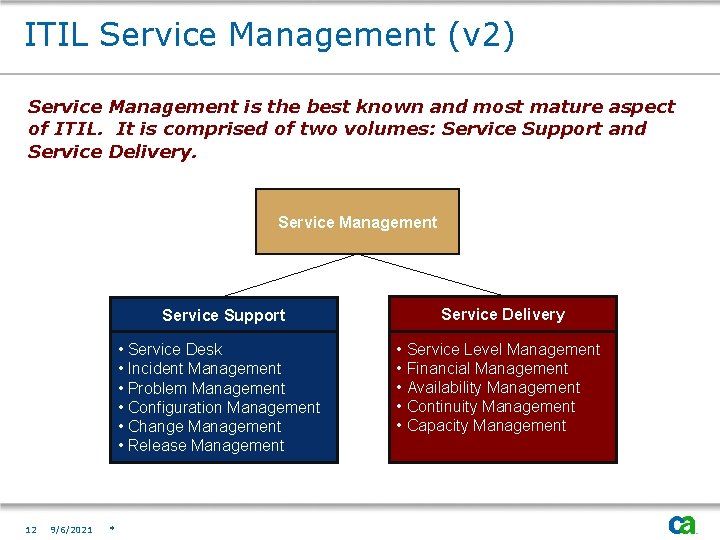
ITIL Service Management (v 2) Service Management is the best known and most mature aspect of ITIL. It is comprised of two volumes: Service Support and Service Delivery. Service Management 12 9/6/2021 * Service Support Service Delivery • Service Desk • Incident Management • Problem Management • Configuration Management • Change Management • Release Management • Service Level Management • Financial Management • Availability Management • Continuity Management • Capacity Management
Core ITIL v 3 Library Source: Pink Elephant – “What’s New in ITIL v 3”, George Spaulding 2007 13 9/6/2021 *
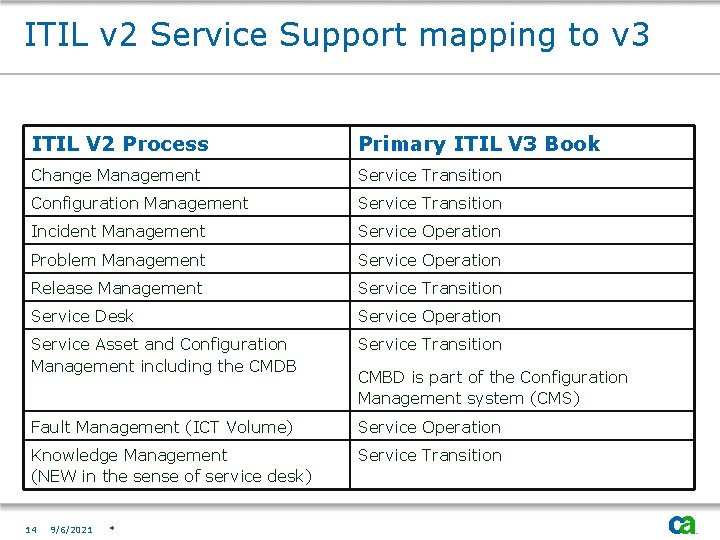
ITIL v 2 Service Support mapping to v 3 ITIL V 2 Process Primary ITIL V 3 Book Change Management Service Transition Configuration Management Service Transition Incident Management Service Operation Problem Management Service Operation Release Management Service Transition Service Desk Service Operation Service Asset and Configuration Management including the CMDB Service Transition Fault Management (ICT Volume) Service Operation Knowledge Management (NEW in the sense of service desk) Service Transition 14 9/6/2021 * CMBD is part of the Configuration Management system (CMS)
ITIL v 2 Service Delivery mapping to v 3 ITIL V 2 Process Primary ITIL V 3 Book Financial Management Service Strategies Availability Management Service Design Capacity Management Service Design IT Service Continuity Management Service Design Referenced in Service Transition, Service Operation and Continual Service Improvement Service Level Management Service Design Service Catalogue Management Service Design 15 9/6/2021 *
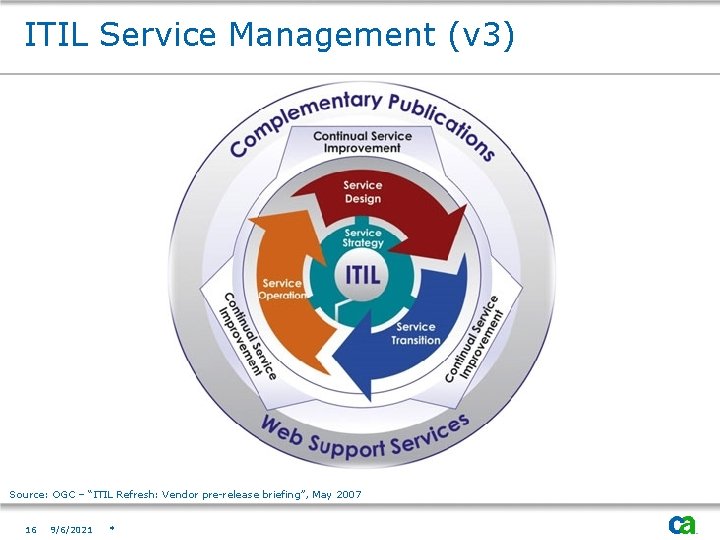
ITIL Service Management (v 3) Source: OGC – “ITIL Refresh: Vendor pre-release briefing”, May 2007 16 9/6/2021 *
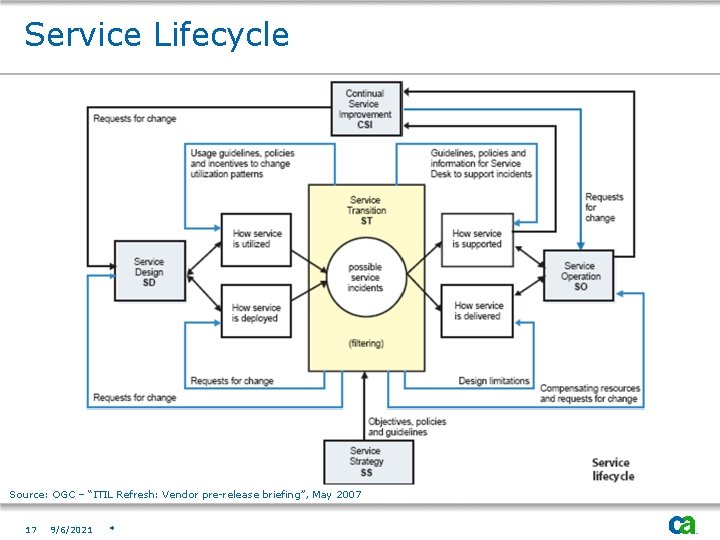
Service Lifecycle Source: OGC – “ITIL Refresh: Vendor pre-release briefing”, May 2007 17 9/6/2021 *
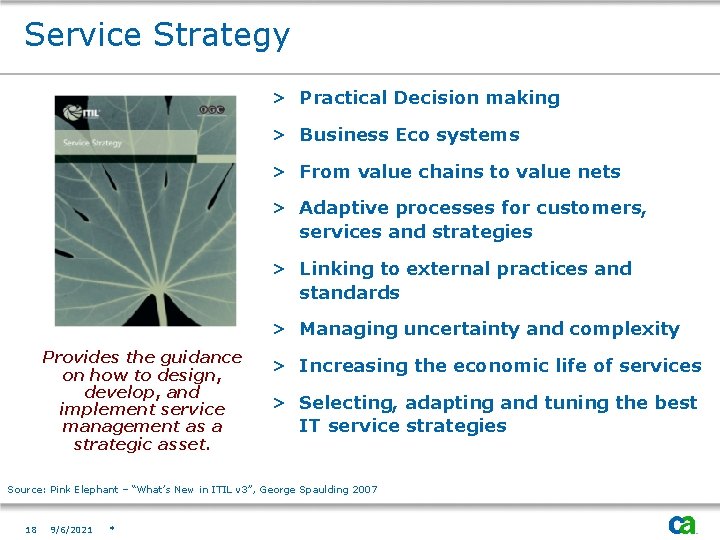
Service Strategy > Practical Decision making > Business Eco systems > From value chains to value nets > Adaptive processes for customers, services and strategies > Linking to external practices and standards > Managing uncertainty and complexity Provides the guidance on how to design, develop, and implement service management as a strategic asset. > Increasing the economic life of services > Selecting, adapting and tuning the best IT service strategies Source: Pink Elephant – “What’s New in ITIL v 3”, George Spaulding 2007 18 9/6/2021 *
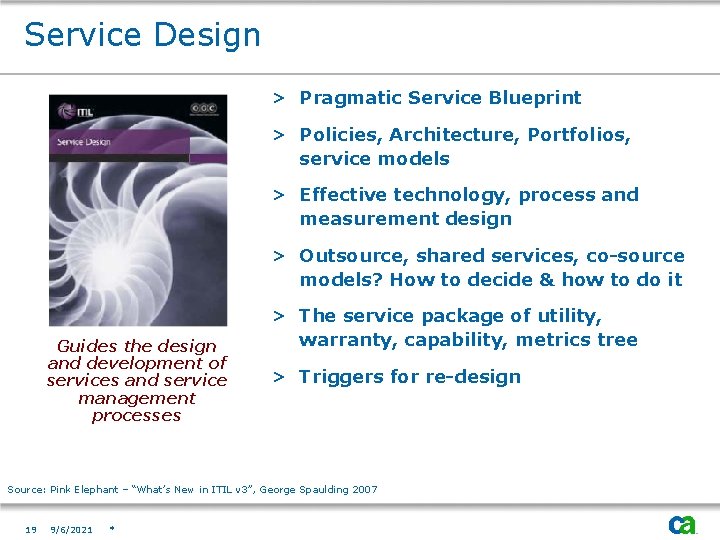
Service Design > Pragmatic Service Blueprint > Policies, Architecture, Portfolios, service models > Effective technology, process and measurement design > Outsource, shared services, co-source models? How to decide & how to do it Guides the design and development of services and service management processes > The service package of utility, warranty, capability, metrics tree > Triggers for re-design Source: Pink Elephant – “What’s New in ITIL v 3”, George Spaulding 2007 19 9/6/2021 *
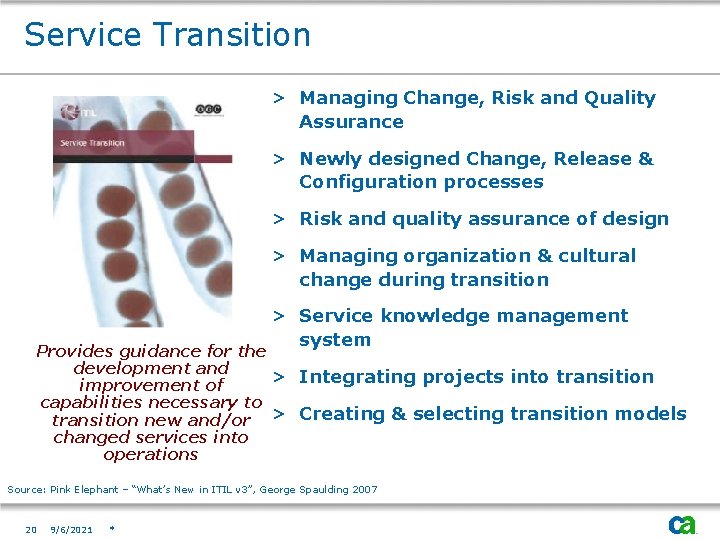
Service Transition > Managing Change, Risk and Quality Assurance > Newly designed Change, Release & Configuration processes > Risk and quality assurance of design > Managing organization & cultural change during transition > Service knowledge management system Provides guidance for the development and > Integrating projects into transition improvement of capabilities necessary to transition new and/or > Creating & selecting transition models changed services into operations Source: Pink Elephant – “What’s New in ITIL v 3”, George Spaulding 2007 20 9/6/2021 *
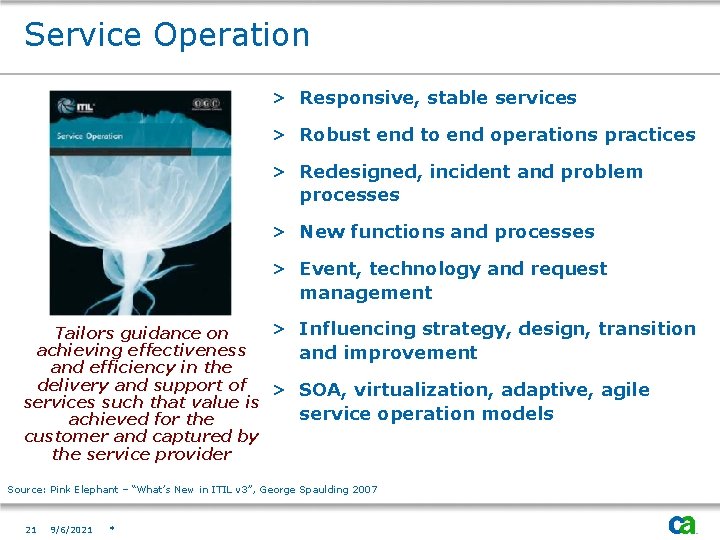
Service Operation > Responsive, stable services > Robust end to end operations practices > Redesigned, incident and problem processes > New functions and processes > Event, technology and request management > Influencing strategy, design, transition Tailors guidance on achieving effectiveness and improvement and efficiency in the delivery and support of > SOA, virtualization, adaptive, agile services such that value is service operation models achieved for the customer and captured by the service provider Source: Pink Elephant – “What’s New in ITIL v 3”, George Spaulding 2007 21 9/6/2021 *
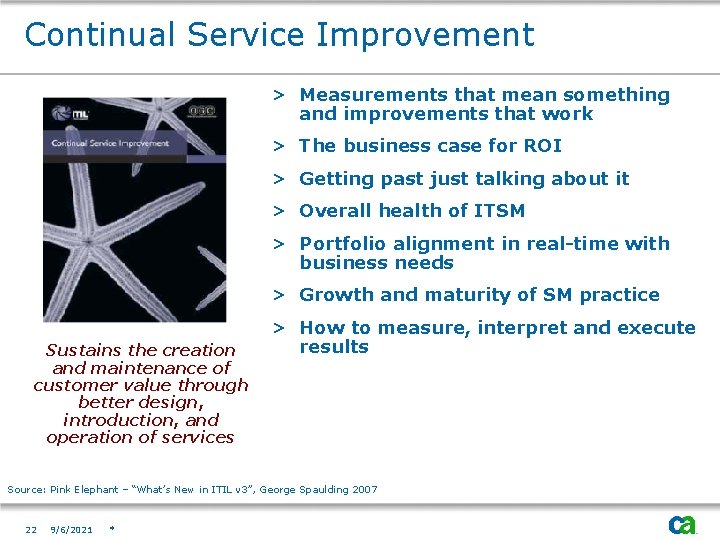
Continual Service Improvement > Measurements that mean something and improvements that work > The business case for ROI > Getting past just talking about it > Overall health of ITSM > Portfolio alignment in real-time with business needs > Growth and maturity of SM practice Sustains the creation and maintenance of customer value through better design, introduction, and operation of services > How to measure, interpret and execute results Source: Pink Elephant – “What’s New in ITIL v 3”, George Spaulding 2007 22 9/6/2021 *
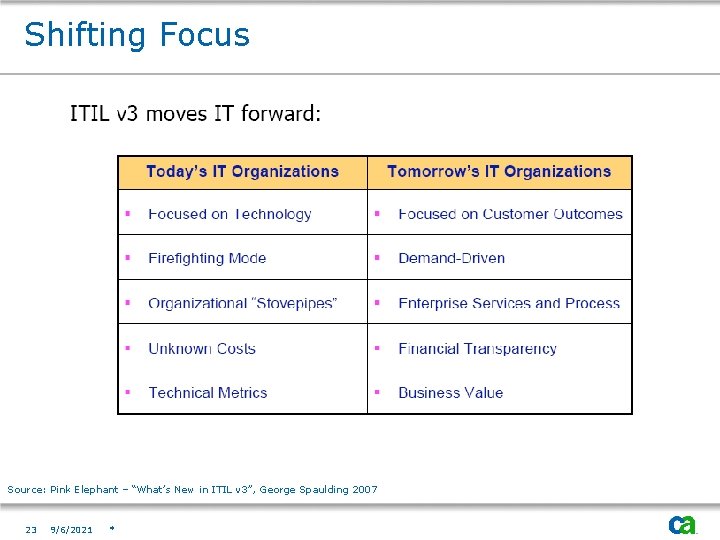
Shifting Focus Source: Pink Elephant – “What’s New in ITIL v 3”, George Spaulding 2007 23 9/6/2021 *
Why ITIL? Why should you implement processes based on the ITIL Framework?
The Case for IT Service Management > The Business is more and more dependent on IT. > Complexity of IT constantly increases. > Customers are demanding more for less. > Global competitiveness growing at a rapid rate requiring a more flexible approach to integration. > Stronger focus on controlling the costs of IT. > Low customer satisfaction levels. 25 9/6/2021 *
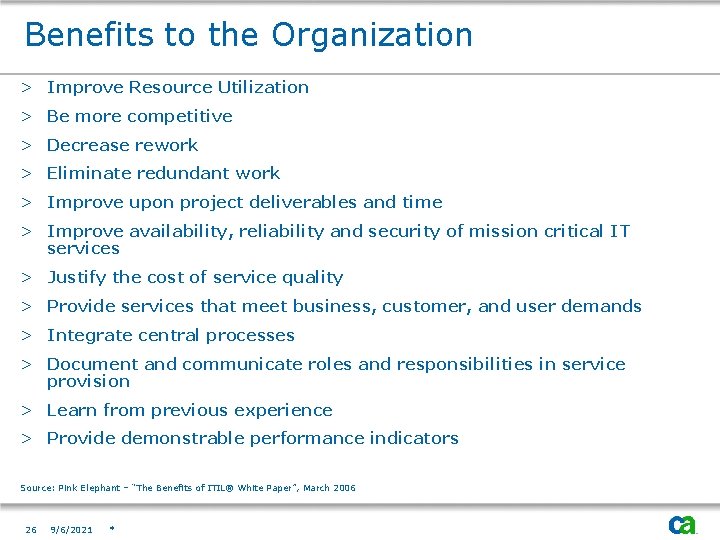
Benefits to the Organization > Improve Resource Utilization > Be more competitive > Decrease rework > Eliminate redundant work > Improve upon project deliverables and time > Improve availability, reliability and security of mission critical IT services > Justify the cost of service quality > Provide services that meet business, customer, and user demands > Integrate central processes > Document and communicate roles and responsibilities in service provision > Learn from previous experience > Provide demonstrable performance indicators Source: Pink Elephant – “The Benefits of ITIL® White Paper”, March 2006 26 9/6/2021 *
Real World Benefits > Procter & Gamble Started using ITIL in 1999 and has realized a 6% to 8% cut in operating costs. Another ITIL project has reduced help desk calls by 10%. In four years, the company reported overall savings of about $500 million. > Caterpillar Embarked on a series of ITIL projects in 2000. After applying ITIL principles, the rate of achieving the target response time for incident management on Web-related services jumped from 60% to more than 90%. > Nationwide Insurance Implementing key ITIL processes in 2001 led to a 40% reduction of its systems outages. The company estimates a $4. 3 million ROI over the next three years. > Capital One An ITIL program that began in 2001 resulted in a 30% reduction in systems crashes and software-distribution errors, and a 92% reduction in “business-critical” incidents by 2003. Source: Pink Elephant – “The Benefits of ITIL® White Paper”, March 2006 27 9/6/2021 *
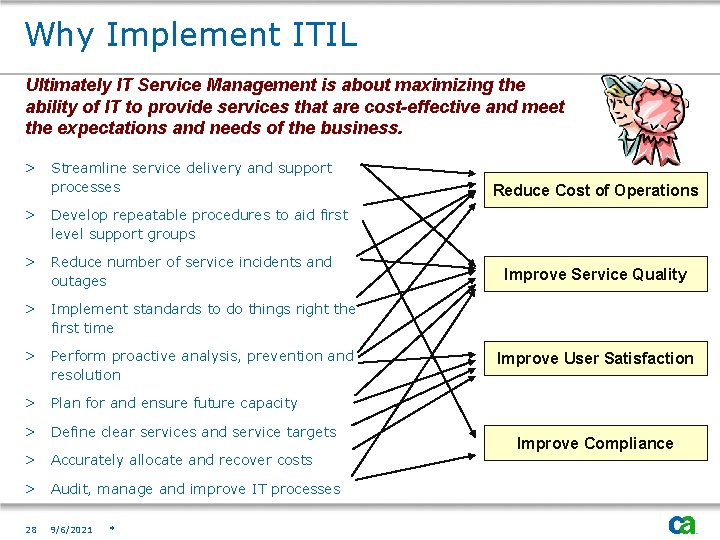
Why Implement ITIL Ultimately IT Service Management is about maximizing the ability of IT to provide services that are cost-effective and meet the expectations and needs of the business. > Streamline service delivery and support processes > Develop repeatable procedures to aid first level support groups > Reduce number of service incidents and outages > Implement standards to do things right the first time > Perform proactive analysis, prevention and resolution > Plan for and ensure future capacity > Define clear services and service targets > Accurately allocate and recover costs > Audit, manage and improve IT processes 28 9/6/2021 * Reduce Cost of Operations Improve Service Quality Improve User Satisfaction Improve Compliance
The How ITIL Implementation Best Practices
ITIL is not a step-by-step process “ITIL Processes can be difficult to implement since ITIL in it's current form describes the "what" but not the "how" of IT service delivery. In other words, a lack of implementation tools and best practices are increasing costs and timelines related to ITIL implementation. ” 30 9/6/2021 *
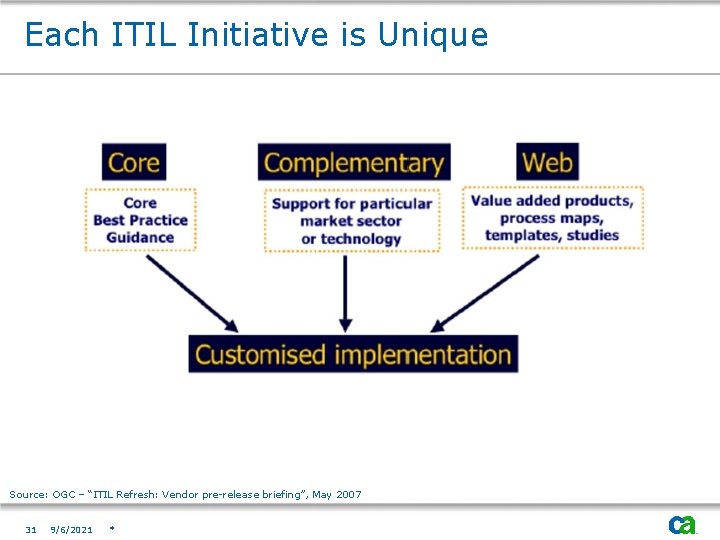
Each ITIL Initiative is Unique Source: OGC – “ITIL Refresh: Vendor pre-release briefing”, May 2007 31 9/6/2021 *
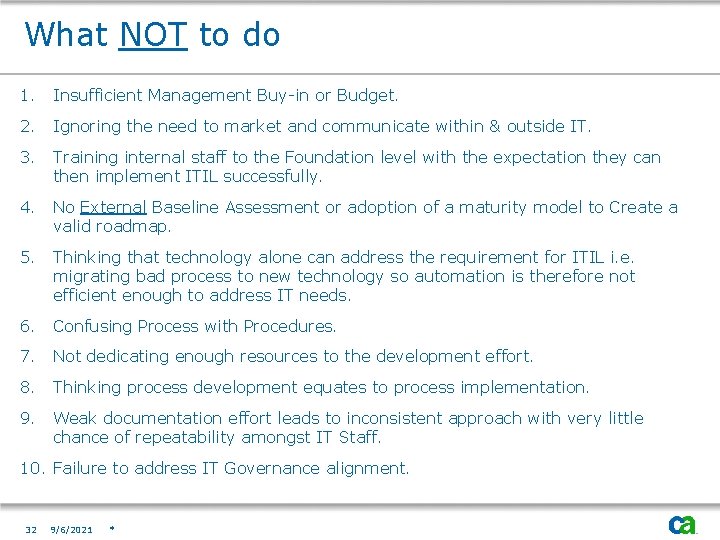
What NOT to do 1. Insufficient Management Buy-in or Budget. 2. Ignoring the need to market and communicate within & outside IT. 3. Training internal staff to the Foundation level with the expectation they can then implement ITIL successfully. 4. No External Baseline Assessment or adoption of a maturity model to Create a valid roadmap. 5. Thinking that technology alone can address the requirement for ITIL i. e. migrating bad process to new technology so automation is therefore not efficient enough to address IT needs. 6. Confusing Process with Procedures. 7. Not dedicating enough resources to the development effort. 8. Thinking process development equates to process implementation. 9. Weak documentation effort leads to inconsistent approach with very little chance of repeatability amongst IT Staff. 10. Failure to address IT Governance alignment. 32 9/6/2021 *
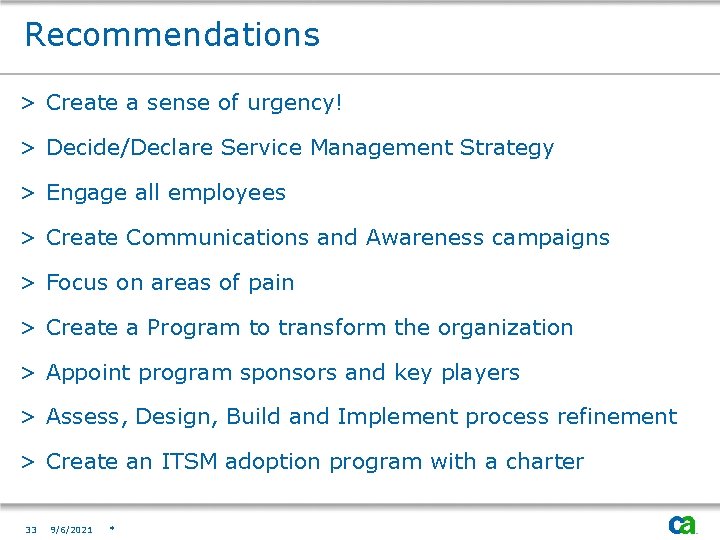
Recommendations > Create a sense of urgency! > Decide/Declare Service Management Strategy > Engage all employees > Create Communications and Awareness campaigns > Focus on areas of pain > Create a Program to transform the organization > Appoint program sponsors and key players > Assess, Design, Build and Implement process refinement > Create an ITSM adoption program with a charter 33 9/6/2021 *
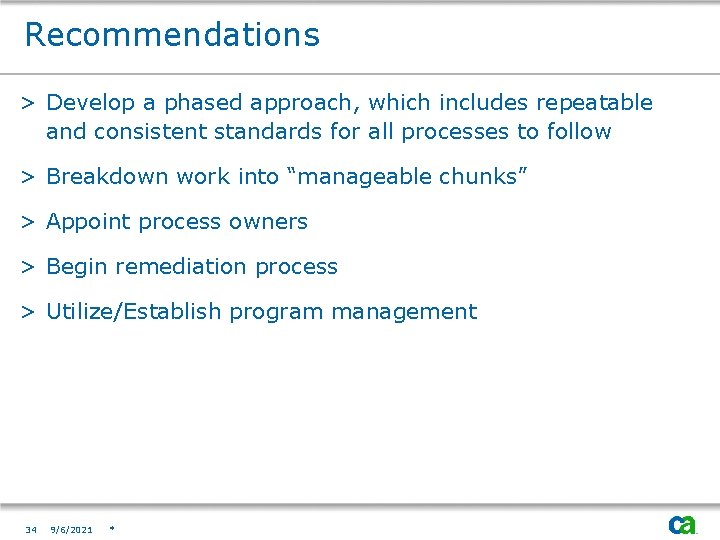
Recommendations > Develop a phased approach, which includes repeatable and consistent standards for all processes to follow > Breakdown work into “manageable chunks” > Appoint process owners > Begin remediation process > Utilize/Establish program management 34 9/6/2021 *
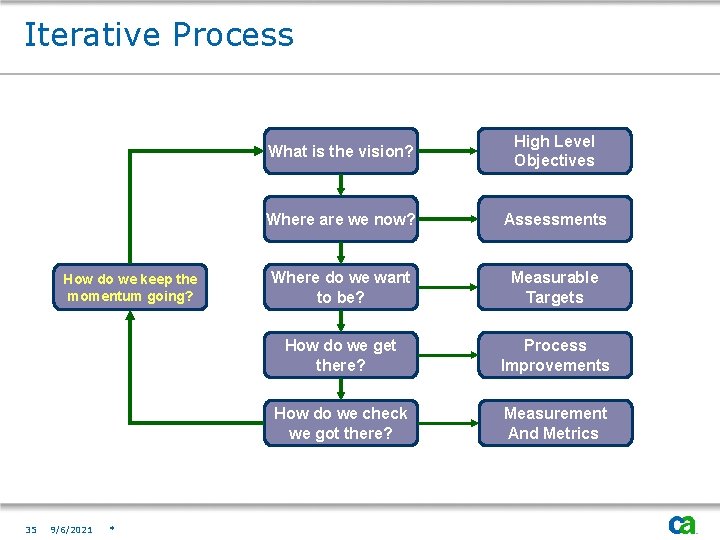
Iterative Process How do we keep the momentum going? 35 9/6/2021 * What is the vision? High Level Objectives Where are we now? Assessments Where do we want to be? Measurable Targets How do we get there? Process Improvements How do we check we got there? Measurement And Metrics
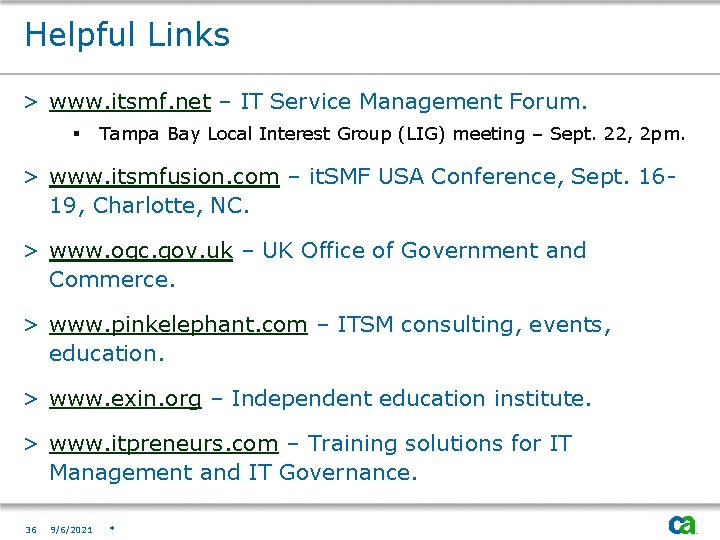
Helpful Links > www. itsmf. net – IT Service Management Forum. § Tampa Bay Local Interest Group (LIG) meeting – Sept. 22, 2 pm. > www. itsmfusion. com – it. SMF USA Conference, Sept. 1619, Charlotte, NC. > www. ogc. gov. uk – UK Office of Government and Commerce. > www. pinkelephant. com – ITSM consulting, events, education. > www. exin. org – Independent education institute. > www. itpreneurs. com – Training solutions for IT Management and IT Governance. 36 9/6/2021 *
Questions? For More Information: T. C. Kaiser Sr. Customer Solution Architect CA, Inc. Thomas. Kaiser@ca. com 813 -731 -7720 mobile 37 9/6/2021 *