
ITI 1120 Lab 9 Slides by Diana Inkpen
ITI 1120 Lab #9 Slides by: Diana Inkpen and Alan Williams
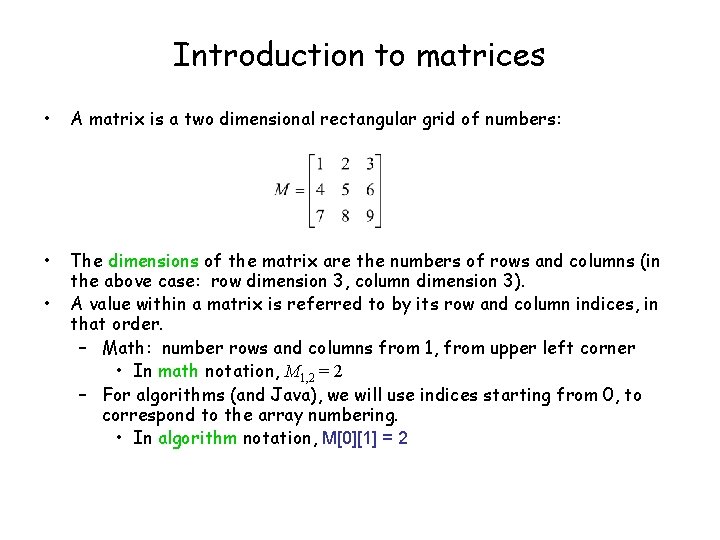
Introduction to matrices • A matrix is a two dimensional rectangular grid of numbers: • The dimensions of the matrix are the numbers of rows and columns (in the above case: row dimension 3, column dimension 3). A value within a matrix is referred to by its row and column indices, in that order. – Math: number rows and columns from 1, from upper left corner • In math notation, M 1, 2 = 2 – For algorithms (and Java), we will use indices starting from 0, to correspond to the array numbering. • In algorithm notation, M[0][1] = 2 •
Matrix element processing • To visit every element of an array, we had to use a loop. • To visit every element of a matrix, we need to use a loop inside a loop: – Outer loop: go through each row of a matrix – Inner loop: go through each column within one row of a matrix.

Matrix example Write an algorithm that finds the sum of the upper triangle of a square matrix (i. e. the diagonal and up). 0 M = 1 2 3 4 1 4 5 3 2 6 3 6 4 3 6 7 2 3 4 2 2 4 2 3 8 3 5 0 1 2 3 4 How do we know if an element of a square matrix is on or above the main diagonal? line_index <= column_index
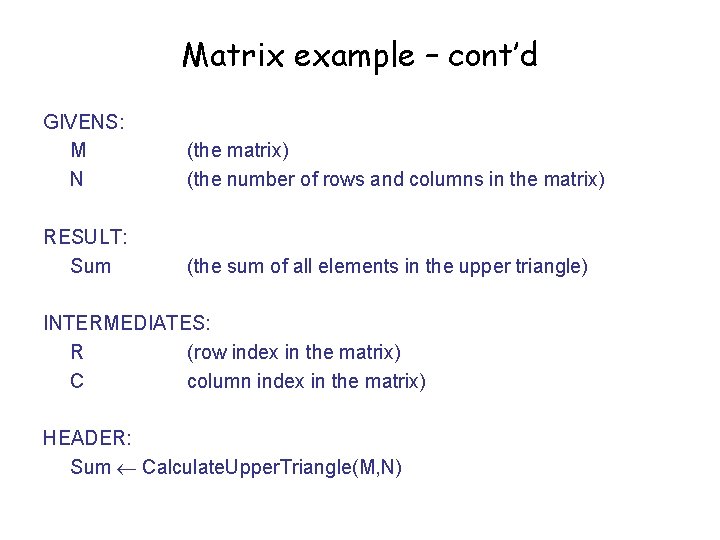
Matrix example – cont’d GIVENS: M N (the matrix) (the number of rows and columns in the matrix) RESULT: Sum (the sum of all elements in the upper triangle) INTERMEDIATES: R (row index in the matrix) C column index in the matrix) HEADER: Sum Calculate. Upper. Triangle(M, N)
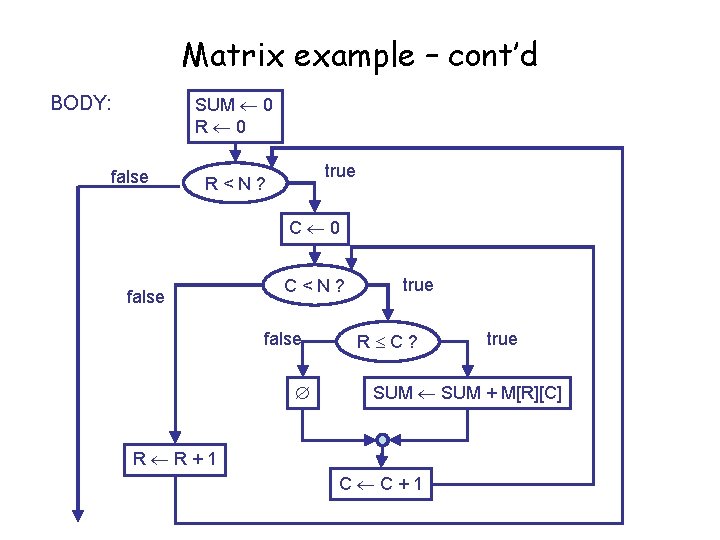
Matrix example – cont’d BODY: SUM 0 R 0 false true R<N? C 0 false C<N? false true R C? true SUM + M[R][C] R R+1 C C+1
Files needed for this lab • Wind. Chill. java – For example 1. • ITI 1120. java – For reading in arrays for example 1. • Matrix. Lib. java – For reading and printing matrices
Matrix Example 1: Objective 1. Design an algorithm that will create a matrix of wind chill values for various temperatures and wind speeds. – – – The set of temperatures will be stored in an array The set of wind speeds will be stored in a second array An algorithm is already available that calculates the wind chill for a specific temperature and wind speed. 2. Implement the algorithm in Java. • For those of you who haven’t yet experienced an Ottawa winter, you may want to keep the results for future use
Given algorithm: Wind Chill calculation • Suppose we are given the following algorithm: Chill Wind. Chill( Temperature, Wind. Speed ) that calculates the wind chill for a given temperature in °C, and wind speed in km/hr. • Restrictions: – Wind. Speed 5. 0 km/hr – Temperature should be between -50. 0°C and +5. 0°C. • More info: http: //www. msc. ec. gc. ca/education/windchill/
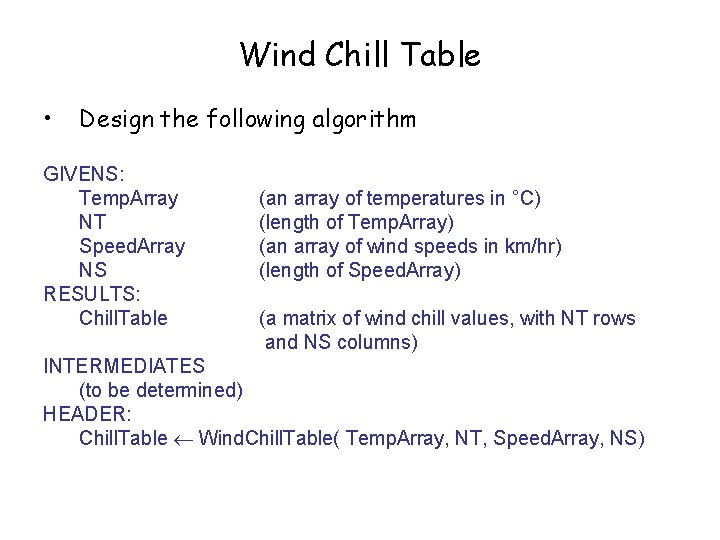
Wind Chill Table • Design the following algorithm GIVENS: Temp. Array NT Speed. Array NS RESULTS: Chill. Table (an array of temperatures in °C) (length of Temp. Array) (an array of wind speeds in km/hr) (length of Speed. Array) (a matrix of wind chill values, with NT rows and NS columns) INTERMEDIATES (to be determined) HEADER: Chill. Table Wind. Chill. Table( Temp. Array, NT, Speed. Array, NS)
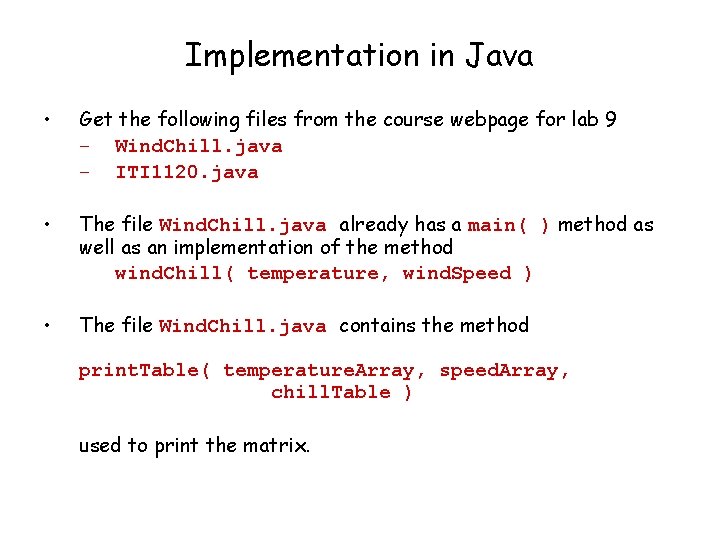
Implementation in Java • Get the following files from the course webpage for lab 9 – Wind. Chill. java – ITI 1120. java • The file Wind. Chill. java already has a main( ) method as well as an implementation of the method wind. Chill( temperature, wind. Speed ) • The file Wind. Chill. java contains the method print. Table( temperature. Array, speed. Array, chill. Table ) used to print the matrix.
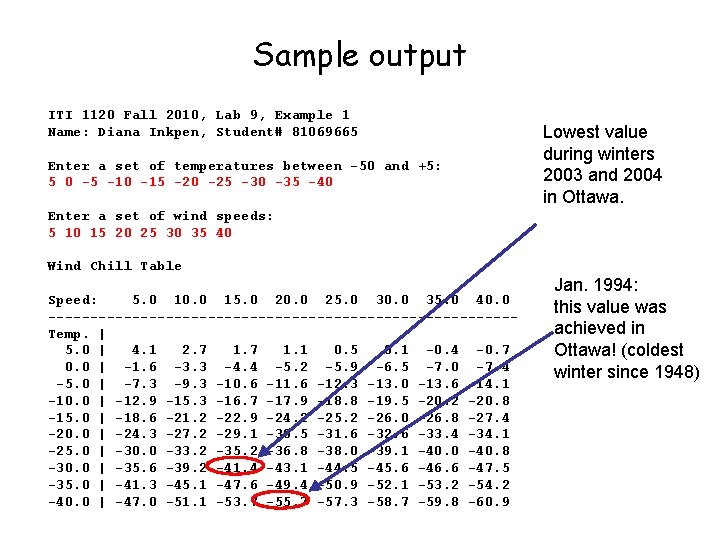
Sample output ITI 1120 Fall 2010, Lab 9, Example 1 Name: Diana Inkpen, Student# 81069665 Enter a set of temperatures between -50 and +5: 5 0 -5 -10 -15 -20 -25 -30 -35 -40 Lowest value during winters 2003 and 2004 in Ottawa. Enter a set of wind speeds: 5 10 15 20 25 30 35 40 Wind Chill Table Speed: 5. 0 10. 0 15. 0 20. 0 25. 0 30. 0 35. 0 40. 0 ----------------------------Temp. | 5. 0 | 4. 1 2. 7 1. 1 0. 5 0. 1 -0. 4 -0. 7 0. 0 | -1. 6 -3. 3 -4. 4 -5. 2 -5. 9 -6. 5 -7. 0 -7. 4 -5. 0 | -7. 3 -9. 3 -10. 6 -11. 6 -12. 3 -13. 0 -13. 6 -14. 1 -10. 0 | -12. 9 -15. 3 -16. 7 -17. 9 -18. 8 -19. 5 -20. 2 -20. 8 -15. 0 | -18. 6 -21. 2 -22. 9 -24. 2 -25. 2 -26. 0 -26. 8 -27. 4 -20. 0 | -24. 3 -27. 2 -29. 1 -30. 5 -31. 6 -32. 6 -33. 4 -34. 1 -25. 0 | -30. 0 -33. 2 -35. 2 -36. 8 -38. 0 -39. 1 -40. 0 -40. 8 -30. 0 | -35. 6 -39. 2 -41. 4 -43. 1 -44. 5 -45. 6 -46. 6 -47. 5 -35. 0 | -41. 3 -45. 1 -47. 6 -49. 4 -50. 9 -52. 1 -53. 2 -54. 2 -40. 0 | -47. 0 -51. 1 -53. 7 -55. 7 -57. 3 -58. 7 -59. 8 -60. 9 Jan. 1994: this value was achieved in Ottawa! (coldest winter since 1948)
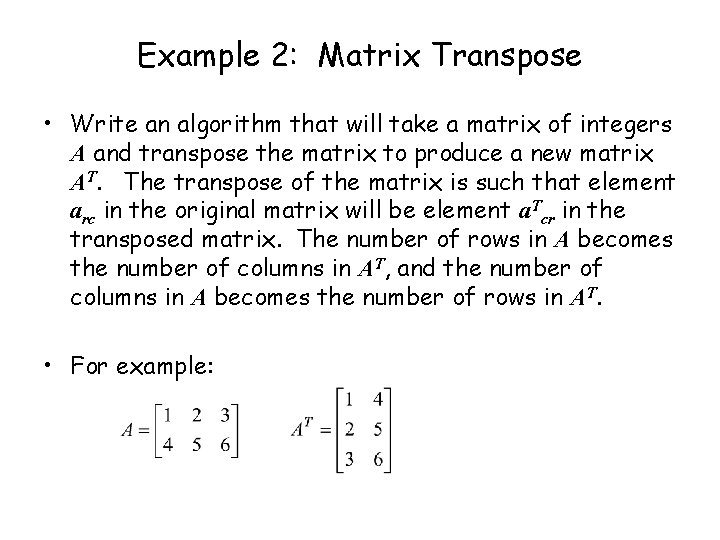
Example 2: Matrix Transpose • Write an algorithm that will take a matrix of integers A and transpose the matrix to produce a new matrix AT. The transpose of the matrix is such that element arc in the original matrix will be element a. Tcr in the transposed matrix. The number of rows in A becomes the number of columns in AT, and the number of columns in A becomes the number of rows in AT. • For example:
Translate to Java • Translate your matrix transpose algorithm to Java • The header of the method should be as follows: public static int[][] transpose( int[][] a ) • Get the following file from the labs webpage – Matrix. Lib. java • The file Matrix. Lib. java has the following useful methods: – Method to read a matrix of integers, of specified dimension. public static int[][] read. Int. Matrix( int num. Rows, int num. Cols ) – Method to print a matrix of integers with nice formatting. public static void print. Matrix( int[][] matrix )
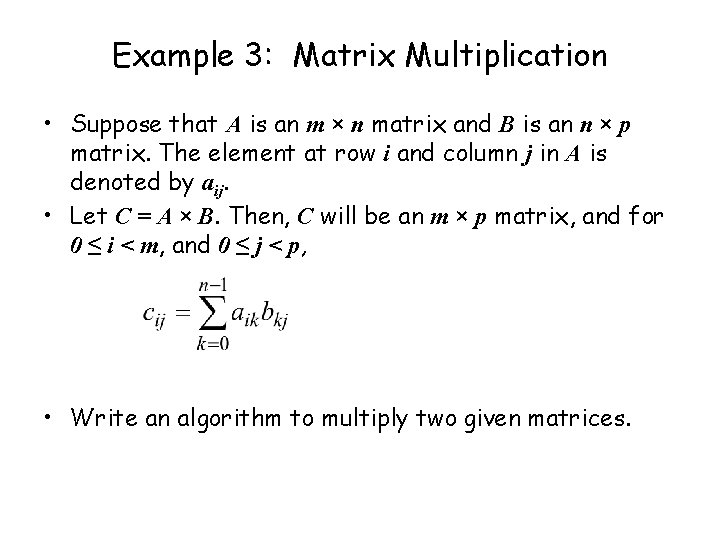
Example 3: Matrix Multiplication • Suppose that A is an m × n matrix and B is an n × p matrix. The element at row i and column j in A is denoted by aij. • Let C = A × B. Then, C will be an m × p matrix, and for 0 ≤ i < m, and 0 ≤ j < p, • Write an algorithm to multiply two given matrices.
Translate to Java • Translate your matrix multiplication algorithm to Java • The header of the method should be as follows: public static int[][] product( int[][] a, int[][] b ) • Use the methods from Matrix. Lib. java to read and print the matrices.
- Slides: 16