
ITER plasma rotation and Ti profiles from highresolution

- Slides: 26
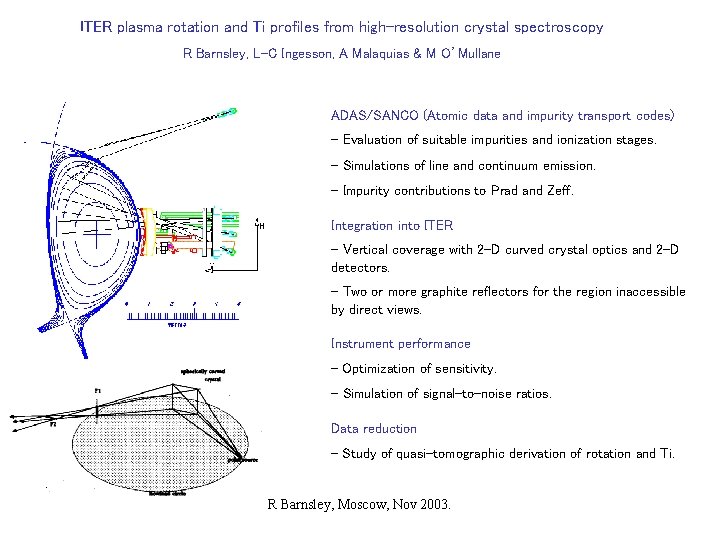
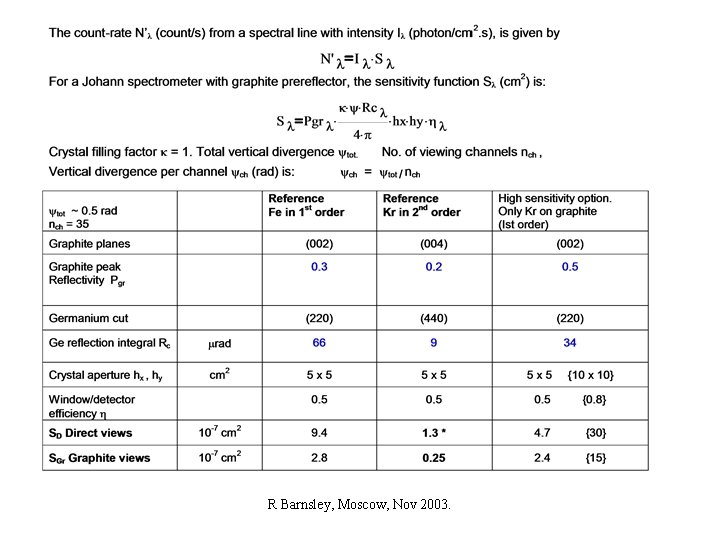
ITER plasma rotation and Ti profiles from high-resolution crystal spectroscopy R Barnsley, L-C Ingesson, A Malaquias & M O’Mullane ADAS/SANCO (Atomic data and impurity transport codes) - Evaluation of suitable impurities and ionization stages. - Simulations of line and continuum emission. - Impurity contributions to Prad and Zeff. Integration into ITER - Vertical coverage with 2 -D curved crystal optics and 2 -D detectors. - Two or more graphite reflectors for the region inaccessible by direct views. Instrument performance - Optimization of sensitivity. - Simulation of signal-to-noise ratios. Data reduction - Study of quasi-tomographic derivation of rotation and Ti. R Barnsley, Moscow, Nov 2003.
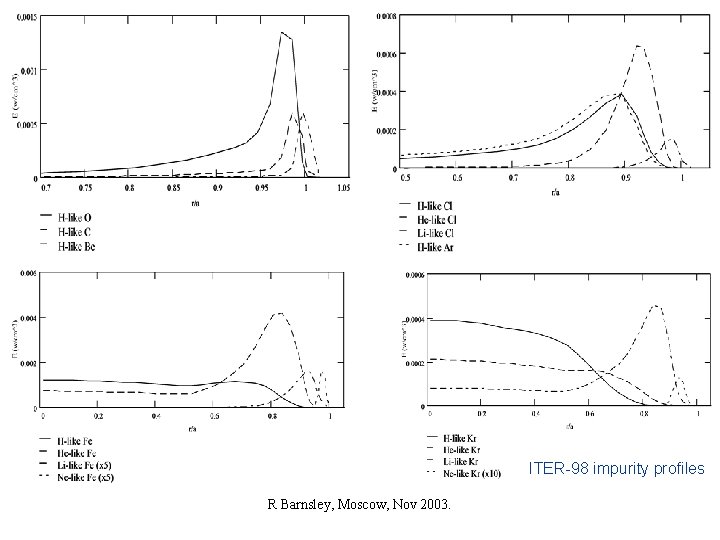
ITER-98 impurity profiles R Barnsley, Moscow, Nov 2003.
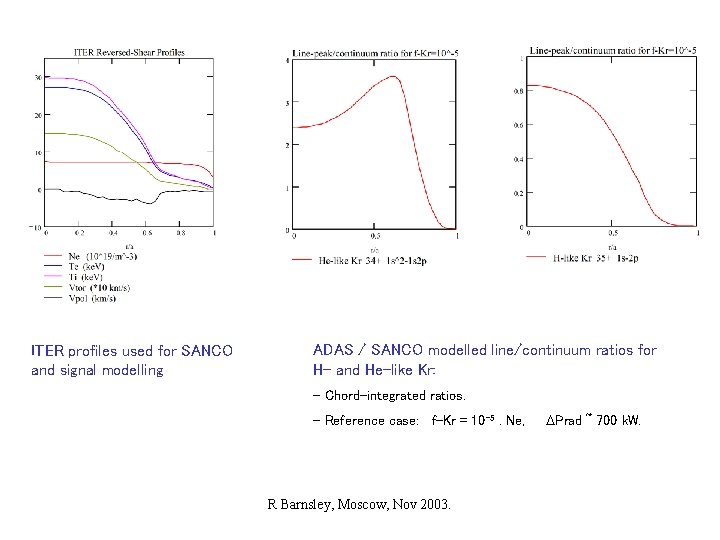
ITER profiles used for SANCO and signal modelling ADAS / SANCO modelled line/continuum ratios for H- and He-like Kr: - Chord-integrated ratios. - Reference case: f-Kr = 10 -5. Ne, R Barnsley, Moscow, Nov 2003. Prad ~ 700 k. W.
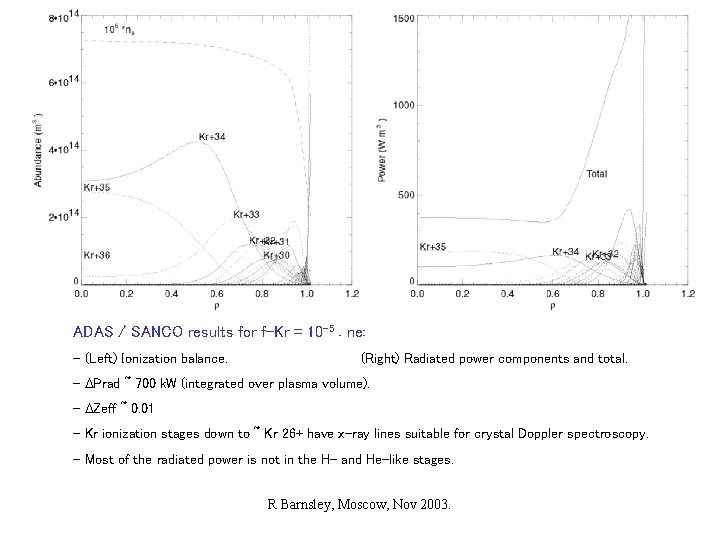
ADAS / SANCO results for f-Kr = 10 -5. ne: - (Left) Ionization balance. (Right) Radiated power components and total. - Prad ~ 700 k. W (integrated over plasma volume). - Zeff ~ 0. 01 - Kr ionization stages down to ~ Kr 26+ have x-ray lines suitable for crystal Doppler spectroscopy. - Most of the radiated power is not in the H- and He-like stages. R Barnsley, Moscow, Nov 2003.
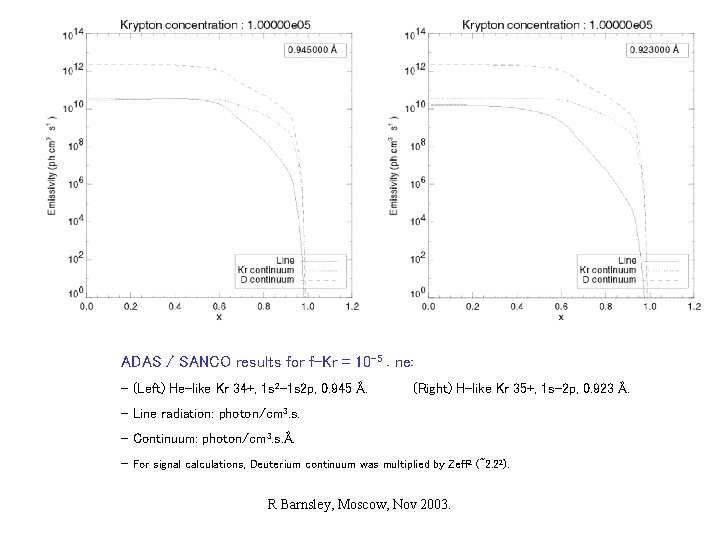
ADAS / SANCO results for f-Kr = 10 -5. ne: - (Left) He-like Kr 34+, 1 s 2 -1 s 2 p, 0. 945 Å. (Right) H-like Kr 35+, 1 s-2 p, 0. 923 Å. - Line radiation: photon/cm 3. s. - Continuum: photon/cm 3. s. Å. - For signal calculations, Deuterium continuum was multiplied by Zeff 2 (~2. 22). R Barnsley, Moscow, Nov 2003.
R Barnsley, Moscow, Nov 2003.
R Barnsley, Moscow, Nov 2003.
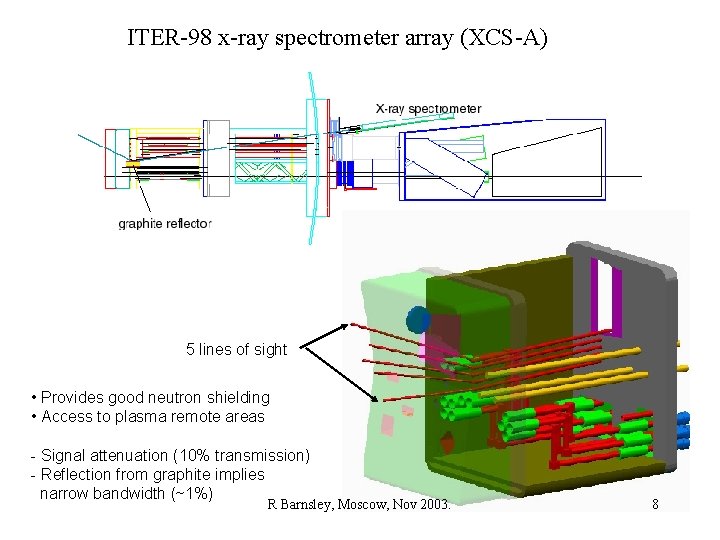
ITER-98 x-ray spectrometer array (XCS-A) 5 lines of sight • Provides good neutron shielding • Access to plasma remote areas - Signal attenuation (10% transmission) - Reflection from graphite implies narrow bandwidth (~1%) R Barnsley, Moscow, Nov 2003. 8
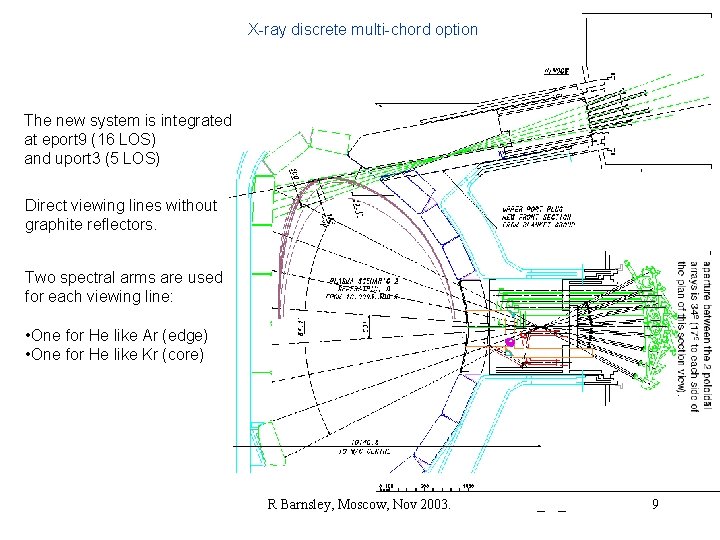
X-ray discrete multi-chord option The new system is integrated at eport 9 (16 LOS) and uport 3 (5 LOS) Direct viewing lines without graphite reflectors. Two spectral arms are used for each viewing line: • One for He like Ar (edge) • One for He like Kr (core) R Barnsley, Moscow, Nov 2003. 9
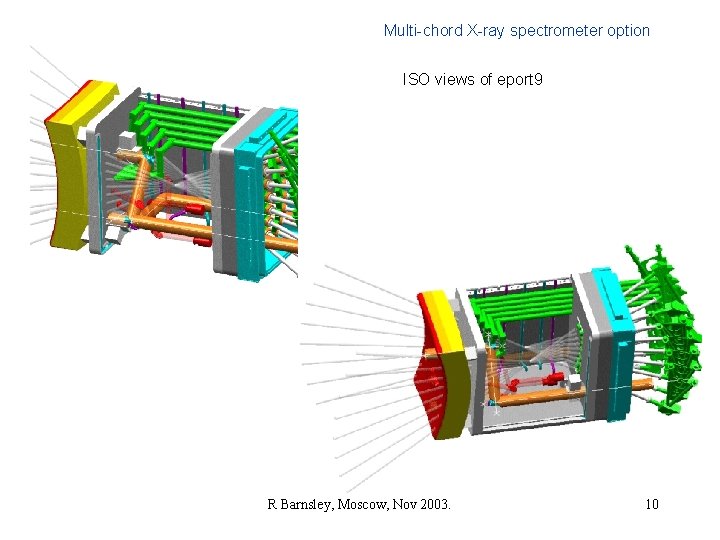
Multi-chord X-ray spectrometer option ISO views of eport 9 R Barnsley, Moscow, Nov 2003. 10
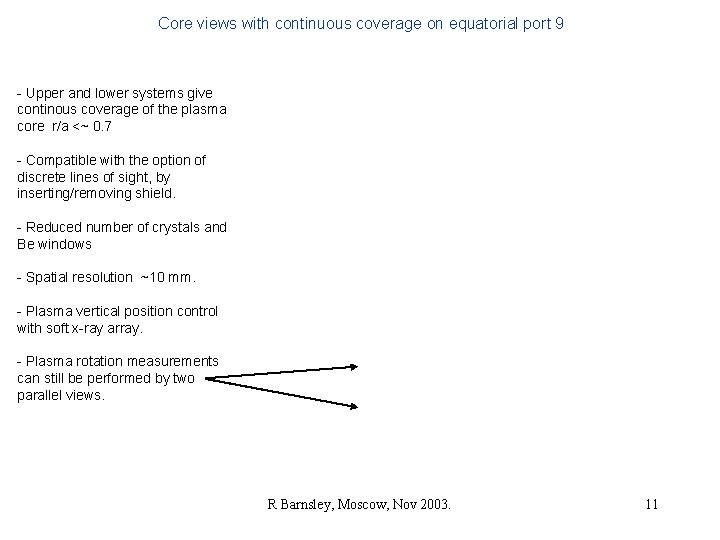
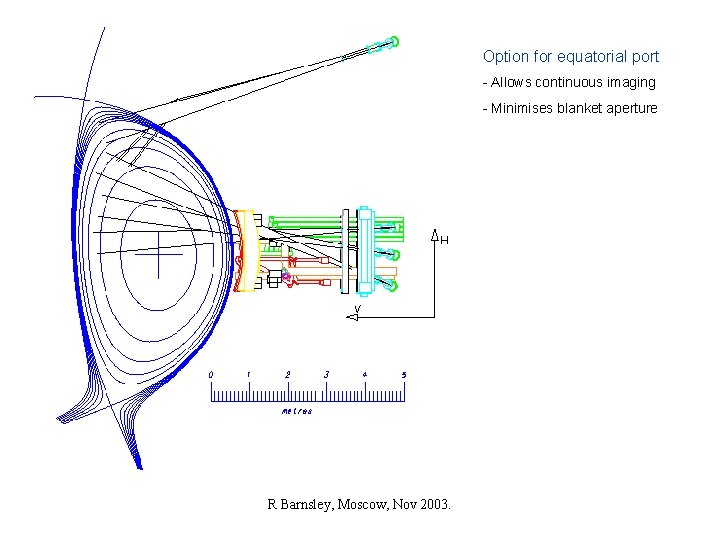
Core views with continuous coverage on equatorial port 9 - Upper and lower systems give continous coverage of the plasma core r/a <~ 0. 7 - Compatible with the option of discrete lines of sight, by inserting/removing shield. - Reduced number of crystals and Be windows - Spatial resolution ~10 mm. - Plasma vertical position control with soft x-ray array. - Plasma rotation measurements can still be performed by two parallel views. R Barnsley, Moscow, Nov 2003. 11
Two or more graphite reflector based lines of sight will complete plasma coverage R Barnsley, Moscow, Nov 2003. 12
Option for equatorial port - Allows continuous imaging - Minimises blanket aperture R Barnsley, Moscow, Nov 2003.
X-ray Views Referred to Mid-plane Profiles R Barnsley, Moscow, Nov 2003. 14
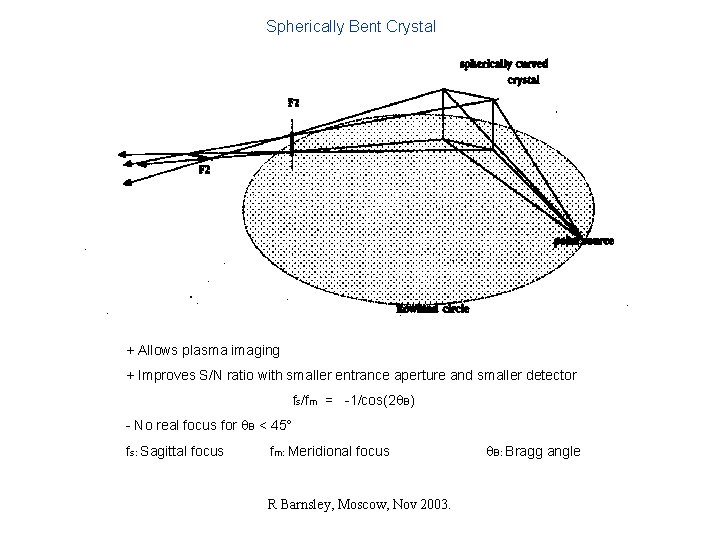
Spherically Bent Crystal + Allows plasma imaging + Improves S/N ratio with smaller entrance aperture and smaller detector fs/fm = -1/cos(2 B) - No real focus for B < 45° fs: Sagittal focus fm: Meridional focus R Barnsley, Moscow, Nov 2003. B: Bragg angle
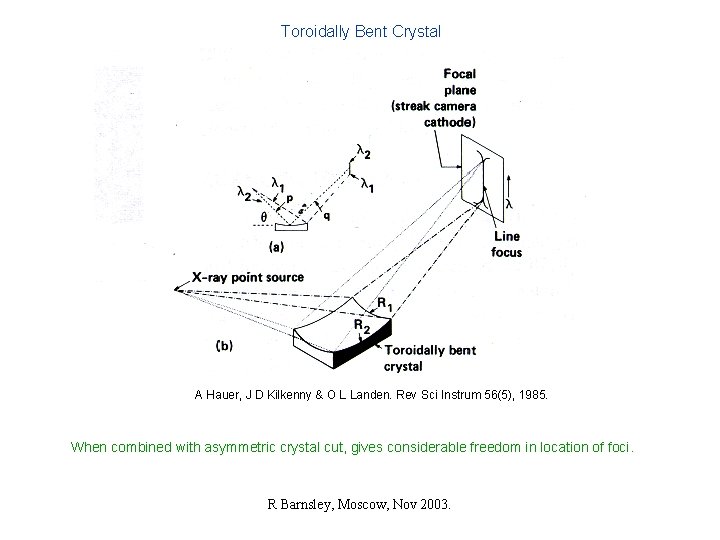
Toroidally Bent Crystal A Hauer, J D Kilkenny & O L Landen. Rev Sci Instrum 56(5), 1985. When combined with asymmetric crystal cut, gives considerable freedom in location of foci. R Barnsley, Moscow, Nov 2003.
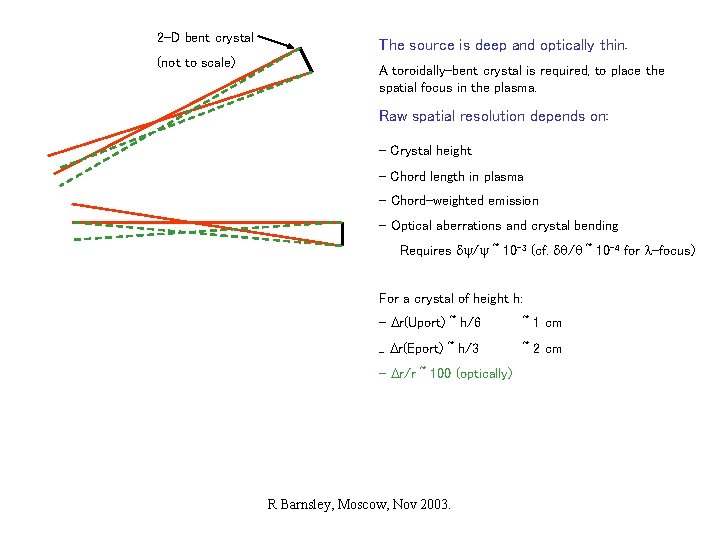
2 -D bent crystal (not to scale) The source is deep and optically thin. A toroidally-bent crystal is required, to place the spatial focus in the plasma. Raw spatial resolution depends on: - Crystal height - Chord length in plasma - Chord-weighted emission - Optical aberrations and crystal bending Requires / ~ 10 -3 (cf. / ~ 10 -4 for -focus) For a crystal of height h: - r(Uport) ~ h/6 ~ 1 cm r(Eport) ~ h/3 ~ 2 cm - - r/r ~ 100 (optically) R Barnsley, Moscow, Nov 2003.
R Barnsley, Moscow, Nov 2003.
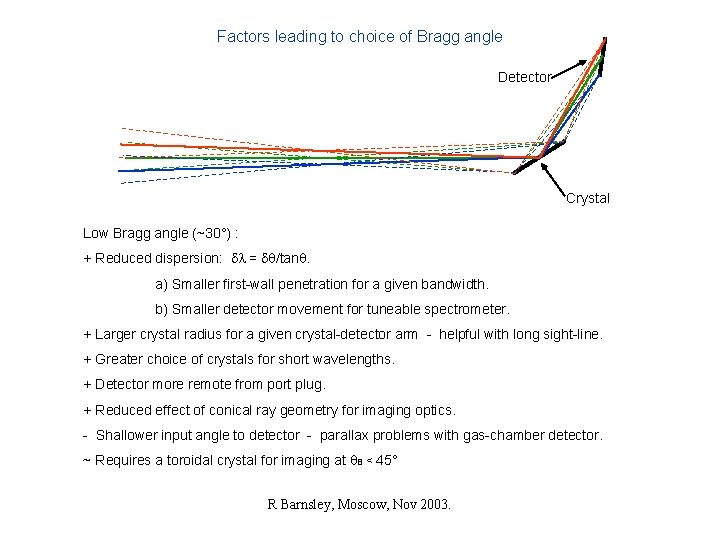
Factors leading to choice of Bragg angle Detector Crystal Low Bragg angle (~30°) : + Reduced dispersion: = /tan. a) Smaller first-wall penetration for a given bandwidth. b) Smaller detector movement for tuneable spectrometer. + Larger crystal radius for a given crystal-detector arm - helpful with long sight-line. + Greater choice of crystals for short wavelengths. + Detector more remote from port plug. + Reduced effect of conical ray geometry for imaging optics. - Shallower input angle to detector - parallax problems with gas-chamber detector. ~ Requires a toroidal crystal for imaging at B < 45° R Barnsley, Moscow, Nov 2003.
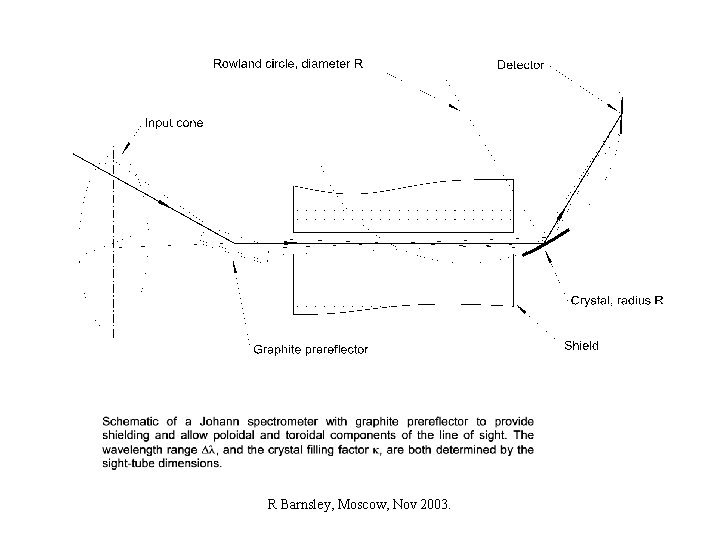
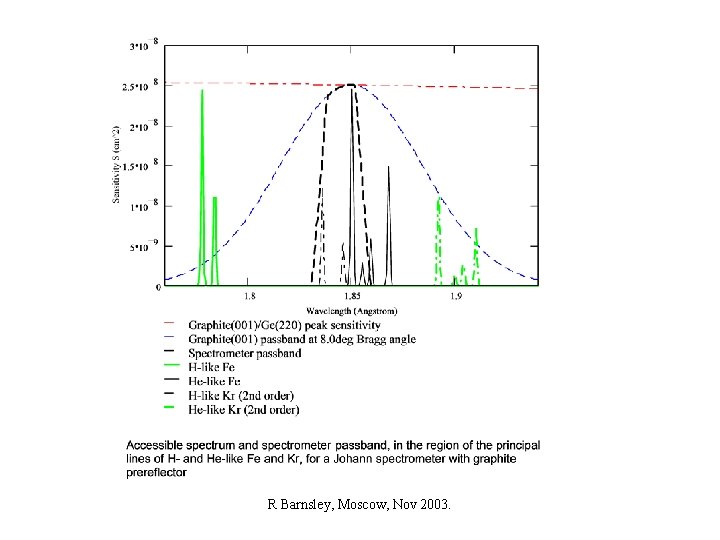
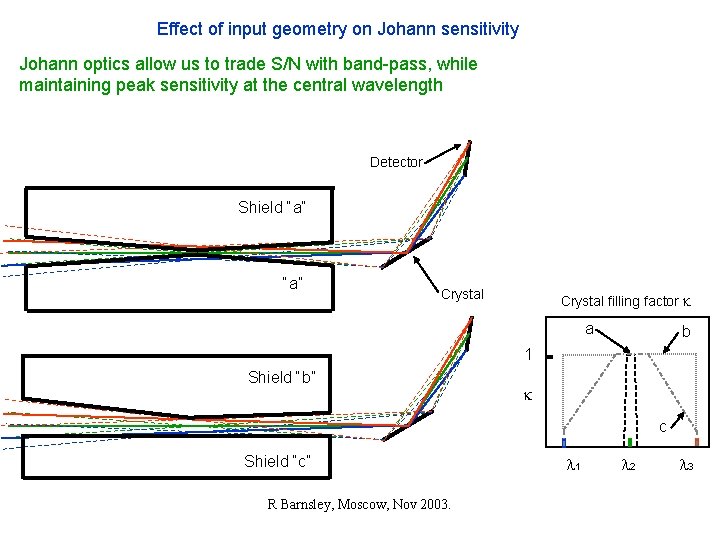
Effect of input geometry on Johann sensitivity Johann optics allow us to trade S/N with band-pass, while maintaining peak sensitivity at the central wavelength Detector Shield “a” Crystal filling factor a b 1 Shield “b” c Shield “c” R Barnsley, Moscow, Nov 2003. 1 2 3
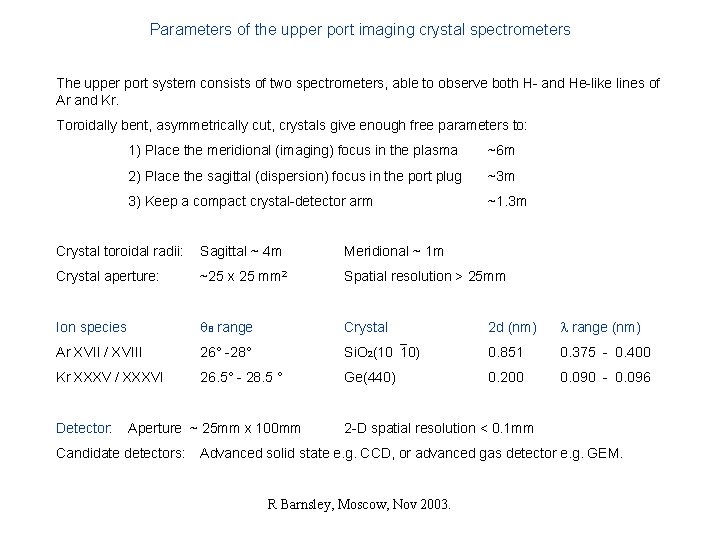
Parameters of the upper port imaging crystal spectrometers The upper port system consists of two spectrometers, able to observe both H- and He-like lines of Ar and Kr. Toroidally bent, asymmetrically cut, crystals give enough free parameters to: 1) Place the meridional (imaging) focus in the plasma ~6 m 2) Place the sagittal (dispersion) focus in the port plug ~3 m 3) Keep a compact crystal-detector arm ~1. 3 m Crystal toroidal radii: Sagittal ~ 4 m Meridional ~ 1 m Crystal aperture: ~25 x 25 mm 2 Spatial resolution > 25 mm Ion species B range Crystal 2 d (nm) range (nm) Ar XVII / XVIII 26° -28° Si. O 2(10 10) 0. 851 0. 375 - 0. 400 Kr XXXV / XXXVI 26. 5° - 28. 5 ° Ge(440) 0. 200 0. 090 - 0. 096 Detector: Aperture ~ 25 mm x 100 mm Candidate detectors: 2 -D spatial resolution < 0. 1 mm Advanced solid state e. g. CCD, or advanced gas detector e. g. GEM. R Barnsley, Moscow, Nov 2003.
R Barnsley, Moscow, Nov 2003.
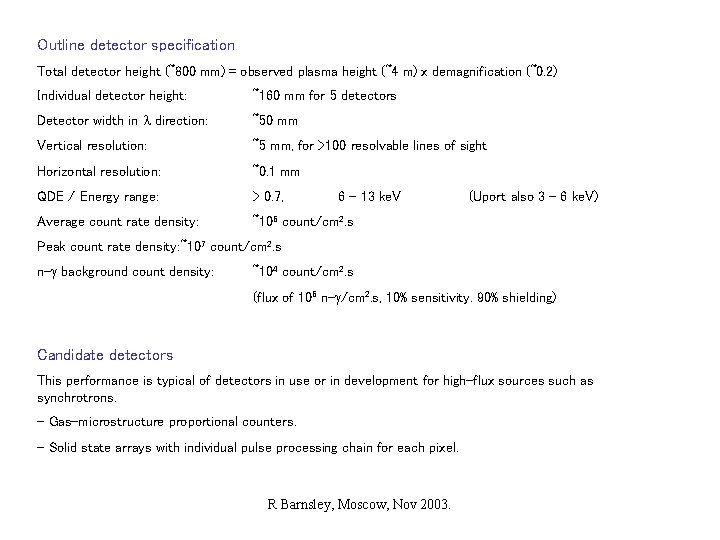
Outline detector specification Total detector height (~800 mm) = observed plasma height (~4 m) x demagnification (~0. 2) Individual detector height: ~160 mm for 5 detectors Detector width in direction: ~50 mm Vertical resolution: ~5 mm, for >100 resolvable lines of sight Horizontal resolution: ~0. 1 mm QDE / Energy range: > 0. 7, Average count rate density: ~106 count/cm 2. s 6 – 13 ke. V (Uport also 3 – 6 ke. V) Peak count rate density: ~107 count/cm 2. s n- background count density: ~104 count/cm 2. s (flux of 106 n- /cm 2. s, 10% sensitivity. 90% shielding) Candidate detectors This performance is typical of detectors in use or in development for high-flux sources such as synchrotrons. - Gas-microstructure proportional counters. - Solid state arrays with individual pulse processing chain for each pixel. R Barnsley, Moscow, Nov 2003.
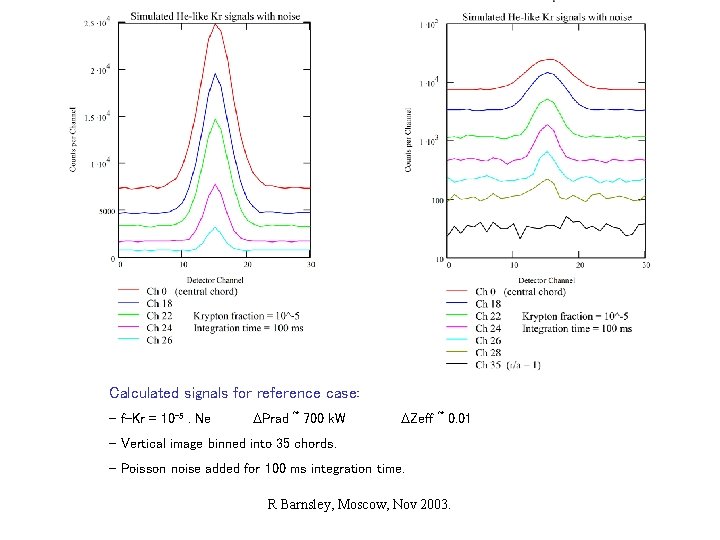
Calculated signals for reference case: - f-Kr = 10 -5. Ne Prad ~ 700 k. W Zeff ~ 0. 01 - Vertical image binned into 35 chords. - Poisson noise added for 100 ms integration time. R Barnsley, Moscow, Nov 2003.
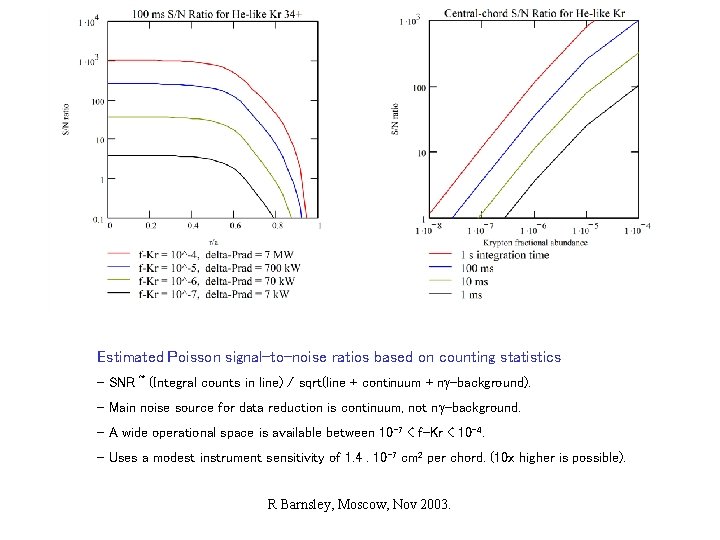
Estimated Poisson signal-to-noise ratios based on counting statistics - SNR ~ (Integral counts in line) / sqrt(line + continuum + n -background). - Main noise source for data reduction is continuum, not n -background. - A wide operational space is available between 10 -7 < f-Kr < 10 -4. - Uses a modest instrument sensitivity of 1. 4. 10 -7 cm 2 per chord. (10 x higher is possible). R Barnsley, Moscow, Nov 2003.
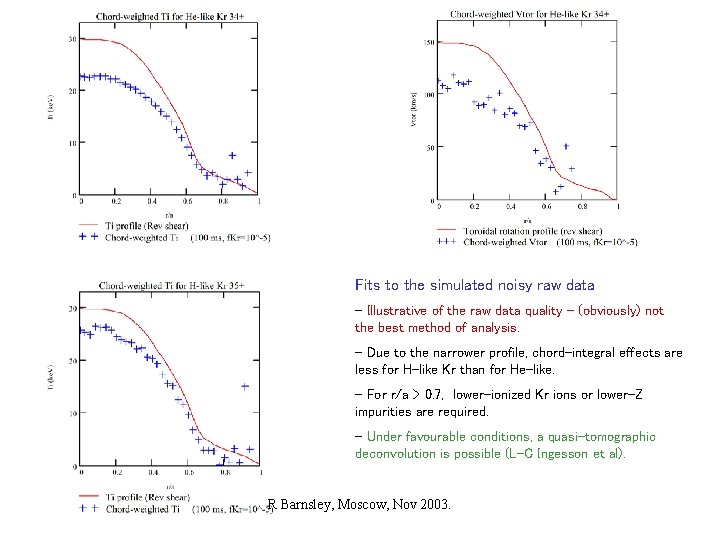
Fits to the simulated noisy raw data - Illustrative of the raw data quality – (obviously) not the best method of analysis. - Due to the narrower profile, chord-integral effects are less for H-like Kr than for He-like. - For r/a > 0. 7, lower-ionized Kr ions or lower-Z impurities are required. - Under favourable conditions, a quasi-tomographic deconvolution is possible (L-C Ingesson et al). R Barnsley, Moscow, Nov 2003.