
Item Sum A New Technique for Asking Quantitative
- Slides: 24
Item Sum: A New Technique for Asking Quantitative Sensitive Questions CESS 2018, Bamberg Mark Trappmann (IAB / Universität Bamberg) Ivar Krumpal (Universität of Leipzig) Antje Kirchner (University of Nebraska at Lincoln) Ben Jann (Universität Bern)
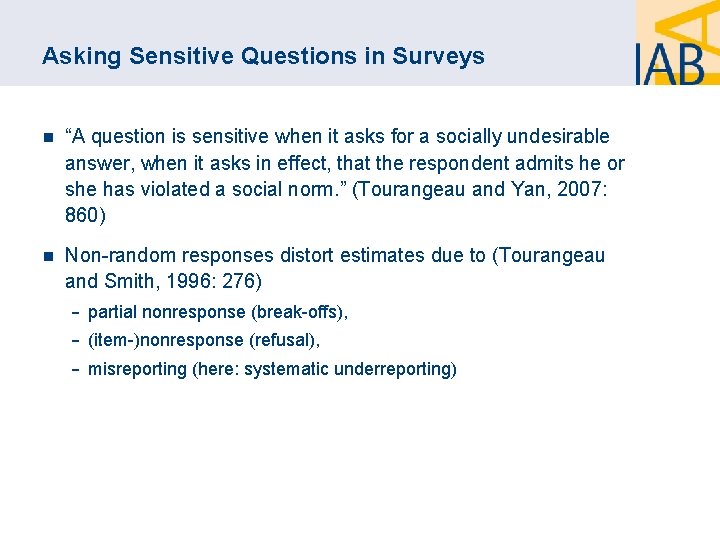
Asking Sensitive Questions in Surveys n “A question is sensitive when it asks for a socially undesirable answer, when it asks in effect, that the respondent admits he or she has violated a social norm. ” (Tourangeau and Yan, 2007: 860) n Non-random responses distort estimates due to (Tourangeau and Smith, 1996: 276) ‐ partial nonresponse (break-offs), ‐ (item-)nonresponse (refusal), ‐ misreporting (here: systematic underreporting) 2
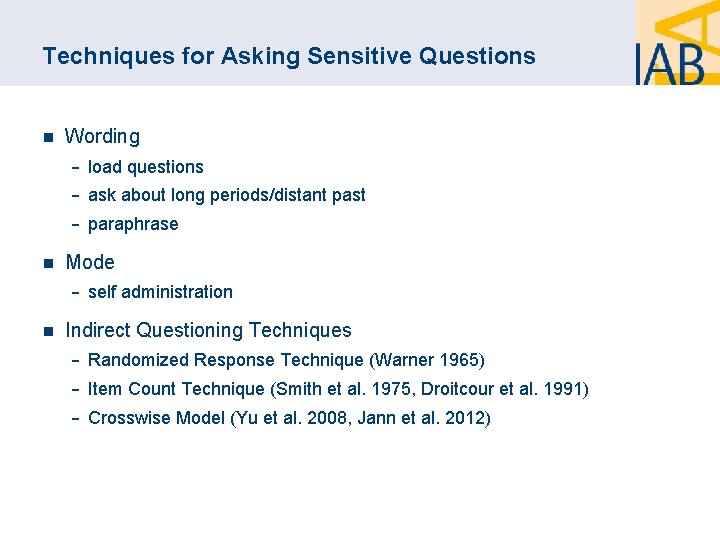
Techniques for Asking Sensitive Questions n Wording ‐ load questions ‐ ask about long periods/distant past ‐ paraphrase n Mode ‐ self administration n Indirect Questioning Techniques ‐ Randomized Response Technique (Warner 1965) ‐ Item Count Technique (Smith et al. 1975, Droitcour et al. 1991) ‐ Crosswise Model (Yu et al. 2008, Jann et al. 2012) 3
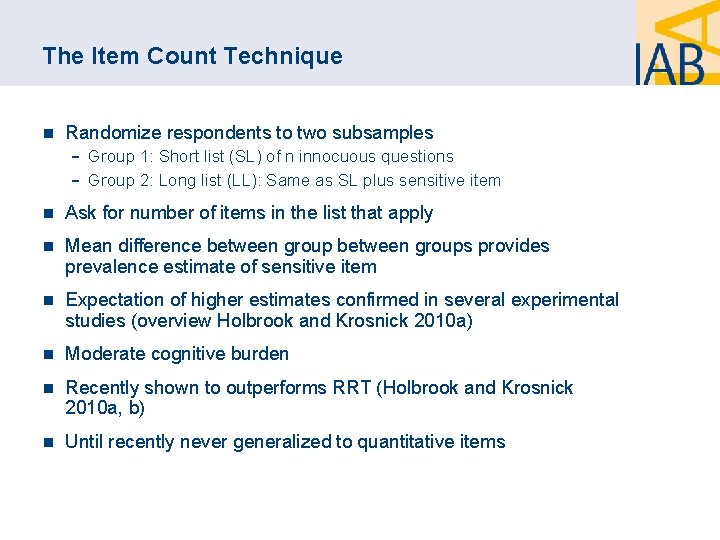
The Item Count Technique n Randomize respondents to two subsamples ‐ Group 1: Short list (SL) of n innocuous questions ‐ Group 2: Long list (LL): Same as SL plus sensitive item n Ask for number of items in the list that apply n Mean difference between groups provides prevalence estimate of sensitive item n Expectation of higher estimates confirmed in several experimental studies (overview Holbrook and Krosnick 2010 a) n Moderate cognitive burden n Recently shown to outperforms RRT (Holbrook and Krosnick 2010 a, b) n Until recently never generalized to quantitative items 4
The Item Sum Technique: Basic Idea n Generalization of the IST n Same randomization to SL and LL n Ask for the sum of values of a list instead of the number of items that apply 5
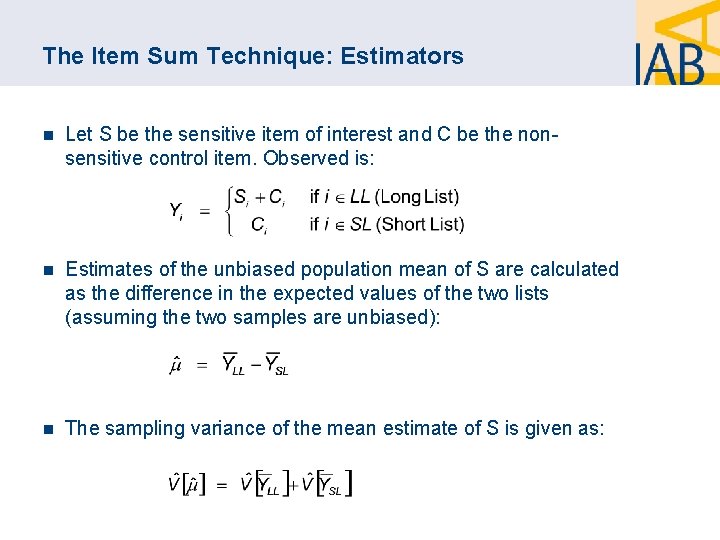
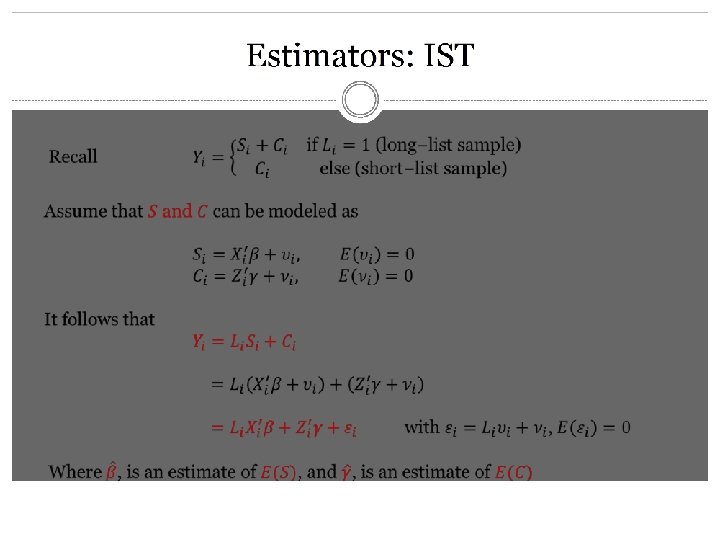
The Item Sum Technique: Estimators n Let S be the sensitive item of interest and C be the nonsensitive control item. Observed is: n Estimates of the unbiased population mean of S are calculated as the difference in the expected values of the two lists (assuming the two samples are unbiased): n The sampling variance of the mean estimate of S is given as: 6
Application: Measurement of Undeclared Work n Obviously sensitive topic: norm violation punishable by law ‐ socially undesirable ‐ fear of disclosure n In spite of this: No nationwide studies in Germany using dejeopardizing techniques (Boockmann et al. 2010) n Wide range of prevalence estimates from existing studies 7
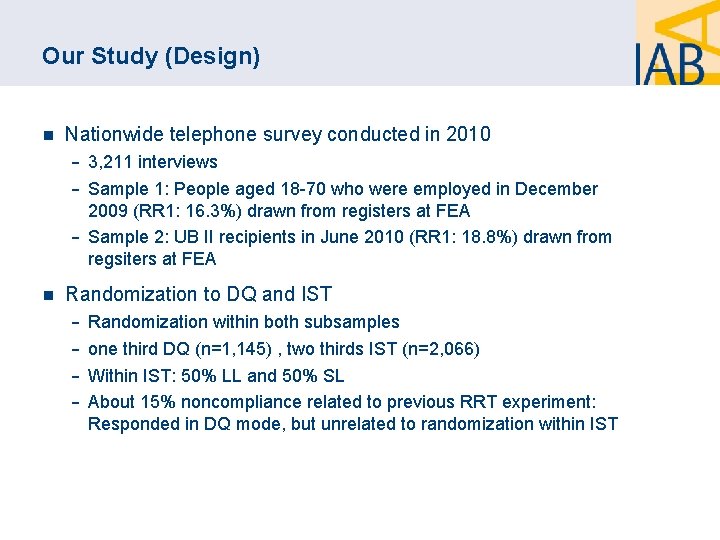
Our Study (Design) n Nationwide telephone survey conducted in 2010 ‐ 3, 211 interviews ‐ Sample 1: People aged 18 -70 who were employed in December 2009 (RR 1: 16. 3%) drawn from registers at FEA ‐ Sample 2: UB II recipients in June 2010 (RR 1: 18. 8%) drawn from regsiters at FEA n Randomization to DQ and IST ‐ Randomization within both subsamples ‐ one third DQ (n=1, 145) , two thirds IST (n=2, 066) ‐ Within IST: 50% LL and 50% SL ‐ About 15% noncompliance related to previous RRT experiment: Responded in DQ mode, but unrelated to randomization within IST 8
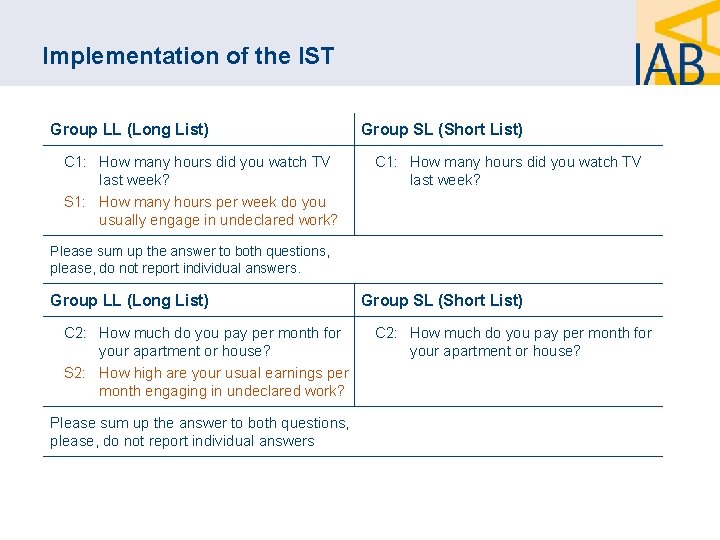
Implementation of the IST Group LL (Long List) C 1: How many hours did you watch TV last week? S 1: How many hours per week do you usually engage in undeclared work? Group SL (Short List) C 1: How many hours did you watch TV last week? Please sum up the answer to both questions, please, do not report individual answers. Group LL (Long List) C 2: How much do you pay per month for your apartment or house? S 2: How high are your usual earnings per month engaging in undeclared work? Group SL (Short List) C 2: How much do you pay per month for your apartment or house? Please sum up the answer to both questions, please, do not report individual answers 9
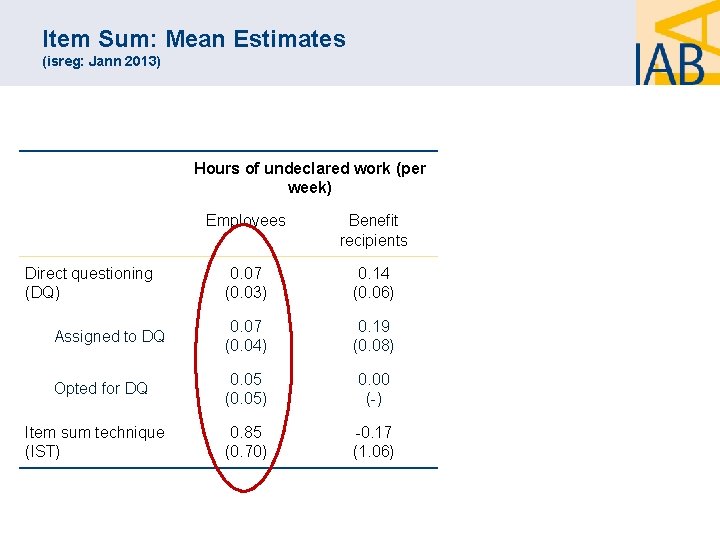
Item Sum: Mean Estimates (isreg: Jann 2013) Hours of undeclared work (per week) Employees Benefit recipients 0. 07 (0. 03) 0. 14 (0. 06) Assigned to DQ 0. 07 (0. 04) 0. 19 (0. 08) Opted for DQ 0. 05 (0. 05) 0. 00 (-) Item sum technique (IST) 0. 85 (0. 70) -0. 17 (1. 06) Direct questioning (DQ) 24 of 29
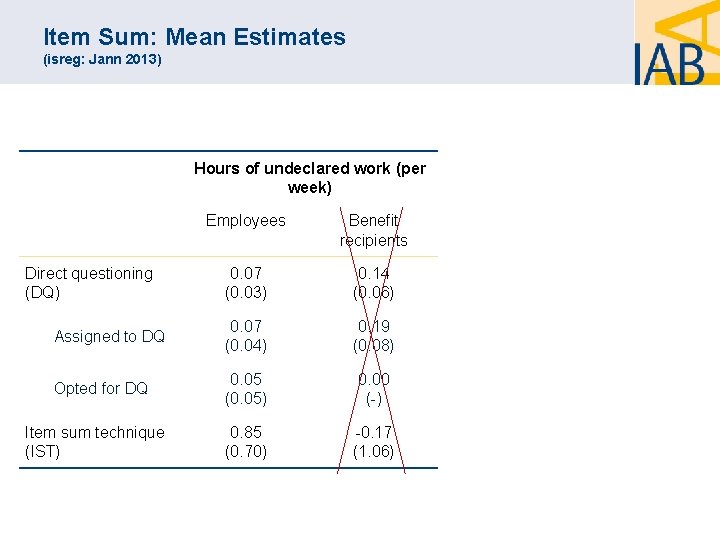
Item Sum: Mean Estimates (isreg: Jann 2013) Hours of undeclared work (per week) Employees Benefit recipients 0. 07 (0. 03) 0. 14 (0. 06) Assigned to DQ 0. 07 (0. 04) 0. 19 (0. 08) Opted for DQ 0. 05 (0. 05) 0. 00 (-) Item sum technique (IST) 0. 85 (0. 70) -0. 17 (1. 06) Direct questioning (DQ) 24 of 29
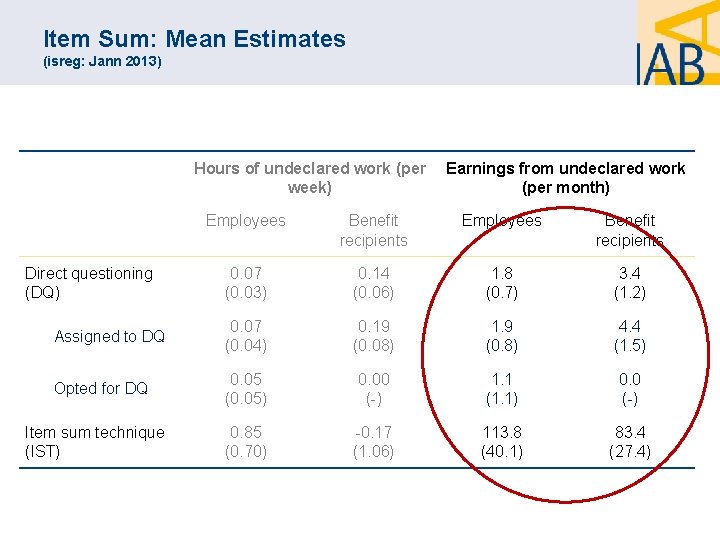
Item Sum: Mean Estimates (isreg: Jann 2013) Hours of undeclared work (per week) Earnings from undeclared work (per month) Employees Benefit recipients 0. 07 (0. 03) 0. 14 (0. 06) 1. 8 (0. 7) 3. 4 (1. 2) Assigned to DQ 0. 07 (0. 04) 0. 19 (0. 08) 1. 9 (0. 8) 4. 4 (1. 5) Opted for DQ 0. 05 (0. 05) 0. 00 (-) 1. 1 (1. 1) 0. 0 (-) Item sum technique (IST) 0. 85 (0. 70) -0. 17 (1. 06) 113. 8 (40. 1) 83. 4 (27. 4) Direct questioning (DQ) 24 of 29
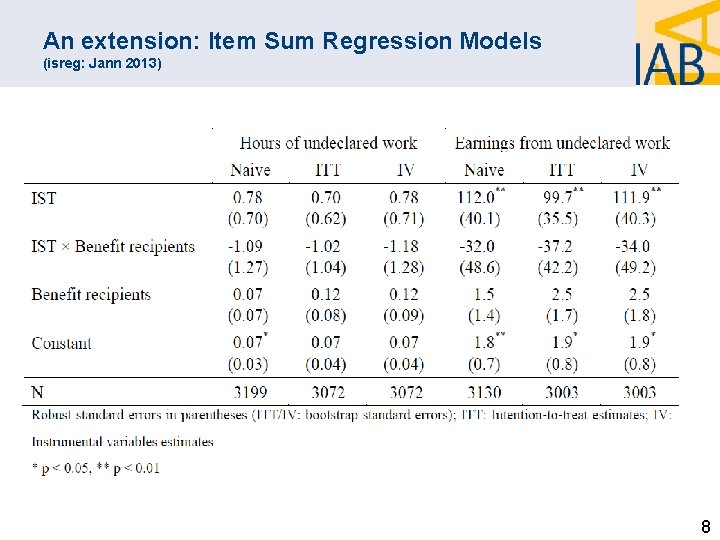
An extension: Item Sum Regression Models (isreg: Jann 2013) 8
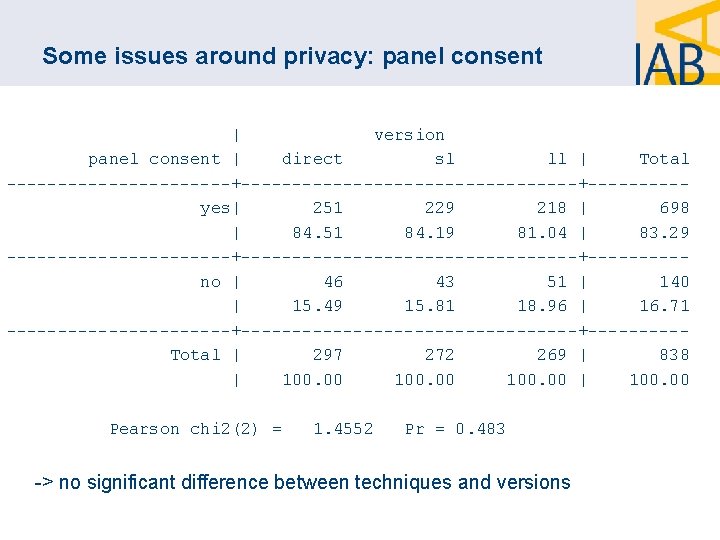
Some issues around privacy: panel consent | version panel consent | direct sl ll | Total -----------+-----------------+-----yes| 251 229 218 | 698 | 84. 51 84. 19 81. 04 | 83. 29 -----------+-----------------+-----no | 46 43 51 | 140 | 15. 49 15. 81 18. 96 | 16. 71 -----------+-----------------+-----Total | 297 272 269 | 838 | 100. 00 | 100. 00 Pearson chi 2(2) = 1. 4552 Pr = 0. 483 -> no significant difference between techniques and versions 1
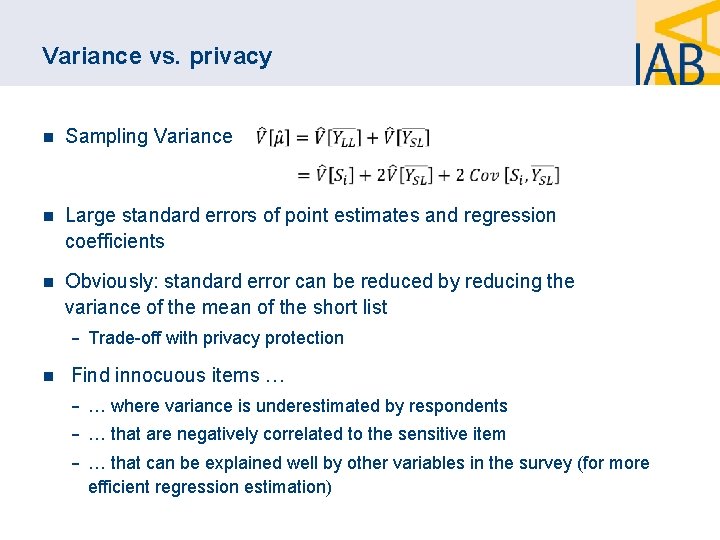
Variance vs. privacy n Sampling Variance n Large standard errors of point estimates and regression coefficients n Obviously: standard error can be reduced by reducing the variance of the mean of the short list ‐ Trade-off with privacy protection n Find innocuous items … ‐ … where variance is underestimated by respondents ‐ … that are negatively correlated to the sensitive item ‐ … that can be explained well by other variables in the survey (for more efficient regression estimation) 1
Summary n IST is a new privacy preserving technique for quantitative sensitive items and applied it in a study on undeclared work ‐ no randomizing device ‐ low cognitive effort ‐ implementation easily possible (interviewer and self administered) n We derived point and regression estimators for IST variables n Results indicate that the item sum technique (IST) can be effective in eliciting a higher extent of the socially undesirable behaviour compared to direct questioning (`more-is-better` assumption) n Unknown why IST produced higher estimates for earnings but not for hours: Further research needed: ‐ not a power issue ‐ choice of innocuous item ‐ Test “no design effect” assumption (Blair and Imai 2012) with two innocuous items 1
Thank You mark. trappmann@iab. de This work has been published as: Trappmann, M. , Krumpal, I. , Kirchner, A. and B. Jann (2014). Item Sum: A New Technique for Asking Quantitative Sensitive Questions. In: Journal of Survey Statistics and Methodology 2(1), 58 -77. www. iab. de
References Blair, G. , and K. Imai (2012), “Statistical Analysis of List Experiments, ” Political Analysis, 20, 47– 77. Boockmann, B. ; Döhrn, R. ; Groneck, M. & Verbeek, H. (2010): Abschätzung des Ausmaßes der Schwarzarbeit. Report. Institut für Angewandte Wirtschaftsforschung e. V. (IAW) und Rheinisch. Westfälisches Institut für Wirtschaftsforschung e. V. (RWI). Droitcour, J. ; Caspar, R. A. ; Hubbard, M. L. ; Parsley, T. L. ; Visscher, W. & Ezzati, T. M. (1991): “The item count technique as a method of indirect questioning: A review of its development and a case study application” In Measurement errors in surveys, eds. P. P. Biemer, R. M. Groves, L. E. Lyberg, N. A. Mathiowetz & S. Sudman, p. 185 -210. Wiley. Holbrook, A. L. , and J. A. Krosnick (2010 a), “Social Desirability Bias in Voter Turnout Reports: Tests Using the Item Count Technique, ” Public Opinion Quarterly, 74, 37– 67. ——— (2010 b), “Measuring Voter Turnout by Using the Randomized Response Technique: Evidence Calling into Question the Method’s Validity, ” Public Opinion Quarterly, 74, 328– 343. Jann, B. (2013): “isreg: Stata module to estimate a regression for item sum data”. Unpublished. Jann, B. , Jerke, J. , & Krumpal, I. (2012). “Asking Sensitive Questions Using the Crosswise Model: An Experimental Survey Measuring Plagiarism. ” Public Opinion Quarterly, 76, 32 -49. 1
References Smith, L. L. , W. T. Federer, and D. Raghavarao (1975), “A Comparison of Three Techniques for Eliciting Truthful Answers to Sensitive Questions, ” in Proceedings of the Social Statistics Section 1974, pp. 447– 452, Washington, DC: American Statistical Association. Tourangeau, R. , & Smith, T. W. (1996): „Asking sensitive questions the impact of data collection mode, question format, and question context. “ Public Opinion Quarterly, 60, 275 -304. Tourangeau, R. & Yan, T. (2007): “Sensitive questions in surveys. ” Psychological Bulletin 133: 859 -883. Warner, S. L. (1965), “Randomized-Response: A Survey Technique for Eliminating Evasive Answer Bias, ” Journal of the American Statistical Association, 60, 63– 69. Yu, J. W. , Tian, G. L. , & Tang, M. L. (2008). “Two new models for survey sampling with sensitive characteristic: design and analysis. ” Metrika, 67, 251 -263. 1
Appendix: Estimators 2
Estimators: IST
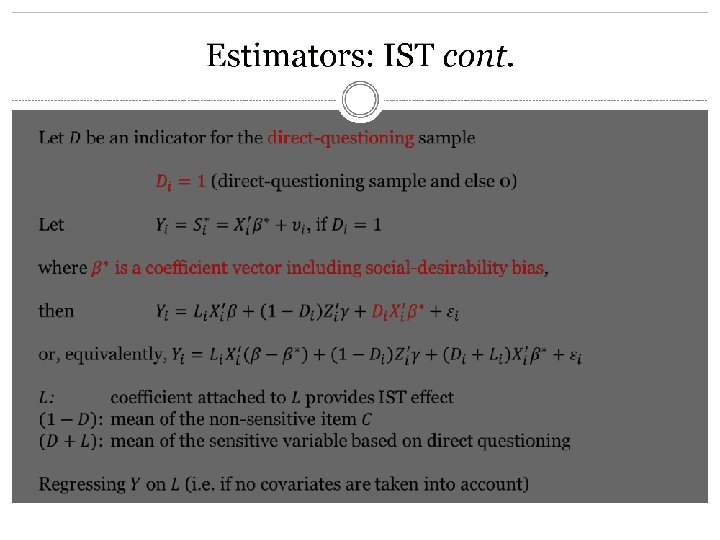
Estimators: IST cont.
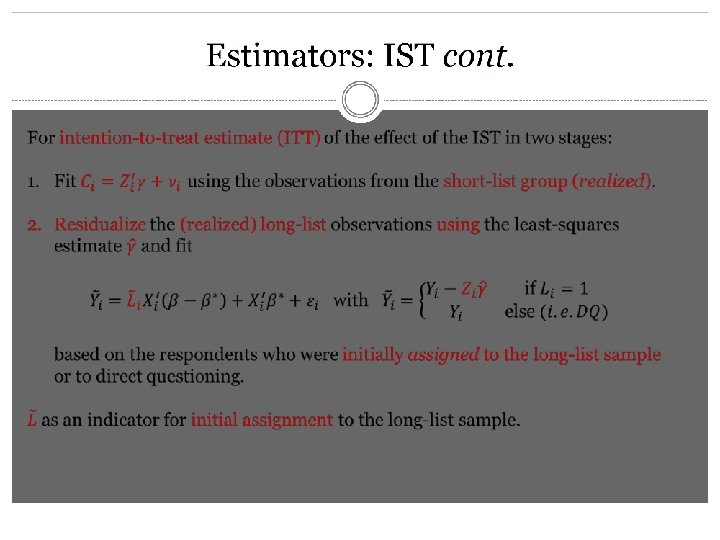
Estimators: IST cont.
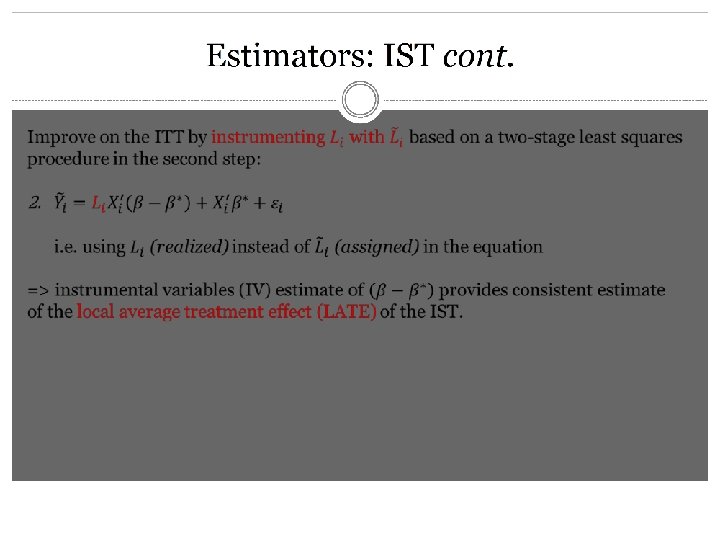
Estimators: IST cont.