
ITEM BASED COLLABORATIVE FILTERING RECOMMENDATION ALGORITHEMS Badrul Sarwar

ITEM BASED COLLABORATIVE FILTERING RECOMMENDATION ALGORITHEMS Badrul Sarwar , George Karypis , Joseph Konstan , John Reidl, Proceedings of the tenth international conference on World Wide Web, 2001 석사 1차 지 애 띠 ESLAB, Inha University
OVERVIEW → Collaborative Filtering → Item based Approach → Experiment → Conclusion 10/24/2021 ESLAB, Inha University 2
INTRODUCTION • Collaborative Filtering → Successful in Information Filtering applications & E-commerce applications • Problems of CF → Scalability → Quality of Recommendations • Research Contributions of This Paper → Analysis of Item based prediction Algorithms & Ways to Implement it. → Formulation of pre computed model of Item Similarity to increase online scalability → Experimental comparison of quality of Item based algorithms to the User-based algorithms 10/24/2021 ESLAB, Inha University 3

COLLABORATIVE FILTERING • Collaborative Filtering Process List of m Users U = {u 1, u 2, . . . , um} List of n Items I = {i 1, i 2, . . . , in} → Prediction is a numeral value, Pa. j, expressing the predicted likeliness of item ij ∉ Iua for the active user ua → Recommendation is a list of N items Ir ⊂ I, that the active user will like the most 10/24/2021 ESLAB, Inha University 4
COLLABORATIVE FILTERING • Two Categories → Memory-based CF - Using the entire user-item database to find of neighbors - Use of statistical techniques - Nearest-neighbor → Model-based CF - Probabilistic model of user ratings - Bayesian Network, Clustering Approach • Challenges → Sparsity → Scalability 10/24/2021 ESLAB, Inha University 5

ITEM-BASED APPROACH • Item Similarity Computation 10/24/2021 ESLAB, Inha University 6

ITEM-BASED APPROACH → Cosine-based similarity → Correlation-based Similarity → Adjusted Cosine Similarity 10/24/2021 ESLAB, Inha University 7
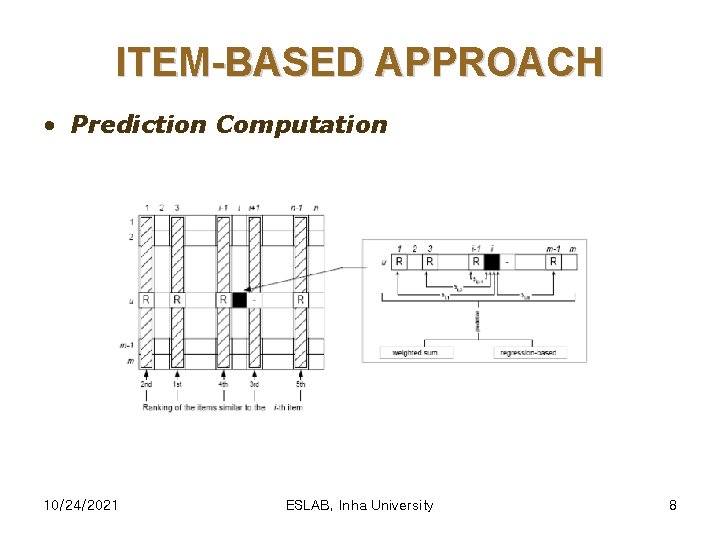
ITEM-BASED APPROACH • Prediction Computation 10/24/2021 ESLAB, Inha University 8
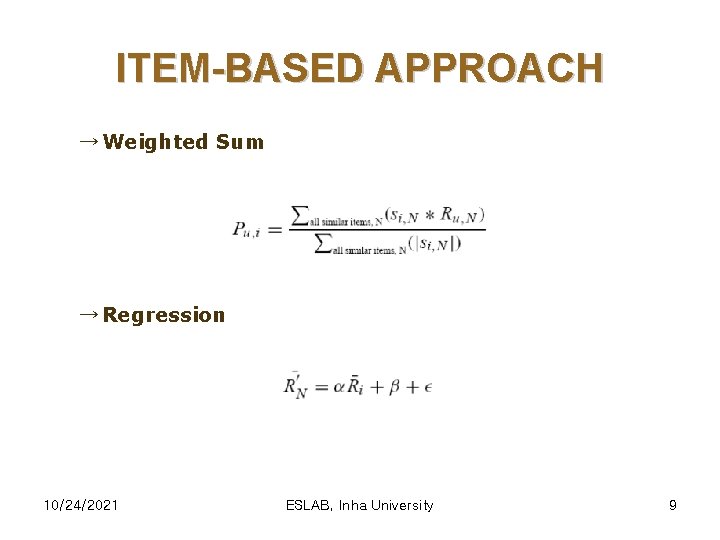
ITEM-BASED APPROACH → Weighted Sum → Regression 10/24/2021 ESLAB, Inha University 9
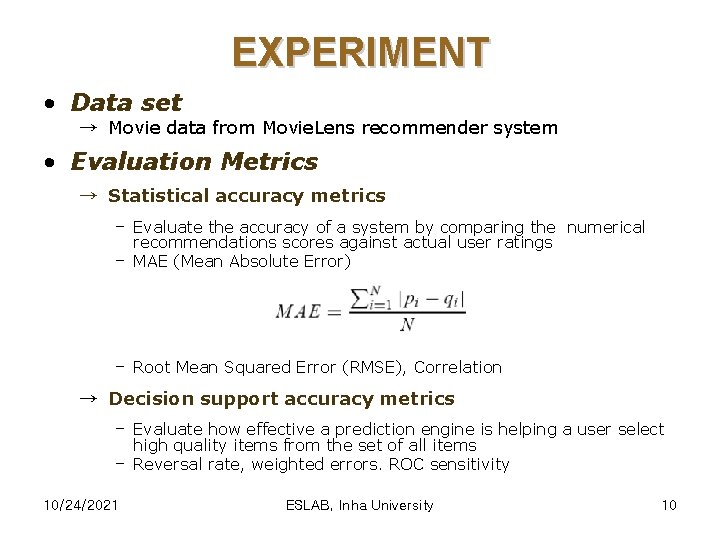
EXPERIMENT • Data set → Movie data from Movie. Lens recommender system • Evaluation Metrics → Statistical accuracy metrics - Evaluate the accuracy of a system by comparing the numerical recommendations scores against actual user ratings - MAE (Mean Absolute Error) - Root Mean Squared Error (RMSE), Correlation → Decision support accuracy metrics - Evaluate how effective a prediction engine is helping a user select high quality items from the set of all items - Reversal rate, weighted errors. ROC sensitivity 10/24/2021 ESLAB, Inha University 10
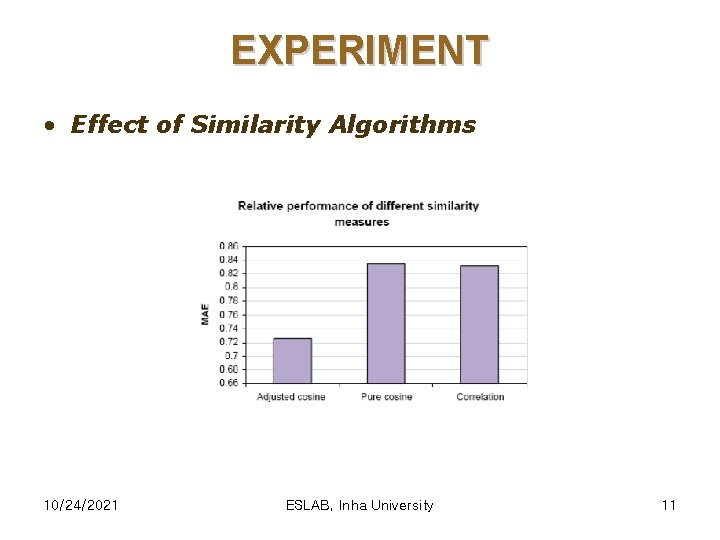
EXPERIMENT • Effect of Similarity Algorithms 10/24/2021 ESLAB, Inha University 11
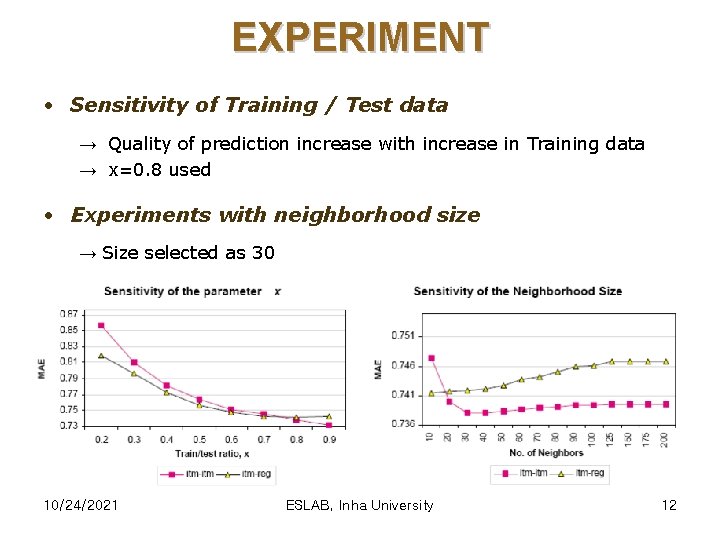
EXPERIMENT • Sensitivity of Training / Test data → Quality of prediction increase with increase in Training data → x=0. 8 used • Experiments with neighborhood size → Size selected as 30 10/24/2021 ESLAB, Inha University 12
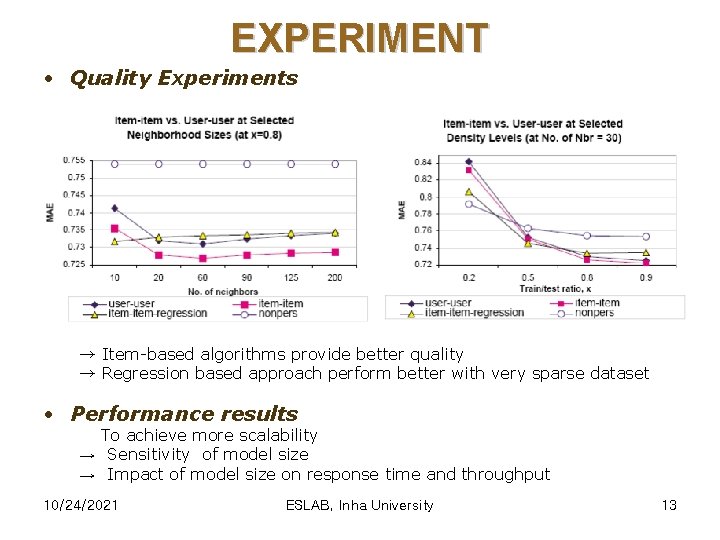
EXPERIMENT • Quality Experiments → Item-based algorithms provide better quality → Regression based approach perform better with very sparse dataset • Performance results To achieve more scalability → Sensitivity of model size → Impact of model size on response time and throughput 10/24/2021 ESLAB, Inha University 13
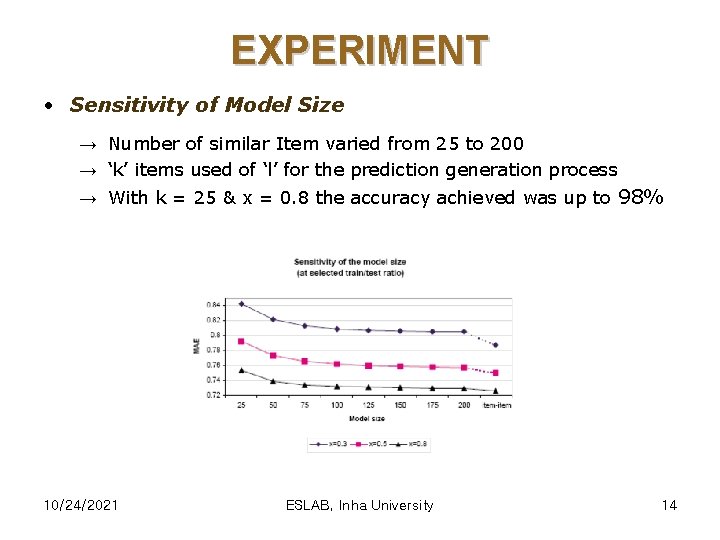
EXPERIMENT • Sensitivity of Model Size → Number of similar Item varied from 25 to 200 → ‘k’ items used of ‘l’ for the prediction generation process → With k = 25 & x = 0. 8 the accuracy achieved was up to 98% 10/24/2021 ESLAB, Inha University 14
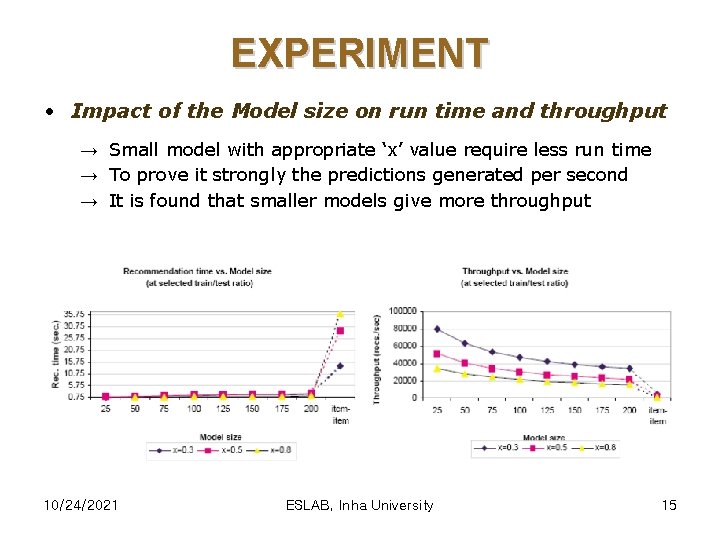
EXPERIMENT • Impact of the Model size on run time and throughput → Small model with appropriate ‘x’ value require less run time → To prove it strongly the predictions generated per second → It is found that smaller models give more throughput 10/24/2021 ESLAB, Inha University 15
CONCLUSION → Item-Item scheme provides better quality of predictions than the User-User scheme (k-nearest neighbor) → Item neighborhood is comparatively static, which results in high performance → Due to model based approach it is possible to get good prediction quality with small subset of items 10/24/2021 ESLAB, Inha University 16
- Slides: 16