
Item 5 Attachment 4 Color Combinations Using Fall

Item 5, Attachment 4: Color Combinations Using Fall 2017 California School Dashboard Data California State Board of Education Meeting January 18, 2018 TOM TORLAKSON State Superintendent of Public Instruction
Purpose • Provide an overview of the background and options for identifying the lowest-performing Title I schools, based on the Fall 2017 California School Dashboard (Dashboard) data. • Seek SBE guidance on future analyses needed. 2
Background • The Every Student Succeeds Act (ESSA) requires states to identify their lowestperforming Title I schools for comprehensive support and improvement. • California was one of the few states to have an established accountability system in place to align with the ESSA. 3
Background (Cont. ) • The criteria for identifying districts for support under the Local Control Funding Formula (LCFF) is based on student group performance. – The same student group (e. g. , socioeconomically disadvantaged) must meet the criteria in two priority areas (e. g. academic and suspension). • The ESSA criteria for identifying schools for support is based on the “all students” performance on all applicable state indicators. 4
Prior SBE Action • September 2016: The SBE approved the LCFF criteria to identify LEAs for assistance and support. • April 2017: An Information Memorandum to the SBE presented three options for identifying the lowest-performing five percent of Title I schools. All three options use the colorcoded performance levels for state indicators in the identification process. • June 2017: A follow up Information Memorandum included data simulations applying the LCFF criteria to identify LEAs for assistance and support that the SBE approved at its September 2016 meeting. • July 2017: The SBE approved the “All Applicable Indicators” method and the Baseline Methodology for identifying the lowest-performing five percent of Title I schools. 5
California School Dashboard • First operational release occurred in December 2017. • Includes six state indicators: – Chronic Absenteeism – Suspension Rate – English Learner Progress (ELPI) – Graduation Rate – College/Career (CCI) – Academic (English/language arts [ELA] and mathematics) 6
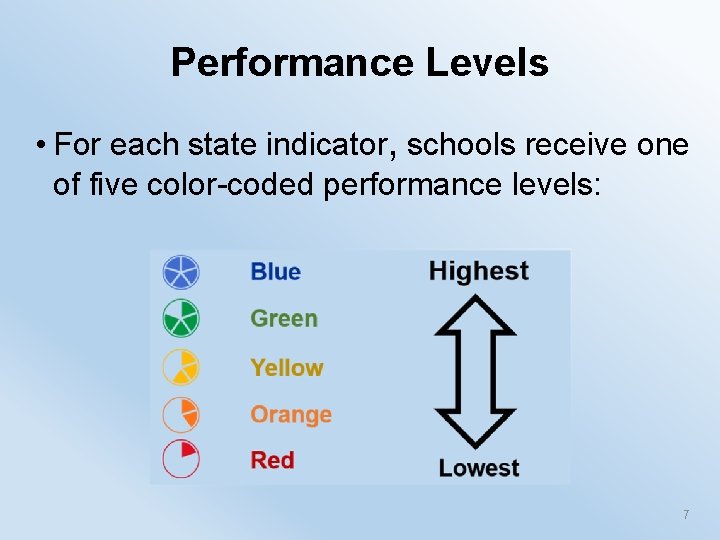
Performance Levels • For each state indicator, schools receive one of five color-coded performance levels: 7
Performance Color Determinations Each state indicator applies to specific grades, for example: –The graduation rate only applies to schools with grade 12 students, and –The academic indicator only applies to schools with grades 3 -8. The denominator varies for each indicator: –Graduation rate is based on the four-year cohort –Suspension rate is based on cumulative enrollment –By design, more students are included in the Suspension Rate than the Graduation Rate. 8
Performance Color Determinations (Cont. ) • For schools to receive a performance color, the school must have at least 30 students in both the current and prior years. 9
Number of Indicators • School enrollment, grade configurations, and English learner (EL) population determine how many state indicators apply to each school. For example: – A large K-12 school could have up to six performance colors (i. e. , Suspension, ELPI, Graduation, ELA, Mathematics, CCI) – A high school serving 9 -12 students can have up to four performance colors. A high school with less than 30 ELs, will have only three performance colors (i. e. , CCI, Graduation, Suspension) – A small school with less than 50 students would most likely only receive one performance color (i. e. , Suspension). 10
Using Color Combinations • The methodology used in the simulations provides equal weight to all applicable indicators, regardless of the number of state indicators that apply to a school. – Schools with four indicators are treated similarly to schools with only one indicator. – Schools with one Red indicator are identified as low performing along with schools with four Red indicators. 11
Using Color Combinations (Cont. ) • This methodology identifies the lowest performing schools based on specific sets of color combinations. These color combinations are provided in Attachment 4. 12
Using Color Combinations (Cont. ) • Four simulations were conducted: – Baseline (All Red and all Red except one Orange) – Title I high schools with graduation rates below 67 percent for three years – Non-Title I high schools with graduation rates below 67 percent for three years – Expanded Baseline (the addition of color combinations) 13
Districts in LCFF Support • Using current data, if the SBE decides to identify for local control funding formula (LCFF) support any district with a low performing school, as many as 84 additional districts could be identified (depending on the methodology selected) 14
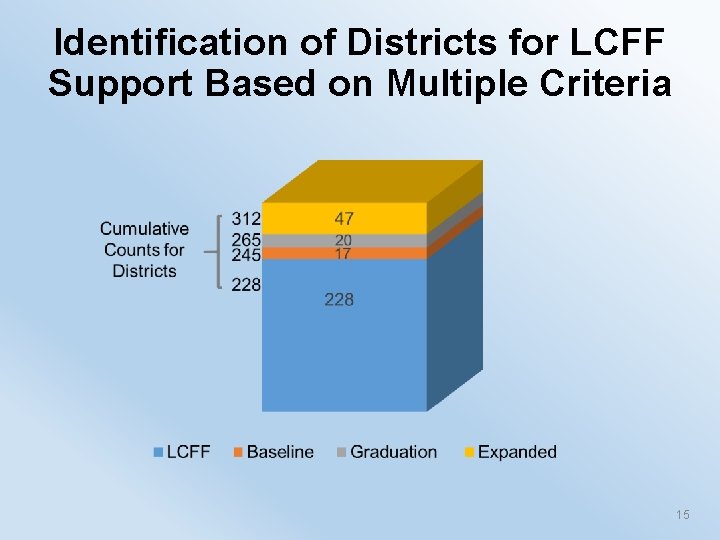
Identification of Districts for LCFF Support Based on Multiple Criteria 15
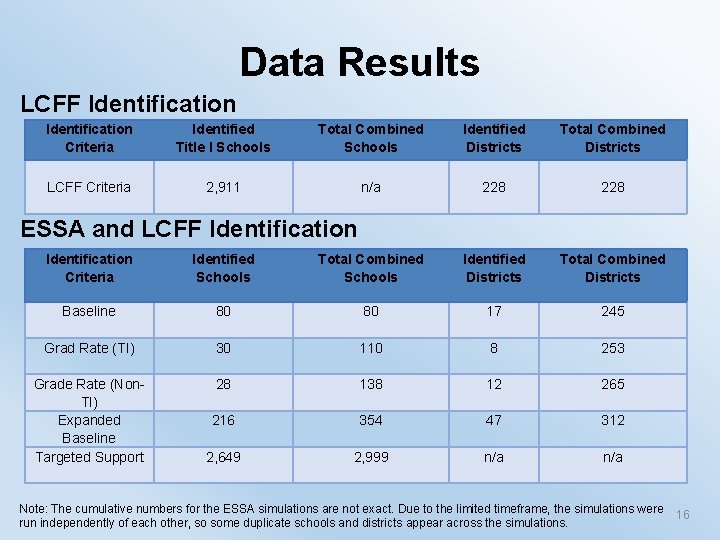
Data Results LCFF Identification Criteria Identified Title I Schools Total Combined Schools Identified Districts Total Combined Districts LCFF Criteria 2, 911 n/a 228 ESSA and LCFF Identification Criteria Identified Schools Total Combined Schools Identified Districts Total Combined Districts Baseline 80 80 17 245 Grad Rate (TI) 30 110 8 253 Grade Rate (Non. TI) Expanded Baseline Targeted Support 28 138 12 265 216 354 47 312 2, 649 2, 999 n/a Note: The cumulative numbers for the ESSA simulations are not exact. Due to the limited timeframe, the simulations were run independently of each other, so some duplicate schools and districts appear across the simulations. 16
Summary of School and District Support Data Simulations • Based on the Fall 2017 Dashboard data: – 2, 911 schools are located in the 228 LEAs currently identified for LCFF support – More than 2 million students attend the Title I schools within the identified LCFF districts. This represents around 54 percent of California's public school students attending Title I schools statewide, and approximately 32 percent of California’s total public school enrollment. 17
Summary of School and District Support Data Simulations (Cont. ) • Approximately 5, 900 schools could be identified for support (2, 900 under LCFF and 3, 000 under ESSA) • Note: 2018 Dashboard data will result in identification of additional districts for LCFF support, different color combinations for ESSA support, and for the first time will include performance levels for the Chronic Absenteeism and College/Career Indicators. 18
- Slides: 18