
Item 11 Progress Report on the Quality Project
- Slides: 5
Item 11: Progress Report on the Quality Project Miho Taguma Project leader on ECEC 7 th Meeting of the OECD Network on Early Childhood Education and Care, Paris, 21 -22 June 2010
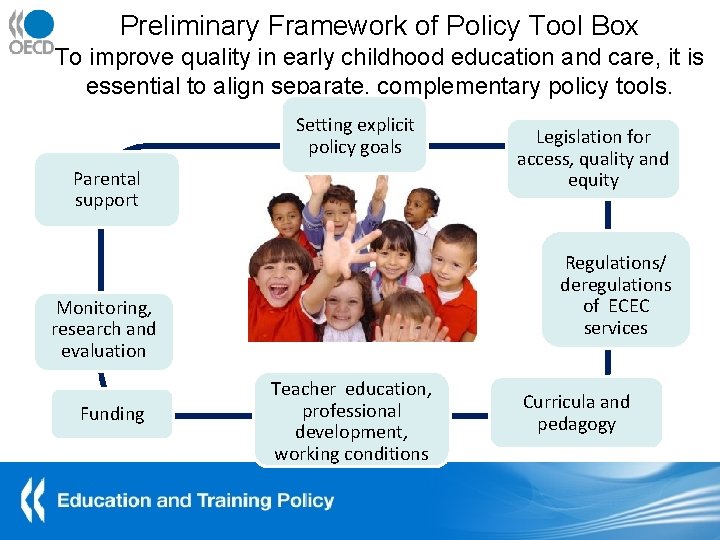
Focus of Item 11 • Analytical framework with an overview of general quality indicators • Preliminary Framework of Policy Tool Box • Findings from thematic literature overview: “parental and community involvement”, “curriculum and pedagogy”, and “professional development and working conditions” • Quality in physical settings from CELE • Discussants from DEN, POR, ITA
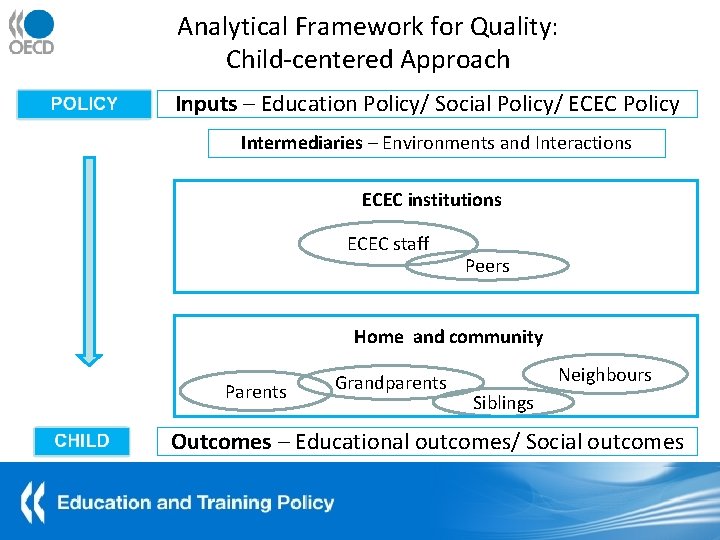
Analytical Framework for Quality: Child-centered Approach Inputs – Education Policy/ Social Policy/ ECEC Policy Intermediaries – Environments and Interactions ECEC institutions ECEC staff Peers Home and community Parents Grandparents Neighbours Siblings Outcomes – Educational outcomes/ Social outcomes
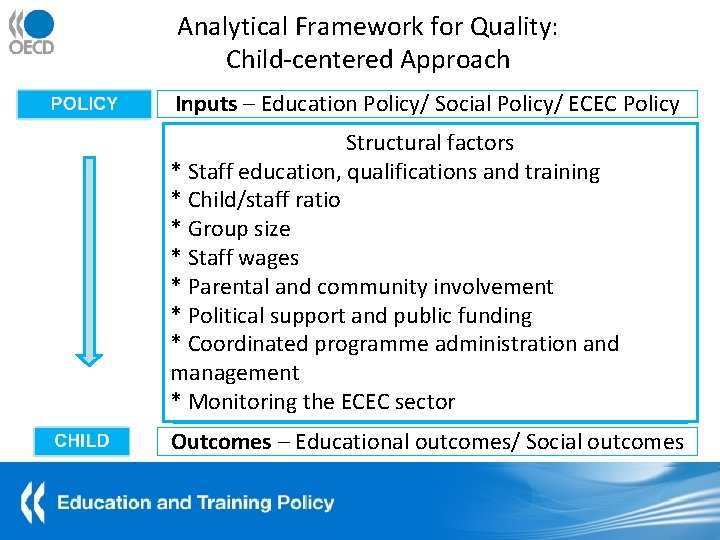
Analytical Framework for Quality: Child-centered Approach Inputs – Education Policy/ Social Policy/ ECEC Policy Structural factors child outcomes Factors that contribute to improving * Staff education, qualifications and training ECEC process factors * Child/staff ratio * Pedagogy and curriculum * Group size * Physical settings * Staff wages * Parental and community involvement Family factors **Political support and public funding SES **Coordinated programme administration and Mental health management * Educational resources at home **Monitoring theat. ECEC sector Early reading home Outcomes – Educational outcomes/ Social outcomes
Preliminary Framework of Policy Tool Box To improve quality in early childhood education and care, it is essential to align separate, complementary policy tools. Setting explicit policy goals Parental support Regulations/ deregulations of ECEC services Monitoring, research and evaluation Funding Legislation for access, quality and equity Teacher education, professional development, working conditions Curricula and pedagogy