
ITEC 452 Distributed Computing Lecture 2 Part 2
ITEC 452 Distributed Computing Lecture 2 – Part 2 Models in Distributed Systems Hwajung Lee
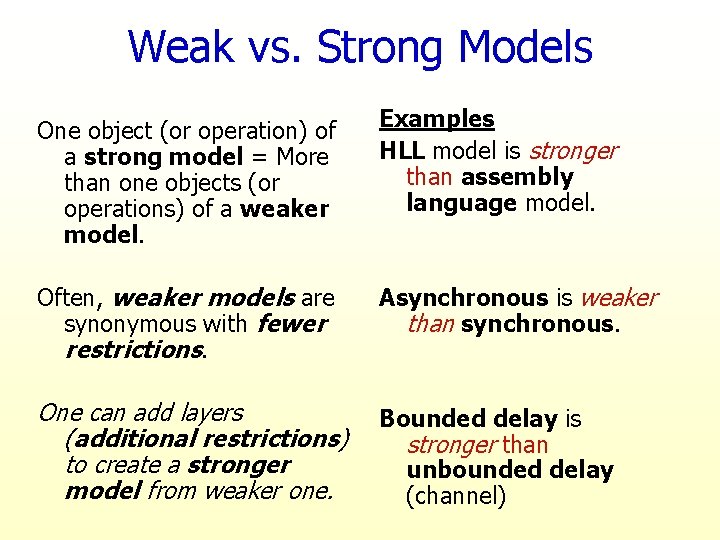
Weak vs. Strong Models One object (or operation) of a strong model = More than one objects (or operations) of a weaker model. Examples HLL model is stronger than assembly language model. Often, weaker models are synonymous with fewer restrictions. Asynchronous is weaker than synchronous. One can add layers (additional restrictions) to create a stronger model from weaker one. Bounded delay is stronger than unbounded delay (channel)

Model transformation Complicated Simple Stronger models - simplify reasoning, but - needs extra work to implement Weaker models - are easier to implement. - Have a closer relationship with the real world “Can model X be implemented using model Y? ” is an interesting question in computer science. Sample problems Non-FIFO to FIFO channel Message passing to shared memory Non-atomic broadcast to atomic broadcast
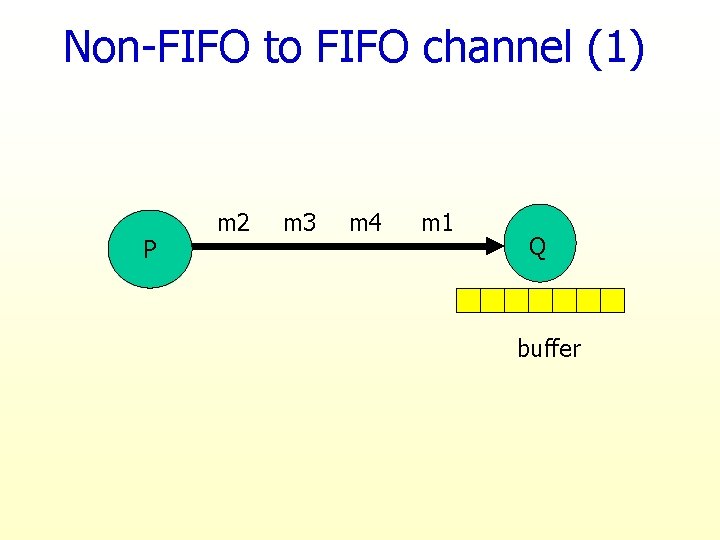
Non-FIFO to FIFO channel (1) P m 2 m 3 m 4 m 1 Q buffer

Non-FIFO to FIFO channel (2) {Sender process P} var i : integer {initially 0} empty repeat send m[i], i to Q; i : = i+1 forever ≠ empty do [k]; {Receiver process Q} var k : integer {initially 0} buffer: buffer[0. . ∞] of msg {initially k: buffer [k] = repeat {STORE} receive m[i], i from P; store m[i] into buffer[i]; {DELIVER} while buffer[k] begin deliver content of buffer [k] : = empty�k : =

Observations (a) Needs Unbounded sequence numbers and (b) Unbounded number of buffer slots Both are bad Now solve the same problem on a model where (a) The propagation delay has a known upper bound of T. (b) The messages are sent out @r per unit time. (c) The messages are received at a rate faster than r. The buffer requirement drops to (r x. T). Thus, Synchrony pays. Question. How to solve the problem using bounded buffer space if the propagation delay is arbitrarily large?
![Message-passing to Shared memory {Read X by process i}: read x[i] {Write X: =](http://slidetodoc.com/presentation_image_h2/13851928b7ccc7dab3bdbd2d19149788/image-7.jpg "Message-passing to Shared memory {Read X by process i}: read x[i] {Write X: =")
Message-passing to Shared memory {Read X by process i}: read x[i] {Write X: = v by process i} - x[i] : = v; - Atomically broadcast v to every other process j (j ≠ i); - After receiving broadcast, This is incomplete. There are process j (j ≠ i) sets x[j] to more pitfalls here. v. Understand the significance of

Non-atomic to atomic broadcast Atomic broadcast = either everybody or nobody receives {process i is the sender} for j = 1 to N-1 (j ≠ i) send message m to neighbor[j] (Easy!) Now include crash failure as a part of our model. What if the sender crashes at the middle? Implement atomic broadcast in presence of crash.
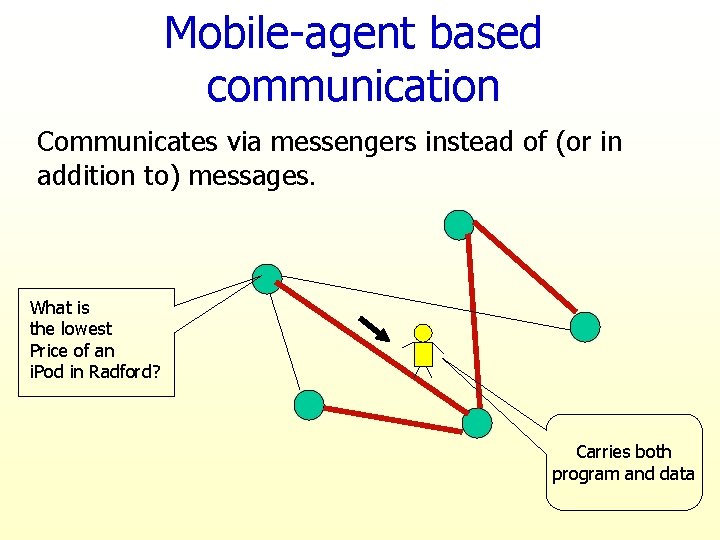
Mobile-agent based communication Communicates via messengers instead of (or in addition to) messages. What is the lowest Price of an i. Pod in Radford? Carries both program and data
- Slides: 9