
ITEC 3010 Systems Analysis and Design I Instructor



- Slides: 51
ITEC 3010: Systems Analysis and Design I Instructor: Dr. Luiz Marcio Cysneiros Office: TEL Building 3053 Email: cysneiro@yorku. ca 1
General Info. • Text: “Systems Analysis and Design in a Changing World” by John Satzinger, Robert Jackson and Stephen Burd 3 rd / 4 th / 5 th edition – Current available 7 th edition. Not the best one to use – Best Editions to use : 5 th and 3 rd • Office Hours: Wednesday: 3: 00 PM to 4: 30 PM – Skype me at luizmarciocys for Office hours Email: cysneiro@yorku. ca How to Better follow this course ? o Reading Material in Advance o Answering questions a the end of each chapter and checking with the answers provided on the course website 2
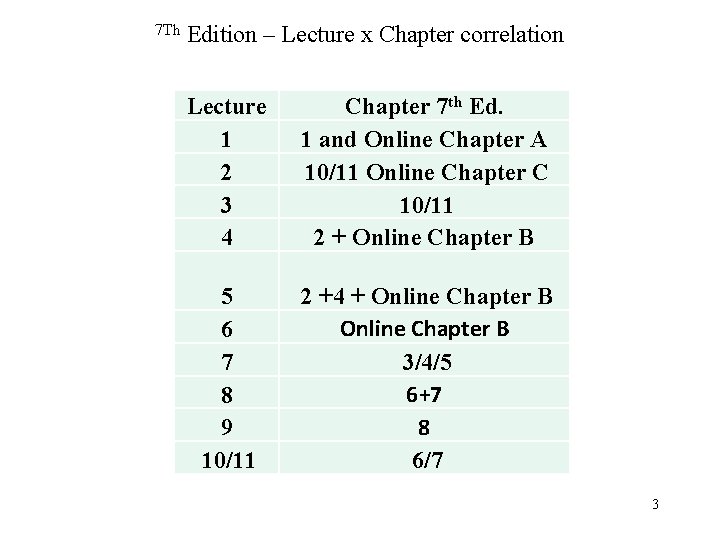
7 Th Edition – Lecture x Chapter correlation Lecture 1 2 3 4 Chapter 7 th Ed. 1 and Online Chapter A 10/11 Online Chapter C 10/11 2 + Online Chapter B 5 6 7 8 9 10/11 2 +4 + Online Chapter B 3/4/5 6+7 8 6/7 3
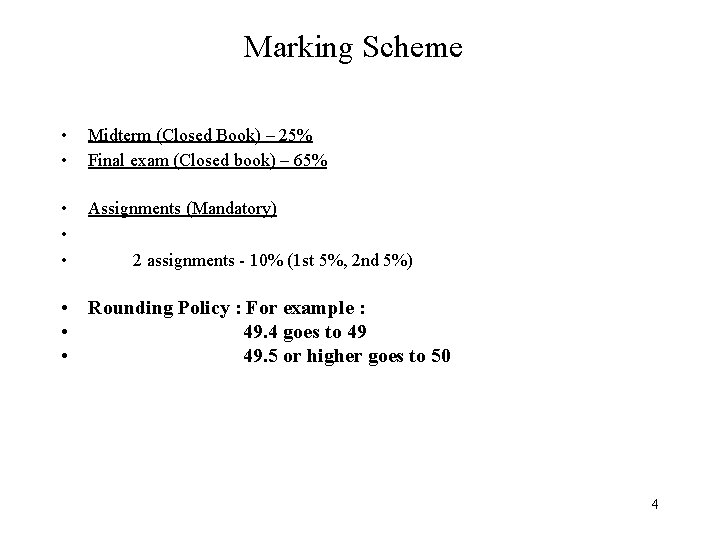
Marking Scheme • • Midterm (Closed Book) – 25% Final exam (Closed book) – 65% • • • Assignments (Mandatory) 2 assignments - 10% (1 st 5%, 2 nd 5%) • Rounding Policy : For example : • 49. 4 goes to 49 • 49. 5 or higher goes to 50 4
5
6
7
8
9
10
Course Objectives • To provide you with new ways of looking at information in the world in order to solve business problems • To introduce you to concepts and methods of System Analysis and design (SAD) • To describe the systems development life cycle (SDLC) • To teach you effective methods for gathering essential information during system analysis • To teach you effective methods for designing systems to solve problems effectively using technology 11
Denys Lasdun – “Our job is to give the client, on time and on cost, not what he wants, but what he never dreamed he wanted; and when he gets it, he recognizes it as something he wanted all the time” 12
Course Topics • Introduction to systems analysis and design – – the analyst as problem solver required skills of systems analysts types of jobs and the analyst’s role Example: Rocky mountain outfitters • The analyst as project manager – the systems development life cycle (SDLC) • • • planning phase analysis phase design phase implementation phase support phase – the project team 13
Topics (continued) • Approaches to Systems Development – Methodologies and Models – 2 approaches: • structured approach • object-oriented approach – Waterfall Models for SDLC – other variations – computer-aided software engineering (CASE) 14
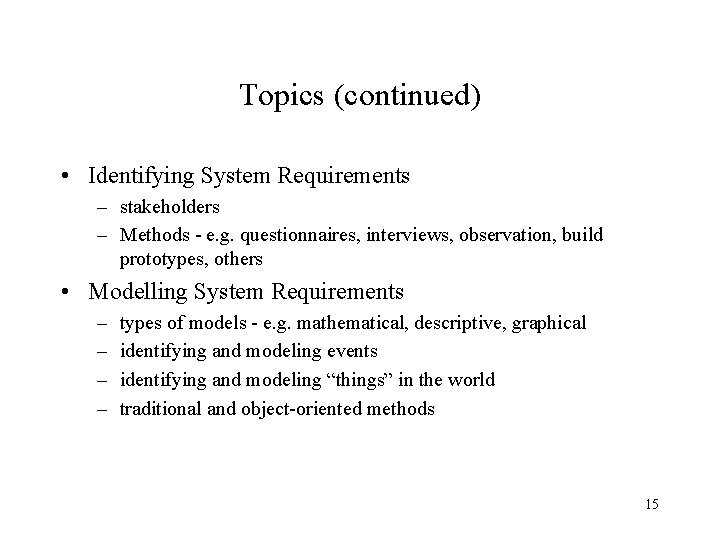
Topics (continued) • Identifying System Requirements – stakeholders – Methods - e. g. questionnaires, interviews, observation, build prototypes, others • Modelling System Requirements – – types of models - e. g. mathematical, descriptive, graphical identifying and modeling events identifying and modeling “things” in the world traditional and object-oriented methods 15
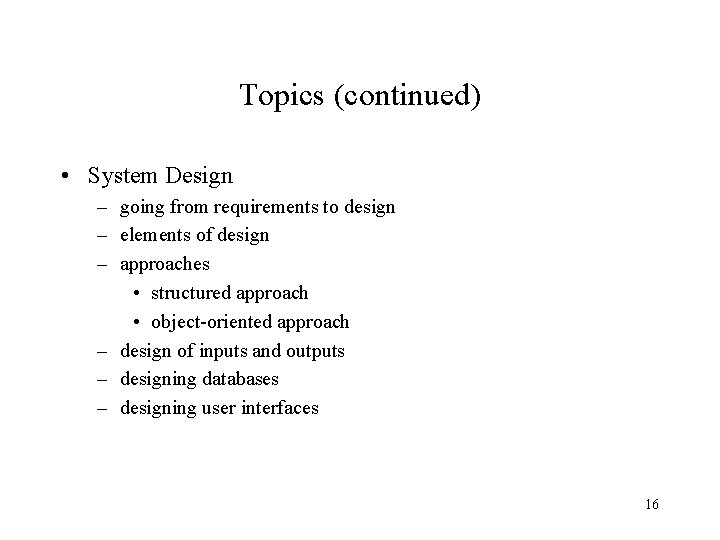
Topics (continued) • System Design – going from requirements to design – elements of design – approaches • structured approach • object-oriented approach – design of inputs and outputs – designing databases – designing user interfaces 16
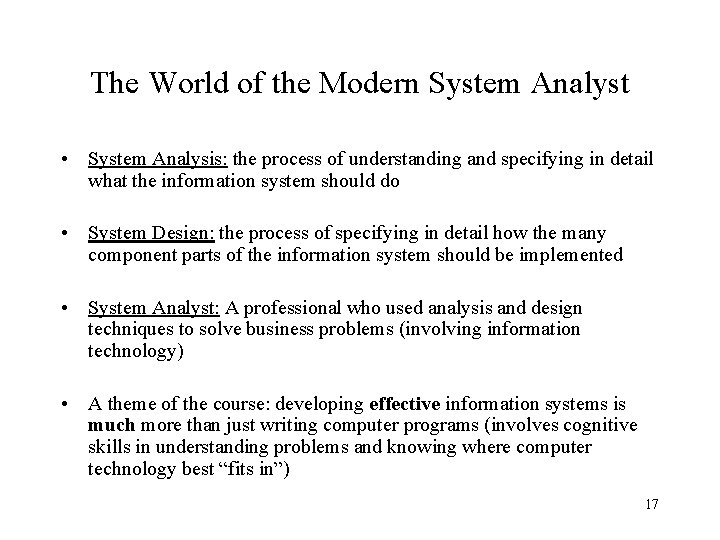
The World of the Modern System Analyst • System Analysis: the process of understanding and specifying in detail what the information system should do • System Design: the process of specifying in detail how the many component parts of the information system should be implemented • System Analyst: A professional who used analysis and design techniques to solve business problems (involving information technology) • A theme of the course: developing effective information systems is much more than just writing computer programs (involves cognitive skills in understanding problems and knowing where computer technology best “fits in”) 17
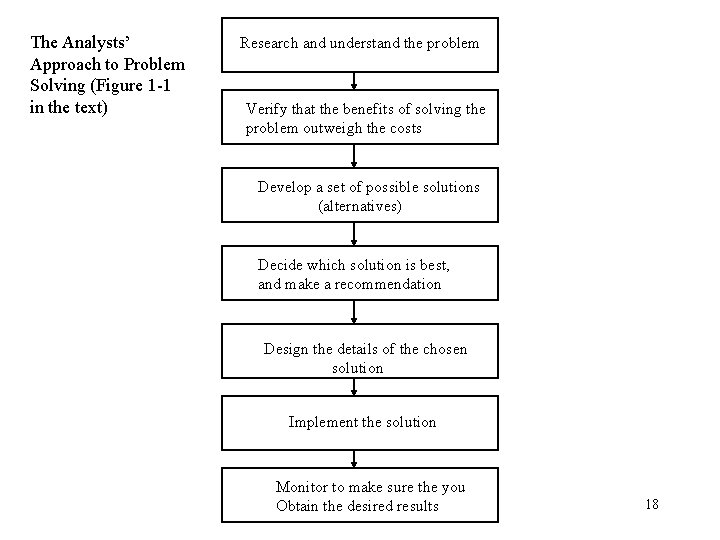
The Analysts’ Approach to Problem Solving (Figure 1 -1 in the text) Research and understand the problem Verify that the benefits of solving the problem outweigh the costs Develop a set of possible solutions (alternatives) Decide which solution is best, and make a recommendation Design the details of the chosen solution Implement the solution Monitor to make sure the you Obtain the desired results 18
Thinking in terms of “Systems” • What is a system? A system is a collection of interrelated components (subsystems) that function together to achieve some outcome (e. g. biological system, computer system, social system) An information system is a collection of interrelated components that collect, process, store and provide as output the information needed to complete business tasks (e. g. payroll system) 19
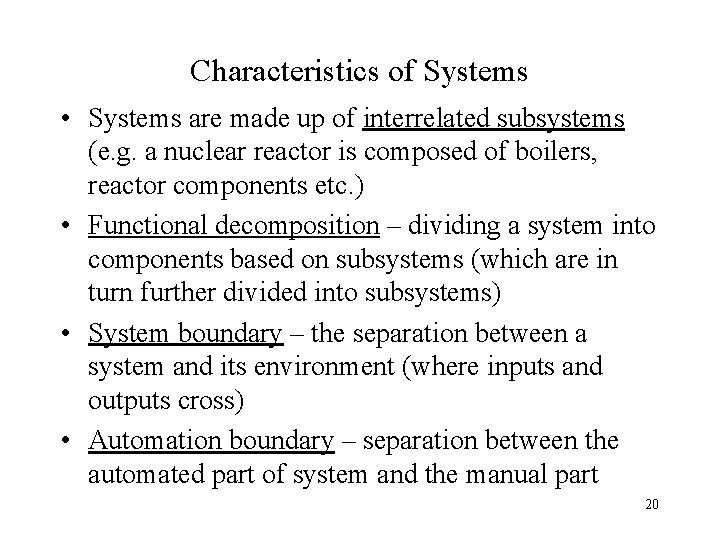
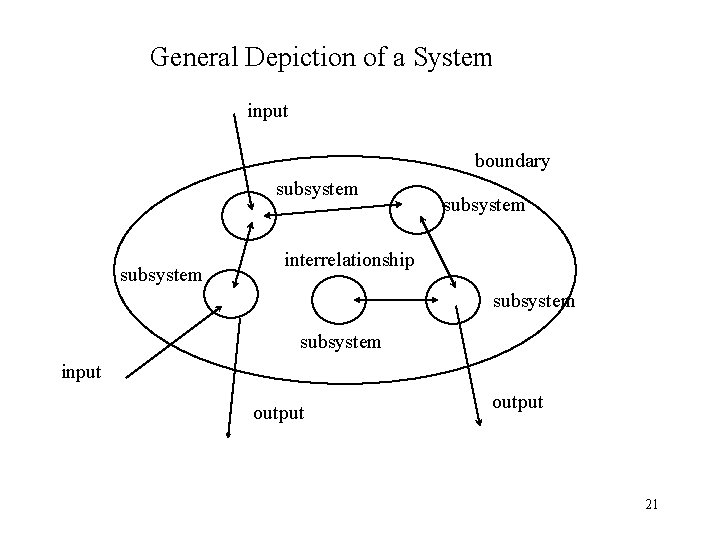
Characteristics of Systems • Systems are made up of interrelated subsystems (e. g. a nuclear reactor is composed of boilers, reactor components etc. ) • Functional decomposition – dividing a system into components based on subsystems (which are in turn further divided into subsystems) • System boundary – the separation between a system and its environment (where inputs and outputs cross) • Automation boundary – separation between the automated part of system and the manual part 20
General Depiction of a System input boundary subsystem interrelationship subsystem input output 21
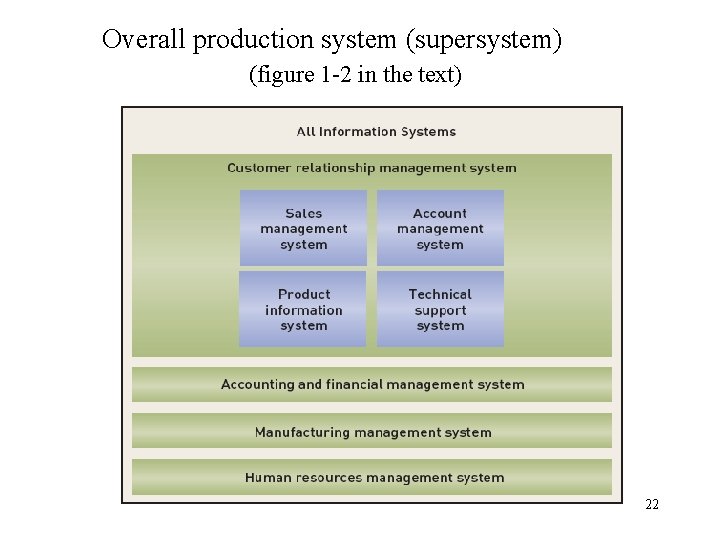
Overall production system (supersystem) (figure 1 -2 in the text) 22
Figure 1 -4: The system boundary and the automation boundary 23
“Systems” Thinking • • Being able to identify something as a system Involves being able to identify subsystems Identifying system characteristics and functions Identifying where the boundaries are (or should be) • Identifying inputs and outputs to systems • Identifying relationships among subsystems 24
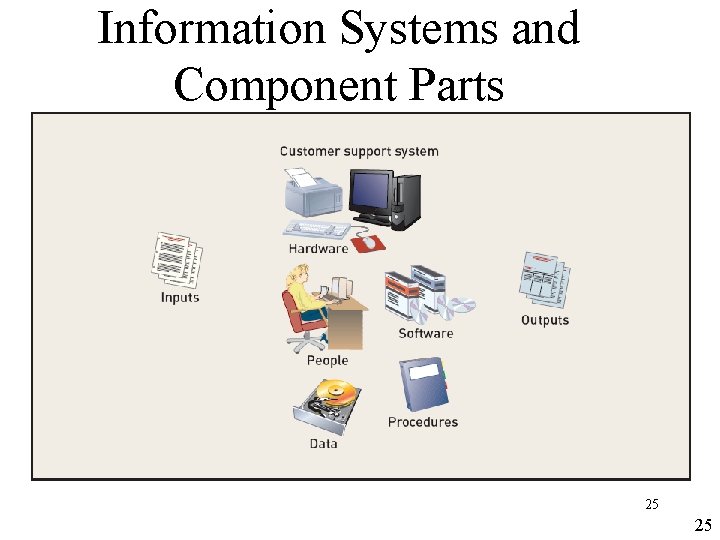
Information Systems and Component Parts 25 25
Types of Information Systems • Transaction processing systems (TPS) – Capture and record information about the transactions that affect the organization (e. g. the sale of an item, a withdrawal from an ATM etc. ) • Management Information Systems (MIS) – Take information captured by the transaction processing system and produce reports management needs for planning and controlling business 26
• Executive Information Systems (EIS) – Provide information for executives to use in strategic planning (could be from organizational database, or outside sources like stock market reports) • Decision Support Systems (DSS) – Support human decision making and allows users to explore the potential impact of available options or decisions (e. g. can ask “what if”) – Closely related to “expert systems” or “knowledgebased” systems 27
Required Skills of the Systems Analyst • Technical Knowledge and Skills • • • Computers and how they work in general Programming languages Devices that interact with computers Communications networks Database and database management systems Operating systems and utilities Tools: software products used to help develop analysis and design specifications and completed system components • e. g. Microsoft Access, Integrated development environments, computer-supported system engineering (CASE) tools 28
• Business Knowledge and Skills • What activities and processes do organizations perform? • How are organizations structured? • How are organizations managed? • What type of work (activity) is done in the organization? (e. g. hospital, bank etc. ) • Who are the “actors” doing the activities About the organization (e. g. company) the system analyst needs to know: • • What the specific organization does What makes it successful What its strategies and plans are What its tradition (“culture”) and values are 29
• People Knowledge and Skills • Single most important interpersonal skill: • To communicate clearly and effectively with others! • Since analysts work on teams with others (e. g. team members, clients etc. ) must understand about people: • • • How people think How people learn How people react to change How people communicate How people work (“activities” and “actors”) • Other areas: • Skill in interviewing, listening and observing • Good written and oral presentation • Being able to work in a team 30
Committed to Social Integration • https: //youtu. be/p. VMj. TGqr. VT 8 31
Typical Job Titles • • • Programmer/analyst Business systems analyst System liaison End-user analyst Business consultant System support analyst System designer Software engineer System architect 32
Typical Job Ad: Systems Analyst – Distribution Center We are the world’s leading manufacturer of women’s apparel products. Our organization in the Far East has openings for a Systems Analyst Requirements: • Bachelor’s degree in Computer Science, Business Administration or closely related field with 5 (+) years of working experience • In-depth understanding of Distribution and Manufacturing concepts (Allocation, Replenishment, Floor Control, Production Scheduling) • Working knowledge of project management and all phases of the software development life cycle • Experience with CASE tools, PC and Bar Code equipment • Working knowledge of AS/400 and/or UNIX environment with the languages C++, Java and/or COBOL are desirable 33
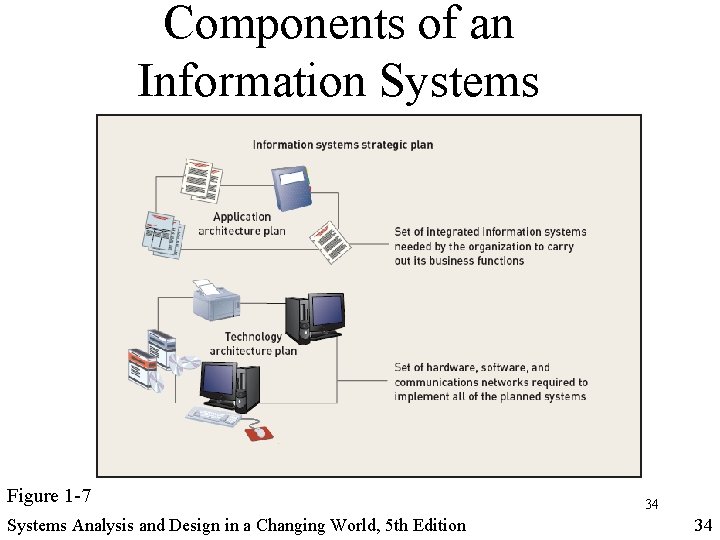
Components of an Information Systems Strategic Plan Figure 1 -7 Systems Analysis and Design in a Changing World, 5 th Edition 34 34
Rocky Mountain Outfitters (RMO) and Its Strategic Information Systems Plan • RMO sports clothing manufacturer and distributor about to begin customer support system project • Need to understand the nature of the business, approach to strategic planning, and objectives for customer support system • RMO system development project used to demonstrate analysis and design concepts 35 35
Introduction to Rocky Mountain Outfitters (RMO) Business • Began in Park City, Utah supplying winter sports clothes to local ski shops • Expanded into direct mail-order sales with small catalog—as catalog interest increased, opened retail store in Park City • Became large, regional sports clothing distributor by early 2000 s in Rocky Mountain and Western states • Currently $180 million in annual sales and 600 employees and two retail stores • Mail-order revenue is $90 million; phone-order 36 revenue is $50 million 36
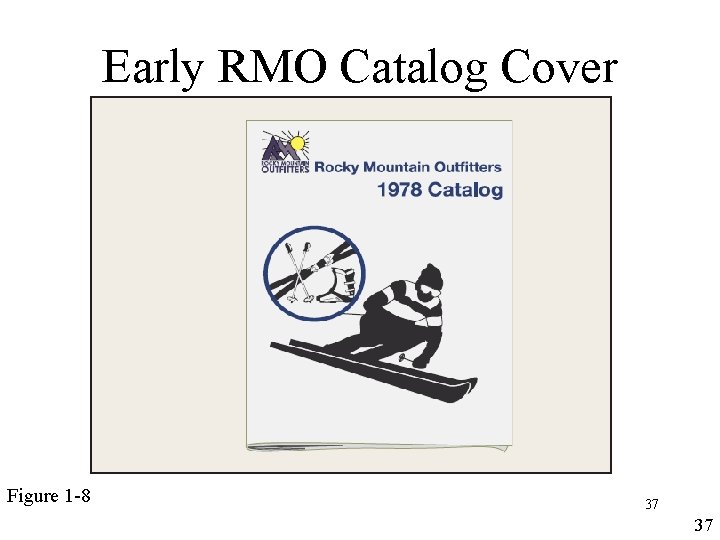
Early RMO Catalog Cover (Fall 1978) Figure 1 -8 37 37
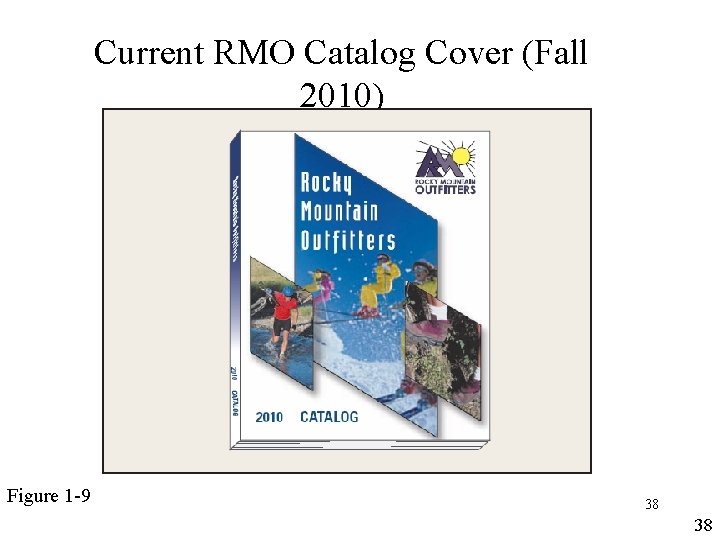
Current RMO Catalog Cover (Fall 2010) Figure 1 -9 38 38
RMO Strategic Issues • Innovative clothing distributor; featured products on Web site ahead of competitors • Original Web site now underperforming – Slow, poor coordination with in-house, poor supply chain management, poor technical support • Market analysis showed alarming trends – Sales growth too slow, age of customers increasing, Web sales small percentage of total 39 39
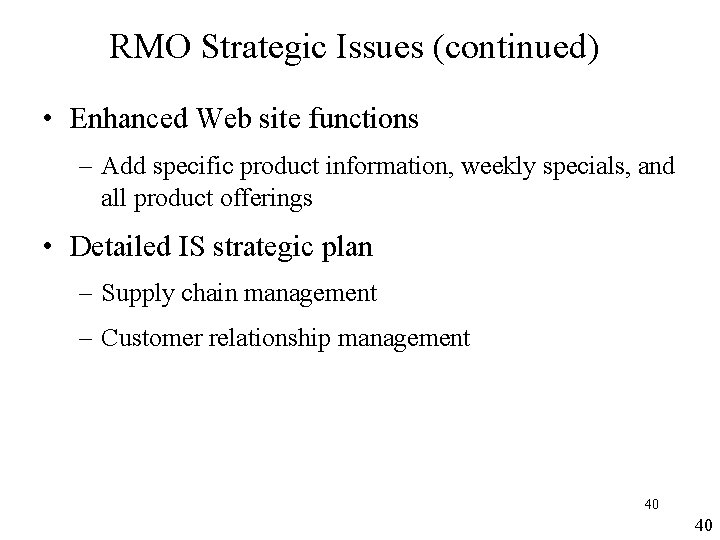
RMO Strategic Issues (continued) • Enhanced Web site functions – Add specific product information, weekly specials, and all product offerings • Detailed IS strategic plan – Supply chain management – Customer relationship management 40 40
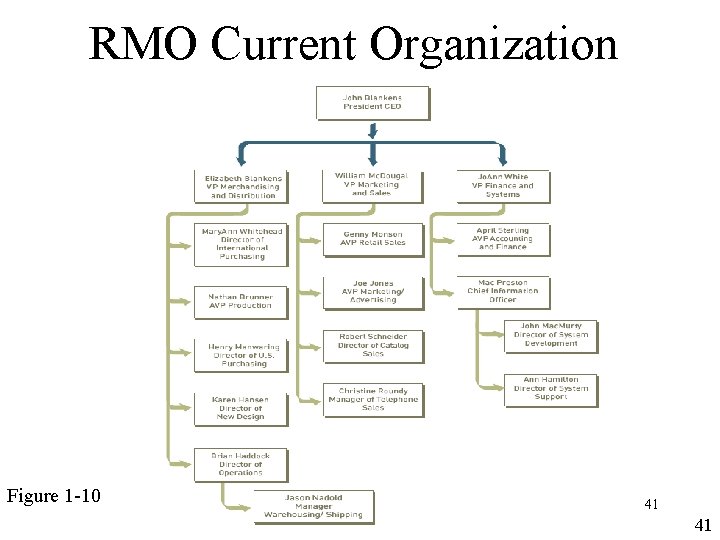
RMO Current Organization Figure 1 -10 41 41
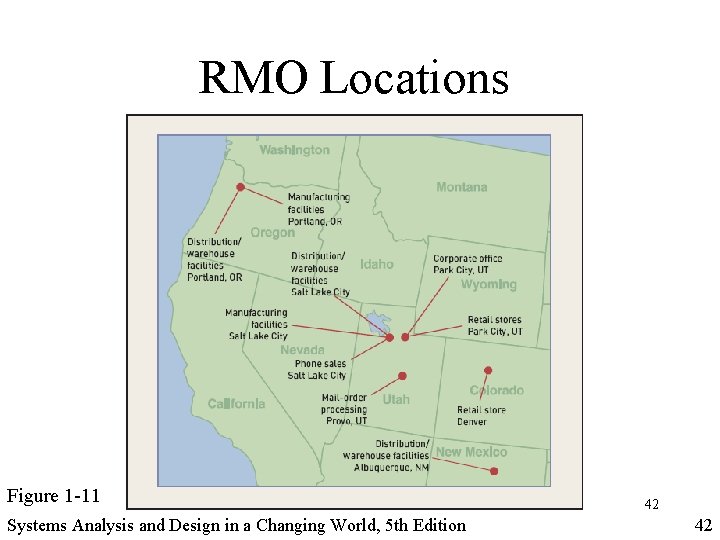
RMO Locations Figure 1 -11 Systems Analysis and Design in a Changing World, 5 th Edition 42 42
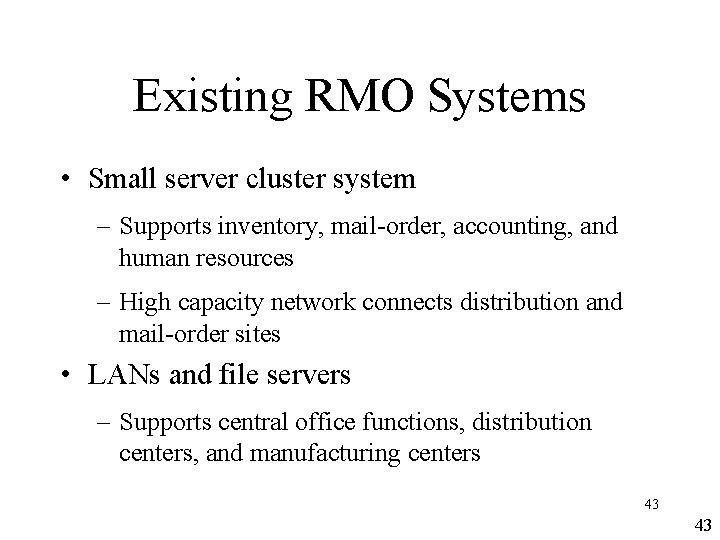
Existing RMO Systems • Small server cluster system – Supports inventory, mail-order, accounting, and human resources – High capacity network connects distribution and mail-order sites • LANs and file servers – Supports central office functions, distribution centers, and manufacturing centers 43 43
Existing RMO Systems (continued) • Supply Chain Management System – Client/Server system in C++ and DB 2 • Mail Order System – Mainframe COBOL/CICS. Unable to handle phone orders • Phone order system – Oracle and Visual Basic system built 6 years ago • Retail store systems – Eight-year-old point-of-sale and batch inventory package, overnight update with mainframe 44 44
Existing RMO Systems (continued) • Office systems – LAN with office software, Internet, e-mail • Human resources system – Thirteen-year-old mainframe-based payroll and benefits • Accounting/finance system – Mainframe package bought from leading vendor • Web Catalog and Order System – Outside company until 2011. Irregular performance 45 45
The Information Systems Strategic Plan • Supports RMO strategic objectives – Build more direct customer relationships – Expand marketing beyond Western states • Plan calls for a series of information system development and integration projects over several years • Project launch: New customer support system to integrate phone orders, mail orders, and direct customer orders via Internet 46 46
RMO Technology Architecture Plan • Distribute business applications – Across multiple locations and systems – Reserve data center for Web server, database, and telecommunications • Strategic business processes via Internet – Supply chain management (SCM) – Direct customer ordering via dynamic Web site – Customer relationship management (CRM) • Web-based intranet for business functions 47 47
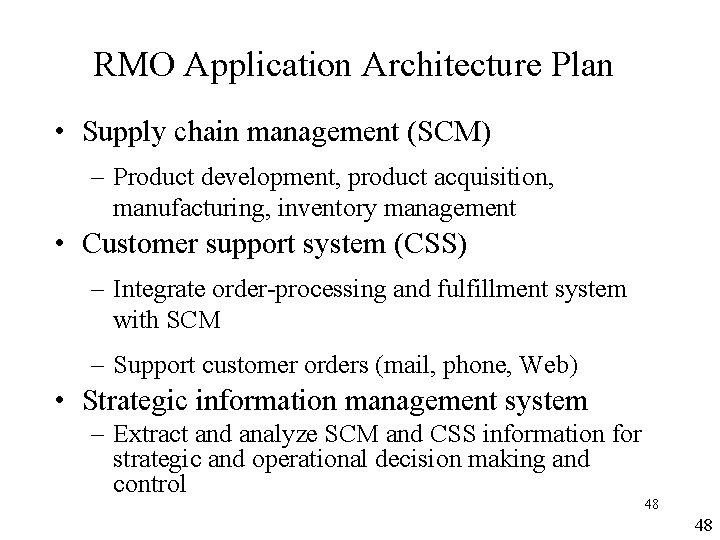
RMO Application Architecture Plan • Supply chain management (SCM) – Product development, product acquisition, manufacturing, inventory management • Customer support system (CSS) – Integrate order-processing and fulfillment system with SCM – Support customer orders (mail, phone, Web) • Strategic information management system – Extract and analyze SCM and CSS information for strategic and operational decision making and control 48 48
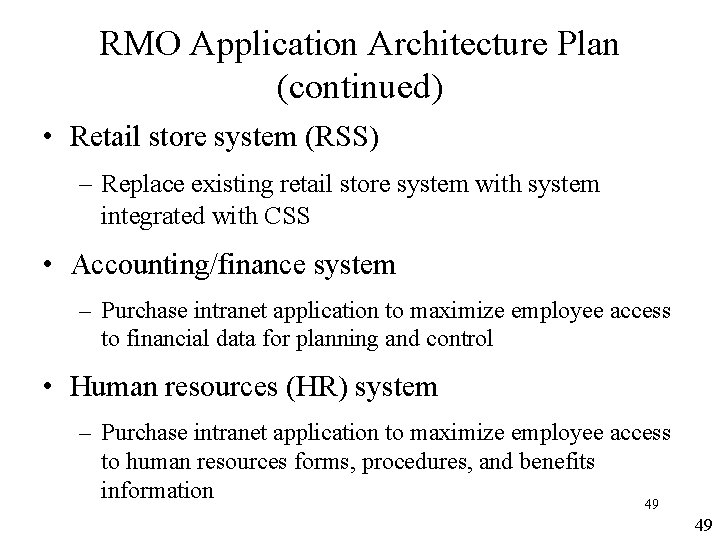
RMO Application Architecture Plan (continued) • Retail store system (RSS) – Replace existing retail store system with system integrated with CSS • Accounting/finance system – Purchase intranet application to maximize employee access to financial data for planning and control • Human resources (HR) system – Purchase intranet application to maximize employee access to human resources forms, procedures, and benefits information 49 49
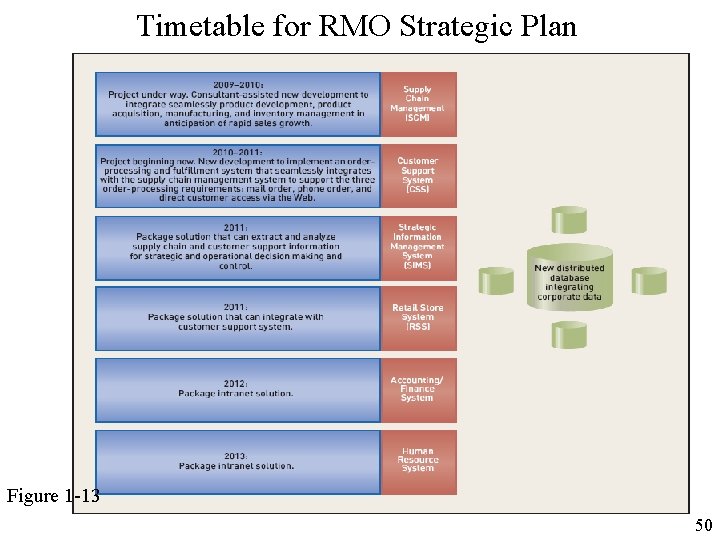
Timetable for RMO Strategic Plan Figure 1 -13 50 50
System Development • Project: a planned undertaking that has a beginning and an end, and which produces a predetermined result or product • Information System development project: planned undertaking that produces a system • Basic activities in development of any new system: – Analysis – to understand information needs – Design – define the system architecture (based on needs) – Implementation – the actual construction of the system 51