
Italian Renaissance Part I Humanism and the Italian

![The Renaissance • French for “rebirth” – (from re [again] and nascere [to be](https://slidetodoc.com/presentation_image_h/31863dd095b1a9acd2472a1885ffd2fe/image-3.jpg "The Renaissance • French for “rebirth” – (from re [again] and nascere [to be")




- Slides: 23
Italian Renaissance
Part I • Humanism and the Italian Renaissance
The Renaissance • French for “rebirth” – (from re [again] and nascere [to be born]) • Origins: Italy, 14 th c. • “High Renaissance, ” 1450 -1527 (centers around 1500) – Art flourished most during this period
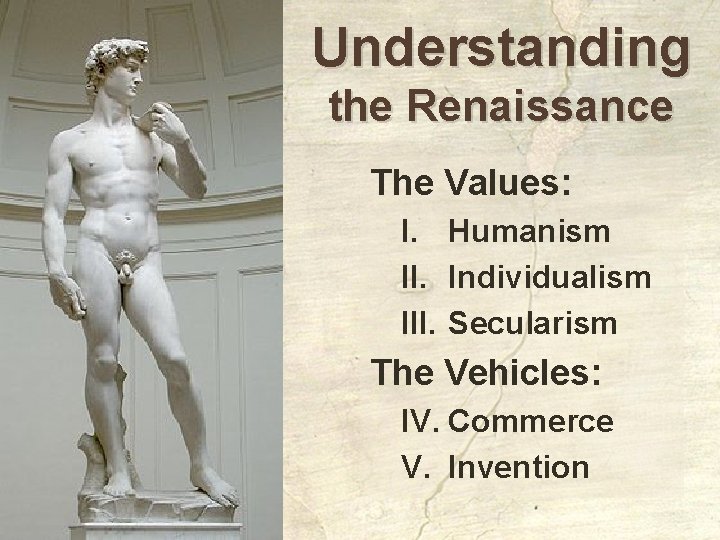
Understanding the Renaissance The Values: I. Humanism II. Individualism III. Secularism The Vehicles: IV. Commerce V. Invention
Classical Studies • Humanism – “the study of humanity” – From studia humanitatis • coined by Cicero to describe the education of a cultivated human being • Classics – Prominent works of Greek, Roman, and Biblical literature – Emphasis: original languages
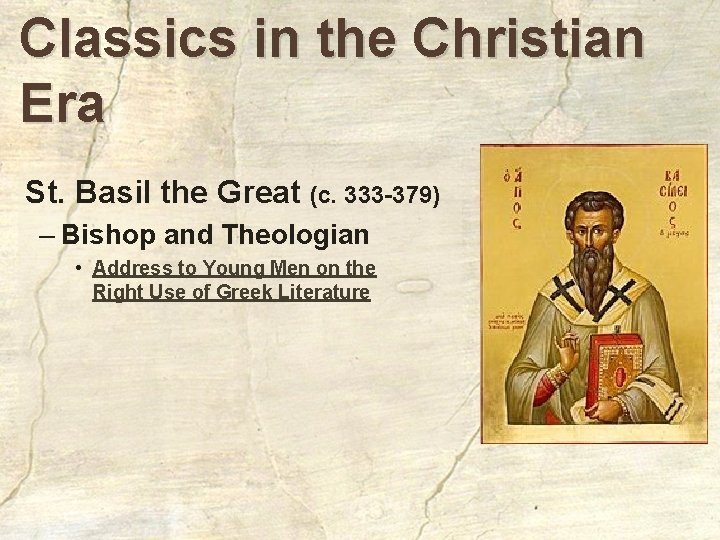
Classics in the Christian Era St. Basil the Great (c. 333 -379) – Bishop and Theologian • Address to Young Men on the Right Use of Greek Literature
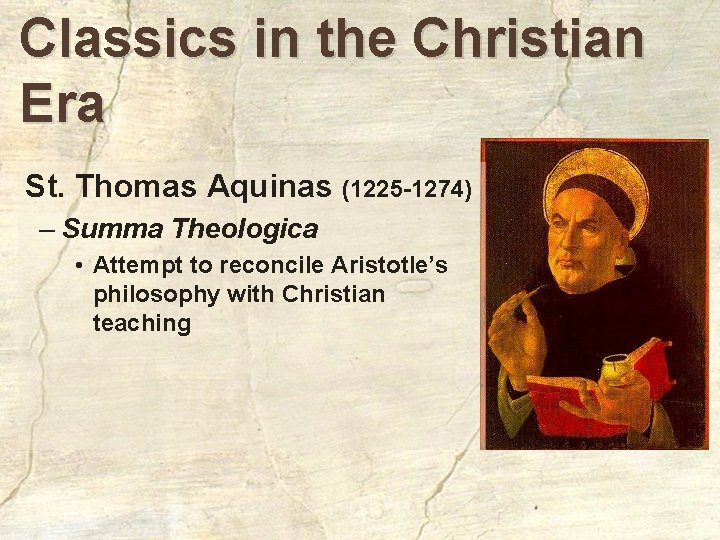
Classics in the Christian Era St. Thomas Aquinas (1225 -1274) – Summa Theologica • Attempt to reconcile Aristotle’s philosophy with Christian teaching
Classics in the Christian Era Classical literature seen as a means to an end…
The Rebirth of Classical Studies Petrarch (c. 1304 -1374) – “Father of Humanism” – “The First Tourist” Recovered crumbling Latin texts, including some of Cicero’s works “Dark Ages” Petrarch
The Rebirth of Classical Studies “Each famous author of antiquity whom I recover places a new offence and another cause of dishonor to the charge of earlier generations, who, not satisfied with their own disgraceful barrenness, permitted the fruit of other minds, and the writings that their ancestors had produced by toil and application, to perish through insufferable neglect… they robbed posterity of its ancestral heritage. ” Petrarch Read Petrarch’s Letter to Posterity
The Robbery The Periochae of Livy http: //www. livius. org/li-ln/livy/periochae The Fall of Carthage as summarized by some unknown medieval monk: When Hasdrubal surrendered to Scipio during the final stage of the siege, his wife, who had -only a few days before- been unable to convince her husband to escape to the victor, threw herself from the citadel into the flames of the burning city with her two children.
Greek Literature Fall of Constantinople (1453) – Turks close Christian universities – Greek scholars flee to Italy with Ancient texts – Plato’s complete works translated into Latin for the first time.
The Rebirth of Human Dignity Pico della Mirandola (1463 -1494) – Oration on the Dignity of Man • The “Manifesto of the Renaissance” – 900 Theses • Syncretism Pico Note Classical Lettering
Secularism Although Petrarch and other Renaissance humanists were devout Christians, they studied the classics for his own enjoyment and edification… an end in themselves. NOTE: Secularism does not necessarily imply an anti-religious or irreligious mindset. Petrarch
Africa Poet Laureate Petrarch’s epic poem, written in Latin, about the exploits of Scipio Africanus during the Second Punic War
Canzoniere Poet Laureate Collection of Petrarch’s vernacular poetry – Mostly Sonnets – Mostly to “Laura” Links: • English/Italian • Full English Text • Full Italian Text
Laura The Love of Petrarch’s Life Laura, illustrated by her virtues and well -celebrated in my verse, appeared to me for the first time during my youth in 1327, on April 6, in the Church of Saint Claire in Avignon, in the first hour of the day; and in the same city, in the same month, on the same sixth day at the same first hour in the year of 1348, withdrew from life, while I was at Verona, unconscious of my loss. . Her chaste and lovely body was interred on the evening of the same day… her soul, as I believe, returned to heaven, ? http: //petrarch. petersadlon. com/laura. html
Machiavelli The Prince – Advice to rulers • “Machiavellian” – The end justifies the means
http: //www. armenian-history. com/Nyuter/HISTORY/Armenia. BC/Roman_Empire_map. png
Baldassare Castiglione The Book of the Courtier – A guide on how to be a respectable (and respected) gentleman (or lady) Portrait of Baldassare Castiglione by Raphael
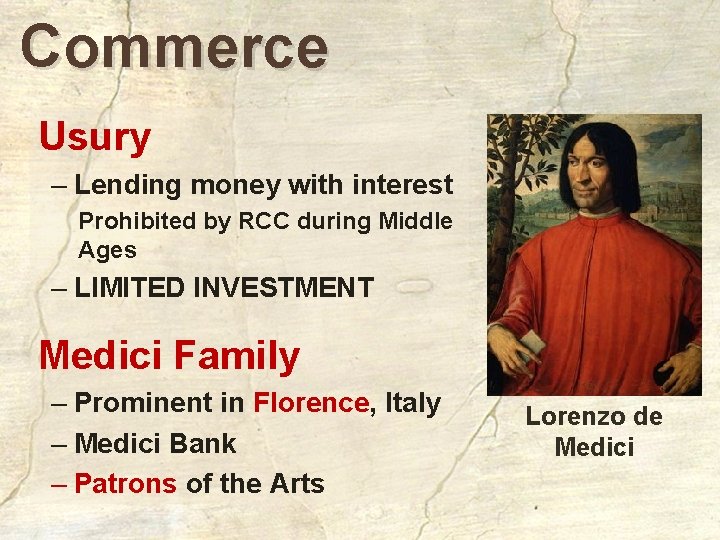
Commerce Usury – Lending money with interest Prohibited by RCC during Middle Ages – LIMITED INVESTMENT Medici Family – Prominent in Florence, Italy – Medici Bank – Patrons of the Arts Lorenzo de Medici
Invention Printing Press – 1454 – Gutenberg experiments with movable type – Gutenberg Bible (1456) • About 180 copies produced Information can spread more quickly than ever before… and at a fraction of the cost!