
Italian and German Unification Italy MidCentury a geographic
![Review: French History 1 st Republic (1792 -1804) The 1 st Empire [1804 -1814]](https://slidetodoc.com/presentation_image_h2/09820fb4942fc63d864a93c9685fc516/image-19.jpg "Review: French History 1 st Republic (1792 -1804) The 1 st Empire [1804 -1814]")
- Slides: 22
Italian and German Unification
Italy @ Mid-Century: a geographic entity, not a political reality “Romantic Republican” – wanted a republic as well as unity Secret Societies – Carbonari and Young Italy (Giuseppi Mazzini) After 1848 unification movement in Italy shifted to Sardinia-Piedmont under King Victor Emmanuel, Count Cavour and Garibaldi Realpolitik instead of romanticism for unification: Machiavellian approach—practical politics
Count Camillo Benso di Cavour (1810 -1861) of Sardinia-Piedmont led the struggle for Italian unification Served as King Victor Emmanuel’s prime minister between 1852 and 1861 Essentially a moderate nationalist and aristocratic liberal Replaced the earlier failed unification revolutionaries such as Mazzini and the Young Italy Movement. Did not employ romantic illusions of a unified Italy (such as those of Mazzini) but rather carried out realpolitik Editor of Il Risorgimento, a newspaper arguing Sardinia should be the foundation of a new unified Italy.
Sardinia-Piedmont (maps 693) Liberal and economically viable state �Modeled on French constitution of 1830: some civil liberties, parliamentary gov't with elections and parliamentary control of taxes. �Reformed the judicial system �Built up infrastructure (roads, canals, ports) �The Law on Convents and Siccardi Law sought to reduce the influence of the Catholic Church. � In response, Pope Pius IX issued his Syllabus of Errors (1864) warning Catholics against liberalism, rationalism, socialism, separation of church and state, and religious liberty. �Also a response to France’s secularization of education during the same period
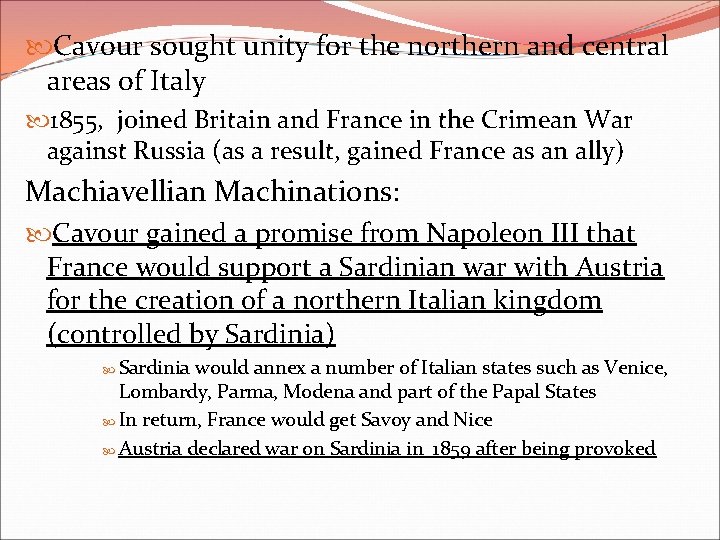
Cavour sought unity for the northern and central areas of Italy 1855, joined Britain and France in the Crimean War against Russia (as a result, gained France as an ally) Machiavellian Machinations: Cavour gained a promise from Napoleon III that France would support a Sardinian war with Austria for the creation of a northern Italian kingdom (controlled by Sardinia) Sardinia would annex a number of Italian states such as Venice, Lombardy, Parma, Modena and part of the Papal States In return, France would get Savoy and Nice Austria declared war on Sardinia in 1859 after being provoked
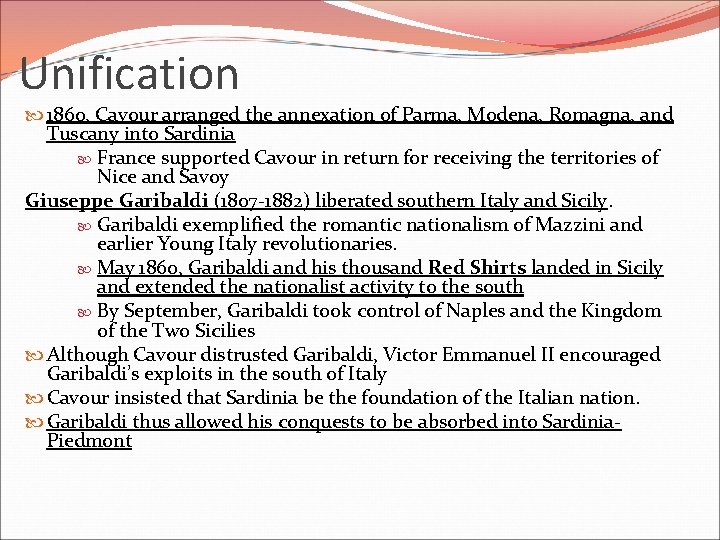
Unification 1860, Cavour arranged the annexation of Parma, Modena, Romagna, and Tuscany into Sardinia France supported Cavour in return for receiving the territories of Nice and Savoy Giuseppe Garibaldi (1807 -1882) liberated southern Italy and Sicily. Garibaldi exemplified the romantic nationalism of Mazzini and earlier Young Italy revolutionaries. May 1860, Garibaldi and his thousand Red Shirts landed in Sicily and extended the nationalist activity to the south By September, Garibaldi took control of Naples and the Kingdom of the Two Sicilies Although Cavour distrusted Garibaldi, Victor Emmanuel II encouraged Garibaldi’s exploits in the south of Italy Cavour insisted that Sardinia be the foundation of the Italian nation. Garibaldi thus allowed his conquests to be absorbed into Sardinia. Piedmont
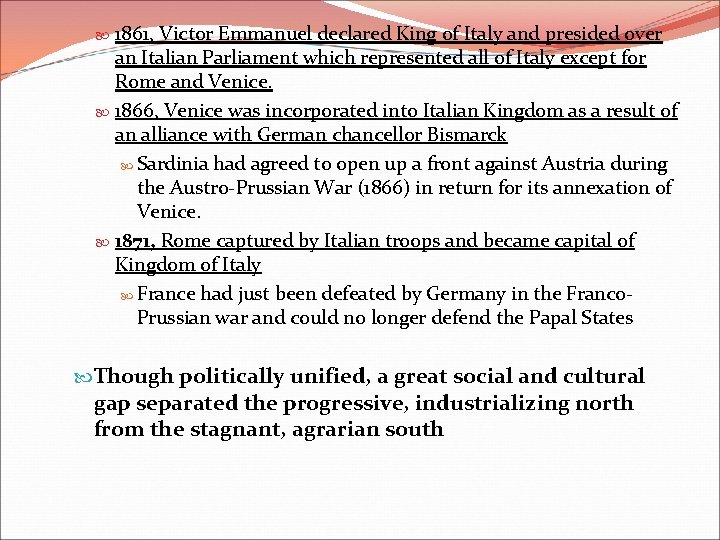
1861, Victor Emmanuel declared King of Italy and presided over an Italian Parliament which represented all of Italy except for Rome and Venice. 1866, Venice was incorporated into Italian Kingdom as a result of an alliance with German chancellor Bismarck Sardinia had agreed to open up a front against Austria during the Austro-Prussian War (1866) in return for its annexation of Venice. 1871, Rome captured by Italian troops and became capital of Kingdom of Italy France had just been defeated by Germany in the Franco. Prussian war and could no longer defend the Papal States Though politically unified, a great social and cultural gap separated the progressive, industrializing north from the stagnant, agrarian south
German Unification Hohenzollern (Prussian)leadership – Map (696) NOT Austrian
Most important political development in Europe between 1848 -1914!! Transformed the balance of power, politically, economically The way it was created determined the character of the new German state, i. e militarist, conservative, monarchist
Otto von Bismarck (1810 -1898) Junker background; obsessed with power “The great questions of the day will not be decided by speeches and resolutions—that was the blunder of 1848 and 1849—but by blood and iron. ” Gov’t continued to collect taxes even though the parliament refused to approve the budget. Voters countered by sending liberal majorities to the parliament between 1862 -1866 Bismarck and the Kaiser worked around the parliament
Prussian-Danish War, 1863 Germany & Austria defeated Denmark and took control of the provinces of Schleswig and Holstein The provinces were jointly administered by Prussia and Austria but conflicts over jurisdiction would lead to a major war between Prussia and Austria Austro-Prussian War (7 Weeks’ War) 1866 Made diplomatic preparations for war with Austria by negotiating with France, Italy, and Russia for noninterference Prussia’s use of railroads to mass troops and use new technology in weapons proved superior to Austria’s military efforts. Prussia’s victory unified much of Germany without Austria. The “kleindeutsch plan” prevailed Austria was given generous peace terms Italy received Venice from Austria
North German Confederation (18670 King William I as president. (Kaiser Wilhelm) Included all the German states except Baden, Wurttemberg, Bavaria, and Saxony The federal constitution allowed each state to retain its own local government The parliament (Reichstag) consisted of two houses that shared power equally. The upper house (bundesrat) included representatives from each state The lower house (bundestag) had representatives elected by universal male suffrage
Franco-Prussian War (1870 -1871) Ems Dispatch Bismarck sought to provoke a war with France in order to further unify Germany and annex Alsace and Lorraine Thus, Bismarck boasted that a French diplomat had been kicked out of Germany after asking William I not to interfere with the succession to the Spanish throne. The alleged snub was exaggerated by Bismarck intentionally in order to provoke France. An infuriated France declared war against Germany
Bismarck used the war with France to bring 4 remaining southern German states into the North German Confederation Bavaria, Baden, Wurttemberg, and Saxony The apparent ease with which Prussia defeated France sent shockwaves throughout Europe. Paris fell to the Germans in January, 1871: Napoleon III was captured The battles of Sedan and Metz were particularly decisive in Prussia’s victory. Treaty of Frankfurt (May, 1871): Alsace and Lorraine ceded to Germany
The German Empire 1871 (Germany now the most powerful nation in Europe) William I became Emperor of Germany (Kaiser Wilhelm) Bismarck became the Imperial Chancellor. Bavaria, Baden, Wurttemberg, and Saxony were incorporated into the German Empire The German Empire’s government was essentially the same federal structure established in 1866. In reality, the Reichstag had little power as the German Empire became a conservative autocracy with the nobility allied with the monarch.
Second French Republic (1848 -1852) Constitution: unicameral legislature (National Assembly); strong executive power; popularlyelected president of the Republic Universal male suffrage President Louis Napoleon: seen by voters as a symbol of stability and greatness
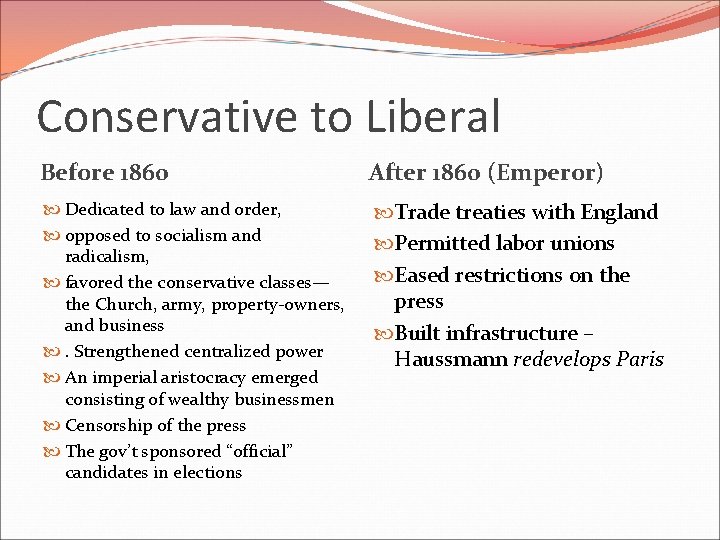
Conservative to Liberal Before 1860 After 1860 (Emperor) Dedicated to law and order, opposed to socialism and radicalism, favored the conservative classes— the Church, army, property-owners, and business . Strengthened centralized power An imperial aristocracy emerged consisting of wealthy businessmen Censorship of the press The gov’t sponsored “official” candidates in elections Trade treaties with England Permitted labor unions Eased restrictions on the press Built infrastructure – Haussmann redevelops Paris
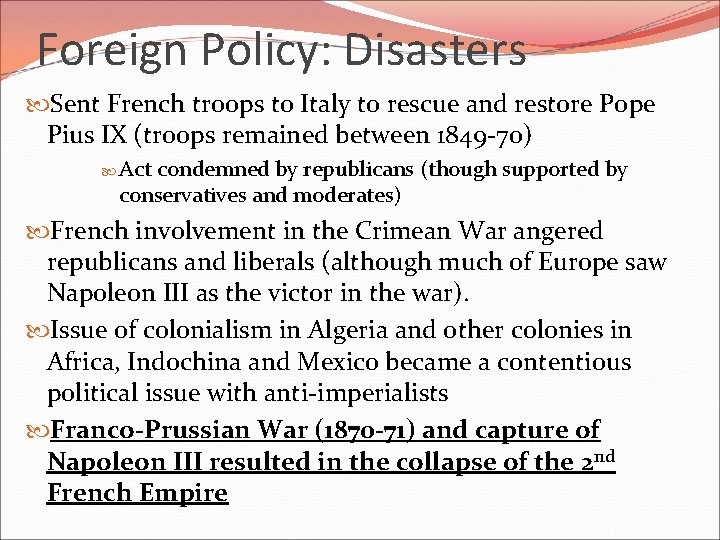
Foreign Policy: Disasters Sent French troops to Italy to rescue and restore Pope Pius IX (troops remained between 1849 -70) Act condemned by republicans (though supported by conservatives and moderates) French involvement in the Crimean War angered republicans and liberals (although much of Europe saw Napoleon III as the victor in the war). Issue of colonialism in Algeria and other colonies in Africa, Indochina and Mexico became a contentious political issue with anti-imperialists Franco-Prussian War (1870 -71) and capture of Napoleon III resulted in the collapse of the 2 nd French Empire
Review: French History 1 st Republic (1792 -1804) The 1 st Empire [1804 -1814] The Restoration of the Bourbons [1814 -1848] The 2 nd Republic [1848 -1852 The 2 nd Empire [18521870] The 3 rd Republic [1870 -1940]
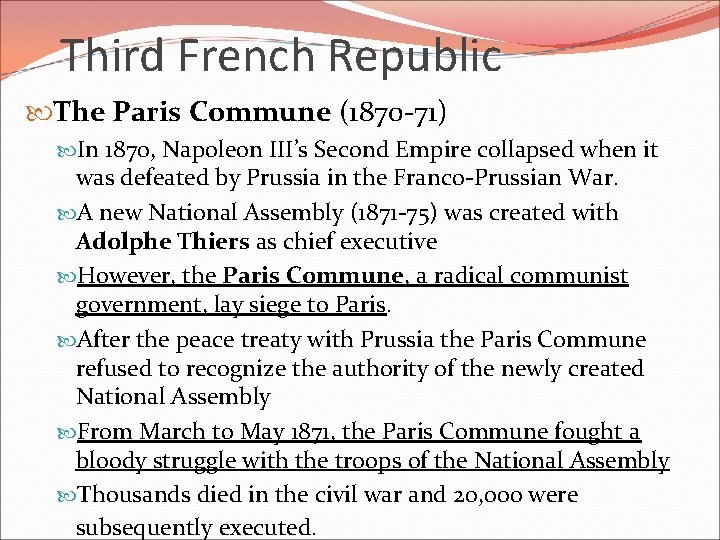
Third French Republic The Paris Commune (1870 -71) In 1870, Napoleon III’s Second Empire collapsed when it was defeated by Prussia in the Franco-Prussian War. A new National Assembly (1871 -75) was created with Adolphe Thiers as chief executive However, the Paris Commune, a radical communist government, lay siege to Paris. After the peace treaty with Prussia the Paris Commune refused to recognize the authority of the newly created National Assembly From March to May 1871, the Paris Commune fought a bloody struggle with the troops of the National Assembly Thousands died in the civil war and 20, 000 were subsequently executed.
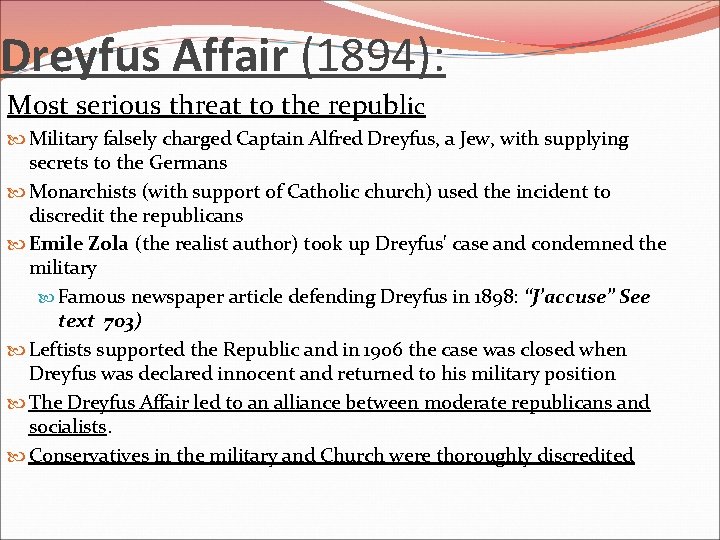
Dreyfus Affair (1894): Most serious threat to the republic Military falsely charged Captain Alfred Dreyfus, a Jew, with supplying secrets to the Germans Monarchists (with support of Catholic church) used the incident to discredit the republicans Emile Zola (the realist author) took up Dreyfus' case and condemned the military Famous newspaper article defending Dreyfus in 1898: “J’accuse” See text 703) Leftists supported the Republic and in 1906 the case was closed when Dreyfus was declared innocent and returned to his military position The Dreyfus Affair led to an alliance between moderate republicans and socialists. Conservatives in the military and Church were thoroughly discredited
The Dreyfus Affair Video: http: //www. youtube. com/watch? v=DDbj 7 k. P 9 LRg http: //www. youtube. com/watch? v=YFCAHGEP 0 M 4&featu re=related http: //www. youtube. com/watch? v=3 z. Fy. IFNs. ZM 8&feature =related http: //www. youtube. com/watch? v=ZZ 604 Wu. HF 1 g&feature =related