
ITACONIC ACID PRODUCTION FROM SORGHUM BRAN A BIOREFINING
ITACONIC ACID PRODUCTION FROM SORGHUM BRAN – A BIOREFINING APPROACH AMINA AHMED EL-IMAM; C. DU; P. S. DYER 27 TH AUGUST, 2015
v. Introduction OUTLINE a. Itaconic acid fermentation and potential mitigants b. Sorghum bran c. Biorefineries d. Motivation & Objectives v. Methods & Findings a. Compositional analyses b. Hydrolysate preparation c. Determination of potential inhibitors d. Hydrolysate enrichment and detoxification e. Fermentation v. Summary
INTRODUCTION • ITACONIC ACID (IA): • A versatile drop-in organic acid monomer • Produced by fermentation of sugars by Aspergillus terreus • High cost limits application – need for cheaper substrates • SORGHUM BRAN (SB): • Sorghum (Sorghum bicolor) is an important cereal • Used in making various foods, feed, ethanol etc • Grain processing generates bran as waste • BIOREFINERY • Facility that integrates biomass conversion with fuels, power and chemical production • Most promising route to creation of biobased industries
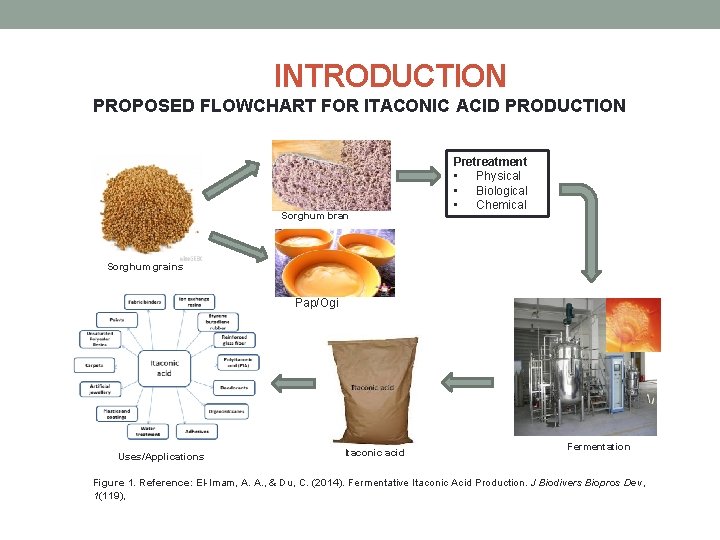
INTRODUCTION PROPOSED FLOWCHART FOR ITACONIC ACID PRODUCTION Sorghum bran Pretreatment • Physical • Biological • Chemical Sorghum grains Pap/Ogi Uses/Applications Itaconic acid Fermentation Figure 1. Reference: El-Imam, A. A. , & Du, C. (2014). Fermentative Itaconic Acid Production. J Biodivers Biopros Dev, 1(119),
MOTIVATION & OBJECTIVES q. MOTIVATION: • Sorghum waste is relatively underutilised though it accumulates in large amounts • Renewable Itaconic acid is beneficial to the environment q. OBJECTIVES: A. Conduct compositional analyses of sorghum bran B. Screen several isolates for desirable traits C. Determine potential inhibitors of itaconic acid fermentation D. Detoxification of the medium E. Produce itaconic acid in economical amounts
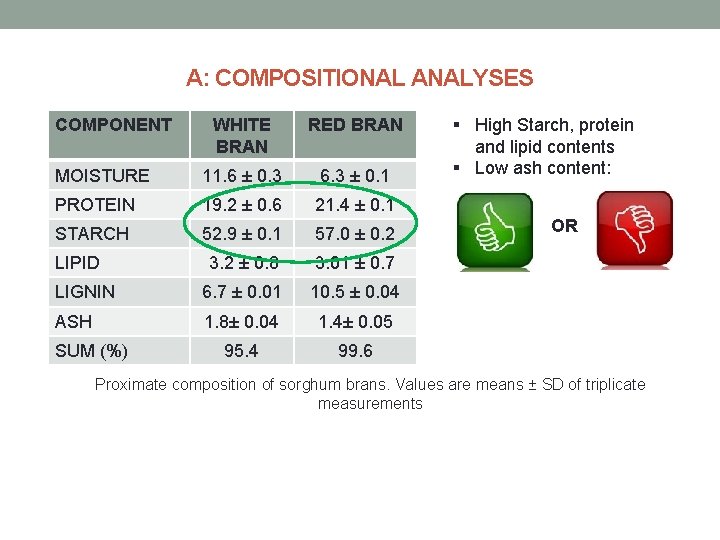
A: COMPOSITIONAL ANALYSES COMPONENT WHITE BRAN RED BRAN 11. 6 ± 0. 3 6. 3 ± 0. 1 PROTEIN 19. 2 ± 0. 6 21. 4 ± 0. 1 STARCH 52. 9 ± 0. 1 57. 0 ± 0. 2 3. 2 ± 0. 8 3. 01 ± 0. 7 LIGNIN 6. 7 ± 0. 01 10. 5 ± 0. 04 ASH 1. 8± 0. 04 1. 4± 0. 05 95. 4 99. 6 MOISTURE • LIPID SUM (%) § High Starch, protein and lipid contents § Low ash content: a OR Proximate composition of sorghum brans. Values are means ± SD of triplicate measurements
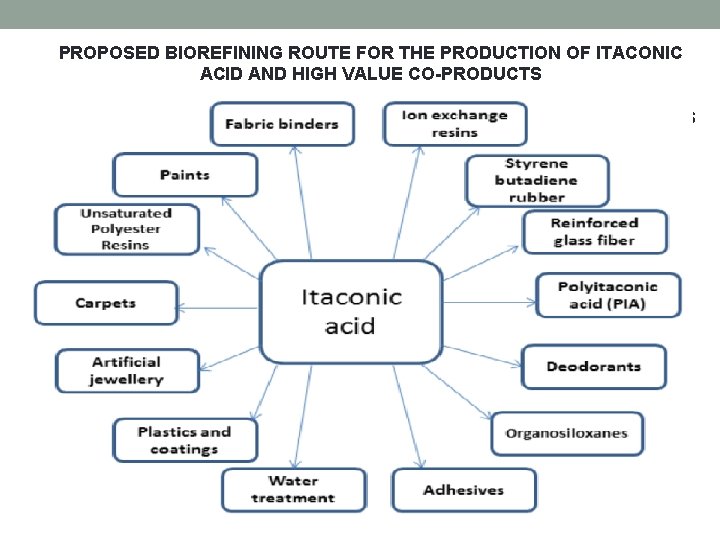
PROPOSED BIOREFINING ROUTE FOR THE PRODUCTION OF ITACONIC ACID AND HIGH VALUE CO-PRODUCTS PROCESS FEEDSTOCK PRODUCTS STARCH MILLING APPLICATIONS FOOD FEED BRAN PHENOLICS HEAT DILUTE ACID HYDROLYSIS SORGHUM GRAINS INDUSTRIAL PRODUCTS HYDROLYSIS RESIDUE ENZYMATIC HYDROLYSIS SUGARS A. terreus FERMENTATION S. cerevisiae/YEAST FERMENTATION PYROLYSIS PRODUCTS ITACONIC ACID VARIOUS INDUSTRIAL USES ETHANOL FUEL/ CHEMICAL
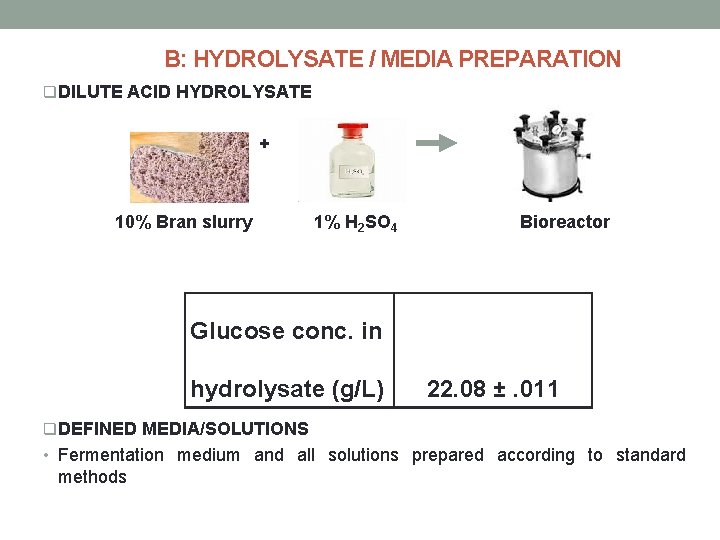
B: HYDROLYSATE / MEDIA PREPARATION q. DILUTE ACID HYDROLYSATE + 10% Bran slurry 1% H 2 SO 4 Bioreactor Glucose conc. in hydrolysate (g/L) 22. 08 ±. 011 q. DEFINED MEDIA/SOLUTIONS • Fermentation medium and all solutions prepared according to standard methods
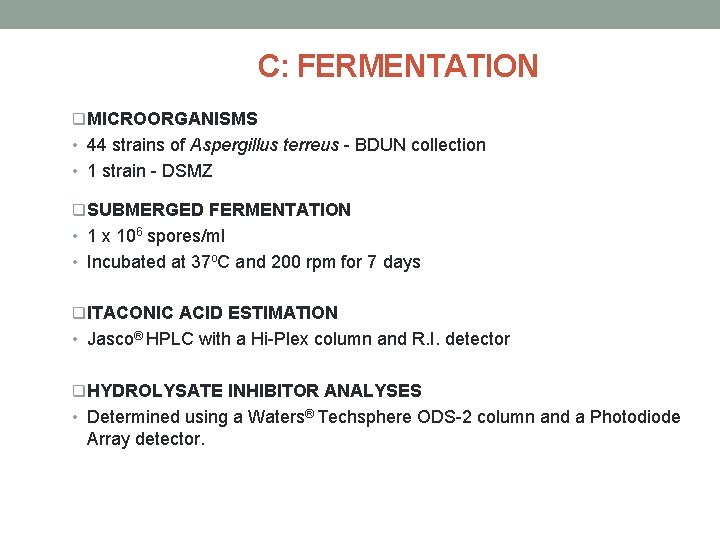
C: FERMENTATION q. MICROORGANISMS • 44 strains of Aspergillus terreus - BDUN collection • 1 strain - DSMZ q. SUBMERGED FERMENTATION • 1 x 10⁶ spores/ml • Incubated at 37 o. C and 200 rpm for 7 days q. ITACONIC ACID ESTIMATION • Jasco® HPLC with a Hi-Plex column and R. I. detector q. HYDROLYSATE INHIBITOR ANALYSES • Determined using a Waters® Techsphere ODS-2 column and a Photodiode Array detector.

0 49 -1 49 -2 49 -3 49 -4 49 -5 49 -6 49 -7 49 -8 49 -9 49 -10 49 -11 49 -12 49 -13 49 -14 49 -15 49 -16 49 -17 49 -18 49 -19 49 -20 49 -21 49 -22 49 -23 49 -24 49 -25 49 -26 49 -27 49 -28 49 -29 49 -30 49 -31 49 -32 49 -33 49 -34 49 -35 49 -36 49 -37 49 -38 49 -39 49 -40 49 -41 49 -42 49 -43 49 -44 49 -45 Itaconic acid yield (g/L) C: FERMENTATION YIELDS ON GLUCOSE MEDIUM 50 45 40 35 ITACONIC ACID 30 25 20 15 10 5 Aspergillus terreus BDUN Strain ID Figure 2: Screening strains of Aspergillus terreus for itaconic acid production on glucose medium.
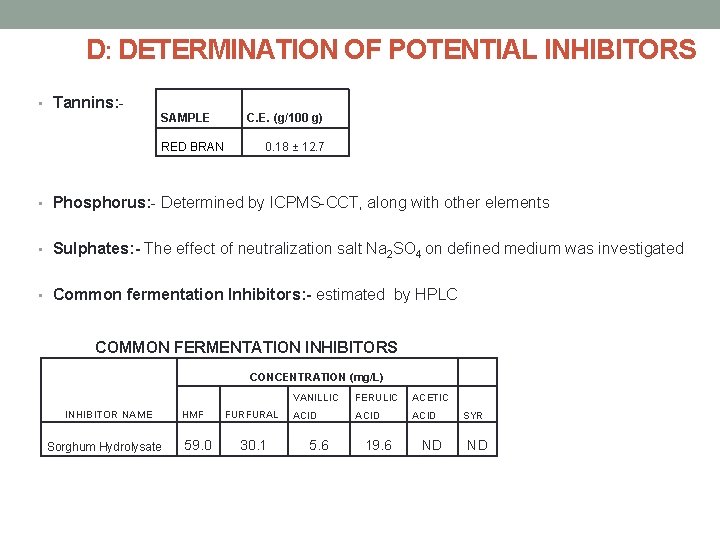
D: DETERMINATION OF POTENTIAL INHIBITORS • Tannins: SAMPLE RED BRAN C. E. (g/100 g) 0. 18 ± 12. 7 • Phosphorus: - Determined by ICPMS-CCT, along with other elements • Sulphates: - The effect of neutralization salt Na 2 SO 4 on defined medium was investigated • Common fermentation Inhibitors: - estimated by HPLC COMMON FERMENTATION INHIBITORS CONCENTRATION (mg/L) INHIBITOR NAME Sorghum Hydrolysate HMF 59. 0 FURFURAL 30. 1 VANILLIC FERULIC ACETIC ACID 5. 6 19. 6 ND SYR ND
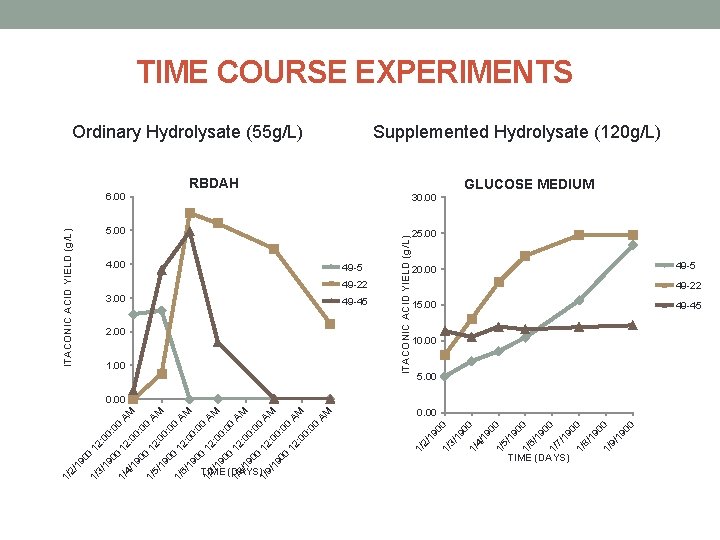
1/ TIME (DAYS) 0 0 19 0 9/ 1/ 0 0 19 0 8/ 1/ 19 0 7/ 1/ 0 0 19 0 6/ 1/ 19 0 5/ 1. 00 19 0 2. 00 1/ 49 -45 0 3. 00 4/ RBDAH 1/ 25. 00 19 0 49 -22 0 5. 00 3/ 30. 00 1/ 6. 00 ITACONIC ACID YIELD (g/L) 49 -5 19 0 4. 00 2/ ITACONIC ACID YIELD (g/L) Ordinary Hydrolysate (55 g/L) 1/ 00 12 3/ : 0 19 0: 00 00 1/ 1 AM 2 4/ : 0 19 0 : 0 00 0 1/ 1 AM 2 5/ : 00 19 : 0 00 0 1/ 1 AM 2 6/ : 00 19 : 0 00 0 1/ 1 AM 2 7/ : 00 19 : 0 00 0 1/ 1 AM 2 8/ : 00 19 : 0 00 0 1/ 1 AM 2: 9/ 00 19 : 0 00 0 12 AM : 0 0: 00 AM 2/ 19 1/ TIME COURSE EXPERIMENTS Supplemented Hydrolysate (120 g/L) GLUCOSE MEDIUM 20. 00 49 -5 49 -22 15. 00 49 -45 10. 00 5. 00 0. 00
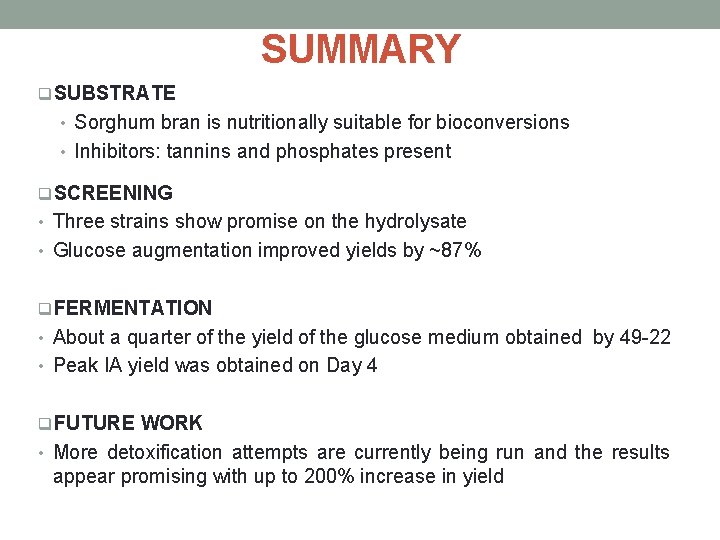
SUMMARY q. SUBSTRATE • Sorghum bran is nutritionally suitable for bioconversions • Inhibitors: tannins and phosphates present q. SCREENING • Three strains show promise on the hydrolysate • Glucose augmentation improved yields by ~87% q. FERMENTATION • About a quarter of the yield of the glucose medium obtained by 49 -22 • Peak IA yield was obtained on Day 4 q. FUTURE WORK • More detoxification attempts are currently being run and the results appear promising with up to 200% increase in yield
ACKNOWLEDGEMENTS ØThe Federal Government of Nigeria ØBioenergy and Fungal Biology groups THANK YOU FOR LISTENING
- Slides: 14