
IT4545 Introduction to Mobile Computing Fall 2020 Course
IT-4545 Introduction to Mobile Computing Fall 2020
Course Information • Books - Programming Mobile Devices: An Introduction for Practitioners by Tommi. Mikkonen, Wiley; 1 st Edition (March 19, 2007). ISBN 10: 0470057386. - Professional Mobile Application Development by Jeff Mc. Wherter& Scott Gowell, Wrox; 1 st Edition (September 4, 2012). ISBN-10: 1118203909
Introduction • “Mobile computing systems are computing systems that may be easily moved physically and whose computing capabilities may be used while they are being moved”. • Examples are • laptops, personal digital assistants (PDAs), and mobile phones
Aspects Of Mobile Computing • Systems are • small size • mobile nature of their use • wireless network connectivity • power sources • functionalities that are particularly suited
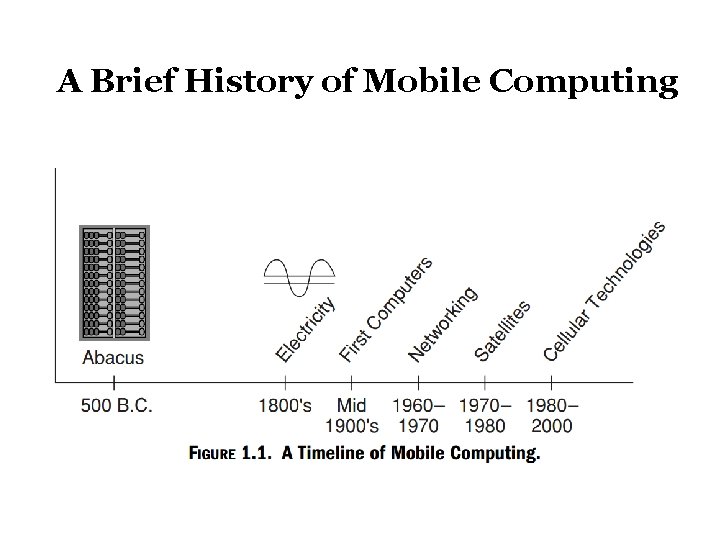
A Brief History of Mobile Computing

Wireless Mobile or Mobile Wireless? • wireless communications and mobile computing • Mobile computing devices need not be wireless. • Wireless communication systems are type of communication system • four pieces to the mobile problem: • mobile user, mobile device, mobile application, and mobile network • Dimensions of mobility: • The set of properties that distinguishes the mobile computing system from stationary computing system
Dimensions of Mobile Computing • Location awareness • Network connectivity quality of service (QOS) • Limited device capabilities • Limited power supply • Support for a wide variety of user interfaces • Platform proliferation • Active transactions
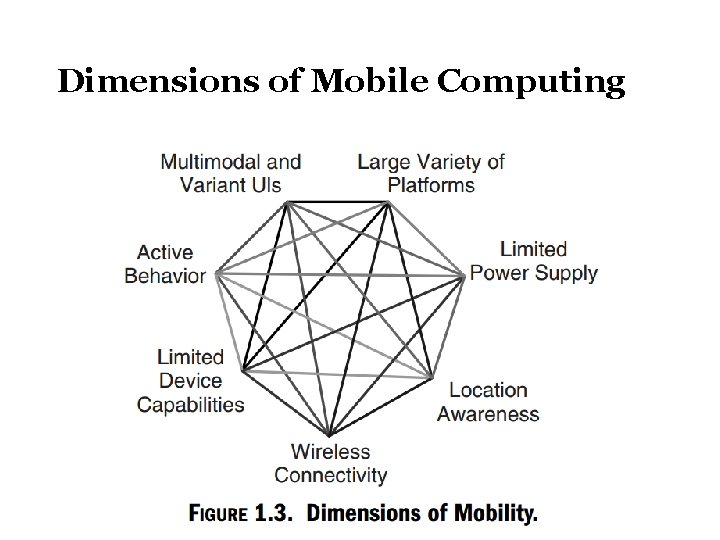
Dimensions of Mobile Computing
Location • A mobile device is not always at the same place: Its location is constantly changing. • Location aware app and systems have Challenges. • localization and location sensitivity • Localization is ability of the architecture of the mobile application to accommodate logic that allows the selection of different business logic, level of work flow, and interfaces based on a given set of location information commonly referred to as locales. e. g. , P. O. S or e-commerce web application • different taxation rules
Location • Location sensitivity is the ability of the device and the software application to first obtain location information while being used and then to take advantage of this location information in offering features and functionality. • location-sensing technologies (triangulation, proximity, and scene analysis) • Triangulation is calculation of the location of a point that lies in the middle of three other points whose exact locations are known.
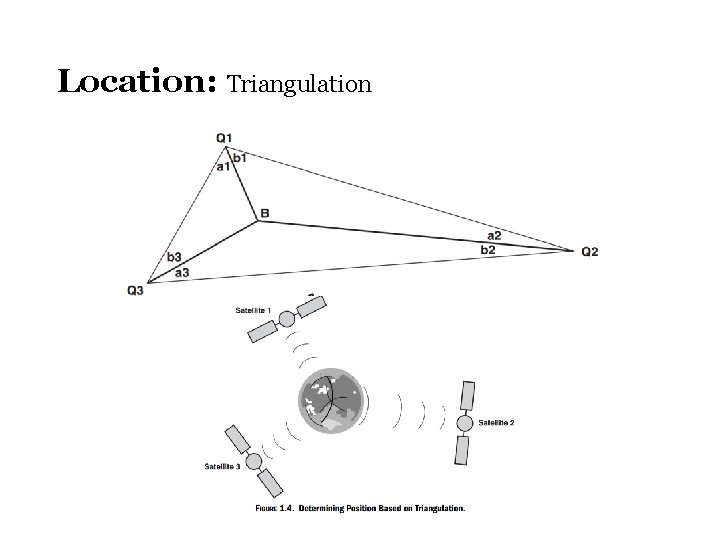
Location: Triangulation
Location • Proximity-based methods measure the relative position of the unknown point to some known point. • Scene analysis relies on image processing and topographical techniques to calculate the location of the unknown point based on a view of the unknown point from a known point. • The most well known location sensing system today is GPS-enabled devices can obtain latitude and longitude with accuracy of about 1– 5 m.
Quality of Service • Mobility means loss of network connectivity reliability. • Physical conditions can significantly affect the quality of service (QOS) • E. g. bad weather, solar flares, and a variety of other climaterelated conditions • Mobile applications have to know how to continue to operate even after they are disconnected from the network or while they connect and disconnect from the network • E. g. User traveling in train downloading affect • Mobile applications should know how to stop working when the application suddenly disconnects from the network and then resume working when it connects again.
Limited Device Storage and CPU • physical size limits; volatile storage, nonvolatile storage, and CPU • smaller is nearly always better • physical boundaries on the size of transistors • heat produced by the transistors • number of transistors on a microchip • So, the constraint on how we develop mobile applications • Mobile applications must be designed to optimize the use of data storage and processing power
Limited Power Supply • limited power supply • must be balanced with the processing power, storage, and size constraints • power supply has a direct or an indirect effect on everything • For example, the brighter the display • power management functionality is built into the operating system • making the right choice of platform and configure it properly
Varying User Interfaces • Stationary computers efficiently operate interfaces with keyboard, mouse, and monitor • Alternative interfaces for mobile devices are voice user interfaces, smaller displays, stylus and other pointing devices, touch-screen displays, and miniature keyboards. • Cumbersome to interact while driving or on the move. • designers and implementers need to understand necessity of finding the best user interface(s) • Next computing revolution in interfaces
Varying User Interfaces • User interfaces are difficult to design and implement for the following reasons • Designers have difficulties learning the user’s tasks. • The tasks and domains are complex. • A balance must be achieved among the many different design aspects, such as standards, graphic design, technical writing, internationalization, performance, multiple levels of detail, social factors, and implementation time. • The existing theories and guidelines are not sufficient. • Iterative design is difficult. • There are real-time requirements for handling input events. • It is difficult to test user interface software. • Today’s languages do not provide support for user interfaces. • Programmers report an added difficulty of modularization of user interface software.
Platform Proliferation • Low cost, small size mobile devices rage manufacturing • Gives rise to proliferation of devices and platforms in market • Platform proliferation has very significant implications on the architecture, design, and development of mobile applications. • For example, it is not wise to write a voice-driven phone book application that runs only on one type of platform. • The software architects and developers should be focused on user’s requirements such as, support of multiple platforms.
Active Transactions • active transactions as those transactions initiated by the system. • Active transactions may be synchronous or asynchronous. • All active transactions are initiated by the system. • Synchronous transactions are time dependent
Active Transactions • Synchronous active transactions properties: • The transaction is initiated by the system, and during the same transaction, the user is given an opportunity, for a finite period of time, to respond to the action initiated by the system. • Synchronous active transactions require a timely response from the user. • The interactions between the system and the user work in a sequential and serial manner during a synchronous transaction. • Synchronous active transactions are established between the system and a single user.
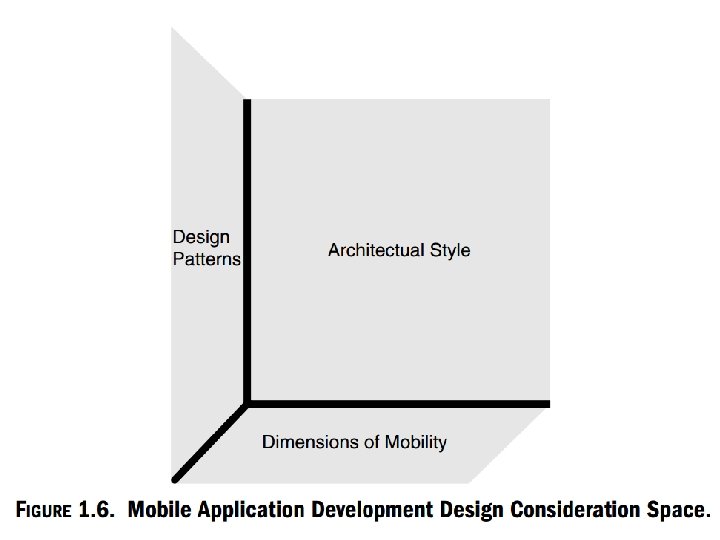
Architecture Of Mobile Software Applications • After gathering requirements require such a high-level plan. • basic prevalent application architectures are, N-Tier, client–server, mobile agent, and peer-to-peer • software architecture to be a particular high-level abstraction of the system and how its components collaborate. • architectural patterns; these are patterns that are recognizable once they are used prevalently in some architectures. • Not fully established design patterns, architectural patterns, or even architectures
- Slides: 22