
IT Standards Management Principles Performance vs Process Successful

![SUMMARY [1] • Standards support interoperable free- market, commercial products and services • Voluntary](https://slidetodoc.com/presentation_image_h2/bd96b205f67cbf4b5eefa78bb44032dc/image-5.jpg "SUMMARY [1] • Standards support interoperable free- market, commercial products and services • Voluntary")
![SUMMARY [2] • Standards development organizations – Accredited: ISO, IEC, BSI, DIN, CSA, JIS,](https://slidetodoc.com/presentation_image_h2/bd96b205f67cbf4b5eefa78bb44032dc/image-6.jpg "SUMMARY [2] • Standards development organizations – Accredited: ISO, IEC, BSI, DIN, CSA, JIS,")
![SUMMARY [3] • Modes of operation: – Codifying existing practice – Cooperative development (since](https://slidetodoc.com/presentation_image_h2/bd96b205f67cbf4b5eefa78bb44032dc/image-7.jpg "SUMMARY [3] • Modes of operation: – Codifying existing practice – Cooperative development (since")
![Business Case for Standards [1] • Research confirms that standards contribute to: – –](https://slidetodoc.com/presentation_image_h2/bd96b205f67cbf4b5eefa78bb44032dc/image-13.jpg "Business Case for Standards [1] • Research confirms that standards contribute to: – –")
![Business Case for Standards [2] • BSI portfolio of formal standards make an annual](https://slidetodoc.com/presentation_image_h2/bd96b205f67cbf4b5eefa78bb44032dc/image-14.jpg "Business Case for Standards [2] • BSI portfolio of formal standards make an annual")
![Business Case for Standards [3] • NIST Study on ISO 10303 estimated the net](https://slidetodoc.com/presentation_image_h2/bd96b205f67cbf4b5eefa78bb44032dc/image-15.jpg "Business Case for Standards [3] • NIST Study on ISO 10303 estimated the net")
![Business Case for Standards [4] “Industry standards, which spread best practice, are essential for](https://slidetodoc.com/presentation_image_h2/bd96b205f67cbf4b5eefa78bb44032dc/image-16.jpg "Business Case for Standards [4] “Industry standards, which spread best practice, are essential for")
![Business Case for Standards [5] • STANDARDS … – Share state-of-the-art know-how about products,](https://slidetodoc.com/presentation_image_h2/bd96b205f67cbf4b5eefa78bb44032dc/image-17.jpg "Business Case for Standards [5] • STANDARDS … – Share state-of-the-art know-how about products,")
- Slides: 23
IT Standards Management Principles • Performance vs. Process – Successful standards specify performance and interface requirements • Don’t tell a vendor how to build a product (process specific • • standards) Interested in the final product - not the process used to get there. Beware of "management" standards – Certain "best practice" guides and specifications such as "configuration management" are generally OK • Market Place Support – Market place - not a Standards Committee - determines which standards are the winners! – Good Market Supported (desirable, useful, workable, effective, etc. ) standards • • Realistically solve user problems Possess genuine utility Else, they become ‘shelf ware’ Need vendors to build COTS that employ open standards 1
IT Standards Management Principles • Avoid Government Unique Standards – Government unique (vs. de jure or ‘commercial’) standards are: • expensive • usually counterproductive to achieving cost effective and interoperable solutions. • Ditto for proprietary solutions • Use MIL-STDS and specifications only when nothing else is available • Government Role – In the US we believe strongly in private enterprise leadership of voluntary standards setting activities. • In sharp contrast to the rest of the world where the government generally has a central, and oftimes strong, role in standards setting and funding of standards activities 2
IT Standards Management Principles • Management of IT Standards Activities – Governing concept needs to separate the management of standardization activities from the technical work • Standards manager owns the process while the • Sponsors and stakeholders own the specific substantive content). – Manage IT standards activities by employing a lifecycle portfolio with decisions based upon: • • • mission goals architecture risk performance expected return on investment (ROI) – For US Do. D we include the relationship to transformation to a net-centric environment in support of the warfighter and supporting Do. D business operations. – Ensuring stakeholder involvement is critical – make it easy for them to participate via a low-drag administrative process. – Very important to make standards visible, understandable and readily available. 3
IT Standards Management Principles • “OPEN” Standards and Specifications, legal issues – The Do. D policy to specify as ‘mandated’ only ‘open’ standards and specifications are rooted in cost and legal considerations. Two examples: • (1) If a public organization were to place in their official registry of mandated standards a proprietary (not ‘open’) specification that belongs to Vendor ‘A’ or to Consortia ‘B’, we are placing the organization in a position of noncompetitively “favoring” that entity at the expense of others and thus subject to being sued accordingly. • (2) If a party in a consortia provides certain intellectual property that is incorporated into the organization’s (nonopen) standard or specification and the public organization places this particular specification into their official registry of mandated standards, we are then opening the organization up to liability for royalty payments for employing that intellectual property 4
SUMMARY [1] • Standards support interoperable free- market, commercial products and services • Voluntary vs. involuntary standards – Voluntary: consumer chooses – Involuntary: government regulation/law • Treaty vs. non-treaty organizations – Treaty: UN, ITU, G 7, NAFTA – Non-Treaty: ISO, IEC, IEEE, IETF 5
SUMMARY [2] • Standards development organizations – Accredited: ISO, IEC, BSI, DIN, CSA, JIS, ANSI, IEEE, UL, NFPA, SAE, ASTM, INCITS • Specification development organizations – Non-accredited: IETF (internet), W 3 C, OMG, ATM Forum, Open Group, IRDA, DAVIC, consortia • U. S. legal environment: antitrust issues are motivation for accredited standards 6
SUMMARY [3] • Modes of operation: – Codifying existing practice – Cooperative development (since mid-1980’s) • Types of documents: – standards (shall), profiles – recommendations (should) – guidelines (may) – technical reports 7
STANDARDS TUTORIAL Part III – Business Case For Standards 8
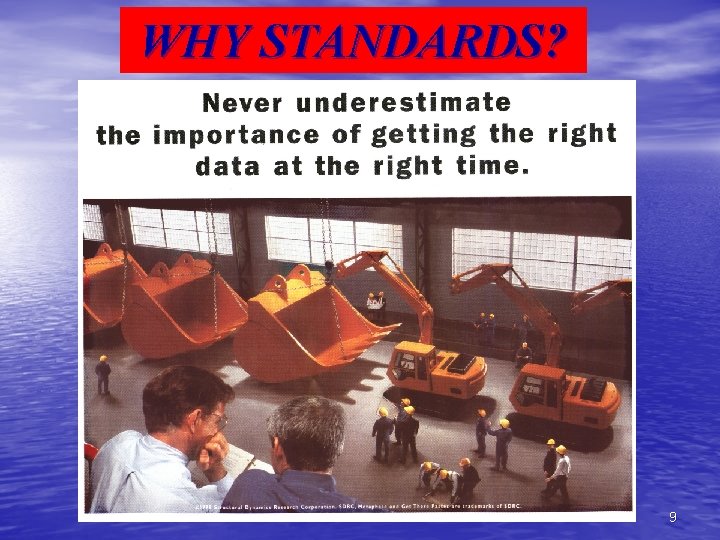
WHY STANDARDS? 9
Benefits of Standards • Encourage Innovation – – – Stimulate Innovation Foster Knowledge Sharing & Synergies Accelerate Speed to Market – – – Improve Efficiency Reduce Costs Increase Consumer Confidence – – – Facilitate Trade Better Access to Markets Reduce Business Risk • Foundation for Growth & Productivity • Facilitate Market Support 10
The Role of Standards • Good Standards are Required to: • Support Dynamic Development of Manufacturing, Services and Business – across all sectors of the manufacturing and service industries – along the global supply chain from supplier to consumer – throughout the lifecycle of products - may be decades • Enhance Government Efficiency • Provide Effective Services to the Citizen 11
The e-Business Requirement • e-Business is becoming a cornerstone of the global economy • Full benefits for consumers, industry and government demand a comprehensive and coherent set of Information Technology standards – Open – Interoperable and scaleable – Internationally accepted/accredited – Market supported 12
Business Case for Standards [1] • Research confirms that standards contribute to: – – Productivity, Growth, Innovation, and International Trade. See: “The Empirical Economics of Standards”, published by UK Department of Trade and Industry and British Standards Institute. 13
Business Case for Standards [2] • BSI portfolio of formal standards make an annual • • • contribution of GBP 2. 5 billion to UK economy 13% of labor productivity growth from 19482002 is attributed to BSI standards Standards proved to be an enabler of innovation, facilitator of technological change, and valuable strategic tool for business Investment in standards makes sound business sense at both micro and macro-economic levels Source: Research team from University of Surrey, Nottingham University Business School, UK and Fraunhofer Institute for Systems Innovation Research, Germany 14
Business Case for Standards [3] • NIST Study on ISO 10303 estimated the net economic benefits from STEP at over $1 B – Decreased avoidance costs • primarily associated with maintaining redundant systems • cost of purchasing redundant CAx systems for the purpose of same • • format data exchange, training cost for maintain designers skills in redundant CAx systems, productivity loss due to designers working on systems they are less familiar with IT staff to support redundant CAx systems outsourcing costs incurred when outside companies are hired to provide data exchange services. – Decreased mitigation costs • cost of reworking models are part of the transfer process • cost of manually reentering data when methods of data exchange are unavailable or unsatisfactory. – Decreased delay costs • profits lost due to decline in market share caused by delays • profits lost due to delay of revenues 15
Business Case for Standards [4] “Industry standards, which spread best practice, are essential for business efficiency and maintaining competitive edge … are the foundation on which business builds success, innovates and increases productivity … and make a significant contribution to the UK economy” Lord Sainsbury, UK Minister for Science and Innovation 16
Business Case for Standards [5] • STANDARDS … – Share state-of-the-art know-how about products, materials services, systems and good practices. – May set rules, provide guidelines, definitions, or requirements to make business simpler, more efficient, and more effective. – Protect the consumer. – Provide governments the technical basis for health, safety and environmental regulations. 17
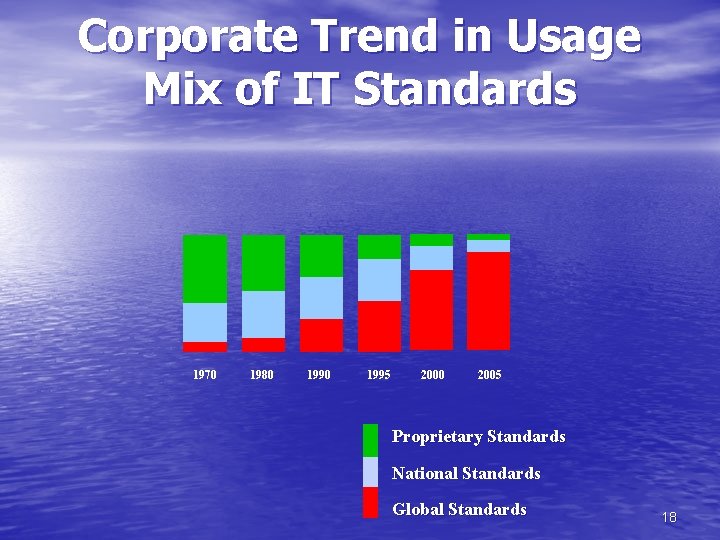
Corporate Trend in Usage Mix of IT Standards 1 1970 1980 1995 2000 2005 Proprietary Standards National Standards Global Standards 18
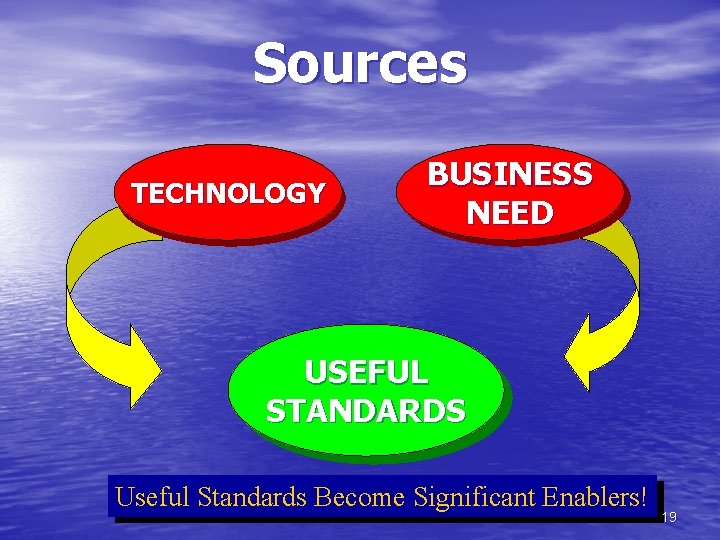
Sources TECHNOLOGY BUSINESS NEED USEFUL STANDARDS Useful Standards Become Significant Enablers! 19
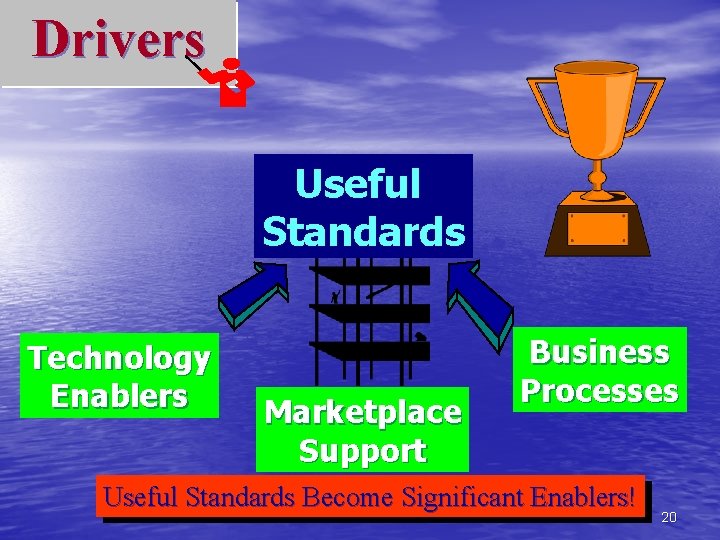
Drivers Useful Standards Technology Enablers Marketplace Support Business Processes Useful Standards Become Significant Enablers! 20
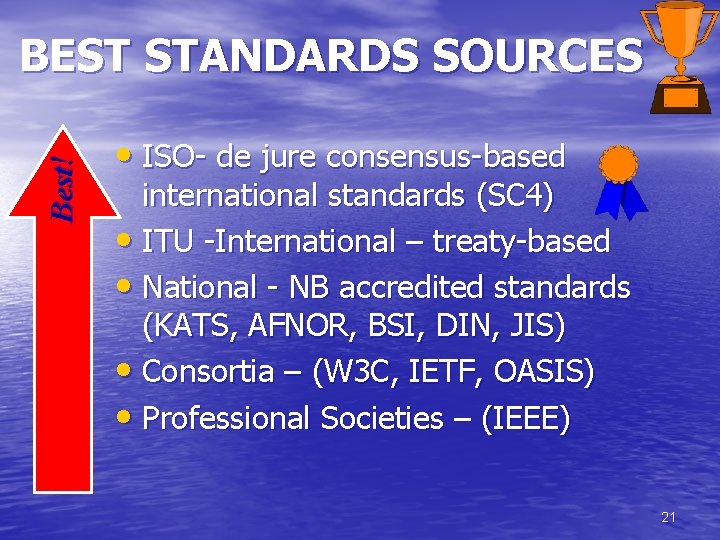
Best! BEST STANDARDS SOURCES • ISO- de jure consensus-based international standards (SC 4) • ITU -International – treaty-based • National - NB accredited standards (KATS, AFNOR, BSI, DIN, JIS) • Consortia – (W 3 C, IETF, OASIS) • Professional Societies – (IEEE) 21
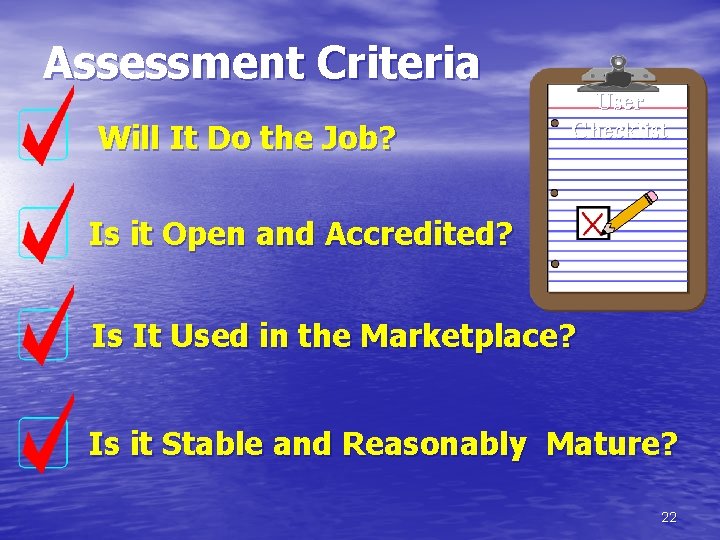
Assessment Criteria Will It Do the Job? User Checklist Is it Open and Accredited? Is It Used in the Marketplace? Is it Stable and Reasonably Mature? 22
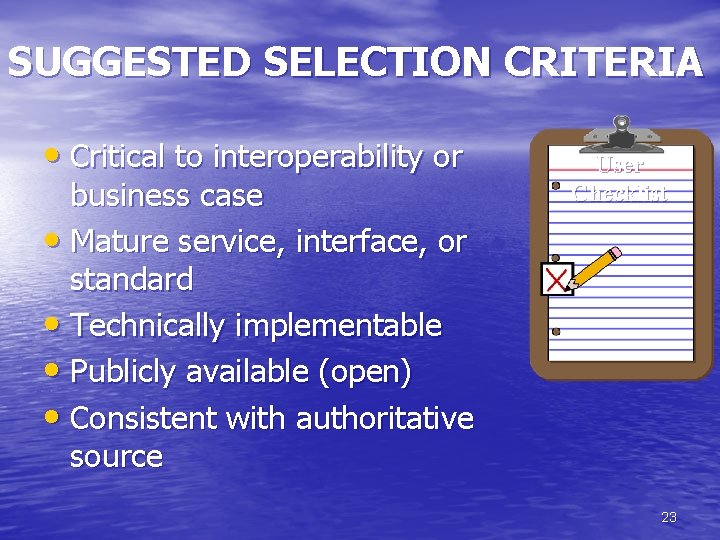
SUGGESTED SELECTION CRITERIA • Critical to interoperability or business case • Mature service, interface, or standard • Technically implementable • Publicly available (open) • Consistent with authoritative source User Checklist 23