
IT Infrastructure Architecture Infrastructure Building Blocks and Concepts
IT Infrastructure Architecture Infrastructure Building Blocks and Concepts Security Concepts (chapter 6)
Introduction • Security is the combination of: – Availability – Confidentiality – Integrity • Focused on the recognition and resistance of attacks • For IT infrastructures availability is a nonfunctional attribute in its own right
Computer crimes • Reasons for committing crime against IT infrastructures: – Personal exposure and prestige – Creating damage – Financial gain – Terrorism – Warfare
Risk management
Risk management • Managing security is all about managing risks • The effort we put in securing the infrastructure should be directly related to the risk at hand • Risk management is the process of: – Determining an acceptable level of risk – Assessing the current level of risk – Taking steps to reduce risk to the acceptable level – Maintaining that level
Risk list • A risk list can be used to quantify risks • Risk is calculated based on: – Asset name - component that needs to be protected – Vulnerability - weakness, process or physical exposure that makes the asset susceptible to exploits – Exploit - a way to use one or more vulnerabilities to attack an asset – Probability - an estimation of the likelihood of the occurrence of an exploit – Impact - the severity of the damage when the vulnerability is exploited
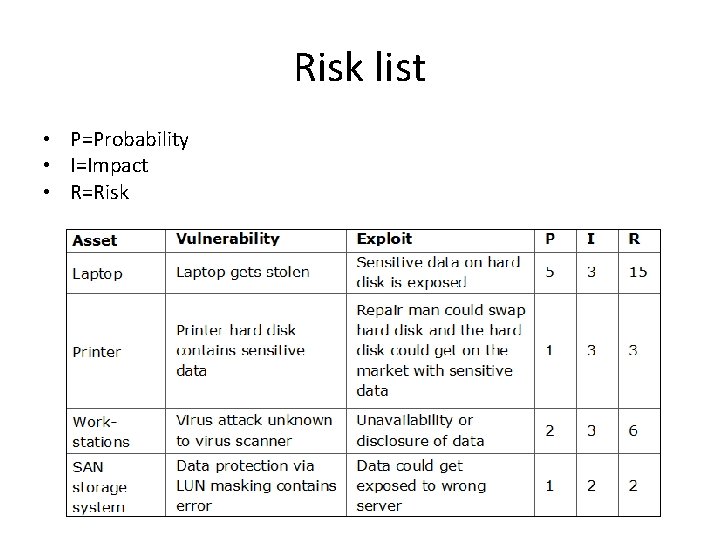
Risk list • P=Probability • I=Impact • R=Risk
Risk response • There four risk responses: – Acceptance of the risk – Avoidance of the risk - do not perform actions that impose risk – Transfer of the risk - for instance transfer the risk to an insurance company – Mitigation of the risk and accepting the residual risk
Exploits • Information can be stolen in many ways • Examples: – Key loggers can send sensitive information like passwords to third parties – Network sniffers can show network packages that contain sensitive information or replay a logon sequence – Data on backup tapes outside of the building can get into wrong hands – Disposed PCs or disks can get into the wrong hands – Corrupt or dissatisfied staff can copy information – End users are led to a malicious website that steals information (phishing)
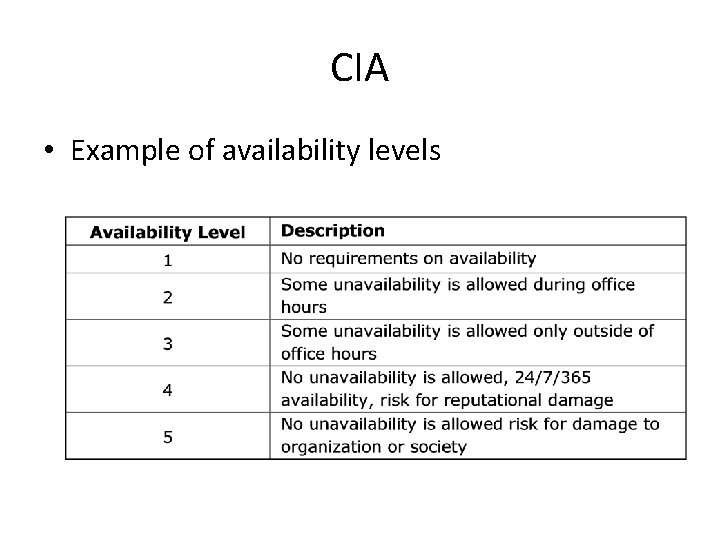
CIA • Three core goals of security (CIA): – Confidentiality - prevents the intentional or unintentional unauthorized disclosure of data – Integrity - ensures that: • No modifications to data are made by unauthorized staff or processes • Unauthorized modifications to data are not made by authorized staff or processes • Data is consistent – Availability - ensures the reliable and timely access to data or IT resources by the appropriate staff
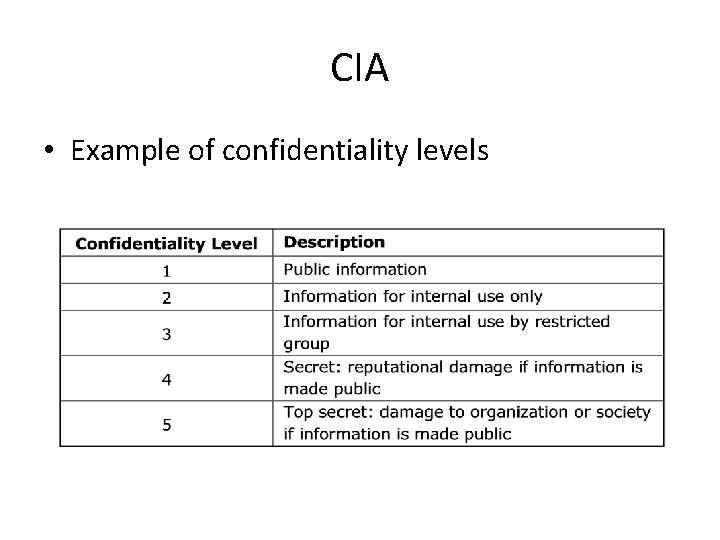
CIA • Example of confidentiality levels
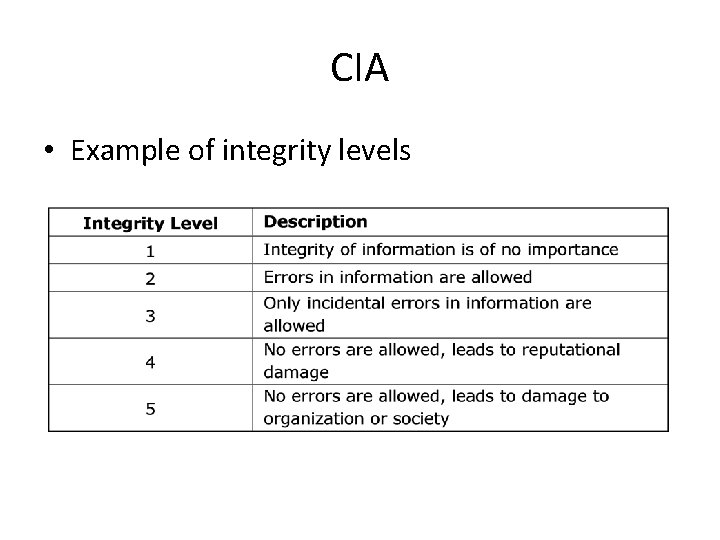
CIA • Example of integrity levels
CIA • Example of availability levels
Security controls • Controls mitigate risks • Security controls must address at least one of the CIA • Information can be classified based on CIA levels • Controls can be designed and implemented based on the identified risk level for CIA
Security controls • Example
Attack vectors • Malicious code – Applications that, when activated, can cause network and server overload, steal data and passwords, or erase data • Worms – Self-replicating programs that spread from one computer to another, leaving infections as they travel • Virus – Self-replicating program fragment that attaches itself to a program or file enabling it to spread from one computer to another, leaving infections as it travels • Trojan Horse – Appears to be useful software but will actually do damage once installed or run on your computer
Attack vectors • Denial of service attack – An attempt to overload an infrastructure to cause disruption of a service – Can lead to downtime of a system, disabling an organization to do its business – In a Distributed Denial of Service (DDo. S) attack the attacker uses many computers to overload the server – Groups of computers that are infected by malicious code, called botnets, perform an attack
Attack vectors • Preventive DDo. S measures: – Split business and public resources – Move all public facing resources to an external cloud provider – Setup automatic scalability (auto scaling, auto deployment) using virtualization and cloud technology – Limit bandwidth for certain traffic – Lower the Time to Live (TTL) of the DNS records to be able to reroute traffic to other servers when an attack occurs – Setup monitoring for early detection
Attack vectors • DDo. S countermeasures: – Immediately inform your internet provider and ask for help – Run a script to terminate all connections coming from the same source IP address if the number of connections is larger than ten – Change to an alternative server (with another IP address) – Scale-out the public facing environment under attack – Reroute or drop suspected traffic
Attack vectors • Social engineering – Social skills are used to manipulate people to obtain information which can be used in an attack • Like passwords or other sensitive information – By nature, people want to help other people
Attack vectors • Phishing – A technique of obtaining sensitive information – The phisher sends an e-mail that appears to come from a legitimate source, like a bank or credit card company, requesting "verification" of information – The e-mail usually contains a link to a fraudulent web page
Attack vectors • Baiting – Baiting uses physical media, like an USB flash drive, left to be found – It relies on the curiosity of people to find out what is on it – The attacker hopes some employee picks up the device and brings it inside the organization – When the device is put into an organization owned PC, malicious software is installed automatically

Security Patterns
Identity and Access Management (IAM) • The process of managing the identity of people and systems, and their permissions • The IAM process follows three steps: – Users or systems claim who they are: identification – The claimed identity is checked: authentication – Permissions are granted related to the identity and the groups it belongs to: authorization
Identity and Access Management (IAM) • Single Sign-On (SSO): – A user logs in once and is passed seamlessly, without an authentication prompt, to SSO enabled applications – Can be implemented using identity providing systems • LDAP • Kerberos • Microsoft Active Directory – Users authenticate to these identity providers – Applications trust the identity provider, so they allow access when a user is authenticated
Identity and Access Management (IAM) • Federated identity management: – Extends SSO above the enterprise level – Creates a trusted identity provider across organizations – Participating organizations share identity attributes based on agreed-upon standards
Authentication • Using one of three ways: – Something you know, like a password or PIN – Something you have, like a bank card, a token or a smartphone – Something you are, like a fingerprint or an iris scan • Multi-factor authentication: – At least two types of authentication are required
Role Based Access Control (RBAC) • In RBAC, instead of granting permissions to individual identities, groups are granted permissions • Identities are members of one or more groups • Groups are related to their roles in the organization • Groups can be nested (a group is member of another group) • RBAC is used in almost all organizations
Segregation of duties and least privilege • Segregation of duties (also known as separation of duties): – Assigns related sensitive tasks to different people or departments – No single person has total control of the system’s security mechanisms • Least privilege: – Users of a system should have the lowest level of privileges necessary to perform their work – Users should only have privileges for the shortest length of time
Segregation of duties and least privilege • In secure systems, multiple distinct administrative roles should be configured: – Security manager – Systems manager – Super user • A two-man control policy can be applied – Two systems managers must review and approve each other’s work – Two systems managers are needed to complete every security sensitive task
Layered security • Layered security (also known as a Defense-In-Depth strategy) implements various security measures in various parts of the IT infrastructure – Instead of having one big firewall and have all your security depend on it, it is better to implement several layers of security • Preferably security layers make use of different technologies – This makes it harder for hackers to break through all barriers, as they will need specific knowledge for each step • Disadvantage: increases the complexity of the system
Cryptography • The practice of hiding information using encryption and decryption techniques • Encryption is the conversion of information from a readable state to apparent random data • Only the receiver has the ability to decrypt this data, transforming it back to the original information • A cipher is a pair of algorithms that implements the encryption and decryption process • The operation of a cipher is controlled by a key
Cryptography • Block ciphers – Input: • A block of plaintext • A key – Output: • A block of cipher text – Used across a wide range of applications, from ATM machine data encryption to e-mail privacy and secure remote access – Standards: • Data Encryption Standard (DES) • Advanced Encryption Standard (AES)
Cryptography • Stream ciphers – Create an arbitrarily long stream of key material – Combines key stream with the plaintext bit-by-bit or character-by-character – Used when data is in transit over the network – RC 4 is a widely-used stream cipher
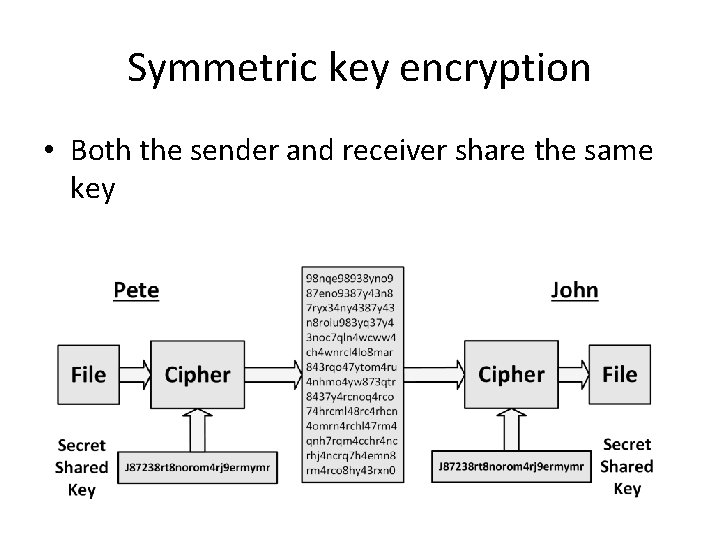
Symmetric key encryption • Both the sender and receiver share the same key
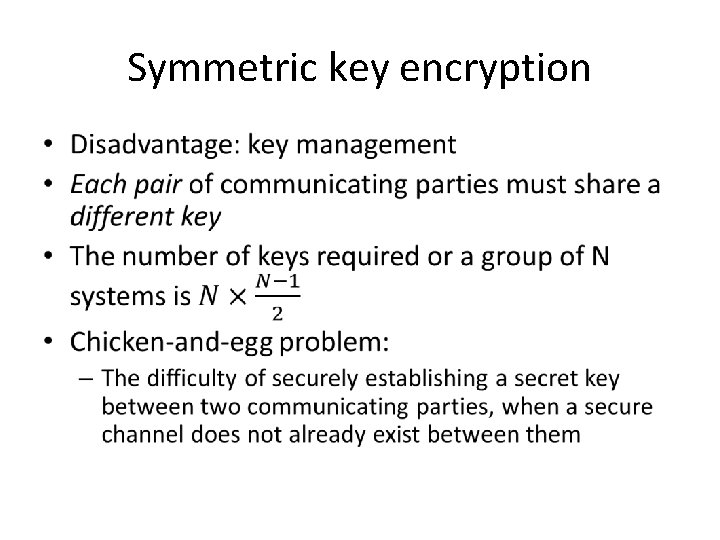
Symmetric key encryption •
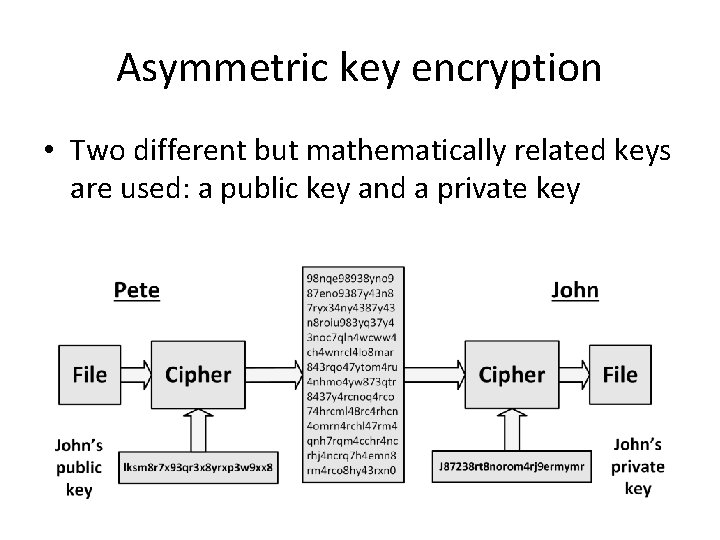
Asymmetric key encryption • Two different but mathematically related keys are used: a public key and a private key
Asymmetric key encryption • Two different but mathematically related keys are used: – a public key - may be freely distributed – a private key - must remain secret by the organization • Diffie–Hellman and RSA algorithms are the most widely used algorithms • Disadvantage: slow – About 1000 to 10, 000 times slower than symmetric key encryption
Asymmetric key encryption • Mostly used to setup a channel between two parties, to safely exchange a new, temporary symmetric key – Pete creates a random secret key and encrypts it using the public key from John – The encrypted secret key is sent to John using an open channel (like the internet) – John is the only party that can decrypt the message, because he has the private key that is related to the public key. John decrypts the message and now knows the secret key – Pete and John start communicating using symmetric key encryption, using the exchanged secret key – When the communication is finished, the shared key is no longer valid and is deleted
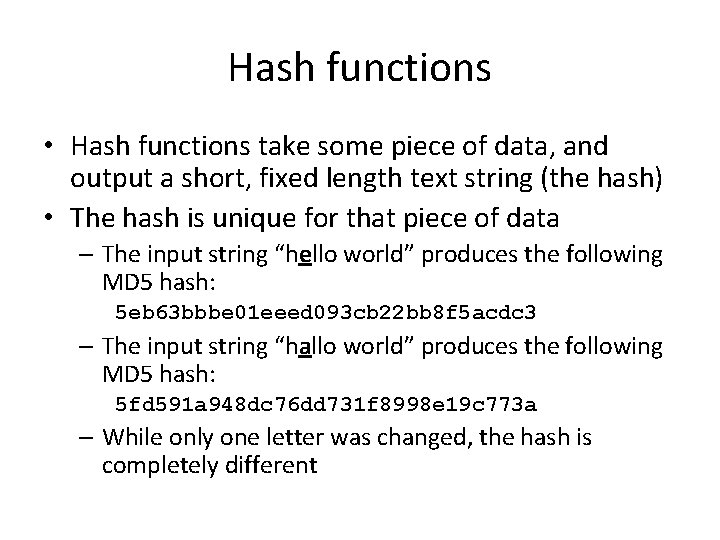
Hash functions • Hash functions take some piece of data, and output a short, fixed length text string (the hash) • The hash is unique for that piece of data – The input string “hello world” produces the following MD 5 hash: 5 eb 63 bbbe 01 eeed 093 cb 22 bb 8 f 5 acdc 3 – The input string “hallo world” produces the following MD 5 hash: 5 fd 591 a 948 dc 76 dd 731 f 8998 e 19 c 773 a – While only one letter was changed, the hash is completely different
Hash functions • Hash functions can be used to validate the integrity of the data • It is practically impossible to find two pieces of data that produce the same hash • Hash functions: – MD 5 – SHA 1 – SHA 512
Digital signatures • To create a digital signature of some text (like an email), a hash is created and encrypted with the private key of the sender • The receiver decrypts the hash key using the sender's public key • The receiver also calculates the hash of the text and compares it with the decrypted hash to ensure the text wasn't tampered with • Since the hash was encrypted using a private key, it is guaranteed that the hash was created by the owner of the private key – the only person that could have created the encrypted hash
Cryptographic attacks • Every encryption method can be broken using a brute force attack – Except a one-time pad cipher with the key of equal or greater length than the message • A brute force attack consists of systematically checking all possible keys until the correct key is found • The amount of effort needed is exponentially dependent on the size of the key • Effective security could be achieved if it is proven that no efficient method (as opposed to the time consuming brute force method) can be found to break the cipher • Most successful attacks are based on flaws in the implementation of an encryption cipher • To ensure a cipher is flawless, the source code is usually open source and thus open to inspection to everyone
- Slides: 43