
It has been said that a patient with

It has been said that ‘a patient with no eyes cannot see , a patient with no legs cannot run, yet a patient with no teeth may result in patients experiencing problems of a functional, aesthetic and psychological nature; expects to eat and act with dentures as with natural teeth.
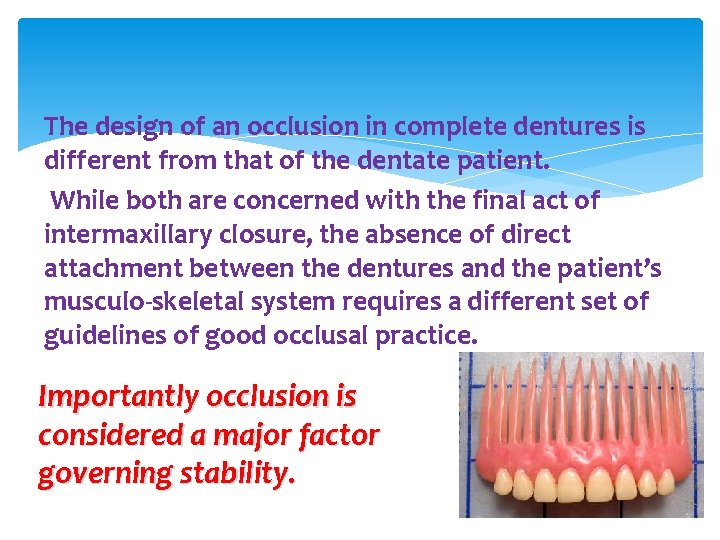
The design of an occlusion in complete dentures is different from that of the dentate patient. While both are concerned with the final act of intermaxillary closure, the absence of direct attachment between the dentures and the patient’s musculo-skeletal system requires a different set of guidelines of good occlusal practice. Importantly occlusion is considered a major factor governing stability.
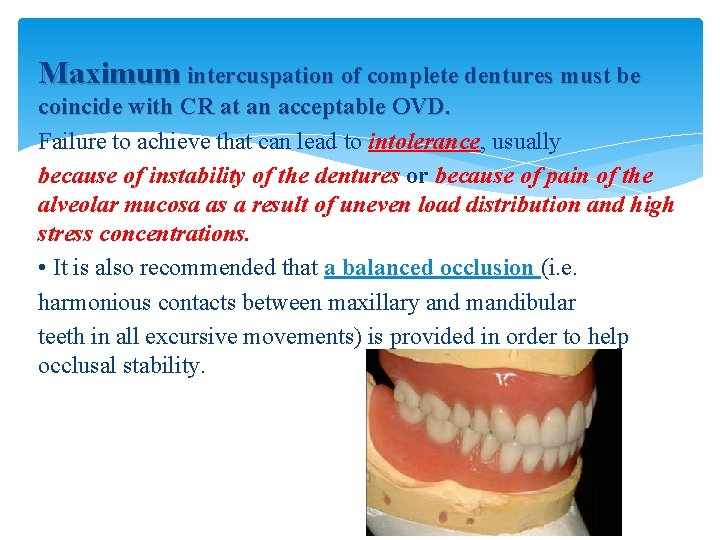
Maximum intercuspation of complete dentures must be coincide with CR at an acceptable OVD. Failure to achieve that can lead to intolerance, usually because of instability of the dentures or because of pain of the alveolar mucosa as a result of uneven load distribution and high stress concentrations. • It is also recommended that a balanced occlusion (i. e. harmonious contacts between maxillary and mandibular teeth in all excursive movements) is provided in order to help occlusal stability.
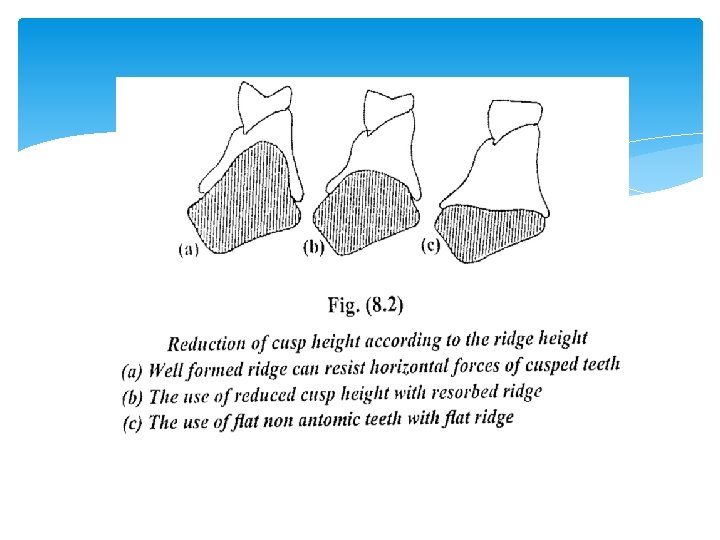
Requirement of Complete Denture Occlusion 1. Stability of occlusion in centric relation position and in an area forward and lateral to it. 2. Balanced occlusal contacts bilaterally for eccentric contacts. 3. Removing interference so that the denture can settle down when there is ridge resorption. 4. Control of horizontal forces by buccoligual cusp height reduction according to the residual ridge resistance and interridge space.
Types of Occlusion Balanced occlusion Monoplane occlusion Lingualised occlusion
Advantages of Balanced Occlusion 1. Distribution of load 2. Stability 3. Reduced trauma 4. Functional movement 5. Efficiency 6. Comfort
Disadvantages Of Balanced Occlusion 1 - More occlusal disharmony during setting of teeth and difficult to correct by adjustment. 2 - Stable bases and precise jaw closer is required. 3 - Increased horizontal forces due to the presence of incline plane of the cups. 4 - Difficult to adapt in jaw relation other than class l.
Monoplane occlusion When the foundation tissues is compromised, i. e. severely resorbed ridge, knife-edge, thin wiry ridge or one that is covered with thick movable flabby tissues, favorable control of occlusal forces can be utilized by the use of non-anatomic teeth arranged.
Advantages of Monoplane Occlusion 1. Simple and less time consuming. 2. Less precise jaw relation records. 3. Lateral forces are reduced by (neutralizing) cuspal eliminating incline. 4. Simpler and easier occlusal adjustments 5. Occlusion is not locked 6. Good for patients with Class II (Retrognathic), Class III (Prognathic) and crossbite ridge relations. 7. For the geriatric patient
Disadvantages least esthetic poor bolus penetration can not be balanced in eccentric excursions.
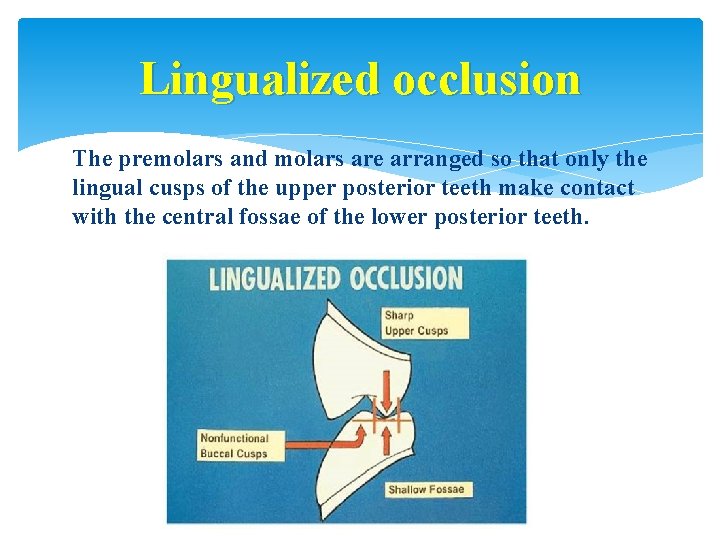
Lingualized occlusion The premolars and molars are arranged so that only the lingual cusps of the upper posterior teeth make contact with the central fossae of the lower posterior teeth.
Advantages 1. Esthetics 2. Better penetration of the food bolus 3. Decrease of vertical and lateral forces 4. Simpler technique. 5. Useful in a wide variety of patients. 6. Added stability is gained during parafunctional movements with a balanced occlusion. 7. Easier to adjust occlusion 8. May be used in Class II, Class III and crossbite
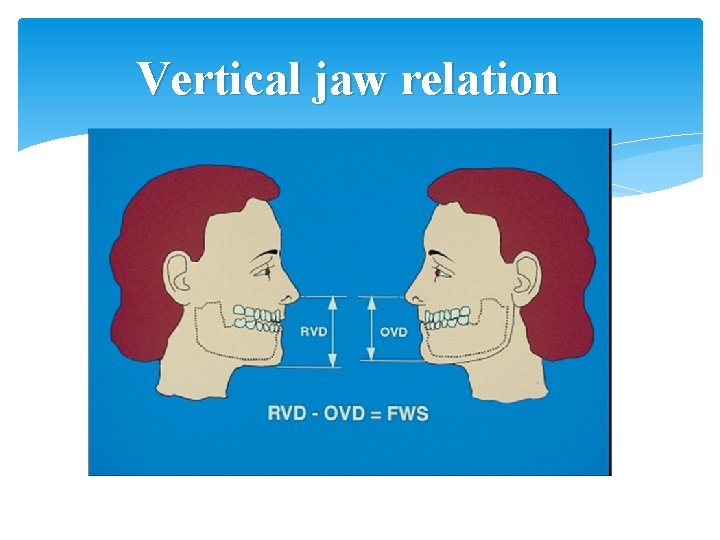
Vertical jaw relation
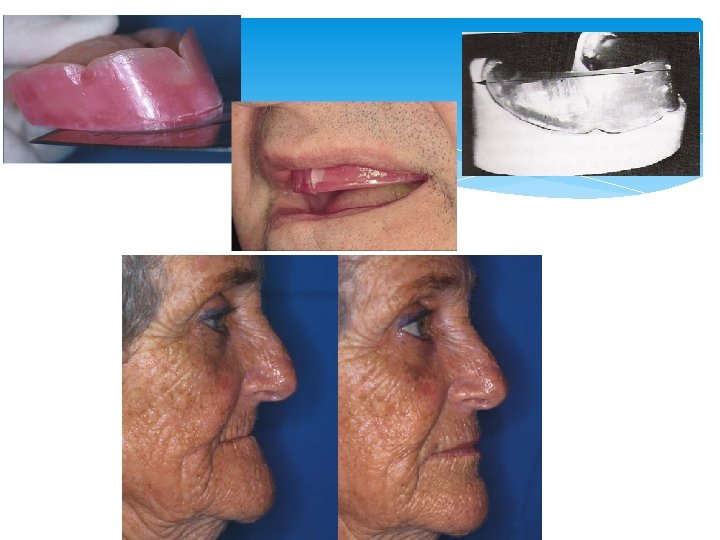
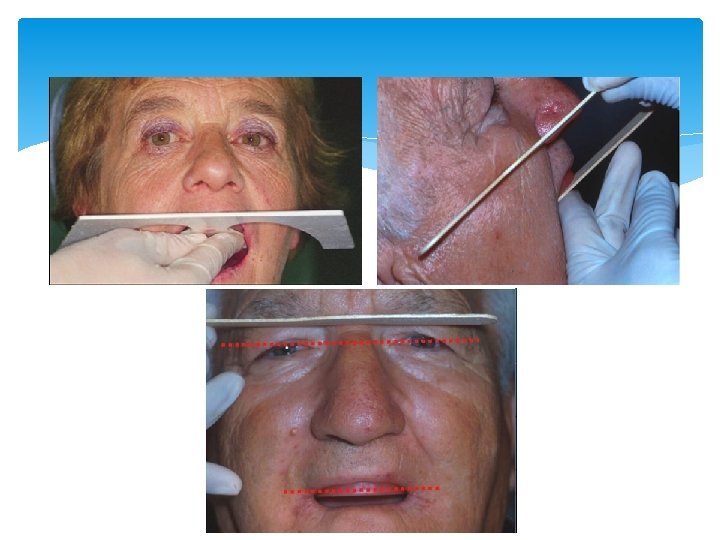
Some methods used to determine occlusal vertical dimension Ø Postural position (PJP, resting vertical dimension); OVD is approximately 2– 4 mm less Ø Measure OVD of satisfactory previous dentures Ø Aesthetics Ø Ridge parallelism: Paralleling the crests of maxillary and mandibular edentulous ridges plus a 5° posterior opening gives an indication of correct vertical dimension. Ø Pre-extraction records Ø Lateral skull radiographs Ø Facial measurement Ø Phonetics
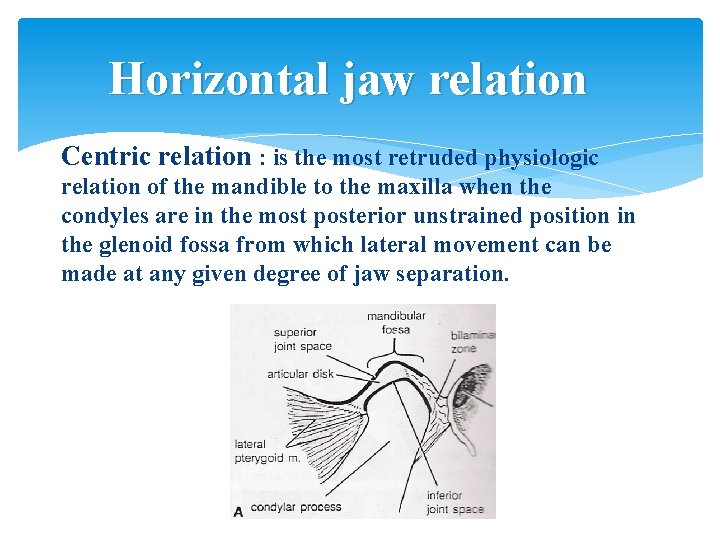
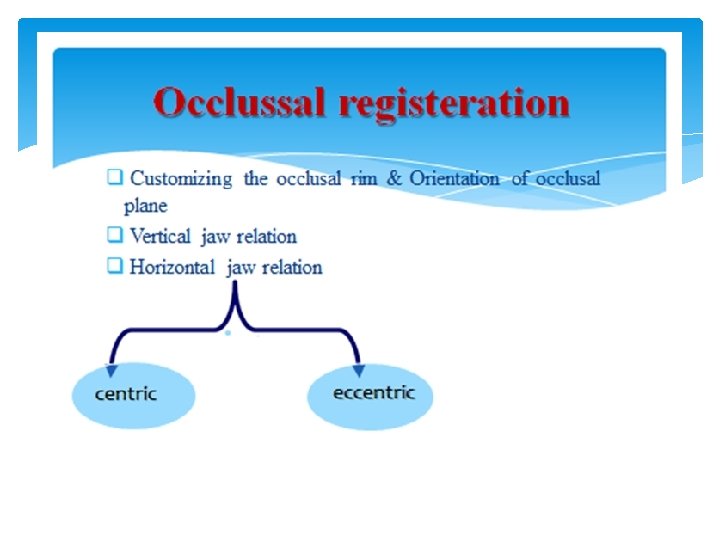
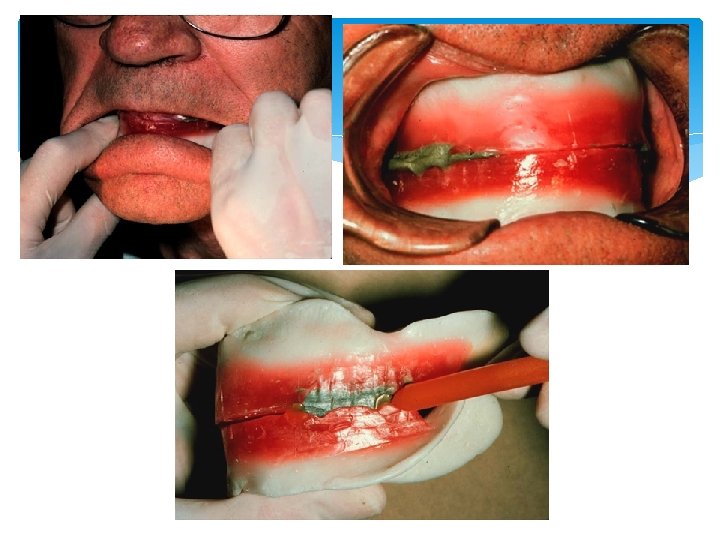
Horizontal jaw relation Centric relation : is the most retruded physiologic relation of the mandible to the maxilla when the condyles are in the most posterior unstrained position in the glenoid fossa from which lateral movement can be made at any given degree of jaw separation.
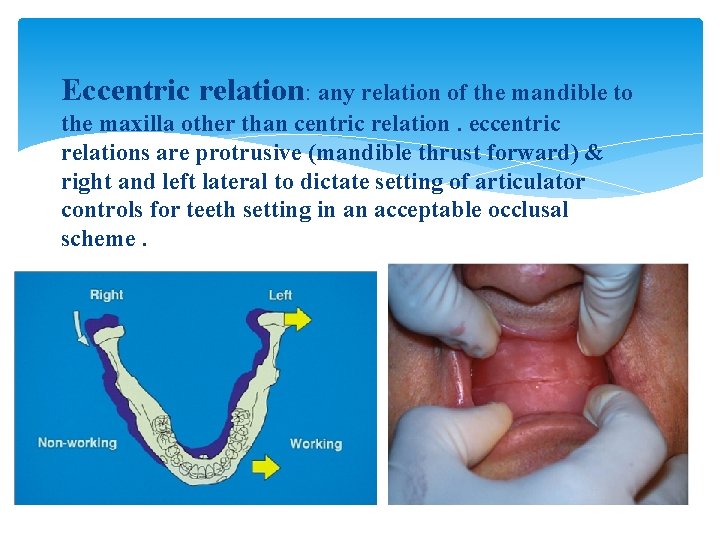
Eccentric relation: any relation of the mandible to the maxilla other than centric relation. eccentric relations are protrusive (mandible thrust forward) & right and left lateral to dictate setting of articulator controls for teeth setting in an acceptable occlusal scheme.
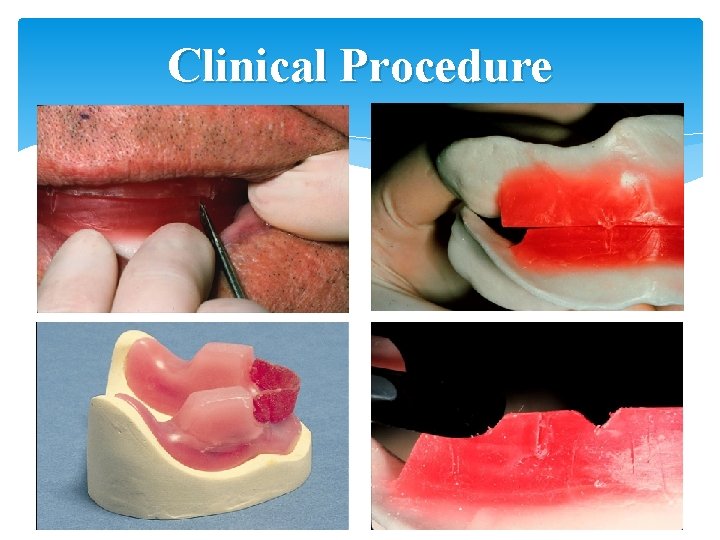
Clinical Procedure

Thank you
- Slides: 23