
IT Economics IT Performance Model Trends ICT What

- Slides: 39
IT Economics
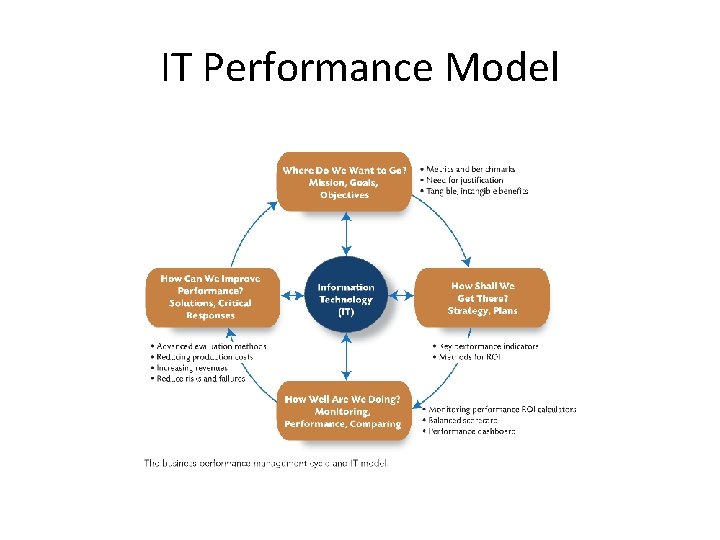
IT Performance Model
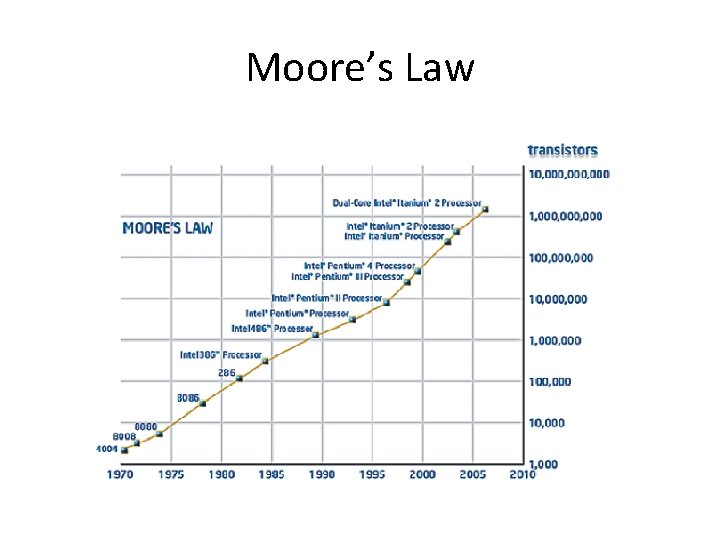
Trends ICT • What trends are apparent in the IT field? – Computational power – Costs • Enables more extensive applications of information technology • Moore’s law – Number of transistors of an integrated circuit would double every year while cost remaining same • Later revised to 18 months
Moore’s Law
Moore’s law • What are the different ways of interpreting this, pertaining to organizations? – Companies can buy double the power in one and half years for the same cost – Price-to-performance ratio continues to decline exponentially • Will this trend continue? – With silicon chips? – Other technologies?
Economic Meaning of Growth of Computing Power • Efficiency – Organizations will perform same computations at decreasing costs over time • Effectiveness – Creative organizations will find new ways of doing things with IT – Apply IT to tasks that are currently computationally feasible but not economically. – New or enhanced products and services • Benefits to consumers
What Economics of IT All About? • Evaluating the costs, benefits and other economic aspects of IT • Productivity
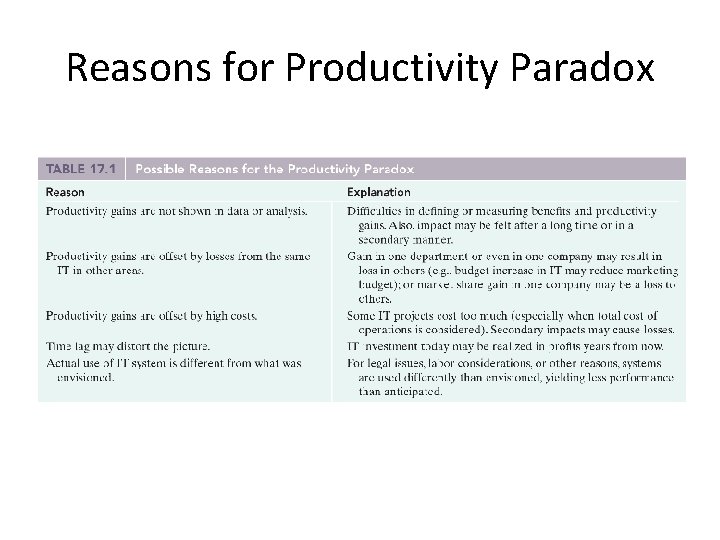
Productivity Paradox • Discrepancy between measures of investment in IT and measures of output at the national level • Productivity – Output divided by input – Productivity could be single factor or multi factor • Few reasons discussed 1. Data and analysis problems hide productivity gains 2. IT productivity gains are offset by losses in other areas 3. IT productivity gains are offset by IT costs or losses 4. Time lags of systems to pay off
Reasons for Productivity Paradox
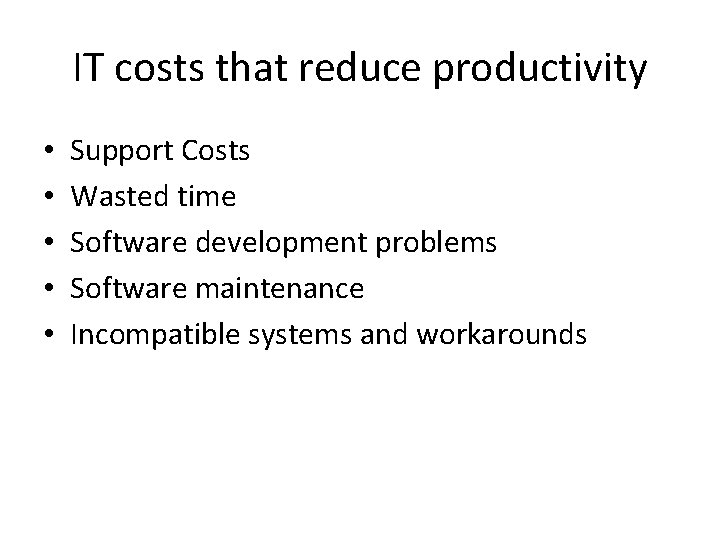
IT costs that reduce productivity • • • Support Costs Wasted time Software development problems Software maintenance Incompatible systems and workarounds
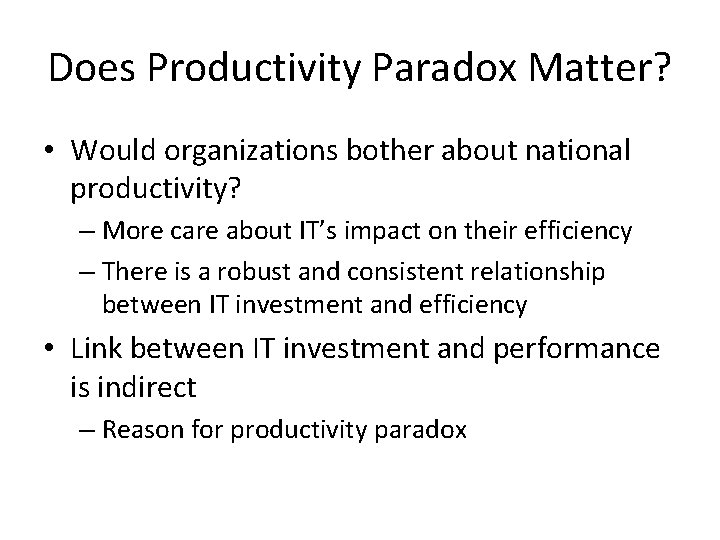
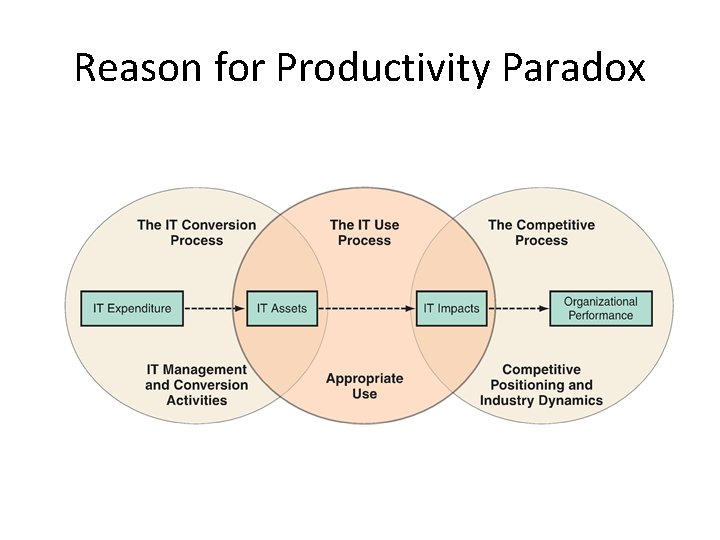
Does Productivity Paradox Matter? • Would organizations bother about national productivity? – More care about IT’s impact on their efficiency – There is a robust and consistent relationship between IT investment and efficiency • Link between IT investment and performance is indirect – Reason for productivity paradox
Reason for Productivity Paradox
Why IT Justification Needed • Pressure from the top management • IT is not necessarily the solution to all problems – IT too has now to compete for funding • To force aligning with the business strategy • Potential stock market increases once an IT in vestment is announced – A study reveals a 32% increase • To assess an IT investment after completion and periodically thereafter • To pay bonuses to those who involved in the project
When is it not needed to justify • When the value of the investment is relatively small for the organization • When the relevant data is not available, inaccurate or too volatile • When the IT project is mandated • However, some qualitative analysis would be good to have to explain the logic of the project
Investment Categories • Invest in infrastructure – data center, networks, data warehouse, an IT security system, and a corporate knowledge base – Made to exist for a long time – Shared by many applications • Invest in Applications – Specific systems and programs for achieving certain objectives – Providing a payroll or taking a customer’s order
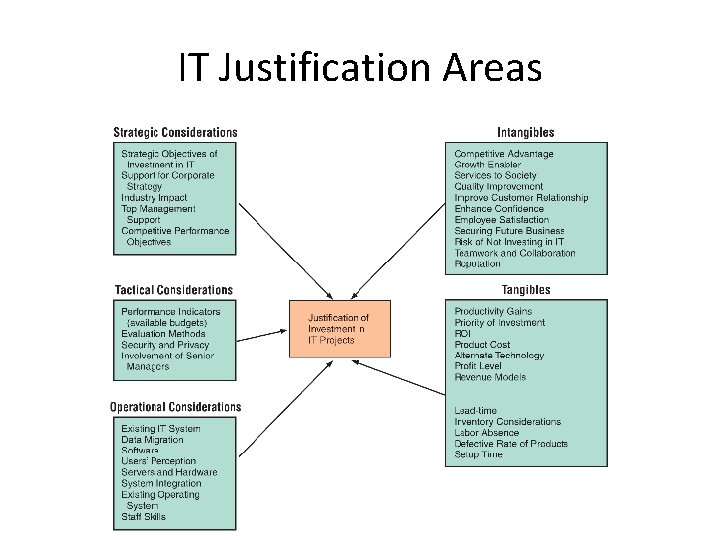
IT Justification Areas
IT Justification Process • Lay an appropriate foundation for analysis, and then conduct your ROI. • Conduct a good research on metrics (including internal and external metrics) and validate them. • Justify, clarify, and document the costs and benefits assumptions. • Document and verify all figures used in the calculation. • Make figures as realistic as possible and include risk analysis. • Do not leave out strategic benefits, including long-term ones. Is the project really bolstering the company’s competitive and strategic advantage? • Be careful not to underestimate costs and overestimate benefits (a tendency of many technology lovers). • Commit all partners, including vendors and top management.
Intangible Benefits • Difficult to justify – Ex. many people would agree that e-mail improves communications, but it is not at all clear how to measure the value of this improvement. • Social subsystem issues – One class of intangible benefits – Comfort to employees, impact on the environment, changes in the power distribution in an organization, green IT, and invasion of the privacy of employees and customers.
Costing of Investments • Placing a monetary value on IT costs is very difficult • Issues: – Fixed costs are not easy to calculate • Shared among multiple systems • Ex. infrastructure cost, cost of IT services, and IT management cost. • IT manager’s salary will not change by adding a new system – Cost of a system doesn’t end after installation – Some costs are not even anticipated • Y 2 K
Transaction Costs • Costs that are associated with the distribution (sale) and/or exchange of products and services • What are different types of transaction costs? – Search cost: cost of locating buyers and sellers – Information cost: learn about the product, basis for pricing, etc. /learn the needs of the buyer, legitimate and financial conditions, etc. – Negotiation cost: costs of meetings, communications, information exchange, etc. – Decision costs: cost of making a decision whether to buy from/sell to a particular seller/buyer – Monitoring cost: costs of ensuring whether the transaction happens as agreed • What is the impact of IT on transaction costs?
Revenue Models • Additional revenues that may generate due to an IT investment – Sales: additional sales revenue from online transactions – Transaction fees: commissions received for transactions – Subscription fees: fees that the customers pay to subscribe to a service – Advertising fees: fees to display advertisements – Affiliate fee: fees for referring to other’s websites – Other: fees for playing games or watching competitions
Impact of Risk • IT can mitigate risk as well as introduce risk • Mitigate risk – Reduce risks to firms by providing timely information – Reduce risks to customers • Delays, incorrect choices, quality concerns • Introduce risk – Financial transactions – Security and privacy of information
Evaluating an IT Investment • Traditional methods to determine ROI – NPV • Converts future values of benefits to their present-value equivalent. • When does NPV works well? – IRR – When costs and returns are well defined (tangible) • Interest rate that makes NPV of future cash in-flows zero. • Higher the value, better • Accepted if greater than cost of capital or minimum acceptable rate set – Payback period • point at which the yearly benefits of a project equal the costs.
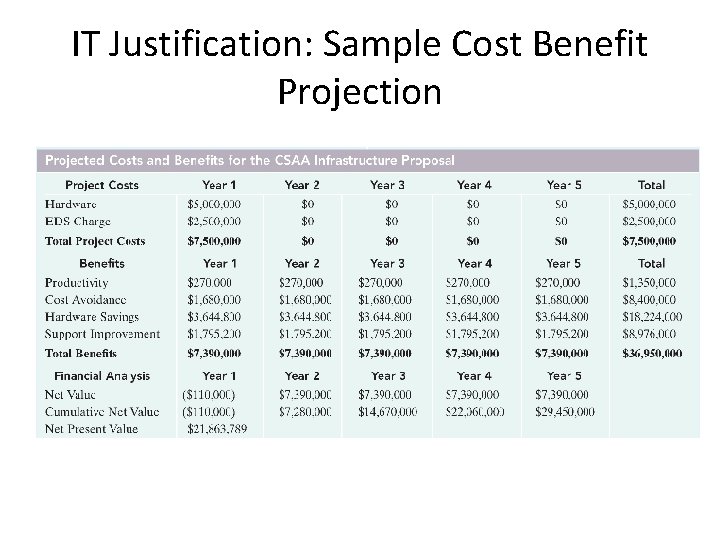
IT Justification: Sample Cost Benefit Projection
Advanced Methods for IT justification • Traditional Methods are not good to evaluate IT investments • There are many justification methods categorized into four approaches – Financial approach: consider only impacts that can be monetary valued – Multi-criteria approach: consider both financial impacts and non- financial impacts that cannot be (or cannot easily be) expressed in monetary terms. – Ratio approach: use several ratios (e. g. , IT expenditures vs. total turnover) to assist in IT investment evaluation – Portfolio approach: apply portfolios (or grids) to plot several investment proposals against decision-making criteria
Common Methods • Business case method – Commonly used in large IT projects – A written document to garner funds for an IT project – Helps to clarify how the organization will use its resources in the best way to accomplish the IT strategy. – Software support for preparation is available
Common Methods • Total Cost of Ownership – A formula for calculating the cost of owning, operating and controlling an IT system over its life cycle • Acquisition cost: hardware and software • Operations cost: maintenance, training, operations, evaluation, technical support, installation, downtime, auditing, virus damage, and power consumption • Control cost: standardization, security, and central services
Common Methods • Benchmarking – Assesses the investments in infrastructure • Assessment of infrastructure is difficult – Comparison of measures of performance or of an organization’s expenditures with the averages for the industry, or comparisons with values of the most efficient performers in the industry – If performance is below standard, corrective action is indicated.
Other Methods • Using third party support – SAP business case builder, IDC (idc. com) • Activity-based costing – Identifies activities in an organization and assigns the cost of each activity • with resources to all products and services according to the actual consumption by each • Expected Value Analysis – Expected value (EV) of future benefits • Value of the benefit multiplied by the probability of the benefit occurring
IT Metrics • A specific, measurable standard against which actual performance is compared • Where does metrics help? – Communicate the strategy to the workforce through performance targets – Increase accountability when metrics are linked to performanceappraisal programs – Align the objectives of individuals, departments, and divisions to the enterprise’s strategic objectives – Evaluate the performance of IT systems, including Web-based systems – Assess the health of companies – Define the value proposition of business models
IT Metrics: Examples • Revenue growth – How much increase in revenue in the past 12 months • Cost reduction – How much sales and promotion costs were reduced • Cost avoidance – What costs were avoided • Customer fulfillment – How much of lead time reduced • Customer service – What is the level of customer satisfaction achieved • Customer communication – How fast is communication via emails
Key Performance Indicators (KPI) • Quantitative expression of critically important metrics – Key performance factors • frequently measure factors that directly deals with performance – Ex. Sales, revenue, profit, etc. • Frequently, one metric can have several KPIs
Balanced Scorecard • A method of evaluating the overall health of organizations and projects (including IT projects) by looking at metrics in four areas – Finance, customer satisfaction, learning and growth for employees, and internal business processes – Each of the four areas can be defined by organizational goals and corresponding measurable metrics
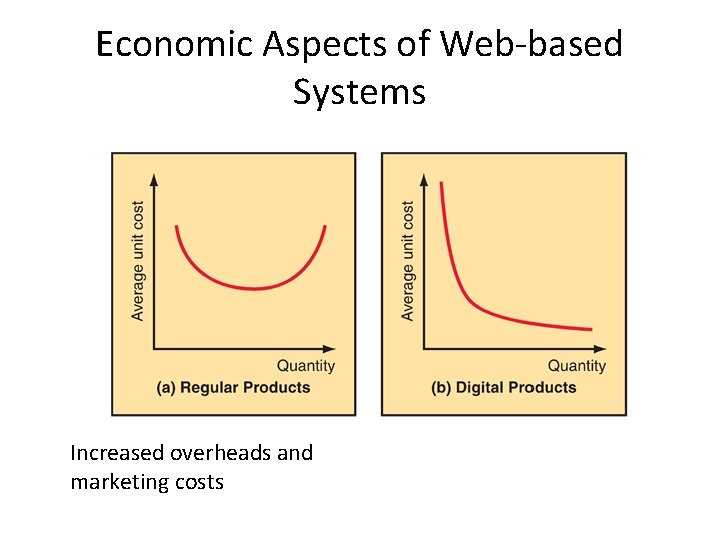
Economic Aspects of Web-based Systems Increased overheads and marketing costs
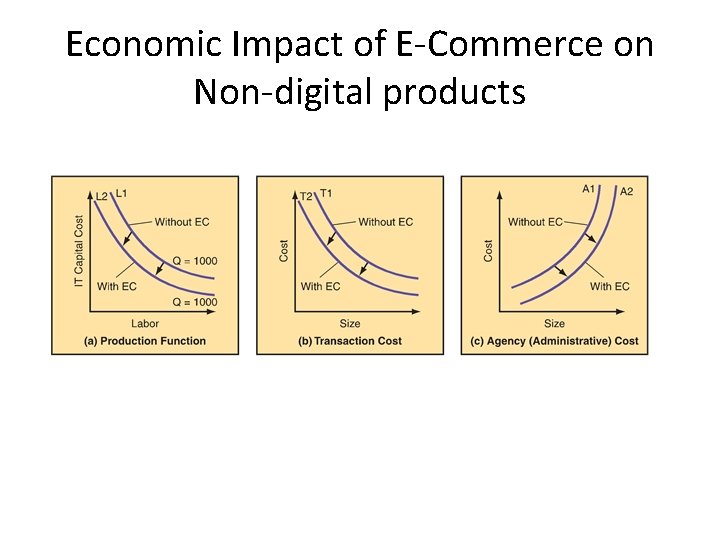
Economic Impact of E-Commerce on Non-digital products
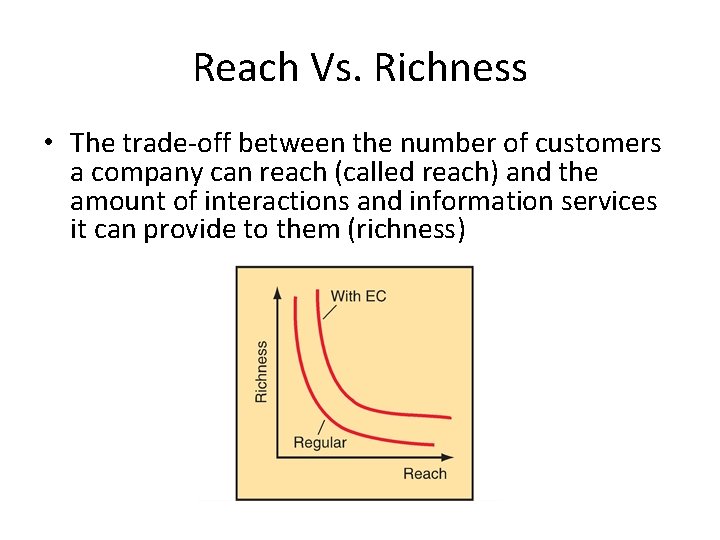
Reach Vs. Richness • The trade-off between the number of customers a company can reach (called reach) and the amount of interactions and information services it can provide to them (richness)
Chargebacks • IT is not a free service – Need to control usage and avoid waste – Costs should not go to an overheads account • Chargeback method helps allocating costs as accurately as possible to users – Enables incentives for controlling usage – Can also generate issues • Sharing fixed costs, technological terms incomprehensible to users, etc.
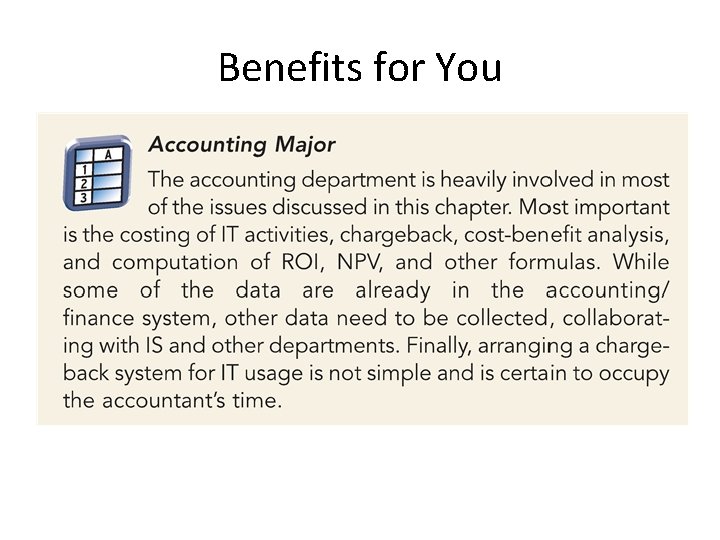
Benefits for You
Benefits for You