
It Could Be Epilepsy EPILEPSY AND SEIZURE RESPONSE
It Could Be Epilepsy… EPILEPSY AND SEIZURE RESPONSE FOR LAW ENFORCEMENT PERSONNEL www. epilepsy. com Contact: Aldith Steer, Director Epilepsy Foundation Developed with grant support from the Centers for Disease Control and Prevention (Grant # U 58 DP 0003832 -04). Contents are the sole responsibility of the authors and do not necessarily represent the views of the CDC.
About the Epilepsy Foundation The MISSION of the Epilepsy Foundation is to stop seizures and SUDEP, find a cure and overcome the challenges created by epilepsy through efforts including education, advocacy and research to accelerate ideas into therapies. HELP for TODAY HOPE for TOMORROW EMPOWER PEOPLE ENCOURAGE RESEARCH Eliminate Barriers Remove Stigma Close Treatment Gap More Epilepsy Scientists Better Treatments Cure for Epilepsy Living Better WITH Epilepsy Living WITHOUT Epilepsy IMPROVED QUALITY OF LIFE
About the Epilepsy Foundation 50 affiliates and chapters around the country (but not in all 50 states) National office in Landover, MD
Learning Objectives To increase the officer’s awareness and recognition of seizure disorders. To review seizure safety and first-aid recommendations. To support the officer’s priority and protect the rights of the individual having a seizure. To raise awareness of online training available for Law Enforcement (+ certificate) to expand upon today’s training. It Could Be Epilepsy 4
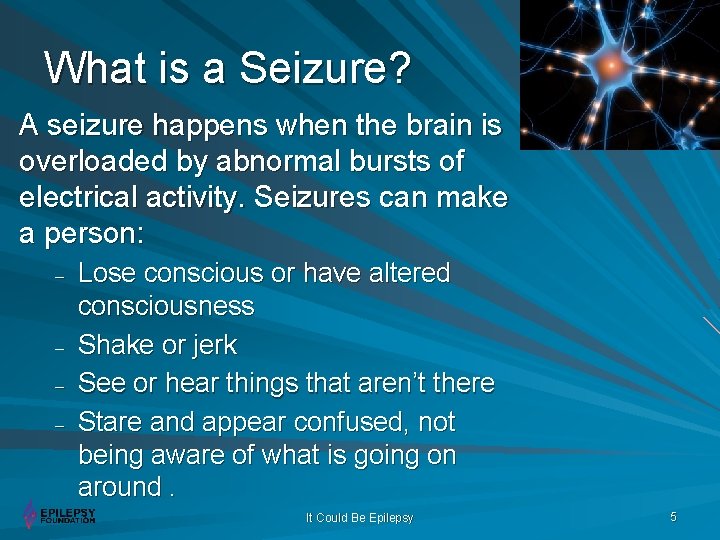
What is a Seizure? A seizure happens when the brain is overloaded by abnormal bursts of electrical activity. Seizures can make a person: – – Lose conscious or have altered consciousness Shake or jerk See or hear things that aren’t there Stare and appear confused, not being aware of what is going on around. It Could Be Epilepsy 5
Seizure Causes Very high fever Drug use, alcohol withdrawal Lack of oxygen to the brain from near drowning or another cause Severe head injury (car accident, gunshot wound, etc. ) Dehydration or hyper-hydration Brain tumor, infection, stroke Complication of diabetes or pregnancy Epilepsy It Could Be Epilepsy 6
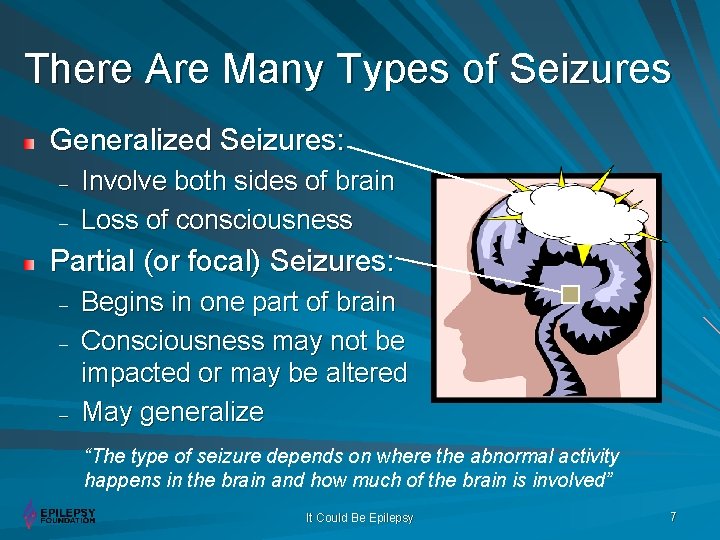
There Are Many Types of Seizures Generalized Seizures: – – Involve both sides of brain Loss of consciousness Partial (or focal) Seizures: – – – Begins in one part of brain Consciousness may not be impacted or may be altered May generalize “The type of seizure depends on where the abnormal activity happens in the brain and how much of the brain is involved” It Could Be Epilepsy 7
What is Epilepsy? Epilepsy, also called a “seizure disorder” is a medical condition. Doctors will usually diagnose a person with epilepsy if: – – – A person has one or more unprovoked seizures. The doctor thinks the person is likely to have more. The seizures were not caused by another medical condition like diabetes or a severe infection. It Could Be Epilepsy 8
Causes of Epilepsy Past head injury Stroke In 70% of people with epilepsy, Brain tumor the cause is Brain infection UNKNOWN Metabolic problems Other neurological conditions Genetic factors It Could Be Epilepsy 9
Who has epilepsy? 1 IN 26 people in the United States will develop epilepsy at some point in their lifetime About 1 out of 10 people will have a seizure in their lifetime. Most common in older adults and children Nearly 3 million Americans It Could Be Epilepsy 10
Let’s Dispel Some Myths… Epilepsy is NOT contagious Epilepsy is NOT just a childhood disorder Epilepsy is NOT mental illness Epilepsy is NOT a cognitive disability or a sign of low intelligence You CAN’T swallow your tongue during a seizure Flashing lights can cause a seizure. . . but only in about 1 in 100 people with epilepsy. It Could Be Epilepsy 11
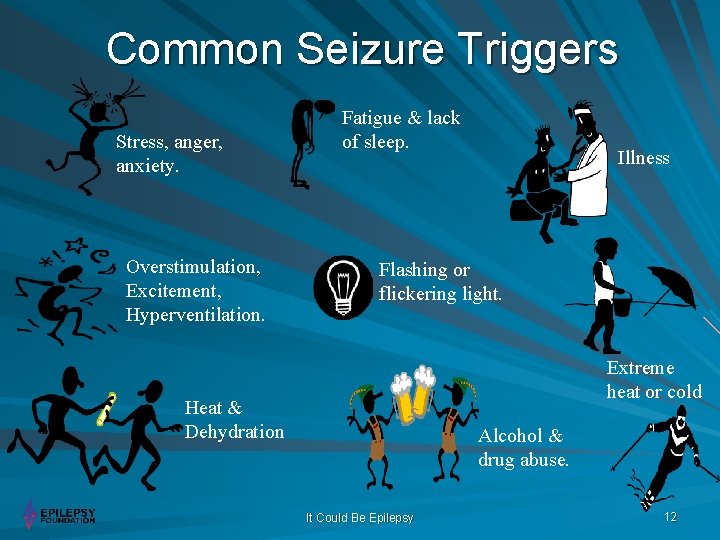
Common Seizure Triggers Stress, anger, anxiety. Overstimulation, Excitement, Hyperventilation. Fatigue & lack of sleep. Illness Flashing or flickering light. Extreme heat or cold Heat & Dehydration Alcohol & drug abuse. It Could Be Epilepsy 12
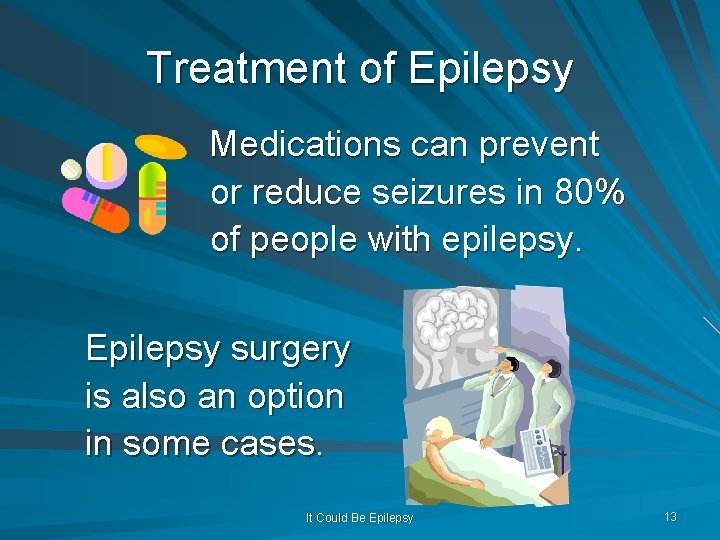
Treatment of Epilepsy Medications can prevent or reduce seizures in 80% of people with epilepsy. Epilepsy surgery is also an option in some cases. It Could Be Epilepsy 13
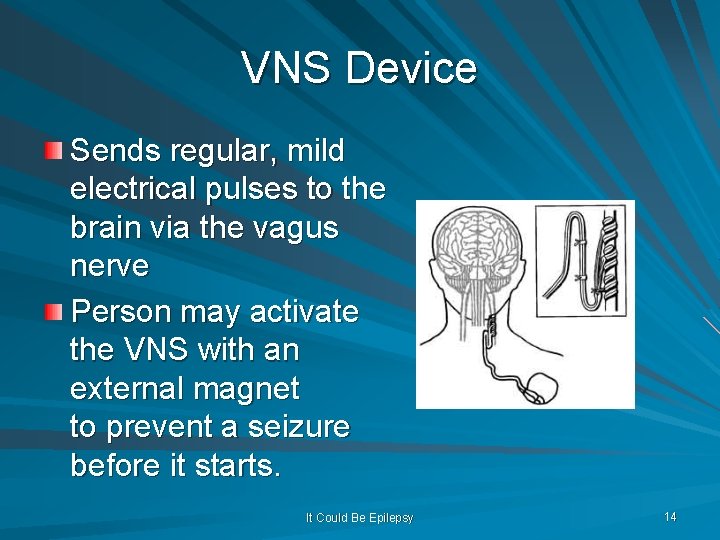
VNS Device Sends regular, mild electrical pulses to the brain via the vagus nerve Person may activate the VNS with an external magnet to prevent a seizure before it starts. It Could Be Epilepsy 14
VIDEO – It Could Be Epilepsy 15
A seizure may appear as: A sudden cry, and fall, followed by § § Convulsive movements of all limbs Shallow/interrupted breathing Loss of bowel/bladder control Slow return to consciousness, post-seizure confusion and/or fatigue This is a generalized tonic-clonic or “grand mal” seizure. It Could Be Epilepsy 16
or a seizure can be… Blank staring, chewing, other repetitive purposeless movements (automatisms) Wandering, confusion, incoherent speech Crying, screaming, mumbling, running, flailing A sudden loss of muscle tone and fall Picking at clothes, disrobing, aimless walking Seizures of this type are known as focal or complex partial seizures It Could Be Epilepsy 17
A Focal Seizure May Be Mistaken For: Drunkenness Illegal drug use Medical conditions such as a stroke or diabetic reaction Mental illness manifestations It Could Be Epilepsy 18
A person having a seizure is: unaware of his/her actions, unable to control his/her body unable to respond to questions or direction from others incapable of organized thought Clumsy, undirected violence is possible when an individual is restrained during a seizure or in the period of confusion following. It Could Be Epilepsy 19
ASSESSMENT… Normal behavior prior to incident; a sudden loss of awareness Automatic, purposeless behaviors Staring, eye rolling, smacking lips Picking clothes, chewing, mumbling Confusion, wandering, outbursts Clumsy, undirected violence It Could Be Epilepsy 20
ASSESSMENT (cont’d) Does person have a known history of seizures or epilepsy: – Question bystanders What did they see? Are they aware of a seizure history in person? Did person announce that he/she was experiencing an aura or was about to have a seizure (warning)? – – Look for Medic-Alert necklace or bracelet See if epilepsy medication in possession It Could Be Epilepsy 21
Responding to a focal/complex partial seizure: Maintain a calm demeanor. Don’t verbally confront or physically restrain the individual. Assess for return of awareness – seizures of this type may last 5 minutes or more Re-orient to place and time It Could Be Epilepsy 22
Responding to a Generalized Tonic-Clonic Seuzre Remain Calm Time Seizure Clear area of obstacles that may cause injury Protect the head Turn person onto side Observe for return of normal breathing as seizure subsides Inform bystanders of what is happening It Could Be Epilepsy 23
Precautions: Make sure airway is clear: position on side, clear secretions NEVER put something in the mouth. NEVER forcibly restrain Insure supervision during period of postseizure confusion Death from a seizure is rare, provided appropriate assistance is given. It Could Be Epilepsy 24
Dangerous Procedures! DON’T Taser the person Restrain or hold them Put anything in the mouth Leave alone until fully conscious Give liquids or medication until fully conscious Keep a person on their back or face down during or following a seizure Obstruct airway
When is it a Seizure Emergency? (i. e. when to transport to ER) Epilepsy Foundation recommends transport to a medical facility in the case of: – – – First-time seizure (or suspected first seizure) Apparent injury Seizure occurs in water Diabetes, pregnancy or other medical condition Seizure lasts more than 5 minutes 2 nd seizure occurs right away without gaining consciousness It Could Be Epilepsy 26
“My husband told the officer and the ambulance crew that I had epilepsy… Instead of peacefully resolving my seizure, they were determined to get me on a gurney. I was becoming more distraught and ended up kicking the police officer. He then said they would handcuff me and they did…” It Could Be Epilepsy 27
Is transport to ER Always necessary? Transport to an ER for medical treatment may NOT be necessary for known epilepsy patients when family/friends/caregivers are able to assist them after the seizure resolves. It Could Be Epilepsy 28
If person is arrested… Arresting officers should notify jail staff if epilepsy is suspected. Person with epilepsy MUST have access to their seizure medications - failure to take medication on schedule may precipitate non-stop seizures that can be fatal. Allow contact with persons doctor. If seizure occurs while in custody, seek prompt medical attention It Could Be Epilepsy 29
Driving After a seizure, drivers are required by law to voluntarily turn in their license. If loss of consciousness or apparent seizure has occurred, law enforcement may file a Driver Condition Report In MD, individuals with epilepsy may apply for reinstatement of driver’s license after they are seizure-free for three months, pending Medical Advisory Board review It Could Be Epilepsy 30
Use of Taser A person having a seizure that affects their behavior is not able to respond to verbal instructions. They should be managed cautiously to avoid triggering further agitation. The taser may disrupt the normal function of an implanted VNS device. It Could Be Epilepsy 31
Americans with Disabilities Act Behaviors resulting from a disability such as epilepsy, should not be criminalized when no crime has been committed. Officers should respond to real threats to health and safety, but also recognize that an individual having a seizure is unaware of his actions and needs assistance. It Could Be Epilepsy 32
Resources Available Local Epilepsy Foundations throughout the U. S. can provide: Support, case management, education and community resource referral to people with epilepsy and their families. Assist with training law enforcement officers It Could Be Epilepsy 33
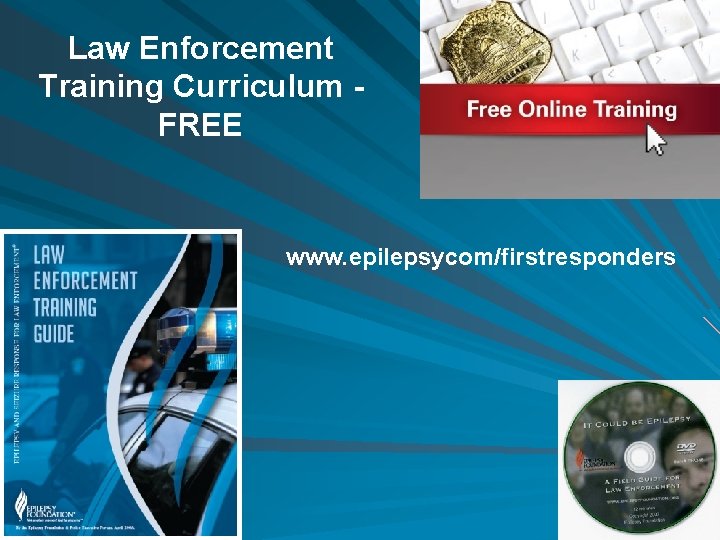
Law Enforcement Training Curriculum FREE www. epilepsycom/firstresponders
Questions? Aldith Steer – – asteer@efa. org 301. 918. 3791 It Could Be Epilepsy 35
- Slides: 35