
IT Basics 6 Rzvan Daniel Zota Faculty of
IT Basics 6 Răzvan Daniel Zota Faculty of Cybernetics, Statistics and Economic Informatics BUES http: //zota. ase. ro/itb 23 -Oct-21
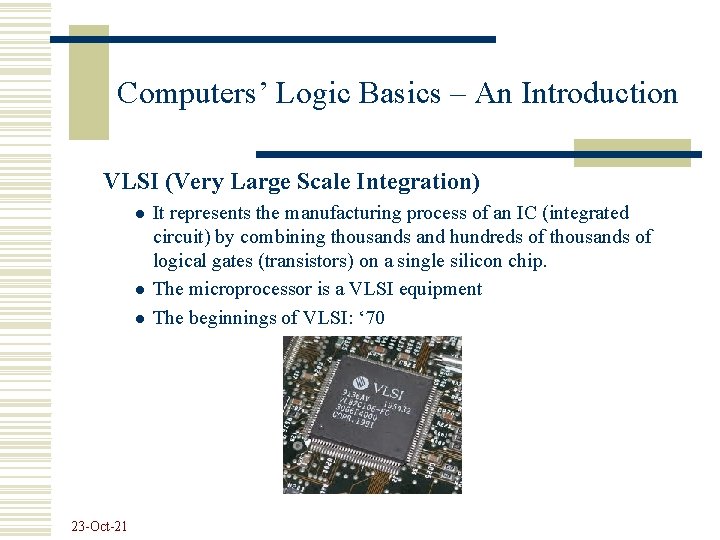
Computers’ Logic Basics – An Introduction VLSI (Very Large Scale Integration) l l l 23 -Oct-21 It represents the manufacturing process of an IC (integrated circuit) by combining thousands and hundreds of thousands of logical gates (transistors) on a single silicon chip. The microprocessor is a VLSI equipment The beginnings of VLSI: ‘ 70

Computers’ Logic Basics – An Introduction ULSI (Ultra Large Scale Integration) – chips with more than 1 million components For example, one Intel® Xeon Core i 7 E 3 Broadwell has 3. 2 billions transistors on a die of only 133 mm 2 As of 2019, the maximum number of transistors in a commercial chip is found in AMD Zen 2, 39. 54 billion ! 23 -Oct-21

The exponential growth in computing power! Source: http: //content. time. com/time/interactive/0, 31813, 2048601, 00. html 23 -Oct-21
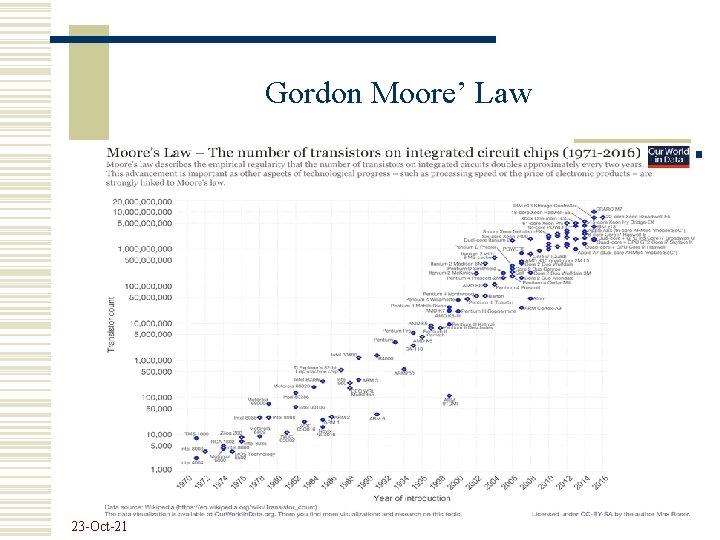
Gordon Moore’ Law 23 -Oct-21

Introduction Digital components n Digital electronics (+5 V, -5 V), (0 V, +5 V) 0 and 1 can be represented by +5 V and -5 V, or 0 V and +5 V n 23 -Oct-21
Introduction Boole’s algebra Basic operations: Disjunction (OR) l Conjunction (AND) l Negation l 23 -Oct-21

Truth tables – disjunction, conjunction, negation 23 -Oct-21 p q p AND q p OR q T T F F T F T F F F T T F F T F T T T F p ~p T F F T
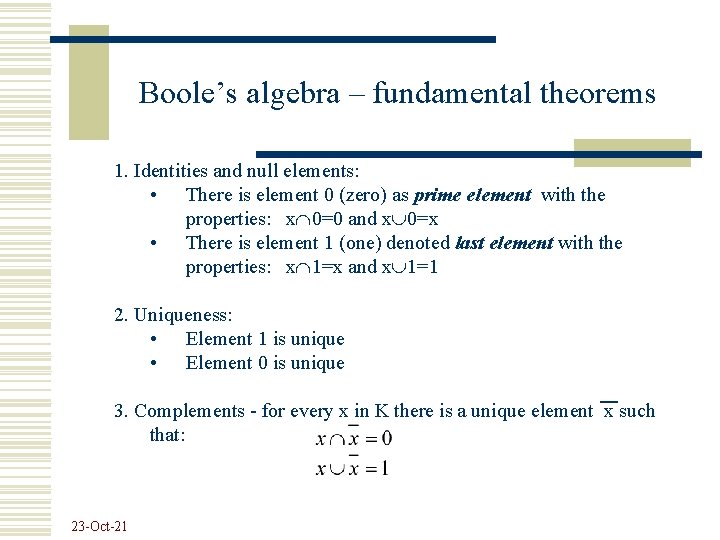
Boole’s algebra – fundamental theorems 1. Identities and null elements: • There is element 0 (zero) as prime element with the properties: x 0=0 and x 0=x • There is element 1 (one) denoted last element with the properties: x 1=x and x 1=1 2. Uniqueness: • Element 1 is unique • Element 0 is unique 3. Complements - for every x in K there is a unique element x such that: 23 -Oct-21
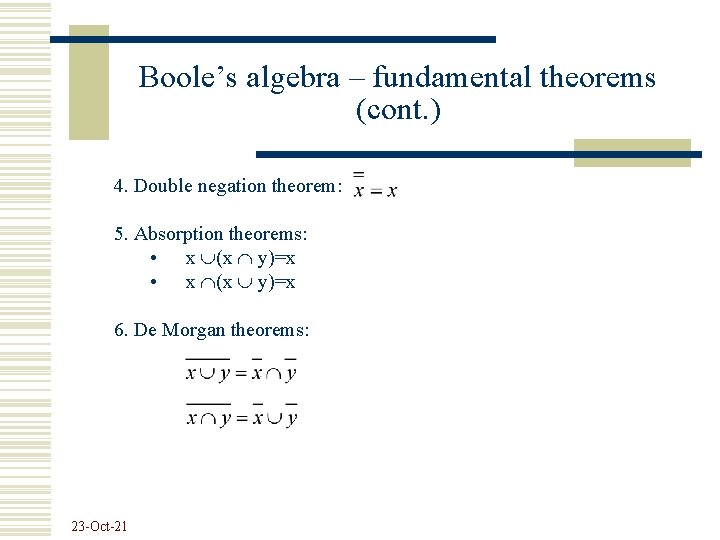
Boole’s algebra – fundamental theorems (cont. ) 4. Double negation theorem: 5. Absorption theorems: • x (x y)=x 6. De Morgan theorems: 23 -Oct-21
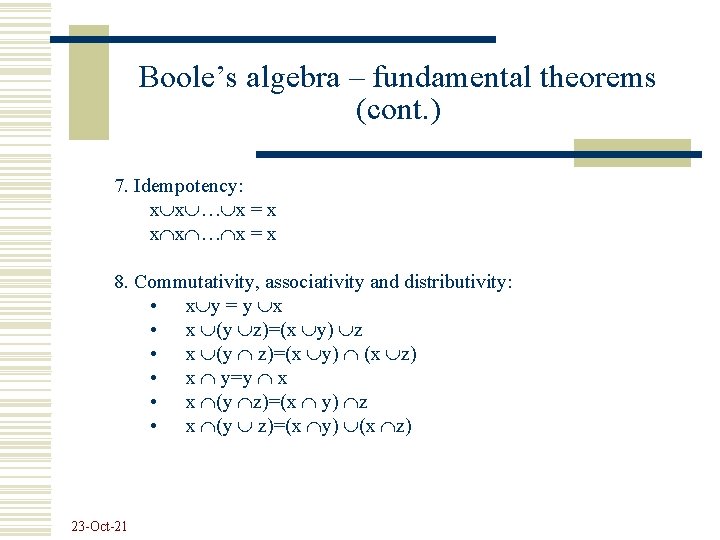
Boole’s algebra – fundamental theorems (cont. ) 7. Idempotency: x x … x = x 8. Commutativity, associativity and distributivity: • x y = y x • x (y z)=(x y) z • x (y z)=(x y) (x z) • x y=y x • x (y z)=(x y) z • x (y z)=(x y) (x z) 23 -Oct-21
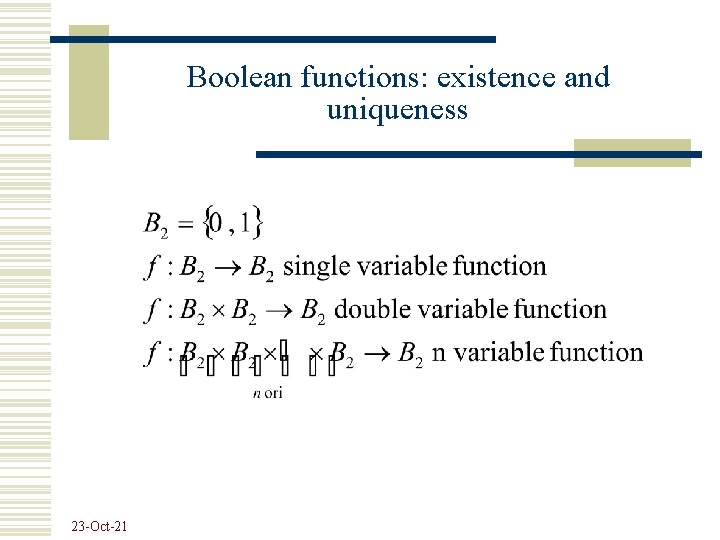
Boolean functions: existence and uniqueness 23 -Oct-21

Primary definitions We call an elementary product/elementary sum a product/sum of variables and/or their negations We call disjunctive canonical form (DCF) of a logical relation, an equivalent relation (with the same truth value) which is a sum of elementary products constructed with the same variables as the initial relation, each product containing all variables (in normal or complementary form) 23 -Oct-21
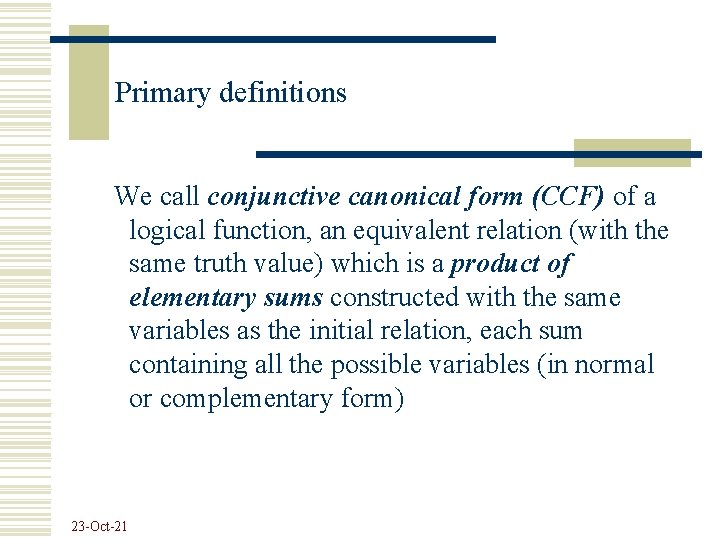
Primary definitions We call conjunctive canonical form (CCF) of a logical function, an equivalent relation (with the same truth value) which is a product of elementary sums constructed with the same variables as the initial relation, each sum containing all the possible variables (in normal or complementary form) 23 -Oct-21
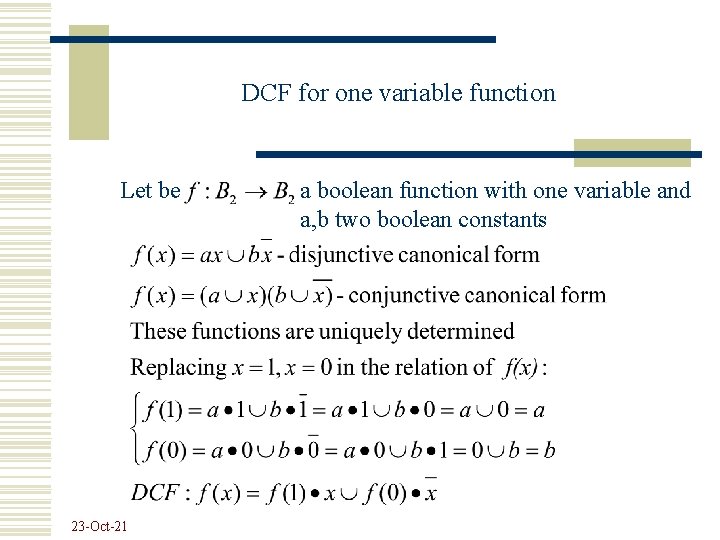
DCF for one variable function Let be 23 -Oct-21 a boolean function with one variable and a, b two boolean constants
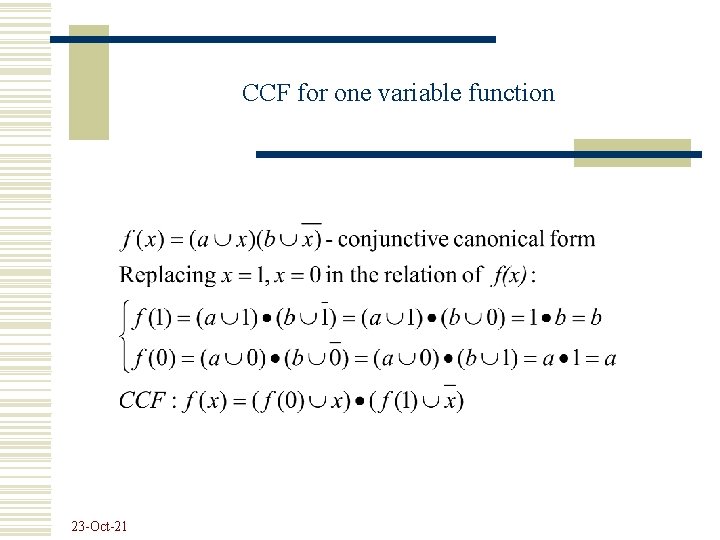
CCF for one variable function 23 -Oct-21

Proof of existence (DCF) 23 -Oct-21
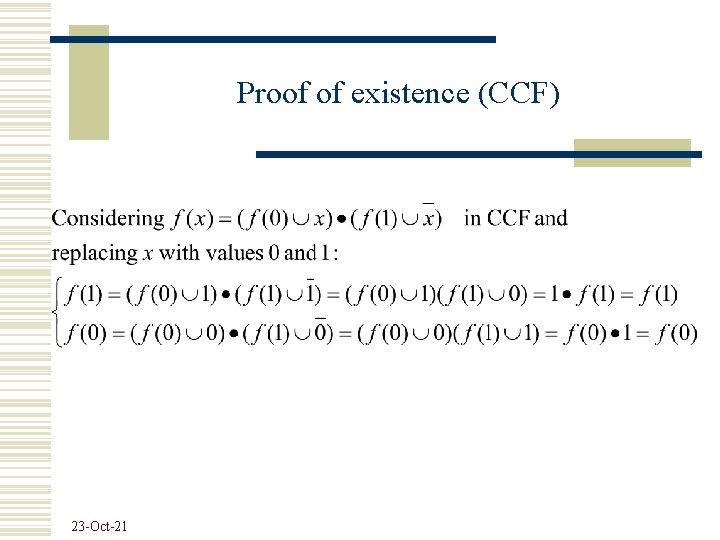
Proof of existence (CCF) 23 -Oct-21
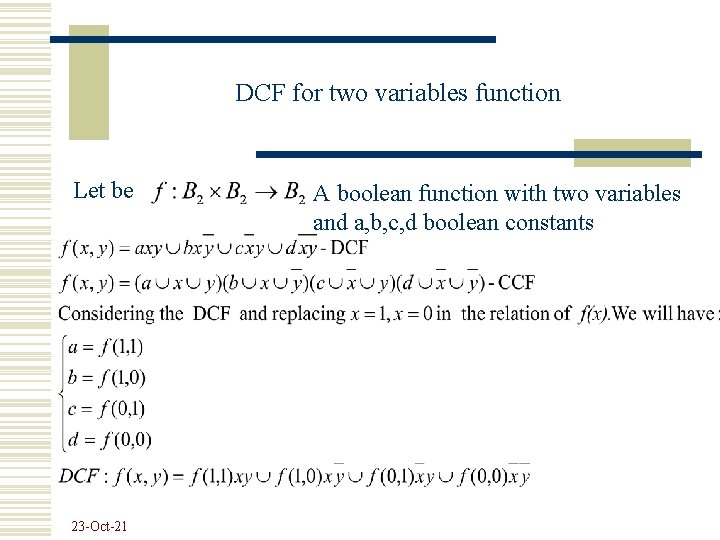
DCF for two variables function Let be 23 -Oct-21 A boolean function with two variables and a, b, c, d boolean constants
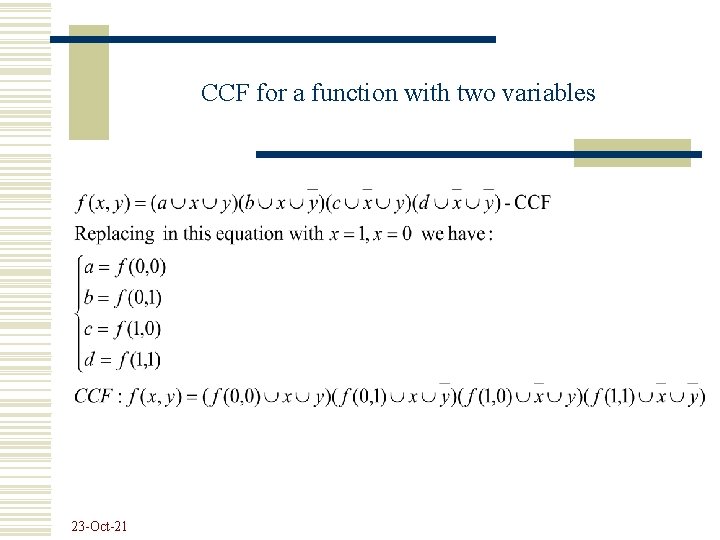
CCF for a function with two variables 23 -Oct-21

Proof of existence for DCF 23 -Oct-21
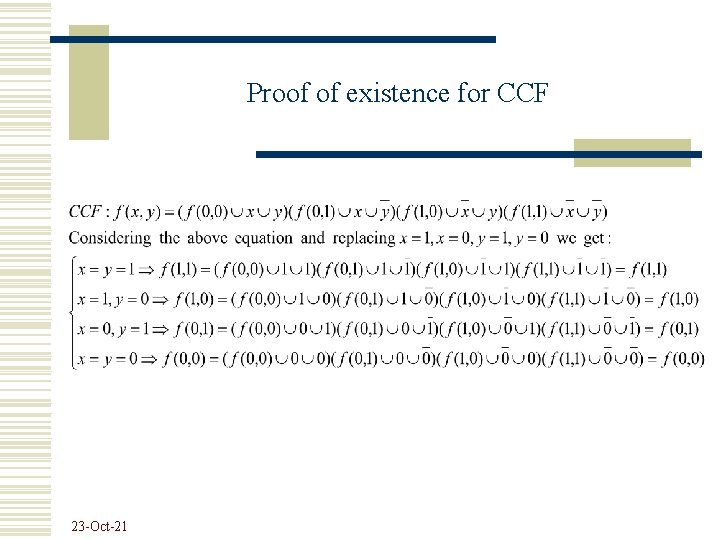
Proof of existence for CCF 23 -Oct-21
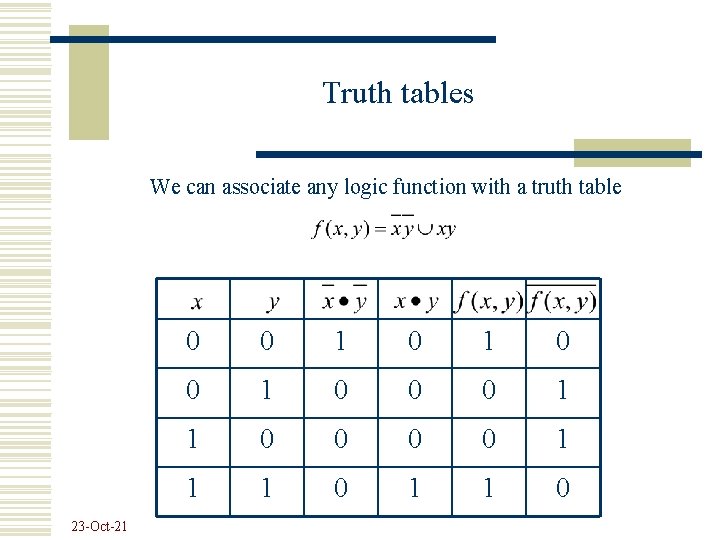
Truth tables We can associate any logic function with a truth table 23 -Oct-21 0 0 0 1 1 0 0 1 1 1 0
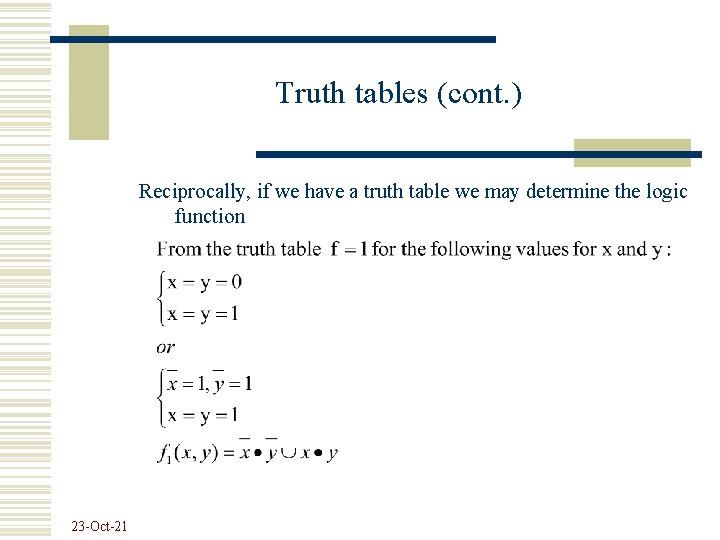
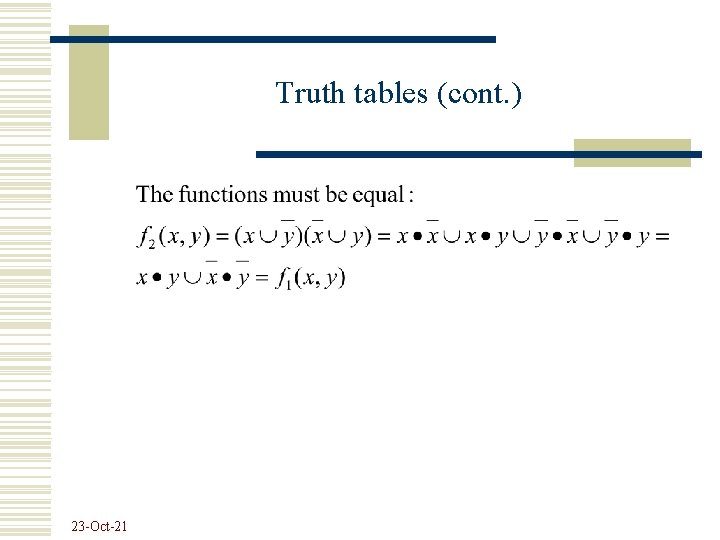
Truth tables (cont. ) Reciprocally, if we have a truth table we may determine the logic function 23 -Oct-21

Truth tables (cont. ) 23 -Oct-21
Truth tables (cont. ) 23 -Oct-21

Logical functions representation Canonical forms: w Minterm form (DCF –disjunctive canonical form) – SUM of products – variables or their complements in a minterm are connected by boolean operation AND, and the minterms are connected by OR. w Maxterm form (CCF –conjunctive canonical form) – PRODUCT of sums – variables or their complements in a maxterm are connected by OR, and maxterms are connected by AND. Another form of representation of a boolean function is the graphical one, using Venn diagrams 23 -Oct-21
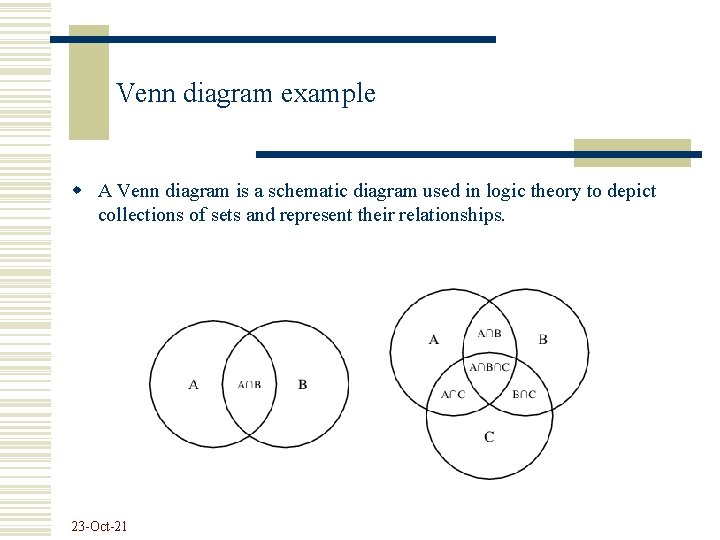
Venn diagram example w A Venn diagram is a schematic diagram used in logic theory to depict collections of sets and represent their relationships. 23 -Oct-21
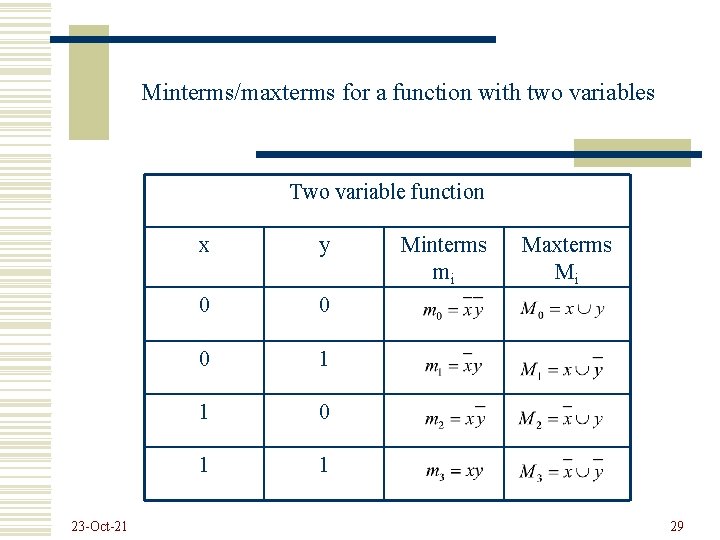
Minterms/maxterms for a function with two variables Two variable function 23 -Oct-21 x y 0 0 0 1 1 Minterms mi Maxterms Mi 29
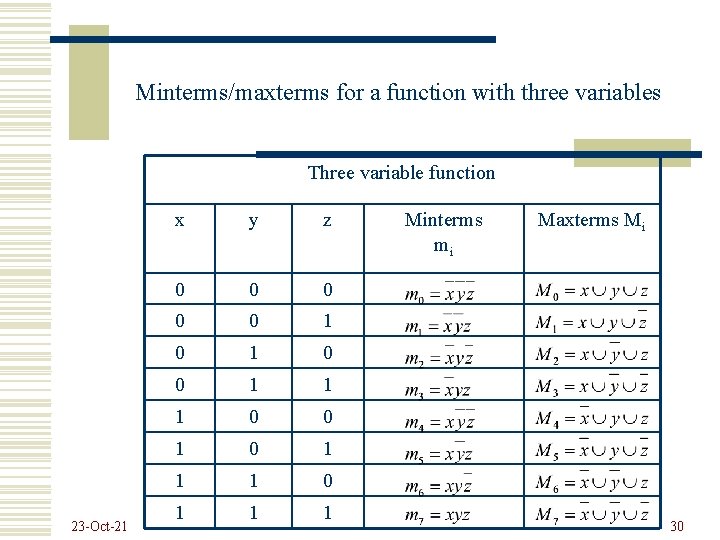
Minterms/maxterms for a function with three variables Three variable function 23 -Oct-21 x y z 0 0 0 1 1 1 0 0 1 1 1 Minterms mi Maxterms Mi 30

Minterms/maxterms - properties Minterms are formed by the combination of the variables (or its’ complements) for which the function has the value of 1. Maxterms are formed by the combination of the variables (or its’ complements) for which the function has the value of 0. 23 -Oct-21 31
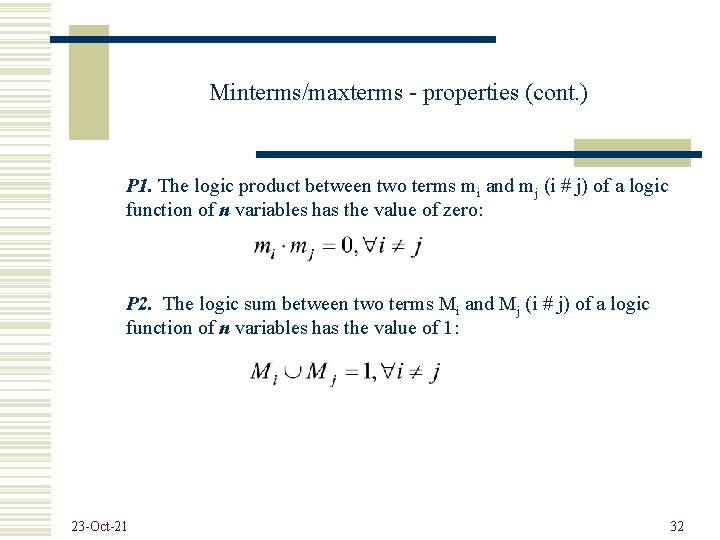
Minterms/maxterms - properties (cont. ) P 1. The logic product between two terms mi and mj (i # j) of a logic function of n variables has the value of zero: P 2. The logic sum between two terms Mi and Mj (i # j) of a logic function of n variables has the value of 1: 23 -Oct-21 32

Minterms/maxterms - properties (cont. ) P 3. A logic function of n variables may be represented by a logic sum of minterms mi (respectively, by a logic product of maxterms Mi): 23 -Oct-21 33
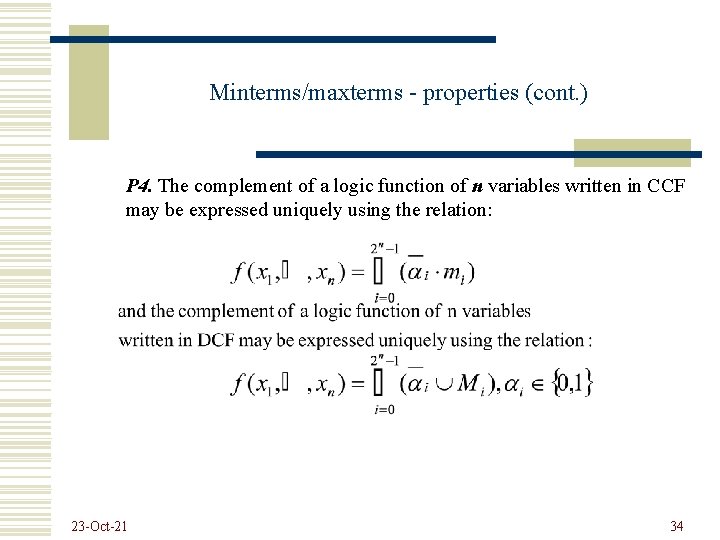
Minterms/maxterms - properties (cont. ) P 4. The complement of a logic function of n variables written in CCF may be expressed uniquely using the relation: 23 -Oct-21 34
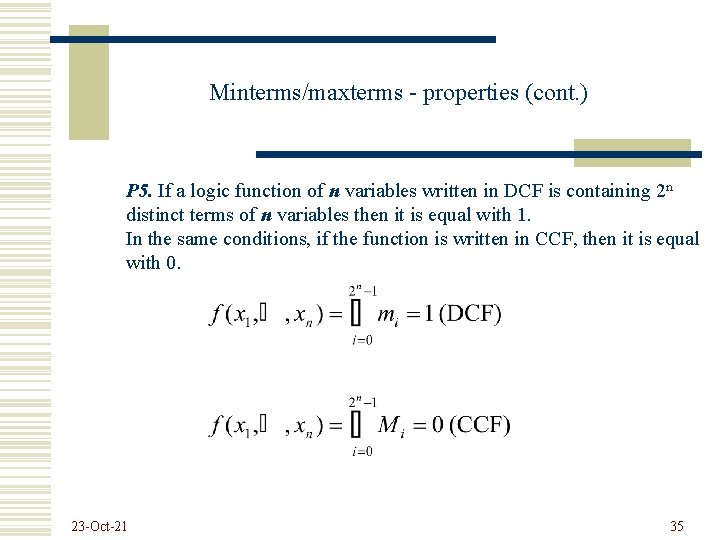
Minterms/maxterms - properties (cont. ) P 5. If a logic function of n variables written in DCF is containing 2 n distinct terms of n variables then it is equal with 1. In the same conditions, if the function is written in CCF, then it is equal with 0. 23 -Oct-21 35
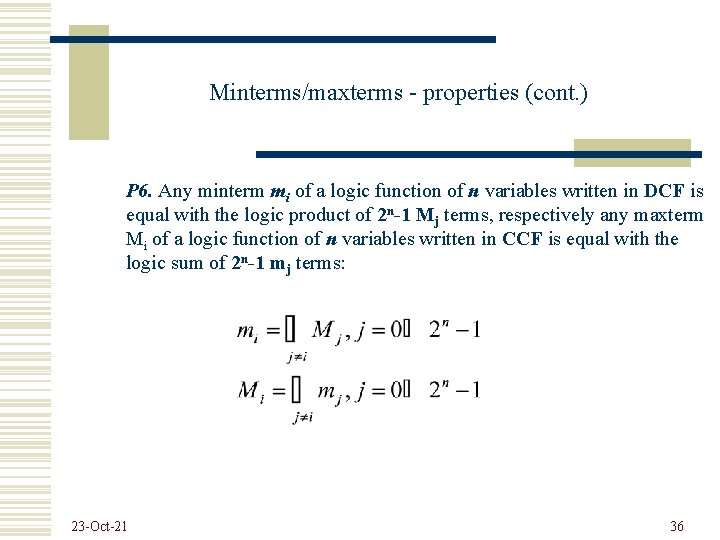
Minterms/maxterms - properties (cont. ) P 6. Any minterm mi of a logic function of n variables written in DCF is equal with the logic product of 2 n-1 Mj terms, respectively any maxterm Mi of a logic function of n variables written in CCF is equal with the logic sum of 2 n-1 mj terms: 23 -Oct-21 36
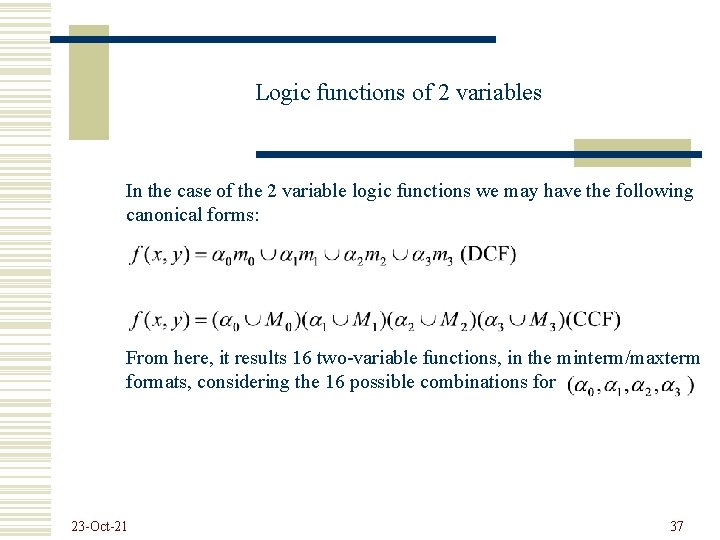
Logic functions of 2 variables In the case of the 2 variable logic functions we may have the following canonical forms: From here, it results 16 two-variable functions, in the minterm/maxterm formats, considering the 16 possible combinations for 23 -Oct-21 37

2 variables logic functions 23 -Oct-21 38
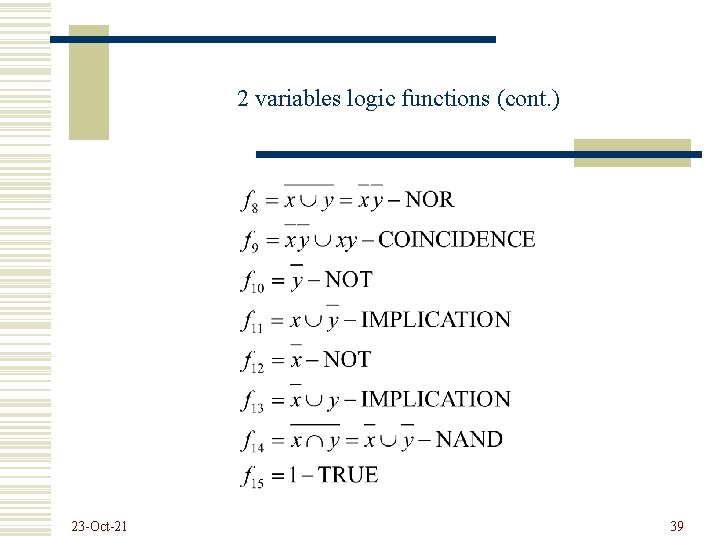
2 variables logic functions (cont. ) 23 -Oct-21 39
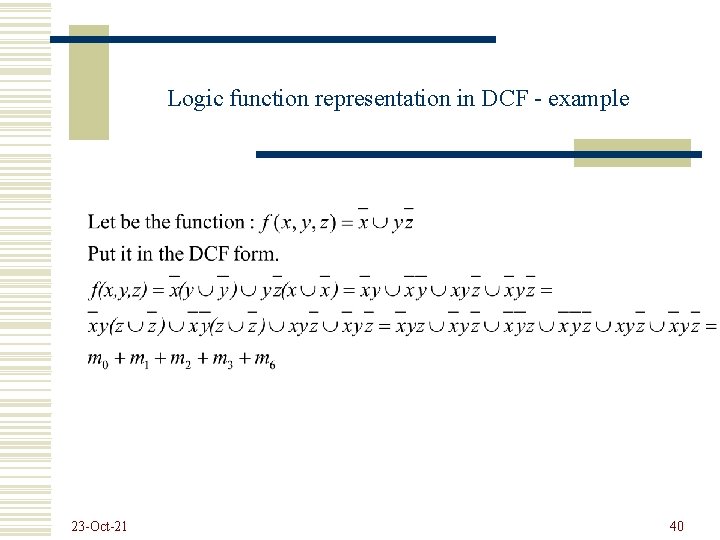
Logic function representation in DCF - example 23 -Oct-21 40
- Slides: 40